Updated August 2026.
Choosing an energy-efficient dehumidifier is not simply a matter of selecting the largest square-foot number on the box. The right model should match the room’s moisture level, temperature, drainage setup, noise tolerance, and expected runtime. For the most reliable comparison, check the exact model number, standardized moisture-removal capacity, and Integrated Energy Factor rather than relying only on a seller’s maximum pint or coverage claim.
This guide compares four residential compressor dehumidifiers for basements, bedrooms, bathrooms, laundry areas, garages, and other damp spaces. Some listings advertise maximum capacities measured in unusually hot and humid conditions, so those figures should not be treated as guaranteed daily performance in a typical home.
The Midea 22 Pint EasyDry is the safest recommendation for buyers who value clear model-level specifications and verified ENERGY STAR data. The AEOCKY 4500 Sq. Ft Dehumidifier is the stronger large-room option, while the Yaufey 5000 Sq. Ft model suits buyers who want high advertised capacity and flexible drainage. The AEOCKY 105 Pint model is aimed at very large, persistently damp spaces, but its maximum capacity should not be compared directly with a standardized DOE rating.
- Use standardized pint capacity and Integrated Energy Factor when available.
- Treat advertised square-foot coverage as a starting point, not a guarantee.
- Choose continuous drainage for long-term basement or laundry-room use.
- Confirm the exact model number in the ENERGY STAR Product Finder before buying.
| Product | Best For | Capacity Basis | Advertised Coverage | Efficiency Verification | Details |
|---|---|---|---|---|---|
| Midea 22 Pint EasyDry | Clear specs and smaller rooms | 22 pints/day standardized model capacity | Up to 1,500 sq. ft. | ENERGY STAR certified; IEF listed at 1.7 L/kWh | Check Price on Amazon |
| AEOCKY 4500 Sq. Ft | Large rooms and basements | Up to 80 pints/day advertised; confirm standardized rating | Up to 4,500 sq. ft. | ENERGY STAR positioning; verify exact current model ID | Check Price on Amazon |
| Yaufey 5000 Sq. Ft | Large damp basements | Up to 80 pints/day advertised; confirm standardized rating | Up to 5,000 sq. ft. | Seller lists ENERGY STAR; confirm exact model in current database | Check Price on Amazon |
| AEOCKY 105 Pint | Very large, persistently damp spaces | Up to 105 pints/day advertised in hot, highly humid conditions | Up to 5,500 sq. ft. | ENERGY STAR positioning; verify exact current model ID | Check Price on Amazon |
Verification note: ENERGY STAR records are tied to exact model numbers, not only brand names or Amazon titles. Seller titles and capacity claims can change. Before purchasing, match the model number on the product label or manual with the current ENERGY STAR Product Finder and compare its standardized capacity and Integrated Energy Factor.
Midea 22 Pint EasyDry ENERGY STAR Dehumidifier
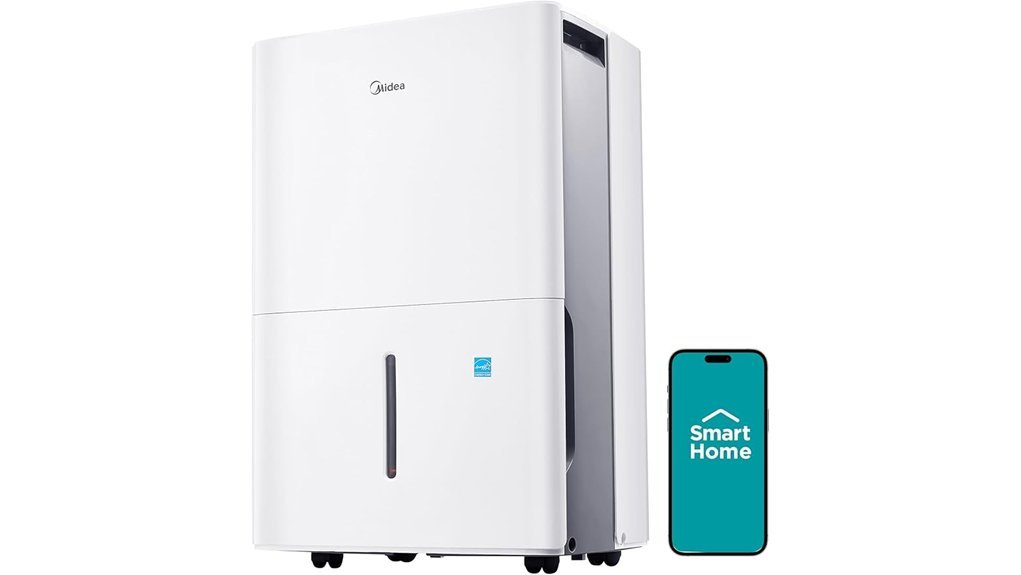
Best for Clear, Verifiable Specifications
The Midea MAD22C1AWS EasyDry removes about 22 pints of moisture per day under its standardized rating and is marketed for spaces up to 1,500 square feet. It is a sensible match for bedrooms, bathrooms, home offices, smaller basements, and other moderately damp rooms where a much larger machine would be unnecessary.
The exact model is listed with a 1.7 L/kWh Integrated Energy Factor. Its controls include an adjustable humidistat, timer, auto restart, auto defrost, washable filter, tank-full shutoff, and a continuous-drain connection. Four caster wheels make room-to-room movement easier.
Why You’ll Like It: The model number, capacity, ENERGY STAR information, physical specifications, and one-year warranty are clearly documented, reducing the uncertainty created by inflated maximum-capacity claims.
Who Should Buy This: Buyers with a bedroom, bathroom, office, apartment, or smaller basement who want straightforward controls and verified efficiency data.
Who Should Avoid This: Buyers trying to dry a very large unfinished basement, flood-damaged area, or space with active water intrusion.
Important: This EasyDry model does not include smart control. It is not the same as Midea’s separate Smart Access models.
Pros:
- ENERGY STAR certified with a listed 1.7 L/kWh Integrated Energy Factor.
- Clearly specified 22-pint daily capacity.
- Auto defrost and auto restart support reliable operation.
- Washable filter, wheels, timer, and continuous-drain connection improve convenience.
Cons:
- No Wi-Fi, app, or voice-assistant control on this model.
- Lower capacity than the large-space options.
- Gravity drainage still requires a suitable downward hose route.
AEOCKY 4500 Sq. Ft Dehumidifier
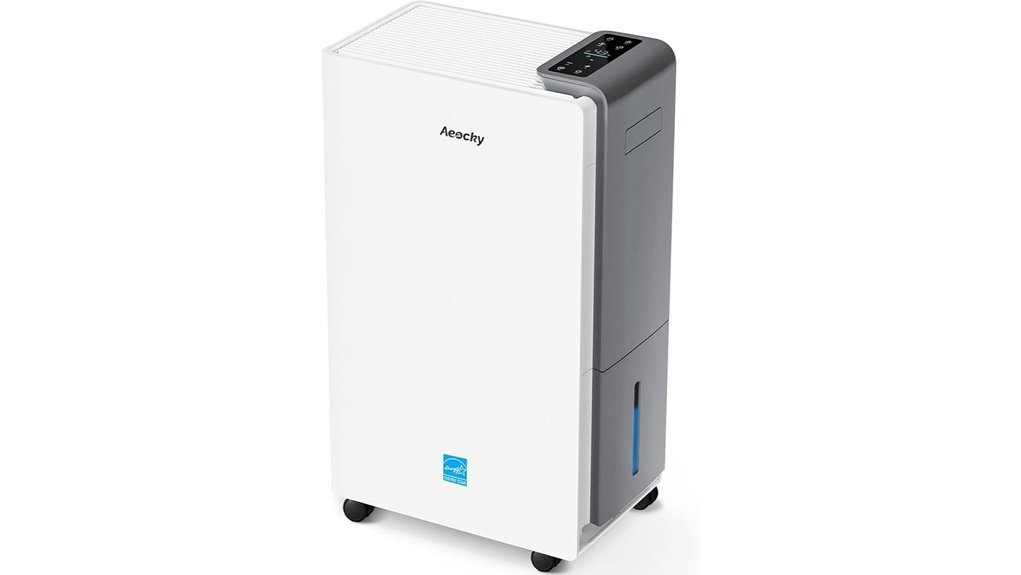
Best Large-Room Pick
The AEOCKY 4500 Sq. Ft Dehumidifier is designed for larger basements, open living areas, garages, and other spaces that may overwhelm a 22-pint unit. The Amazon listing advertises removal of up to 80 pints per day in hot, highly humid conditions, but buyers should use the exact model’s current standardized rating for direct comparisons.
It includes an adjustable humidistat, automatic humidity control, auto defrost, a tank-full shutoff, and a drain-hose connection for continuous gravity drainage. Its seller-listed sound level is about 44 dB, although real-world sound depends on fan speed, compressor cycling, floor vibration, and room acoustics.
Why You’ll Like It: It combines large-space positioning, automatic humidity control, drainage flexibility, and relatively quiet seller-listed operation.
Who Should Buy This: Buyers with a large basement, garage, or open-plan lower level who can confirm the exact model number and standardized rating before ordering.
Who Should Avoid This: Buyers shopping for a small bedroom or anyone who wants to compare products using only fully verified model-level efficiency data.
Consider Before Buying: AEOCKY listing titles have used both standardized and hot-condition maximum figures. Do not treat the 80-pint number as the amount every home will collect each day.
Pros:
- Designed for large residential spaces.
- Supports automatic humidity control and continuous drainage.
- Auto defrost improves usability in cooler rooms within the specified operating range.
- Seller-listed 44 dB operation is relatively low for a large compressor model.
Cons:
- Capacity wording varies across listings and should be verified by exact model number.
- Advertised square-foot coverage may overstate performance in divided or severely damp spaces.
- The tank still requires manual emptying when continuous drainage is unavailable.
Yaufey 5000 Sq. Ft Dehumidifier
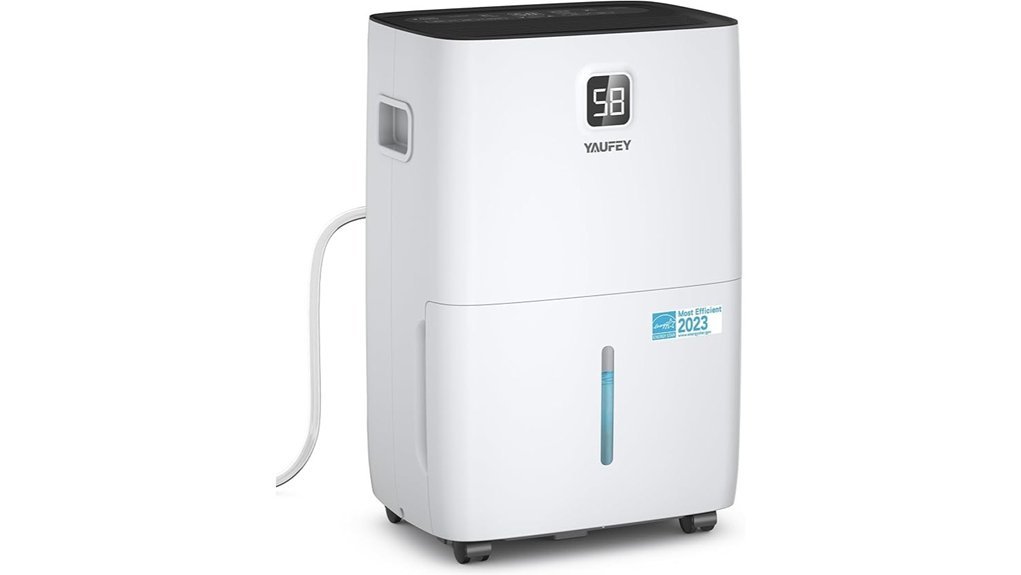
Best for Large Basements With a Floor Drain
The Yaufey 5000 Sq. Ft Dehumidifier targets large basements, storage areas, and open rooms with persistent moisture. The listing advertises removal of up to 80 pints per day and adjustable humidity control from 30% to 80% relative humidity.
The continuous-drain option is especially useful in a basement because it reduces the need to carry a full tank upstairs. Automatic shutoff helps prevent overflow when the tank is used, while the timer, caster wheels, washable filter, and operating modes improve day-to-day usability.
Why You’ll Like It: It offers high advertised capacity, flexible tank or hose drainage, and controls suited to long-term basement use.
Who Should Buy This: Buyers with a large damp basement or storage area and a nearby gravity drain.
Who Should Avoid This: Buyers who cannot verify the exact current ENERGY STAR model record or who need a built-in pump to move water uphill.
Consider Before Buying: The seller’s ENERGY STAR and maximum-capacity wording should be checked against the exact model label. Its 1.06-gallon tank may also fill quickly during the first days in a very damp room.
Pros:
- High advertised moisture-removal capacity.
- Adjustable humidity control and several operating modes.
- Supports both tank collection and continuous gravity drainage.
- Automatic shutoff, auto defrost, wheels, and a washable filter improve convenience.
Cons:
- The advertised maximum should not be treated as a standardized daily result.
- Current ENERGY STAR status should be confirmed by exact model number.
- The tank may require frequent emptying in severe humidity.
AEOCKY 105 Pint Dehumidifier
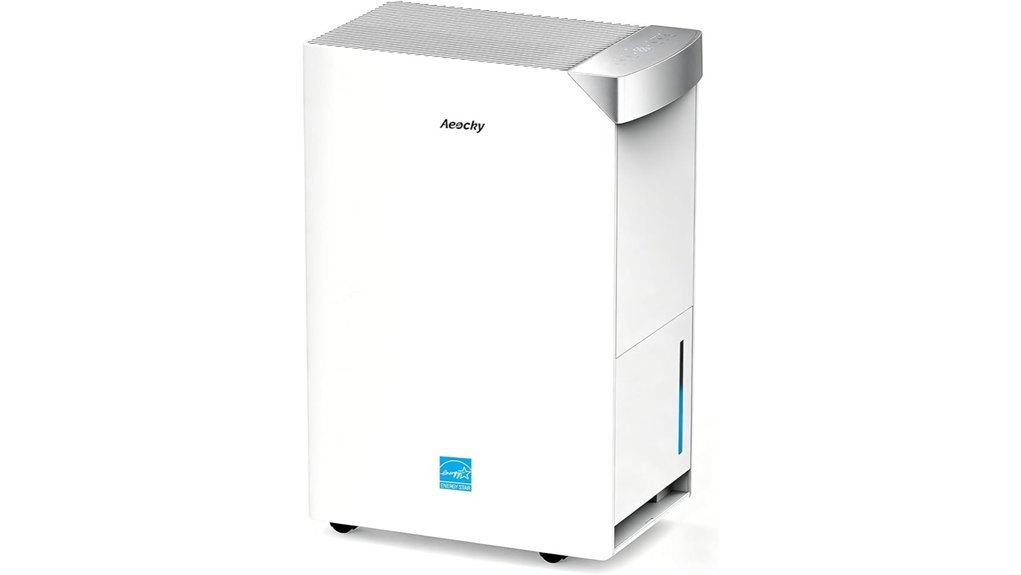
Best for Very Large, Persistently Damp Spaces
The AEOCKY LEO-Lite-2 is marketed for spaces up to 5,500 square feet and advertises removal of up to 105 pints of moisture per day in hot, highly humid conditions. It is intended for large basements, garages, workshops, storage areas, and open rooms where a smaller machine may struggle to reach the selected humidity level.
The unit includes an intelligent humidistat, drain-hose connection, timer, auto defrost, continuous operation, caster wheels, and a 1.45-gallon tank for manual collection when a suitable drain is unavailable.
Why You’ll Like It: It provides the highest advertised hot-condition capacity in this comparison while retaining automatic humidity control and continuous drainage.
Who Should Buy This: Buyers with a very large, persistently damp space who understand the difference between an advertised hot-condition maximum and a standardized capacity rating.
Who Should Avoid This: Buyers with a small room, limited floor space, or no practical way to handle the amount of water collected during high-humidity operation.
Consider Before Buying: Confirm the current model identification, standardized capacity, Integrated Energy Factor, warranty, and operating wattage. Do not compare the 105-pint maximum directly with another model’s standardized DOE capacity.
Pros:
- Highest advertised maximum capacity in this guide.
- Designed for large residential spaces.
- Supports continuous gravity drainage.
- Includes automatic humidity control, timer, and auto defrost.
Cons:
- Larger and heavier than a medium-room model.
- The 1.45-gallon tank may fill quickly in severe humidity.
- Seller maximums may be much higher than standardized normal-condition performance.
How to Choose an Energy-Efficient Dehumidifier
The most efficient choice is usually the unit that is properly sized for the room and can reach the target humidity without running continuously. Compare standardized capacity, Integrated Energy Factor, drainage, noise, tank size, and low-temperature performance rather than relying only on the largest advertised coverage number.
Compare Standardized Capacity
A dehumidifier’s standardized daily capacity tells you how much moisture it removes under defined test conditions. Some listings also advertise a much higher maximum measured in hotter and more humid air. Look for phrases such as DOE capacity, standardized capacity, or ENERGY STAR water-removal capacity when comparing two models.
A smaller unit can be sufficient for a moderately damp bedroom, while a large or severely damp basement may require a higher standardized capacity. Water leaks, seepage, and poor exterior drainage should be repaired instead of relying on a dehumidifier alone.
Check ENERGY STAR and Integrated Energy Factor
ENERGY STAR certification is tied to the exact model number. When available, compare the Integrated Energy Factor, measured in liters of water removed per kilowatt-hour. A higher number means more moisture is removed for the electricity consumed under the applicable test procedure.
Actual operating cost still depends on local electricity prices, runtime, fan speed, humidity setting, room temperature, and the amount of outside moisture entering the space.
Treat Coverage as an Estimate
Manufacturer coverage figures such as 1,500, 4,500, or 5,500 square feet are useful starting points, but they are not guarantees. Ceiling height, doors, wall layout, airflow, groundwater, laundry activity, and outdoor humidity all affect the required capacity.
For divided rooms, it may be more effective to place the unit in the dampest area and improve airflow than to rely on one large square-foot claim.
Consider Noise and Placement
Seller-listed sound levels can help with initial comparison, but test methods are not always explained. Compressor cycling, fan speed, floor vibration, and room acoustics can change how loud a unit feels.
Place the dehumidifier on a stable, level surface with the manufacturer’s recommended clearance around the intake and exhaust. Do not press it directly against furniture or block the airflow path.
Choose the Right Drainage Method
Tank drainage allows flexible placement but requires regular emptying. Automatic shutoff should stop operation when the tank is full, which also means the room receives no further dehumidification until the tank is emptied.
Continuous gravity drainage is more convenient when the hose can run downward without kinks to a suitable drain. A standard gravity-drain model cannot normally push water uphill. Uphill drainage requires a built-in pump or a separate condensate pump.
Do Not Confuse a Humidistat With Wi-Fi
“Smart humidity control” often means that the machine senses humidity and cycles automatically. It does not necessarily mean Wi-Fi, smartphone control, Alexa, or Google Assistant compatibility. Check the exact model number when remote control is important.
Check Low-Temperature Performance
Basements and garages can become cool enough for frost to form on a dehumidifier’s coils. Auto defrost helps maintain operation, but every compressor unit has a specified operating-temperature range. Check the manual before using the machine in an unheated space.
Before You Buy Checklist
- Measure the room and assess whether it is slightly, moderately, or severely damp.
- Compare standardized pint capacity, not only the advertised hot-condition maximum.
- Match the exact model number with current ENERGY STAR data.
- Compare Integrated Energy Factor when it is available.
- Confirm whether the unit has gravity drainage, a pump, or tank-only collection.
- Check tank size, filter access, noise, dimensions, weight, and operating-temperature range.
- Confirm the exact model’s warranty and smart-control features.
- Use a grounded outlet and follow the manufacturer’s extension-cord instructions.
Frequently Asked Questions
How Do I Maintain My Dehumidifier for Efficient Operation?
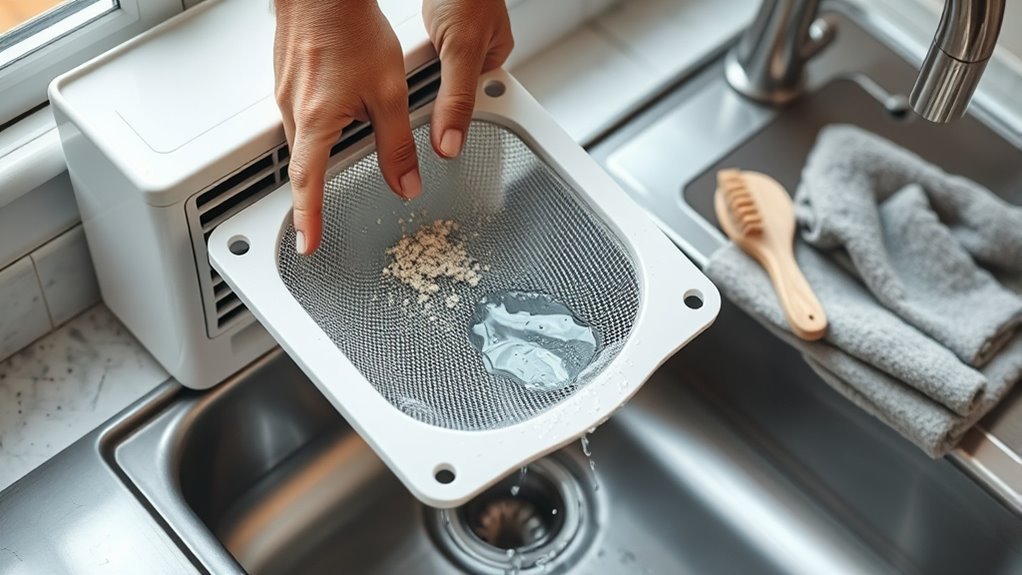
Clean the washable filter according to the manual, empty and rinse the tank, inspect the drain hose for kinks or buildup, and keep the intake and exhaust unobstructed. Unplug the unit before cleaning it. If the machine has been tilted or transported on its side, let it stand upright for the period specified by the manufacturer before turning it on.
What Is the Ideal Humidity Level for My Home?
A target between approximately 30% and 50% relative humidity works for many homes. During humid weather, a setting near 45% to 50% can provide a practical balance between comfort, moisture control, and electricity use. Avoid running the unit so aggressively that the room becomes uncomfortably dry.
Can a Dehumidifier Help With Mold and Dust Mites?
Lower humidity can make conditions less favorable for mold growth and dust mites, but a dehumidifier does not remove all airborne particles and does not replace an air purifier or professional mold remediation. Existing leaks, wet materials, and visible mold should be addressed directly.
Are There Safety Concerns With Dehumidifiers?
Use a grounded outlet, keep the cord and plug dry, avoid overloaded circuits, and follow the manufacturer’s extension-cord instructions. Keep the unit upright and stable, maintain clear airflow, clean the filter, and route the drain hose where it cannot create a trip or water hazard.
How Noisy Are Dehumidifiers During Operation?
Residential compressor dehumidifiers create fan and compressor noise. The perceived sound varies with fan speed, compressor cycling, floor vibration, and room acoustics. Treat seller-listed decibel figures as comparison aids unless the test method is clearly stated.
Should I Use the Tank or Continuous Drainage?
Use the tank when you need flexible placement and can empty it regularly. Choose continuous drainage for a basement or laundry area with a nearby drain. Gravity drainage requires a continuous downward path, while uphill drainage normally requires a pump.
Why Does My Dehumidifier Remove Less Water Than Advertised?
Moisture-removal rates fall as the room becomes cooler or reaches the selected humidity. Advertised maximums may also be measured under hotter and more humid conditions than those in your home. Airflow restrictions, a dirty filter, frost, an undersized unit, or a full tank can further reduce performance.
Is a Bigger Dehumidifier Always More Efficient?
No. An oversized model may cost more, take up more space, and provide little practical benefit in a small room. The better choice is a properly sized model with a strong Integrated Energy Factor, suitable drainage, and controls that prevent unnecessary runtime.
Conclusion
The Midea 22 Pint EasyDry is the most defensible recommendation in this comparison because its exact model specifications, ENERGY STAR status, capacity, Integrated Energy Factor, smart-control status, and warranty are clearly documented. It is best suited to smaller and medium rooms rather than very large basements.
For a larger area, the AEOCKY 4500 Sq. Ft Dehumidifier offers broader coverage, automatic humidity control, and continuous drainage. The Yaufey 5000 Sq. Ft model is another basement-focused option, while the AEOCKY 105 Pint model targets very large, persistently damp spaces. With all three high-capacity models, verify the exact standardized rating and current ENERGY STAR model record before making a direct efficiency comparison.
Start with standardized moisture-removal capacity and room conditions, then compare Integrated Energy Factor, exact ENERGY STAR model status, drainage, tank size, noise, and warranty. A correctly sized dehumidifier running at a sensible humidity setting is usually a better investment than the model with the largest advertised square-foot number.