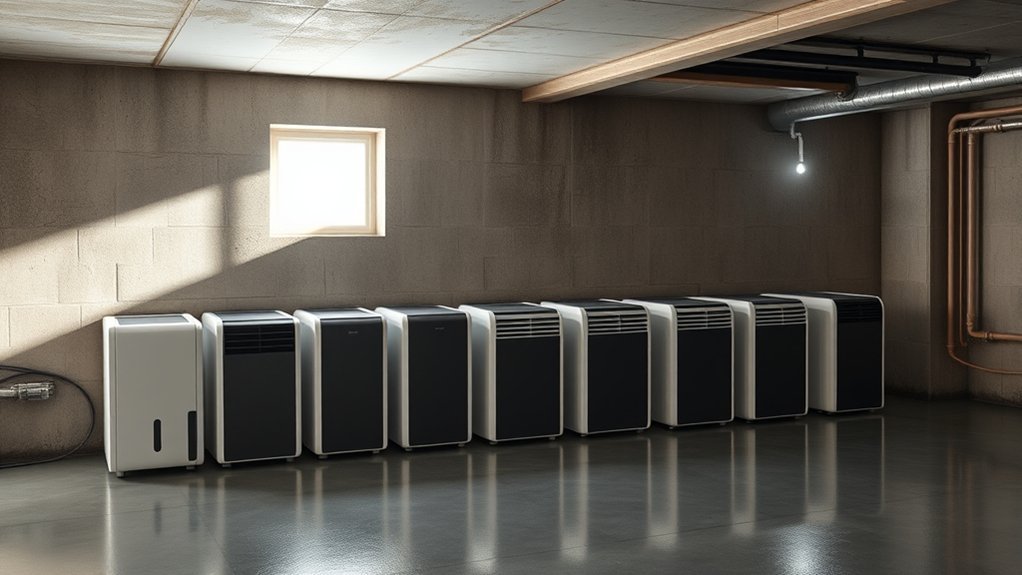
A damp stone basement needs more than a small moisture collector. The best dehumidifier should have enough compressor capacity for the basement’s moisture load, reliable automatic defrost, and a practical way to drain the collected water. After removing undersized passive and thermoelectric options, this guide compares seven compressor dehumidifiers for small, medium, and large stone basements.
Affiliate disclosure: As an Amazon Associate I earn from qualifying purchases. Product specifications and availability can change, so confirm the current listing before ordering.
Quick Answer: The AEOCKY 4500 Sq.Ft Dehumidifier With Pump is the most convenient all-around option when your stone basement does not have an easy floor-drain connection. For a smaller basement, the Waykar 2000 Sq. Ft Dehumidifier offers a more compact setup. For a very damp, open basement, compare the Waykar 80-Pint, Ludatido 80-Pint, and DECIUU Max 100-Pint models.
Important: A dehumidifier controls airborne moisture. It will not repair foundation cracks, plumbing leaks, poor exterior drainage, or active water seepage.
Key Takeaways
- Best overall with a pump: AEOCKY 4500 Sq.Ft Energy Star Dehumidifier With Pump.
- Best for a smaller basement: Waykar 2000 Sq. Ft Energy Star Dehumidifier.
- Best large water tank: Ludatido 80-Pint ENERGY STAR Dehumidifier.
- Highest advertised maximum: DECIUU Max 100-Pint Energy Star Dehumidifier.
- Best drainage setup: Choose gravity drainage when a floor drain is nearby or a pump model when water must travel upward.
- Do not size by square footage alone: Dampness, temperature, airflow, and water intrusion can matter more than floor area.
Quick Comparison
| Product | Best For | Advertised Maximum | Drainage | Amazon |
|---|---|---|---|---|
| Waykar 2000 Sq. Ft | Small to medium basements | 34 pints/day under high-temperature, high-humidity conditions | Tank or gravity hose | Check Details |
| Waykar 80-Pint | Large open basements | 80 pints/day at 95°F and 90% RH | Tank or gravity hose | Check Details |
| Ludatido 80-Pint | Buyers wanting a larger tank | 80 pints/day maximum | 1.72-gallon tank or gravity hose | Check Details |
| AEOCKY 4500 With Pump | Basements without easy gravity drainage | 80 pints/day maximum | Tank, gravity hose, or built-in pump | Check Details |
| Vellgoo 64-Pint | Medium to large basements | 64 pints/day maximum | Three drainage configurations | Check Details |
| AEOCKY 50-Pint | Compact compressor performance | 50 pints/day under extreme test conditions | Tank or gravity hose | Check Details |
| DECIUU Max 100-Pint | Very damp, large basements | 100 pints at 95°F/90% RH; 70 pints at 86°F/80% RH | Tank, included hose, or garden hose | Check Details |
Capacity note: “Maximum” pint figures are often measured under unusually warm and humid conditions. Do not compare them directly with a capacity measured under a different test condition.
Waykar 2000 Sq. Ft Energy Star Dehumidifier
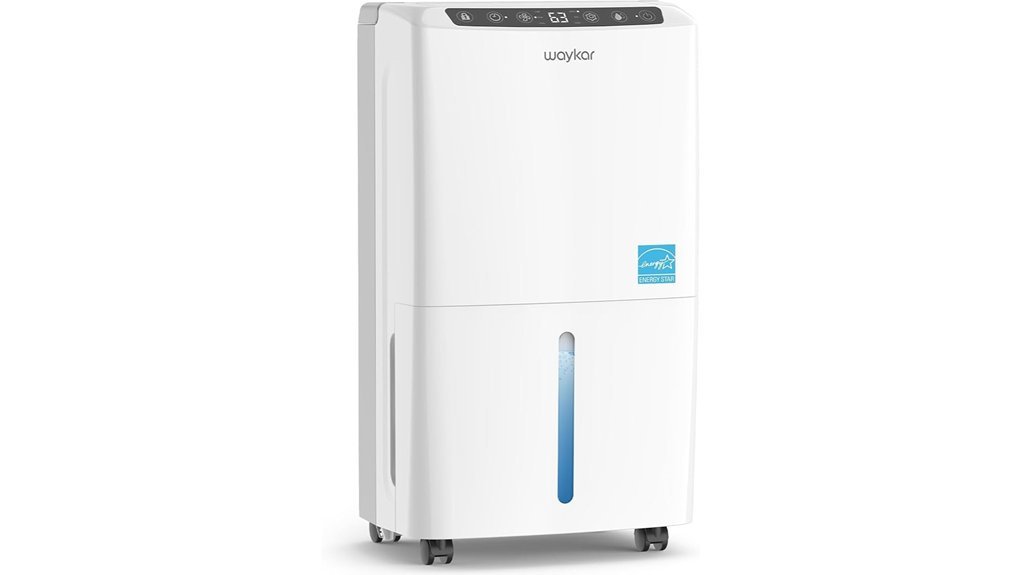
Best for Small to Medium Basements
The Waykar 2000 Sq. Ft model is a practical starting point for a smaller stone basement that has damp air but no major water intrusion. The manufacturer advertises a maximum removal rate of 34 pints per day under 95°F and 90% relative humidity conditions. It includes a 0.62-gallon tank and supports both manual collection and continuous gravity drainage.
Its compact footprint is easier to place than the larger 80- and 100-pint-class models. The listing also advertises quiet operation, automatic shutoff, automatic defrost, and a washable filter. Those features make it useful for a finished basement, office, workshop, or basement room located below a living area.
Best For: Small to medium stone basements with moderate humidity and access to a low drain.
Why You’ll Like It: It combines compressor-based moisture removal, a compact body, and continuous drainage without requiring the space of a high-capacity model.
Who Should Avoid It: Owners of large, divided, very wet, or actively leaking basements may need a higher-capacity unit or more than one dehumidifier.
Pros:
- Compact compressor model for smaller basement spaces.
- Tank and continuous gravity-drain options.
- Automatic defrost and full-tank shutoff.
- Washable filter for routine maintenance.
Cons:
- The 34-pint figure is a maximum measured under hot, humid conditions.
- The 0.62-gallon tank may fill quickly without continuous drainage.
- May recover slowly in a large or extremely damp stone basement.
Waykar 80 Pints Energy Star Dehumidifier for Home
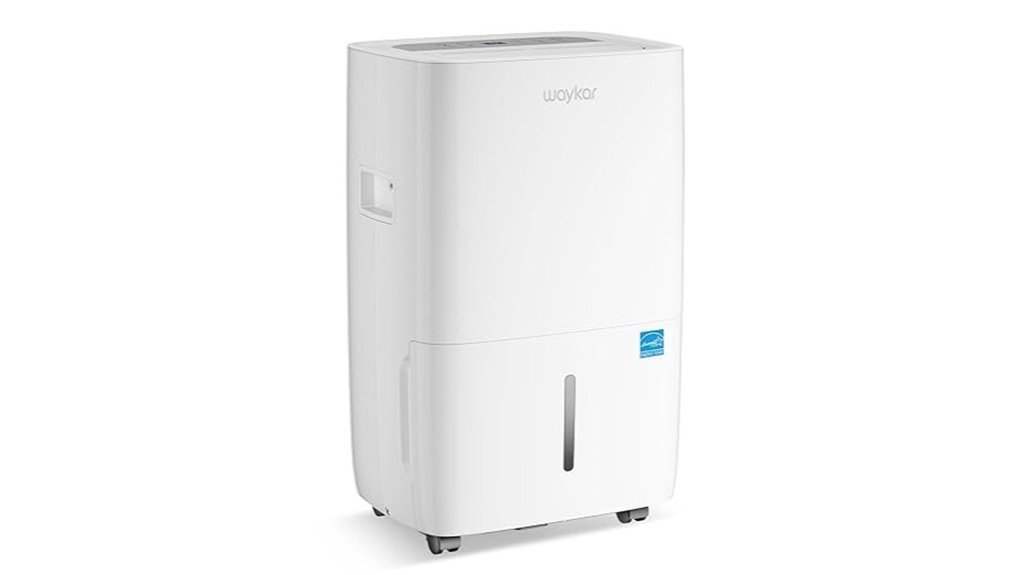
Best Value for a Large Basement
The Waykar 80-Pint model is designed for larger open areas and is advertised for spaces up to 5,000 square feet. Its maximum 80-pint rating is measured at 95°F and 90% relative humidity, so actual collection in a cooler stone basement will normally be lower.
The model offers adjustable humidity control, automatic defrost, automatic restart, a 24-hour timer, and 90-degree swinging airflow. The listing states an operating noise level of approximately 42 dB. Water can be collected in the 1.14-gallon tank or routed to a low floor drain through the included hose or a compatible garden-hose connection.
Best For: Large, open stone basements where gravity drainage is available.
Why You’ll Like It: The swinging airflow can help distribute dry air more evenly across an open basement, while continuous drainage reduces daily maintenance.
Who Should Avoid It: Skip it when the only drain is above the unit; this model is better suited to gravity drainage than upward pumping.
Pros:
- High advertised maximum for large and very damp spaces.
- Adjustable humidistat and multiple fan settings.
- Automatic defrost and restart after a power interruption.
- Supports continuous gravity drainage.
Cons:
- The advertised square-foot coverage may be optimistic in divided or actively wet basements.
- The water tank still requires frequent emptying when no hose is used.
- Does not include the drainage flexibility of a built-in pump.
Ludatido ENERGY STAR Dehumidifier, 80 Pint/Day
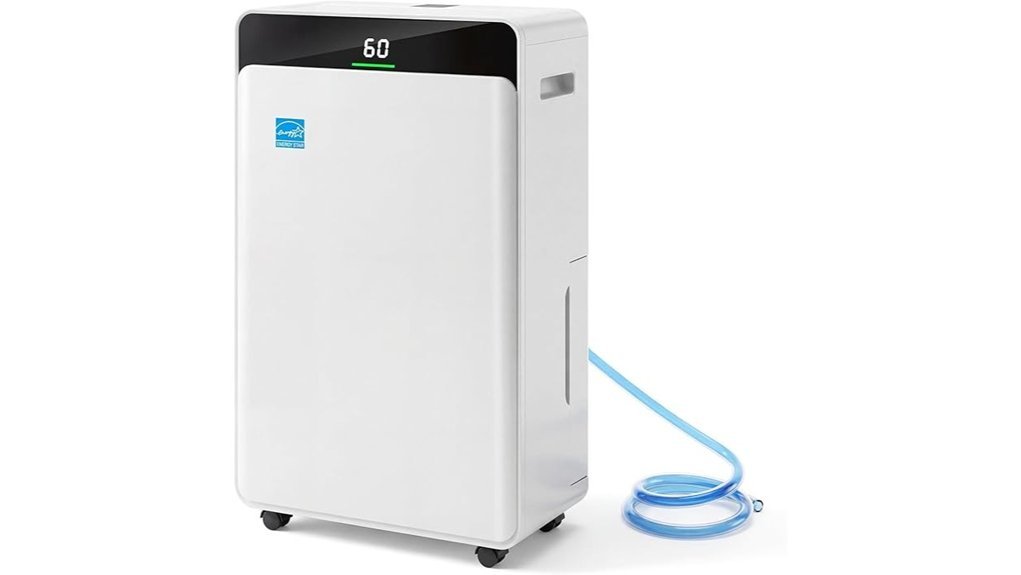
Best Large Water Tank
The Ludatido 80-Pint dehumidifier stands out for its advertised 1.72-gallon water tank. That larger reservoir can reduce emptying frequency when a drain hose cannot be used. The seller describes the unit as an ENERGY STAR model with a maximum removal rate of 80 pints per day and coverage up to 5,000 square feet.
It includes continuous gravity drainage, full-tank shutoff, a 24-hour timer, multiple operating modes, a child lock, and automatic humidity control. The seller advertises a minimum noise level of 35 dB, although sound will vary with fan speed, compressor operation, placement, and room acoustics.
Best For: Buyers who need a high-capacity compressor unit but may rely on the tank for at least part of the time.
Why You’ll Like It: Its larger tank provides more flexibility than models with smaller reservoirs, while the hose connection supports hands-off operation near a floor drain.
Who Should Avoid It: Buyers who require upward drainage should choose a model with a built-in pump.
Pros:
- Large 1.72-gallon water tank.
- Continuous gravity-drain connection.
- Automatic shutoff, timer, child lock, and humidity control.
- Suitable for larger open basement areas based on the seller’s specifications.
Cons:
- Capacity, coverage, efficiency, and noise figures are seller-reported specifications.
- Its larger body requires more floor space.
- No integrated condensate pump is identified for this model.
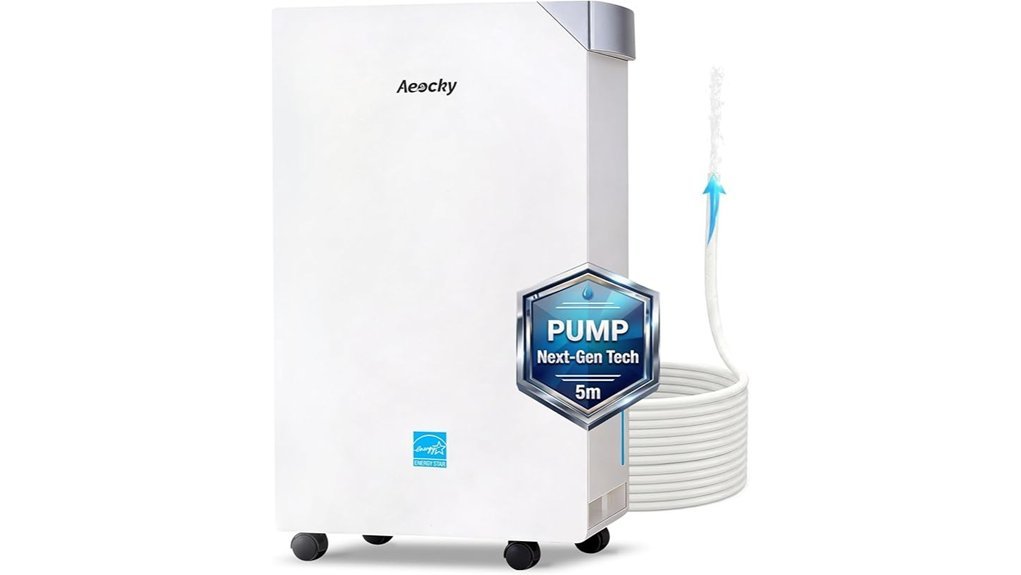
AEOCKY 4500 Sq.Ft Energy Star Dehumidifier with Pump
Best Overall With a Pump
The AEOCKY 4500 Sq.Ft model is the most versatile choice in this group when drainage is the main concern. Unlike gravity-only units, this version includes a built-in pump that can move condensate upward to an appropriate sink, standpipe, or other approved drain location.
The seller advertises a maximum capacity of 80 pints per day and coverage up to 4,500 square feet. It also includes an intelligent humidistat, automatic defrost, a drain hose, and compressor-based operation. The pump makes it especially useful in an old stone basement where the dehumidifier must sit below the available drain.
Best For: Stone basements without an accessible floor drain or sump connection at floor level.
Why You’ll Like It: The integrated pump can eliminate the need to place the unit on a shelf or empty its tank manually.
Who Should Avoid It: Buyers with a convenient floor drain may not need to pay extra for pump functionality.
Pros:
- Built-in pump provides more drainage flexibility.
- Automatic humidity control and automatic defrost.
- High advertised maximum moisture-removal capacity.
- Useful for long-term basement operation when correctly drained.
Cons:
- A pump adds mechanical complexity compared with gravity drainage.
- Buyers should verify the current pump lift, hose length, and installation limits.
- The 4,500-square-foot figure is a manufacturer coverage estimate, not a guarantee for every basement.
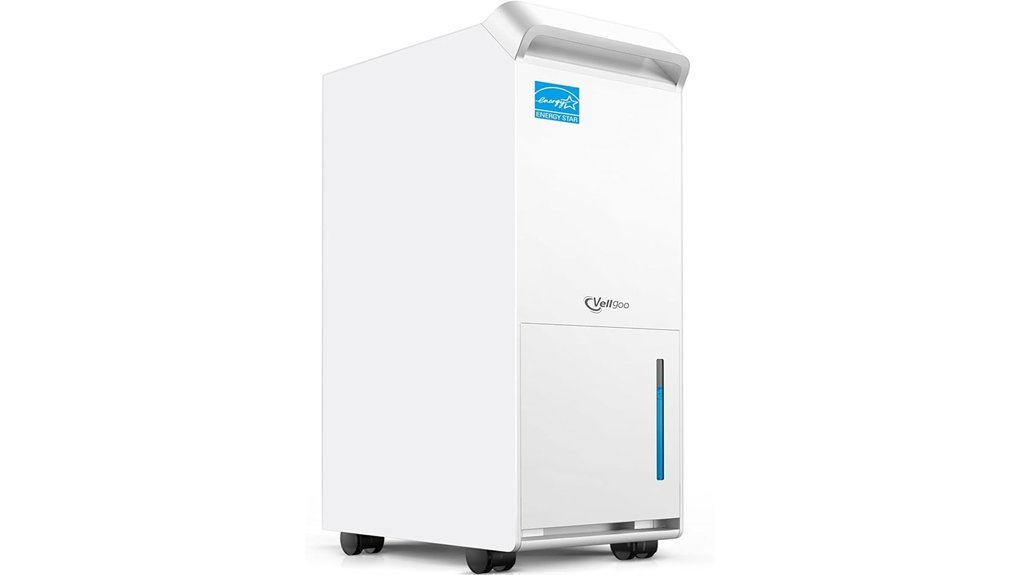
Vellgoo 64 Pint Energy Star Dehumidifier for Home
Best Mid-Capacity Alternative
The Vellgoo model is advertised with a maximum capacity of 64 pints per day and coverage up to 4,000 square feet. That places it between compact compressor models and the larger 80- or 100-pint-class options.
Its main basement-friendly features include smart humidity control, automatic defrost, automatic restart, mobility casters, and three drainage configurations. It can be a practical fit when you want more capacity than a small-room model without moving to the largest unit in the comparison.
Best For: Medium to large stone basements with moderate or seasonally high humidity.
Why You’ll Like It: It balances capacity, mobility, automatic controls, and drainage flexibility.
Who Should Avoid It: A basement with severe seepage or a drain located above the unit may require a pump model or professional moisture correction.
Pros:
- 64-pint advertised maximum for medium to large spaces.
- Automatic defrost and restart.
- Multiple drainage arrangements.
- Casters make repositioning easier.
Cons:
- The maximum rating should not be compared with ratings measured under different conditions.
- Advertised 4,000-square-foot coverage may be lower in a divided basement.
- Routine filter and drainage-path maintenance is still required.
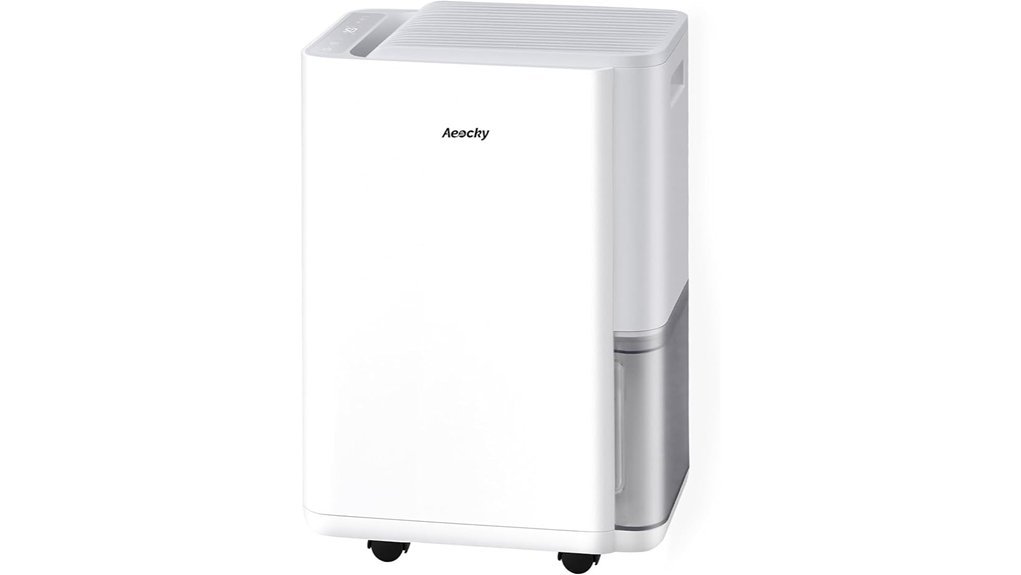
AEOCKY 50 Pint Dehumidifier for Home and Basement
Best Compact Compressor Option
The AEOCKY 50-Pint model is designed for buyers who want compressor performance in a smaller housing. Its listing advertises a maximum removal rate of 50 pints per day under extreme hot and humid conditions. Because the listing uses inconsistent 2,500- and 3,500-square-foot references, it is safer to treat this as a small- to medium-basement option rather than relying on the largest coverage claim.
The unit includes a 0.5-gallon tank, a drain-hose connection, an adjustable humidistat, automatic operation, and a compact body. It can work well in a basement room, workshop, storage area, or smaller open basement when the moisture load is not extreme.
Best For: Small to medium basements where floor space is limited.
Why You’ll Like It: It provides compressor-based moisture removal in a body that is easier to position than many full-size units.
Who Should Avoid It: Large or very wet basements may overwhelm its practical capacity, especially at cooler temperatures.
Pros:
- Compact compressor design.
- Adjustable humidistat and continuous-drain connection.
- Easier to move and position than larger models.
- Appropriate for localized basement humidity control.
Cons:
- The product listing contains inconsistent square-foot coverage claims.
- The 0.5-gallon tank is small for continuous high-humidity use.
- The 50-pint figure is a maximum measured under extreme conditions.
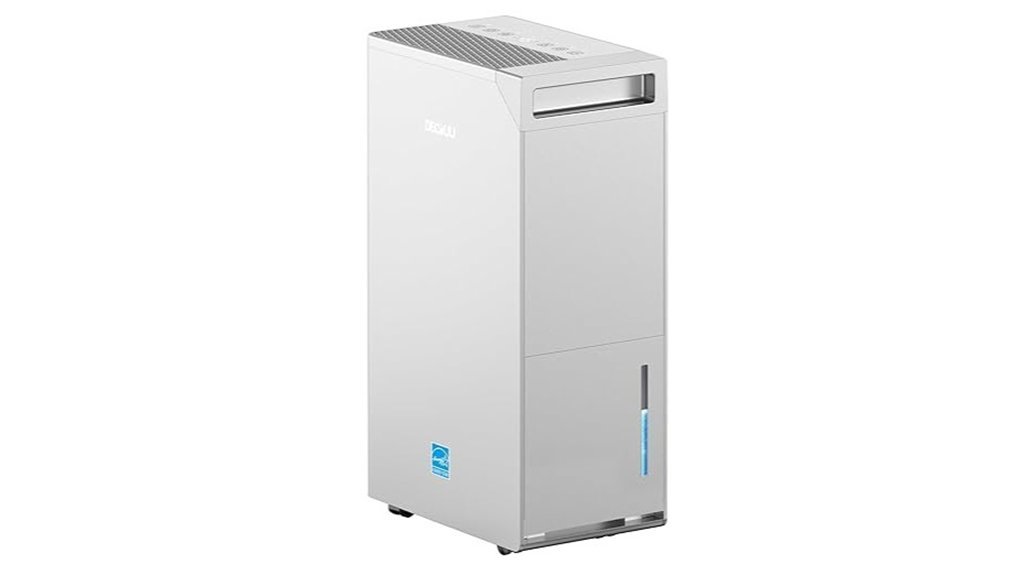
DECIUU Max 100 Pint Energy Star Dehumidifier
Best High-Capacity Maximum Rating
The DECIUU model has the highest advertised maximum in this comparison. Its listing states that it can remove up to 100 pints per day at 95°F and 90% relative humidity and up to 70 pints per day at 86°F and 80% relative humidity. Providing both figures makes this listing easier to interpret than a single maximum-condition claim.
The unit is advertised for areas up to 5,000 square feet and includes a 1.45-gallon tank, a 35%–80% adjustable humidistat, automatic defrost, automatic restart, a child lock, three fan speeds, and several drainage configurations. Water can be collected in the tank, routed through the included hose, or drained through a compatible garden hose.
Best For: Large, very damp stone basements that need a high-capacity gravity-drain model.
Why You’ll Like It: Its listing provides capacity figures for two different temperature and humidity conditions, helping buyers make a more realistic comparison.
Who Should Avoid It: It is a large unit and does not replace foundation waterproofing or a built-in drainage pump.
Pros:
- Highest advertised maximum in this comparison.
- Capacity disclosed for two different humidity conditions.
- 1.45-gallon tank and multiple drainage choices.
- Automatic defrost, restart, child lock, and adjustable humidity control.
- Seller states up to two years of product protection.
Cons:
- Large housing requires adequate floor space and airflow clearance.
- The 100-pint number applies to a hot, extremely humid test condition.
- No built-in pump is identified for upward drainage.
Factors to Consider When Choosing a Dehumidifier for a Stone Basement
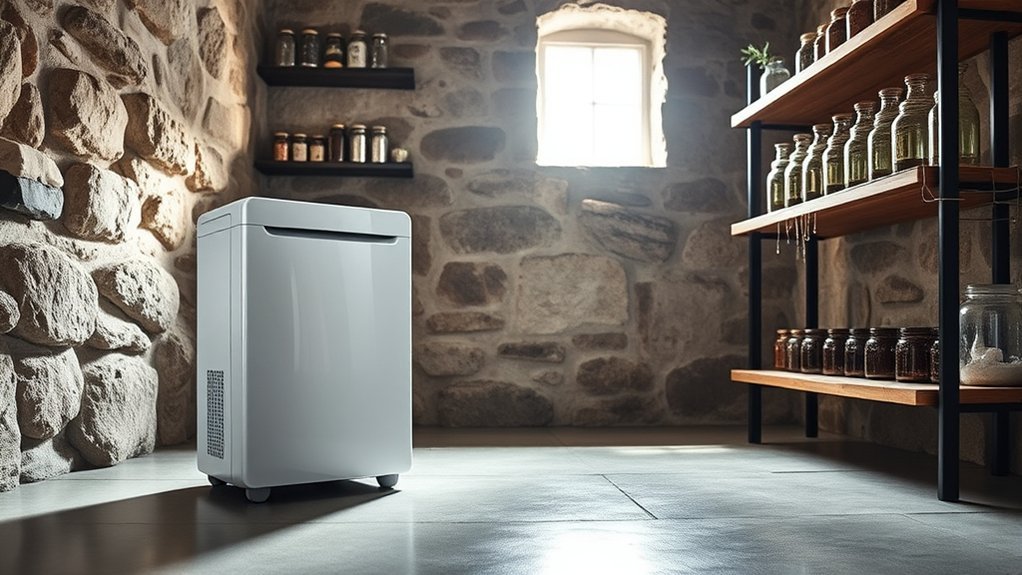
Stone basements often have cooler surfaces, irregular airflow, porous walls, and seasonal moisture changes. Choose a dehumidifier according to the actual humidity load and drainage setup rather than relying only on the largest square-foot number printed in a listing.
Find the Water Source First
Inspect the basement for leaking pipes, foundation cracks, clogged gutters, poor grading, sump-pump problems, and visible seepage. A dehumidifier can remove water vapor from the air, but it cannot stop liquid water from entering the basement. Correct active water problems before expecting any portable unit to maintain stable humidity.
Compare Capacity Under the Same Conditions
Daily capacity is measured in pints collected over 24 hours, but sellers may publish a maximum obtained at 95°F and very high relative humidity. A unit’s output will normally be lower in a cool basement. Check whether the listing provides a standardized rating or clearly states the temperature and humidity used for its maximum figure.
ENERGY STAR recommends approximately 20–30 pints per day for a slightly to moderately damp room under 2,000 square feet, 25–40 pints for a very damp room, and 30–50 pints for a wet room. Larger rooms may require 30, 40, or more than 50 pints per day. Review ENERGY STAR dehumidifier guidance before choosing a size.
Coverage and Basement Layout
Manufacturer square-foot figures assume relatively open airflow. A basement divided by doors, storage walls, utility rooms, or narrow passages may need more than one unit or a fan to move air between sections. Choose based on the dampest area rather than the basement’s total floor area alone.
Choose the Right Drainage Method
Continuous drainage is usually the most important convenience feature for a basement. A gravity hose must slope downward for its entire run. If the available sink or drain is above the dehumidifier, select a model with a built-in pump or route water to a suitable condensate pump installed according to its instructions.
Verify the hose diameter, included hose length, garden-hose compatibility, pump lift, and whether the hose is included before purchasing.
Look for Automatic Defrost
Stone basements can remain cool even in summer. Moisture may freeze on the evaporator coil when a compressor dehumidifier operates in low temperatures. Automatic defrost temporarily manages that buildup and is an important feature for cool basement use. Check the manufacturer’s minimum operating temperature when the basement regularly becomes cold.
Check Energy Efficiency Carefully
ENERGY STAR certification is more useful than a vague statement such as “uses 40% less power.” The certification evaluates moisture removal in relation to energy consumption under specified conditions. Timers and humidistats can also reduce unnecessary runtime by allowing the compressor to cycle off when the target humidity is reached.
Set a Practical Humidity Target
A target around 45%–50% relative humidity is practical for many basements. Setting the humidistat unnecessarily low can increase runtime, heat, noise, and electricity use. Use a separate digital hygrometer to check whether the unit’s built-in sensor is reasonably accurate.
Consider Compressor Noise
Full-size compressor dehumidifiers produce fan noise, compressor vibration, and occasional cycling sounds. Published ratings may represent the lowest fan setting or measurements taken under controlled conditions. Place the unit on a level, solid surface and keep it away from walls or loose objects that could amplify vibration.
Tank Size and Portability
Tank capacity is not the same as daily moisture-removal capacity. A high-capacity unit can have a relatively small tank and may shut off several times per day in humid weather. If continuous drainage is unavailable, prioritize a larger tank, comfortable handle, smooth casters, and an easy-to-remove bucket.
Safety and Restart Features
Useful safety and convenience features include full-tank shutoff, automatic defrost, overload protection, washable filters, child locks, and automatic restart after a power interruption. Keep the plug, receptacle, and extension connections away from damp floors. Follow the manual’s clearance and electrical instructions, and do not use an extension cord unless the manufacturer specifically permits it.
Before You Buy Checklist
- Measure the basement and note whether it is open or divided into rooms.
- Check humidity with a separate hygrometer for several days.
- Look for seepage, plumbing leaks, condensation, and standing water.
- Confirm the lowest seasonal basement temperature.
- Decide whether you will use a tank, gravity hose, or built-in pump.
- Verify hose size, hose length, pump lift, and included accessories.
- Check the current ENERGY STAR status and warranty terms.
- Leave enough space around the air intake and exhaust.
- Plan how often the filter and drain hose will be cleaned.
Frequently Asked Questions
What Humidity Level Should I Maintain in a Stone Basement?
A setting around 45%–50% relative humidity works well for many basements. Conditions below 60% help limit the damp environment associated with condensation and musty odors. Avoid setting the unit much lower than necessary because this can increase energy use and runtime.
How Do I Maintain My Dehumidifier for Optimal Performance?
Inspect and clean the air filter according to the manual, keep the intake and exhaust clear, clean the water tank, and inspect the drain hose for algae, kinks, or blockages. Confirm that the unit is level and periodically compare its humidity display with a separate hygrometer.
Can I Use a Dehumidifier in a Finished Basement?
Yes. Choose a model with enough capacity for the space and consider noise, heat output, drainage access, and placement. Leave the required clearance around the unit, and keep doors open when one machine must serve several connected rooms.
Will a Dehumidifier Stop Water From Seeping Through Stone Walls?
No. It can remove water vapor after moisture enters the space, but it cannot repair cracks, failed mortar, poor exterior drainage, or hydrostatic pressure. Active seepage should be investigated separately.
Does a Dehumidifier Remove Existing Mold?
No. Lower humidity can make future growth less favorable, but a dehumidifier does not remove existing mold or contaminated materials. Significant mold or recurring water intrusion may require professional evaluation and remediation.
What Is the Average Lifespan of a Dehumidifier?
Lifespan varies with build quality, runtime, temperature, filter maintenance, drainage care, and power conditions. Instead of relying on a fixed number of years, compare warranty coverage, replacement-filter availability, customer support, and whether the unit is appropriately sized so it does not run continuously.
How Noisy Are Dehumidifiers During Operation?
Compressor models create noticeable fan and compressor noise. Published ratings should be treated as reference points rather than guarantees because fan speed, floor construction, wall distance, and room acoustics can change the perceived sound.
Are There Energy-Efficient Options for Larger Basements?
Yes. Look for a currently certified ENERGY STAR model with enough capacity for the actual moisture load. An undersized unit that runs constantly may be less practical than a properly sized unit that reaches the target humidity and cycles off.
Do I Need a Built-In Pump?
You need a pump when the collected water must travel upward or when no continuously downward hose route is available. A floor drain or sump below the dehumidifier normally allows simpler gravity drainage.
Conclusion
The right dehumidifier for a stone basement depends on moisture severity, room layout, temperature, and drainage access. The AEOCKY 4500 Sq.Ft Dehumidifier With Pump is the strongest all-around choice when water must be moved upward. The Waykar 2000 Sq. Ft model is better suited to a smaller basement, while the Waykar 80-Pint, Ludatido 80-Pint, and DECIUU Max 100-Pint models provide higher advertised capacity for larger or wetter spaces.
Before ordering, inspect the basement for active leaks, compare capacity figures under equivalent test conditions, and confirm the current drainage accessories, warranty, certification, and operating-temperature range. Correct sizing and reliable continuous drainage will usually matter more than decorative features or an oversized square-foot claim.