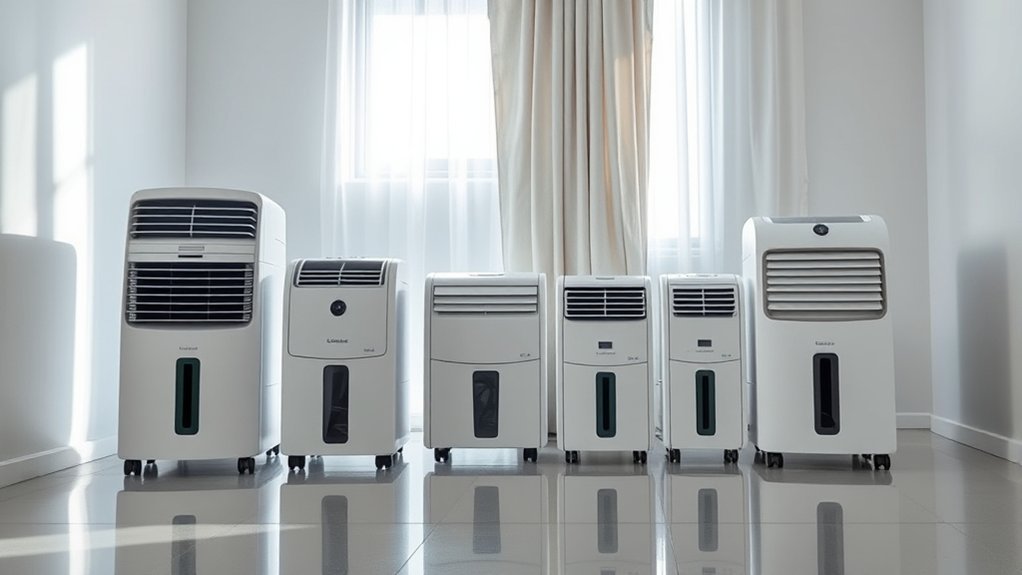
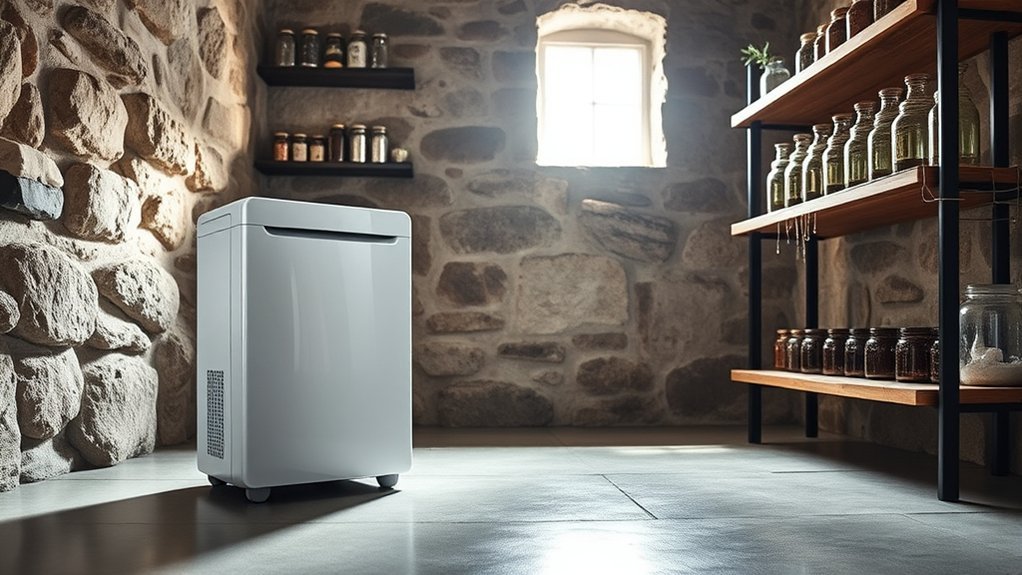
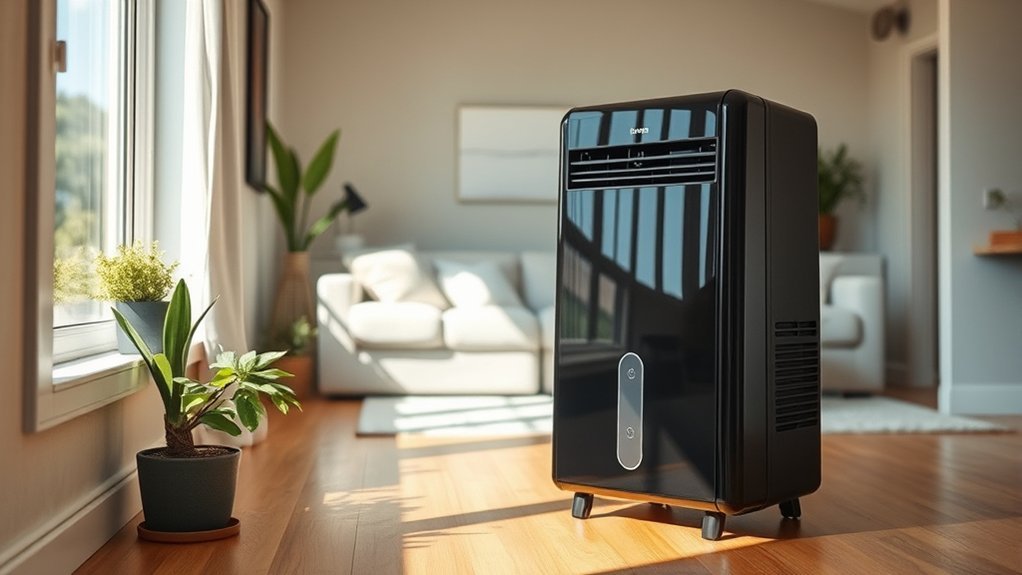
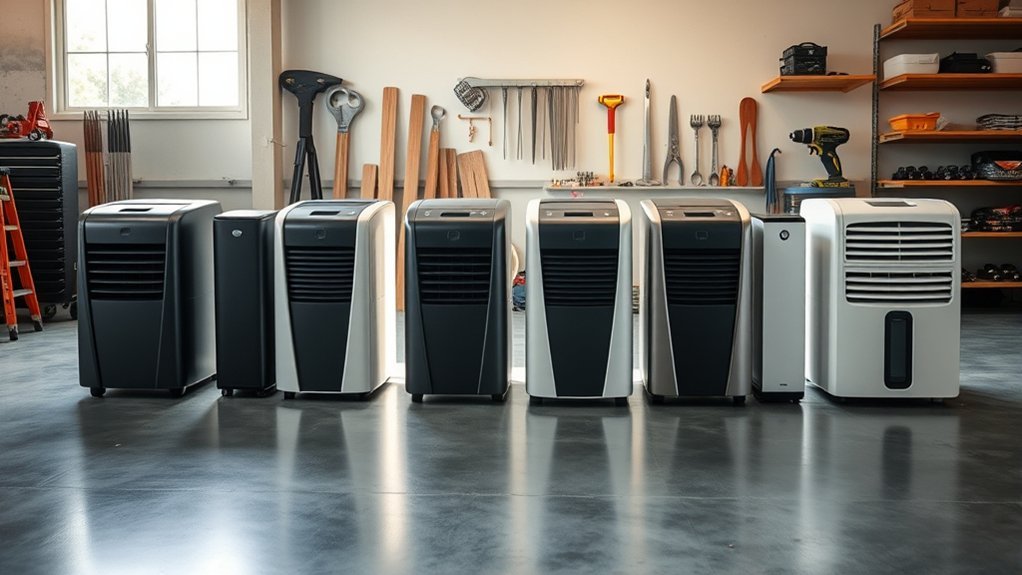
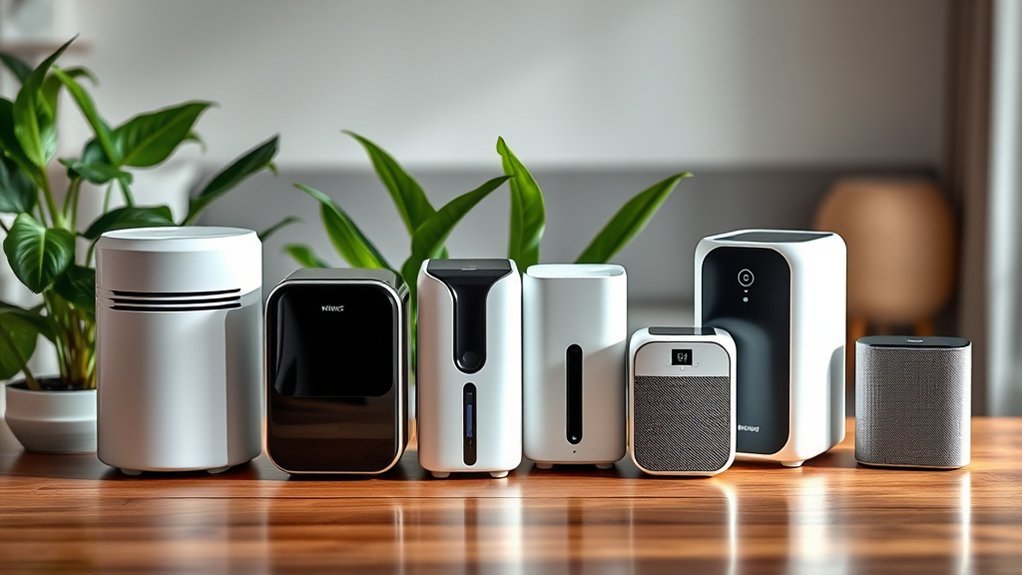
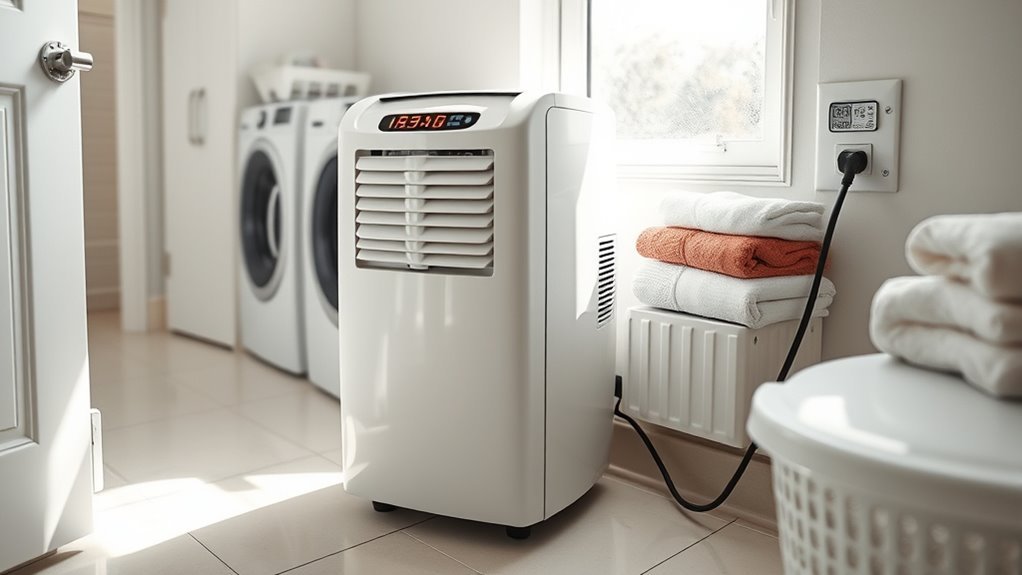
Choosing the best domestic dehumidifier in 2026 starts with the moisture problem, not the largest square-foot number printed on the listing. Compressor dehumidifiers with meaningful pint-per-day capacity, a humidistat, and continuous drainage are generally better for basements, laundry rooms, and persistently damp living spaces. Compact thermoelectric models are quieter and easier to move, but they are intended mainly for mild humidity in bedrooms, bathrooms, RVs, offices, and other small enclosed areas.
Our strongest large-space option is the Waykar 80-Pint model, while the KNKA 34-Pint unit offers a more manageable compressor option for moderate moisture problems. For localized small-room humidity, the NovaLivin DH-CS02, ToLife 95 OZ, and BeOkay 1657ML models provide more portable alternatives.
How We Compared These Products
This is an editorial comparison based on current product listings, available manuals, stated moisture-removal capacity, tank size, drainage, controls, noise-related features, portability, and intended room type. It is not a claim of hands-on testing. Marketplace specifications can change, so confirm the exact model and current details before ordering.
Quick Verdict
- Best Large-Space Pick: Waykar 80-Pint Home Dehumidifier
- Best Mid-Size Compressor Pick: KNKA 2500 Sq.Ft Dehumidifier
- Best Compact Pick: NovaLivin DH-CS02 68 OZ Dehumidifier
- Best Quiet Bedroom Pick: ToLife 95 OZ Dehumidifier
- Best for Very Small Rooms: BeOkay 1657ML Small Dehumidifier
Quick Comparison of the Best Domestic Dehumidifiers
| Product | Type | Best For | Listed Removal / Tank | Drainage | Amazon |
|---|---|---|---|---|---|
| Waykar 80 Pint | Compressor | Large rooms, basements, and persistent dampness | Up to 80 pints/day at 95°F and 90% RH; 62 pints/day at 86°F and 80% RH; 0.92-gallon tank | Tank or gravity drain hose | Check Price |
| KNKA 34 Pint | Compressor | Medium-to-large damp rooms and laundry areas | Up to 34 pints/day according to the listing; 3L tank | Tank or gravity drain hose | Check Price |
| NovaLivin DH-CS02 | Thermoelectric | Small bedrooms, bathrooms, offices, and RVs | Up to 34 oz/day at 86°F and 80% RH; 68 oz tank | Removable tank | Check Price |
| ToLife 95 OZ | Thermoelectric | Bedrooms and localized mild humidity | Listing states up to 1L/day without clear test conditions; 95 oz tank | Removable tank | Check Price |
| BeOkay 1657ML | Thermoelectric | Very small bedrooms, bathrooms, and offices | Listed at 0.3L/day; 1657 ml / 58 oz tank | Removable tank | Check Price |
Important: Daily removal figures measured in warm, highly humid conditions are not directly comparable with ratings measured under cooler or drier conditions. Advertised coverage also depends on temperature, room layout, airflow, and the amount of moisture entering the space.
Waykar 80-Pint Home Dehumidifier
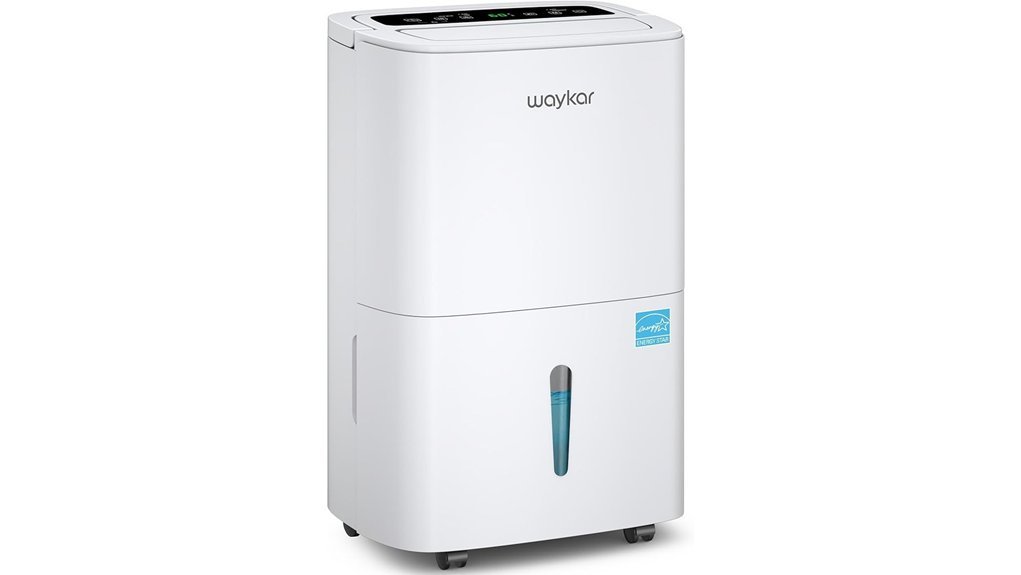
Best Large-Space Pick: Waykar’s YDZ-80 compressor dehumidifier is the strongest fit in this list for basements, open living areas, laundry rooms, and other spaces with persistent excess moisture. The listing markets it for areas up to 5,000 sq. ft. and states removal of up to 80 pints per day at 95°F and 90% RH or 62 pints per day at 86°F and 80% RH.
Those warm, high-humidity figures should not be treated as directly equivalent to a standardized capacity measured under cooler conditions. Use them to understand the model’s relative position in this comparison rather than as a guarantee of what it will collect in your home.
You can set a target humidity, collect water in the approximately 0.92-gallon removable tank, or connect a hose for continuous gravity drainage. Automatic defrost, automatic restart, self-drying, a timer, casters, a handle, and a washable filter make it easier to use in a basement or laundry area with less daily attention.
ENERGY STAR note: The Amazon listing markets this model as a 2025 ENERGY STAR product. Confirm that the exact YDZ-80 model or its UPC appears in the current ENERGY STAR Product Finder before relying on that certification claim.
Why You’ll Like It: It combines the highest stated moisture-removal potential in this comparison with continuous drainage and useful maintenance features.
Who Should Buy It: Choose it for a large room, basement, laundry area, or other space where humidity remains high and a mini thermoelectric unit would be too slow.
Who Should Avoid It: Buyers treating only a closet, tiny bathroom, or mildly humid bedroom may find it larger, louder, and more complex than necessary.
Pros:
- Built for larger and more persistently damp spaces.
- Supports both tank collection and continuous gravity drainage.
- Includes automatic defrost, restart, self-drying, a timer, casters, and a washable filter.
- Adjustable humidity control supports more hands-off operation.
Cons:
- The bucket still needs regular emptying when a drain hose is not used.
- The headline 80-pint figure is based on warm, extremely humid test conditions.
- The advertised 5,000-square-foot coverage is not a performance guarantee.
- It may be excessive for small rooms or occasional condensation.
KNKA 2500 Sq.Ft Dehumidifier with Drain Hose
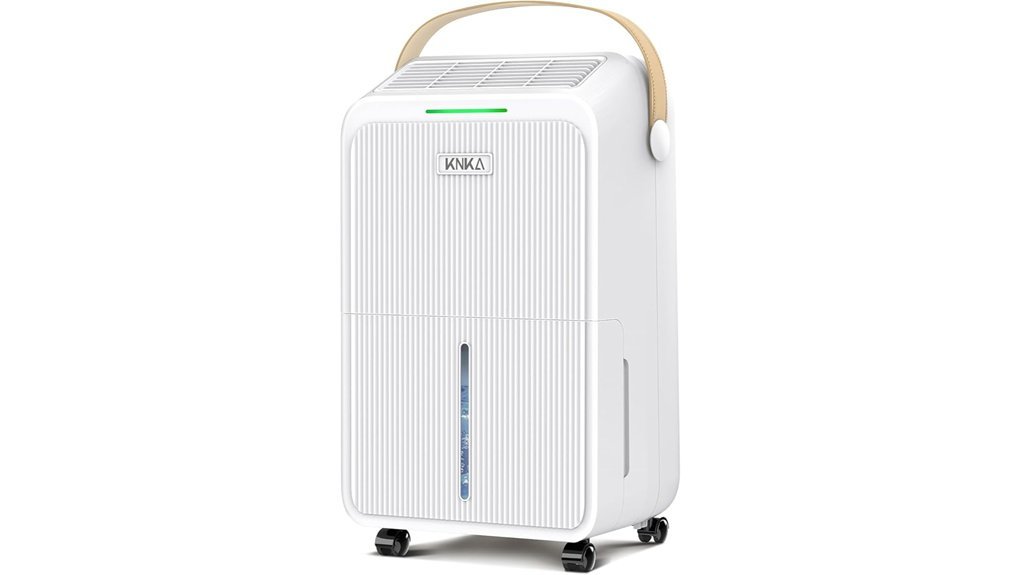
Best Mid-Size Compressor Pick: The KNKA model is a practical choice when a mini dehumidifier is too weak but the larger Waykar is more than the room requires. Its listing states removal of up to 34 pints per day and coverage up to 2,500 sq. ft. Actual results will depend on temperature, starting humidity, room layout, and the amount of moisture entering the space.
DEHU mode allows target-humidity control, DRY mode supports indoor laundry drying, and CONT mode provides continuous operation for damp conditions. The 3L tank, included 3.28-foot drain hose, automatic shutoff, automatic defrost, washable filter, wheels, timer, and real-time display make it a versatile middle-ground option.
Why You’ll Like It: It provides compressor-based moisture removal, several useful modes, and hose drainage without moving into the largest capacity class.
Who Should Buy It: It suits medium-size basements, laundry rooms, garages, larger bedrooms, or living areas with recurring dampness.
Who Should Avoid It: It may be unnecessary for a compact bathroom or closet, while very wet or unusually large spaces may require greater standardized capacity.
Pros:
- Listed to remove up to 34 pints per day.
- Offers dehumidifying, laundry-drying, and continuous modes.
- Includes a removable tank and gravity drain hose.
- Automatic defrost, wheels, a timer, and a washable filter add convenience.
Cons:
- The 3L tank may fill quickly in a very damp room.
- The included drain hose is relatively short.
- The conditions behind the headline 34-pint rating are not clearly explained in the listing.
- The 2,500-square-foot figure should be treated as a maximum marketing estimate.
NovaLivin DH-CS02 Dehumidifier with 68 OZ Tank
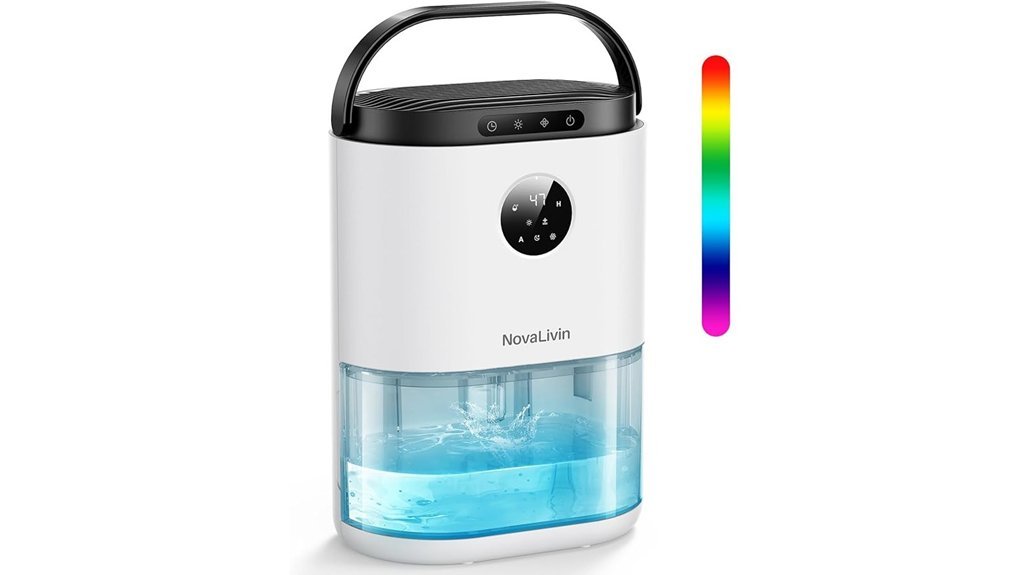
Best Compact Pick: The NovaLivin DH-CS02 is a dual-semiconductor thermoelectric model designed for localized humidity control. Its manual states removal of up to 34 ounces per day at 86°F and 80% RH, while its removable tank holds 68 ounces. That makes it more suitable for a small enclosed bedroom, bathroom, office, RV, or similar area than for a wet basement.
The current listing identifies coverage around 30 square meters, but room-size claims for compact dehumidifiers should be treated cautiously. Performance will be best in a closed, warm room with mild-to-moderate humidity and limited new moisture entering the area.
Strong, sleep, and automatic modes provide more control than a basic one-button mini unit. The digital display, automatic shutoff, timer, and optional seven-color light add everyday convenience.
Why You’ll Like It: It combines a comparatively useful removal rate for its class with portable sizing and bedroom-oriented controls.
Who Should Buy It: It is a reasonable fit for localized condensation, a slightly musty small room, bathroom humidity after showers, or RV moisture.
Who Should Avoid It: It is not the right tool for water seepage, flooding, a large basement, or severe whole-room dampness.
Pros:
- Manual states up to 34 oz of daily removal under warm, humid test conditions.
- Compact design with a useful 68 oz tank.
- Includes automatic shutoff, timer, sleep mode, and a digital display.
- Suitable for small enclosed areas where portability matters.
Cons:
- Substantially less powerful than a compressor dehumidifier.
- Performance drops when doors or windows remain open.
- The tank may need frequent emptying during humid weather.
- No continuous hose drainage is highlighted.
ToLife 1000 Sq.Ft Home Dehumidifier with LED Light
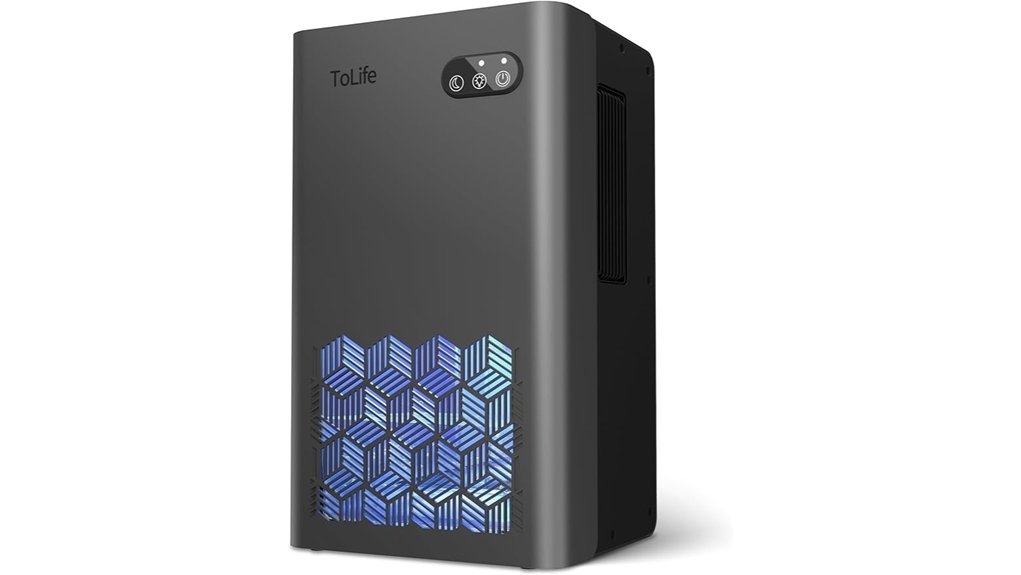
Best Quiet Bedroom Pick: ToLife’s 95 oz model is a thermoelectric dehumidifier aimed at bedrooms, bathrooms, and other enclosed spaces with localized excess humidity. The listing states a dehumidification capacity of up to 1 liter per day, but it does not clearly identify the test conditions behind that figure.
The product is marketed for spaces up to 1,000 sq. ft. Treat that number as a maximum coverage claim rather than an indication that the unit can match a compressor dehumidifier in a large room. It is more appropriately used for mild dampness, condensation, or musty air in a closed bedroom or small living area.
Its 95 oz tank can reduce emptying frequency compared with many smaller units. Powerful and sleep modes, automatic shutoff, a portable body, and an optional seven-color light make it convenient for overnight use.
Why You’ll Like It: The larger tank, sleep mode, and portable design are well suited to bedroom-oriented moisture control.
Who Should Buy It: Consider it when low noise, portability, and tank size matter more than rapid extraction.
Who Should Avoid It: Buyers who need fast drying across a basement, laundry room, or large open floor plan should choose a compressor model.
Pros:
- Large 95 oz tank for a compact thermoelectric unit.
- Sleep mode and automatic shutoff support overnight use.
- Portable design with an optional seven-color night light.
- Two operating modes keep the controls simple.
Cons:
- Thermoelectric performance is limited compared with compressor units.
- The test conditions behind the stated 1-liter daily capacity are unclear.
- The advertised 1,000 sq. ft. coverage may be optimistic in damp conditions.
- No continuous drain-hose connection is highlighted.
BeOkay 1657ML Small Dehumidifier for Home
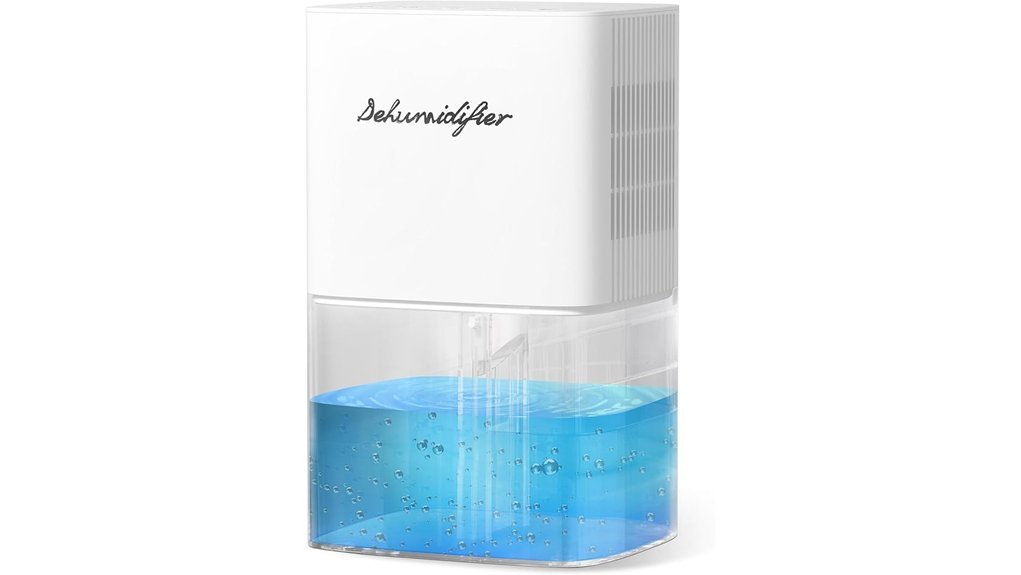
Best for Very Small Rooms: The BeOkay DH-AA2 is a 1657 ml, 58 oz thermoelectric dehumidifier for a small bedroom, bathroom, office, or similar enclosed area. Its listing identifies approximately 230 sq. ft. of coverage and a moisture-removal rate of 0.3 liters per day.
The 1657 ml tank is relatively large compared with its daily removal rate, so the tank may not require emptying every day under mild conditions. However, a large tank does not make the unit equivalent to a compressor model.
You can choose among sleep, normal, and performance modes, use several timer settings, and switch among ten color-light options. Automatic shutoff helps prevent tank overflow, while the listing states that sleep-mode noise remains below 40 dB.
Why You’ll Like It: It offers a large tank for its extraction rate, simple controls, and useful bedroom features in a compact body.
Who Should Buy It: It suits a very small enclosed room with mild condensation or a modest musty-air problem.
Who Should Avoid It: It will not replace a compressor dehumidifier for a basement, laundry room, active leak, or serious moisture problem.
Pros:
- 1657 ml tank reduces emptying frequency relative to its listed removal rate.
- Three modes, several timers, and automatic shutoff add convenience.
- Compact design works well in tight spaces.
- Approximately 230 sq. ft. is a more realistic small-room claim than many oversized mini-unit claims.
Cons:
- Listed removal is only 0.3 liters per day.
- Designed for very small enclosed rooms, not large spaces.
- Moisture removal will be much slower than a compressor model.
- Color lights may not matter to buyers who prefer basic controls.
Factors to Consider When Choosing Domestic Dehumidifiers
Choose a home dehumidifier by matching its technology and moisture-removal capacity to the room, dampness level, temperature, and drainage setup. Square-foot coverage alone is not enough because two rooms of the same size can have very different moisture loads.
Compressor vs. Thermoelectric Dehumidifiers
A compressor dehumidifier is usually the better choice for a basement, laundry room, large living space, or room where humidity rises again quickly. These units remove more water, commonly include an adjustable humidistat, and often support continuous drainage.
A thermoelectric or semiconductor model is smaller and generally quieter, but it removes far less moisture. Choose one for localized mild humidity in a warm, enclosed bedroom, bathroom, closet, RV, or office. Do not expect a mini unit to correct foundation seepage or dry a wet basement.
Room Size and Advertised Coverage
Use the square-foot figure as an initial filter, not a guarantee. Closed bedrooms and bathrooms are easier to manage than open-plan areas, high-ceiling rooms, or basements with seepage. The amount of moisture entering the room matters more than floor area alone.
Moisture-Removal Capacity and Test Conditions
Daily moisture-removal capacity describes how much water a unit can extract in 24 hours under specified conditions. Listings may use very warm, highly humid test conditions that produce a larger number than a standardized test performed in cooler air. Compare ratings only when the conditions are similar.
A higher-capacity compressor unit is generally more suitable for a wet basement or large room. A mini thermoelectric model is intended for gradual control of condensation and localized dampness.
Tank Size and Drainage
Tank volume tells you how much water the bucket can store before it needs emptying. It does not show how much water the machine can remove each day. A mini unit can have a large tank but still extract moisture slowly.
For regular use in a basement or laundry room, a hose connection is often more convenient than relying on a bucket. Gravity drainage requires the hose to slope downward toward a suitable drain. If the drain is above the unit, you need a separate condensate pump or a dehumidifier with a built-in pump.
Noise and Sleep Modes
Thermoelectric units are usually quieter than compressor models, which can make them more comfortable in bedrooms and offices. However, published decibel figures are not always measured under identical conditions.
Check whether sleep mode reduces fan speed or only dims the display and lighting. A quieter mode may also reduce moisture-removal performance.
Energy Efficiency and Certification
Energy efficiency matters when a compressor dehumidifier will operate for many hours. Match the exact model number or UPC with the current ENERGY STAR Product Finder instead of relying only on a broad brand claim or marketplace title.
Keep the filter clean and do not block the intake or outlet. Restricted airflow can reduce extraction and increase operating time.
Temperature and Automatic Defrost
Compressor dehumidifiers can lose efficiency in cool rooms because frost may form on the coils. Automatic defrost is useful in basements, garages, and other cooler areas. Thermoelectric models also have preferred operating ranges and generally perform better in warmer conditions.
Humidistat, Timers, and Automatic Shutoff
A built-in humidistat lets you choose a target relative humidity and allows a compressor unit to cycle instead of running continuously. Timers can reduce unnecessary operation, while automatic shutoff prevents overflow when the bucket is full, tilted, or incorrectly installed.
A separate hygrometer is useful for checking the room independently because built-in sensors can differ from the actual humidity elsewhere in the space.
Placement and Maintenance
Leave the clearance required by the manufacturer so air can circulate freely. Do not place an electrical dehumidifier where it can be splashed, stand in water, or block a doorway.
Inspect and clean reusable filters regularly, wash and dry the tank to control residue, and check the drain hose for kinks, clogs, poor slope, or leaks.
Before You Buy
- Confirm whether the product is a compressor or thermoelectric model.
- Compare daily removal capacity, not only tank size or square-foot coverage.
- Check the temperature and humidity conditions behind the stated capacity.
- Confirm whether the drain hose is included and long enough for your setup.
- Verify the exact model number, voltage, plug type, warranty, and certification claims.
- Measure available floor space and required airflow clearance.
- Fix plumbing leaks, seepage, drainage problems, or other moisture sources first.
Frequently Asked Questions
What Humidity Level Should I Set at Home?
A broad target of 30% to 50% relative humidity works for many homes, with approximately 40% to 50% often providing a comfortable balance. Lower settings make the dehumidifier run longer and may not be necessary. During cold weather, a lower indoor level may help reduce condensation on windows and other cold surfaces.
Do I Need a Mini or Compressor Dehumidifier?
Choose a mini thermoelectric model for mild dampness in a small enclosed bedroom, closet, RV, office, or bathroom. Choose a compressor model when the area is larger, moisture returns quickly, laundry is drying indoors, or the room has persistent dampness.
Is Tank Size the Same as Dehumidification Capacity?
No. Tank size is the amount of collected water the bucket can hold. Dehumidification capacity is the amount of moisture the machine can remove during a stated period, usually 24 hours. A unit can have a large tank while still extracting moisture slowly.
What Size Dehumidifier Suits a Basement With Water Seepage?
Use a properly sized compressor model with a humidistat and continuous drainage, but repair the source of the water as well. A dehumidifier can remove moisture from the air; it cannot repair foundation cracks, failed exterior drainage, plumbing leaks, or active flooding.
How Often Should Dehumidifier Filters Be Cleaned?
Inspect a washable filter every two to four weeks during regular use and clean it sooner in dusty rooms. Follow the product manual because filter design and maintenance intervals vary. Replace a filter only when the manufacturer specifies replacement or when it becomes damaged.
Can a Dehumidifier Reduce Musty Odors and Mold Risk?
Reducing excess humidity can make conditions less favorable for musty odors and new mold growth. A dehumidifier does not remove existing mold or replace cleaning, leak repair, ventilation, or professional remediation when contamination is extensive.
What Noise Level Is Quiet for a Home Dehumidifier?
For a bedroom, look for a low-noise or sleep mode and compare published decibel figures when available. A thermoelectric unit may be quieter, but it also removes less moisture. A compressor model can be substantially more effective while producing noticeable fan and compressor noise.
Can I Use a Dehumidifier in a Bathroom?
Only use one where the manufacturer permits it and where the appliance cannot be splashed or exposed to standing water. Keep it outside wet zones, use a properly protected electrical outlet, and follow all clearance, voltage, and placement instructions in the manual.
Conclusion
The best domestic dehumidifier depends on how much moisture you need to remove and how quickly it returns. The Waykar 80-Pint model is the strongest large-space choice in this comparison, while the KNKA 34-Pint model offers a more manageable compressor option for medium-size rooms and moderate dampness.
For bedrooms, bathrooms, RVs, offices, and localized condensation, the NovaLivin DH-CS02, ToLife 95 OZ, and BeOkay 1657ML models are easier to place and generally quieter. Their lower extraction rates mean they should not be treated as substitutes for a compressor dehumidifier in a persistently wet space.
Final Recommendation: Start with a compressor model if the room is large, consistently damp, used for indoor laundry drying, or needs continuous drainage. Choose a compact thermoelectric model only when portability, low noise, and gradual small-room moisture control matter more than fast extraction.
Before buying: Confirm the exact model number, daily removal test conditions, tank size, drain-hose requirements, operating temperature, electrical requirements, warranty terms, certification claims, and current availability on the linked product page.