Excess workshop humidity can encourage condensation, musty odors, and corrosion on stored tools. A good workshop dehumidifier needs enough moisture-removal capacity for damp floors, outdoor-air leakage, and frequently opened doors. The strongest verified fits in this guide are the KNKA 34-Pint for balanced capacity and drainage, the Midea 22-Pint for buyers who prefer an established brand and ENERGY STAR certification, and the Aiusevo AS280 for smaller enclosed workshops. Compare the rating basis, drainage setup, operating temperature, and workshop layout before choosing.
Affiliate disclosure: This article contains Amazon affiliate links. We may earn a commission from qualifying purchases at no additional cost to you.
How these picks were compared: We reviewed published moisture-removal capacity, drainage options, temperature guidance, portability, controls, and available product documentation. We did not conduct hands-on testing. Product listings and included accessories can change, so confirm the current model number and manual before ordering.
Quick Verdict
- Best Overall for Medium Workshops: KNKA 34-Pint Dehumidifier
- Best Established-Brand Option: Midea 22-Pint ENERGY STAR Dehumidifier
- Best for Small Workshops: Aiusevo AS280 21-Pint Dehumidifier
Important: Advertised coverage is only a starting point. A workshop with an exterior door, damp concrete, poor insulation, high ceilings, or divided work areas may need more capacity than its floor area suggests. Pint ratings can also use different test conditions, so two similar numbers are not always directly comparable.
Workshop Dehumidifier Comparison
| Product | Listed Capacity | Advertised Coverage | Drainage | Best For | Amazon |
|---|---|---|---|---|---|
| KNKA PD22SC-12 | Up to 34 pints/day, manufacturer-listed | Up to 2,500 sq. ft. | 3L tank or included gravity-drain hose | Medium, moderately damp workshops | Check Current Amazon Availability |
| Midea MAD22C1AWS | 22 pints/day, ENERGY STAR/DOE-rated | Up to 1,500 sq. ft. | 0.8-gallon tank or gravity hose; hose not included | Small to medium workshops | Check Current Amazon Availability |
| Aiusevo AS280 | Up to 21 pints/day at 95°F and 90% RH | Up to 1,500 sq. ft. | 2L tank or included gravity-drain hose | Small, enclosed workshops | Check Current Amazon Availability |
Capacity comparison note: Treat the pint figures as published ratings, not guaranteed daily collection amounts. The Midea rating follows a standardized ENERGY STAR/DOE basis, while the KNKA and Aiusevo figures should be checked against the current listing and manual before making a direct capacity comparison.
KNKA 2,500 Sq. Ft. Dehumidifier with Drain Hose
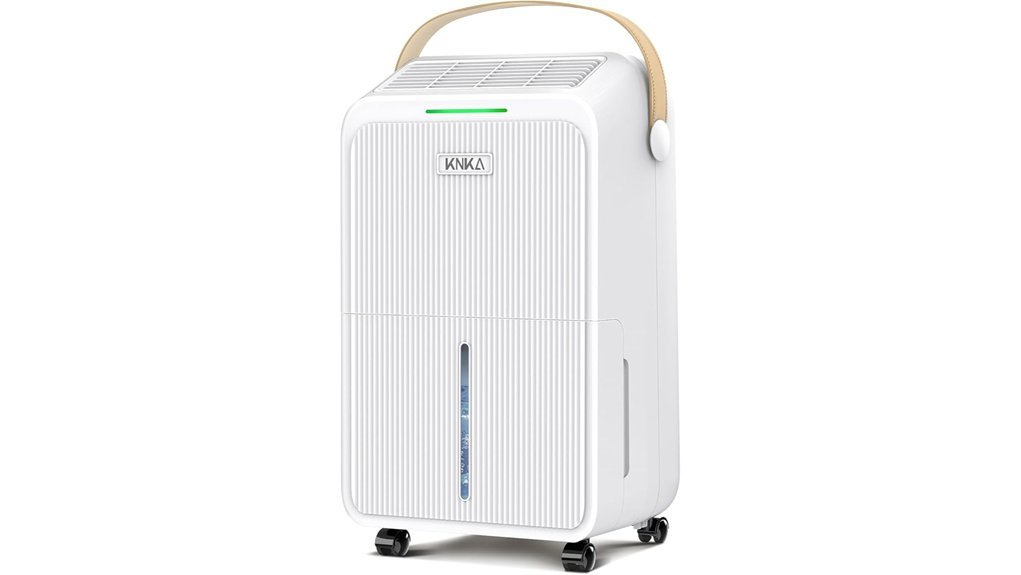
Best Overall for Medium Workshops
The KNKA PD22SC-12 is a balanced option for workshop owners who need more moisture-removal capacity than a small room unit but do not need an industrial machine. Its published materials list a maximum capacity of 34 pints per day and advertised coverage of up to 2,500 square feet.
It includes adjustable dehumidification, drying, and continuous modes. The 3-liter tank handles manual collection, while the included drain hose can reduce interruptions when the unit is positioned above a suitable floor drain or sump basin.
Why You’ll Like It
- Useful middle-ground capacity: A practical fit for many one-room workshops, garages, and hobby spaces.
- Included continuous-drain hose: Helps avoid frequent bucket emptying when gravity drainage is available.
- Automatic humidity control: Lets the unit cycle around a selected target instead of running without control.
- Portable design: Wheels and a carrying handle make repositioning easier.
Who Should Buy This: Owners of medium-sized, enclosed workshops who want a practical balance of capacity, portability, and included drainage hardware.
Who Should Avoid This: Buyers with a freezing or near-freezing workshop, several closed-off rooms, heavy groundwater intrusion, or a need to pump water uphill.
Pros:
- Higher listed moisture-removal capacity than the smaller options in this guide.
- Includes multiple operating modes and adjustable humidity control.
- Supports tank collection and gravity-fed continuous drainage.
- Includes a drain hose.
Cons:
- The rating basis is not presented as clearly as the standardized Midea rating.
- Advertised square-foot coverage may be optimistic in drafty or divided workshops.
- Gravity drainage requires a lower drain and a continuously downward-sloping hose.
- Long-term support and warranty details should be confirmed with the current seller.
Before ordering: Confirm that the listing identifies model PD22SC-12 and includes the drain hose shown in the product details.
Midea 1,500 Sq. Ft. 22-Pint ENERGY STAR Dehumidifier
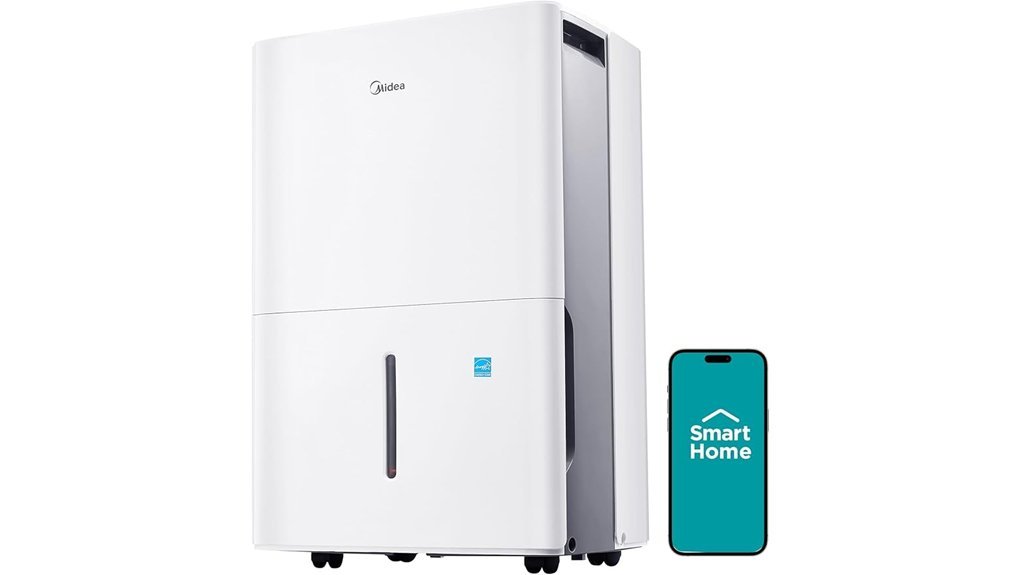
Best Established-Brand Option
The Midea MAD22C1AWS is a sensible choice for a small to medium workshop where moderate moisture control is needed. It is rated at approximately 22 pints per day, is advertised for spaces up to 1,500 square feet, and has current ENERGY STAR certification.
Its adjustable humidistat lets you select a target humidity level, while the reusable filter helps protect airflow when it is cleaned regularly. The unit also supports automatic defrost, auto restart, timer operation, bucket collection, and gravity-fed continuous drainage through a compatible hose.
Why You’ll Like It
- Stronger documentation: The model, capacity, efficiency certification, and support information are easier to verify than many marketplace-only alternatives.
- Adjustable humidity control: Allows the unit to cycle around a selected target.
- Washable filter: Useful in workshops where airborne dust can build up quickly.
- Portable layout: Wheels and side handles make repositioning easier.
- One-year manufacturer warranty: Adds a clearer support path than less established options.
Who Should Buy This: Buyers with a small or moderately damp workshop who value standardized capacity data, ENERGY STAR certification, straightforward controls, and brand support.
Who Should Avoid This: Owners of very large, highly humid, frequently open, or very cold workshops that require more capacity or low-temperature equipment.
Pros:
- Standardized 22-pint capacity rating.
- ENERGY STAR certified.
- Tank and gravity-drain options.
- Automatic defrost, restart, humidistat, and timer functions.
- Reusable air filter and one-year warranty.
Cons:
- The 0.8-gallon tank may fill quickly in damp conditions.
- A compatible gravity-drain hose is not included.
- It does not have a built-in condensate pump.
- The surrounding temperature should remain above approximately 41°F.
Cold-workshop note: This compressor unit is not intended for freezing conditions. Confirm the current manual’s minimum operating temperature before using it in an unheated garage or workshop.
Aiusevo AS280 21-Pint Dehumidifier
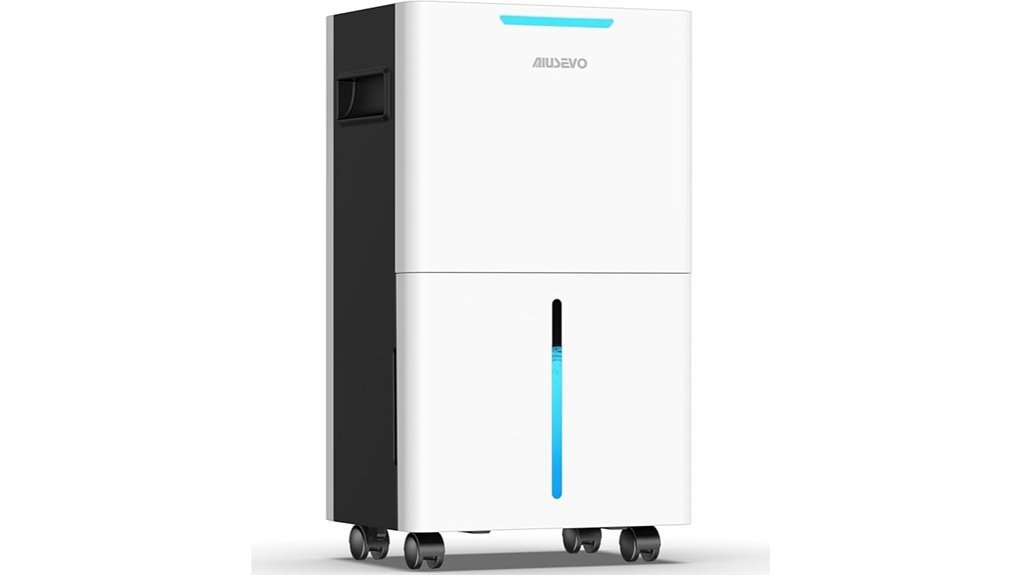
Best for Small Workshops
The Aiusevo AS280 is a compact compressor dehumidifier rated to remove up to 21 pints per day at 95°F and 90% relative humidity. It is advertised for spaces up to 1,500 square feet, but its capacity and two-liter tank make it a more realistic fit for a small, enclosed workshop with moderate seasonal humidity.
Its DEHU mode provides adjustable humidity control, DRY mode runs more aggressively for damp materials, and CONT mode supports continuous operation. The tank automatically shuts the unit off when full, while the included drain hose offers a hands-free gravity-drain alternative.
Why You’ll Like It
- Compact footprint: Easier to place where workshop floor space is limited.
- Three operating modes: Provides more flexibility than a basic on-and-off unit.
- Included drain hose: Avoids a separate hose purchase for a compatible gravity-drain setup.
- Portable design: Wheels and handles simplify movement around the workspace.
Who Should Buy This: Owners of small, enclosed workshops with moderate humidity who want a compact compressor model and an included drain hose.
Who Should Avoid This: Buyers managing severe dampness, multiple rooms, frequent exterior-air exchange, near-freezing temperatures, or a workshop that needs a built-in pump.
Pros:
- Compressor-based moisture removal.
- Adjustable humidistat and three operating modes.
- Includes a drain hose.
- Relatively lightweight and easy to move.
Cons:
- The two-liter tank may require frequent emptying without continuous drainage.
- The 21-pint rating is measured under hot, very humid conditions and should not be compared directly with a DOE-rated figure.
- Advertised coverage should not be treated as guaranteed workshop coverage.
- Warranty and long-term support details should be confirmed with the current seller.
Before ordering: Confirm that the listing identifies model AS280, includes the drain hose, and states the current warranty terms.
Factors to Consider When Choosing a Dehumidifier for a Workshop
A workshop creates different challenges from a bedroom or living room. Concrete floors, exterior doors, cold weather, dust, wet materials, and poor insulation can all increase the amount of work a dehumidifier must perform.
Prioritize Moisture-Removal Capacity
Daily moisture-removal capacity is measured in pints per day. It should not be confused with the size of the collection tank. A 22-pint model may remove up to roughly 22 pints over 24 hours under its specified test conditions even though its bucket holds only a small portion of that amount.
For a small, moderately damp workshop, a portable model in the low-20-pint range may be a practical starting point. A higher-capacity unit provides more headroom for medium spaces, damp concrete, high ceilings, frequent door opening, or longer periods of humid weather.
Compare the Capacity Rating Basis
Not every advertised pint rating uses the same temperature and humidity conditions. A model rated in hot, saturated air can show a larger number than it would under the cooler DOE test used for standardized U.S. ratings.
When two products have similar pint figures, check whether both use the same test standard. If the listing does not identify the test basis, treat the number as a manufacturer claim and leave extra capacity for difficult workshop conditions.
Treat Coverage Claims as Estimates
Advertised square-foot coverage does not account for every workshop condition. Ceiling height, airflow, open doors, damp concrete, insulation, partitions, and starting humidity can all affect performance.
A smaller open room may be easier to dehumidify than a similarly sized workshop divided by shelving, walls, stored materials, or closed work areas. When conditions are difficult, selecting more capacity can reduce how long the compressor must run.
Check the Workshop Temperature
Standard compressor dehumidifiers lose efficiency as the temperature drops. Frost can develop on the coils, causing the unit to pause for defrosting or stop removing moisture effectively.
Check the manufacturer’s minimum operating temperature before buying. For a workshop that regularly approaches freezing, consider equipment specifically designed for low-temperature operation or a suitable desiccant or commercial solution.
Choose the Right Drainage Method
Manual tank collection is simple but can become inconvenient during humid weather. Continuous drainage lets water flow through a hose to a nearby floor drain, sump basin, or condensate pump.
The models in this guide use gravity drainage rather than a built-in pump. The hose must slope downward without kinks or uphill sections. If water must travel upward to a sink or window, use a compatible external condensate pump and follow its installation instructions.
Plan for Dust and Filter Maintenance
Wood dust, metal particles, sanding residue, and general workshop debris can clog the air filter and reduce airflow. Inspect the filter more frequently than you would in a clean living area.
Follow the manual when cleaning the filter, and never reinstall a washable filter until it is completely dry. Keep the air intake and exhaust clear of walls, cabinets, curtains, and stored materials.
Keep It Away from Workshop Hazards
These are portable household-style dehumidifiers, not explosion-proof or industrial dust-rated machines. Do not place them where grinding sparks, welding spatter, paint spray, flammable vapors, heavy sawdust, or splashing water can reach the intake, plug, controls, or electrical components.
A dehumidifier controls moisture only. It does not replace dust collection, fume extraction, combustion-gas monitoring, or ventilation required for the work being performed.
Consider Noise and Placement
Manufacturer-listed noise ratings are useful for comparison, but the actual sound can change with fan speed, floor vibration, and room acoustics. Place the unit on a firm, level surface and avoid positioning it against a lightweight wall or resonant metal cabinet.
If you perform detailed or quiet work, choose a lower fan setting when humidity permits and place the unit away from the primary workbench.
Look for Efficient Automatic Control
An adjustable humidistat can reduce wasted energy by cycling the compressor after the selected humidity level is reached. ENERGY STAR certification provides a standardized efficiency reference, while automatic restart and timer functions can make routine operation easier.
Keep the filter clean, close exterior doors when practical, and repair major water-entry problems instead of expecting the dehumidifier to compensate for an active leak.
Check Warranty and Support
Verify the model number, return window, warranty length, replacement-part availability, and customer-support contact before buying. This is especially important for marketplace brands whose listings or sellers may change over time.
Check Electrical Requirements
Connect the unit to a suitable grounded outlet and follow the electrical instructions in its manual. Avoid lightweight or undersized extension cords. If an extension cord is permitted, it must be properly rated for the appliance and workshop environment.
Keep the plug and receptacle away from standing water, wet floors, grinding sparks, paint spray, and flammable vapors.
Before You Buy
- Measure the open workshop area and ceiling height.
- Check typical winter and summer temperatures.
- Identify whether the moisture comes from humidity, leaks, condensation, or groundwater.
- Compare pint ratings only after checking their test conditions.
- Confirm whether a floor drain, sump basin, or external condensate pump is available.
- Check the model’s minimum operating temperature.
- Plan enough clearance around the air intake and exhaust.
- Confirm the listing’s model number, included hose, warranty, and return terms.
- Confirm that the electrical circuit can support the appliance.
Frequently Asked Questions
What Size Dehumidifier Do I Need for a Small Workshop?
A portable compressor model in the low-20-pint range can be a practical starting point for a small, enclosed workshop with moderate humidity. Choose more capacity when the space has damp concrete, poor insulation, frequent door opening, high ceilings, or persistently high humidity.
Can I Use a Dehumidifier in an Unheated Workshop?
Yes, but only when the workshop remains within the model’s permitted operating-temperature range. Standard compressor units may collect less water or develop frost in cold conditions. Check the manual for the minimum temperature and automatic-defrost instructions.
What Humidity Level Is Best for Workshop Tools?
A target around 45% to 50% relative humidity is a practical starting point for many workshops. The best setting depends on the materials, climate, temperature, and equipment being stored. Use a separate hygrometer to check conditions in different parts of the room.
Will a Dehumidifier Stop Tools From Rusting?
Reducing humidity can lower the risk of condensation and corrosion, but it cannot guarantee that tools will never rust. Dry wet tools promptly, avoid storing metal directly on damp concrete, use suitable protective coatings, and address leaks or condensation sources.
Do I Need a Drain Pump?
You do not need a pump when the hose can run continuously downhill to a floor drain or sump basin. If the water must move upward to a sink, window, or higher drain, use a compatible external condensate pump. The models in this guide do not list a built-in pump.
Can I Run a Workshop Dehumidifier Continuously?
Many portable units offer a continuous mode, but they still need proper airflow, a secure drainage setup, regular filter cleaning, and operation within the manual’s temperature range. Inspect the hose and drain connection periodically rather than treating the setup as maintenance-free.
Where Should I Place a Workshop Dehumidifier?
Place it on a stable, level surface with the manufacturer-recommended clearance around the intake and exhaust. Keep it away from sawdust piles, grinding sparks, welding spatter, paint spray, flammable vapors, and locations where water can splash onto electrical components.
Does a Dehumidifier Replace Workshop Ventilation?
No. A dehumidifier controls airborne moisture, but it does not remove welding fumes, paint vapors, carbon monoxide, fine dust, or other hazardous contaminants. Continue using appropriate ventilation, dust collection, and fume-extraction equipment.
How Do I Maintain My Workshop Dehumidifier?
Inspect and clean the filter regularly, empty and wash the tank, check the drain hose for blockage or leaks, and keep the intake and exhaust unobstructed. Workshop dust may require more frequent filter cleaning than normal household use.
Final Recommendation
The KNKA 34-Pint Dehumidifier offers the best balance for many medium-sized workshops because it combines a higher listed capacity with adjustable controls and an included gravity-drain hose.
The Midea 22-Pint ENERGY STAR Dehumidifier is the stronger choice for buyers who prioritize standardized performance data, verified efficiency certification, and clearer manufacturer support. The compact Aiusevo AS280 is better suited to moderate humidity in a small, enclosed work area.
Before ordering, compare the workshop’s temperature, moisture source, layout, drainage access, rating test conditions, and electrical setup. A properly sized dehumidifier can help reduce condensation and corrosion risk, but leaks, standing water, hazardous fumes, and ventilation problems must be corrected separately.