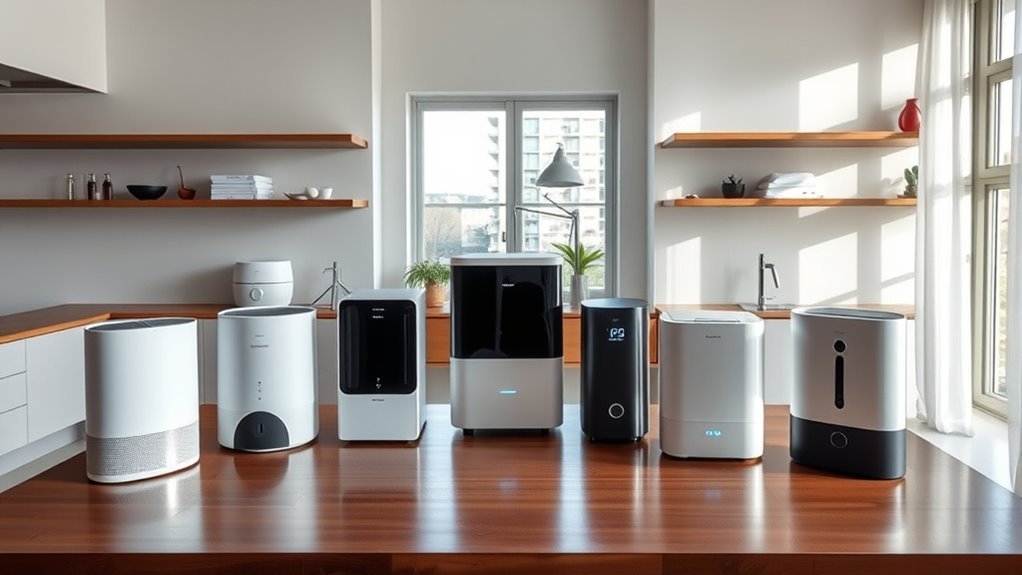
A 400 sq ft room can feel uncomfortable when moisture lingers, but the right dehumidifier depends on how damp the space really is. The six models below are compact thermoelectric dehumidifiers intended for mild humidity, warm bedrooms, bathrooms, closets, RVs, and similar spaces. They are quieter and easier to move than many compressor units, but their moisture-removal capacity is much lower.
Important sizing note: Manufacturer coverage claims such as 500 or 1,000 sq ft should not be treated as the same thing as a standardized pint-per-day capacity rating. ENERGY STAR recommends roughly 20 to 30 pints per day from a portable dehumidifier for a small-to-medium room that feels slightly or moderately damp. Choose one of the compact models in this guide only when the moisture problem is mild. For persistent condensation, wet walls, laundry drying, basement seepage, or visible mold, fix the moisture source and use a properly sized compressor model.
Updated August 2026. Product specifications and seller claims were checked for consistency, but Amazon listings can change.
Quick verdict
- Best overall controls: KeepGlad 98OZ, thanks to its humidity display, drain hose, timer, washable filter, and three fan speeds.
- Best for continuous drainage: Levoair Mini, which includes a 5-foot gravity drain hose and a simple one-button design.
- Best quiet bedroom option: ZUKBEN D2, with a published sleep-mode noise level below 30 dB and a 12-hour timer.
- Best high-output compact option: UBBO 95oz, with a claimed maximum extraction of 1.2 liters per day under warm, highly humid test conditions.
How these picks were compared
The ranking considers published moisture-removal capacity, tank size, drainage options, noise, controls, portability, and honest limitations. Seller-stated room coverage was treated as a rough use-case claim, not as proof that a compact thermoelectric unit can replace a 20- to 30-pint compressor dehumidifier.
Quick Comparison of Dehumidifiers for a 400 Sq Ft Room
| Model | Tank | Claimed Maximum Extraction* | Drainage | Best For | Amazon |
|---|---|---|---|---|---|
| KeepGlad RX02-B | 98 oz | 2.8 pints/day (listing data) | Tank or drain hose | Controls and monitoring | Check Amazon Details |
| Levoair Mini | 68 oz | Up to 35 oz/day at 86°F and 80% RH | Tank or 5-ft hose | Low-maintenance drainage | Check Amazon Details |
| ZUKBEN D2 | 75 oz | Up to 23 oz/day at 86°F and 60% RH | Manual tank | Quiet bedroom use | Check Amazon Details |
| UBBO 95oz | 95 oz | Up to 1.2 L/day at 86°F and 80% RH | Tank or drain hose | Warm, mildly damp rooms | Check Amazon Details |
| NineSky | 95 oz | Not consistently published | Manual tank | Simple high/night modes | Check Amazon Details |
| TENKER | 77 oz | Not consistently published | Manual tank | Dual-fan compact design | Check Amazon Details |
*Published maximums are generally measured in warm, humid test conditions and may be much lower in a cooler or less humid room.
KeepGlad 98OZ Dehumidifier for Home
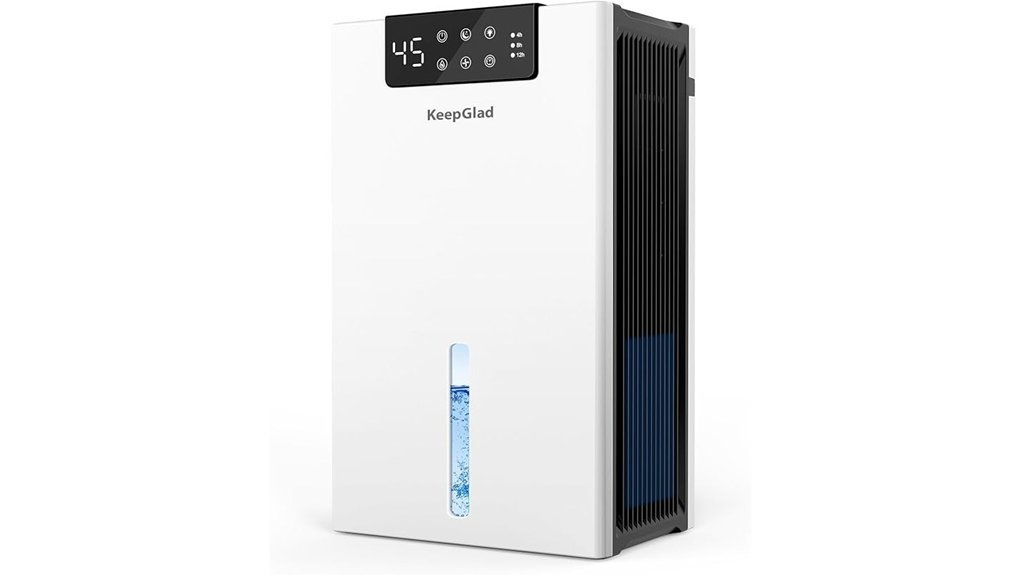
The KeepGlad RX02-B offers the strongest control package in this roundup. Its 98 oz tank, humidity display, three fan speeds, timer, washable filter, and drain-hose option make it easier to manage than basic one-button models. Amazon product data lists a dehumidification capacity of 2.8 pints per day, which is still far below the 20- to 30-pint range commonly recommended for a genuinely damp room.
This model is particularly useful when you want to monitor room humidity rather than simply switch the unit on and hope for the best. The display helps you track trends, although a separate hygrometer is still useful for checking accuracy. Continuous drainage can reduce tank-emptying chores when the hose is routed downhill.
Why You’ll Like It: It combines better monitoring, more fan control, a large tank, and two drainage methods.
Best For: Mildly damp bedrooms, bathrooms, laundry-adjacent rooms, or finished basements that stay warm and do not have active water intrusion.
Who Should Avoid It: Buyers who need verified 20-pint-or-higher compressor performance for a persistently wet basement.
Pros:
- 98 oz tank is the largest in this group.
- Humidity display and digital controls improve day-to-day usability.
- Includes continuous-drain capability and a washable filter.
- Three fan speeds and a sleep mode provide more control over noise and airflow.
Cons:
- Its listed 2.8-pint daily capacity remains far below a standard room dehumidifier.
- The filter requires periodic cleaning.
- Displayed humidity should be checked against a separate hygrometer if precise control matters.
Levoair Mini Dehumidifier with Drain Hose
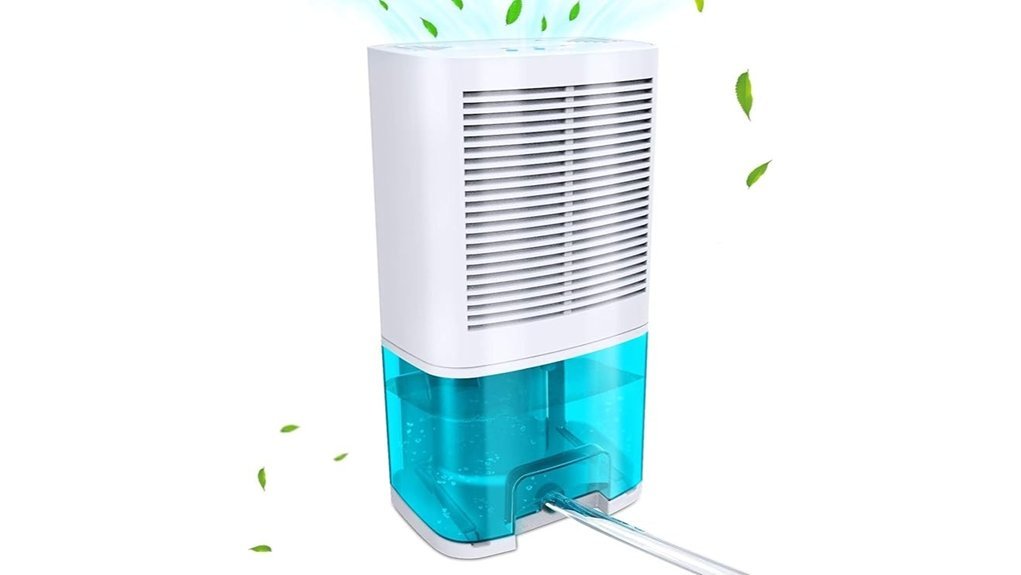
The Levoair Mini is the easiest pick here for buyers who do not want to empty a tank every day. It uses a 68 oz tank and includes a 5-foot hose for gravity-fed continuous drainage. The manufacturer lists a maximum extraction rate of up to 35 oz per day at 86°F and 80% relative humidity, which is roughly 2.2 pints per day.
Its compact 5-pound design and one-button control suit bedrooms, bathrooms, closets, RVs, and other mildly damp areas. The unit is listed below 40 dB and includes automatic shutoff when the tank is full. The drain hose must slope continuously downward to a suitable drain or container because the unit does not include a pump.
Why You’ll Like It: The included hose reduces routine maintenance, while the narrow footprint is easy to place beside a vanity, dresser, or storage shelf.
Best For: Warm rooms where a nearby floor drain, sink, or other lower drain point is available.
Who Should Avoid It: Anyone needing strong cold-basement performance or a hose that can move water upward.
Pros:
- Includes a 5-foot continuous drain hose.
- Published extraction reaches up to 35 oz per day in warm, very humid conditions.
- Lightweight 5-pound design is easy to relocate.
- Automatic shutoff provides tank-overflow protection.
Cons:
- Performance is reduced below about 59°F or at lower humidity levels.
- Continuous drainage depends on gravity and correct hose placement.
- It does not provide compressor-level moisture removal for seriously damp rooms.
ZUKBEN D2 Dehumidifier with 75 OZ Water Tank and Timer
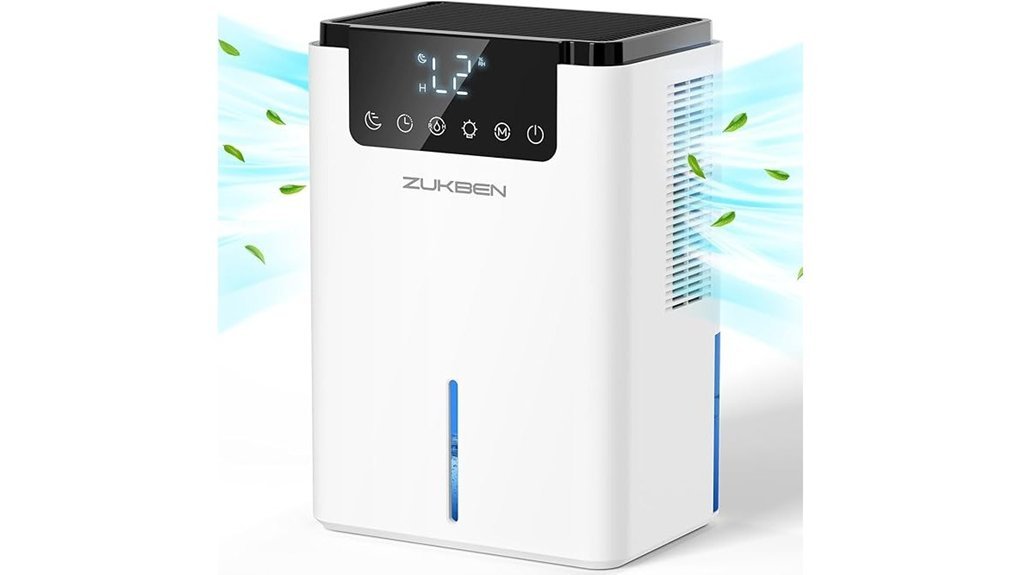
The ZUKBEN D2 is a sensible match for a mildly humid 400 sq ft bedroom when quiet operation and a flexible timer matter more than heavy-duty extraction. Its 75 oz tank reduces how often you need to empty it, while the published maximum moisture-removal rate is up to 23 oz per day at 86°F and 60% relative humidity. Actual collection will usually be lower in cooler or drier conditions.
Two operating modes make it easy to balance speed and sound. Powerful mode increases airflow, while sleep mode is listed below 30 dB for less disruption at night. The timer supports scheduled operation for up to 12 hours, and automatic shutoff helps prevent tank overflow.
Why You’ll Like It: It combines a relatively large tank, low published sleep-mode noise, a timer, and simple controls in a compact unit.
Best For: Bedrooms, home offices, bathrooms, RVs, and other warm spaces with light condensation or musty air.
Who Should Avoid It: Buyers dealing with wet walls, repeated window runoff, laundry drying, basement seepage, or humidity that remains above 60% despite continuous operation.
Pros:
- 75 oz tank provides more runtime between manual emptying.
- Up to 12-hour timer offers flexible scheduled use.
- Sleep mode is listed below 30 dB.
- Automatic shutoff helps prevent overflow.
Cons:
- Maximum extraction is only about 1.4 pints per day under favorable conditions.
- No continuous drain hose is listed, so the tank must be emptied manually.
- Thermoelectric performance drops as room temperature and humidity fall.
UBBO 95oz Dehumidifier with Drain Hose
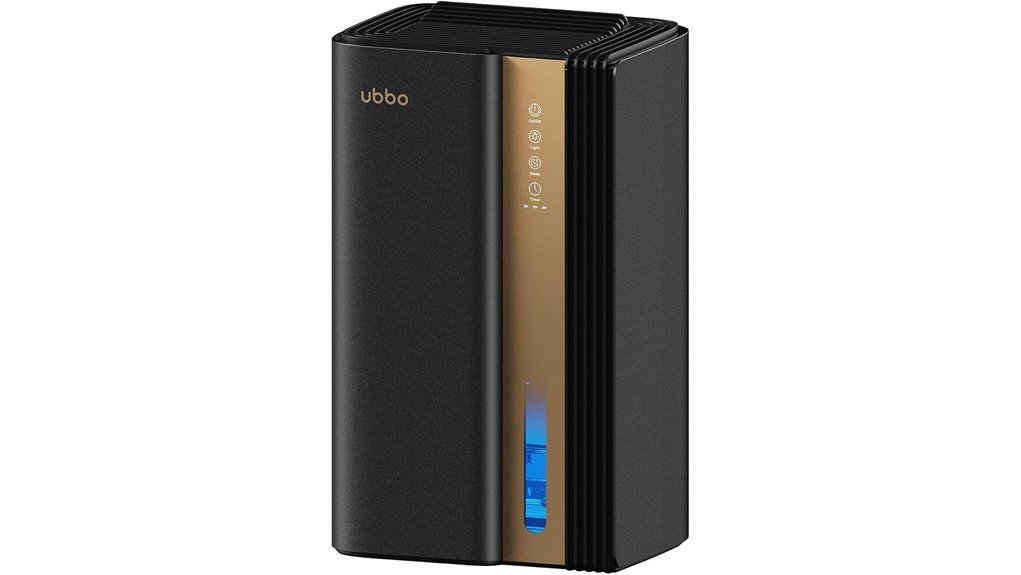
The UBBO 95oz model uses dual semiconductor condensers and lists a maximum moisture-removal rate of up to 1.2 liters per day at 86°F and 80% relative humidity. That is about 2.5 pints per day under ideal conditions, placing it near the top of this compact group while still remaining well below compressor-dehumidifier capacity.
The included drain hose supports continuous use, and sleep mode is listed at about 35 dB. A timer, automatic shutoff, washable filter, removable tank, and seven-color light add convenience. Treat the 1.2-liter figure as a seller-stated ideal-condition maximum rather than a standardized DOE capacity rating.
Why You’ll Like It: It offers one of the stronger published extraction figures in this roundup plus continuous drainage.
Best For: Warm bathrooms, bedrooms, kitchens, RVs, and other spaces with mild but recurring moisture.
Who Should Avoid It: Buyers expecting the 1,000 sq ft coverage claim to mean it can handle a wet basement or whole-floor humidity problem.
Pros:
- Claimed output reaches up to 1.2 liters per day in warm, highly humid conditions.
- Includes a drain hose for gravity-fed continuous drainage.
- Sleep mode, timer, washable filter, and auto shutoff improve convenience.
- 95 oz tank reduces manual emptying compared with smaller units.
Cons:
- Real-world extraction can be substantially lower than the ideal-condition maximum.
- The 35 dB sleep-mode rating is quieter than many appliances but not silent.
- Seller-stated coverage should not be compared directly with DOE pint ratings.
NineSky Dehumidifier with 95oz Tank
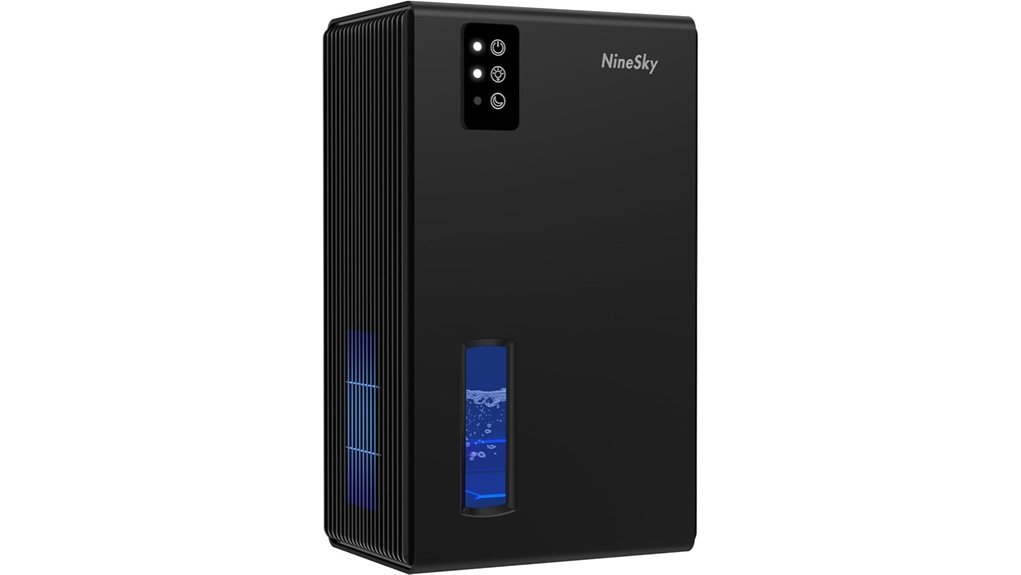
The NineSky model is a straightforward compact option with a 95 oz tank, high-speed mode, night mode, automatic shutoff, and seven-color ambient lighting. Its footprint is approximately 8.3 by 5.7 by 14 inches, making it easy to place in a bedroom, bathroom, closet, or RV without occupying much floor space.
The current listing does not provide a clear daily moisture-removal figure for this exact ASIN. That makes it harder to compare directly with the ZUKBEN, Levoair, KeepGlad, or UBBO models. Treat the advertised 1,000 sq ft coverage as a placement claim, then judge results with a hygrometer and the amount of water actually collected.
Why You’ll Like It: Controls are simple, the tank is large for a thermoelectric unit, and night mode turns off distracting lights.
Best For: Buyers who want easy operation and light moisture control without advanced settings.
Who Should Avoid It: Anyone who requires a clearly documented extraction rate, built-in humidistat control, or continuous drainage.
Pros:
- 95 oz tank reduces how often it needs to be emptied.
- High-speed and night modes suit daytime and bedroom use.
- Automatic shutoff helps prevent spills.
- Compact footprint fits small spaces.
Cons:
- A clear daily moisture-removal figure is not consistently published for this ASIN.
- No continuous drain hose is clearly listed.
- It lacks the monitoring controls offered by the KeepGlad model.
TENKER Dehumidifier with 77oz Water Tank
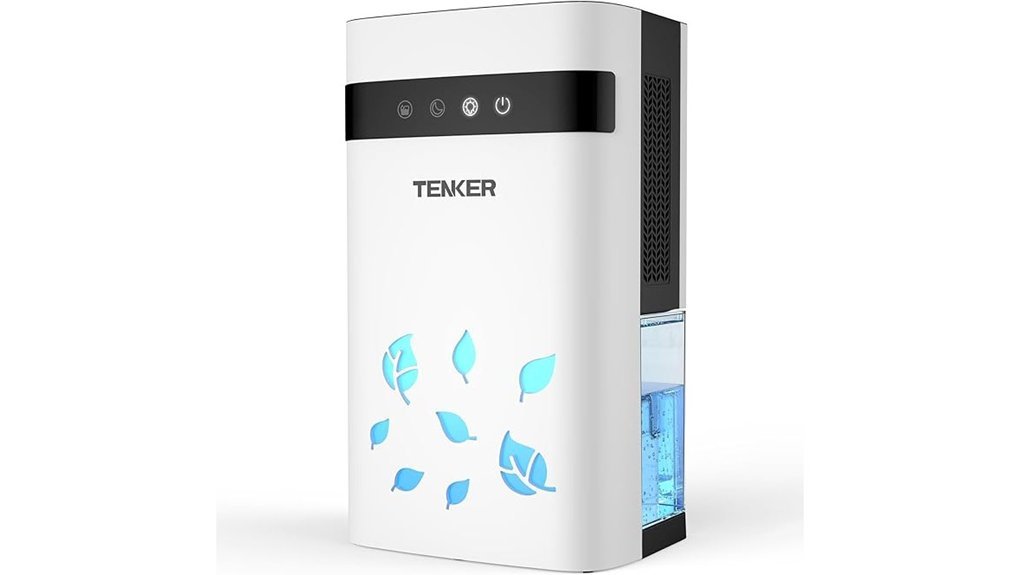
The TENKER model uses dual fans and dual semiconductor condensers in a compact body with a 77 oz tank. It includes sleep mode, automatic shutoff, and seven-color lighting, making it suitable for buyers who want simple humidity control without a large compressor unit.
The listing uses broad 1,000 sq ft coverage language, but the available capacity fields are not consistent enough for a clean apples-to-apples comparison. Assess performance by tracking room humidity and daily water collection rather than relying on the coverage claim alone.
Why You’ll Like It: The dual-fan design is intended to improve airflow while keeping the unit compact and bedroom-friendly.
Best For: Mild humidity in bedrooms, bathrooms, closets, and RVs.
Who Should Avoid It: Anyone who needs a drain hose, a humidity display, or clearly documented pint-per-day output.
Pros:
- Dual fans and dual semiconductor condensers support steady airflow.
- 77 oz tank is reasonably large for a compact model.
- Sleep mode and automatic shutoff improve bedroom usability.
- Lightweight format is easier to move than a compressor unit.
Cons:
- Exact daily extraction is not consistently documented for this ASIN.
- No continuous drainage option is clearly listed.
- It is unsuitable for heavy moisture loads despite the broad coverage claim.
Factors to Consider When Choosing a Dehumidifier for a 400 Sq Ft Room
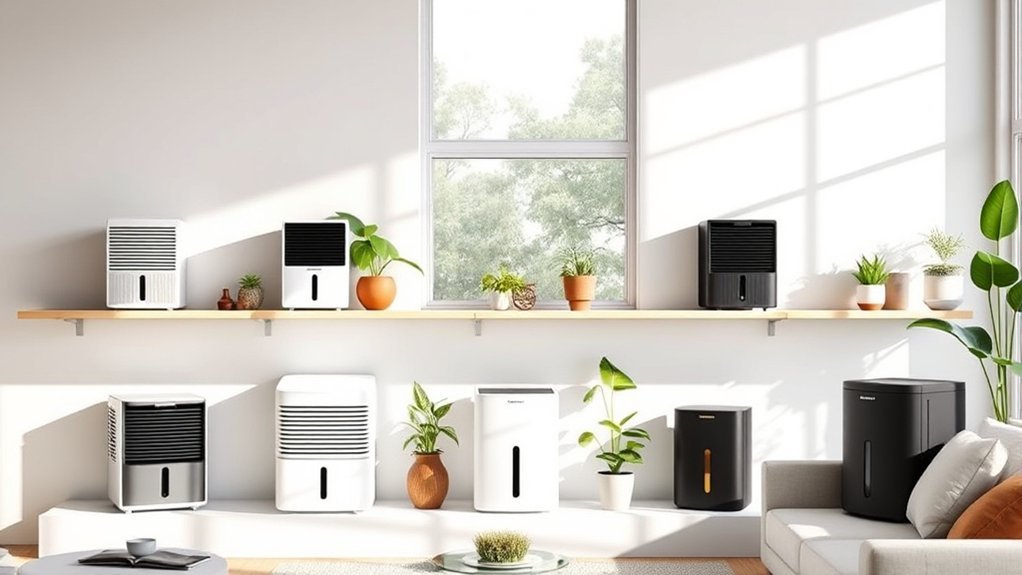
For a 400 sq ft room, the most important decision is not the tank size or LED color. It is whether the room needs a compact thermoelectric dehumidifier or a much stronger compressor model. Use the checklist below to avoid buying an undersized unit.
1. Match the Technology to the Moisture Level
Thermoelectric or Peltier dehumidifiers are compact, quiet, and easy to move. They work best in warm spaces with light condensation, a mild musty smell, or localized moisture. They are not a direct replacement for a compressor dehumidifier when a room is consistently damp.
ENERGY STAR sizing guidance recommends approximately 20 to 30 pints per day for a small-to-medium room that feels slightly or moderately damp. The compact models in this article advertise roughly 1.4 to 2.5 pints per day when a maximum is published. For persistent humidity, use a properly sized compressor unit rather than relying on a broad square-foot claim.
2. Compare Extraction Rate, Not Only Tank Size
A 95 oz tank does not mean the unit removes 95 oz of water every day. Tank capacity only tells you how much water the reservoir can hold. The more useful performance number is ounces, liters, or pints removed per 24 hours, along with the temperature and relative humidity used for the test.
Comparisons are meaningful only when the test conditions are similar. A maximum measured at 86°F and 80% RH will look much stronger than the same unit operating in a 68°F room at 55% RH.
3. Check Operating Temperature and Humidity
Thermoelectric models generally collect less water as the air becomes cooler or drier. For example, the Levoair documentation warns that performance is reduced below about 59°F. A cold basement may therefore need a compressor or desiccant design intended for lower temperatures.
Use a separate hygrometer to measure the room before and after running the unit. The EPA recommends keeping indoor relative humidity below 60%, ideally between 30% and 50%.
4. Choose the Right Drainage Method
Manual tanks are simple but require regular emptying. A drain hose is useful when you plan to run the dehumidifier for long periods. Remember that the compact hose-equipped models in this guide use gravity drainage, so the hose must run continuously downhill without kinks or raised loops.
If there is no lower drain point nearby, choose a larger tank or be prepared to empty it manually. Never place the hose where discharged water can damage flooring or create a slip hazard.
5. Consider Noise and Sleep Mode
For bedrooms and home offices, look for a published sleep-mode noise figure and the ability to turn off indicator lights. Models advertised below 30 dB will generally be less noticeable than those around 35 to 40 dB, but room acoustics and fan speed affect perceived sound.
Place the unit on a stable, level surface. Vibration against furniture or an uneven floor can make a quiet fan sound much louder.
6. Look for Useful Controls
A timer is useful for scheduled operation, while a humidity display helps you see whether the room is improving. Automatic shutoff is essential for tank-based use. Adjustable fan speeds, light controls, and a washable filter add convenience but do not compensate for low extraction capacity.
If precise humidity control matters, verify the display with a separate hygrometer. Small built-in sensors can read differently depending on their location near the intake or exhaust.
7. Evaluate Energy Use Honestly
Compact thermoelectric models often use less power than compressor dehumidifiers, but they also remove much less water. Compare watts and daily extraction together rather than assuming the lowest-watt unit is automatically the most efficient.
Do not assume a compact model is ENERGY STAR certified unless the exact model appears in the official certified-product database. ENERGY STAR certification and DOE pint ratings are most commonly used to compare compressor-based portable dehumidifiers.
8. Prioritize Placement, Maintenance, and Safety
Keep the air inlet and outlet clear, place the unit on a stable surface, and follow the manufacturer’s clearance instructions. Unplug the unit before cleaning, wash reusable filters as directed, and inspect the tank and hose for slime or blockage.
A dehumidifier manages airborne moisture but does not repair leaks or remove established mold. Fix plumbing, roof, drainage, or ventilation problems first. If visible mold covers a large area or keeps returning, consider professional assessment.
Frequently Asked Questions
Are Compact Dehumidifiers Powerful Enough for 400 Square Feet?
They can help in a warm 400 sq ft room with mild humidity, especially when doors and windows remain closed. They are usually not powerful enough for persistent dampness, wet surfaces, active leaks, or frequent laundry drying. In those cases, use a 20- to 30-pint compressor dehumidifier sized to the moisture load.
How Often Should I Empty the Water Tank?
Empty it whenever the full-tank indicator appears. In mild humidity, a 68 to 98 oz tank may last several days. In warmer, wetter conditions, it may fill sooner. Check the tank daily during the first week so you can learn how quickly your room produces moisture.
What Humidity Level Should I Target?
A practical indoor target is about 30% to 50% relative humidity, while keeping it below 60% helps reduce conditions that support mold growth, according to EPA moisture-control guidance. Use a hygrometer instead of relying only on how the room feels.
Can I Use a Dehumidifier in Winter?
Yes, but compact thermoelectric models become less effective in cool air. Check the minimum operating temperature in the manual. For a cold basement, garage, or crawl space, choose a dehumidifier specifically designed for lower-temperature operation.
Do These Dehumidifiers Remove Mold?
No. A dehumidifier can reduce excess moisture that contributes to mold growth, but it does not remove existing mold or repair the water source. Clean or remediate mold appropriately and fix leaks, condensation, or ventilation problems.
Are Compact Dehumidifiers Noisy?
Most thermoelectric models are quieter than compressor units. The models here advertise sleep-mode noise from below 30 dB to about 40 dB. Actual sound depends on fan speed, placement, room acoustics, and whether the unit vibrates against nearby furniture.
Will a Dehumidifier Increase My Electric Bill?
Any continuously operating appliance adds to electricity use. The cost depends on wattage, runtime, and your utility rate. A low-watt compact model may cost less to run but can be poor value if it runs continuously without lowering the room’s humidity. Measure results with a hygrometer and stop or upgrade the unit if it is ineffective.
How Long Do Compact Dehumidifiers Last?
Lifespan varies by build quality, operating hours, heat exposure, cleaning, and power-supply durability. There is no reliable universal five- or ten-year figure for these exact models. Keep vents and filters clean, prevent tank buildup, and replace the unit if output drops sharply, the fan becomes noisy, or the power adapter overheats.
Conclusion
For a mildly humid 400 sq ft room, the KeepGlad RX02-B offers the best overall control package, the Levoair Mini is the most convenient for continuous drainage, and the ZUKBEN D2 is a strong bedroom choice when low noise and a timer are priorities. The UBBO is worth considering when you want one of the higher published extraction rates among compact thermoelectric models.
Do not choose by square-foot coverage alone. Compare the published daily extraction rate, test conditions, drainage method, room temperature, and actual humidity readings. When the space is consistently damp or has visible water problems, skip these compact units and move to a properly sized compressor dehumidifier while correcting the underlying moisture source.