Last updated: August 19, 2026 · Reviewed for affiliate-compliance, moisture-control accuracy, current product fit, and unfinished-basement use.
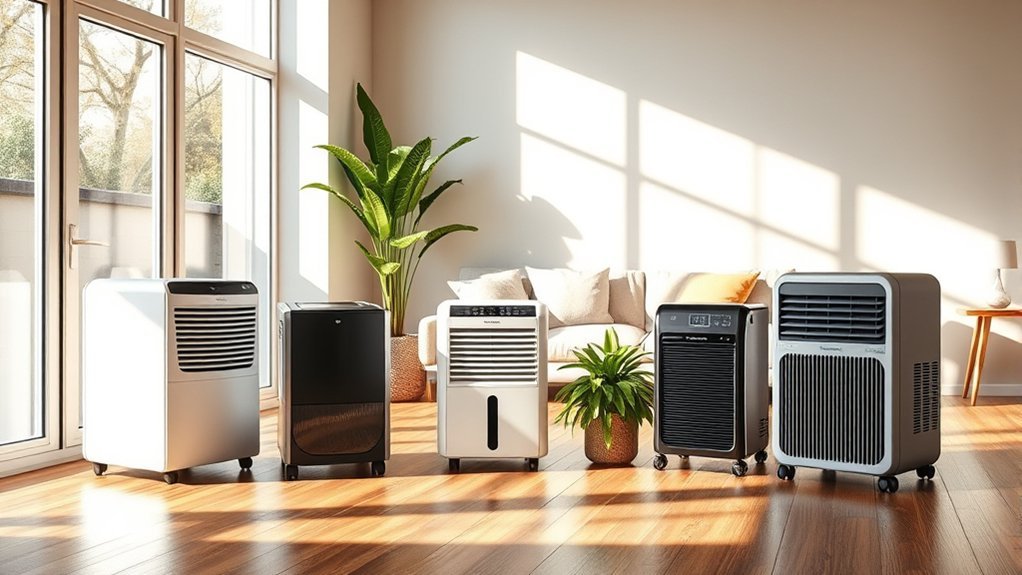
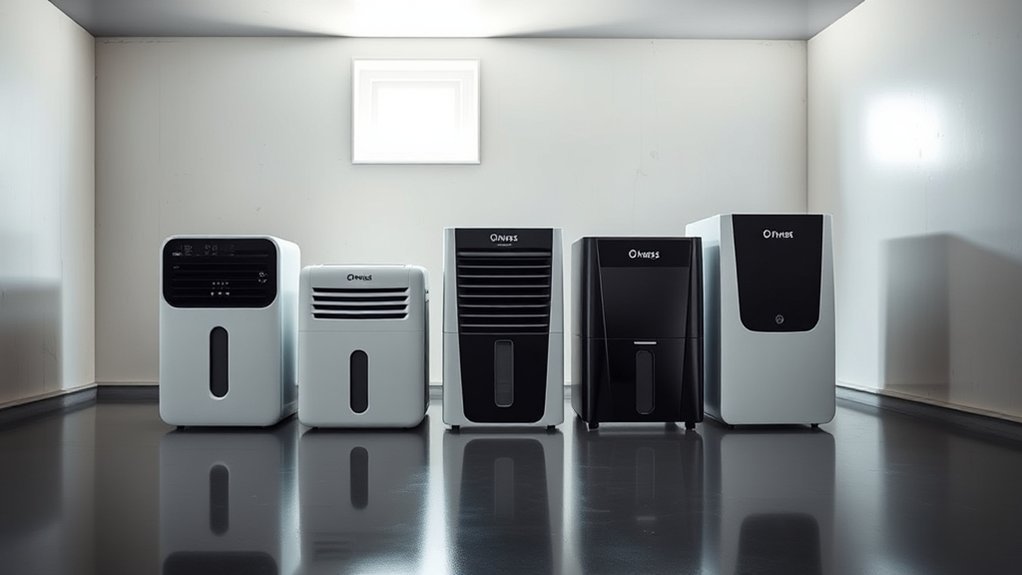
If you’re looking for the best dehumidifiers for unfinished basements in 2026, prioritize moisture-removal capacity, basement temperature, continuous drainage, and humidity control before advertised square-foot coverage. For a consistently damp unfinished basement, a compressor dehumidifier is usually the better fit because it can remove substantially more water per day than compact semiconductor units. In this guide, the strongest fits are VEAGASO for overall basement use, Vellgoo for larger or wetter spaces, BANABIE for a balanced 32-pint-class option, and PLUSCENT for smaller basement areas.
Affiliate Disclosure: This article contains Amazon affiliate links. If you buy through these links, we may earn a commission at no extra cost to you.
Quick Verdict: Choose the VEAGASO 34 Pint model if you want the best overall balance of drainage, humidity control, auto-defrost, and basement-focused features. Choose Vellgoo if you need more listed capacity for a larger or more humid basement. BANABIE is a practical mid-capacity alternative, while PLUSCENT is better suited to smaller unfinished basements where a compact compressor unit makes more sense.
Humidity target: The EPA recommends keeping indoor relative humidity below 60% and ideally between 30% and 50%, while ENERGY STAR generally considers 30% to 50% RH optimal for buildings. EPA humidity guidance · ENERGY STAR dehumidifier guidance
Quick Comparison Table
| Product | Best For | Listed Capacity / Coverage | Drainage Type | Amazon |
|---|---|---|---|---|
| VEAGASO 2500 Sq.Ft Dehumidifier with Drain Hose | Best overall for damp unfinished basements | Up to 34 pints/day under warm, high-humidity listing conditions; up to 2,500 sq. ft. listed | 2L tank or included drain hose | View Latest Deal on Amazon |
| Vellgoo 4,000 Sq.Ft 64 Pint Dehumidifier | Large or more humid unfinished basements | 64 pints/day and 4,000 sq. ft. listed in current product details | Tank, included hose, or compatible continuous-drain setup | Check Current Amazon Availability |
| BANABIE 2500 Sq.Ft 32 Pint Dehumidifier | Balanced mid-capacity basement use | 32 pints/day; up to 2,500 sq. ft. listed | Tank or drain hose | Check Price on Amazon |
| PLUSCENT 21 Pint Portable Dehumidifier for Home | Smaller unfinished basements and laundry areas | Up to 21 pints/day under warm, high-humidity listing conditions; up to 1,500 sq. ft. listed | 1.5L tank or gravity drain hose | Check Product Details on Amazon |
Before You Buy: For unfinished basements, check whether you have a nearby floor drain, sink, sump pit, or another safe gravity-drain route. Continuous drainage can save a lot of tank-emptying when humidity stays high.
Capacity warning: Do not compare marketing pint numbers as if every brand used the same conditions. ENERGY STAR explains that standardized portable-dehumidifier testing uses cooler conditions intended to better reflect basement use, while some product listings advertise higher maximum removal at much warmer, more humid conditions. ENERGY STAR testing and capacity guidance
Safety Note: A dehumidifier controls airborne moisture, but it does not repair leaks, foundation seepage, plumbing failures, or standing water. Fix active water intrusion first.
How We Evaluated These Basement Dehumidifiers
This roundup is based on current product-page checks where accessible, listed specifications, basement-use requirements, and EPA/ENERGY STAR moisture-control guidance. We prioritized models that better match unfinished-basement needs: meaningful daily moisture removal, continuous-drain support, humidity controls, auto-defrost or cold-condition support where listed, and practical tank or hose options.
Testing note: We did not complete hands-on lab testing of these models. Noise, long-term reliability, warranty service, and real-world water removal can vary by temperature, humidity, room layout, and seller configuration, so those points are presented as listing-based information rather than personal-test claims.
VEAGASO 2500 Sq.Ft Dehumidifier with Drain Hose
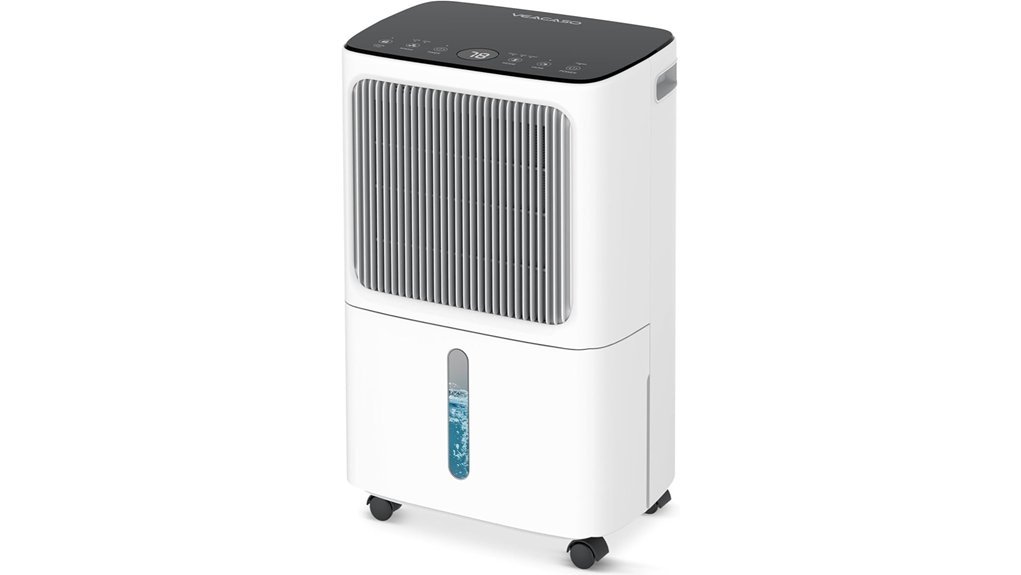
Best Overall: The VEAGASO 34 Pint model is the strongest all-around fit in this roundup for a typical damp unfinished basement. The current Amazon listing for ASIN B0BVZ62Y3M lists up to 34 pints per day under warm, high-humidity conditions, coverage up to 2,500 sq. ft., a 2L tank, an included drain hose, automatic defrost, a washable filter, power-failure memory, and a 24-hour timer.
The biggest basement advantage is the combination of continuous drainage and automatic humidity control. If you can route the hose downhill to a floor drain, sink, or sump area, the unit can run without repeated bucket emptying. The listing also states operation at up to 40dB in low-speed mode, although actual perceived noise will depend on placement and room acoustics.
Why You’ll Like It: It solves the two most common unfinished-basement hassles at once: persistent humidity and frequent tank emptying. The controls are simple enough for routine use, while the hose setup makes it more practical for unattended moisture control.
Who Should Buy This: Choose it for a medium to large unfinished basement that stays damp, especially if you have a reliable gravity-drain path and want auto-defrost plus humidity control.
Who Should Avoid This: Skip it if your basement is substantially larger than the listed coverage, regularly has standing water, or needs restoration-grade drying after flooding.
Price Positioning: Mid-capacity compressor option with a useful feature set for everyday basement moisture control.
One-Line Verdict: The best overall balance here for buyers who want a basement-focused compressor unit with continuous drainage and automatic controls.
Best For: Damp unfinished basements, laundry areas, large rooms, and buyers who want a drain hose included.
Pros:
- Up to 34 pints/day listed moisture removal for stronger basement duty than compact semiconductor units.
- Included drain hose, 2L tank, auto shut-off, and continuous mode reduce day-to-day maintenance.
- Automatic defrost, washable filter, timer, and power-failure memory are practical basement features.
Cons:
- The 34-pint figure is a warm/high-humidity listing maximum and should not be treated as directly comparable with every standardized pint rating.
- Gravity drainage still requires a drain point lower than the outlet unless you add a separate pump solution.
- A 2L tank can fill quickly in very humid conditions if you do not use the drain hose.
Vellgoo 4,000 Sq.Ft 64 Pint Dehumidifier
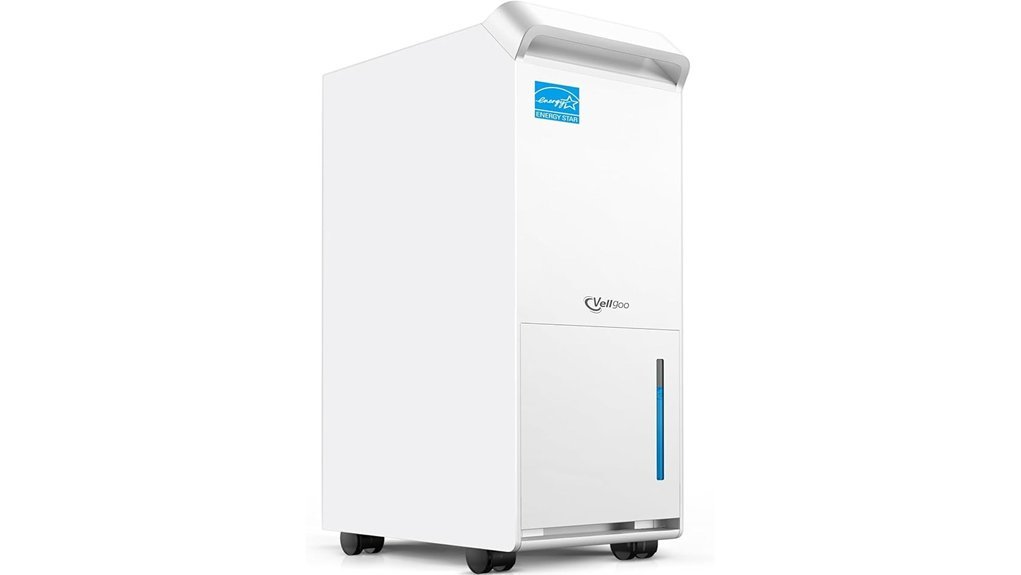
Best for Large Basements: For a larger or more humid unfinished basement, the Vellgoo linked under ASIN B0GD73QQ4M offers the highest listed capacity in this roundup. Current Amazon product details list a 4,000 sq. ft. floor area, 64-pint capacity, 5.5L tank, three speeds, a drain hose, humidity control, washable filter, 24-hour timer, and child lock.
Its larger tank and stronger listed moisture-removal figure make it a better candidate when a smaller 20- to 30-pint-class unit would spend too much time running. Current Amazon product details also describe the linked configuration as ENERGY STAR 2025 certified. Because product pages can contain multiple size options or updated variants, confirm the selected size on Amazon before ordering.
Why You’ll Like It: This is the higher-capacity choice for buyers who care more about moisture removal and continuous drainage than compact size. It is also easier to leave running in a basement when you can use the included drain hose.
Who Should Buy This: Choose it for a larger unfinished basement, garage, or persistently humid lower level where a higher-capacity portable dehumidifier makes sense.
Who Should Avoid This: Avoid it if you only need humidity control in a small basement room or do not have enough open floor space around the intake and exhaust.
Price Positioning: Higher-capacity option for larger spaces and heavier moisture loads.
One-Line Verdict: The strongest listed-capacity choice in this article for a large damp basement, with the usual caution that real performance depends on temperature and humidity.
Best For: Large unfinished basements, garages, and higher-humidity spaces where continuous drainage is preferred.
Pros:
- Current product details list 64-pint capacity and 4,000 sq. ft. coverage.
- 5.5L tank and included drain hose give you both manual and continuous-drain options.
- Humidity control, washable filter, timer, child lock, and multiple fan speeds improve day-to-day usability.
Cons:
- Larger footprint than compact models, so it needs more placement space and clear airflow.
- Product-page wording can vary across size options or updated configurations, so confirm the selected variant before purchase.
- Compressor noise may be noticeable below quiet bedrooms or offices, even if the basement itself is unfinished.
BANABIE 2500 Sq.Ft 32 Pint Dehumidifier
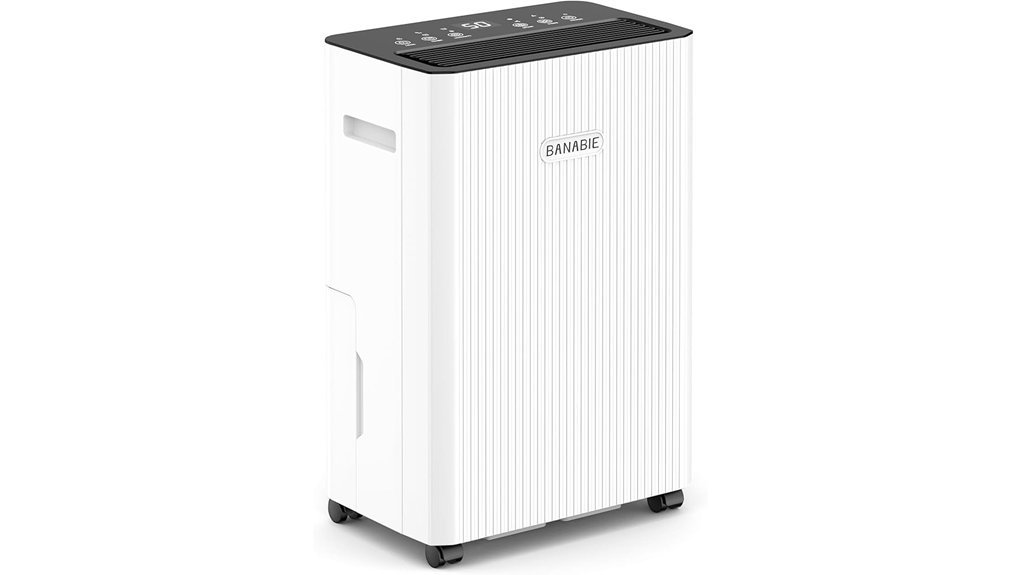
Best Balanced Alternative: The linked ASIN B0GLMCGSVV corresponds to the BANABIE PD8R-03QE, a rotary-compressor dehumidifier marketed for up to 2,500 sq. ft. and up to 32 pints of moisture removal per day. Listing data also describes a drain-hose option, smart humidity control, a 24-hour timer, two speeds, and a 0.66-gallon tank.
For an unfinished basement, its biggest value is the middle-ground combination of compressor-based moisture removal and continuous drainage without moving up to the larger Vellgoo. The 32dB figure shown in seller/listing data should be treated as a manufacturer or seller claim rather than an independently verified sound measurement.
Why You’ll Like It: It offers enough listed capacity to make sense for many medium basement spaces while still giving you automatic humidity control and hose drainage.
Who Should Buy This: Choose it if you want a mid-capacity compressor model for a medium basement and value a compact footprint relative to larger high-capacity units.
Who Should Avoid This: Skip it if your basement is very large, chronically wet, or you want a product with more easily verifiable current manufacturer documentation and support details.
Price Positioning: Mid-range compressor alternative between the smaller PLUSCENT and higher-capacity Vellgoo.
One-Line Verdict: A sensible mid-capacity basement option, but treat coverage and sound-level figures as listing claims and verify the current Amazon detail page before buying.
Best For: Medium unfinished basements where continuous drainage and automatic humidity control are priorities.
Pros:
- Listed 32-pint/day capacity gives it a more appropriate basement-use profile than low-output semiconductor models.
- Drain-hose support and humidity controls reduce manual maintenance.
- Rotary-compressor design is better aligned with sustained basement moisture removal.
Cons:
- Direct Amazon product data was less consistently accessible during this update than for the other retained models.
- Advertised 32dB operation should be treated as a listing claim, not an independently measured result.
- Coverage claims should not replace actual humidity measurements and moisture-load assessment.
PLUSCENT 21 Pint Portable Dehumidifier for Home
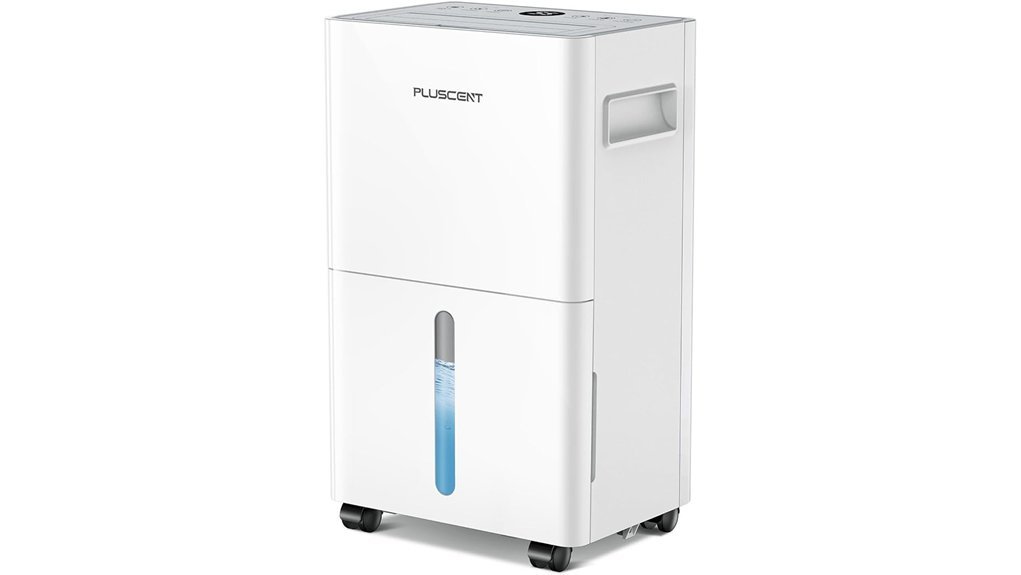
Best for Smaller Basements: The PLUSCENT model linked under ASIN B0FRG3SLC2 is a compact compressor dehumidifier listed for up to 1,500 sq. ft. and up to 21 pints of moisture removal per day under warm, very humid conditions. Current Amazon product details list a 1.5L tank, 160W power, continuous drainage, automatic defrost, automatic restart, adjustable humidity control, a washable filter, and a 24-hour timer.
This is the better choice when your unfinished basement is smaller and you do not need the capacity or footprint of the Vellgoo. The Amazon page describes the 21-pint number as a maximum under extreme or high-humidity test conditions, so use it as a marketing maximum rather than assuming it matches a standardized basement-condition rating.
Why You’ll Like It: It gives smaller-basement buyers compressor-based moisture removal, automatic defrost, and continuous drainage in a more compact package.
Who Should Buy This: Choose it for a smaller unfinished basement, laundry area, or lower-level room where humidity is persistent but not severe.
Who Should Avoid This: Avoid it for a very large or wet basement where a higher-capacity dehumidifier is more appropriate.
Price Positioning: Smaller compressor option for buyers who want basement-ready features without paying for excess capacity.
One-Line Verdict: The best compact compressor choice in this list for smaller basement spaces.
Best For: Small to medium basement areas, laundry rooms, and buyers who want auto-defrost plus a drain hose connection.
Pros:
- Compressor technology provides stronger moisture removal than the compact semiconductor units removed from this roundup.
- Automatic defrost, restart, timer, washable filter, and humidity control are useful for basement operation.
- 1.5L tank plus continuous drainage gives you a choice between manual and hose-based water removal.
Cons:
- Up to 21 pints/day is a warm/high-humidity maximum, so real basement output may be lower.
- The 1.5L tank is small for a damp basement if you do not use the drain hose.
- Not the best fit for large or severely damp unfinished basements.
Which Type of Dehumidifier Is Best for an Unfinished Basement?
For most unfinished basements, a compressor dehumidifier is the better starting point because basement moisture loads are often too high for small semiconductor units. Compressor models also more commonly offer continuous drainage, automatic humidity control, and defrost features that are useful in cooler lower-level spaces.
The key is to size by actual moisture conditions rather than marketing square footage alone. ENERGY STAR recommends choosing capacity based on both room size and how damp the space is, and it notes that it is generally better to oversize than undersize a portable dehumidifier. If the basement has active leaks, seepage, or standing water, fix the source first instead of relying on a dehumidifier alone. See ENERGY STAR sizing guidance
Factors to Consider When Choosing a Dehumidifier for an Unfinished Basement
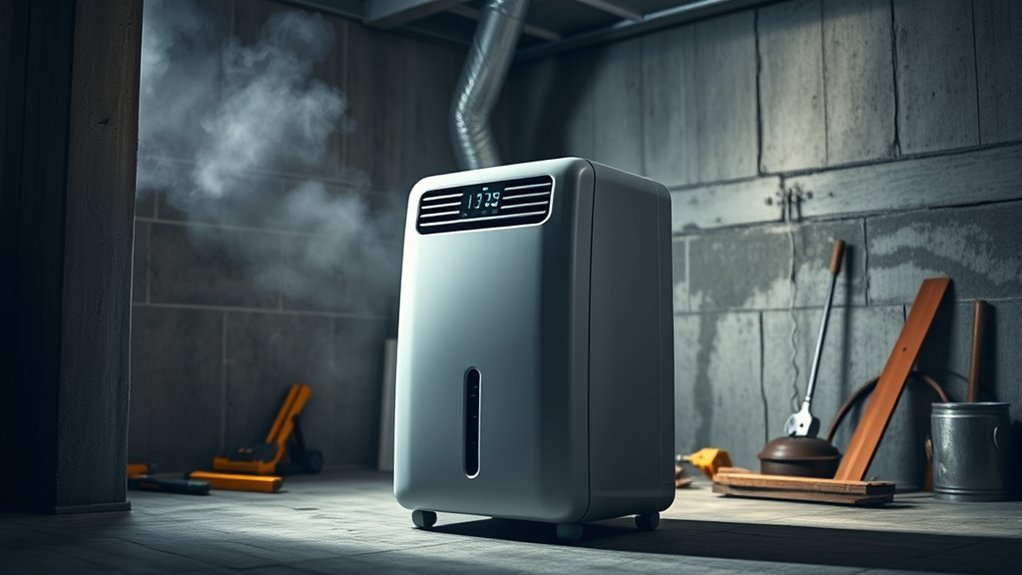
When choosing a dehumidifier for your unfinished basement, focus on daily moisture removal, room size, temperature, drainage, humidity controls, noise, and maintenance. Square-foot coverage is useful as a rough reference, but it should not be the only sizing metric.
Key Performance Metrics
Start with the basement’s measured relative humidity and how damp it feels. A room that is only mildly humid needs less capacity than a space with condensation, musty odors, damp concrete, or frequent laundry moisture. ENERGY STAR sizes portable dehumidifiers by both room area and dampness level, not floor area alone.
Also compare drainage, auto-defrost, humidistat controls, auto-restart, tank size, and filter access. Continuous drainage is especially valuable when the basement stays humid for long periods because it prevents the bucket from becoming the limiting factor.
Ideal Coverage Area
Measure the actual basement floor area, but treat the manufacturer’s coverage number as a ceiling rather than a guarantee. Open layouts, exterior-wall seepage, laundry equipment, poor airflow, and very high RH can all increase the moisture load.
If two models cover your square footage, favor the one with more credible daily moisture-removal capacity and better drainage for a damp unfinished basement. ENERGY STAR specifically notes that capacity depends on both room size and moisture conditions.
Drainage Options Available
Most portable dehumidifiers use a removable tank, a gravity drain hose, or both. A gravity hose is usually the easiest option in an unfinished basement if you have a floor drain, sink, or sump area that is lower than the unit’s drain outlet.
If the only drain point is higher than the dehumidifier, gravity drainage will not work by itself. In that case, choose a model with a built-in pump or use a separate compatible condensate-pump setup rather than routing the hose uphill.
Noise Level Considerations
Compressor dehumidifiers make fan and compressor noise, and manufacturer dB figures are not always measured the same way. Compare the stated sound level, fan-speed options, and where the unit will sit relative to bedrooms, offices, or living rooms above the basement.
Placing the unit on a level, solid surface and leaving clear airflow around it can also reduce vibration and prevent the fan from working harder than necessary.
Safety Features Required
Useful basement features include auto shut-off when the tank is full, auto-defrost for cooler conditions, power-failure memory or auto-restart, a washable filter, and a stable hose connection for continuous drainage. Follow the manufacturer’s clearance and electrical instructions, and do not use the appliance where it can contact standing water.
A dehumidifier does not replace leak repair, foundation drainage, sump maintenance, or flood cleanup. EPA guidance emphasizes moisture-source control, including fixing leaks and seepage, as the first step.
Before You Buy Checklist
- Measure the basement: Use the actual floor area instead of an estimate.
- Measure humidity: Check RH with a separate hygrometer for several days, especially during humid weather.
- Judge dampness: Note musty odors, condensation, damp concrete, laundry moisture, or recurring seepage.
- Plan drainage: Confirm whether a gravity hose can continuously slope to a safe drain.
- Check temperature: Cooler basements benefit from auto-defrost or clearly stated low-temperature operation.
- Protect stored items: Keep cardboard, fabric, tools, and wood away from damp walls and floors.
- Allow airflow: Leave the manufacturer-recommended clearance around the intake and exhaust.
- Recheck RH after setup: Adjust the humidistat based on measured humidity rather than running continuously without a target.
Pro Tip: Place the dehumidifier where air can circulate freely around the intake and exhaust. Avoid pushing it tightly against walls, stored boxes, or basement shelving.
Better Results: Close basement windows during humid weather, use continuous drainage when practical, clean the filter on schedule, and address seepage or plumbing leaks instead of asking the dehumidifier to compensate for an active water source.
Frequently Asked Questions
How Often Should I Empty the Dehumidifier’s Water Tank?
Empty it whenever the tank is full or close to full. In a damp basement, that may mean daily or even more often during humid weather. If frequent emptying is inconvenient, use a properly sloped continuous drain hose when the model supports one.
Can Dehumidifiers Help Prevent Mold Growth in Basements?
They can reduce the high-humidity conditions that support mold growth, but they do not fix the moisture source. EPA guidance recommends keeping indoor RH below 60% and ideally around 30% to 50%, while also repairing leaks, seepage, and other water problems.
What Is the Ideal Humidity Level for Basements?
A practical target is generally 30% to 50% RH, with indoor humidity kept below 60%. In colder weather, you may need a lower target to reduce condensation on cold surfaces.
Are There Energy-Efficient Models Available for Large Spaces?
Yes. ENERGY STAR certifies qualifying dehumidifiers, and proper sizing matters because an undersized unit may run for long periods without reaching the target humidity. Compare certified efficiency, capacity, and the actual dampness of your basement.
How Noisy Are These Dehumidifiers During Operation?
Noise varies by compressor, fan speed, cabinet design, and where the unit sits. Use manufacturer dB figures as a comparison point rather than a guarantee, and place the unit on a level surface away from rooms where vibration or fan noise would be distracting.
Is a Compressor or Semiconductor Dehumidifier Better for an Unfinished Basement?
For most damp unfinished basements, a compressor dehumidifier is the better fit because it offers much higher daily moisture removal and more basement-friendly drainage and control features. Small semiconductor models are better reserved for light moisture in small rooms, closets, RVs, or other low-load spaces.
Where Should I Place a Dehumidifier in an Unfinished Basement?
Place it on a flat, stable surface with the manufacturer-recommended airflow clearance. Keep stored boxes, curtains, and shelving away from the intake and exhaust. For gravity drainage, route the hose continuously downhill without kinks.
Will a Dehumidifier Cool an Unfinished Basement?
No. A dehumidifier is not an air conditioner. Lower humidity can make the space feel less clammy, but compressor dehumidifiers usually release some heat while operating.
Final Recommendation
Best overall: VEAGASO 2500 Sq.Ft is the most balanced choice here for a typical damp unfinished basement because it combines compressor-based moisture removal, automatic controls, auto-defrost, and an included drain hose.
Best for larger or wetter basements: Vellgoo 4,000 Sq.Ft 64 Pint offers the highest listed capacity in this roundup and is the better starting point when moisture load is heavier.
Best balanced alternative: BANABIE 2500 Sq.Ft 32 Pint fits medium spaces where you want compressor performance, humidity control, and hose drainage.
Best for smaller basements: PLUSCENT 21 Pint is the compact compressor pick for a smaller unfinished basement or laundry area.
Best buying move: Measure RH, confirm drainage, and compare daily moisture removal before relying on square-foot claims. If the basement has seepage or standing water, solve that source first.
Conclusion
The best dehumidifier for an unfinished basement is usually a compressor model that matches the room’s actual moisture load and can drain continuously. VEAGASO offers the best overall feature balance in this list, Vellgoo is the stronger choice for larger or more humid spaces, BANABIE is a practical mid-capacity alternative, and PLUSCENT fits smaller basements where a compact compressor unit is enough.
Whichever model you choose, use a hygrometer, keep the target humidity in a sensible range, allow proper airflow, clean the filter, and fix leaks or seepage rather than relying on dehumidification alone. Those steps matter more than chasing the largest advertised square-foot number.