Disclosure: As an Amazon Associate, we earn from qualifying purchases. If you click a link on this page and make a purchase, we may receive a small commission at no extra cost to you.
Choosing an air purifier for a large room gets confusing when coverage numbers, filtration claims, and “smart” features are described without context. The Coway Airmega 400 AP-2015F combines dual-sided filtration, automatic air-quality control, and a published noise range of 22 to 52 dB(A) in a substantial 24.7-pound unit. Its strongest case is powerful, hands-off filtration for large living areas, but it does not include the Wi-Fi or app controls found on the Airmega 400S. This review breaks down what you actually get, how the coverage figures should be interpreted, and who gets the most value from it.
Quick Verdict
Rating: 8.5/10
Best For: Large living rooms, open layouts, pet households, and buyers who want automatic filtration without relying on an app.
Bottom Line: The Airmega 400 offers strong airflow, dual-sided HEPA and activated-carbon filtration, quiet low-speed operation, and useful automatic modes. Its main tradeoffs are its large footprint, dual-filter replacement cost, and lack of Wi-Fi connectivity.
Key Takeaways
- The Coway Airmega 400 is model AP-2015F and uses two washable pre-filters plus two Max2 filter assemblies.
- Coway rates it for 3,120 square feet at 1 air change per hour or 1,560 square feet at 2 air changes per hour.
- Published CADR ratings are 328 for smoke, 328 for dust, and 400 for pollen.
- Noise is rated from 22 to 52 dB(A), while maximum power consumption is 66 watts.
- Smart Mode, Eco Mode, and Sleep Mode automate operation, but the Airmega 400 itself is not Wi-Fi or app enabled.
- The dual-filter layout suits large spaces well, but replacing two Max2 filters can cost more than maintaining a smaller single-filter purifier.
Key Specifications
| Specification | Detail |
|---|---|
| Brand | Coway |
| Model | Airmega 400, AP-2015F |
| Product Type | Large-room air purifier |
| Coverage | 3,120 ft² at 1 air change/hour; 1,560 ft² at 2 air changes/hour |
| CADR | 328 smoke, 328 dust, 400 pollen |
| Filtration | Washable pre-filter + Max2 filter set with activated carbon and HEPA filtration |
| Filter Layout | Two pre-filters and two Max2 filters |
| Filter Life | Approximately 6 to 12 months depending on use and air processed |
| Dimensions | 14.8 W × 22.8 H × 14.8 D inches |
| Weight | 24.7 lb |
| Noise | 22 to 52 dB(A) |
| Power Consumption | 66 W maximum |
| Airflow Settings | Sleep, Low, Medium, High |
| Automatic Modes | Auto, Eco, Sleep |
| Timer | 1, 4, or 8 hours |
| Wi-Fi / Mobile App | No |
| Air Quality Monitor | Real-time colored air-quality indicator |
| Certification | ENERGY STAR certified |
| Warranty | 5-year limited coverage for specified motor and electronic parts, subject to Coway warranty terms |
What Is the Coway Airmega 400?
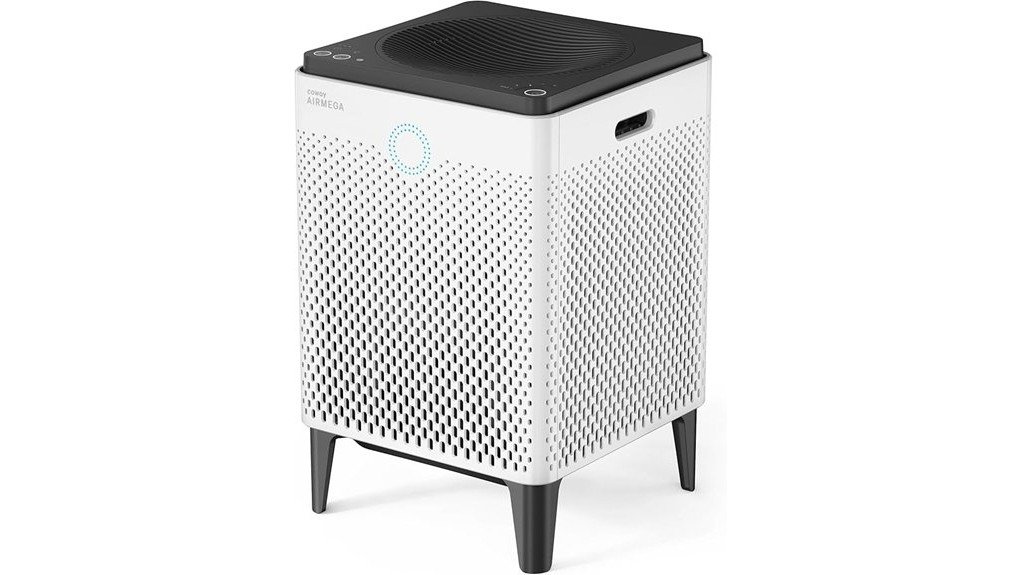
The Coway Airmega 400 is a large-room, floor-standing air purifier built around a dual-sided filtration system. Air enters through both sides, where washable pre-filters catch larger debris such as hair and dust before air passes through the Max2 filter assemblies.
Each Max2 assembly combines activated-carbon and HEPA filtration. This approach gives you particle filtration plus help with common household odors and airborne VOCs. The purifier also monitors air quality and can automatically change fan behavior instead of requiring constant manual adjustment.
The AP-2015F is the non-connected Airmega 400. The word “Smart” in its operating features refers to automatic sensor-based modes, not smartphone connectivity.
Before You Buy: Do not read the 3,120-square-foot coverage figure as identical performance in every room size. Coway associates that figure with one complete air change per hour. The published 1,560-square-foot figure corresponds to two air changes per hour, so larger spaces receive fewer complete air changes over the same period.
Who Should Buy It?
Best For
- Large living rooms, open layouts, and other spaces that benefit from high airflow.
- Homes with pets, dust, pollen, or recurring household odors.
- Buyers who want sensor-based automatic operation without depending on Wi-Fi or an app.
Skip If
- You specifically want remote app controls, schedules, or Wi-Fi connectivity.
- You only need to clean a small bedroom and would rather use a smaller purifier with lower replacement-filter costs.
- You do not have room for a 14.8-inch-square floor unit with air intakes on both sides.
Filtration and Air-Cleaning Performance
The Airmega 400’s main advantage is its dual-filter design. Two washable pre-filters catch larger debris before it reaches the two Max2 assemblies. The Max2 filters combine activated carbon with HEPA filtration, allowing the system to address both suspended particles and common odors.
Coway lists CADR ratings of 328 for smoke, 328 for dust, and 400 for pollen. Those figures make the purifier much better suited to large rooms than a compact desktop or small-bedroom purifier.
Coway also states that its current HyperCaptive filtration system can capture very small airborne particles under specified laboratory test conditions. In everyday use, your results will still depend on room size, airflow, doors, windows, pollution sources, fan speed, and how well the filters are maintained.
Large-Room Coverage Explained
The most useful way to understand coverage is by looking at air changes rather than one maximum floor-area number. Coway lists 3,120 square feet at one air change per hour and 1,560 square feet at two air changes per hour.
That means the purifier can move air through a very large open space, but you should choose your target room size based on how frequently you want the room’s air processed. A smaller room receives more frequent circulation than a room near the maximum published coverage.
Pro Tip: For faster cleanup after cooking, vacuuming, opening windows, or other short-term particle events, run a higher fan setting first. Once air quality improves, Auto or Eco Mode can take over.
Smart Modes and Controls
The Airmega 400 includes automatic features even though it does not connect to a phone. Its pollution sensor monitors indoor air quality and the LED indicator gives you visual feedback about current conditions.
Auto Mode
Auto Mode adjusts fan speed according to detected air quality. This is useful when pollution levels change throughout the day because you do not have to keep switching between Low, Medium, and High manually.
Eco Mode
Eco Mode is designed to reduce unnecessary fan operation when the room remains clean. If pollution is detected again, the purifier can resume operation.
Sleep Mode
Sleep Mode reduces disturbance when room conditions are dark and clean. The Airmega 400’s overall published sound range is 22 to 52 dB(A), so lower-speed operation is much easier to live with in bedrooms or quiet living spaces than full-speed operation.
No Wi-Fi on the AP-2015F
The Airmega 400 does not provide mobile-app control or remote scheduling. If those features matter to you, the closely related Airmega 400S is the model to compare.
Design and Everyday Usability
At 14.8 × 22.8 × 14.8 inches and 24.7 pounds, the Airmega 400 is substantial without being unusually tall. Its square footprint lets it sit against the visual flow of a room more easily than some wide tower designs, but you still need to give its side air intakes room to breathe.
The controls are located on the unit itself, and the real-time air-quality display gives you immediate feedback without opening an app. Filter indicators also help you track when the washable pre-filters need attention and when the Max2 filters are approaching replacement.
Filter Maintenance and Running Costs
The washable pre-filters are your first maintenance point. Cleaning them helps keep large particles, pet hair, and dust from loading the more expensive Max2 filters too quickly. Follow Coway’s cleaning instructions rather than washing components that are not designed to be washed.
Coway describes the Max2 filter lifespan as roughly 6 to 12 months, with actual replacement timing influenced by use and the amount of air processed. Because the Airmega 400 operates with two Max2 assemblies, filter replacement is a more meaningful ownership cost than it is on many smaller single-filter purifiers.
That cost is one of the clearest tradeoffs for the higher airflow and dual-sided filtration design.
Energy Efficiency and Noise Levels
The Airmega 400 has a listed maximum power consumption of 66 watts and is ENERGY STAR certified. Auto and Eco operation can reduce unnecessary high-speed running when the sensor detects cleaner conditions.
Its published sound range is 22 to 52 dB(A). The lowest end is suitable for quiet use, while the upper end is more noticeable when you need maximum airflow. That is a reasonable compromise for a purifier designed to move a larger volume of air.
How It Performs in Real Use
For a Large Living Room
This is where the Airmega 400 makes the most sense. Its dual intake, dual Max2 filters, and higher airflow can serve spaces where a small purifier would need to run at maximum speed constantly.
For Pet Households
The washable pre-filters can capture larger debris such as fur and dust before those particles reach the main filters. Activated carbon also adds odor control, although no purifier replaces normal cleaning, litter maintenance, or ventilation.
For Bedrooms and Nighttime Use
The 22 dB(A) low end of the published noise range and automatic Sleep Mode make nighttime use practical. However, the physical size may be unnecessary for a small bedroom unless you specifically want its higher airflow capacity.
For Cooking, Dust, and Temporary Pollution
Running a higher fan speed can help process airborne particles more quickly after cooking, vacuuming, or outdoor pollution enters through open doors and windows. Once conditions improve, you can return to Auto or Eco Mode instead of leaving the purifier on its highest setting.
Setup Tips for Better Results
- Remove all protective packaging from the filters before first use.
- Keep both side air intakes unobstructed so the dual-filter system can pull air freely.
- Avoid placing the purifier where curtains, furniture, or walls block major airflow paths.
- Use Auto Mode for everyday operation and higher fan settings when you need faster particle removal.
- Clean the washable pre-filters according to Coway’s instructions and watch the filter-life indicators.
- Do not treat the purifier as a substitute for ventilation, source control, a dehumidifier, or professional remediation when those are needed.
Compatibility and Safety
The Airmega 400 is a corded household air purifier designed for indoor air cleaning. Follow the Coway manual for filter installation, cleaning, electrical use, placement, and servicing.
An air purifier can reduce airborne particles and some odors, but it does not correct moisture problems, remove mold growing on building materials, repair combustion sources, or replace required ventilation. If you have a serious indoor-air-quality, smoke, mold, or building-safety problem, address the source as well as filtering the air.
Pros and Cons
Pros
- High airflow and coverage suited to large rooms and open layouts.
- Two washable pre-filters plus two Max2 HEPA and activated-carbon filter assemblies.
- Strong published CADR ratings, especially the 400 pollen CADR.
- Auto, Eco, and Sleep modes reduce how much manual adjustment you need.
- Quiet 22 dB(A) low-end operation and ENERGY STAR certification.
Cons
- No Wi-Fi or mobile-app control on the AP-2015F.
- Uses two Max2 filter assemblies, so replacement-filter costs can be significant.
- Large-room coverage numbers vary substantially depending on the target air-change rate.
Is It Worth the Price?
The Airmega 400 sits in the premium end of the residential air-purifier market. What you are paying for is not an app or elaborate connectivity. The value comes from high airflow, dual filters, large-room capability, automatic air-quality control, relatively quiet low-speed operation, and a substantial five-year limited warranty on specified motor and electronic components.
It offers the strongest value when you genuinely need to clean a large room or open layout. If you only need a purifier for a compact bedroom, paying for this much airflow and replacing two Max2 filters may not make financial sense.
It is also not the best fit if app control is high on your priority list. In that case, the 400S provides a more direct upgrade path.
How It Compares to Alternatives
The Coway Airmega 400S is the closest alternative. It offers the same general large-room platform but adds Wi-Fi, mobile-app integration, scheduling, and connected controls. Choose the 400S if remote control matters enough to justify moving to the connected model.
The Coway Airmega 300 is worth comparing for smaller spaces. It uses a similar automatic-mode concept but has lower airflow and lower published room coverage. The Airmega 400 makes more sense when you want the stronger large-room performance and do not need app connectivity.
Frequently Asked Questions
How large of a room can the Coway Airmega 400 handle?
Coway lists coverage of 3,120 square feet at one air change per hour and 1,560 square feet at two air changes per hour. Choose a room size based on how frequently you want the room’s air processed, not just the largest number on the specification sheet.
Does the Airmega 400 have Wi-Fi or app control?
No. The AP-2015F Airmega 400 has automatic Smart, Eco, and Sleep modes but is not Wi-Fi or app enabled. The Airmega 400S is the connected version to consider if you want mobile control.
How often should I replace the Airmega 400 filters?
Coway describes the Max2 filter lifespan as roughly 6 to 12 months, depending on use and air processed. The purifier includes filter-life indicators, so use those along with the maintenance instructions rather than replacing filters only by calendar date.
Can I wash the filters?
The pre-filters are washable. The Max2 filter assemblies are replacement filters, so follow Coway’s maintenance instructions and do not wash filter components that are not designed for washing.
Is the Coway Airmega 400 quiet enough for a bedroom?
Its published sound range is 22 to 52 dB(A), so low-speed operation can be quite quiet. Sleep Mode is also designed to reduce disturbance, although high-speed operation will be more noticeable.
Can I use the Airmega 400 in a basement?
You can use it for airborne particle and odor filtration in a suitable indoor basement space. It does not remove excess moisture like a dehumidifier, so humidity, leaks, or active mold growth need to be addressed separately.
Does the Coway Airmega 400 produce ozone?
ENERGY STAR certification data for the AP-2015F lists its technology as fan-and-filter purification and reports 0.0 ppb ozone emissions under the certification data. The unit relies on mechanical filtration rather than an ozone-generating cleaning process.
Who should skip the Airmega 400?
Skip it if you only need a small-room purifier, have very limited floor space, or specifically want Wi-Fi and mobile-app controls. A smaller Coway model or the connected Airmega 400S may fit those needs better.
The Bottom Line
The Coway Airmega 400 AP-2015F is a strong choice when you need substantial airflow, dual HEPA and activated-carbon filtration, automatic air-quality control, and quiet low-speed operation in a large room. It earns an 8.5/10 recommendation for that use, but buyers who want Wi-Fi controls, a smaller footprint, or lower filter-replacement costs should compare other models first.