LiDAR in a robot vacuum is a laser-based sensing system that measures distance and builds an internal map of the home. It helps the machine recognize walls, furniture, and open paths with high precision, even in dim light. That capability changes how the vacuum moves, plans routes, and avoids repeated coverage. The real question is how this technology compares with other navigation methods, and why that difference matters indoors.
What Is LiDAR in a Robot Vacuum?
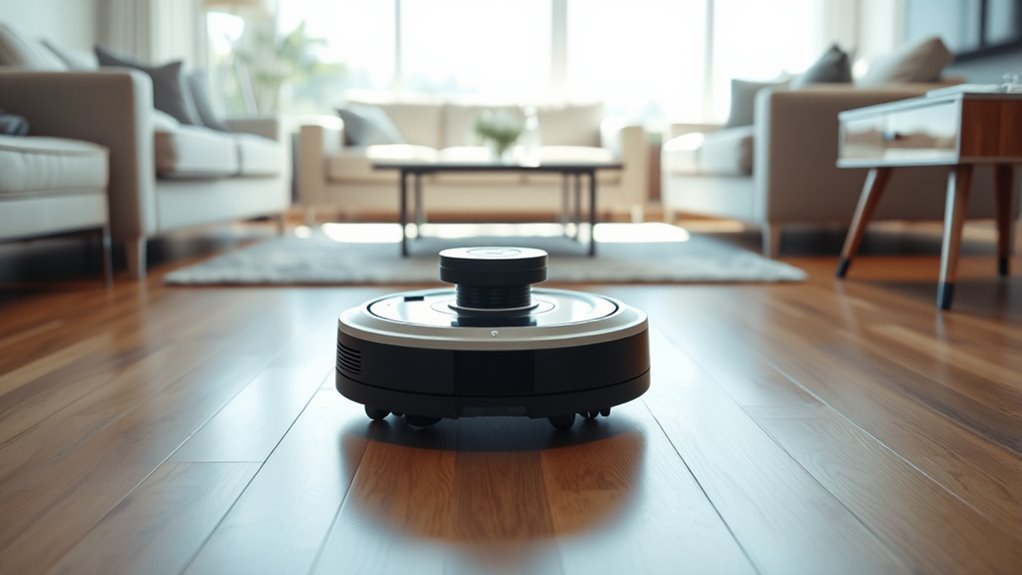
LiDAR in a robot vacuum refers to a Light Detection and Ranging system that uses laser pulses to measure distances and build a precise 3D map of the surrounding space.
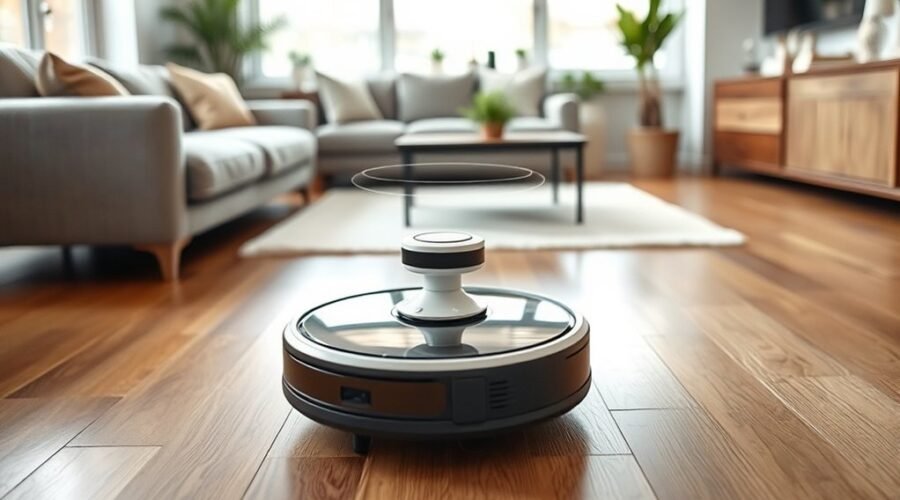
In practice, a spinning turret emits laser pulses several times per second, allowing the robot vacuum to continuously assess its environment and support navigation with high accuracy. The system functions in low light and darkness, which frees cleaning schedules from dependence on illumination.
It detects obstacles as small as 2 centimeters, improving obstacle avoidance in cramped or irregular rooms. By recording the home layout, LiDAR enables the robot to remember spatial boundaries and establish no-go zones for targeted cleaning.
It detects obstacles as small as 2 centimeters, improving avoidance and helping the robot remember boundaries and no-go zones.
The resulting map is internal, operational, and optimized for movement efficiency. This combination of sensing, mapping, and control gives the machine disciplined autonomy, reducing collisions and helping it clean with consistent precision across complex domestic spaces.
How LiDAR Maps Your Home
LiDAR maps a home by emitting rapid laser scans that measure room geometry and obstacle positions from reflected returns.
Its time-of-flight calculations convert pulse return intervals into precise spatial coordinates, producing a continuously updated layout in real time.
These maps are retained in memory, allowing the robot vacuum to reuse routes, avoid no-go zones, and adjust to changes in the environment.
Laser Scans Room Layout
Using laser pulses and a rotating 360-degree sensor, the system measures distances to surrounding objects and converts those readings into a precise room map, typically accurate to within 2 to 5 centimeters.
LiDAR builds a map of your home for navigation systems that shape cleaning paths with minimal waste.
- walls, sofas, and table legs traced in crisp outlines
- open corridors distinguished from tight passages
- obstacle detection around chairs, toys, and cables
- complex layouts stored for repeat runs
- low-light conditions handled for smart cleaning
During an initial pass, the vacuum learns geometry, then repeats optimized routes without hesitation. The result is controlled movement, fewer collisions, and more autonomous coverage.
Time Of Flight Mapping
A stream of laser pulses provides the vacuum’s spatial reference by applying the Time of Flight principle: each pulse is emitted, reflected from nearby surfaces, and timed on return to calculate distance with high precision. LiDAR converts these measurements into mapping data, building 3D mapping from walls, furniture, and open floor space. Continuous scanning, often several rotations per second, refreshes obstacle detection in real time. Environmental adaptability follows naturally: darkness or variable lighting does not degrade laser pulses or distance calculation.
| Function | Effect |
|---|---|
| Time of Flight | precise range sensing |
| 3D mapping | room geometry recovery |
| Continuous scanning | live obstacle detection |
| Persistent memory | stored map retention |
This persistent memory supports repeated cleaning without dependence on light, allowing the system to navigate with disciplined efficiency and practical autonomy.
Persistent Maps And Routes
Persistent mapping allows a robot vacuum to retain a navigable model of the home after each scan cycle, so the system can reuse spatial data during later cleaning sessions.
LiDAR emits laser pulses across the home environment, building detailed maps with accuracy near 2 to 5 centimeters. Those persistent maps support navigation, cleaning paths, and obstacle detection, even in low light, giving robot vacuums reliable freedom of movement.
- hallways traced in clean geometric lines
- furniture edges stored as stable coordinates
- no-go zones marked around fragile items
- routes adjusted around chairs and cords
- repeated scans refining coverage over time
How LiDAR Improves Navigation
LiDAR improves robot vacuum navigation by emitting laser pulses to generate precise 3D maps of interior spaces, enabling the machine to plan efficient cleaning routes and avoid obstacles with millimeter-level sensing and typical positional accuracy within 2 to 5 centimeters. In robot vacuums, this distance measurement produces accurate maps of home layouts, including tight corridors and open rooms.
| Capability | Technical effect | User result |
|---|---|---|
| Laser scanning | Rapid environment modeling | Better navigation |
| Obstacle sensing | Millimeter-level detection | Fewer collisions |
| Low-light operation | Reliable mapping at night | Unrestricted cleaning |
| Route memory | Stored floor plans | Consistent cleaning routes |
| Elevation detection | Recognition of steps | Safer multi-floor homes |
This continual scanning supports autonomous path correction, preserves coverage efficiency, and lets the device maintain no-go zones without manual reprogramming. Because LiDAR functions in low-light conditions, cleaning remains effective after dark. By recognizing elevation changes, the system supports multi-floor homes while reducing risk. The result is disciplined, liberated cleaning behavior.
LiDAR vs. vSLAM in Robot Vacuums
Compared with camera-based navigation, LiDAR and vSLAM represent two distinct approaches to robot vacuum mapping and control. LiDAR emits laser pulses to build precise maps, giving robot vacuums accuracy near ±2-5 cm. vSLAM uses camera images and visual features, which can speed navigation but weakens depth perception in cluttered rooms.
- A laser ring tracing walls in darkness
- A camera lens tracking chair legs and edges
- A grid map forming around complex spaces
- A budget model moving quickly through open floors
- A premium unit holding a steadier path
Under varying lighting conditions, LiDAR remains reliable, while vSLAM depends on illumination to read features correctly. That technical difference shapes mapping quality, especially in complex spaces where misread objects can disrupt routes.
The cost comparison is equally clear: LiDAR-equipped robot vacuums usually command higher prices because of their precision hardware, while vSLAM models are often cheaper and more accessible. For consumers seeking liberated movement from manual cleaning, the tradeoff is speed versus certainty.
When LiDAR Works Best at Home
LiDAR performs especially well in low-light conditions, where its navigation remains accurate without dependence on ambient illumination.
It also supports efficient routing in large, complex floorplans by generating detailed spatial maps and maintaining 2 to 5 centimeter positioning precision.
These conditions improve obstacle avoidance and reduce missed coverage during cleaning cycles.
Low-Light Navigation
In low-light or fully dark environments, the laser-based sensing used in robot vacuums remains highly effective because it does not depend on ambient illumination to perceive surroundings.
LiDAR technology supports precise navigation through low light by emitting laser pulses that build 3D maps with high mapping accuracy. This enables reliable obstacle detection and stable cleaning paths, even in cluttered rooms.
- Dim hallway
- Dark bedroom corner
- Chair legs in silhouette
- Doorway threshold
- Quiet nighttime sweep
For homes with complex layouts, the continuous scan helps preserve efficient cleaning without camera dependence.
The result is liberated scheduling: cleaning can occur at night or in dim rooms while the system maintains control, avoids collisions, and tracks space geometry with consistent analytical precision.
Large, Complex Floorplans
Large, complex floorplans are where LiDAR often shows its greatest practical advantage at home.
LiDAR scans large complex floor plans and builds detailed 3D maps that represent rooms, furniture, and passages with strong precision. That spatial model supports navigation through intricate layouts, including tight corners and crowded zones, while helping the robot avoid obstacles.
Because it works in low-light conditions, coverage remains consistent across expansive spaces where illumination varies. The system also remembers the map, enabling efficient cleaning paths that reduce missed areas and unnecessary repetition.
In multi-level homes, LiDAR can detect elevation changes, improving safety near stairs and floor shifts. For occupants seeking greater autonomy from manual cleaning, this capability translates into reliable, structured movement across demanding interiors.
What LiDAR Features Matter Most
Several LiDAR capabilities determine whether a robot vacuum navigates well or merely moves systematically. In practice, the most valuable metrics are scan precision, obstacle detection, mapping persistence, and low-light resilience. A LiDAR unit that measures within 2 to 5 centimeters gives the robot vacuum enough accuracy for disciplined navigation and broader cleaning coverage in a smart home.
- A spinning turret sends laser pulses five times per second, sketching room edges.
- Fine 3D mapping reveals chair legs, table bases, and narrow passages.
- Low-light conditions do not degrade sensing, so night runs remain reliable.
- Persistent maps preserve layouts, freeing future sessions from repeated discovery.
- AI technology refines obstacle recognition in cluttered zones.
When these features work together, the machine can hold room structure in memory, set no-go zones, and adapt routes with analytical restraint. That combination turns autonomous cleaning into a controlled system rather than a random patrol, granting users more usable time and less household friction.
Frequently Asked Questions
Is Lidar Better for Robot Vacuums?
Yes, LiDAR technology is often better for robot vacuums, improving robot navigation, mapping accuracy, obstacle detection, and cleaning efficiency. Compared with camera systems, cost comparison, battery consumption, maintenance requirements, user experience, and brand comparisons vary.
What Are the Downsides of Using Lidar?
Downsides include LiDAR accuracy limits, cost implications, maintenance challenges, mapping limitations, battery consumption, surface compatibility issues, weaker obstacle detection, data privacy concerns, integration complexity, and occasional user experience tradeoffs, especially under bright or reflective conditions.
What Are the Downsides of Using a Robotic Vacuum Cleaner?
In summary, robotic vacuum cleaners often face limits in robot vacuum performance, battery life, navigation accuracy, maintenance costs, carpet cleaning, pet hair, noise levels, suction power, floor types, and user experience, despite convenience.
Which Lidar Robot Vacuum Is the Best?
DEEBOT X9 PRO OMNI appears best overall, balancing LiDAR technology, Robot vacuum features, Mapping accuracy, Navigation efficiency, Obstacle detection, Battery life, User reviews, Maintenance tips, Brand comparisons, and a premium Price range.
Conclusion
To summarize, LiDAR gives a robot vacuum a measured awareness of its surroundings, converting reflected laser pulses into accurate maps and cleaner routes. The coincidence is useful: the more ordinary a home looks to a person, the more data-rich it becomes to the machine. That alignment of simplicity for the user and precision for the device explains its value. In low light, around obstacles, and across repeated runs, LiDAR consistently supports efficient, reliable cleaning.