
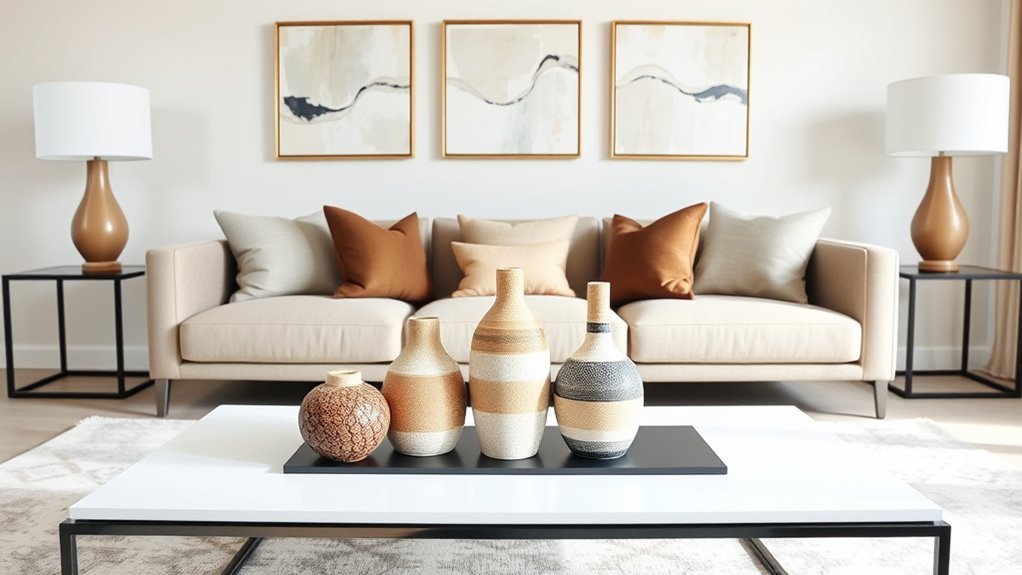
Walking into a room that feels effortlessly pulled together rarely comes down to expensive furniture. Often, the difference is the Rule of Three in decorating, a classic styling guideline that groups objects, colors, textures, or lighting in odd-numbered clusters so surfaces feel balanced rather than stiff. Whether your coffee table looks cluttered or your bookshelves feel like a rigid showroom display, arranging related pieces into a clear visual trio gives your eyes a natural path to follow. Treat the principle as a flexible editing tool rather than a strict law, and you can restyle most surfaces in minutes using decor you already own.
Quick Answer
The Rule of Three in decorating is a styling principle that arranges objects, colors, textures, or lighting in groups of three to create asymmetric balance and visual interest. Build a trio with one dominant anchor piece and two smaller supporting items that vary in height, shape, and texture while sharing a unifying color or material.
At a Glance
| Time Required | 15–30 minutes for one shelf, table, or sofa; 1–2 hours for a full room refresh |
| Difficulty | Beginner-friendly |
| Tools Needed | Decor you already own, a phone camera, an optional tape measure, and a tray or book stack |
| Cost | $0 if you shop your own home; optional cost only if adding a missing accent piece |
What Is the Rule of Three in Decorating?
The Rule of Three in decorating is an interior styling principle built around grouping related visual elements in threes—or larger odd numbers like five and seven—so an arrangement feels dynamic and complete. While two matching objects create formal mirror symmetry, three items form the smallest number needed to establish a recognizable pattern and a relaxed visual triangle. Current designer guidance from Real Simple treats the Rule of Three as a flexible composition tool rather than a rigid formula.
The number three alone does not make an arrangement work. Three identical jars lined up like tin soldiers look flat because they compete equally for attention. A successful trio pairs contrast with connection: the pieces share a common thread (such as warm earth tones or natural textures) while differing noticeably in height, footprint, or shape.
Three Ways Designers Apply the Rule
You can apply the concept across three distinct scales in a room:
- Surface vignettes: Grouping three decor pieces—such as a tall ceramic vase, a medium framed print, and a low sculptural bowl—on a coffee table, nightstand, or shelf.
- Architectural and furniture zones: Hanging three pendant lights over a kitchen island, arranging three framed prints in a row, or pairing a reading chair, side table, and floor lamp.
- Room-wide ratios: Balancing three main colors (the 60-30-10 palette), three contrasting textures (such as linen, oak, and matte black metal), or three layers of lighting.
How to Use the Rule of Three in Your Home
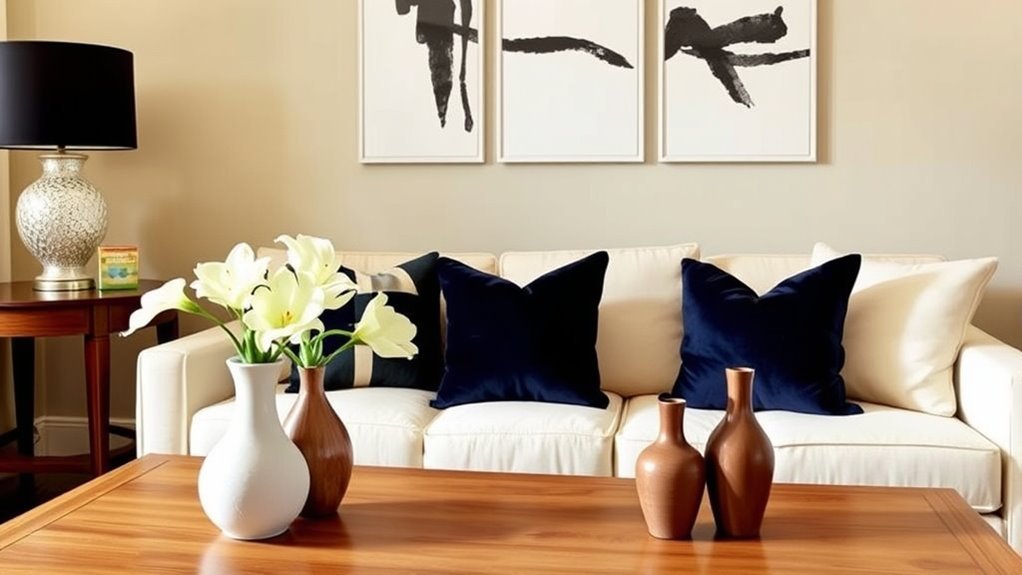
To use the Rule of Three effectively, treat each grouping like a small visual pyramid where one piece leads and two pieces support it. Follow a step-by-step height and spacing progression so your eye travels smoothly from the tallest point down to the lowest detail without getting stuck on a flat horizon line.
- Clear the surface completely. Remove everything from the table, mantel, or shelf section first so existing clutter does not crowd your new arrangement.
- Place one dominant anchor piece. Choose the tallest or visually heaviest item first, such as a leafy plant, table lamp, tall vase with branches, or upright framed print.
- Add a medium supporting piece at two-thirds height. Pick an object that reaches roughly half to two-thirds the height of your anchor and connects by color, material, or mood, such as a ceramic candle beside a stoneware pitcher.
- Finish with a low, tactile accent. Complete the trio with a piece under one-third the height of the anchor, such as a shallow catchall dish, decorative box, stone coasters, or a small object resting on a horizontal stack of books.
- Arrange the footprints in a loose triangle. Offset the three items so one sits toward the back, one sits slightly to the side, and the smallest piece sits closer to the front edge.
- Tighten the gap to 1 to 3 inches. Keep tabletop objects within 1 to 3 inches of one another—or slightly overlapping in sightline—while leaving at least 30% to 50% of the surrounding surface open as breathing room.
- Step back 10 feet and take a phone photo. Looking at a quick two-dimensional photo on your screen immediately exposes awkward gaps, lopsided weight, or shapes that look too repetitive.
Pro Tip: Count visual units rather than every physical item. A horizontal stack of two or three books reads as a single base, a vase holding five eucalyptus stems counts as one vertical anchor, and a woven tray acts as a frame that binds loose items into one cohesive vignette.
Recommended Products

- TOUCH OF BEAUTY: Elegantly contoured with an exquisite crackled mosaic design, this set of two candle holders makes for perfect brown table decorations and blends beautifully with any home decor. ★Candles and other decor accents shown are not included★
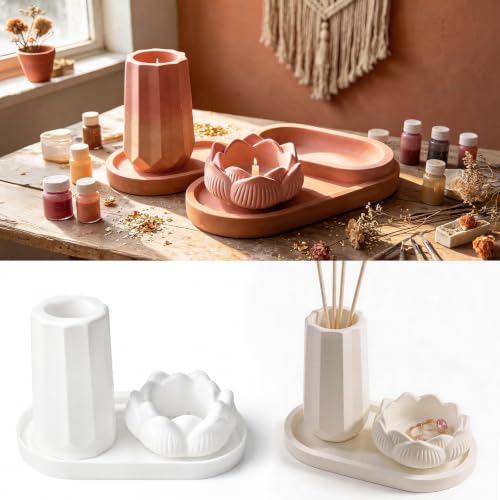
【3 PCS MULTI-FUNCTION MOLD SET】Includes lotus candle holder mold, candle jar mold and resin tray mold; three distinct shapes to meet diverse DIY crafting needs in one purchase

All-in-one Farmhouse Centerpiece Set: skip the hassle of buying pieces separately; This complete decor set includes a wooden tray, 3 pillar candles, a ceramic vase, and faux flower arrangement; Everything you need to create a beautifully styled centerpiece in seconds
Rule of Three Quick Formulas by Room
Each surface in your home has different sightlines and functional needs, so a coffee table trio requires a lower profile than a hallway console arrangement. Use these room-by-room formulas to style unfinished surfaces using items you already own, then adjust spacing based on how you use the furniture daily.
| Area | Easy Trio (High + Medium + Low) | Why It Works | Quick Adjustment |
|---|---|---|---|
| Coffee table | Vase with greenery, stack of 2–3 books, low ceramic bowl | Combines organic height, crisp rectangular lines, and a curved catchall. | Anchor the trio inside a tray if pieces look lost on a large table. |
| Open shelf | Leaning 8×10 frame, trailing small plant, lidded box | The frame builds vertical height, the foliage softens edges, and the box adds weight. | Leave at least one-third of the shelf empty on one side. |
| Sofa corner | 22-inch solid pillow, 20-inch patterned pillow, 12×20-inch textured lumbar | Each cushion has a distinct size and visual job without overwhelming the seat. | Repeat one shared accent shade across all three fabrics. |
| Nightstand | Table lamp, hardcover book with water carafe, small ring dish | Balances bedtime task lighting and daily function with a clean footprint. | Keep the ring dish toward the front corner for easy reach. |
| Dining table | Three graduated candlesticks, or low floral vessel plus two votives | Creates central rhythm down the table while leaving room for serving dishes. | Keep centerpieces under 12 inches tall during meals so guests can see across. |
| Entryway console | Wall mirror or art, tall buffet lamp, catchall bowl for keys | Welcomes guests with height, warm illumination, and an immediate drop zone. | Tuck a pair of woven ottomans underneath if the lower space looks bare. |
Pro Tip: Run the 30-Second Trio Test before buying anything new. Ask three questions: Can you immediately tell which piece is the anchor? Do at least two pieces differ in height and texture? Is there enough empty space around the group to read it as one vignette? If any answer is no, adjust spacing or swap one item from another room.
Recommended Products

🌷LIGHT UP YOUR HOME WITH TAPER CANDLE HOLDERS : The elegant & beautiful candlestick holders set of 2 black taper candle holders will make it a magnificent addition to any living space. The craftsmanship of black candle holders piece will add class to usability. Housewarming gift for Women & Men.

ELEGANT DESIGN: SET of 3. These candlestick holders are sold in pack of assorted size. They are golden Brass color with a brushed metal design, vintage & modern feel. They are slender, hourglass shape, heavy and with a good weight.

Premium Quality Candle Holders: Crafted from solid aluminum alloy, our taper candle holders boast a durable, rust-proof, and corrosion-resistant design. The exquisite electroplated finish of sets them apart them from hollow metal alternative candle stick candle holders, ensuring a long-lasting and elegant presence in your home decor.
Rule of Three Ideas for Color, Shelves, and Pillows
Once you are comfortable grouping tabletop objects, you can scale the same principle up to color palettes, bookcase layouts, and soft textiles. Starting on a single shelf or sofa corner lets you test combinations quickly before you commit to painting walls or rearranging a full room. You can also use these formulas when you display sentimental items alongside everyday accessories.
| Grouping | Color & Material Mix | Best Placement |
|---|---|---|
| Tall stoneware vase, medium glass candle, low wooden bowl | Warm neutrals with matte clay, clear glass, and natural wood grain | Coffee table or entryway console |
| Three stacked books topped with one sculptural object | Linen spines in earth tones, black and white, or muted coastal hues | Bookshelves, side tables, or nightstand |
| Three taper or pillar candles in staggered heights | Coordinating brass, matte black, or ribbed glass holders | Dining table runner or fireplace mantel |
| Three throw pillows in graduated dimensions | One solid linen, one geometric or botanical print, one bouclé or knit | Sofa corner, sectional, or bed headboard |
Recommended Products

Get Ready To Impress: Transform your space into a realm of sophistication with these realistic decor books! The lovely coffee table books are destined to steal the spotlight as coffee table decor or bookshelf decor, leaving your guests in awe of your aesthetic taste

📚Elevate Your Space Instantly:Upgrade your home with this set of 8 decorative books, designed to bring a clean, modern aesthetic to any space. Perfect as coffee table decor, bookshelf decor, or living room accents, these faux books create a curated, designer-inspired look in seconds.

Modern Wicker Storage Basket – This modern wicker storage basket offers strong, stylish organization and storage throughout your home using premium woven construction. These baskets could easily adapt into any room as home decor or be used as storage bins.
Color Palettes and the 60-30-10 Rule
For room color, the Rule of Three pairs naturally with the 60-30-10 color rule, which divides a room into roughly 60% dominant color (walls, large area rugs, and primary sofa), 30% secondary color (drapery, accent chairs, and wood tones), and 10% accent color (throw pillows, artwork, and vases). Even if you prefer a neutral room, you can apply that same three-part split to textures—such as 60% smooth plaster and cotton, 30% warm oak and woven rattan, and 10% brushed brass or black iron. For a complete step-by-step palette workflow, see our guide to building a living room color scheme.
Bookcases and the Zigzag Shelf Method
Styling an entire bookcase does not mean placing three separate trinkets on every single shelf, which quickly looks repetitive. Instead, alternate visual weight down the unit: place a three-piece cluster on the left side of the top shelf balanced by a single horizontal book stack on the right, then reverse that layout on the shelf below. This creates a relaxed diagonal zigzag that guides the eye from top to bottom.
Note: The Rule of Three does not require every object in your home to sit in a literal group of three. It can just as easily mean repeating three core materials, layering three light sources, or balancing three furniture pieces in one seating zone.
Examples of the Rule of Three in Decor
Moving beyond small tabletop clusters lets you use trios to solve layout, lighting, and wall-spacing problems across the house. The seven applications below show how designers use groups of three to anchor everything from kitchen islands to bare walls and front porches.
A strong trio combines contrast and connection: one element leads, while the other two support the composition without competing for equal attention.
- Tabletop centerpieces: Group three vessels of staggered heights filled with fresh stems, dried branches, or greenery. Keep one detail consistent—such as matching matte ceramic glazes or a single flower variety—so the cluster reads as a unified centerpiece.
- Open shelving vignettes: Pair a leaning framed photo, a trailing pothos plant, and a solid stone or wood object on one shelf section. Leave open negative space beside the cluster so the eye has a place to rest.
- Sofa and bed pillows: Layer one 22-inch solid square pillow in back, one 20-inch patterned pillow in the middle, and a smaller textured lumbar cushion in front. If your pattern includes three colors, pull the solid and textured pillows from two of those shades.
- Three-part room palettes: Anchor a space with a dominant base, a supporting tone, and a crisp contrast—such as warm alabaster walls, natural white oak furniture, and matte black hardware.
- Wall art triptychs: Hang three identically sized frames in a horizontal row above a sofa or bed, or stack three smaller prints vertically on a narrow hallway wall. Space the frames 2 to 4 inches apart so your eye perceives the trio as one cohesive artwork rather than three isolated pictures.
- Layered room lighting: Combine three distinct light sources—overhead fixtures, reading lamps, and directional spotlights—following U.S. Department of Energy lighting guidelines for balancing ambient, task, and accent illumination. You can also hang three pendant lights evenly across a kitchen island.
- Furniture and outdoor groupings: Carve out a reading nook with three functional pieces: an armchair, a small drink table, and an arc floor lamp. Outdoors, group three weatherproof planters of graduated heights beside your front door, or plant one large container using the classic “thriller, filler, spiller” trio (one tall upright plant, one bushy mid-level plant, and one trailing vine).
Why the Rule of Three Enhances Visual Appeal
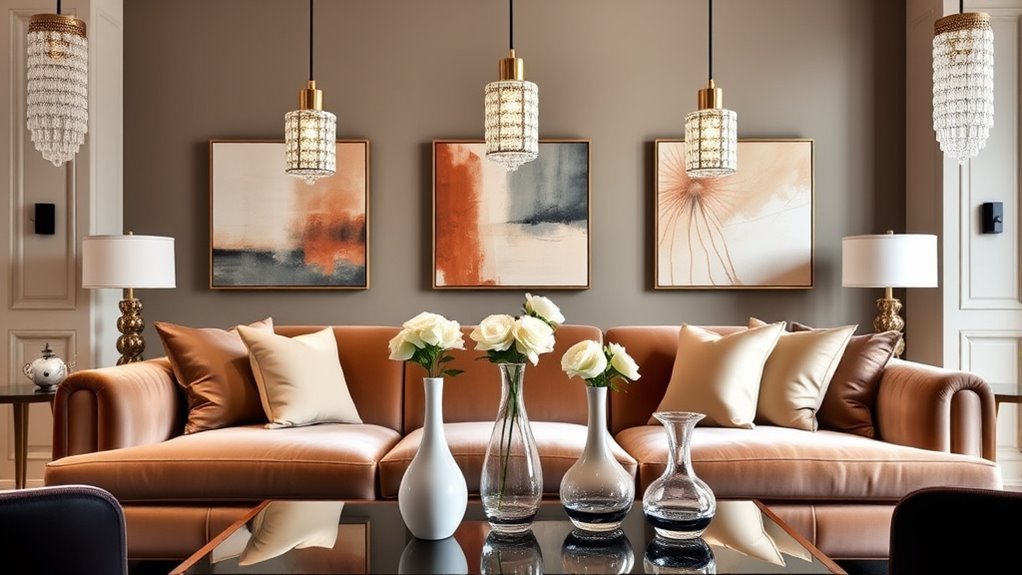
The Rule of Three works because of how human visual perception organizes shapes, distances, and balance in a physical space. While it is a design convention rather than a rigid law of physics, perceptual psychology and classic interior design theory explain why three varied items often feel more engaging than a pair or a crowded lineup.
In visual psychology, Gestalt principles describe how the brain automatically groups separate items into a unified whole. As Encyclopaedia Britannica on proximity in perception explains, objects placed close together are perceived as a single pattern rather than isolated parts. When you place three decor items within a few inches of each other (proximity), repeat a shared brass or ceramic finish (similarity), and set them on a tray (common region), your brain reads the arrangement effortlessly as one calm vignette.
Odd numbers also encourage informal (asymmetrical) balance. Two identical objects invite the eye to compare both sides for mirror symmetry, which looks calm and formal on a bedroom nightstand pair but can feel static on a coffee table. Three items of different heights form a visual triangle that keeps the gaze moving around the composition.
This interplay connects directly to foundational concepts of balance, rhythm, emphasis, proportion, scale, and harmony. According to Utah State University Extension design principles, dark, warm, or coarse-textured surfaces carry heavier visual weight than cool, light, or transparent ones—which is why a small dark bronze sculpture can visually counterbalance a much taller clear glass vase in a three-piece grouping.
Tips for Mastering the Rule of Three in Your Style
Mastering the Rule of Three comes down to editing contrast and connection so your three pieces look curated rather than thrown together. Before buying new decor, gather five or six candidate pieces from around your home and test combinations on a cleared surface.
- Stagger heights clearly: Aim for a distinct high, medium, and low profile rather than three items that sit within an inch of the same height. Use a horizontal stack of two books to boost a medium object if needed.
- Layer front to back: Avoid lining all three items along the exact same depth plane. Pull the smallest piece slightly forward and overlap its back edge with the taller anchor behind it to build three-dimensional depth.
- Repeat one unifying bridge: Link diverse shapes by repeating at least one subtle element across the group, such as warm wood undertones, cream linen, or aged brass.
- Contrast three geometry types: Combine a vertical cylinder or rectangle (like a tall vase or frame), a horizontal block (stacked books or a box), and an organic or spherical form (a round bowl, trailing plant, or sculptural knot).
- Mix tactile finishes: Pair something smooth or reflective (glass, glazed ceramic, polished metal) with something matte and something rough or woven (travertine, raw wood, rattan, linen).
- Protect negative space: Leave empty surface around the vignette so the silhouette of the triangle stands out clearly. Do not force every surface into a trio if a single sculptural vase or a symmetrical pair fits the architecture of the room better.
Warning: Keep safety in mind when styling staggered trios. Never place a lit candle underneath or within a few inches of taller dried branches, pampas grass, or trailing plant foliage in the same grouping. Secure top-heavy vases on high shelves with museum putty, and anchor three-piece gallery frames into wall studs or properly rated drywall anchors over beds and sofas.
Common Mistakes When Decorating in Threes
When a three-piece vignette looks awkward, the culprit is almost always flat height, miniature scale, or poor spacing rather than the objects themselves. Use these quick fixes to troubleshoot an arrangement before you spend money replacing your decor.
- The “Soldier Lineup” (everything is lined up at the same height): Three objects of equal height sitting in a straight row look like a store shelf. Pull the smallest object forward to form a triangle and elevate one piece on two books.
- The “Dollhouse Effect” (three tiny trinkets on a large table): Three miniature items floating in the center of a 48-inch coffee table look like clutter. Swap one small item for a substantial anchor (at least 10 to 14 inches tall or wide) and corral the trio on a tray.
- Floating drift (pieces sit too far apart): When three items sit 8 to 10 inches apart on a mantel, the eye reads them as three lonely objects instead of one group. Slide them within 1 to 3 inches of each other so their silhouettes nearly touch.
- Zero shared DNA (the pieces look random): If a coastal shell, an industrial iron gear, and a neon glass vase sit together with nothing in common, the trio feels chaotic. Swap one piece so at least two items share a color family or material.
- Over-styled clones (all three pieces match): Buying a pre-packaged set of three identical graduated candleholders in the exact same finish can look stiff. Replace the middle piece with a different material—such as a small plant or stacked books—to break up the set.
- Background noise (nearby clutter ruins the vignette): Even a well-proportioned trio disappears when surrounded by mail, remotes, and stray mugs. Clear a 6-to-12-inch buffer zone around your arrangement.
When to Break the Rule of Three
The Rule of Three is a helpful starting point, but breaking it intentionally is often what gives a room maturity and calm. Step away from three-item groupings whenever scale, architectural symmetry, or everyday function calls for a different number.
- Use one statement piece when a single object has enough scale and sculptural presence to hold a surface on its own, such as an oversized ceramic urn with branches on a round entry table or a large canvas above a mantel.
- Use two symmetrical pieces when you want formal calm and order, such as matching lamps flanking a bed, two identical sconces beside a bathroom mirror, or a pair of armchairs facing a sofa. You can also combine symmetry with odd numbers by placing a matching three-piece cluster on either end of a long mantel.
- Use five or seven items when styling an extra-long fireplace mantel, a deep 60-inch coffee table, or an expansive dining table where three objects look sparse. Group those five or seven pieces into overlapping sub-clusters so they still feel organized.
- Leave the surface completely empty when a room already features bold wallpaper, an intricate rug, or heavy architectural millwork. Intentional negative space gives busy rooms a visual pause.
Rule of Three vs. Related Decorating Rules
Interior design uses several popular number-based guidelines that sound nearly identical but solve completely different problems. While the Rule of Three governs how many objects or elements you group together, rules like the Rule of Thirds and the 60-30-10 formula focus on grid placement, color ratios, or room-wide variety.
| Rule | What It Means | Best Use |
|---|---|---|
| Rule of Three | Group related decor objects, textures, lighting layers, or colors in sets of three with varied heights and scales. | Coffee tables, shelves, throw pillows, triptych art, and small vignettes. |
| Rule of Thirds | Divide a wall or room elevation into a three-by-three grid (nine boxes) and place focal points along the intersecting lines. | Wall art height, furniture proportions (such as a sofa spanning two-thirds of a wall), and focal elevations. |
| 60-30-10 Rule | Distribute a room’s palette into 60% dominant color, 30% secondary color, and 10% accent color. | Whole-room color schemes and material/texture distribution. |
| 3-5-7 Rule | Scale odd-numbered groupings up from three items to clusters of five or seven when styling wider surfaces. | Long fireplace mantels, wide bookcases, gallery walls, and king beds. |
| 3-4-5 Method | A room-layering formula popularized by interior designer Nancy Cavaliere: combine 3 patterns, 4 period styles or eras, and 5 colors or textures. | Eclectic or maximalist rooms that need a cap on pattern and style mixing. |
Key Takeaways
- Build every three-piece vignette with a clear hierarchy: one tall anchor, one medium supporting piece (about two-thirds the height), and one low front accent.
- Arrange tabletop items in a loose triangle with 1 to 3 inches between pieces, and leave 30% to 50% of the surface open for breathing room.
- Count visual units rather than individual items: a book stack, a filled vase, or a corralling tray reads to the eye as a single unit.
- Scale the concept beyond knickknacks using the 60-30-10 color and texture split, three lighting layers (ambient, task, accent), or a three-piece reading nook.
- Break the rule whenever one bold statement piece, a symmetrical pair, or a larger 5- or 7-item mantel cluster suits the architecture of the room better.
Frequently Asked Questions
What is the Rule of 3 in decorating?
The Rule of 3 in decorating is a styling guideline that groups three related objects, colors, textures, or lighting elements to create balanced, natural-looking arrangements. A strong trio combines one dominant anchor piece with two smaller supporting pieces that vary in height, shape, and finish.
Why do things look better in threes?
Objects grouped in threes look appealing because three is the smallest number capable of forming an asymmetrical visual triangle that moves the eye around a display. It is a flexible design convention rather than a scientific law, so symmetrical pairs or single statement pieces can work better in formal or minimalist spaces.
What are the three basics of decorating?
While interior design textbooks typically list five to seven core principles, a practical beginner trio is balance, proportion and scale, and harmony. Together, these three fundamentals ensure that visual weight is distributed evenly, furniture fits the dimensions of the room, and colors and materials feel unified.
What is the difference between the Rule of Three and the Rule of Thirds?
The Rule of Three focuses on quantity, grouping three related objects, colors, or textures together in a display. The Rule of Thirds focuses on spatial composition, dividing a wall or room view into a three-by-three grid of nine boxes and placing focal points where the grid lines intersect.
What is the 3-5-7 rule in decorating?
The 3-5-7 rule extends odd-number styling from small three-item vignettes to larger clusters of five or seven objects for wide surfaces like mantels, bookshelves, and gallery walls. To prevent a five- or seven-piece display from looking cluttered, vary the heights and group the items tightly enough to read as one composition.
What is the 3 4 5 rule for decorations?
The 3-4-5 decorating rule is a room-layering formula popularized by interior designer Nancy Cavaliere that combines 3 patterns, 4 period styles or design eras, and 5 colors or textures in one space. Unlike the Rule of Three for tabletop vignettes, the 3-4-5 method is a whole-room cap that keeps eclectic or maximalist rooms from feeling chaotic.
Does the Rule of Three work for pillows?
Yes, styling throw pillows in threes is one of the easiest ways to dress a sofa corner or bed. Combine one large solid square pillow (such as 22 inches), one medium patterned pillow (20 inches), and one smaller textured lumbar pillow, repeating at least one color across all three covers.
Can I use more than three decor items?
Yes, you can use five, seven, or more items on large coffee tables, long mantels, and multi-shelf bookcases. The easiest way to keep larger counts tidy is to bundle smaller items into visual units—such as stacking three books under a candle or corralling small pieces inside a tray—so the eye still perceives three main groupings.
Conclusion
Mastering the Rule of Three is about editing with purpose rather than forcing every shelf and table to obey a strict count. Pick one cluttered surface in your home today, clear it completely, and rebuild a single loose triangle using one tall anchor, one medium supporting piece, and one low tactile accent. Take a quick phone photo to check your spacing and negative room, and do not hesitate to switch to a single bold statement piece or a symmetrical pair if that serves the room better.
Sources
- Real Simple: How to Use the Rule of 3: supports odd-number groupings, variation in scale and texture, wider applications, and when to break the rule.
- Better Homes & Gardens: Rule of Three in Home Decor: supports practical applications to objects, furniture, artwork, 60-30-10 color ratios, cushions, and lighting.
- Interaction Design Foundation: Gestalt Principles: supports visual grouping through perceptual principles such as proximity, similarity, and common region.
- Encyclopaedia Britannica: Proximity in Perception: supports how nearby elements are perceived as a unified group or pattern.
- Homes & Gardens: Principles of Interior Design: supports balance, rhythm, emphasis, proportion and scale, and harmony as broader interior-design principles.
- Utah State University Extension: Principles of Design: supports formal vs. informal (asymmetrical) balance, proportion, scale, and the visual weight of colors and textures.
- U.S. Department of Energy: Light Fixtures and Layered Illumination: supports combining ambient overhead, task, and accent lighting layers.
- Better Homes & Gardens: Rule of Thirds in Interior Design: supports the three-by-three grid distinction between the Rule of Three and Rule of Thirds.
- Apartment Therapy: 3-5-7 Decorating Rule: supports extending odd-number styling to clusters of five and seven on larger surfaces.
- Apartment Therapy: 3-4-5 Decorating Method: supports Nancy Cavaliere’s 3 patterns, 4 period styles, and 5 colors or textures framework.





[…] What Is the Rule of Three in Decorating? Definition, Examples & Tips […]