Disclosure: As an Amazon Associate, we earn from qualifying purchases. If you click a link on this page and make a purchase, we may receive a small commission at no extra cost to you.
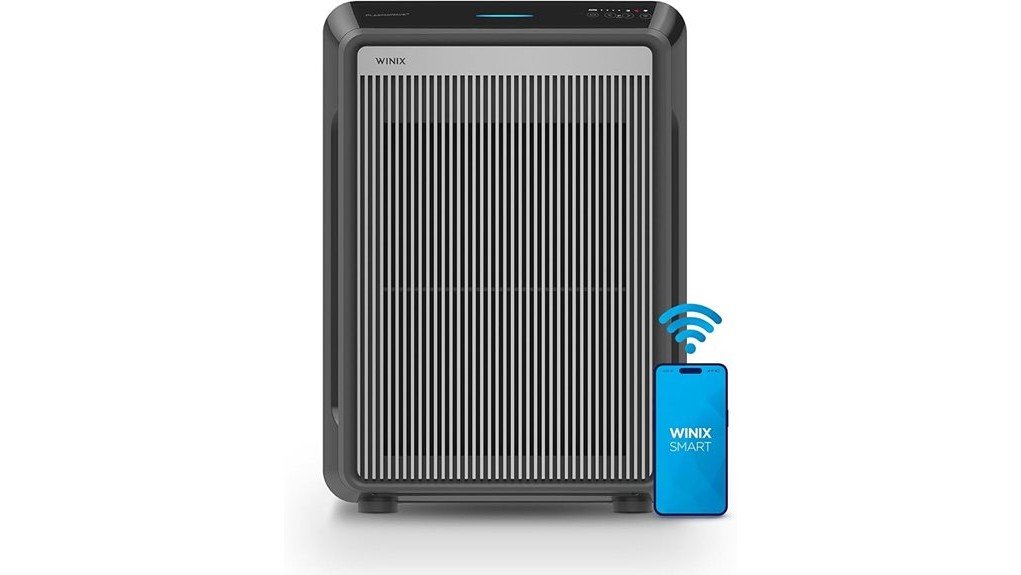
Keeping dust, pollen, pet dander, smoke particles, and household odors under control can be difficult in a larger bedroom or living area. The Winix 9800 Air Purifier combines True HEPA filtration, activated carbon, smart sensors, WiFi controls, and PlasmaWave technology in one floor-standing unit. Its strongest points are its verified room coverage, automatic operation, and quiet lowest setting, while its size and ongoing filter replacements deserve consideration. This review explains where the Winix 9800 performs well, what ownership involves, and who should consider a different purifier.
Quick Verdict
Rating: 8.6/10
Best For: Larger bedrooms, living rooms, pet households, allergy-conscious buyers, and people who want app-based monitoring.
Bottom Line: The Winix 9800 offers strong multi-stage filtration, useful automatic controls, and quiet low-speed operation. Its larger footprint, replacement-filter costs, and PlasmaWave feature may not suit every buyer.
| Specification | Detail |
|---|---|
| Brand | Winix |
| Model | 9800 |
| Product Type | 4-stage True HEPA smart air purifier |
| Verified Room Size | 522 sq. ft. |
| Dimensions | 16.5 in W × 11.8 in D × 23.2 in H |
| Weight | 18.7 lb |
| Power | AC 120 V / 60 Hz, 95 W |
| Filtration | Pre-filter, activated carbon, True HEPA, PlasmaWave |
| True HEPA Performance | Captures 99.99% of tested airborne particles as small as 0.003 microns |
| Minimum Noise Level | 26.2 dB |
| Smart Features | WiFi, Winix Smart App, air-quality indicator, Auto Mode, smart sensors |
| Replacement Filter | Winix Filter A, SKU 115115 |
| Included Filters | 1 pre-filter, 4 activated carbon filters, 1 True HEPA filter |
| Warranty | 2 years |
Key Takeaways
- The Winix 9800 is designed for larger rooms, with a current verified room-size specification of 522 square feet.
- Its four-stage system combines a washable pre-filter, activated carbon, True HEPA filtration, and switchable PlasmaWave technology.
- The True HEPA filter is designed to capture 99.99% of tested airborne particles as small as 0.003 microns.
- WiFi, smart sensors, Auto Mode, and a real-time air-quality indicator reduce the amount of manual adjustment required.
- A 26.2 dB minimum noise level and automatic Sleep Mode make it practical for bedrooms and other quiet spaces.
What Is the Winix 9800 Air Purifier?
The Winix 9800 is a floor-standing smart air purifier designed for home use. At 16.5 inches wide, 11.8 inches deep, and 23.2 inches high, it is larger than a compact tabletop purifier but still manageable for a bedroom, family room, apartment, or open living area.
Air passes through four purification stages. The pre-filter catches larger debris, the activated carbon stage targets common household odors and VOCs, the True HEPA filter captures fine airborne particles, and PlasmaWave provides an additional optional treatment stage. You can also monitor the unit through the Winix Smart App rather than relying only on its physical controls.
Who Should Buy It?
Best For
- Bedrooms, living rooms, and similar spaces around its verified 522 sq. ft. room-size rating.
- Homes dealing with pollen, dust, pet dander, smoke particles, or everyday household odors.
- Buyers who value automatic fan adjustments, app controls, and real-time air-quality feedback.
Skip If
- You need a very small purifier for a desk, narrow room, or tight floor space.
- You do not want to budget for periodic HEPA and carbon filter replacements.
- You prefer a purifier without an ionization-related feature and do not want to manage the PlasmaWave setting.
Before You Buy: Room-size claims do not mean you can place the purifier anywhere and get identical results. Winix recommends keeping the unit on a hard, flat surface with roughly 12 to 18 inches of clearance from walls for better airflow.
How the Four-Stage Filtration System Works
1. Washable Pre-Filter
The first stage deals with larger visible particles before they reach the more expensive filters. Regularly cleaning this pre-filter can reduce buildup and help the remaining filtration stages work without unnecessary blockage.
2. Activated Carbon Filter
The activated carbon filters are designed to reduce household odors and VOCs. This makes the 9800 useful in homes where cooking smells, pet odors, or other everyday odors are part of the air-quality problem.
3. True HEPA Filter
The True HEPA filter is the main particle-capture stage. Winix states that it captures 99.99% of tested airborne particles as small as 0.003 microns, including common pollutants such as pollen, dust, smoke particles, and pet dander.
4. PlasmaWave Technology
PlasmaWave is enabled by default when the purifier powers on, but the feature can be switched off using the controls. It is also disabled automatically in Sleep Mode unless you turn it back on.
This ability to disable PlasmaWave is useful if you specifically prefer standard mechanical and carbon filtration. The purifier’s True HEPA and carbon filters remain core parts of the system.
Smart Controls and Automatic Air-Quality Monitoring
The Winix 9800 includes an air-quality indicator and smart sensor system. In Auto Mode, the purifier responds to detected air conditions by changing fan speed instead of requiring you to adjust it each time air quality changes.
Its WiFi connection adds remote monitoring and control through the Winix Smart App. Initial setup requires a compatible wireless network, and the current manual specifies a 2.4 GHz-capable router for pairing.
The sensor needs a short period after startup before it begins normal air-quality detection. That means you should not judge the indicator immediately after turning the unit on.
Pro Tip: Use Auto Mode for everyday operation after giving the purifier enough open space around its intake and outlet. A purifier pushed tightly against furniture or a wall cannot move room air as effectively.
Noise Level and Sleep Mode
The Winix 9800 reaches a minimum noise level of about 26.2 dB, which is one of its more useful features for bedrooms. Sleep Mode lowers the fan to a setting below the normal Low speed and turns off the bright air-quality indicator.
The built-in light sensor can detect a darkened room while the unit is operating in Auto Mode and move the purifier into Sleep Mode. This makes overnight operation less distracting without requiring you to change settings manually every evening.
Higher fan settings will naturally create more airflow noise. Buyers who are especially sensitive to sound should judge the purifier by the setting they expect to use most often rather than assuming the 26.2 dB figure applies at every speed.
Cleaning and Filter Maintenance
The pre-filter can be cleaned with a vacuum or soft brush. If it becomes heavily soiled, Winix allows it to be rinsed with room-temperature water, but it must be fully dry before it goes back into the purifier.
The True HEPA filter is not washable. Winix’s Filter A replacement set includes one True HEPA filter and four activated carbon filters. The manufacturer’s current guidance recommends replacing the HEPA filter about every 12 months and the carbon filter about every three months under normal conditions.
Actual replacement timing can vary with air quality and usage. A home with pets, frequent cooking, wildfire smoke, or unusually dusty conditions may load filters differently from a low-pollution household.
How It Performs in Real Use
In a Bedroom
The combination of a 26.2 dB minimum noise level, light-sensitive Sleep Mode, and dimmed indicators makes the 9800 well suited to overnight operation. Its physical size is the main tradeoff, so measure the intended location before buying.
In a Living Room
A verified room-size rating of 522 square feet makes more sense for a living room than a small personal purifier. Auto Mode is especially useful here because air conditions may change during cooking, cleaning, pet activity, or when several people are in the room.
In a Home With Pets
The pre-filter can catch larger debris before it reaches the HEPA stage, while the True HEPA filter targets airborne pet dander and the carbon stage addresses odors. You still need normal vacuuming and surface cleaning because an air purifier only handles pollutants that reach its airflow path.
During Cooking or Smoke Events
The carbon and True HEPA stages give the 9800 a useful combination for odors and airborne smoke particles. For a sudden pollution event, a higher fan setting can move more air than Sleep or Low mode, although it will also be louder.
Setup Tips Before First Use
Place the purifier indoors on a solid, level surface. Leave about 12 to 18 inches between the unit and nearby walls or obstacles so the intake and outlet have room to move air.
Remove all filter packaging before operating the purifier. Confirm that the pre-filter, carbon filter, and True HEPA filter are installed in the correct order before replacing the front panel.
For WiFi setup, keep the purifier within a reliable range of your router and follow the Winix Smart App pairing process. If pairing fails, check the network password and router connection before assuming the purifier itself has a fault.
Compatibility and Safety
The Winix 9800 is specified for 120 V household use in the USA and Canada. Do not block the intake or outlet, operate the unit on its side, place it near steam or excessive moisture, or use it without the required filters installed.
The model uses PlasmaWave technology. It should not be described as producing absolutely zero ozone. The official Winix documentation identifies the unit as meeting California ozone-emissions requirements and carrying CARB certification. PlasmaWave can also be disabled if you prefer not to use that stage.
Always unplug the purifier before cleaning. Do not wash the True HEPA filter, and follow the manufacturer’s manual for maintenance, electrical safety, and filter replacement.
Pros and Cons
Pros
- True HEPA filtration captures 99.99% of tested airborne particles as small as 0.003 microns.
- Verified room-size rating of 522 square feet.
- Quiet 26.2 dB minimum setting with automatic Sleep Mode.
- WiFi app control, real-time air-quality indication, and Auto Mode.
- PlasmaWave can be disabled rather than forcing you to use it continuously.
Cons
- The 23.2-inch-tall cabinet takes more floor space than a compact purifier.
- HEPA and carbon filters are ongoing replacement expenses.
- WiFi setup and PlasmaWave controls add features that buyers wanting a very simple purifier may not need.
Is It Worth the Price?
The Winix 9800 makes the most sense when you will actually use its combination of larger-room filtration, smart sensors, Auto Mode, WiFi control, and low-noise operation. Those features provide more everyday convenience than a basic purifier that only offers manual fan settings.
Value also depends on replacement-filter costs. Because the system uses disposable carbon filters and a non-washable True HEPA filter, ownership does not end with the original purchase. Buyers who regularly use the purifier should include those replacement costs in their decision.
It is worth considering if you want automatic air-quality management in a medium-to-large room. It is less compelling if you only need a small purifier for occasional use or do not care about smart controls.
How It Compares to Alternatives
The Winix 9800 sits between simple manual HEPA purifiers and more expensive premium smart models. Within the Winix range, the Winix 5510 is worth comparing if you want another modern True HEPA option. Buyers shopping across brands may also compare models such as the Coway Airmega 250.
The 9800’s main appeal is the combination of four-stage filtration, automatic sensing, WiFi control, quiet low-speed operation, and a verified room-size rating above 500 square feet. A simpler alternative can make more sense if app control and PlasmaWave are not priorities.
Frequently Asked Questions
How large a room can the Winix 9800 handle?
The current Winix manual lists a verified room size of 522 square feet. Actual results still depend on room layout, ceiling height, pollutant levels, airflow, and where you place the purifier.
How often should the filters be replaced?
Winix recommends replacing the True HEPA filter about every 12 months and the activated carbon filter about every three months under normal conditions. Heavy dust, smoke, pets, and frequent operation can affect actual filter life.
Can I wash the Winix 9800 filters?
The pre-filter can be vacuumed or rinsed when heavily soiled, then dried completely before reinstallation. Do not wash or reuse the True HEPA filter.
Is the Winix 9800 good for pollen and pet dander?
Its True HEPA stage is designed to capture airborne particles including pollen, dust, smoke particles, and pet dander. It works best as part of regular household cleaning rather than as a replacement for vacuuming or removing pollutant sources.
Does the Winix 9800 produce ozone?
It is more accurate not to describe the PlasmaWave-equipped 9800 as producing absolutely zero ozone. Winix documentation states that the model meets California ozone-emissions limits and is CARB certified, and PlasmaWave can be switched off from the controls.
Can I use the Winix 9800 without WiFi?
Yes. The purifier has onboard controls for normal operation, so WiFi is an additional convenience rather than a requirement for basic air purification.
Who should skip the Winix 9800?
Skip it if you only need a tiny purifier, lack suitable floor space, or want to avoid recurring filter costs. A simpler model may also make more sense if you have no interest in WiFi, automatic sensors, or PlasmaWave.
The Bottom Line
The Winix 9800 is a strong choice for buyers who want True HEPA filtration, activated carbon, automatic sensing, WiFi controls, and quiet low-speed operation in a room around its 522 sq. ft. verified rating. Its main compromises are its larger cabinet and the ongoing cost of replacement filters, while buyers concerned about PlasmaWave can disable that feature.
For a bedroom, living room, pet household, or other regularly occupied space where automatic operation matters, the Winix 9800 earns our 8.6/10 recommendation.