
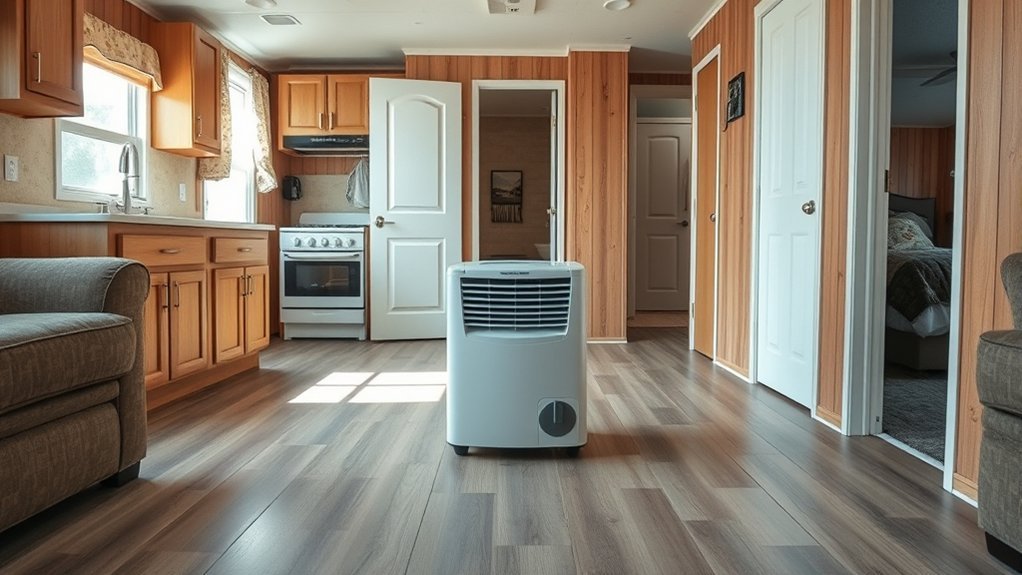
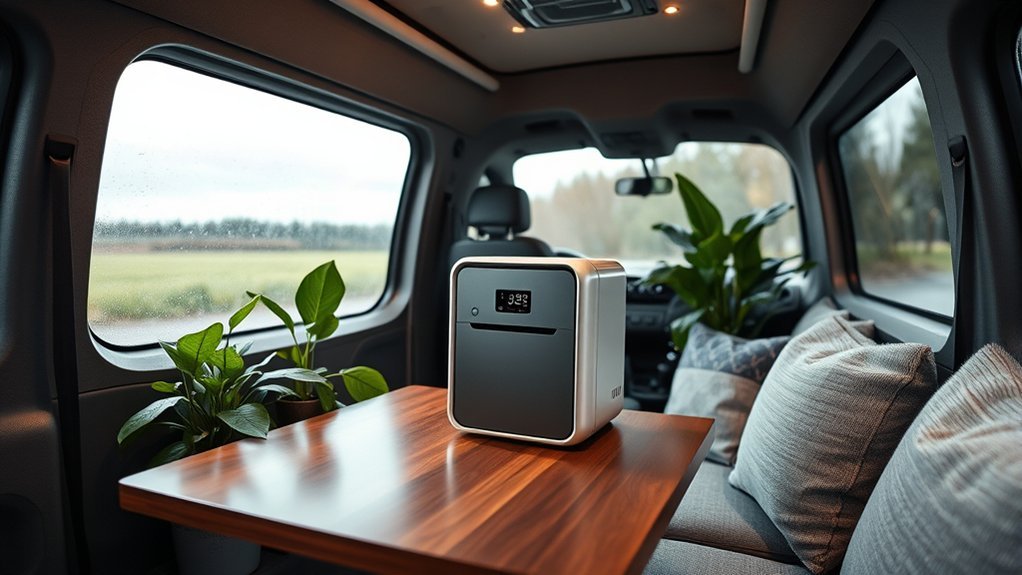
A dehumidifier in a mobile home works best when it can pull damp air from the problem area without blocked airflow. In most layouts, that means a central, open spot near the dampest rooms, with enough clearance around the unit and a level floor for safe drainage. The goal is simple: remove moisture before it spreads into walls, floors, closets, and the crawl space.
Last updated: August 19, 2026
Quick Answer
Place a dehumidifier in a mobile home in a central, open area near the dampest rooms, such as the bathroom, kitchen, laundry area, or hallway. Keep the intake and outlet unobstructed, follow your model’s required wall clearance, and aim for indoor humidity around 30%–50% when practical.
Key Takeaways
- For whole-home moisture control, choose a central open area such as a hallway or living-room edge, not a closed bedroom or corner.
- For a single damp room, place the dehumidifier in that room with doors and windows to the outside closed.
- Use a hygrometer to confirm the dampest area instead of guessing by smell alone.
- Keep the unit on a level surface, away from heat sources, curtains, furniture, and tight closets.
- If the crawl space is damp, fix leaks and ponding first, then check the home’s skirting-ventilation and ground-vapor-retarder requirements before adding a crawl-space dehumidifier.
At a Glance
| Time Required | Varies: indoor placement is quick; drainage setup and crawl-space inspection take longer |
| Difficulty | Easy for indoor placement; moderate for crawl-space drainage and electrical setup |
| Tools Needed | Hygrometer, dehumidifier manual, drain hose if using continuous drainage, flashlight for crawl-space checks |
| Cost | Usually $10–$50 for a hygrometer; drain hose cost varies; no cost if simply moving the unit |
Where Should a Dehumidifier Go in a Mobile Home?
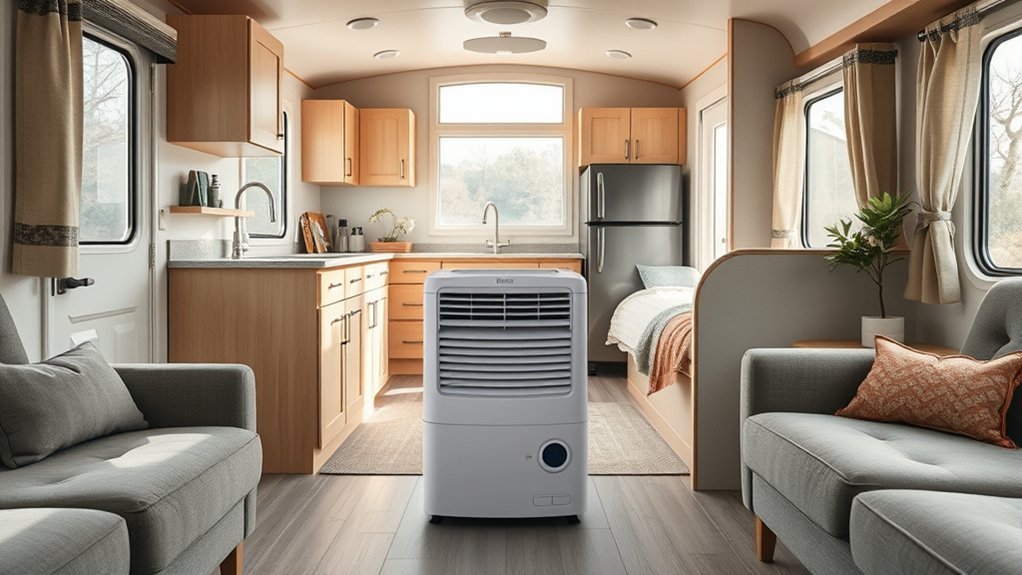
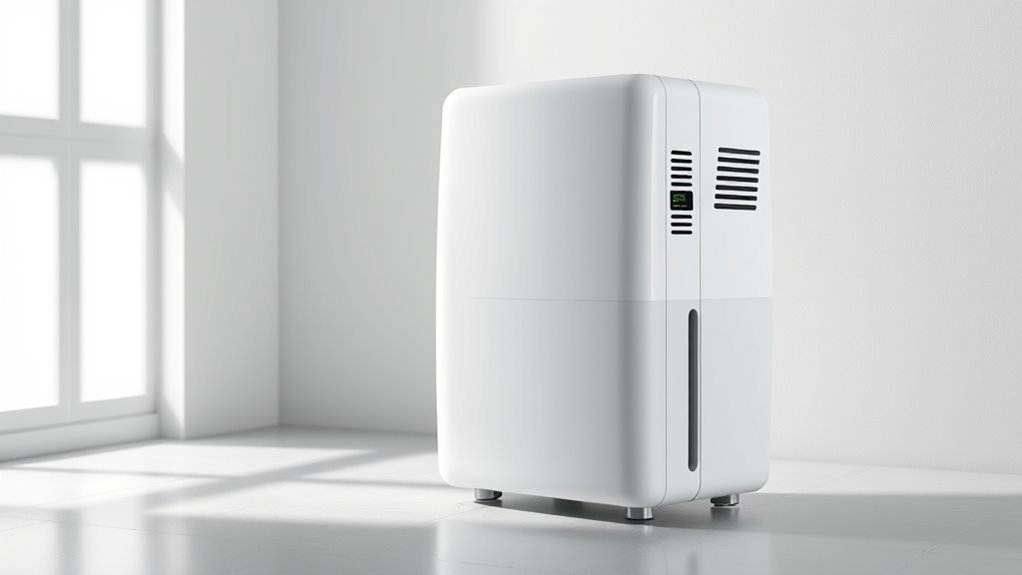
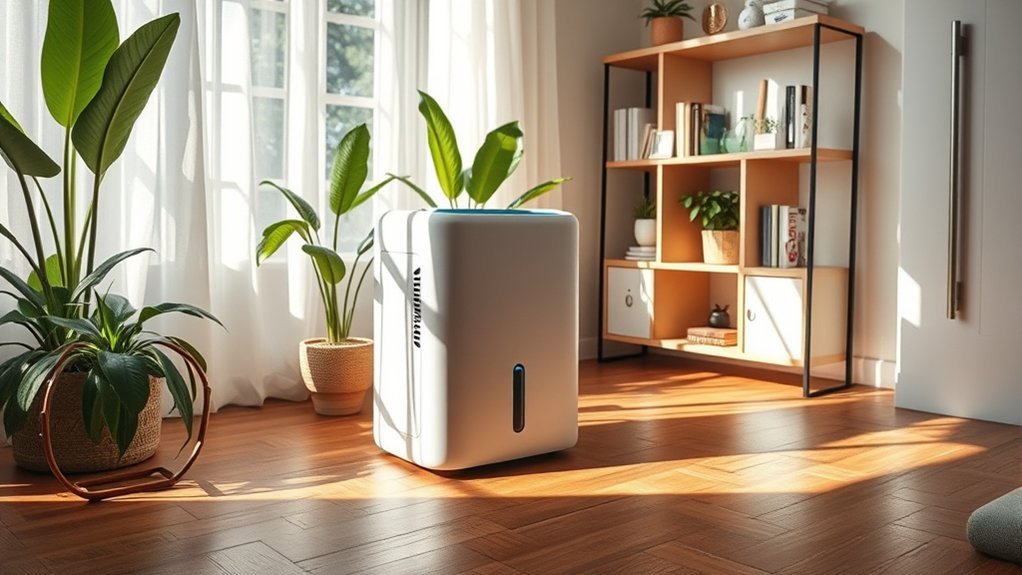
The best place for a dehumidifier in a mobile home is usually a central, open area near the dampest part of the home. A hallway, open living-room edge, or space between the kitchen and bathroom often works better than a corner bedroom because the unit can pull damp air from more than one zone.
Keep the dehumidifier away from furniture, curtains, boxes, wall corners, and anything that blocks the intake or outlet. Clearance is model-specific, so use the minimum distance in your dehumidifier manual instead of relying on one universal number. The practical rule is to keep every intake and exhaust grille fully open to room air.
For general indoor moisture control, the EPA recommends keeping indoor humidity between 30% and 50% when practical. If your mobile home stays above that range, a dehumidifier can help, but placement matters just as much as the setting.
Pro Tip: Put a small hygrometer in the bathroom, kitchen, bedroom, and living area for a day. Place the dehumidifier near the room or hallway with the highest reading instead of guessing by smell alone.
What Are the Best Rooms for a Dehumidifier?
The best rooms for a dehumidifier in a mobile home are the areas that create or collect the most moisture. Start with the room where the humidity is highest, then decide whether you need one-room drying or whole-home support.
| Bathroom | Best after showers, weak exhaust fan performance, condensation on mirrors, or mildew odors. |
| Kitchen | Helpful when boiling, simmering, dishwashing, or poor range ventilation raises humidity. |
| Laundry area | Useful near damp laundry, but a manufactured-home dryer must still exhaust outdoors. 24 CFR § 3280.708 requires gas and electric clothes dryers to exhaust outside, not beneath the home. |
| Bedroom | Good for musty closets, damp bedding, window condensation, or high nighttime humidity. |
| Hallway or living area | Best for broader coverage when interior doors are open and the unit is sized for the area. |
If you are drying one room, keep that room’s door mostly closed and close windows to the outside. If you are trying to help the whole mobile home, keep interior doors open so air can move back to the unit, but keep exterior doors and windows closed when the outdoor air is humid.
Should You Put a Dehumidifier in the Crawl Space?
You can put a dehumidifier in a mobile home crawl space if that is where the moisture problem starts, but do not use it as a cover-up for leaks, standing water, damaged skirting, or missing ground moisture control. A crawl-space dehumidifier works best after you correct the source of moisture.
For manufactured homes installed under HUD’s Model Manufactured Home Installation Standards, 24 CFR § 3285.505 requires ventilation openings in a skirted crawl space. The minimum vent area is generally 1 square foot per 150 square feet of home floor area, or 1 square foot per 1,500 square feet when an approved ground vapor retarder covers the entire area beneath the home. Check the home’s installation instructions and local requirements before changing or sealing crawl-space vents.
Warning: Do not run a household dehumidifier in a wet crawl space with unsafe wiring, standing water, or an unprotected outlet. Use a properly rated unit, follow local electrical code, and have a qualified professional handle unsafe crawl-space wiring or drainage problems.
Recommended Products

120 PPD Crawl Space Dehumidifier: The Sentinel HD55S Energy Star Certified dehumidifier removes up to 120 pints of moisture per day at saturation (55 PPD at AHAM) and effectively controls humidity in spaces up to 1,300 sq. ft. Its rugged metal housing is built for demanding environments and long-term reliability, making it ideal for crawl spaces, basements, warehouses, offices, factories, and storage areas

Specially Designed for Crawl Spaces— The AIUSEVO commercial dehumidifier features a high-performance compressor and a powerful 265 CFM airflow, removes up to 125 pint/d(at 95°F, 90% RH). Covers up to 6500 sq. ft. It can keep humidity at an ideal level and prevent excessive moisture from damaging your personal belongings. With compact dimensions of 19.3" x 17.8" x 17.5" , it fits between floor joists and in low-clearance crawl spaces. Ideal for Garage,warehouses, offices, factories, shops

PRO-GRADE 70-PINT PERFORMANCE – This AlorAir Crawl Space Dehumidifier removes up to 70 pints per day under saturated conditions (35 pints per day under AHAM standards). The advanced R32 system efficiently controls humidity in areas up to 1,000 sq. ft. Ideal for crawl spaces, basements, garages, attics, commercial and industrial environments. Serious performance meets modern efficiency.
Crawl Space Humidity Risks
High crawl-space humidity can lead to musty odors, damp insulation, soft subfloors, mold growth, pest activity, and wood decay. In a mobile home, moisture under the floor can also move upward through gaps, duct leaks, plumbing penetrations, and floor openings.
Before placing a dehumidifier there, check for these problems:
- Standing water after rain
- Plumbing leaks or sweating pipes
- Disconnected or leaky ducts
- Torn belly board or damaged insulation
- Missing or damaged ground vapor barrier
- Blocked vents or skirting problems
- Musty odors coming through floor registers or closets
If you find active leaks or ponding water, fix those first. A dehumidifier removes water vapor from the air; it cannot solve a drainage or plumbing problem by itself.
Ventilation and Airflow
Do not seal manufactured-home crawl-space vents just to make a dehumidifier work harder against less outdoor air. Under the HUD model installation standard, a skirted crawl space uses ventilation openings on at least two opposite sides for cross-ventilation, with specific vent-area rules. If your home has an engineered or locally approved alternative, follow that approved design rather than generic crawl-space advice.
Keep the dehumidifier away from joists, stored items, skirting walls, and insulation so the intake and outlet stay open. If the unit uses a gravity drain, the hose must slope continuously to the drain. If the hose rises, kinks, or sags, water can back up and shut the unit off.
Dehumidifier Placement Options
There are three common placement choices in a mobile home:
- Central indoor placement: Best for overall comfort and general humidity control.
- Room-specific placement: Best for one damp bathroom, kitchen, bedroom, or laundry area.
- Crawl-space placement: Best when the moisture source is under the home and the crawl space is safe, accessible, and prepared for drainage.
If the crawl space is damp but the living area is also humid, you may need both source control under the home and an indoor unit during humid months.
How Do You Choose the Right Size Dehumidifier?
Choose the dehumidifier size based on the damp area, not just the square footage of the entire mobile home. A small unit may work for one bedroom or bathroom, while a larger unit may be needed for an open-plan home, a very humid climate, or a crawl space with a heavy moisture load.
Check the product’s pint-per-day rating, coverage area, operating temperature range, drainage options, and whether it is designed for the space where you plan to use it. ENERGY STAR sizes portable dehumidifiers by both the area being treated and how damp that area is before dehumidification.
Sizing shortcut: For a space under 2,000 square feet, current ENERGY STAR guidance lists about 20–30 pints/day for slightly to moderately damp conditions (roughly 50%–75% RH) and 25–40 pints/day for very damp conditions (roughly 75%–90% RH). Use the manufacturer’s coverage limits and operating-temperature range too, especially for a crawl space.
You may need a larger unit or a second unit if:
- The home stays above 60% RH even after several days of operation.
- The unit runs constantly but the room still smells musty.
- The damp area is separated by closed doors or narrow hallways.
- The crawl space is damp and the living space is humid.
- You see condensation, swollen flooring, or recurring mildew.
A dehumidifier works best after moisture sources are controlled. Fix leaks, improve exhaust, and stop outside damp air before asking the unit to do all the work.
Recommended Products

High-Efficiency Dehumidifier for Home:This small dehumidifier is also equipped with a compressor that can dehumidify 20 pints per day and can efficiently dehumidify an area of 1500sq ft continuously. Keep your space as comfortable and dry as possible with a small footprint

1,500 Sq.Ft. OF COVERAGE - Midea dehumidifier with drain hose is able to collect 20 pint (Similar to 30 PT-2012 DOE) of water a day and adjust humidity from 35% to 85%, perfect for use for basement, bathroom, bedroom, or crawlspace.

【Powerful Compressor】This Dehumidifier For Basement Is Equipped With A Powerful Air Compressor That Can Suck Moist Air Into A Coil Filled With Coolant. Equipped With Automatic Defrosting Function, This Means That When Frost Forms On The Evaporator Coil, The Compressor Will Cycle Off While The Fan Continues To Run Until The Frost Disappears. Condensed Moist Air Drips Into The Reservoir From The Coil, Discharging Dry And Fresh Air Into The Room.
How Do You Improve Airflow Around a Dehumidifier?
To improve airflow around a dehumidifier, place it where the intake and outlet can move air freely. Do not tuck it behind a chair, beside a bed skirt, inside a closet, or against skirting or stored items in the crawl space.
| Action | Why It Helps |
|---|---|
| Follow your model’s required clearance and keep all grilles unobstructed | Prevents blocked intake and outlet airflow |
| Use a level hard surface | Helps the bucket, float switch, and drain hose work correctly |
| Close exterior doors and windows | Stops new humid outdoor air from constantly entering |
| Open interior doors for whole-home drying | Lets damp air move back to the unit |
| Clean the filter and grille | Keeps airflow strong and reduces strain on the fan |
If you use gravity drainage, keep the hose secure and continuously sloped toward the drain, with no kinks, loops, or rises that can stop water flow. If the drain point is higher than the unit, use a dehumidifier with a condensate pump or another manufacturer-approved pumping setup.
Where Should You Not Place a Dehumidifier?
You should not place a dehumidifier in spots that block airflow, confuse the humidity sensor, create a leak risk, or make the unit unsafe to run.
- Do not place it in a tight corner. Corners trap air and reduce circulation.
- Do not place it inside a closed closet. The unit may overheat, and it will not dry the rest of the home well.
- Do not place it against curtains, bedding, furniture, or storage boxes. Fabric and clutter can block the intake or outlet.
- Do not place it beside a heater, stove, fireplace, or strong heat source. Heat can affect readings and make the unit work harder.
- Do not place it in direct sun if another spot is available. Direct sun can warm the sensor area and distort readings.
- Do not place it on thick carpet if the unit cannot sit level. A tilted unit can drain poorly or trigger bucket issues.
- Do not use it in standing water or unsafe crawl-space conditions. Fix water and electrical hazards first.
Note: Avoid extension cords unless your specific manual allows them. Many dehumidifier manuals warn against extension cords or adapter plugs because of fire and shock risk.
Safety check: Before running an older portable dehumidifier, check the U.S. Consumer Product Safety Commission dehumidifier recall page. CPSC has warned consumers to stop using certain recalled dehumidifiers because of overheating and fire hazards.
How Can You Control Mobile Home Humidity in Summer?
Summer humidity is harder on mobile homes because warm outdoor air can leak through gaps, skirting, vents, windows, and doors. A dehumidifier helps, but it should be part of a moisture-control plan.
Use these steps:
- Run the air conditioner when needed. Air conditioning removes some moisture while cooling.
- Use the dehumidifier in the most humid zone. Check with a hygrometer and move the unit if readings show a better spot.
- Run exhaust fans while cooking and bathing. Vent moisture outdoors before it spreads.
- Close windows when outdoor air is humid. Open windows only when outdoor humidity is lower than indoor humidity.
- Repair plumbing leaks quickly. Even small leaks can keep humidity high.
- Check skirting, belly board, and ducts. Moist crawl-space air can enter the living area through gaps.
- Keep RH in a reasonable range. Aim for 30%–50% when practical, and avoid long periods above 60%.
The U.S. Department of Energy explains that moisture moves through homes by air movement, diffusion, heat transfer, and indoor activities such as cooking and showering. In a mobile home, reducing air leaks and moisture sources often makes the dehumidifier more effective.
What Are the Signs of Too Much Moisture?
Too much moisture in a mobile home usually shows up before major damage starts. Watch for these warning signs:
- Musty odors in closets, bedrooms, cabinets, or near floor registers.
- Condensation on windows, pipes, walls, or metal surfaces.
- Mildew or mold spots around bathrooms, windows, closets, or under sinks.
- Peeling paint, swollen trim, or soft flooring that suggests damp materials.
- Clammy air even when the air conditioner is running.
- Dust-mite or allergy flare-ups in humid rooms.
- Wet insulation or belly-board damage under the mobile home.
The University of Minnesota Extension notes that excess moisture symptoms include window condensation, mildew, mold, peeling paint, and dust mites. If you see those signs, do not only move the dehumidifier. Look for the moisture source.
How Do You Maintain a Dehumidifier for Best Results?
A dehumidifier works best when it is clean, level, unobstructed, and set to a realistic humidity target. Poor maintenance can make the unit louder, weaker, and less efficient.
Use this maintenance checklist:
- Clean the filter regularly. Follow the cleaning interval in your model’s manual, and clean it sooner if airflow drops or dust builds up.
- Keep the grille clear. Vacuum dust from the intake and outlet areas.
- Empty and wash the bucket. Standing water can smell musty if ignored.
- Check the drain hose. Make sure it is tight, sloped, unkinked, and draining where intended.
- Keep the unit upright. If it has been tilted or moved, follow the manual before restarting.
- Check the humidity reading. Use a separate hygrometer if the built-in reading seems off.
- Inspect for frost or error codes. A room that is too cold can reduce performance on some units.
Set the humidity control low enough to remove moisture, but not so low that the unit runs nonstop without improving comfort. For most mobile homes, a practical target is around 45%–50% RH in humid weather, with adjustments based on comfort, condensation, and the manufacturer’s instructions.
Troubleshooting: Why Is the Unit Running but Humidity Still High?
If the dehumidifier runs but your mobile home still feels damp, the problem is usually placement, sizing, airflow, or an ongoing moisture source.
| Problem | Likely Fix |
|---|---|
| Humidity drops near the unit but not elsewhere | Move it to a more central spot or open interior doors. |
| Unit runs constantly | Check for open windows, undersizing, high outdoor humidity, or active leaks. |
| Bucket fills very fast | Use continuous drainage and inspect for a hidden moisture source. |
| Air feels damp even with AC running | Check AC sizing, fan settings, duct leaks, and crawl-space moisture. |
| Musty smell returns after the unit shuts off | Look for mold, damp insulation, wet subflooring, or a crawl-space source. |
If you find visible mold, recurring water damage, or a damp crawl space that keeps returning after repairs, consider a qualified mold, HVAC, or manufactured-home professional. A dehumidifier can manage air moisture, but it cannot replace structural repair, drainage correction, or safe mold cleanup.
Recommended Products

POWERFUL 2,500 SQ. FT. COVERAGE - Stop letting sticky, heavy air dictate your comfort. The BANABIE dehumidifier utilizes a high-efficiency rotary compressor to deliver heavy-duty moisture removal, extracting 32 pints daily (at 95°F, 90%RH). Engineered with a smart integrated airflow system, this unit effectively covers up to 2,500 Sq. Ft., ensuring that your basement, crawl space, or large open floor plans stay bone-dry

Quiet & High-Efficiency Dehumidifier: Featuring next-generation semiconductor cooling technology, this quiet dehumidifier delivers efficient moisture removal while running at ultra-low noise (≤40dB). Stable humidity levels are maintained, making your home environment more comfortable and pleasantly dry.

Semiconductor dehumidifiers use thermoelectric cooling to remove moisture from the air. They create a drier, more comfortable environment by reducing humidity and improving air quality.
Frequently Asked Questions
Are dehumidifiers good for mobile homes?
Yes, dehumidifiers can be good for mobile homes because they help reduce indoor humidity, musty odors, condensation, and moisture that can support mold or dust mites. They work best when you also fix leaks, use exhaust fans, close humid outdoor air out, and keep the unit clean.
Where should you not place a dehumidifier?
Do not place a dehumidifier in a tight corner, closed closet, direct contact with furniture or curtains, beside a strong heat source, on an uneven surface, or in standing water. The unit needs open airflow, a level base, safe power, and reliable drainage.
Should a dehumidifier be on the floor or elevated?
Use the position required by your model’s manual. If the unit is designed for floor use, set it on a stable, level floor. Elevate it only when the manufacturer allows it and the surface is strong and level, such as when gravity drainage needs a lower drain point.
How far should a dehumidifier be from the wall?
There is no single wall-clearance number for every dehumidifier. Use the minimum clearance in your model’s manual and make sure no wall, furniture, curtain, or stored item blocks the intake or exhaust grille.
Should the dehumidifier run with the windows open?
Usually no. A dehumidifier works best in an enclosed area when humid outdoor air is kept out. Close exterior doors and windows during humid weather. Open windows only when outdoor air is drier than indoor air.
Is one dehumidifier enough for a whole mobile home?
One dehumidifier may be enough for a small, open mobile home if it is sized properly and interior doors stay open. You may need a second unit if rooms are closed off, the crawl space is damp, the home has a long narrow layout, or humidity stays high after several days.
Conclusion
To get the best results, place your dehumidifier in a central, open spot near the dampest area of your mobile home. Follow your model’s required clearance, set the unit on a level surface, close humid outdoor air out, and use a hygrometer to confirm your humidity level. Aim for about 30%–50% RH when practical, and investigate leaks, crawl-space moisture, or ventilation problems if the unit has to run constantly. Good placement helps, but moisture control works best when the source of dampness is fixed too.
Sources
- EPA — Care for Your Air: A Guide to Indoor Air Quality — supports the 30%–50% indoor humidity guidance and use of a humidity gauge.
- EPA — Mold Course, Chapter 2 — supports keeping indoor RH below 60% and ideally 30%–50% for mold prevention.
- ENERGY STAR — Dehumidifiers — supports sizing by room area and dampness level.
- eCFR — 24 CFR § 3285.505 — supports manufactured-home crawl-space ventilation and ground-vapor-retarder requirements.
- eCFR — 24 CFR § 3280.708 — supports the requirement for manufactured-home clothes dryers to exhaust outside.
- U.S. Consumer Product Safety Commission — Dehumidifier Recalls — supports checking older units for fire-hazard recalls.
- University of Minnesota Extension — Controlling Moisture Problems in Your Home — supports identifying moisture sources before relying on dehumidification.

57vcasino? Alright, alright, alright! Not bad, decent selection, and the customer service is pretty responsive. I’d recommend giving it a try! Find them at 57vcasino.