
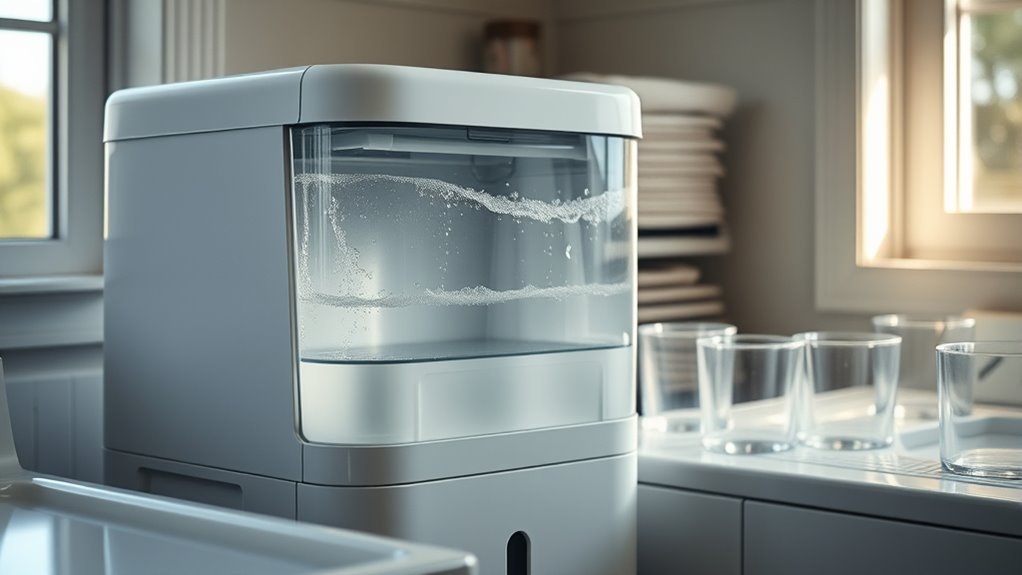
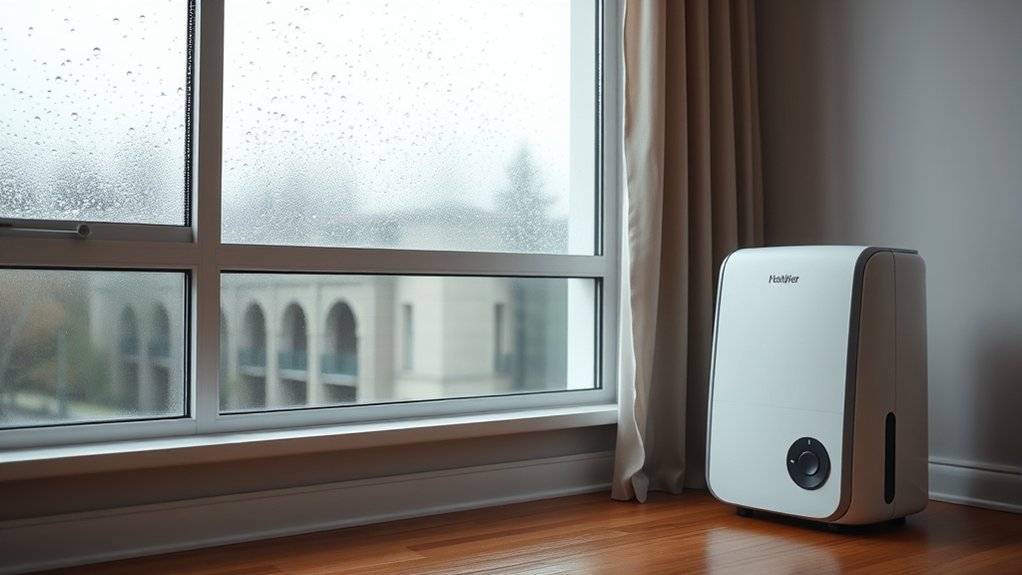
Wondering how much water should a dehumidifier collect per day? It is easy to worry when a “50-pint” unit pulls several gallons of water on day one, or barely a cup a few days later. Because daily water removal depends on your room’s temperature, relative humidity (RH), and moisture load, the water level in the tank is only half the story.
Quick Answer
A portable dehumidifier typically collects anywhere from under 2 pints per day in a dry, stabilized room to 20–50+ pints (2.5–6.25 gallons) per day in a warm, wet basement. Because pint ratings measure output at 65°F and 60% relative humidity, judge performance by whether indoor humidity stays between 30% and 50% rather than by bucket volume.
Key Takeaways
- Pint ratings reflect lab conditions: Current U.S. ratings measure 24-hour output at 65°F and 60% RH, which is about 30% to 35% lower on paper than pre-2019 labels tested at 80°F.
- Tank size is much smaller than daily capacity: Most 20- to 50-pint portable units have a 1- to 2-gallon (8- to 16-pint) bucket, requiring multiple emptyings or a drain hose during heavy drying.
- Expect a 3-to-4-day pull-down phase: Output is highest during the first few days while damp air, concrete, wood, and fabrics release trapped moisture, then drops once the room stabilizes.
- Fast collection means high moisture load: A tank that fills every few hours points to humid air infiltration, wet materials, or water seepage rather than a broken appliance.
- Low collection is only a fault when humidity stays high: If room RH remains above your setting in a 65°F+ space, check for a dirty filter, blocked grilles, coil frost, or sensor failure.
How Much Water Should a Dehumidifier Collect Per Day?
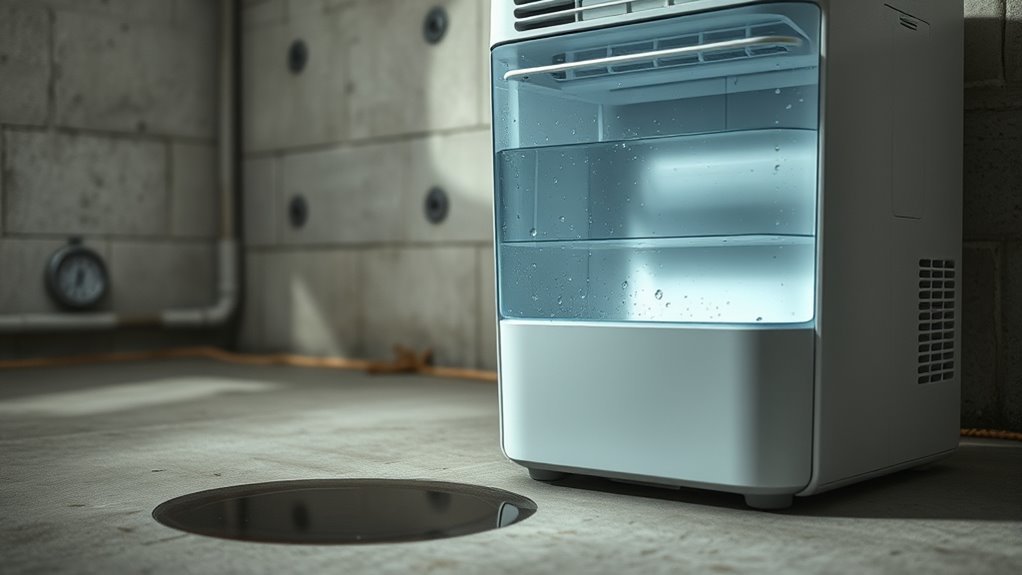
A dehumidifier should collect enough water to bring your room’s relative humidity down to 30%–50%, which means daily output naturally swings from full capacity on damp days to almost zero once the room is dry. A 35- or 50-pint model may pull 3 to 6 gallons (24 to 48 pints) in the first 24 hours in a humid basement, then drop to 2 to 6 pints a day as it cycles on and off to maintain your setting.
The number printed on the box—such as 20, 35, or 50 pints per day (PPD)—is its rated capacity (8 pints equal 1 U.S. gallon). Under the U.S. Department of Energy’s federal test procedure (10 CFR Part 430, Appendix X1), portable dehumidifiers are tested at 65°F (±2°F) dry-bulb temperature and 60% (±2%) relative humidity, while ducted whole-home units are tested at 73°F and 60% RH. Because real rooms rarely stay at exactly 65°F and 60% RH for 24 hours straight, your daily total will vary.
As ENERGY STAR’s testing and capacity guide explains, the federal test temperature for portable units dropped from 80°F to 65°F to better reflect cooler basements. Cooler air holds less water vapor, so modern pint labels look smaller than older ratings for the exact same cooling power: a current 20-pint unit equals an older 30-pint unit, a current 30- to 35-pint unit equals an older 50-pint unit, and a current 45- to 50-pint unit equals an older 70-pint unit.
| Measurement | What It Means | Typical Real-World Numbers |
|---|---|---|
| Rated capacity (current DOE standard) | Moisture removed in 24 hours of continuous operation at 65°F and 60% RH (73°F for whole-home models). | Small: 20–22 pints (2.5–2.75 gal) Medium: 30–35 pints (3.75–4.4 gal) Large: 50 pints (6.25 gal) |
| Bucket (tank) capacity | How much water the removable plastic tank holds before the float switch pauses the unit. | 8 to 16 pints (1 to 2 gallons) on most portable models—only 25% to 40% of the unit’s daily rated capacity. |
| Actual daily collection | The actual water condensed from your room over 24 hours based on temperature, RH, and runtime. | Initial pull-down (70%+ RH): 15–50+ pints/day Maintenance (45%–50% RH): 0–8 pints/day |
Note: A 50-pint dehumidifier usually has a 12- to 16-pint (1.5- to 2-gallon) bucket. In a wet room, it can fill the tank in 6 to 8 hours, shut off automatically, and wait to be emptied three or four times before reaching its full 24-hour output.
Instead of aiming for a full bucket every day, aim for stable indoor humidity. The U.S. Environmental Protection Agency recommends keeping indoor relative humidity between 30% and 50% to inhibit mold growth and dust mites. Controlling indoor dampness and airborne allergens also helps prevent COPD flare-ups and breathing difficulties in people with chronic lung conditions. Once your room holds steady at 45%–50% RH, low daily water collection means the machine has done its job.
How to Measure Your Dehumidifier’s Daily Water Collection
You can measure your dehumidifier’s true 24-hour output by tracking both the total water removed and the drop in room relative humidity with an independent digital hygrometer. Built-in dehumidifier sensors sit right next to the appliance’s coils and fan, so they often read 5% to 10% off from the rest of the room.
- Measure the starting conditions. Place a standalone digital hygrometer/thermometer near the center of the room (away from the dehumidifier’s exhaust) and record the starting RH and temperature.
- Empty and dry the bucket. Slide the clean tank firmly back into its bay so the float switch and magnetic reed sensor engage properly.
- Close doors and windows. Sealing the room stops humid outdoor or hallway air from continuously replenishing the moisture load during your test.
- Set the humidistat to 45% or 50% RH. Select high fan speed for maximum airflow unless your owner’s manual specifies a different test setting.
- Run the unit for 24 hours. Note any hours the compressor sits idle because the full-bucket shutoff triggered before you could empty the tank.
- Measure every emptied bucket. Pour the collected water into a quart or gallon pitcher (1 quart = 2 pints; 1 gallon = 8 pints) and sum the 24-hour total.
- Compare ending RH and temperature. A 10% to 20% drop in room RH confirms the unit is extracting moisture effectively, even if total pints fall below its lab rating.
Pro Tip: Keep a three-day log of starting RH, ending RH, room temperature, runtime hours, and pints collected. According to GE Appliances operating guidelines, a dehumidifier in a very damp room often runs continuously for 3 to 4 days before drying out porous materials and settling into normal cycling.
If the bucket fills overnight and the automatic shutoff pauses the compressor for several hours, your 24-hour total will understate the machine’s true capacity. Attach a continuous drain hose for an uninterrupted 24-hour test in wet spaces.
How Do Dehumidifiers Collect Water?
A compressor (refrigerant) dehumidifier collects water by pulling humid room air across a cold evaporator coil, cooling the air below its dew point so water vapor condenses into liquid droplets. The water drips into the collection tank or drain hose, while the reheated, drier air flows back into the room.
Warm Air Intake
Moisture removal starts with steady airflow through the intake grille and dust filter. When warm, humid air moves freely across the coils, condensation happens rapidly; when a clogged filter, furniture, or a wall blocks the intake, air volume drops and daily water collection plummets.
Air temperature determines how much moisture the air can hold at a given relative humidity. Air at 80°F and 60% RH holds nearly twice as much water vapor per cubic foot as air at 65°F and 60% RH, which is why the exact same dehumidifier pulls far more water in a warm summer laundry room than in a chilly 60°F cellar.
Coil Condensation Process
Inside the cabinet, a sealed refrigerant system chills the evaporator coil below the room air’s dew point temperature. As humid air touches the cold metal fins, invisible water vapor condenses into beads of water and drains downward by gravity.
| Step | What Happens Inside the Unit |
|---|---|
| 1 | The internal fan draws moist room air through the intake grille and washable air filter. |
| 2 | Air passes over the cold evaporator coil, dropping below its dew point temperature. |
| 3 | Water vapor condenses into liquid droplets on the cold coil fins. |
| 4 | Gravity channels the droplets down the drain pan into the bucket, gravity hose, or internal pump reservoir. |
| 5 | The dehumidified air passes over the warm condenser coil and exits into the room 2°F to 5°F warmer. |
Warning: Never drink dehumidifier water, cook with it, give it to pets, or pour it into humidifiers or CPAP machines. This greywater condenses on bare metal coils and sits in an unsterilized plastic bucket, meaning it can harbor mold spores, bacteria, dust, and trace metal ions (such as copper, aluminum, or lead solder). Do not use it on edible garden plants or in steam irons; dispose of it down a drain or use it only to flush toilets.
Water Storage Tank
Condensed water drips into the removable storage tank until the rising water lifts a styrofoam or plastic float switch, triggering the full-tank shutoff. Every portable dehumidifier immediately stops its compressor when the tank is full, tilted, or slightly ajar.
- Check that the bucket sits flush and level inside its compartment after emptying.
- Empty the tank as soon as the “Bucket Full” light illuminates or the alert beeps.
- Wash the tank every 2 to 4 weeks with warm water and mild dish soap to prevent slimy biofilm and musty odors.
- Switch to a gravity hose or built-in condensate pump whenever the tank fills more than once or twice a day.
Remember that tank volume only controls how often you walk to the sink—a larger bucket does not make the compressor extract moisture any faster.
What Affects a Dehumidifier’s Water Output?
Seven primary factors control how many pints of water your dehumidifier collects per day: starting relative humidity, room temperature, active moisture sources, room square footage, humidistat setpoint, airflow clearance, and actual runtime hours. Changing even one of these variables can double or halve daily collection.
| Factor | Effect on Daily Collection | What to Check |
|---|---|---|
| Starting relative humidity | At 75%–90% RH, collection often meets or exceeds the unit’s rated pint capacity; at 45%–50% RH, collection drops sharply. | Verify room RH with a standalone digital hygrometer placed away from the unit. |
| Room temperature | Temperatures above 70°F speed up condensation; temperatures below 65°F cut output and can ice up standard coils. | Keep room temperature within the manual’s range (typically 41°F to 90°F for auto-defrost models). |
| Active moisture sources | Groundwater seepage, plumbing leaks, wet concrete, hang-drying laundry, and unvented showers keep output high indefinitely. | Inspect basement walls, slab cracks, sump pits, dryer vents, and window seals. |
| Room size and air exchange | Open doors, open windows, or spaces over 2,000 sq. ft. continuously feed new humid air into the unit. | Close doors and windows and match the unit’s pint rating to your square footage. |
| Humidity setting | Setting 35%–40% or “Continuous” forces nonstop runtime; setting 50% lets the compressor cycle off once dry. | Set 45%–50% RH for normal living and storage spaces to save electricity. |
| Airflow and clearance | Dusty filters or furniture blocking the grilles starve the cold coil of moist air and reduce daily pints. | Leave at least 18 inches of open space on all sides and rinse the air filter every 2–4 weeks. |
| Actual runtime | Every hour the unit sits idle with a full bucket or on an off-timer reduces 24-hour water removal. | Check timer settings, float movement, and whether a drain hose is needed. |
The best performance target is stable 30%–50% indoor relative humidity, not a constantly full bucket.
Once damp concrete, framing lumber, carpets, and cardboard boxes finish releasing their stored moisture after the first 3 to 4 days, daily water collection should fall noticeably. That drop proves your room is drying out.
Why Isn’t My Dehumidifier Filling Fast Enough?
When a dehumidifier collects little or no water, the most common reason is simply that the room has already reached its target humidity or the air is too cool for efficient condensation. Before assuming a mechanical breakdown, check your independent hygrometer reading and the room temperature against the troubleshooting causes below.
| Possible Cause | What You May Notice | What to Do |
|---|---|---|
| Room is already dry | Your standalone hygrometer reads at or below the setpoint (e.g., 45%–50% RH) and the compressor stays off. | No fix needed—the dehumidifier is maintaining target humidity properly. |
| Setpoint is too high or sensor is off | The room feels clammy and a separate hygrometer reads 60% RH, but the unit’s display says 45% and shuts off. | Lower the humidistat setting by 5%–10% and ensure at least 18 inches of clearance around the unit’s sensor. |
| Cold room or frosted coils | Room is below 65°F; frost or ice coats the rear coils, or the compressor cycles off while the fan runs to defrost. | Unplug to let heavy ice melt, clean the filter, and check your manual’s minimum temperature (usually 41°F for low-temp models). |
| Restricted airflow | Exhaust air feels weak or warm, and the mesh intake filter or grille is caked with lint and dust. | Turn off and unplug the unit, vacuum and rinse the filter, let it dry completely, and reinstall. |
| Misaligned bucket or stuck float | The “Bucket Full” light stays on or blinks even when the tank is completely empty. | Reseat the tank squarely and verify that the internal float arm and magnet move freely without binding. |
| Compressor or refrigerant fault | The fan blows in a warm (65°F+), humid (60%+ RH) room, but the exhaust air isn’t warm, coils aren’t cold, and zero water drips after 12–24 hours. | Check the manual for error codes and warranty service; sealed refrigerant leaks typically require unit replacement. |
As ENERGY STAR’s dehumidifier guidance points out, standard compressor coils frequently ice over when room temperatures drop below 65°F. While many modern basement units include auto-defrost cycles that let them operate down to 41°F, they still pause moisture removal whenever the defrost cycle runs, cutting daily pint output significantly in chilly spaces. Note that a light coating of frost during the first 30 to 60 minutes of startup is normal, whereas thick ice buildup indicates low room temperature or a clogged air filter.
Recommended Products

1-【Widely Application】The digital LCD monitor can be used in home, office, garage, schools, hotels, laboratories, kindergartens, aquaculture, instrument workshop, warehouse, reptile tank terrarium, aquarium, hermit crab habitat, and other places where temperature/humidity measurement is required.

1-【Widely Application】The digital LCD monitor can be used in home, office, garage, schools, hotels, laboratories, kindergartens, aquaculture, instrument workshop, warehouse, reptile tank terrarium, aquarium, hermit crab habitat, and other places where temperature/humidity measurement is required.

Face Icon Comfort Indicator: Humidity temperature gauge features face icons to indicate DRY/COMFORT/WET air conditions, quickly informs you how to adjust your humidifier or dehumidifier to achieve optimal comfort.
Why Is My Dehumidifier Collecting Too Much Water?
A dehumidifier cannot manufacture water—if its tank fills up two to four times a day, it is pulling that moisture directly from humid indoor air, wet building materials, or an active water intrusion source. High water collection proves the refrigeration system is working hard against a heavy moisture load.
Recommended Products
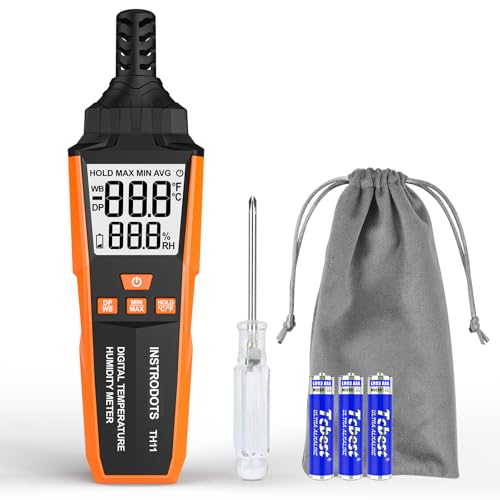
HIGH-PRECISION THERMOMETER HYGROMETER - Unlike traditional temperature humidity meter, this digital hydrometer adopts a high-precision semiconductor sensor from SWITZERLAND to ensure measurements accurately and quickly. With short response time and strong anti-interference ability, more secure and accurate, the humidity meter can be used for a wide range of applications.

【Readings be Switched Between Fahrenheit and Celsius】 Round Digital Thermometer ease to achieve the mutual conversion between Fahrenheit (°F) and Celsius (°C),(with temperature switch button- °C/°F mode)

Wellness Indicator: This humidity meter with humidity level icon indicates air conditions - DRY/COMFORT/WET, allowing this humidity sensor to ensure you’re always aware of changes to your home/household with just a quick glance
High Humidity Levels
When starting humidity sits between 70% and 95% RH—common in summer basements, crawl spaces, laundry rooms, or after a leak—even a mid-size unit will fill its 1- to 2-gallon bucket every 6 to 10 hours. Follow these steps to tell whether your unit is catching up or losing ground:
- Check your standalone hygrometer at the start and end of a 24-hour run.
- Verify whether room RH is steadily dropping toward 50% over 3 to 4 days.
- Compare your room’s size and dampness against ENERGY STAR’s recommended capacity bands:
- Slightly to moderately damp (50%–75% RH): 20–30 PPD under 2,000 sq. ft. (30+ PPD over 2,000 sq. ft.)
- Very damp (75%–90% RH): 25–40 PPD under 2,000 sq. ft. (40+ PPD over 2,000 sq. ft.)
- Wet with visible condensation or seepage (90%–100% RH): 30–50 PPD under 2,000 sq. ft. (50+ PPD over 2,000 sq. ft.)
- Confirm that basement windows, exterior doors, and crawl space vents stay shut during humid weather.
- Switch from “Continuous” mode to a 45%–50% RH target once the space dries out so the unit stops over-drying porous surfaces.
If bucket volume stays high for the first few days while RH drops from 75% to 50%, your dehumidifier is sized properly. If the machine runs 24/7 for more than 4 days and RH remains stuck above 60%, either the unit is undersized for the square footage or new moisture is continuously entering the room.
Warm Damp Placement
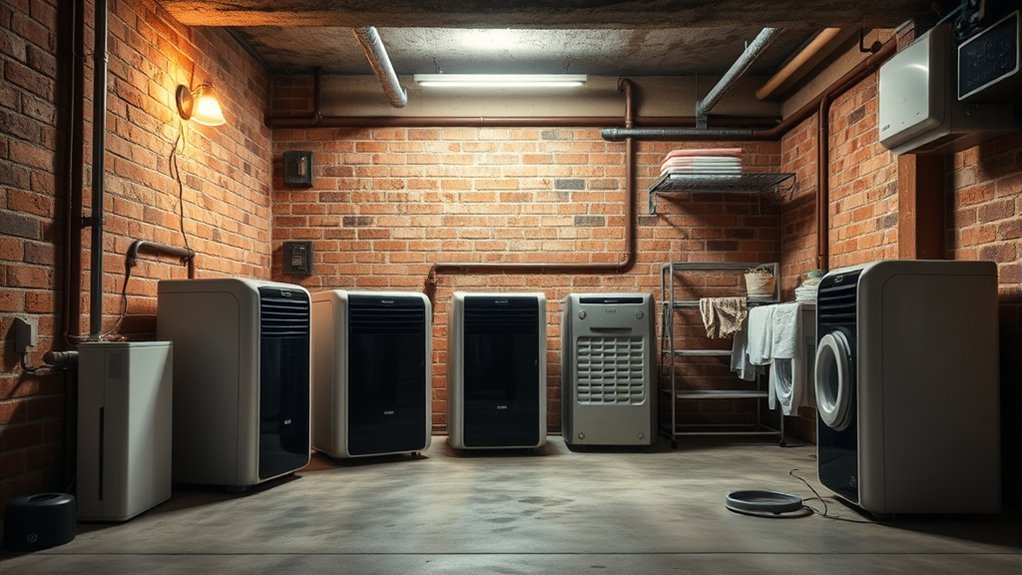
Placing a dehumidifier in a warm, damp area maximizes daily condensation because warm air carries a heavy load of water vapor into the cold coils. Basements surrounded by damp soil, utility rooms with uninsulated cold-water pipes, and rooms connected to unconditioned crawl spaces routinely produce gallons of condensate every day.
Moving the appliance to a drier room upstairs will reduce how often you empty the bucket, but it leaves the damp area vulnerable to mold growth within 24 to 48 hours. Instead, track down and eliminate the moisture source:
- Plumbing and appliance leaks: Check water heaters, washing machine hoses, sink traps, and boiler relief valves.
- Foundation and slab seepage: Look for efflorescence (white powdery mineral deposits), damp cove joints, or hairline cracks in concrete walls and floors, and ensure exterior gutters and downspouts carry rainwater away from the foundation.
- Wet materials: Remove or dry soaked carpet padding, drywall, insulation, and cardboard boxes within 24 to 48 hours.
- Unvented clothes dryers: Confirm the dryer exhaust duct vents completely outdoors and hasn’t come loose behind the machine.
- Open windows in summer: Opening basement windows on warm, muggy days floods cool subterranean walls with high-dew-point air that immediately condenses.
- Blocked exhaust fans: Run vented bathroom and kitchen exhaust fans during showers and cooking.
- Uncovered sump pits or floor drains: Install an airtight lid over open sump basins so standing groundwater cannot evaporate into the basement air.
Warning: A dehumidifier removes water vapor from the air, but it cannot fix a plumbing leak, stop foundation seepage, or replace standing-water extraction. If standing water reaches the appliance, power cord, or wall outlet, do not step into the water—shut off power at the main circuit breaker only if your footing is completely dry, and call a licensed professional.
When Should You Empty the Tank or Use a Drain Hose?
Empty the bucket whenever the full-tank light turns on, or switch to a continuous drain hose if your dehumidifier fills its tank more than once a day. Because a 35- or 50-pint dehumidifier only holds 1 to 2 gallons (8 to 16 pints) in its removable tank, manual emptying quickly becomes impractical in a damp basement.
- Manual bucket emptying: Best for bedrooms, living areas, or already-dry spaces where the tank only needs emptying every few days. Empty and rinse the bucket before turning the unit off for extended periods so stagnant water does not grow mold or bacteria.
- Gravity drain hose: Best when a floor drain or sump pit sits lower than the threaded hose outlet on the back or side of your dehumidifier. Most portable units accept a standard 3/4-inch garden hose thread.
- Built-in condensate pump: Best when water must be pushed upward (typically up to 15 feet vertically) into a utility sink, laundry standpipe, or window drain.
For reliable gravity drainage, GE’s dehumidifier drainage guidance emphasizes cutting the garden hose to the shortest practical length and routing it on a continuous downward slope to the floor drain with no upward loops, kinks, or submerged ends. Also make sure the removable bucket stays firmly seated inside the cabinet—most portable dehumidifiers (both gravity-drain and pump models) will not run if the bucket is removed, and internal drain pumps only activate once the bucket fills.
Recommended Products
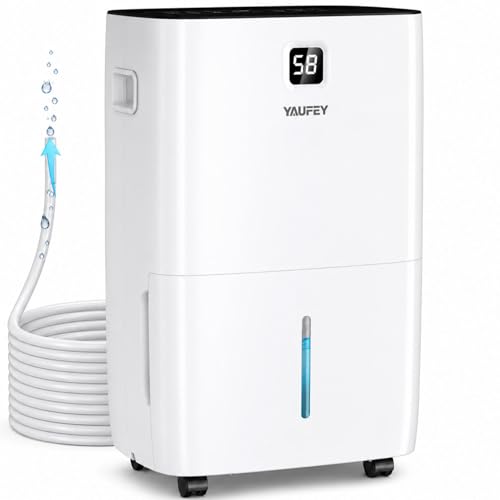
Dehumidifier for Basement: This dehumidifier for home removes up to 150 pints (95℉, 90% RH) of moisture per day and with a maximum dehumidification area of 8500 square feet. This dehumidifier with drain hose has a dehumidification range of 30% to 80%, increasing or decreasing by 5% at a time, which you can adjust to your preferred humidity level. In addition, this basement dehumidifier has 3 modes for you to choose from - Living Area (50% RH), Basement (45% RH) and Continuous (CO).

AUTOMATIC CONDENSATE PUMP: features a vertical-type switch to reduce footprint and is designed to automatically remove condensate produced by boilers, furnaces, air conditioners and de-humidifiers

Energy- Efficient Performance: avylo dehumidifier Certified ENERGY STAR Most Efficient 2025 with an EER of 2.05 L/kWh; Powered by a high-efficiency compressor and optimized airflow design, with a maximum daily dehumidification capacity of 90 pints(90°F,90% RH); Ideal for basements, home, living rooms, garages, and large areas up to 5000 sq. ft., keeping your home dry, comfortable
How to Keep Water Output Consistent
Simple monthly maintenance keeps airflow strong and prevents slime or dust from blocking the coil, float switch, and drain lines. Always turn the dehumidifier off and unplug it from the wall before cleaning any part of the unit.
- Clean the air filter every 2 to 4 weeks: Vacuum loose dust and rinse the mesh filter in warm water, then let it dry completely before reinstalling.
- Maintain 18 inches of clearance: Keep the intake and exhaust grilles at least 18 inches away from walls, curtains, storage totes, and furniture so air circulates freely across the room.
- Wash and sanitize the bucket: Scrub the water tank every few weeks with mild dish soap and warm water to prevent algae and biofilm buildup.
- Test the float switch: Confirm the float pivots smoothly and hasn’t become weighed down by mineral scale or slime.
- Flush drain hoses and ports: Inspect gravity hoses and pump tubing periodically for kinks, sediment, or algae blockages.
- Monitor for coil frost: Check the rear intake grille in cool basements; if frost persists beyond 60 minutes, clean the filter and verify the room stays above the model’s minimum operating temperature.
- Plug directly into a grounded 15-amp wall outlet: Never use an extension cord or power strip with a dehumidifier, as high continuous current draw can overheat undersized cords.
When Should You Call a Dehumidifier Professional?
Call the manufacturer’s support line, an authorized appliance technician, or a licensed electrician if your dehumidifier shows electrical hazards, mechanical noises, or zero water collection in a warm, humid room. A rapidly filling bucket is normal in a damp room and does not require appliance repair, though chronic water intrusion may require a waterproofing contractor or plumber.
Unplug the dehumidifier immediately and stop using it if you notice any of these warning signs:
- A burning plastic, acrid, or electrical odor
- Sparks, smoke, a hot wall plug, or a frayed power cord
- A 15-amp circuit breaker or GFCI outlet that trips repeatedly
- Loud grinding, metal-on-metal scraping, or violent compressor rattling
- A fan motor or compressor that fails to start when set well below room RH
- Thick ice blocks on the evaporator coil that return after cleaning the filter in a 65°F+ room
- Persistent digital error codes indicating a humidity sensor or sealed-system fault
- Water pooling underneath the cabinet while the bucket and drain connections are dry and properly seated
- Zero water condensed over 24 hours while room temperature is above 65°F and measured RH is 60% or higher
Check your warranty coverage and serial number before scheduling paid repairs. Because portable dehumidifiers use hermetically sealed refrigeration systems, an out-of-warranty compressor burnout or refrigerant leak usually costs more to repair than replacing the unit.
Frequently Asked Questions
Should a Dehumidifier Fill Up Every Day?
No, a dehumidifier does not need to fill its bucket every day to work properly. During the first 3 to 4 days in a damp basement or during muggy summer weather, the 1- to 2-gallon tank may fill multiple times a day. Once the room reaches its 30% to 50% relative humidity target, the compressor cycles off for long stretches and collects far less water.
How Much Water Is Normal to Come Out of a Dehumidifier?
Normal daily water output ranges from less than 2 pints in an already-dry room to 20–50+ pints (2.5 to 6.25 gallons) in a warm, wet space. Rather than looking for a fixed daily pint total, check a standalone hygrometer: if indoor relative humidity drops into the 30% to 50% range and holds steady, your dehumidifier’s output is normal.
Does a 50-Pint Dehumidifier Collect 50 Pints Every Day?
No, a 50-pint dehumidifier only removes 50 pints (6.25 gallons) per day when running nonstop at the federal test condition of 65°F and 60% relative humidity. In a cooler or drier room, it will collect much less water, and because its removable bucket typically holds only 12 to 16 pints (1.5 to 2 gallons), it will pause whenever the tank fills unless connected to a drain hose.
Why Does My Dehumidifier Collect Less Water After a Few Days?
Collecting less water after 3 to 4 days is usually a sign that your room air, concrete, wood, and furnishings have dried out. As relative humidity drops toward your 45% or 50% setpoint, less water vapor remains in the air to condense on the coils. Verify with a separate hygrometer that room humidity has actually fallen before troubleshooting the unit.
Can You Reuse Water From a Dehumidifier?
You can use dehumidifier water to flush toilets, but you should never drink it, cook with it, give it to pets, water edible crops, or pour it into steam irons, humidifiers, or CPAP machines. Because the condensate forms on bare metal coils and sits in an unsterilized bucket, it can contain mold spores, bacteria, dust, and trace metal residue.
Conclusion
Your dehumidifier’s success is measured by a comfortable 30% to 50% relative humidity reading on a room hygrometer, not by how many times you carry a full bucket to the sink. Expect heavy water collection during the first 3 to 4 days in a warm, damp room, followed by a steady drop in daily pints once the space dries out.
To check your unit today, place an independent digital hygrometer in the room, set the humidistat to 45%–50%, clean the air filter, and make sure the cabinet has at least 18 inches of airflow clearance. If the bucket fills more than once or twice a day, attach a downward-sloped garden hose or activate the built-in pump—and if humidity stays above 60% after several days, inspect the room for air leaks, foundation seepage, or plumbing issues.
Sources
- ENERGY STAR: Dehumidifier Testing and Capacity: Explains rated pint capacity, the 80°F-to-65°F federal testing change, and old-versus-new capacity equivalents.
- ENERGY STAR: Dehumidifiers: Provides room-size capacity charts by dampness level, low-temperature coil frost guidance, and energy-saving tips.
- 10 CFR Part 430, Appendix X1: Establishes the U.S. Department of Energy test procedure for portable (65°F, 60% RH) and whole-home (73°F, 60% RH) dehumidifiers.
- U.S. EPA: Care for Your Air: Recommends maintaining indoor relative humidity between 30% and 50% and drying wet materials within 24 to 48 hours to prevent mold.
- GE Appliances: Ideal Dehumidifier Operating Conditions: Details the 18-inch airflow clearance rule, 41°F–90°F temperature limits, normal 30–60 minute startup frost, and 3-to-4-day initial continuous runtime.
- GE Appliances: Dehumidifier Draining Options: Covers manual tank emptying, downward-sloped gravity garden hose setup, and internal condensate pump operation.
- National Heart, Lung, and Blood Institute: Living With COPD: Supports indoor air quality management and trigger reduction for people with chronic respiratory conditions.

[…] and how comfortable it will be to live with day after day. The most important numbers are pints per day, Integrated Energy Factor (IEF), airflow, noise level, operating temperature, and drainage type. […]
[…] it uses electricity, and how easy it will be to run in your room. The ratings to check first are pints per day and Integrated Energy Factor (IEF). Then compare airflow, noise, operating temperature, drainage […]
[…] warm spaces where quiet operation matters more than fast drying. They usually remove ounces of water per day, not pints. If the space stays above 60% relative humidity after several days of continuous use, […]
[…] capacity is measured in pints per day, which means how much water the unit can remove from the air in 24 hours under test conditions. […]
[…] Most portable dehumidifiers work best on a smooth, level surface that can support the unit when the water bucket is full. For example, a Midea dehumidifier manual advises placing the unit on a smooth, level floor […]
[…] A dehumidifier may produce little or no water when the room is already dry or cool. ENERGY STAR notes that frost can form on some units below about 65°F (18°C), reducing moisture removal. If coils are icy, turn the unit off and let it defrost according to the manual before testing drainage again. If the drain works but water output still seems low, see how much water a dehumidifier should collect per day. […]
[…] A bucket that fills within several hours does not automatically mean the unit is faulty. It may be removing moisture from humid air, damp concrete, wet laundry, a recent leak, or building materials that have absorbed water. Check the room with a separate hygrometer and look for open windows, plumbing leaks, foundation seepage, or other moisture sources. For a deeper performance check, see how much water a dehumidifier should collect per day. […]
[…] For a rough estimate, divide the usable bucket volume by the amount of water collected over 24 hours. If the bucket reaches about half full in 24 hours under stable conditions, for example, plan to check it again before roughly another 24 hours have passed. Actual performance will change as the room dries or outdoor humidity changes. If you are trying to judge whether the amount itself is normal, see our guide to how much water a dehumidifier should collect per day. […]
[…] daily water collection will vary with RH, temperature, runtime, and moisture entering the home. See how much water a dehumidifier should collect per day for a practical performance-check […]
[…] moisture entering the room. Low water collection does not always mean the appliance has failed. See how much water a dehumidifier should collect per day for a fuller performance […]
[…] If you are unsure whether a powered unit is removing enough water, see our guide to how much water a dehumidifier should collect per day. […]
[…] filling points to a high moisture load, but bucket volume is not the same as rated capacity. See how much water a dehumidifier should collect per day for a better performance […]
[…] Unit runs but removes little or no water […]
[…] amount depends on your toilet and how much water your dehumidifier collects. Older inefficient toilets can use substantially more water per flush than modern WaterSense […]
[…] A falling reading, water in the bucket or drain, warmer dry air leaving the unit, and reduced condensation are all useful signs. However, tank volume alone is not a reliable performance test because collection naturally slows as the room becomes drier. For more detail on interpreting condensate volume, see how much water a dehumidifier should collect per day. […]
[…] There is no universal number of pints that every dehumidifier should collect in a day. Actual collection depends on rated capacity, room size, starting humidity, temperature, runtime, air leakage, wet materials, and ongoing moisture sources. For a dedicated 24-hour measurement method, see our guide to how much water a dehumidifier should collect per day. […]
[…] If you are trying to decide whether the amount of collected water is normal, see how much water a dehumidifier should collect per day. […]
[…] A dehumidifier consumes electricity and releases some heat into the space, so it does not automatically lower total energy use. It may improve comfort enough to avoid setting the thermostat unusually low. When buying a unit, compare capacity, drainage options, noise, low-temperature performance, and energy efficiency. ENERGY STAR says certified dehumidifiers are 20% more efficient than non-certified models under its current specification. If you want to judge real-world output after installation, see how much water a dehumidifier should collect per day. […]
[…] How Much Water Should a Dehumidifier Collect Per Day? […]
[…] The amount collected in the bucket should usually fall as the room dries, but that trend alone is not proof. Weather changes and new moisture can raise collection again. For a deeper performance check, see how much water a dehumidifier should collect per day. […]
[…] you are unsure whether the amount of collected water is normal, see how much water a dehumidifier should collect per day. If the room stays humid despite correct setup, use the dedicated guide to troubleshoot a […]