Affiliate disclosure: As an Amazon Associate I earn from qualifying purchases. This article contains affiliate links to Amazon, so we may earn a commission if you buy through them, at no extra cost to you.
The two best baby monitors for 2026 are the Infant Optics DXR-8 Video Baby Monitor and the VAVA Baby Monitor with 2 Cameras. Infant Optics offers a reliable non-WiFi design, clear audio, strong range, and interchangeable lenses. VAVA adds split-screen viewing, 720P video, two-way audio, and a long-lasting battery. Both stand out for privacy, night vision, and ease of use. More details can help narrow the right choice for any nursery.
Infant Optics DXR-8 Video Baby Monitor
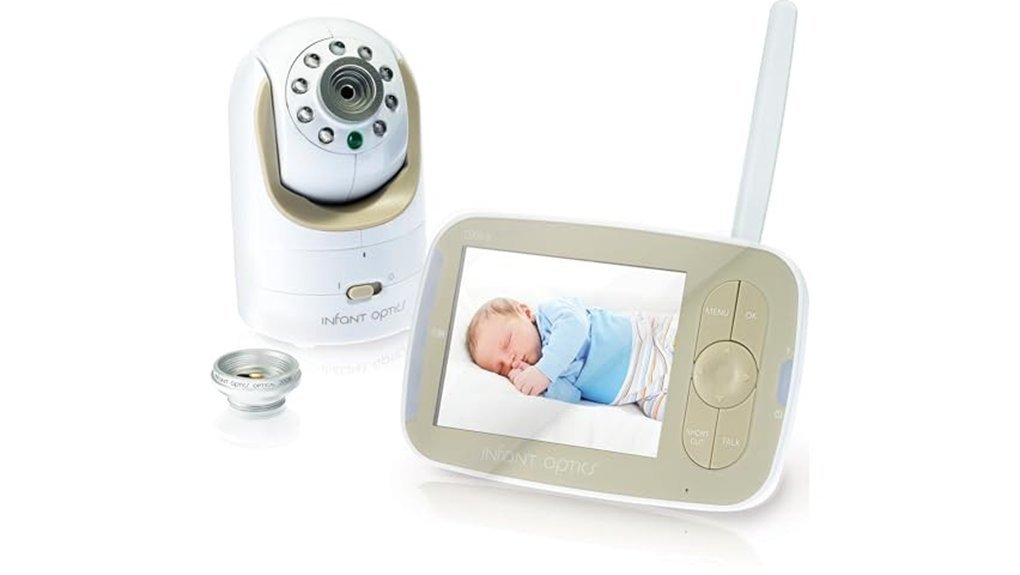
The Infant Optics DXR-8 Video Baby Monitor is a strong choice for parents who want a reliable, privacy-focused monitor with straightforward controls. The DXR-8 delivers 480p video and clear audio through a dedicated non-WiFi unit, avoiding internet-based access and smartphone dependency. Its long battery life and exceptional signal range support extended monitoring. Button-controlled pan, tilt, and zoom functions add flexibility, while interchangeable lenses allow different viewing angles. The monitor emphasizes simplicity, privacy, and dependable performance. Its compact design and easy controls make it practical for everyday use in a family setting.
Best For: Parents who want a reliable, privacy-focused baby monitor with easy-to-use controls, long battery life, and no WiFi dependency.
Pros:
- Non-WiFi design helps protect privacy and avoids internet-based access.
- Long battery life and strong signal range support extended monitoring.
- Interchangeable lenses plus pan, tilt, and zoom offer flexible viewing.
Cons:
- 480p resolution is clear but not as sharp as higher-resolution monitors.
- Wide-angle lens is sold separately, adding extra cost for more viewing options.
- Lacks smartphone app connectivity for remote viewing on a phone.
VAVA Baby Monitor with 2 Cameras, Two-Way Audio
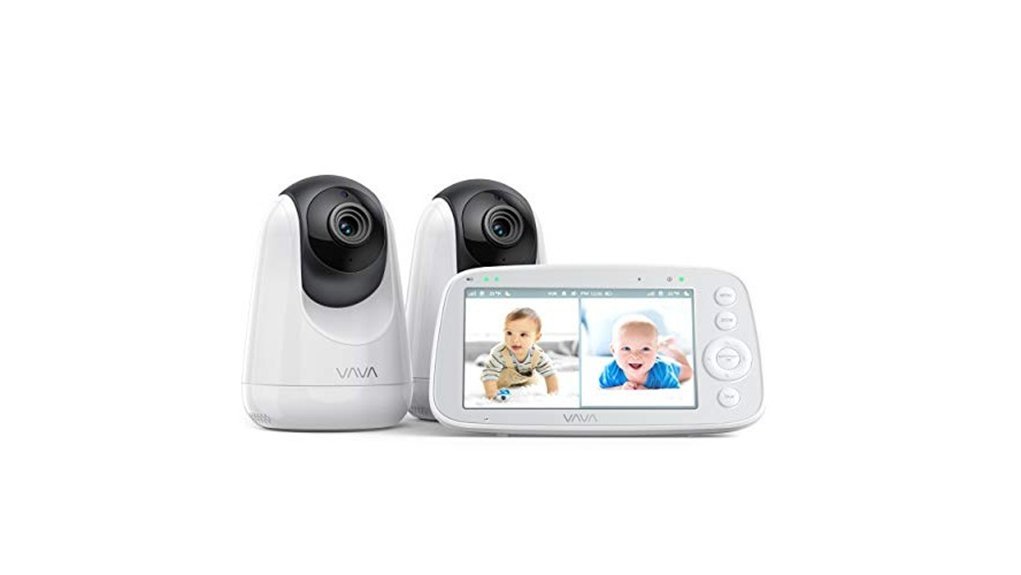
With split-screen viewing, VAVA suits parents monitoring two children or two nursery angles. The 5-inch handheld display shows 720P video, giving sharper detail than older units, while full-color daytime viewing and greyscale infrared night vision preserve clarity around the clock. Two-way audio lets caregivers speak directly to the baby, and LED noise indicators provide quick visual alerts. A 4500mAh battery supports up to 12 hours with the display on, or 24 hours off. Its 480ft to 900ft range keeps the feed stable across rooms, and 2X, 4X zoom plus auto-pilot panoramic scanning improve coverage.
Best For: Parents who want a reliable two-camera baby monitor with a large display, clear day/night video, and easy room-to-room monitoring.
Pros:
- 5-inch 720P handheld display with split-screen viewing for two cameras
- Two-way audio, LED noise alerts, and clear infrared night vision
- Strong wireless range plus useful zoom and auto-pilot panoramic scanning
Cons:
- Screen size may still feel small for users wanting a larger monitor
- Battery life is good, but full-time display use may still require daily charging
- Best features are geared toward in-home monitoring rather than remote app-based access
Factors to Consider When Choosing Baby Monitors 2026: Top Picks and Buying Guide
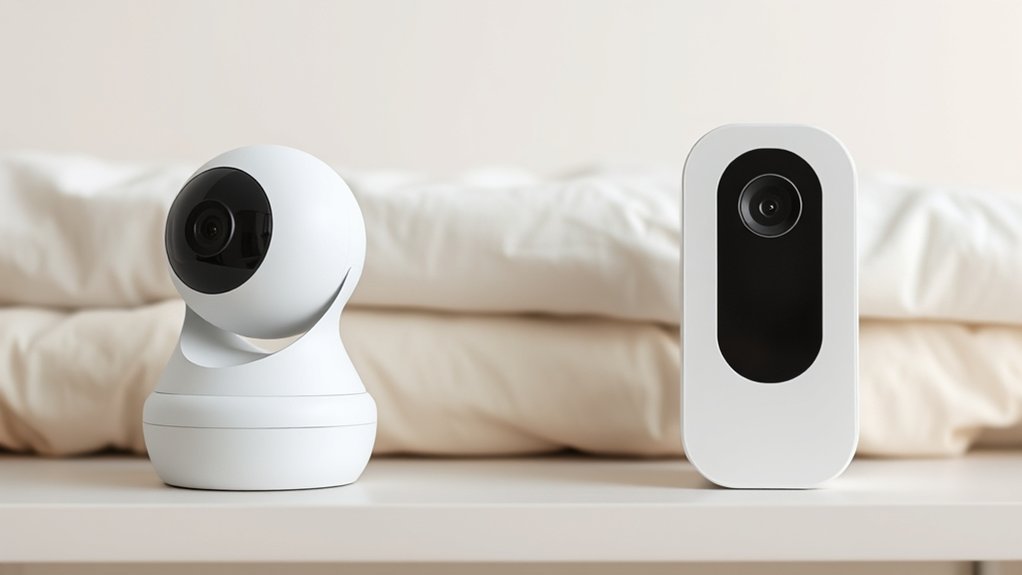
In 2026, choosing a baby monitor depends on several practical factors that shape everyday use. Video resolution, battery performance, wireless range, audio clarity, and night vision each play a key role in overall reliability. A strong monitor balances these features to support clear, dependable supervision.
Video Resolution
Video resolution plays a major role in how clearly a baby monitor displays your child and the surrounding environment, making it easier to spot important details at a glance. Higher resolutions deliver sharper images, helping caregivers assess posture, movement, and room conditions with less effort. Common options include 480p, 720p, and 1080p, with 720p offering roughly three times the detail of 480p. That added clarity becomes especially useful at night when paired with infrared night vision, which can preserve visibility in low light. The display size also matters, since a larger screen can make fine details easier to see and viewing more comfortable. Choosing the right balance between resolution and screen size improves overall monitoring quality.
Battery Performance
Battery performance matters just as much as image quality because a baby monitor must stay powered through naps, bedtime, and overnight use. Higher-capacity batteries typically deliver longer run times, with some models lasting about 12 hours in display mode and up to 24 hours with the display turned off. Rechargeable batteries are preferable because they reduce frequent replacements and support continuous monitoring. It is also useful to check whether manufacturers list separate figures for active use and standby, since real-world battery life can vary widely. Low-battery indicators add another layer of reliability by warning caregivers before shutdowns occur. For nighttime use, efficient long-duration operation is especially valuable, since frequent recharging can interrupt monitoring and reduce convenience.
Wireless Range
Wireless range is a key factor because it determines how far a caregiver can move from the nursery while still receiving a clear signal, with many monitors spanning roughly 480 feet to more than 900 feet. In practice, the quoted distance should be treated as a starting point, not a guarantee. Walls, floors, and nearby electronics can reduce performance, especially in larger homes or houses with dense construction. A longer range supports moving between rooms, stepping into the yard, or handling chores without losing coverage. For families monitoring more than one child or space, split-screen models may be useful when all cameras remain within the supported range. Manufacturer specifications should always be checked against the home’s layout to confirm suitability.
Audio Clarity
Audio clarity matters as much as range, since a monitor is only useful if it reliably carries a baby’s cries, coos, and other sounds without distortion. Strong models preserve natural sound and reduce muffling, making it easier to notice changes in tone or urgency. Two-way audio adds value by letting caregivers speak back clearly while still receiving alerts for disturbances. LED noise indicators provide a visual backup, helping when ambient noise or distance makes listening difficult. Monitors with advanced audio filtering can suppress background chatter, fan noise, or household activity, improving the focus on baby sounds. Battery life also deserves attention, because long-lasting power supports uninterrupted monitoring through naps and overnight periods. Reliable audio performance is thus a core feature, not an optional extra.
Night Vision
Night vision is essential for keeping a clear view of the baby after lights out, and most monitors rely on infrared cameras to provide that visibility without disturbing sleep. Automatic infrared modes are common, letting the system switch from daylight to darkness without manual changes. Range matters: some units clearly show a crib at only a few feet, while stronger models can reach beyond 30 feet in the dark. Higher-resolution night vision improves detail, helping caregivers notice subtle movement or position changes. Many monitors also include indicators or small LED lights that confirm night vision is active, reducing guesswork. For buyers, the best choice balances clarity, coverage, and reliable automatic operation so the monitor performs consistently through overnight use.
Privacy Protection
Privacy protection has become a major factor in choosing a baby monitor, especially for families that want to avoid unnecessary exposure of audio and video feeds. A model that works without WiFi can reduce risk by avoiding third-party access and limiting online vulnerabilities. Digital privacy features help keep transmitted data secure, while robust encryption adds another layer against hacking attempts. Non-internet-connected monitors also support dedicated viewing units and instant playback, lowering dependence on smartphones and reducing breach exposure. Families often favor monitors that clearly prioritize privacy, since sensitive information should not travel across insecure networks. In practice, the safest options are those that combine closed transmission systems, strong encryption, and minimal connectivity, creating a more controlled environment for monitoring.
Screen Size
Beyond security and connection type, screen size plays a major role in how practical a baby monitor feels day to day. Larger displays, usually 3.5 to 5 inches, make it easier to see the baby clearly and catch important details without constant leaning in. That added visibility can also reduce eye strain, especially when checking the feed from across a room. Many larger screens pair well with 720p or higher resolution, which sharpens both daytime and nighttime video. Some monitors include split-screen support, letting several cameras appear at once on one display. Portability still matters, though, so lightweight and compact units are often preferred for moving around the home while keeping the image easy to view.
Zoom Features
Zoom features help parents view a baby more clearly without moving the camera or changing position, which can be especially useful during quick checks at night or across a larger nursery. A monitor with 2X to 4X zoom can reveal small movements, facial expressions, or blanket placement with greater precision. Remote pan, tilt, and zoom controls add convenience by letting the camera be adjusted from the parent unit, helping maintain full nursery coverage. Some models also include interchangeable lenses, such as wide-angle and zoom options, which provide more flexibility for different room layouts. Strong zoom performance is particularly valuable in low light, where clearer magnification can reduce manual adjustments and support steadier monitoring throughout the day and night.
Frequently Asked Questions
How Do Baby Monitors Protect Against Hacking?
Baby monitors protect against hacking by using encrypted connections, strong passwords, regular firmware updates, and secure Wi‑Fi settings. Some also offer two-factor authentication and device alerts, reducing unauthorized access and protecting privacy.
Can Baby Monitors Track Room Temperature Accurately?
Yes, many baby monitors can track room temperature fairly accurately, though sensor quality varies. Their readings are usually useful for general comfort monitoring, but dedicated thermometers typically provide more precise measurements and faster updates.
Do Baby Monitors Work During Power Outages?
Usually not; during a blackout, most monitors become silent little paperweights, while battery-backed or battery-powered models keep watching. Parental vigilance, ironically, still depends on electricity unless the monitor has its own reserve power.
Are Baby Monitor Apps Compatible With All Smartphones?
No, baby monitor apps are not compatible with all smartphones. Compatibility depends on operating system, app version, hardware, and minimum requirements. Some apps support only recent iPhones or Android devices, limiting universal use.
How Far Can Baby Monitors Transmit Through Walls?
How far through walls can they transmit? Typically, baby monitors reach 100–1,000 feet in open space, but walls reduce that dramatically; several interior walls can weaken or block signals, especially for Wi‑Fi or older analog units.
Conclusion
Like a lantern in a quiet nursery, the best monitors do more than watch; they guide anxious parents through the night. The Infant Optics DXR-8 stands as a steady lighthouse, while the VAVA with two cameras resembles twin sentries keeping guard. In choosing between them, families weigh clarity, battery life, night vision, privacy, screen size, and zoom, seeking a device that turns uncertainty into calm and darkness into reassurance.