Best Dehumidifier for Basement With Hose in 2026
Last updated: June 26, 2026
Affiliate disclosure: This article contains Amazon affiliate links. If you buy through these links, we may earn a commission at no extra cost to you.
If you need a basement dehumidifier with a hose in 2026, the right pick depends on three things: basement size, daily moisture load, and where the water will drain. A compact model can work for a smaller finished basement, but a damp, unfinished space usually needs higher pint capacity and reliable continuous drainage. HOPSEN’s 34-pint model fits medium spaces, Waykar’s 80-pint Energy Star unit handles larger basements, KeepGlad is quiet and compact for smaller rooms, Aiusevo offers a 21-pint design with a drain hose, and Vellgoo Max delivers strong 64-pint performance with anti-overflow protection.
Use this guide to compare hose length, coverage area, tank size, noise level, portability, energy efficiency, and drainage setup before choosing. The best option should keep humidity steady, reduce musty air, and limit how often you need to empty a bucket. For the best results, choose a model that can hold your basement near the common 30% to 50% indoor humidity range, while also matching your drain location and basement layout.
Quick Verdict
Best overall for large damp basements: Waykar 80 Pint Energy Star Dehumidifier with Drain Hose.
Best balance of power and longer hose setup: Vellgoo Max 64 Pint Dehumidifier for Basement.
Best compact quiet option: KeepGlad Dehumidifier for Home with 7 Ambient Lights.
Best medium-basement pick: 34 Pints/Day Dehumidifier for Home and Basement.
Best portable 1,500 sq. ft. option: 1500 Sq. ft Dehumidifier with Drain Hose.
Quick Picks
- Best for medium basements: 34 Pints/Day Dehumidifier for Home and Basement
- Best for large damp basements: Waykar 80 Pint Energy Star Dehumidifier with Drain Hose
- Best quiet compact option: KeepGlad Dehumidifier for Home with 7 Ambient Lights
- Best portable 1,500 sq. ft. option: 1500 Sq. ft Dehumidifier with Drain Hose
- Best high-capacity energy-efficient pick: Vellgoo Max 64 Pint Dehumidifier for Basement
How We Compared These Basement Dehumidifiers
To make the comparison easier, this guide focuses on buyer-use factors that matter most in a basement: listed coverage area, moisture removal rate, hose drainage support, tank backup, portability, noise level, energy-saving features, and ease of maintenance. Because basement conditions vary, the best choice is not always the highest-capacity unit. A finished basement office may need quiet operation, while a large unfinished basement may need stronger pint removal and better hose placement.
Before You Buy Checklist
- Measure your basement: Match the unit to square footage and dampness level, not just the product name.
- Check the drain location: Gravity drainage needs a downhill path from the dehumidifier to the drain.
- Look at hose length: A short hose may require placing the unit close to a floor drain.
- Decide if you need a pump: If the hose must drain uphill, choose a pump-ready setup.
- Plan for maintenance: Washable filters and auto shut-off help keep the unit easier to manage.
Basement Dehumidifier With Hose Comparison
| Product | Best For | Coverage | Moisture Removal | Drainage | Amazon |
|---|---|---|---|---|---|
| 34 Pints/Day Dehumidifier for Home and Basement | Medium basements and everyday moisture control | Up to 2,500 sq. ft. | Up to 34 pints/day | Continuous drainage supported | Check Price |
| Waykar 80 Pint Energy Star Dehumidifier with Drain Hose | Large damp basements | Up to 5,000 sq. ft. | Up to 80 pints/day | Includes 3.3-foot drain hose | Check Price |
| KeepGlad Dehumidifier for Home with 7 Ambient Lights | Quiet use in smaller or medium spaces | Up to 1,000 sq. ft. | Up to 40 ounces/day | Includes drain hose | Check Price |
| 1500 Sq. ft Dehumidifier with Drain Hose | Portable use in basements, laundry rooms, and RVs | Up to 1,500 sq. ft. | Up to 21 pints/day | Includes 3.28-foot hose | Check Price |
| Vellgoo Max 64 Pint Dehumidifier for Basement | Large basements needing strong, efficient moisture control | Up to 4,000 sq. ft. | Up to 64 pints/day | Includes 6.56-foot hose and garden hose adapter | Check Price |
34 Pints/Day Dehumidifier for Home and Basement
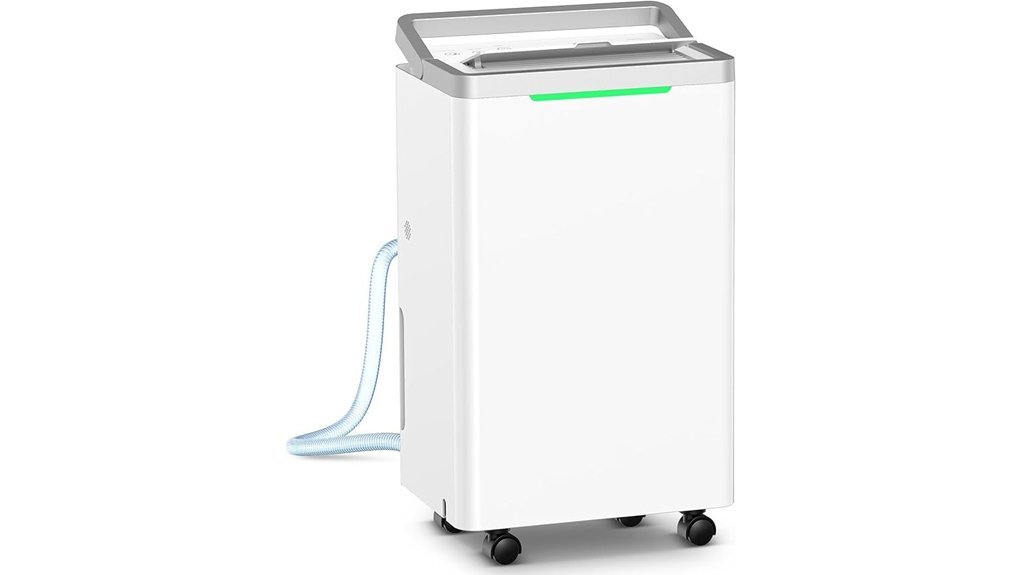
Best for medium basements: The HOPSEN 34 Pints/Day Dehumidifier is a strong pick if you need reliable moisture control in a basement or other medium-to-large space up to 2,500 sq. ft. You can pull up to 34 pints of moisture a day, and its 38 dB low-speed operation won’t disrupt your routine. Use the adjustable humidistat to target 45%–55% RH for daily comfort or 35%–45% for laundry. The 24-hour timer, sleep mode, and 3-color humidity indicator make control easy. With casters, a handle, and continuous drainage, you’ll simplify setup and upkeep.
Why it stands out: This model balances capacity, quiet operation, and basement-friendly drainage. It is a practical choice when you need more power than a mini unit but do not need a very large 80-pint machine. It also works well for buyers who want a simple dehumidifier that can run near a floor drain instead of depending only on the bucket.
Who should buy this: Choose it if you have a medium basement, finished lower-level room, laundry room, or storage area that feels damp but not severely wet.
Who should avoid this: Skip it if your basement is very large, has standing water issues, or needs uphill drainage without a separate pump.
Best For: Homeowners who need a quiet, compact dehumidifier for basements or medium-to-large spaces up to 2,500 sq. ft., with easy humidity control and flexible drainage.
Pros:
- Removes up to 34 pints of moisture per day, making it effective for damp areas.
- Quiet 38 dB low-speed operation is suitable for everyday use in bedrooms or living spaces.
- Includes useful features like a 24-hour timer, sleep mode, humidity indicator, and continuous drainage.
Cons:
- The 0.6-gallon tank may require frequent emptying if continuous drainage isn’t used.
- Best performance is limited to spaces up to 2,500 sq. ft., so it may not suit larger areas.
- Lacks advanced smart-home or app-based controls found on some higher-end models.
Bottom Line: Choose this one if your basement is damp but not huge, and you want a manageable unit with simple controls and hose drainage.
Waykar 80 Pint Energy Star Dehumidifier with Drain Hose
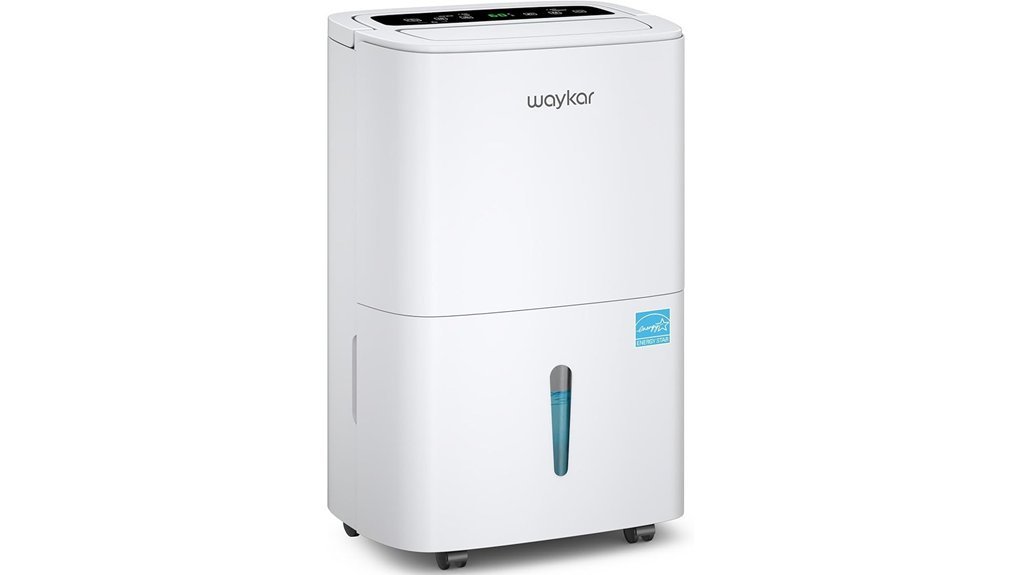
Best for large damp basements: Waykar’s 80-pint capacity makes this a strong pick if you’re battling a large, damp basement. You can cover up to 5,000 sq. ft. while pulling up to 80 pints a day in extreme humidity. Its Energy Star design helps you save power, and the auto defrost feature keeps it running in cooler spaces down to 41°F. Set your target humidity from 30% to 80%, then choose auto, continuous, or timer-based operation. Use the 3.3-foot drain hose for nonstop drainage, or empty the tank. Four casters, a handle, and a washable filter make upkeep easy.
Why it stands out: The high pint rating and wide coverage make it better suited for bigger basements, wet storage areas, and spaces where a smaller unit may run too often. If your basement feels musty after rain or stays damp through summer, this type of higher-capacity option can reduce bucket-emptying hassle when the hose is placed correctly.
Who should buy this: Choose it if your basement is large, unfinished, cool, or regularly humid, and you want stronger moisture removal than a compact model can provide.
Who should avoid this: Avoid it if you only need light moisture control in a small room, or if the included hose length will not reach your drain without an extension or layout change.
Best For: Homeowners needing a high-capacity, energy-efficient dehumidifier for large damp spaces like basements, with flexible drainage and easy mobility.
Pros:
- Covers up to 5,000 sq. ft. and removes up to 80 pints per day in very humid conditions.
- Energy Star certified with auto defrost, making it efficient for cooler spaces down to 41°F.
- Includes convenient features like a drain hose, washable filter, casters, handle, and 24-hour timer.
Cons:
- Bulkier than smaller dehumidifiers, so it may take up more floor space.
- The drain hose is only 3.3 feet, which may limit placement options for continuous drainage.
- Best suited for large areas, so it may be more than some smaller rooms need.
Bottom Line: Pick this model if your basement is large, cool, or consistently damp, and you want strong daily moisture removal with hose drainage.
KeepGlad Dehumidifier for Home with 7 Ambient Lights
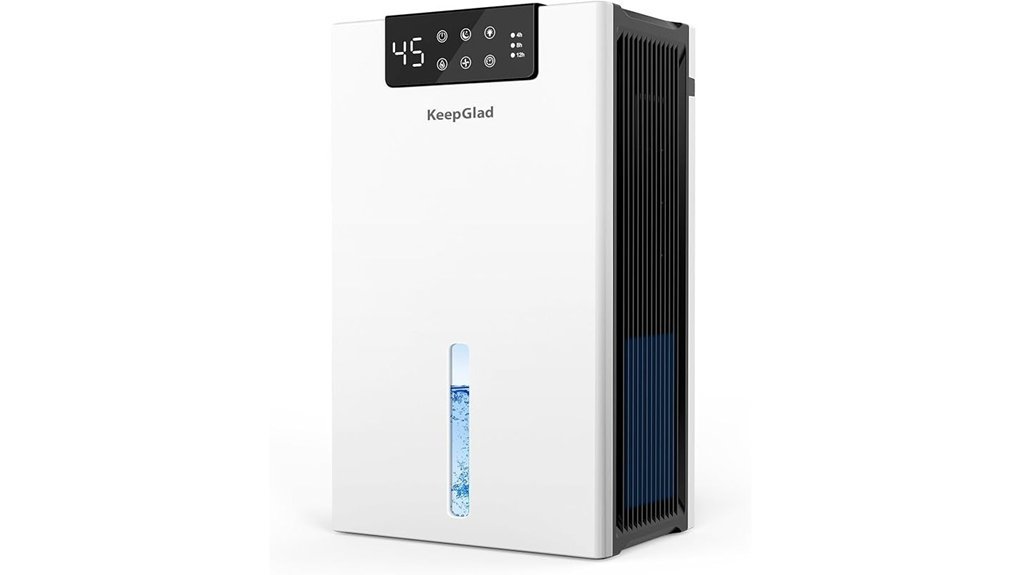
Best quiet compact option: KeepGlad’s 98-ounce tank suits you if you want steady dehumidifying for spaces up to 1,000 square feet. You can pull up to 40 ounces of moisture a day, and the unit can drop humidity from 80% to 40% in standard mode. Choose from three fan speeds, check the real-time display, and set 4-, 8-, or 12-hour timers to save power. The 28 dB sleep mode keeps nights quiet, while auto shut-off, washable filters, and the included drain hose make upkeep easy. Seven ambient lights add a nice touch.
Why it stands out: This is the most compact, quiet-focused option in the roundup. It is better for smaller basement rooms, bathrooms, RVs, or bedrooms than for a large, wet basement. It also appeals to buyers who want low noise, simple controls, and a lighter moisture-control solution instead of a bulky basement machine.
Who should buy this: Choose it for a finished basement bedroom, hobby room, bathroom, closet area, RV, or small lower-level room where quiet operation matters.
Who should avoid this: Skip it if your basement has heavy dampness, widespread musty odor, or a large open layout that needs pint-level removal rather than ounce-level removal.
Best For: Homeowners needing a quiet, easy-to-use dehumidifier for medium-sized spaces like basements, bedrooms, bathrooms, or RVs.
Pros:
- Removes up to 40 ounces of moisture per day and covers areas up to 1,000 square feet.
- Quiet 28 dB sleep mode, plus convenient timer settings and real-time humidity display.
- Washable filter, auto shut-off, and included drain hose make maintenance simple.
Cons:
- 98-ounce tank may require frequent emptying in very humid conditions if not using continuous drainage.
- Best suited for smaller to medium spaces, so it may be less effective for very large areas.
- Plastic construction and basic design may feel less premium than higher-end models.
Bottom Line: Choose this model for quiet, light-duty basement moisture control, not for severe dampness or large open spaces.
1500 Sq. ft Dehumidifier with Drain Hose
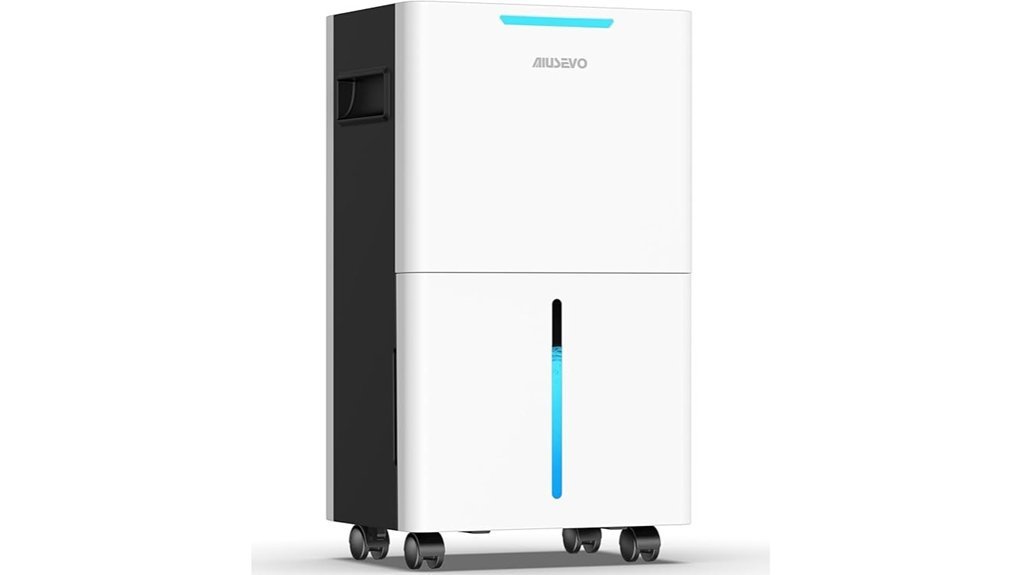
Best portable 1,500 sq. ft. option: If you need a 1500 sq. ft. basement dehumidifier with drain hose, Aiusevo’s AS280 fits the bill. You can cover up to 1,500 square feet while removing 21 pints of moisture daily, and the 3.28-foot hose lets you run continuous drainage without emptying the 0.52-gallon tank. Its DEHU, DRY, and CONTINUOUS modes help you match humidity needs, while the 24-hour timer and automatic control keep things simple. At just 15.3 pounds, it’s easy to move with lift-up handles and 360° wheels, and the digital display keeps you informed.
Why it stands out: This model is built for buyers who want a portable unit with rolling wheels, a digital display, and hose drainage for smaller basements or multi-room use. It is especially useful when you need one machine you can move between a basement, laundry room, bathroom, or RV instead of leaving it fixed in one place.
Who should buy this: Choose it if you want a compact dehumidifier for smaller basement zones and you value wheels, handles, and simple mode choices.
Who should avoid this: Avoid it if your basement is very wet or very large, because a higher-capacity model will likely be more suitable for demanding moisture loads.
Best For: Homeowners who need a compact, portable dehumidifier for up to 1,500 sq. ft., especially for basements, bedrooms, bathrooms, RVs, or laundry areas.
Pros:
- Covers large spaces up to 1,500 sq. ft. while removing up to 21 pints of moisture per day.
- Offers continuous drainage with the included 3.28-foot hose, plus easy portability with wheels and handles.
- Includes useful modes like DEHU, DRY, and CONTINUOUS, along with a 24-hour timer and digital humidity display.
Cons:
- The 0.52-gallon tank is relatively small if you’re not using the drain hose.
- Best performance is tied to high humidity conditions, so results may vary in less damp spaces.
- At 15.3 pounds, it’s portable but not as lightweight as ultra-compact models.
Bottom Line: This is a good fit when you want a movable dehumidifier for a smaller basement, laundry area, or damp room with nearby drainage.
Vellgoo Max 64 Pint Dehumidifier for Basement
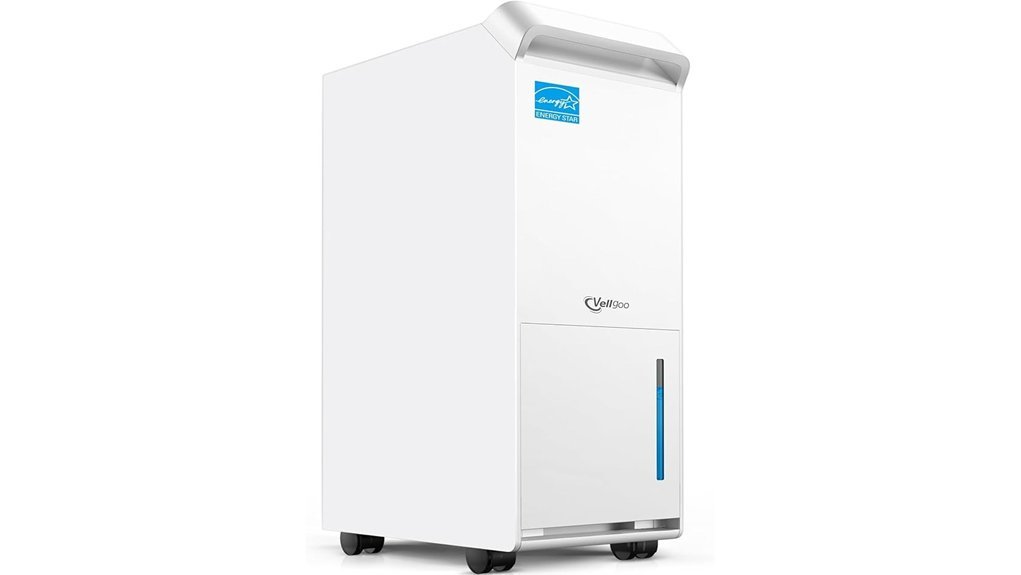
Best high-capacity energy-efficient pick: Vellgoo’s Max 64 Pint Dehumidifier suits larger basements that need efficient, hands-off moisture control. You can cover up to 4,000 sq. ft., and the unit pulls up to 64 pints a day in humid conditions. Its Energy Star 2024 Most Efficient rating helps you cut power use by as much as 44% versus standard models. You get continuous drainage with the included 6.56-foot hose or a garden hose adapter, plus comfort, continuous, and humidity-control modes. A washable filter, 24-hour timer, and child lock make upkeep simple.
Why it stands out: The longer included hose, large coverage rating, and garden hose adapter make it one of the easier options to set up for extended basement drainage. If your drain is not right beside the unit, the longer included hose can make placement more flexible than shorter-hose models.
Who should buy this: Choose it if you need strong moisture removal for a large basement and want an efficient unit with more drainage flexibility.
Who should avoid this: Skip it if you only need a small, quiet dehumidifier for a bedroom, closet, or lightly damp finished space.
Best For: Homeowners with large basements or up to 4,000 sq. ft. of space who want an energy-efficient, low-maintenance dehumidifier with continuous drainage options.
Pros:
- Energy Star 2024 Most Efficient rating can reduce energy use by up to 44%.
- Strong 64-pint/day dehumidification capacity is well-suited for humid, larger spaces.
- Flexible drainage, washable filter, timer, and child lock make it easy to use.
Cons:
- May be more dehumidifier than needed for small rooms or lightly damp spaces.
- Continuous drainage setup may require placing it near a drain or using the hose.
- Bulkier size could make it less convenient to move or store.
Bottom Line: Choose the Vellgoo Max if you need strong moisture removal, flexible hose setup, and efficient operation for a bigger basement.
Factors to Consider When Choosing a Dehumidifier for Basement With Hose
When you choose a dehumidifier for your basement with a hose, make sure it matches your coverage area and pulls enough moisture for the space. You’ll also want to check your drainage options, since a hose setup should drain easily and without hassle. Don’t forget to compare noise level and energy efficiency so you get a unit that works well without driving up costs or disrupting your home.
Coverage Area
Coverage area should be one of the first things you check, since the best dehumidifier for your basement has to match the room’s size and moisture load. You’ll see models rated for spaces from about 1,000 to 5,000 square feet, so measure your basement before you buy. A small unit may work in a dry, compact space, but a larger, damper basement usually needs a model with more capacity to stay effective. For example, some 34-pint units suit up to 2,500 sq. ft., while 80-pint models can handle up to 5,000 sq. ft. Also, think about how humid your basement gets. If moisture lingers, choose a unit that can keep indoor humidity in the 30% to 50% range without struggling.
Moisture Removal Rate
Once you’ve matched a dehumidifier to your basement’s size, the next thing to check is how much moisture it can actually pull from the air each day. That number is the moisture removal rate, and manufacturers list it in pints per day. You might see compact units rated around 21 pints, while heavy-duty models can remove 80 pints or more. If your basement often hits 90% humidity, you’ll want a stronger unit so it can keep up. Also, don’t rely only on the label: performance is usually tested at 95°F and 90% relative humidity, which can differ from your home. Pick a model with extra capacity for your space so it can handle damp conditions and keep the basement comfortable year-round.
Drainage Options
Another key factor is drainage, especially if you want a dehumidifier that can run without constant attention. You should look for continuous drainage through a built-in drain hose, so moisture leaves the unit without frequent tank emptying. That setup works well in damp basements where humidity stays high. If you prefer more flexibility, choose a model that accepts a standard garden hose connection, since it can fit different layouts and reach a nearby drain more easily. Also, check the water tank capacity; a larger tank gives you more backup if the hose disconnects. An anti-overflow function adds protection by shutting the unit off when the tank fills, which helps you avoid spills and keeps operation safe while you manage drainage.
Hose Placement
A hose only works well when gravity can move water from the unit to the drain. Place the dehumidifier higher than the drain point when possible, avoid tight bends, and keep the hose from sitting in standing water. If the hose needs to run upward to a sink or window, choose a model with a built-in pump or use a compatible external pump.
Noise Level
Noise level matters, especially if your basement doubles as a living area, workspace, or bedroom. You’ll want a dehumidifier that won’t distract you while you relax, read, or work. Some models run as quietly as 28 dB, which is ideal if you’re sensitive to sound. A low-speed setting can drop noise to about 38 dB, similar to a quiet library, and that’s often enough for everyday use. If you need nighttime comfort, choose a unit with Sleep Mode, which usually cuts both sound and light. Be cautious with higher-capacity models, since they can be louder. Check the decibel rating before you buy so you can match the machine to your noise tolerance and keep your basement comfortable.
Energy Efficiency
After you’ve thought about noise, it’s smart to look at energy use, especially if your basement dehumidifier will run often through humid seasons. Choose an Energy Star certified model, since it meets EPA efficiency standards and can cut electricity costs by up to 44% versus standard units. Check the moisture removal rating too: a 64- to 80-pint unit often works more efficiently in very damp basements because it cycles less. Lower wattage also matters, since it can reduce power draw during long run times. Look for auto-defrost and self-drying features; they help the unit stay efficient in cooler basement air. Finally, clean or replace filters regularly so airflow stays strong and your dehumidifier keeps removing moisture without wasting energy.
Tank Size and Auto Shut-Off
Even when you plan to use continuous drainage, tank size still matters. A larger bucket gives you backup if the hose clogs, disconnects, or cannot drain fast enough. Auto shut-off is also important because it helps prevent overflow when the tank fills. For a basement, this feature is especially useful if the unit runs while you are away from home.
Portability and Storage
Portability matters if you plan to move the dehumidifier between your basement, laundry room, bathroom, garage, or RV. Look for casters, lift handles, compact dimensions, and a manageable weight. A heavier high-capacity model may be better for one permanent basement location, while a lighter unit with wheels may be easier if you need flexible moisture control in several spaces.
Maintenance and Filter Care
A basement dehumidifier works best when airflow stays clear. Washable filters are useful because you can rinse or vacuum them without buying replacements often. Also check whether the tank is easy to remove, whether the hose connection is secure, and whether the unit has reminders or visible indicators. Simple maintenance features can make a big difference if the machine runs daily during humid months.
Pro Tips for Better Basement Moisture Control
- Place the dehumidifier where air can circulate freely around the intake and exhaust.
- Keep doors and windows closed during humid weather so the unit is not fighting outdoor moisture.
- Use a separate hygrometer if you want to double-check the room humidity reading.
- Clean the filter regularly, especially in dusty basements or laundry areas.
- Fix leaks, seepage, and poor grading first, because a dehumidifier cannot solve active water intrusion.
Frequently Asked Questions
How Often Should Basement Dehumidifier Filters Be Cleaned?
You should clean your basement dehumidifier filter every 2 to 4 weeks, and more often if you see dust buildup. Check the manual, since some models need monthly rinsing or vacuuming to keep airflow strong.
Can a Hose Dehumidifier Run Continuously All Summer?
Yes, you can run it nonstop all summer, as long as the drainage path is set up correctly. You’ll need proper drainage, clean filters, and occasional checks so the hose does not kink, clog, or back up. If the basement is very damp, check the drain setup during the first few days to make sure water flows correctly.
What Hose Length Works Best for Basement Drainage?
You’ll usually do best with a 5 to 15-foot hose, since it reaches a drain without kinking or losing flow. Keep it slightly downhill, and you can extend longer only if the unit supports it. If the hose is too long, sharply bent, or running uphill without a pump, drainage may slow down or stop.
Do Dehumidifiers Help Prevent Mold on Basement Walls?
Yes, you can help prevent mold on basement walls with a dehumidifier by lowering humidity. Keep levels around 30%–50%, fix leaks, and improve airflow, but you’ll still need to clean existing mold promptly. A dehumidifier helps control moisture, but it should not replace proper waterproofing or mold cleanup when those are needed.
Is a Pump Necessary for Uphill Water Drainage?
Yes. If you’re draining uphill, you’ll usually need a pump. For example, if your basement hose must rise to a sink, gravity won’t help, so the pump pushes water out reliably and keeps your system running smoothly.
What Size Dehumidifier Is Best for a Basement?
The best size depends on the basement square footage and how damp it feels. A smaller 1,000 to 1,500 sq. ft. unit may work for a finished room or light moisture. A 2,500 to 5,000 sq. ft. unit is usually better for larger basements, musty storage rooms, or high-humidity areas that need stronger daily moisture removal.
Should I Use the Bucket or the Hose?
Use the hose if you want more hands-off operation, especially in a basement where humidity stays high. The bucket is useful as a backup, but it can fill quickly in damp conditions. For continuous drainage, make sure the hose is firmly connected, slopes downward, and drains into a safe location.
Final Verdict
For a large, damp basement, the Waykar 80 Pint Energy Star Dehumidifier with Drain Hose is the strongest choice in this roundup because it offers the highest listed capacity and wide coverage. For a balance of power and efficiency, the Vellgoo Max 64 Pint Dehumidifier for Basement is another strong option, especially if you want a longer hose setup. For smaller rooms or quieter use, the KeepGlad Dehumidifier for Home with 7 Ambient Lights is the easiest compact pick.
Final Recommendation Box
Choose Waykar if your main problem is a large, damp basement that needs strong moisture removal.
Choose Vellgoo Max if you want high capacity, energy-focused operation, and a longer included hose.
Choose HOPSEN if your basement is medium-sized and you want a practical balance of power and quiet use.
Choose KeepGlad if you need a quiet compact unit for a smaller finished room or light dampness.
Choose Aiusevo if portability, wheels, and a 1,500 sq. ft. rating matter most.
Conclusion
Choosing the right basement dehumidifier with a hose can make a huge difference in comfort, air quality, and mold prevention. You want a model that fits your space, drains easily, and runs efficiently without constant attention. Match the pint rating to your basement size, check the hose setup before buying, and choose a unit with auto shut-off for extra protection. The best option gives you steady moisture control and peace of mind. Pick wisely, and you’ll keep your basement drier, cleaner, and easier to enjoy year-round.