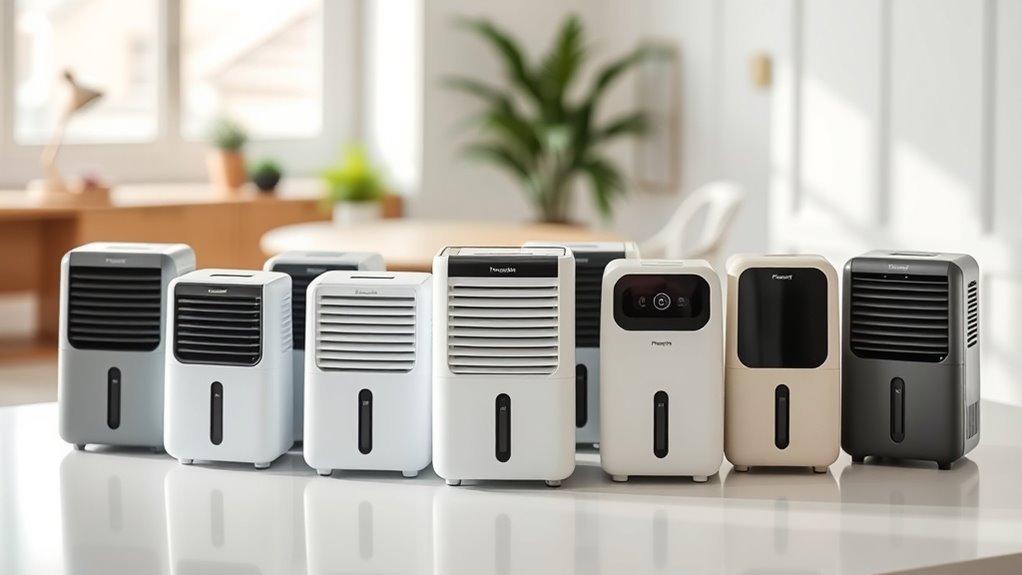
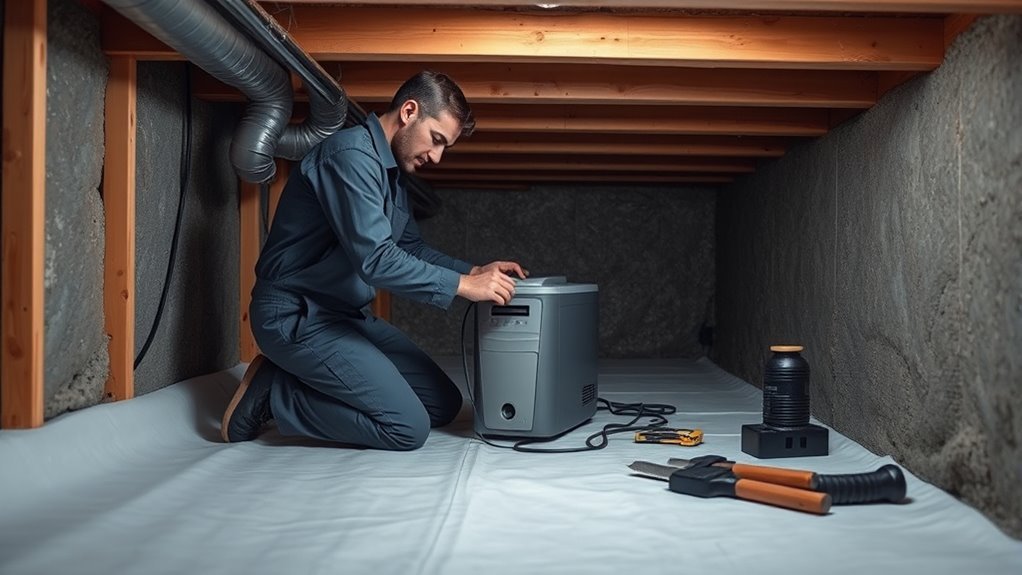
A cool basement needs more than a high square-footage claim. The best dehumidifier should have a compressor suited to basement conditions, automatic defrost, enough moisture-removal capacity for the room’s dampness, and a practical drain setup. After removing small thermoelectric units and listings with uncertain current purchase options, the strongest choices here are the AEOCKY 4500 Sq.Ft, DECIUU 100 Pint, Vellgoo 64 Pint, VEAGASO 34 Pint, and Aiusevo 21 Pint dehumidifiers. Use the comparison below to match capacity, drainage, and room size to your basement.
Quick Verdict
Best overall for a cool, large basement: AEOCKY 4500 Sq.Ft because its listing specifically highlights automatic defrost, operation around 65°F, strong moisture removal, and ENERGY STAR Most Efficient 2025 certification. Choose DECIUU when maximum capacity and a larger tank matter most, Vellgoo for an efficient large-basement alternative, VEAGASO for a mid-size basement, or Aiusevo for a smaller basement with moderate dampness.
Quick Comparison
| Product | Best For | Listed Coverage | Listed Capacity | Drainage | Cool-Basement Advantage | Check Details |
|---|---|---|---|---|---|---|
| AEOCKY 4500 Sq.Ft | Best Overall | Up to 4,500 sq. ft. | Up to 80 pints/day at the listing’s high-humidity condition | Tank, included drain hose, or garden-hose adapter | Auto defrost and listing-stated performance around 65°F | Check on Amazon |
| DECIUU 100 Pint | Best High Capacity | Up to 5,000 sq. ft. | Up to 100 pints/day at 95°F and 90% RH | 5.5L tank, drain hose, or garden-hose adapter | Auto defrost and adjustable humidistat | Check on Amazon |
| Vellgoo 64 Pint | Best Efficient Large Pick | Up to 4,000 sq. ft. | Up to 64 pints/day | Three drainage options | Auto defrost, auto restart, and Most Efficient 2024 listing | Check on Amazon |
| VEAGASO 34 Pint | Best for Mid-Size Basements | Up to 2,500 sq. ft. | Up to 34 pints/day | 2L tank or included drain hose | Auto defrost, continuous mode, and quiet-operation claim | Check on Amazon |
| Aiusevo 21 Pint | Best for Smaller Basements | Up to 1,500 sq. ft. | Up to 21 pints/day | 0.52-gallon tank or drain hose | Automatic defrost and three operating modes | Check on Amazon |
Capacity note: Some listings advertise a maximum moisture-removal figure measured in hotter, more humid conditions than a typical basement. Compare products using the same test conditions whenever possible, and size the unit for both floor area and how wet the basement feels.
AEOCKY 4500 Sq.Ft Smart Dehumidifier with Drain Hose
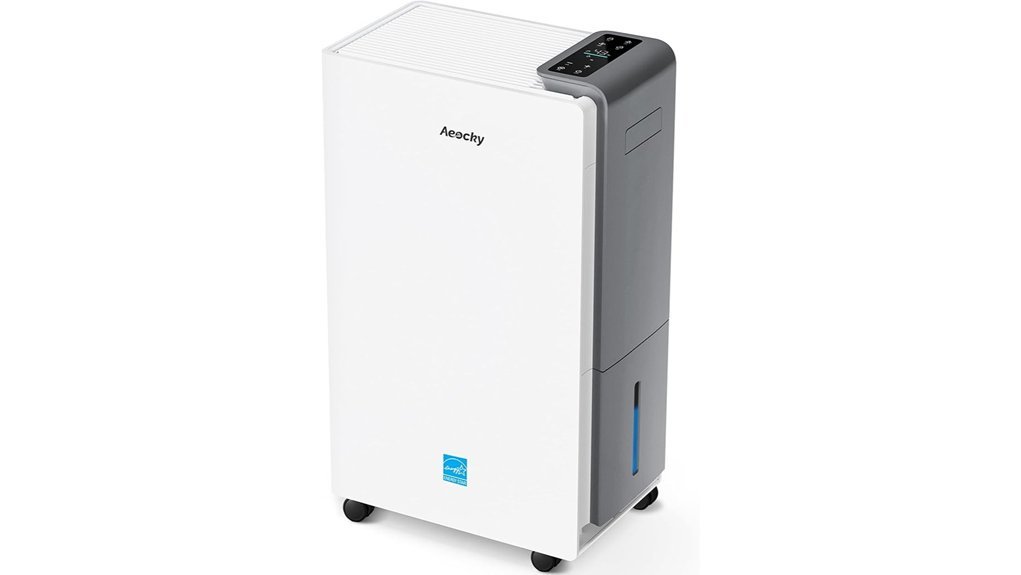
The AEOCKY RHEA-001 is the strongest match for a large, cool basement because its listing focuses on low-temperature operation, automatic defrost, energy efficiency, and hands-off humidity control. It is listed for spaces up to 4,500 sq. ft. and claims up to 80 pints per day at 95°F and 95% RH, or 59.3 pints per day at 86°F and 80% RH. The listing also identifies it as ENERGY STAR Most Efficient 2025 and states a lowest fan noise of 44 dB.
You can set the target humidity, use the included drain hose for gravity drainage, or connect a garden hose with the supplied adapter. Power-loss memory is useful in basements where brief outages occur, while the 1.45-gallon tank gives you a workable manual-drain option.
Why You’ll Like It: It combines high capacity with the clearest cool-basement positioning in this roundup.
Best For: Large basements that stay damp and hover around the mid-60s Fahrenheit.
Who Should Avoid It: Buyers with a small, mildly damp room who do not need a large compressor unit.
Pros:
- Listing-stated operation around 65°F with automatic defrost.
- High listed moisture-removal capacity for large basements.
- ENERGY STAR Most Efficient 2025 designation on the current listing.
- Drain hose, garden-hose adapter, humidistat, and power-loss memory.
Cons:
- The highest pint figure is measured in hotter and more humid conditions than most basements.
- At about 31 lbs, it is better left in one main location than moved frequently.
- Large-space capacity may be unnecessary for a small basement room.
DECIUU 100 Pint Dehumidifier with Drain Hose
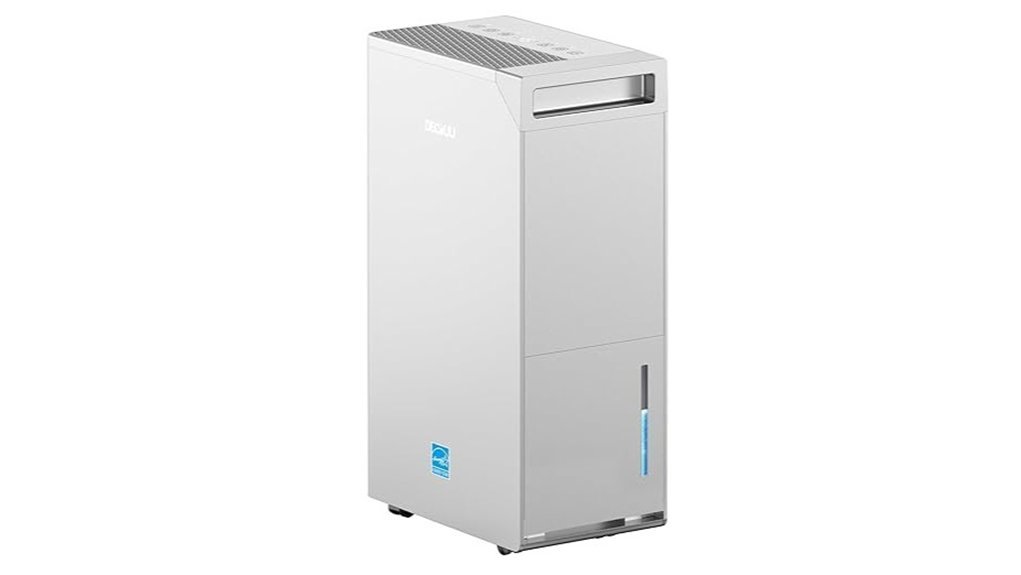
The DECIUU Max 100 Pint Dehumidifier is a practical choice for a very damp or unusually large basement. Its current listing covers up to 5,000 sq. ft. and states moisture removal of up to 100 pints per day at 95°F and 90% RH, with a lower 70-pint figure at 86°F and 80% RH. That distinction matters because real basement output will depend on temperature and humidity.
The unit includes automatic defrost, a humidistat adjustable from 35% to 80% RH, a 5.5L tank, a 6.56-foot drain hose, and a garden-hose adapter. Those three drainage choices make it easier to run continuously near a floor drain or sump area.
Why You’ll Like It: It offers the largest tank and highest maximum capacity among the retained products.
Best For: Large, wet basements, storage areas, garages, or laundry zones with a nearby drain.
Who Should Avoid It: Anyone with a compact room or limited floor space.
Pros:
- High maximum moisture-removal claim and coverage up to 5,000 sq. ft.
- Automatic defrost and adjustable humidity control.
- Large 5.5L tank with drain-hose and garden-hose options.
- Wheels, handle, timer, child lock, and washable filter.
Cons:
- The 100-pint figure is a maximum measured in very hot, humid air.
- Its 32.8-lb weight can make stairs and frequent relocation inconvenient.
- It may cycle inefficiently if greatly oversized for a small, mildly damp room.
Vellgoo 64 Pint Dehumidifier with Smart Control
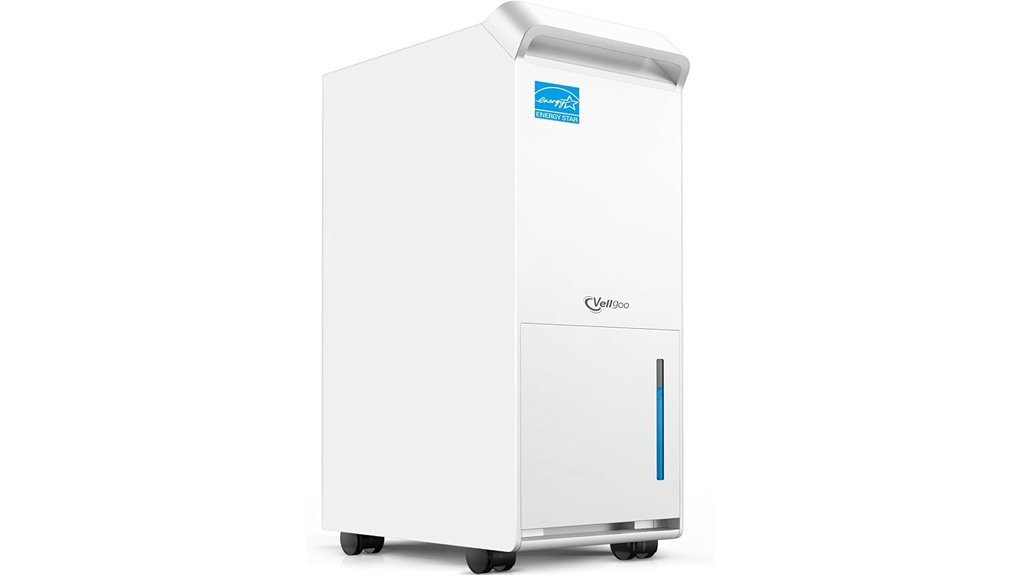
The Vellgoo model linked here is the 4,000 sq. ft., 64-pint version—not a 4,500 sq. ft. or 70-pint model. Its current listing identifies it as ENERGY STAR Most Efficient 2024 and includes smart humidity control, automatic defrost, automatic restart, and three drainage options.
This is a balanced alternative for buyers who want more capacity than a 21- or 34-pint unit without stepping up to a 100-pint maximum model. Set the desired humidity, use the bucket when convenient, or route the drain connection for longer unattended operation.
Why You’ll Like It: It gives large-basement coverage with an efficiency-focused feature set and flexible drainage.
Best For: Large basements where efficiency, automatic restart, and drain flexibility are priorities.
Who Should Avoid It: Buyers who specifically need a built-in pump to move water upward.
Pros:
- Listed for up to 4,000 sq. ft. with a maximum 64-pint daily capacity.
- ENERGY STAR Most Efficient 2024 designation on the current listing.
- Automatic defrost and restart support basement use.
- Multiple drainage choices reduce bucket-emptying work.
Cons:
- The linked model’s specs are lower than the original article claimed.
- No built-in pump is highlighted for lifting water to a higher drain.
- A large unit can take up noticeable floor space in a tight utility room.
VEAGASO 2500 Sq.Ft Dehumidifier with Drain Hose
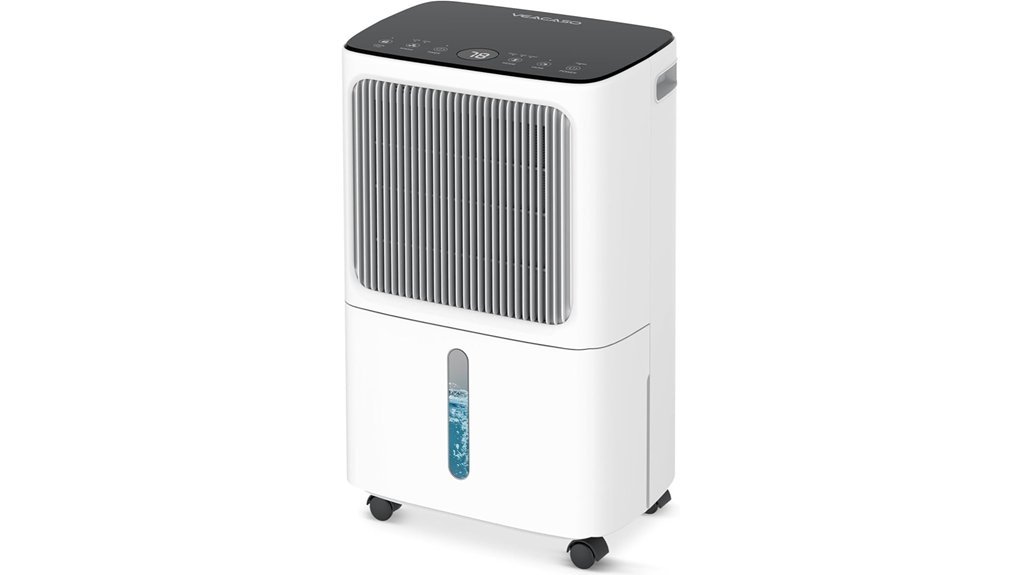
The VEAGASO model is a sensible middle-ground choice for a basement that needs compressor performance but not the highest capacity in the roundup. Its listing states coverage up to 2,500 sq. ft., moisture removal up to 34 pints per day, automatic defrost, and a 2L water tank.
You can select DEHU mode for target-humidity control, DRY mode for laundry, or CONT mode for ongoing operation. The included drain hose allows gravity drainage, while the bucket shuts the unit off automatically when full. The seller also lists operation around 40 dB, although actual sound will vary by fan setting and room acoustics.
Why You’ll Like It: It offers useful basement features without the size and output of the largest models.
Best For: Medium to large basements with moderate or persistent dampness.
Who Should Avoid It: Very wet basements with seepage or spaces that need commercial-grade water removal.
Pros:
- Up to 34 pints per day and 2,500 sq. ft. of listed coverage.
- Automatic defrost, humidistat control, and three operating modes.
- Included drain hose for continuous gravity drainage.
- Portable design with handles, wheels, timer, and washable filter.
Cons:
- The 2L bucket will fill quickly in damp conditions if the hose is not used.
- It does not advertise a built-in pump.
- Square-footage coverage should not replace sizing by actual dampness.
Aiusevo 1500 Sq. Ft. 21 Pint Dehumidifier
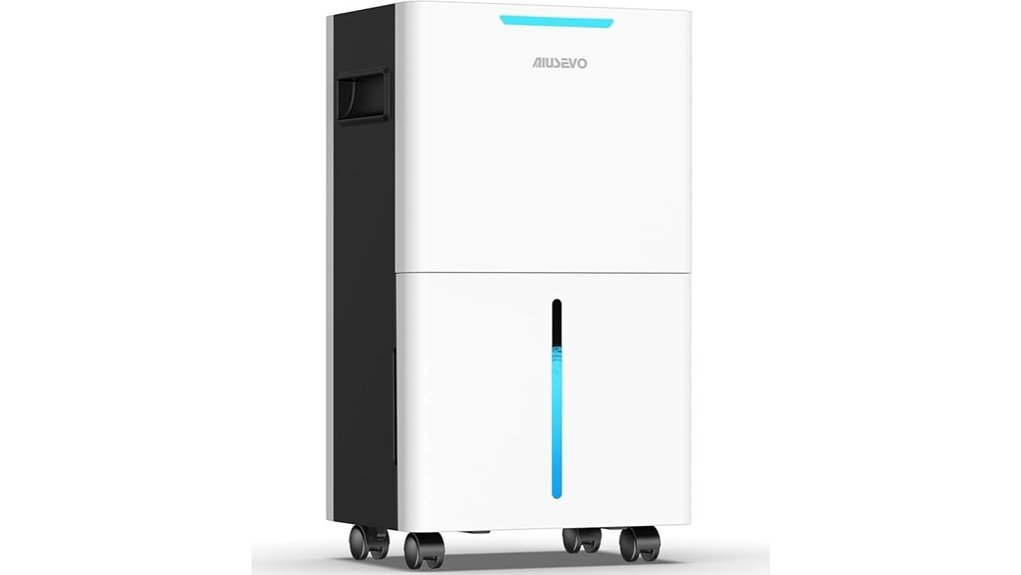
The Aiusevo 21 Pint Dehumidifier is the smallest retained compressor model and fits a smaller basement or finished basement room with moderate moisture. Its listing states coverage up to 1,500 sq. ft., a 21-pint daily capacity, automatic defrost, a 0.52-gallon tank, and an included drain hose.
DEHU, DRY, and CONTINUOUS modes make it easier to switch between normal humidity control, indoor laundry drying, and longer runtime. Because the bucket is relatively small, the drain hose is the better setup when the basement stays damp for long periods.
Why You’ll Like It: It provides compressor-based moisture removal in a smaller, simpler package.
Best For: Smaller basements, basement bedrooms, or utility rooms with mild to moderate dampness.
Who Should Avoid It: Large or wet basements that need more than 21 pints per day.
Pros:
- Compressor design with automatic defrost.
- Three modes, digital controls, timer, child lock, and drain hose.
- More appropriate for a small basement than an oversized 80- or 100-pint maximum model.
Cons:
- The 0.52-gallon tank may need frequent emptying.
- Lower capacity is not suitable for heavy seepage or very high humidity.
- The listing does not provide a prominent ENERGY STAR designation.
Factors to Consider When Choosing a Home Dehumidifier for a Cool Basement
The right dehumidifier depends on more than the largest number in the title. Check operating temperature, test conditions, basement dampness, drainage, noise, and maintenance before choosing.
Low-Temperature Performance
Basements often sit near or below 65°F. At cooler temperatures, frost can form on a compressor dehumidifier’s coils and reduce moisture removal. Look for automatic defrost and a manufacturer-stated operating-temperature range. If the basement regularly approaches freezing, do not rely on a standard portable compressor model; warm the space, correct the moisture source, or choose equipment specifically designed for lower temperatures.
Pint Capacity and Test Conditions
Pint capacity tells you how much water a unit can remove in 24 hours under specified conditions. Some listings show a high “maximum” value measured in very hot, humid air, while standardized ratings use cooler conditions that better resemble basements. Compare like with like. For a space under 2,000 sq. ft., a 20- to 30-pint rated unit may suit mild dampness, while a wetter space may need 30 to 50 pints or more. Large or persistently wet basements need additional capacity, but leaks and seepage should be repaired rather than treated only with a dehumidifier.
Humidity Range Control
Choose a unit with an adjustable humidistat and aim for roughly 30% to 50% relative humidity. A setting around 45% to 50% works well for many basements without forcing the machine to run constantly. Use a separate hygrometer to confirm the reading, because built-in sensors can be affected by the air immediately around the unit.
Auto Defrost Feature
Automatic defrost pauses dehumidification when ice forms, allows the coils to clear, and then resumes normal operation. This is one of the most important features for a cool basement. It protects performance, but it does not mean every unit will work efficiently at every low temperature, so always check the listed operating range.
Continuous Drain Options
A gravity drain hose is the easiest setup when a floor drain or sump opening sits below the dehumidifier outlet. Keep the hose sloping downward without kinks. If the only drain is higher than the unit, choose a model with a built-in pump or add a compatible condensate pump. Never route a hose where a backup could spill onto finished flooring.
Energy Efficiency Rating
A basement dehumidifier may run for many hours, so ENERGY STAR certification and a higher integrated energy factor can reduce operating cost. Efficiency matters most when comparing units with similar capacity. Do not choose a unit only because it has lower wattage; an undersized model may run continuously and remove less water.
Noise Level
For a finished basement, office, or bedroom, look for a lower listed decibel level and a quiet or sleep mode. Remember that seller-stated sound measurements may use different test distances and fan settings. Hard walls and an empty basement can also make compressor noise sound louder than it does in a furnished room.
Portability and Placement
Check the unit’s weight, dimensions, handles, and caster wheels before carrying it downstairs. Place it on a level surface with the intake and exhaust clear. Follow the manual’s clearance requirements, keep doors and windows closed during operation, and avoid placing the unit where dripping water could reach the power cord or outlet.
Before You Buy Checklist
- Measure the basement and note whether it feels slightly damp, very damp, or wet.
- Record the typical basement temperature and relative humidity.
- Confirm the product’s rated capacity and the conditions used for any maximum-pint claim.
- Choose gravity drainage, a built-in pump, or manual bucket emptying before ordering.
- Check tank size, noise level, filter access, hose length, warranty terms, and return policy.
- Repair plumbing leaks, foundation seepage, and drainage problems instead of relying on the appliance alone.
Frequently Asked Questions
How Often Should I Clean a Basement Dehumidifier Filter?
Check the filter about every two to four weeks and clean it according to the manual. Homes with pets, renovation dust, or heavy basement traffic may need more frequent cleaning. Reduced airflow, extra noise, or longer runtimes are signs that the filter needs attention.
Can I Use a Dehumidifier in a Basement With Freezing Temperatures?
A standard portable compressor dehumidifier is generally not the right choice for freezing conditions. Ice can form on the coils and stop effective moisture removal. Warm the space or use equipment specifically rated for the actual temperature.
Should I Run a Dehumidifier Continuously or on a Timer?
Use the humidistat rather than a timer whenever possible. Set the target around 45% to 50% RH and let the unit cycle automatically. Continuous mode is useful after a moisture spike or in a persistently damp area, especially when a drain hose is installed.
Do Basement Dehumidifiers Need a Separate Drain Pump?
Not always. Gravity drainage works when the hose can run downhill to a floor drain, sink, or sump. You need a built-in or separate condensate pump when water must travel upward to reach the drain.
How Much Electricity Does a Basement Dehumidifier Use?
Energy use depends on wattage and runtime. Multiply the unit’s watts by the number of operating hours, then divide by 1,000 to estimate kilowatt-hours. For example, a 500-watt unit running for 12 hours uses about 6 kWh. A correctly sized ENERGY STAR model with an accurate humidistat may cycle off more often.
What Humidity Should I Set in My Basement?
A target between 45% and 50% RH is a practical starting point for many basements. Keep the level below 60%, and adjust if you see condensation, smell mustiness, or find that the unit runs without stopping.
Will a Dehumidifier Fix a Wet Basement?
No. A dehumidifier controls moisture in the air, but it cannot repair foundation cracks, plumbing leaks, poor grading, clogged gutters, or active seepage. Correct the water source first, then use a dehumidifier to manage remaining humidity.
Conclusion
For most large, cool basements, the AEOCKY 4500 Sq.Ft is the best-balanced choice because its listing combines automatic defrost, performance around 65°F, strong capacity, and ENERGY STAR Most Efficient 2025 certification. The DECIUU 100 Pint is better for maximum moisture load, while the corrected Vellgoo 64 Pint offers an efficient large-space alternative. Choose the VEAGASO 34 Pint for a mid-size basement or the Aiusevo 21 Pint for a smaller, moderately damp room.
Final Recommendation
Measure temperature and humidity before buying, compare pint figures under similar test conditions, and plan the drainage route in advance. A properly sized compressor unit with automatic defrost and a working drain setup will be more useful than a small thermoelectric model with a large square-footage claim.