
Disclosure: This article contains affiliate links. If you buy through them, we may earn a small commission at no extra cost to you. Prices and availability on Amazon can change at any time.
Breaking down a whole chicken with a kitchen knife is slow, slippery, and genuinely risky. A proper pair of poultry shears turns a ten-minute wrestling match into a thirty-second job — spatchcocking a bird, removing joints, snipping backbones and trimming fat without the blade skating off a wet drumstick.
This 2026 guide covers four poultry shears that are genuinely built for the job: the spring-loaded Gerior Heavy Duty Poultry Shears, the take-apart OXO Good Grips Spring-Loaded Poultry Shears, the hot-forged Mercer Culinary 9.5-inch Poultry Shears, and the compact, dishwasher-safe HENCKELS Kitchen Shears for Poultry. Below you’ll find what each one is good at, who should skip it, and how to choose between them.
Quick Verdict
- Best Overall: Gerior Heavy Duty Poultry Shears — spring-loaded, full-size, and the easiest all-rounder for whole birds.
- Best for Comfort & Cleaning: OXO Good Grips Spring-Loaded Poultry Shears — blades separate fully for washing.
- Best Premium: Mercer Culinary Forged Poultry Shears — hot-forged, made in Spain, built for precise joint work.
- Best Compact Pick: HENCKELS Kitchen Shears for Poultry — small, locking, and dishwasher safe.
How these picks were chosen: selections are based on published manufacturer and retailer specifications — blade construction, blade length, locking mechanisms, take-apart design and stated care instructions — plus how well each tool matches real poultry tasks. We have not performed independent lab testing, and we don’t quote prices or ratings, since those change constantly on Amazon.
Poultry Shears Comparison Table
| Shears | Best For | Key Detail | Cleaning | Link |
|---|---|---|---|---|
| Gerior Heavy Duty Poultry Shears | Best Overall | 9.6″ long, spring-loaded, micro-serrated, safety lock | Dishwasher safe per maker; hand wash advised | Check Price |
| OXO Good Grips Spring-Loaded Poultry Shears | Best for Comfort & Cleaning | Curved tapered blades, bone notch, blades come apart | Hand wash, dry promptly | Check Price |
| Mercer Culinary Forged Poultry Shears, 9.5″ | Best Premium | Hot-forged high-carbon steel, made in Spain, safety lock | Hand wash only | Check Price |
| HENCKELS Kitchen Shears for Poultry | Best Compact Pick | 3.5″ serrated blades, locking blades, approx. 4.8 oz | Dishwasher safe | Check Price |
1. Gerior Heavy Duty Poultry Shears — Best Overall
BEST OVERALL
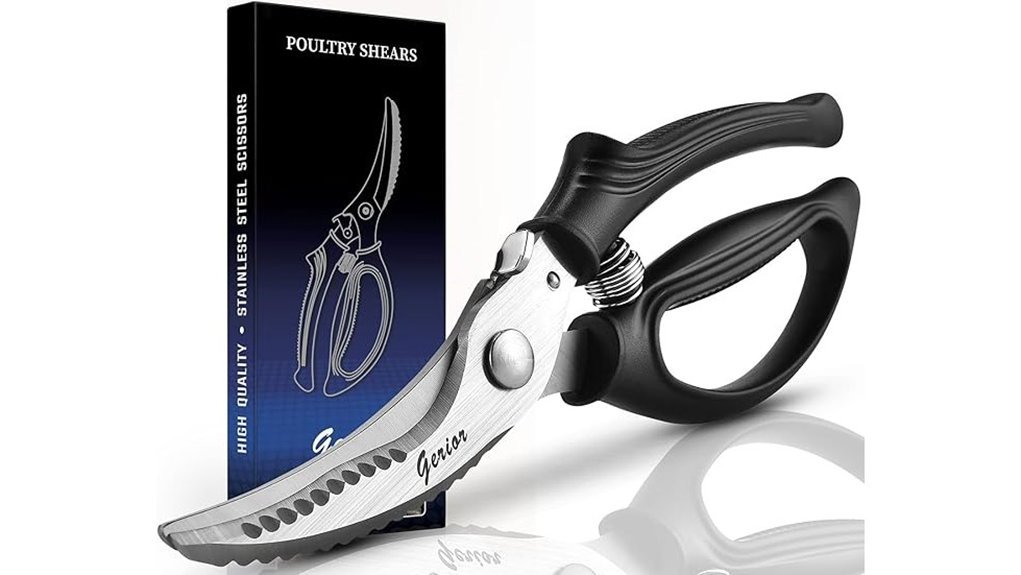
If you only want one pair of shears in the drawer, this is the sensible default. The Gerior Heavy Duty Poultry Shears run roughly 9.6 inches with thick stainless blades, which gives you the length and leverage to work through a whole chicken or turkey rather than nibbling at it. The spring-loaded handle reopens the blades for you after every cut, so a long butchering session doesn’t leave your hand aching.
Why You’ll Like It: the micro-serrated, anti-slip edges bite into wet skin instead of sliding off it — the single biggest frustration when you try this job with an ordinary knife. A two-position handle switches between a normal user mode and a locked mode for storage, and the multipurpose blades handle raw meat, tough tendons, fat trimming, and herbs or vegetables when you’re not cooking a bird.
Who Should Buy This: home cooks who regularly spatchcock chicken, break down whole birds, or want one heavy-duty shear that also earns its keep on everyday kitchen tasks.
Who Should Avoid This: anyone with a tightly packed utensil drawer, or cooks who prefer a short, knife-like shear for fine detail work.
Pros:
- Spring-loaded handles reduce hand fatigue during long prep sessions.
- Anti-slip, micro-serrated blades grip slippery poultry skin securely.
- Locking mode makes storage safer in a shared or family kitchen.
- Genuinely multipurpose — meat, tendons, fat, herbs and vegetables.
Cons:
- At around 9.6 inches, it’s a bulky tool for a small or crowded drawer.
- The manufacturer lists it as dishwasher safe, but hand washing and prompt drying will preserve the edge far longer.
- Gerior is a less established name than OXO, HENCKELS or Mercer, so long-term brand support is harder to judge.
2. OXO Good Grips Spring-Loaded Poultry Shears — Best for Comfort & Cleaning
BEST FOR COMFORT & CLEANING
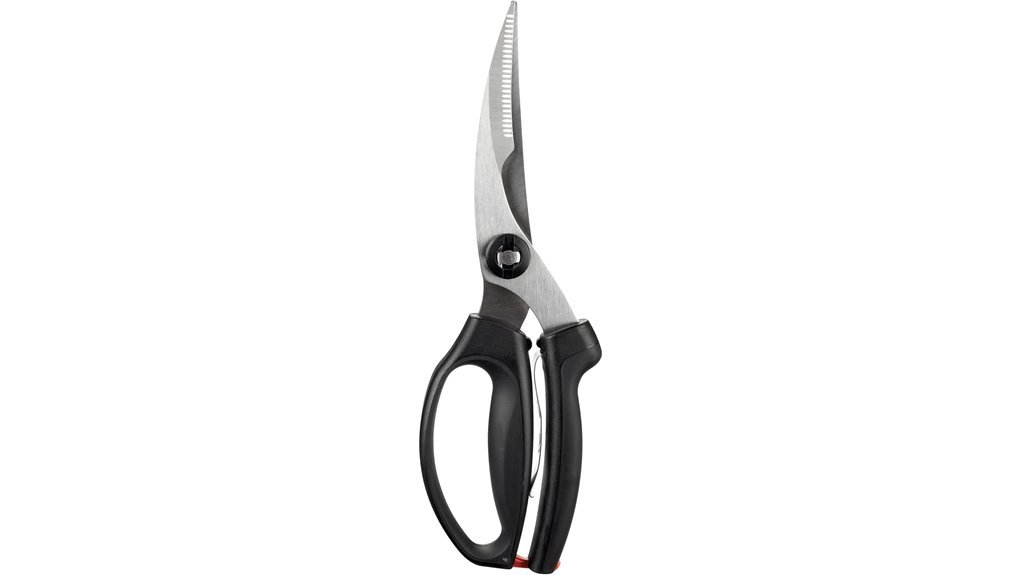
OXO built these specifically around the awkward parts of poultry prep. The stainless blades are curved and tapered so they can reach into a cavity or around a joint, and a notch cut into the blade holds a small bone in place instead of letting it roll out from under the edge. The spring-loaded soft-grip handle does the reopening work for you.
Why You’ll Like It: the safety detailing is the best of the four. A handle loop and bolster stop your hand sliding forward onto the blade mid-cut — a real hazard with greasy hands — and a handle lock keeps the blades shut in storage. Best of all, the blades separate completely, so raw chicken residue can’t hide in the pivot. That’s a hygiene advantage a fixed-pivot shear simply can’t match.
Who Should Buy This: cooks who handle raw poultry often and care most about thorough cleaning, plus anyone who finds standard shears uncomfortable or unsafe in wet hands.
Who Should Avoid This: anyone who wants to throw everything in the dishwasher — OXO specifies hand washing in warm, soapy water followed by prompt drying.
Pros:
- Blades come apart for genuinely thorough cleaning between the pivot.
- Bone notch holds small bones steady for controlled, accurate cuts.
- Handle loop, bolster and handle lock are strong, practical safety features.
- Curved, tapered blades reach into places straight blades can’t.
Cons:
- Hand wash only — no dishwasher shortcut, and it needs drying immediately.
- The take-apart design means one more step to reassemble after every wash.
- Amazon stock on this listing can be intermittent; check current availability before you plan around it.
3. Mercer Culinary Forged Poultry Shears, 9.5 Inch — Best Premium

BEST PREMIUM
Mercer is a professional-kitchen brand, and this 9.5-inch shear is the most seriously built tool here. It’s hot-forged from high-carbon stainless steel and made in Spain, with a fine-toothed blade edge that grips food rather than pushing it away. Where cheaper shears crush, these cut.
Why You’ll Like It: precision. Mercer positions these for cutting up all types of poultry — chicken, turkey, duck — as well as small game, removing joints and cutting small bones. If you break down birds regularly and want clean separations at the joint rather than ragged tears, forged construction is what you’re paying for. Textured grip points keep control with wet hands, and a safety lock secures the blades for storage.
Who Should Buy This: keen home cooks, hunters processing small game, and anyone who wants a tool that will still be sharp and tight in a decade.
Who Should Avoid This: casual cooks who spatchcock a chicken twice a year — the extra outlay won’t pay for itself. Also skip it if you want a spring-loaded handle, since this is a traditional non-sprung design.
Pros:
- Hot-forged high-carbon stainless steel — the most durable construction in this roundup.
- Fine-toothed edge grips food for clean, precise joint separation.
- Textured grip points and a safety lock at the handle end.
- Made in Spain by a recognised professional cutlery brand.
Cons:
- Hand wash with warm water and mild soap only — do not put these in the dishwasher.
- Mercer covers this model with a limited one-year warranty, which is shorter than some competitors advertise.
- Highest upfront cost of the four picks.
- No spring-loaded action, so your hand does the reopening.
4. HENCKELS Kitchen Shears for Poultry — Best Compact Pick
BEST COMPACT PICK
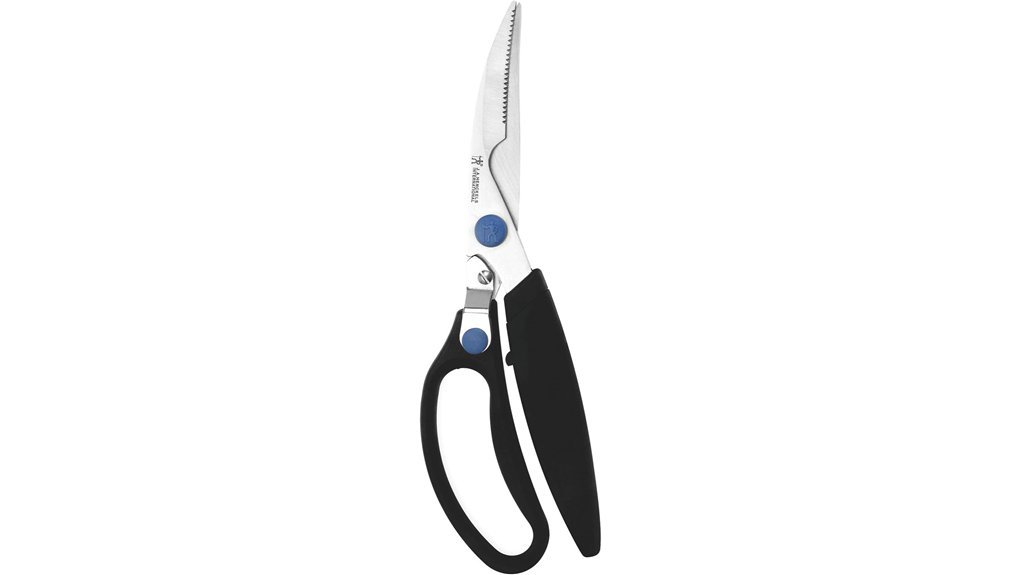
This is the small, no-fuss option. HENCKELS lists it as a 4-inch shear with 3.5-inch serrated blades, weighing under five ounces — so it disappears into a drawer and never feels unwieldy. The serrations and the purpose-shaped handle are built specifically for breaking down poultry quickly.
Why You’ll Like It: it’s the easiest of the four to live with. The blades lock closed for safe storage, and unlike the OXO and Mercer picks it’s rated dishwasher safe, so post-chicken cleanup is genuinely hands-off. For anyone nervous about raw poultry, being able to send the tool straight to the machine is worth a lot.
Who Should Buy This: cooks with limited drawer space, anyone who wants a dishwasher-safe poultry shear, and people who find full-size shears heavy or awkward in smaller hands.
Who Should Avoid This: anyone regularly breaking down a large turkey. Short blades mean less leverage, and you’ll work harder on thicker joints than you would with the Gerior or Mercer.
Pros:
- Compact and light — around 4.8 ounces, easy to control.
- Dishwasher safe, the simplest cleanup of the four picks.
- Locking blades for safe storage.
- Serrated edges and a poultry-shaped handle designed for the task.
Cons:
- Short 3.5-inch blades give less leverage on large birds and thicker joints.
- Purpose-built for poultry, so it’s less of a general-duty kitchen shear than the Gerior.
- The blade alloy is listed inconsistently across retailer pages — check the current listing if steel type matters to you.
How to Choose Poultry Shears: Buying Guide
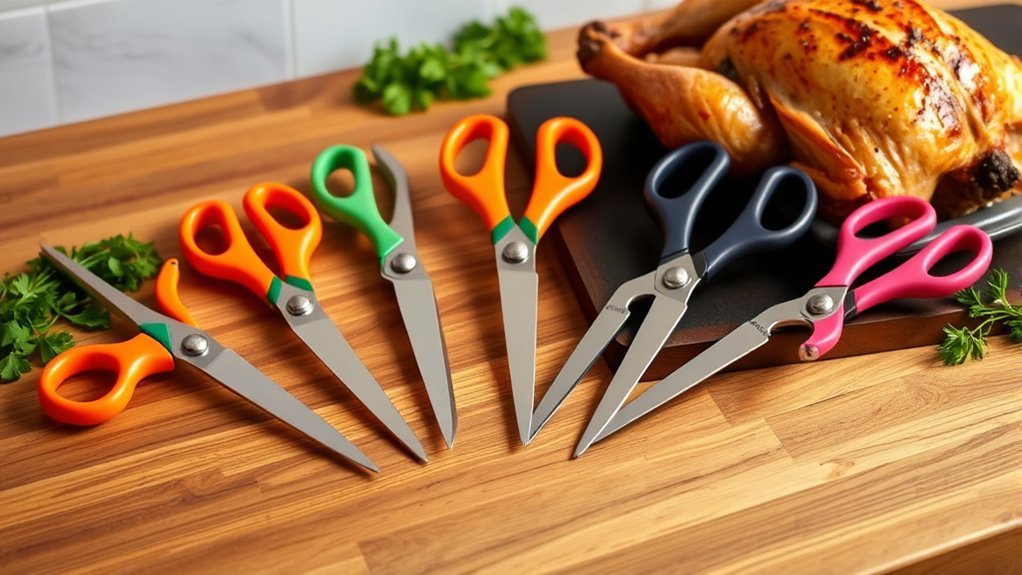
Four things separate shears you’ll still be using in five years from ones you’ll quietly replace: blade material, handle design, safety mechanisms, and how easy they are to clean. Here’s what each one actually means in practice.
Blade Material and Length
Stainless steel is the standard for kitchen shears because it resists rust and corrosion around wet, salty, acidic food. High-carbon stainless steel, especially when hot-forged as in the Mercer pick, holds an edge longer and takes more force at the joint before flexing. Blade thickness matters too — thicker blades resist twisting on small bones, while thinner ones give finer control.
Blade length is the spec most buyers overlook. Longer blades mean more leverage, which is what you want for turkey and larger birds. Shorter blades are more controllable and easier to store but make you work harder on thick joints. Serrated or micro-serrated edges matter more than they sound: they bite into wet poultry skin instead of sliding off it.
Handle Design and Spring Loading
Poultry prep is repetitive, so handle design decides whether the job is comfortable or exhausting. Spring-loaded handles reopen the blades automatically after each cut, which removes half the muscular work of a long session — the Gerior and OXO picks both have this. Textured or soft-grip handles keep control when your hands are greasy, and a handle that fits your hand size matters more than any spec on the box. If you have smaller hands or reduced grip strength, a lighter, shorter shear will serve you better than a heavy full-size one.
Safety Features Worth Having
A blade lock is non-negotiary in a shared kitchen. Every pick here has one, and it keeps sharp serrated blades closed in a drawer where hands go searching. A bolster or handle loop — as on the OXO — stops your hand sliding forward onto the blade if it slips mid-cut, which is the most common way people get hurt with shears. A bone notch holds small bones steady so they don’t roll out from under the edge.
Safety note: None of these shears is designed to cut through large or load-bearing bones such as a beef femur or a pork shoulder. They are rated for poultry joints, small bones, cartilage and skin. Forcing them through heavy bone risks chipping the blade and slipping — use a cleaver or bone saw for that work.
Cleaning and Maintenance
Raw poultry makes cleaning a hygiene issue, not just a chore. Take-apart shears, like the OXO, separate at the pivot so nothing gets trapped in the hinge — the most hygienic design available. Fixed-pivot shears need warm soapy water worked into the joint and prompt drying to prevent water spots and corrosion.
Check the manufacturer’s care instructions rather than assuming: of these four, the HENCKELS is rated dishwasher safe, the Gerior is listed as dishwasher safe but will last longer hand washed, and both the OXO and Mercer are hand wash only. Dishwasher detergents are harsh on edges even when a tool technically survives them.
Versatility Beyond Chicken
Good poultry shears do more than cut chicken. They’re the fastest tool for spatchcocking — removing the backbone so a bird lies flat and roasts evenly — as well as trimming fat, separating joints, portioning wings, and cutting through cartilage. Broader kitchen shears like the Gerior double as general-purpose scissors for herbs, vegetables and packaging. Narrower, purpose-built shears like the HENCKELS and Mercer trade that flexibility for better performance on poultry itself.
Before You Buy: Quick Checklist
- How big are the birds? Turkeys and large roasters need longer blades and more leverage.
- How often will you use them? Occasional use doesn’t justify forged construction; weekly use does.
- Dishwasher or sink? Decide this first — it eliminates half the market immediately.
- Any grip or hand strain concerns? Prioritise a spring-loaded handle.
- Children or a shared drawer? Insist on a blade lock.
- Left-handed? Check the hand-orientation field on the listing before ordering.
- Drawer space? A 9.6-inch shear is noticeably larger than a 4-inch one.
Frequently Asked Questions
How do I clean and maintain poultry shears?
Wash them straight after use, before residue dries. If your shears come apart at the pivot, separate them and wash each blade in warm soapy water, then rinse and dry completely — moisture left in the hinge is what causes spotting and corrosion. For fixed-pivot shears, work suds into the joint area and dry immediately. Follow the manufacturer’s care instructions, since some models are dishwasher safe and others are explicitly not.
Can poultry shears cut through bones?
They handle small bones, joints and cartilage — chicken and turkey ribs, wing joints, a backbone when spatchcocking. They are not designed for large or dense bones such as beef or pork leg bones. Forcing them through heavy bone can chip the edge, spring the pivot, or cause a dangerous slip. Use a cleaver or bone saw for those cuts.
What’s the difference between poultry shears and kitchen shears?
Poultry shears typically have curved or tapered blades to work around bone and into a cavity, plus features like a bone notch and heavier pivot construction. General kitchen shears have straight blades and often add extras such as bottle openers or nutcracker sections. A dedicated poultry shear is better on birds; a general kitchen shear is more useful the rest of the week.
How do I spatchcock a chicken with shears?
Place the bird breast-side down, locate the backbone, and cut along one side of it from tail to neck, then repeat on the other side to remove the backbone entirely. Flip the bird over and press firmly on the breastbone until it lies flat. Longer, spring-loaded shears make this much easier than short ones.
Are poultry shears suitable for left-handed users?
Some models are ambidextrous and others are built for right-handed use, and manufacturers don’t always label this consistently across retailers. Check the hand-orientation field on the product listing before ordering, and note that spring-loaded designs are generally more forgiving for left-handed cooks than a fixed offset handle.
How often should I sharpen poultry shears?
Most poultry shears — including all four picks here — use micro-serrated or fine-toothed edges that cannot be sharpened at home the way a plain-edge knife can. Attempting it usually destroys the serrations. Keep them clean and dry, avoid hard bone, and replace them when cutting performance drops noticeably. If you want a shear you can resharpen, look specifically for a plain-edge model.
Final Recommendation
If you want one pair and don’t want to think about it: the Gerior Heavy Duty Poultry Shears. Full-size leverage, spring-loaded handles, a safety lock, and enough versatility to earn a permanent place in the drawer.
If hygiene is your priority: the OXO Good Grips Spring-Loaded Poultry Shears, because the blades separate completely for cleaning.
If you break down birds weekly and want a tool for the long haul: the hot-forged Mercer Culinary 9.5-inch shears.
If drawer space and dishwasher convenience matter most: the compact HENCKELS Kitchen Shears for Poultry.
Conclusion
Poultry shears are one of the few kitchen tools that immediately change how a task feels. The difference between sawing at a chicken with a knife and cleanly snipping out a backbone in seconds is not subtle — and unlike most gadgets, a decent pair earns its drawer space every time you cook a bird.
Match the tool to the job rather than the price tag: longer blades for big birds, spring loading for comfort, a take-apart design for hygiene, and a blade lock in any kitchen where other people go through the drawers. Get that combination right and you’ll be using the same pair for years.





[…] 4 Best Poultry Shears for 2027: Top Picks and Buying Guide […]