
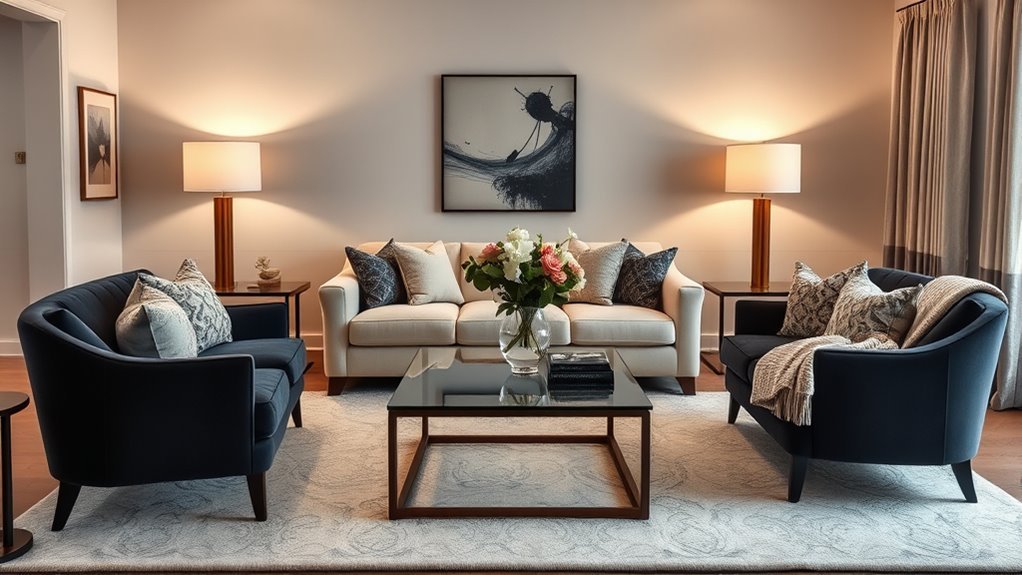
To arrange your living room for conversation, build the layout around people first and the TV second. Face or angle the main seats toward one another, keep tables within easy reach, and preserve a clear route around the seating group. As a practical starting point, facing seats often work well about 6 to 8 feet apart, although a broader range of roughly 3.5 to 10 feet can work depending on the room, furniture depth, and how intimate you want the group to feel.
Last updated: August 19, 2026. Spacing guidance, accessibility references, room-planning app availability, and structured-data notes were rechecked.
Quick Answer
Arrange your living room for conversation by placing sofas and chairs so they face or angle toward one another. In a medium-size room, facing seats about 6 to 8 feet apart are a useful starting point, while roughly 3.5 to 10 feet can work across different layouts. Leave about 16 to 18 inches between seating and the coffee table, protect the main walking path, and aim for about 36 inches of clear width where easy or accessible movement matters.
Key Takeaways
- Face seats toward each other or angle them inward so conversation feels natural.
- Treat 6 to 8 feet between facing seats as a starting point, not a fixed rule; smaller and larger rooms may need different spacing.
- Use a coffee table, ottoman, or shared side table as the center of the seating zone.
- Protect the main traffic route and aim for about 36 inches of clear width where inclusive movement matters.
- Anchor the group with a rug large enough for at least the front legs of the main seating pieces.
- Layer warm, dimmable lighting so faces are visible without harsh glare.
At a Glance
| Time Required | Varies by room size and furniture weight; measuring first reduces unnecessary moving |
| Difficulty | Easy to moderate, depending on furniture weight |
| Tools Needed | Tape measure, painter’s tape, paper sketch, furniture sliders |
| Cost | Free if you rearrange what you own; optional cost for a rug, lamps, or small tables |
How to Arrange Your Living Room for Conversation
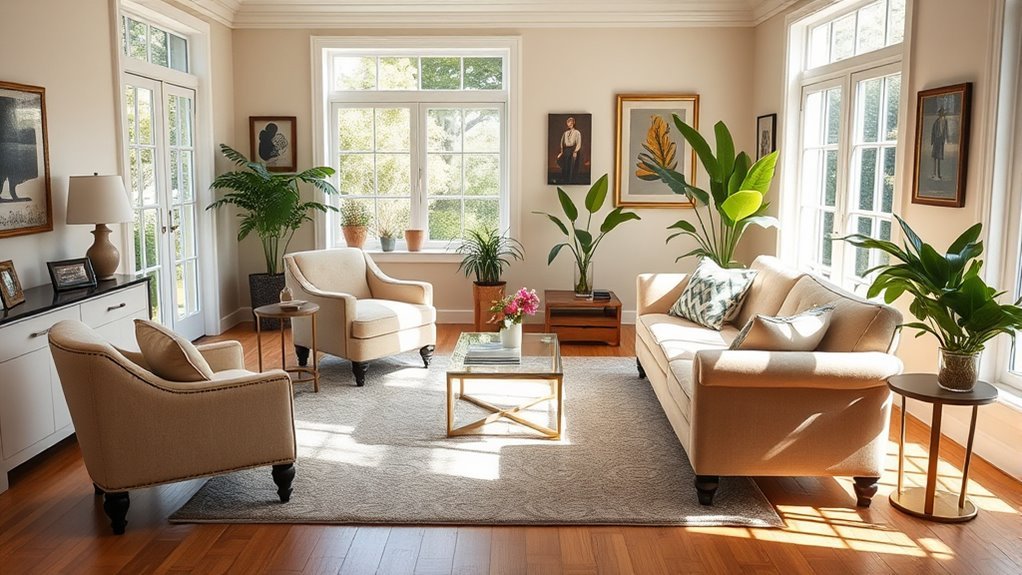
When you want to create a living room that invites conversation, the way you arrange your seating matters most. Instead of automatically lining every piece around the walls or aiming every seat toward the television, pull the main sofa and chairs into a clear seating group. People should be able to make eye contact, hear one another at a normal speaking level, reach a table, and leave their seat without making someone else move.
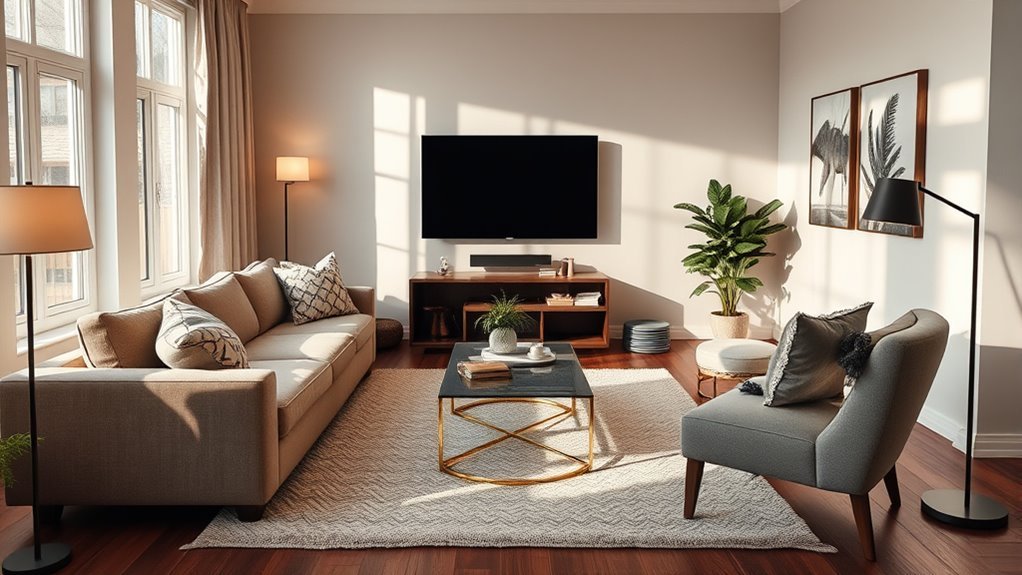
Start by choosing the room’s main focal point. This might be a fireplace, a window, a coffee table, artwork, or a media wall. Then place the largest seating piece first, usually the sofa, and add chairs so they face the sofa or angle toward it. A U-shaped, L-shaped, facing-sofa, or loose circular layout can all support conversation when the distances and walkways suit the room.
Note: A TV can still be part of the room, but it does not have to control every seat. In a conversation-friendly layout, at least some chairs should face or angle toward people rather than only facing the screen.
Choose the Right Seating Arrangement for Your Living Room
The best seating arrangement depends on your room shape, furniture size, and how you use the space. For many rooms, one sofa with two chairs facing or angled toward it is an easy starting point because it gives people clear sightlines while keeping the center open for a coffee table or ottoman.
| Room or Priority | Good Starting Layout | Why It Works |
|---|---|---|
| Small living room | Loveseat or compact sofa with one or two slim chairs | Keeps sightlines open without filling every wall |
| Medium living room | One sofa with two chairs opposite or angled inward | Creates a clear conversation group with flexible TV viewing |
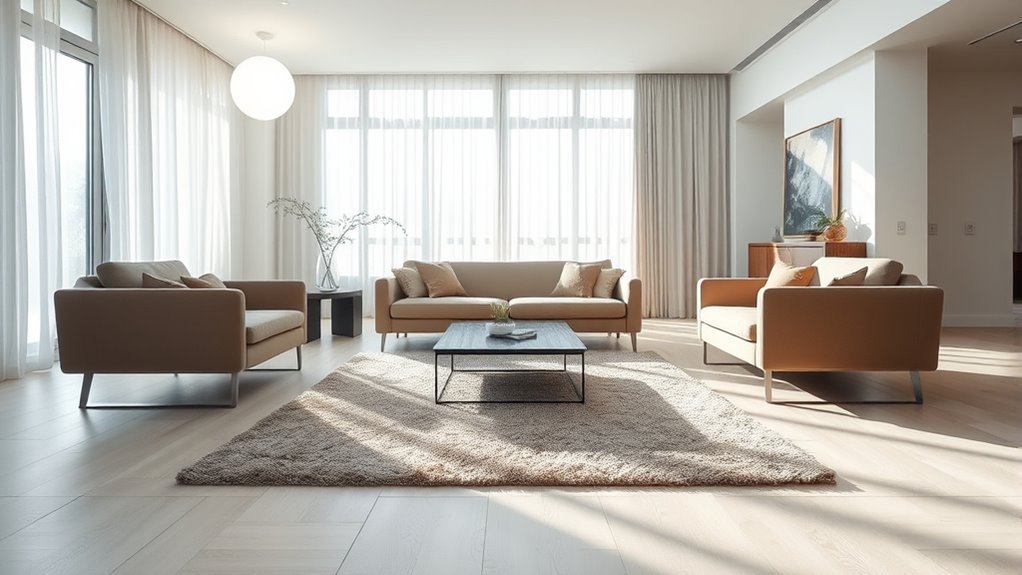
| Large living room | Two facing sofas or two smaller conversation zones | Prevents guests from being spread across one oversized seating circle |
| TV plus conversation | Sofa toward the screen with angled or swivel chairs | Lets chairs turn toward people during conversation and toward the TV when needed |
| Long or narrow room | Slim sofa with smaller chairs across or diagonally opposite | Breaks up the tunnel effect without blocking the main path |
Recommended Products

【Butterfly‑Wing Back Design】Distinctive butterfly wing‑shaped back creates chic decorative appeal. Cream‑white velvet finish elevates modern, boho and minimalist interiors. Works beautifully as accent chair for vanity, reading nook and living‑room corner besides dining use.

Timeless Mid-Century Elegance: Featuring sleek splayed legs, refined synthetic leather, and classic button-tufted detailing, this mid-century modern chair brings understated luxury to living rooms, bedrooms, or cozy reading corners

SET OF 2 MODERN BISTRO CHAIRS: Offers comfortable, stylish seating for restaurants, bistros, dining rooms, living rooms, kitchens, and other indoor or outdoor commercial or residential environments
How Far Apart Should Seating Be for Conversation?
Use seating distance as a range rather than a single magic number. Current living-room layout guidance commonly treats roughly 3.5 to 10 feet between seating as a workable overall range, while facing seats around 6 to 8 feet apart can be a comfortable starting point in many medium-size rooms. The right distance changes with furniture depth, room scale, acoustics, and whether the group is meant to feel intimate or open.
For a large or open-plan room, avoid stretching one seating group simply to fill the floor. If guests at opposite ends begin to feel disconnected, create two smaller zones instead. One might center on the fireplace or coffee table, while a second pair of chairs creates a quieter reading or conversation corner.
- Place sofas and chairs so people can see each other without turning their whole body.
- Use about 6 to 8 feet between facing seats as a practical starting point when the room permits.
- Treat roughly 3.5 to 10 feet as a broader design range rather than a mandatory target.
- Use a central coffee table, ottoman, or cluster of small tables as the shared focal point.
- In a large or open-plan room, create more than one smaller zone instead of one oversized seating area.
For a small living room, a loveseat with two lightweight accent chairs can work better than a deep sectional. For a large living room, two sofas facing each other can create a strong center as long as their spacing still supports normal conversation.
Select Comfortable Seating
Comfortable seating keeps guests relaxed and encourages them to stay. Choose sofas and chairs with supportive backs, seat depths that fit how your household sits, and enough side surfaces for drinks or phones. If your room is small, chairs with open legs, slim arms, or swivel bases can make the arrangement feel lighter and easier to adjust.
Flexible seating also helps. Ottomans, poufs, stools, and small accent chairs can move closer during gatherings and tuck away afterward. If you host often, avoid layouts where one person is stranded far from the group or stuck behind a coffee table with no easy exit.
Ensure Optimal Flow
A conversation layout should not block the way through the room. Keep the main path from entrances, hallways, and doorways clear. The numbers below are design starting points rather than building-code requirements for a typical private living room, except where the separate ADA reference is specifically noted.
| Area | Useful Starting Point | Why It Helps |
|---|---|---|
| Seat to coffee table | About 16 to 18 inches | Keeps the surface reachable while leaving knee room |
| Facing conversation seats | About 6 to 8 feet as a starting point | Often keeps people comfortably connected in a medium-size room |
| Broader seat-to-seat range | Roughly 3.5 to 10 feet | Allows for small, medium, and larger layouts without treating one distance as universal |
| Main walkway | About 30 to 36 inches where space permits | Makes regular movement around larger furniture easier |
| Tight secondary passage | About 18 to 24 inches when space is limited | Provides a compromise in compact rooms where the path is not the primary circulation route |
| Inclusive accessible-route target | 36 inches of clear width where possible | Provides more usable clearance for guests who need extra maneuvering space |
These spacing ranges are consistent with commonly used living-room layout guidance. For example, Emily Henderson’s living-room layout guidance uses a broad 3.5-to-10-foot seating range and recommends larger clearances for main walkways when the room permits.
Make Sure Everyone Can Move Around Comfortably
To keep your living room comfortable, plan movement before you finalize furniture placement. Walk through the room as if you are carrying a drink, greeting a guest, or moving from the sofa to another room. If you repeatedly have to turn sideways, step around sharp corners, or ask someone to move their legs, adjust the path before worrying about perfect symmetry.
For a main residential traffic route, roughly 30 to 36 inches is a useful design goal where the room permits. In tighter secondary areas, less clearance may be workable. If inclusive movement is important, aim for about 36 inches of clear width. The 2010 ADA Standards for Accessible Design specify a 36-inch minimum clear width for many accessible walking surfaces in covered public and commercial settings. A typical private home may not be governed by that standard, but the dimension is a useful accessibility reference when planning generous circulation.
Warning: Do not let rugs, ottomans, floor lamps, cords, or side tables create tripping points in the main walkway. A layout is not functional if guests have to dodge obstacles to reach a seat.
Use Rugs and Tables to Define Your Space
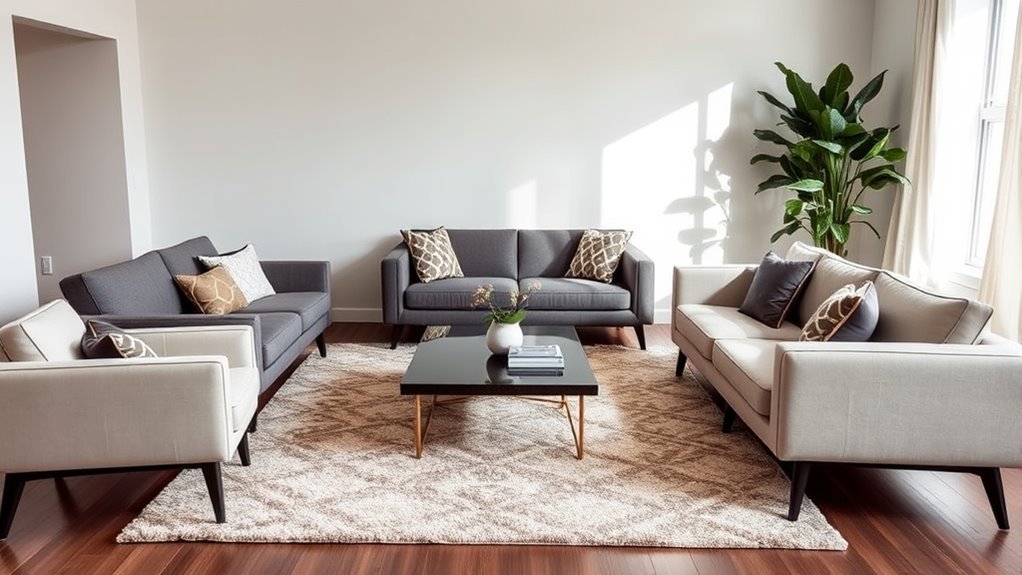
A rug makes a conversation area feel intentional because it visually connects furniture that might otherwise look scattered. One widely used approach is to choose a rug large enough for at least the front legs of the sofa and main chairs to rest on it. In a larger room, placing all legs on the rug can make the group feel even more grounded. Houzz’s rug-placement guidance likewise describes the front-legs-on approach as a common way to unify a seating arrangement.
- Use the rug to frame the seating zone, not to float alone under the coffee table.
- Place the coffee table or ottoman near the center of the rug so the main seats can reach it.
- Add side tables near chairs that sit beyond comfortable coffee-table reach.
- Keep table heights practical for the seat beside them rather than choosing height only for appearance.
A common coffee-table starting point is about 16 to 18 inches from the sofa edge, which gives many people usable reach while retaining legroom. 2Modern’s current spacing guide uses the same approximate range.
Pro Tip: Before buying a rug or moving heavy furniture, mark the seating and rug edges on the floor with painter’s tape. Then sit, stand, and walk through the taped layout to test scale and circulation before committing.
Recommended Products

Soft & Durable: This 8x10 area rug low-pile combines soft faux wool fibers with a 0.25-inch height for comfort. Tight weaving reduces shedding and edge fraying, making it perfect for high-traffic areas like living rooms, bedrooms, and entryways

Ultra-Soft Low Pile Rug: Gent drizz living room rugs 8x10 made of Upgraded durable low pile faux wool fibers, 0.25'' thick, featuring a soft fuzzy density surface, soft and pliable to the touch, providing great comfort for your bare feet. The low pile makes it easy for your Large area rug to clean and is perfect for homes with kids and pets

Machine Washable Area Rugs: Our living room rug, one of the 8x10 area rugs, surfaces is resistant to stains and dirt, and can be easily cleaned with a rag or vacuum cleaner; for deep cleaning, use a washing machine
Choose the Right Lighting to Enhance Conversation
Good lighting makes faces visible and helps the room feel relaxed. Avoid relying only on one bright overhead fixture. Instead, use layers: ambient light for the room, task light near reading chairs, and accent light to soften corners or highlight artwork.
Warm white lighting often suits evening living-room use because it creates a softer atmosphere than very cool light. Dimmable fixtures are especially useful when their bulbs and dimmers are compatible. According to ENERGY STAR, LED lighting products can produce light up to 90% more efficiently than incandescent bulbs, making LEDs a practical option for layered lighting when you choose suitable brightness and color temperature.
| Lighting Type | Purpose | Best Placement |
|---|---|---|
| Table Lamps | Soft, face-level glow | Side tables beside sofas or chairs |
| Floor Lamps | Ambient or reading light | Corners, reading chairs, or beside sectionals |
| Accent Lighting | Adds depth and atmosphere | Artwork, shelves, plants, or architectural features |
| Dimmers | Controls mood and glare | Main fixtures and lamps with compatible bulbs |
If voices sound unusually harsh or echo around the room, look at the surfaces as well as the seating distance. Rugs, curtains, upholstered furniture, cushions, and other soft materials can make a hard-surfaced room feel less acoustically exposed. You do not need to fill the space with decor; add soft surfaces where they also serve a practical or visual purpose.
Recommended Products

Unique & Exquisite Modern Design ✨ This 63-inch black floor lamp boasts a mid-century inspired silhouette with three globe lights artfully arranged on a U-shaped triple metal frame. The elegant minimalist structure blends seamlessly with contemporary, vintage, or industrial decor, adding a touch of sophistication to living rooms, bedrooms, or offices.

Smooth dimming: Compatible with most dimmers on the market, these LED bulbs provide smooth dimming control from 10% to 100% without flickering or buzzing, giving you the perfect brightness for any moment

【3 Way Light Bulbs】 :Our 3 way LED light bulbs offers 3 brightness settings to match your lighting needs. With a soft white light and a high color rendering index, it effectively illuminates any space with vibrant, natural colors. At 360lm, 720lm, and 1080lm, it is perfect for a variety of settings, from reading to entertaining guests
Tailor Your Layout to Fit Your Lifestyle
A good living room layout should match how you actually live. A room used for family movie nights needs a different balance than a room used mostly for coffee with friends, book club, reading, or board games. Decide what happens most often, then let that priority guide the furniture.
Identify Key Activities
List the main activities your living room supports. Common examples include:
- Casual conversation with friends or family
- Watching TV or sports
- Reading, relaxing, or listening to music
- Game nights or coffee table activities
- Entertaining larger groups
If conversation is the top priority, keep the seating group tighter and more inward-facing. If TV is equally important, use swivel chairs, angled chairs, or a sofa facing the screen with side chairs turned toward the group.
How Do You Balance Conversation With a TV?
You do not have to choose between a conversational room and a usable television. One practical compromise is to give the sofa a clear TV view while placing one or two chairs opposite or diagonally across from it. Swivel chairs are especially flexible because they can turn toward the sofa during conversation and toward the screen during a movie.
Avoid directing every chair toward the television unless screen viewing is genuinely the room’s main job. When the TV is off, the seating should still look like one connected group rather than a row of spectators waiting for the screen to turn on.
Assess Space Limitations
Measure the room before you move furniture. Note the length and width, doorway swings, windows, fireplace projection, outlets, vents, and any traffic path that must stay open. Then sketch the room or tape furniture footprints on the floor.
For narrow living rooms, avoid turning the entire space into one straight corridor of furniture. Try a slim sofa on one long wall with two small chairs across from it, or use one chair and one movable ottoman to create a lighter conversation corner. For open-plan rooms, use the back of a sofa, a large rug, lighting, or a console table to define the living area without creating a physical barrier.
Choose Seating That Fits Daily Life
Choose seating that supports both posture and connection. Very deep lounge seating is useful for relaxing, but some people find more upright chairs easier for longer conversations. A mix of a comfortable sofa, supportive accent chairs, and flexible ottomans usually gives the room more options than relying on one furniture type.
Mixing seat shapes can also make the group easier to adjust. Pair a sofa with chairs that are simple to pull closer, or add a bench or pouf for casual overflow seating. The goal is not perfect symmetry; it is a room where each seat still feels connected to the group.
Measure Before You Rearrange
The fastest way to avoid a frustrating layout is to measure first. Start with the biggest piece, usually the sofa. Make sure it fits the wall or floating position you want, then check whether the coffee table, rug, chairs, and main traffic route still fit around it.
- Measure the room’s length and width.
- Mark windows, doors, fireplace, TV wall, outlets, and major walkways.
- Measure the sofa, chairs, coffee table, side tables, and rug.
- Use painter’s tape to mark the furniture footprint on the floor.
- Walk the paths before moving heavy pieces into place.
- Sit in each main seat and check whether you can see the other people in the group naturally.
This planning step prevents common problems such as blocked paths, cramped seating, undersized rugs, and chairs that look balanced from the doorway but sit too far from the rest of the conversation.
Test Your Conversation Layout Before You Finish
Once the furniture is roughly in place, test the arrangement from a guest’s point of view instead of judging it only while standing in the doorway. A successful layout should pass five simple checks:
- Eye-contact test: Sit in every main seat. Can you see the other people in the group without twisting your whole body?
- Reach test: Can each main seat reach a coffee table, ottoman, or side table without a large stretch?
- Exit test: Can someone leave a chair without forcing another person to stand or pull in their legs?
- Walkway test: Can you walk the primary route through the room without turning sideways around furniture?
- Dual-purpose test: If the TV matters, can people adjust their view of it without destroying the conversation arrangement?
If the layout fails one of these checks, move the smallest or most flexible piece first. Shifting a chair, ottoman, side table, or rug a few inches is usually easier than immediately relocating the main sofa.
Common Mistakes to Avoid When Arranging Your Living Room
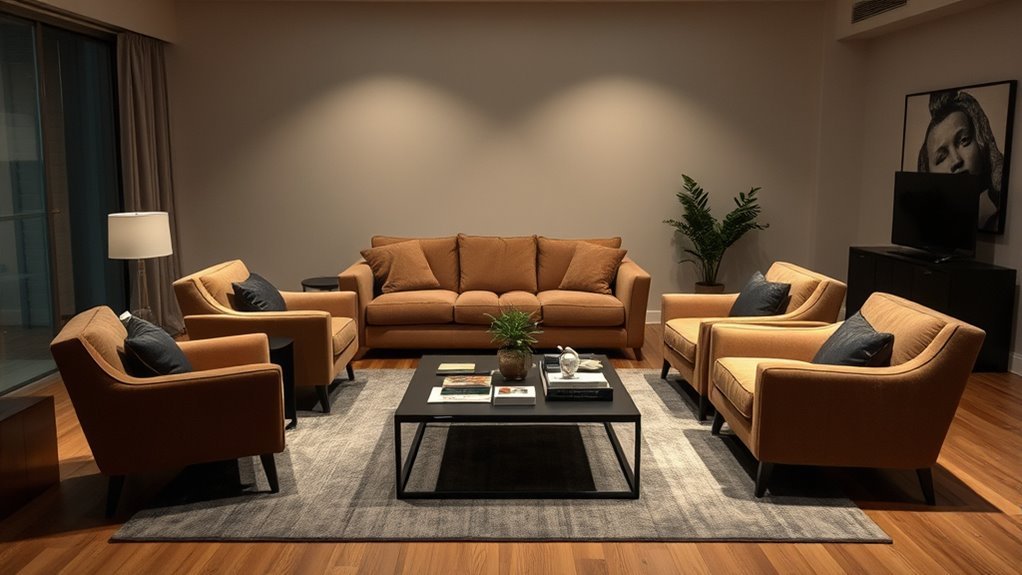
When arranging your living room, small layout mistakes can make the space feel awkward even if the furniture itself is attractive. Watch for these common problems:
| Mistake | Impact | Better Fix |
|---|---|---|
| Pushing every piece against the wall | Can make the conversation group feel disconnected | Float a chair, ottoman, table, or the sofa inward when space permits |
| Ignoring traffic patterns | Creates awkward navigation | Protect the main path and aim for roughly 30 to 36 inches where the room permits |
| Choosing furniture that is too large | Crowds the room and limits movement | Use slimmer chairs, open legs, or fewer oversized pieces |
| Using a rug that is too small | Makes the seating group feel disconnected | Choose a rug that reaches at least the front legs of the main seats |
| Depending only on overhead light | Can create flat or harsh lighting | Add table lamps, floor lamps, or compatible dimmers |
| Pointing every seat at the TV | Makes face-to-face conversation less natural | Angle or swivel at least some chairs toward the seating group |
Frequently Asked Questions
How do you set up a living room for conversation?
Place the main seats so they face or angle toward each other, then add a reachable coffee table, ottoman, or side tables. Keep the group close enough for normal conversation, preserve a clear path around it, and test the arrangement from every seat before finalizing it.
How far apart should seating be for conversation?
Facing seats about 6 to 8 feet apart are a useful starting point in many medium-size living rooms. A broader range of roughly 3.5 to 10 feet can still work depending on furniture depth, room size, acoustics, and how intimate you want the seating group to feel.
What is the 2/3 rule for living rooms?
The two-thirds rule is a flexible proportion guideline, not one fixed formula. Designers may apply a two-thirds relationship to a sofa and wall, a sofa and rug, or the furniture group and surrounding space. Use it as a visual starting point, then prioritize comfortable reach, clear walkways, and the way your household actually uses the room.
Should living room couches be against the wall?
Not necessarily. In a small room, a sofa may need to sit against a wall. If you have more space, pulling seating inward can make the conversation group feel more connected. Even when the sofa stays on the wall, angled chairs, a rug, and a central table can draw the layout toward the middle.
Is there a free app that can help me rearrange my room?
Yes. Roomstyler offers free room-planning access, magicplan currently provides a free Starter Plan for up to two projects, Planner 5D has a free Basic plan with limited features, and SketchUp Free provides browser-based 3D modeling. Free-plan limits can change, so check the provider’s current plan details before starting a large project.
How do you arrange a living room for both conversation and TV?
Give the main sofa a comfortable TV view, then place side chairs opposite or diagonally so they still face the conversation group. Swivel chairs are useful when you want the same seat to turn toward people during conversation and toward the screen during movies.
Conclusion
Arranging your living room for conversation is less about following one perfect furniture diagram and more about connecting the people who use the room. Face or angle seats toward one another, keep tables within reach, protect the main walkway, and use the rug and lighting to hold the group together. Start with the largest furniture piece, test the layout from every seat, and adjust the smallest movable pieces until people can talk, stand, and walk through the room naturally.
Sources
- ADA.gov — 2010 ADA Standards for Accessible Design — supports the 36-inch clear-width accessibility reference and its proper regulatory context.
- ENERGY STAR — Learn About LED Lighting — supports the LED efficiency statement.
- Emily Henderson — How to Layout a Living Room — supports the broader seating-distance range and practical walkway guidance used as design starting points.
- 2Modern — How Far Should a Coffee Table Be From a Sofa? — supports the approximate 16-to-18-inch coffee-table spacing guideline.
- Houzz — Area Rug Placement Guidance — supports using a sufficiently large rug to connect the seating group, including the front-legs-on approach.
- Roomstyler — 3D Home Planner — supports current free room-planning availability.
- magicplan — Starter Plan — supports current free access for up to two projects.
- Planner 5D — Subscription Types — supports the current free Basic plan and its limited functionality.
- SketchUp — SketchUp Free — supports current browser-based free modeling availability.
- Google Search Central — Changes to HowTo and FAQ Rich Results — supports the current limitation of FAQ rich-result visibility and deprecation of HowTo rich results.



[…] plug in a vacuum or other device. If the furniture plan is still undecided, finalize your living room seating arrangement for conversation before locking in special-purpose floor […]
[…] For a deeper seating plan, see our step-by-step guide to arranging living room seating for conversation. […]