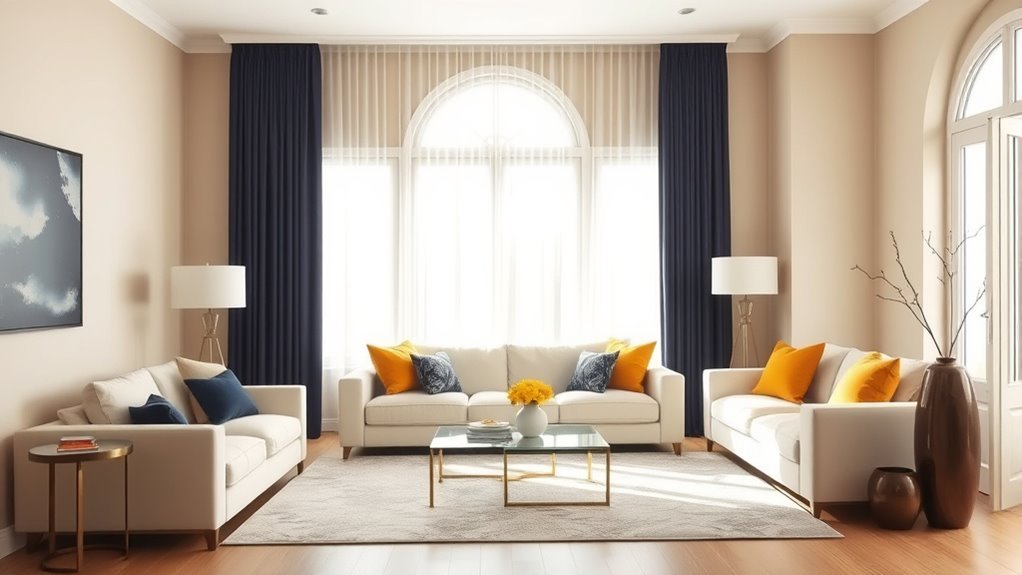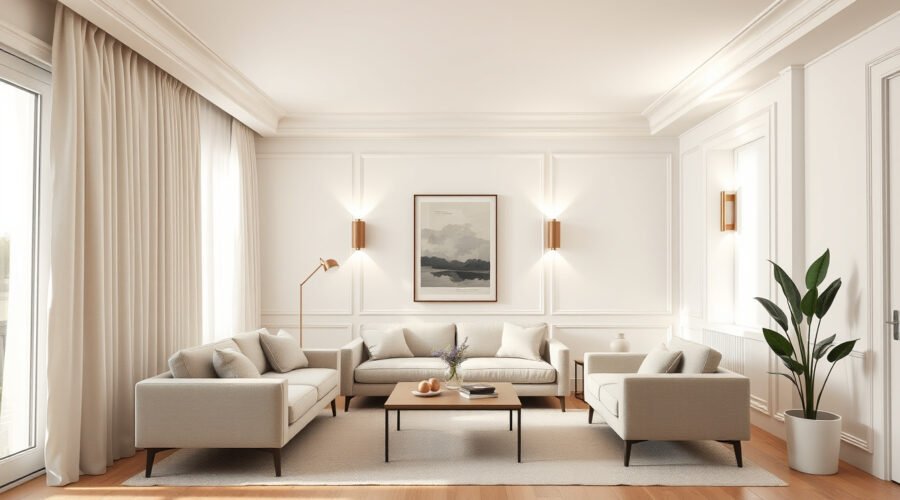
A low-ceiling living room can still feel bright, calm, and stylish when you guide the eye upward, keep bulky pieces low, and use light carefully. The goal is not to hide the ceiling. It is to make the whole room feel balanced, open, and intentional with paint, drapes, furniture scale, lighting, storage, and artwork working together.
Quick Answer
To make a low-ceiling living room look higher, use light wall and ceiling colors, hang curtains close to the ceiling, choose low-profile furniture, add vertical lines, use slim lighting, and keep wall-mounted pieces tall and narrow. Avoid bulky overhead fixtures, heavy window treatments, dark ceiling paint, and cluttered furniture layouts.
Key Takeaways
- Use vertical details such as tall art, floor-to-ceiling drapes, narrow shelving, and subtle stripes to pull the eye upward.
- Choose low, clean-lined furniture so there is more open wall space above the seating.
- Use slim LED fixtures, sconces, table lamps, and uplights instead of heavy chandeliers or bulky ceiling fans.
- Keep paint colors light and connected from wall to ceiling to reduce visual breaks.
- Measure before you hang drapes, lighting, shelves, or artwork so the room feels taller without creating hazards or crowding walkways.
At a Glance
| Time Required | 1 weekend for paint, curtains, lighting swaps, and styling; longer for built-ins or moulding |
| Difficulty | Easy to moderate; electrical work and built-ins may require a pro |
| Tools Needed | Tape measure, level, pencil, drill, anchors, paint supplies, ladder, stud finder, and light bulbs or fixtures |
| Cost | Low for styling changes; moderate for paint, drapes, and fixtures; high for custom cabinetry or built-ins |
Understanding the Challenges of Low Ceilings
Low ceilings can make a living room feel cozy, but they can also make the space feel heavy if the furniture, lighting, and color choices press downward. An 8-foot ceiling is common in many homes, but it can feel low beside taller modern rooms, open floor plans, or large windows.
The best design approach is to reduce horizontal visual breaks. Heavy crown lines, short curtains, bulky sofas, dark ceilings, and large overhead fixtures all remind the eye where the ceiling stops. Light colors, tall vertical shapes, slim lighting, and low furniture do the opposite: they make the room feel more open without changing the structure.
Note: Before buying anything, measure the ceiling height, window height, sofa height, fixture depth, and main walkway width. Low ceilings are easier to improve when every item is chosen to fit the room’s real proportions.
Create Vertical Impact With Lines and Patterns
Vertical lines are one of the simplest ways to make a low-ceiling living room feel taller. They guide the eye from floor to ceiling instead of side to side. The key is restraint. One or two strong vertical moves are enough; too many stripes, tall shelves, and busy patterns can make the room feel crowded.
Try these vertical design ideas:
- Use subtle striped wallpaper on one wall rather than all four walls.
- Choose tall, narrow art instead of wide horizontal pieces above the sofa.
- Style slim bookcases vertically with books, vases, and framed pieces stacked at different heights.
- Use paneling or shiplap vertically to make the walls feel longer.
- Choose upright plants such as a snake plant or fiddle-leaf fig, but keep the pot narrow.
Pro Tip: If you use stripes, keep the contrast soft. A pale beige stripe on warm white walls usually feels taller and calmer than high-contrast black-and-white stripes.
Choose Low-Profile Furniture That Opens the Wall Space
Furniture scale matters as much as paint color. Tall, bulky furniture can make a low ceiling feel even closer. Lower seating leaves more open wall above the sofa and chairs, which helps the room breathe.
Look for sofas and chairs with clean lines, lower backs, and visible legs. A sofa with a tight back and raised legs often feels lighter than an overstuffed rolled-arm sofa that sits directly on the floor. Choose slim side tables, open-frame coffee tables, and media consoles that do not tower over the room.
Avoid pushing every piece against the wall. Even a few inches of breathing room behind a sofa or chair can make the layout feel more intentional. Keep the tallest pieces, such as bookcases or cabinets, on one wall so they read as a planned vertical feature instead of scattered visual weight.
Recommended Products
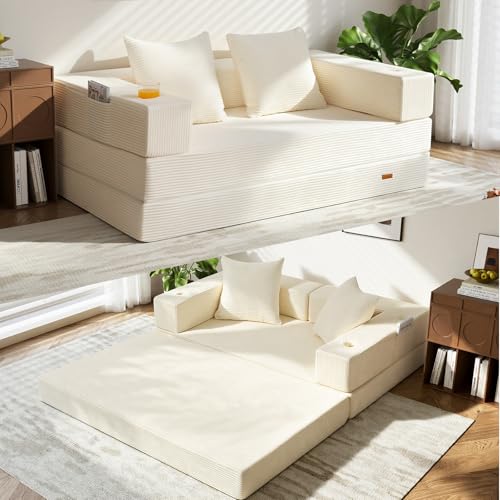
LOW-PROFILE FLOOR SEATING: Seat height is 11.8 in., lower than a standard boneless couch seat of 17 to 19 in.; sits close to the floor for lounging, reading, and gaming; place against a wall for back support

Two-seat lounge design: A low seat, gently sloped back and armless shape create a relaxed place to read, watch TV or unwind together. This loveseat adds casual seating to a living room, bedroom or apartment.

Low-Profile 59-In Floor Sofa: Boneless couch with 11.8-in seat height; not standard-height seating. Ideal for floor lounging, kids' rooms, dorms & small spaces. 4-in-1 design converts from loveseat to floor couch, futon or sleeper bed
Hang Drapes to Enhance Ceiling Height
Drapes can dramatically change how high a room feels. Instead of mounting the rod directly above the window trim, hang it closer to the ceiling. This makes the window look taller and creates one clean vertical line from near the ceiling to the floor.
Recommended Products

Pair Sold: Each package includes 2 panels of blackout curtains. Each panel measures 40"W x 84"L, with a pair measuring 80"W x 84"L. Each panel has 6 anti-rust silver grommets(1.6 inch inner diameter) which would fit most standard curtain rods

100% BLACKOUT: These 100% blackout curtains utilize advanced technology to completely block out natural light and effectively filter out UV rays, plunging your room into total darkness so you can enjoy a restful sleep day or night. Combined with excellent thermal and sound insulation, they help maintain a stable room temperature and dampen outside noise, making them ideal for bedrooms, living rooms, and nurseries—creating a peaceful, private space for relaxation.

Pair Sold: Each package includes 2 panels of blackout curtains for bedroom. Each panel measures 40"W x 84"L, with a pair measuring 80"W x 84"L. The curtains blackout have 2 hanging options (Rod pocket & Clip Style) with a 3-inch rod pocket to fit standard or decorative curtain rods. Don't worry if this blackout curtain is a few inches shorter than your window. Hang with rings & hooks for easy 3-4" height adjustment.
Optimal Drapery Height
For most low-ceiling living rooms, mount the curtain rod about 4 to 6 inches above the window frame, or just below the ceiling or crown moulding when space allows. Let the panels reach the floor. Floor-length drapes draw the eye upward and make the wall feel taller.
Use a rod that extends several inches beyond each side of the window. This lets the curtains stack outside the glass, which makes the window look wider and lets in more daylight.
Fabric Choice Matters
Lightweight fabrics keep the room airy. Linen, cotton, sheers, and light-filtering blends usually work better than thick, heavy panels in a low-ceiling room. If you want a richer fabric, choose a simple style and avoid bulky puddling on the floor.
| Fabric or Pattern | Best Use in a Low-Ceiling Room |
|---|---|
| Sheer or light-filtering fabric | Adds softness without blocking natural light |
| Linen or cotton panels | Creates a relaxed, tailored look |
| Subtle vertical stripe | Adds height without overwhelming the wall |
| Heavy velvet | Use sparingly; choose a simple pleat and avoid extra bulk |
Use Lighting to Enhance Perceived Height
Lighting can make a low ceiling feel brighter and more open when the light spreads across the room instead of hanging heavily in the center. The goal is layered light: a slim ceiling fixture, wall sconces or picture lights, table lamps, and one or two uplights.
LED lighting is a smart choice because the U.S. Department of Energy notes that residential ENERGY STAR LED products use at least 75% less energy and last up to 25 times longer than incandescent lighting. DOE guidance on LED lighting also explains that LEDs are directional, which makes them useful for recessed lights, task lighting, and fixtures where you want controlled light spread.
Recommended Products

3CCT Selectable Color Temperature: Select your preferred color temperature via the toggle switch on the fixture before mounting. Three preset tones are available: 3000K Bright White, 4000K Cool White, and 5000K Daylight. This fixture requires hardwiring to a standard ceiling J-Box (sold separately). Once installed, it works only with a regular ON/OFF wall switch for basic on/off control. Recommended for flat ceilings with pre-installed junction boxes.

【Easy Installation and Long Lifespan 】 Clear instructions included, just take 3 easy steps, Hepside flush mount ceiling light can be fitted quickly in few minutes. Adopting high quality LEDs inside and up to 25000hrs lifespan, 20 times longer than a typical incandescent light. Providing you with a stable and soft light source for much longer.

【Upgraded Design for Easy Installation】Our enhanced design makes installation a breeze! Follow the clear instructions in the manual to complete setup in just minutes. No special tools are required—only basic household tools. Enjoy hassle-free installation that anyone can manage, regardless of DIY skills
Choose Light Fixtures Wisely
Do not automatically avoid every flush mount. In a low-ceiling living room, a slim flush mount or low-profile semi-flush fixture often works better than a chandelier or long pendant. Choose a fixture that hugs the ceiling, diffuses light evenly, and does not visually dominate the room.
Good options include:
- Low-profile flush mounts with a simple shade
- Short semi-flush fixtures with a vertical or open frame
- Recessed downlights on a dimmer
- Wall sconces that send light upward or both up and down
- Table lamps with narrow bases and soft shades
- Floor lamps that direct light upward
Warning: If you are replacing hardwired lighting, use a qualified electrician unless you are experienced and local code allows the work. In narrow circulation paths, keep sconces and wall-mounted fixtures shallow so they do not project awkwardly into the walkway.
Illuminate Vertical Surfaces
Bright walls make a low room feel more open. Use sconces, picture lights, or small lamps to wash light across vertical surfaces. This helps the eye read the wall as taller and keeps the room from feeling like all the light is trapped at coffee-table height.
Be careful with fixture projection. The U.S. Access Board explains that wall-mounted objects along circulation paths can create protruding-object hazards when they project too far, especially with leading edges between 27 inches and 80 inches above the floor. Its protruding object guidance is written for accessibility standards, but it is also a useful reminder to keep sconces, shelves, and cabinets slim in tight walkways.
Select Light and Monochromatic Paints to Enhance Airiness
Light paint colors help bounce light around the room. Soft white, warm ivory, pale greige, misty blue, light sage, and gentle beige can all work well. The best color depends on your daylight, flooring, and furniture undertones.
For the strongest height effect, keep the ceiling and walls close in color. Painting the ceiling the same color as the walls, or one shade lighter, reduces the hard stop where the wall meets the ceiling. This makes the room feel smoother and taller.
Avoid very dark ceiling colors unless you want a moody, cocoon-like room. Dark colors can be beautiful, but they usually make the ceiling feel lower. If you love depth, use a medium tone on one accent wall and keep the ceiling light.
Warning: Paint can release volatile organic compounds, and the U.S. EPA recommends increasing ventilation when using products that emit VOCs. Choose low-odor or low-VOC paint when possible, follow the label, open windows when conditions allow, and use fans safely to move fumes outdoors. If your home was built before 1978, do not sand or disturb old painted surfaces before checking for lead-safe requirements.
Utilize Crown Moulding for Added Elegance
Crown moulding can work in a low-ceiling room when it is scaled carefully. The mistake is choosing moulding that is too deep, too ornate, or too high-contrast. That creates a heavy border around the top of the room.
For an 8-foot ceiling, choose a modest profile and paint it the same color as the wall or ceiling. This gives the room a finished look without chopping up the height. If the room already has crown moulding, keep the contrast soft. Bright white crown against a dark wall can look crisp, but it also emphasizes the ceiling line.
If you are installing new moulding, test a sample first. Hold it where the wall meets the ceiling and view it from the sofa, doorway, and main walkway. If the moulding draws attention to itself more than the room, choose a simpler profile.
Bring Materials Up to the Ceiling for a Cohesive Look
Stopping wall treatments short can make the room look chopped up. When practical, carry materials all the way to the ceiling. Vertical shiplap, picture-frame moulding, narrow paneling, built-in shelving, and full-height cabinetry can all make the ceiling feel more intentional.
Use this idea in a controlled way:
- Choose one main feature wall. Too many full-height treatments can make the room busy.
- Keep the color quiet. A tone-on-tone wall treatment feels taller than a high-contrast one.
- Align vertical seams. Straight, evenly spaced lines look calm and polished.
- Leave some negative space. Not every wall needs storage, art, or trim.
Add Built-Ins for Vertical Storage
Built-ins are useful in low-ceiling living rooms because they can turn short walls into clean vertical storage. The best built-ins reach close to the ceiling, use simple lines, and do not stick too far into the room.
Choose tall, narrow shelves instead of short, wide units. Mix closed storage at the bottom with open shelves above. Closed cabinets hide visual clutter, while open shelves give you space to style a few vertical objects, framed art, and books.
Paint built-ins the same color as the wall for a seamless look. If you want contrast, use it inside the shelves or on hardware rather than making the whole unit a dark block.
Note: In a small living room, built-ins should solve clutter, not create more of it. Leave open space around the shelves and avoid filling every shelf from edge to edge.
Use Mirrors and Reflective Surfaces Carefully
Mirrors can make a low-ceiling living room feel brighter, but placement matters. A tall mirror placed across from a window or near a lamp can reflect light and add vertical lift. A wide mirror hung too low can make the wall feel shorter.
Choose tall mirrors, vertical frames, glass-top tables, polished hardware, or a lightly reflective lamp base. Keep the effect subtle. Too many shiny surfaces can make the room feel busy, especially under a low ceiling.
Scale the Rug and Layout to Make the Room Feel Larger
A small rug can make the furniture feel cramped, which makes the ceiling feel lower by comparison. Use a rug large enough for at least the front legs of the sofa and chairs to sit on it. This ties the seating area together and makes the floor plane feel wider.
Keep the center of the room open. Choose a coffee table with slim legs or a transparent top, and avoid oversized ottomans unless they provide needed storage. The more open floor you can see, the less compressed the room feels.
Strategically Place Artwork to Draw the Eye Upward
Artwork is one of the easiest ways to guide the eye upward. Instead of one wide piece that stretches horizontally, try a tall canvas, a vertical pair of frames, or a gallery wall that climbs slightly upward.
Use these artwork rules:
- Go vertical. Tall, narrow frames make the wall feel longer.
- Hang with intention. Keep the center of art near eye level, but allow taller pieces to extend upward.
- Avoid tiny art floating high. Small frames hung near the ceiling look disconnected.
- Repeat frame finishes. Consistent frames keep the wall calm and less cluttered.
The strongest low-ceiling rooms do not rely on one trick. They combine low furniture, vertical lines, light paint, layered lighting, and clean storage so the room feels taller from every angle.
Renter-Friendly Low Ceiling Ideas
You do not need built-ins or construction to improve a low-ceiling living room. Renters can still create height with removable and reversible choices.
- Use tension or no-drill curtain rods when allowed.
- Choose plug-in sconces instead of hardwired sconces.
- Lean a tall mirror against the wall and secure it safely with anti-tip hardware if allowed.
- Use peel-and-stick vertical wallpaper on one feature wall.
- Swap bulky lampshades for slimmer, lighter shades.
- Use tall bookcases that can move with you.
- Choose light-colored slipcovers, pillows, and rugs to brighten the room without repainting.
Common Mistakes to Avoid
Low ceilings become more noticeable when too many design elements push downward. Avoid these common mistakes:
- Mounting curtains at the window trim. This makes the window and wall look shorter.
- Choosing a bulky ceiling fan. Use a low-profile fan only if airflow is essential, or consider floor and table fans instead.
- Using heavy, dark drapes. They can visually pull the ceiling down.
- Buying tall, overstuffed furniture. Low, clean-lined furniture usually works better.
- Painting the ceiling dark by accident. A dark ceiling is a style choice, not a height trick.
- Overfilling shelves. Clutter makes the walls feel shorter and heavier.
- Ignoring fixture depth. Always check how far a light, fan, shelf, or sconce projects into the room.
Frequently Asked Questions
How do you design a living room with low ceilings?
Design a low-ceiling living room with low-profile furniture, light paint, floor-length curtains mounted high, slim lighting, vertical artwork, and clean storage. Keep the ceiling and walls close in color, avoid bulky overhead fixtures, and use mirrors or lamps to brighten vertical surfaces.
How do you make a room with a low ceiling look higher?
Make a low ceiling look higher by reducing visual breaks. Hang curtains near the ceiling, choose tall narrow decor, use vertical wall treatments, paint the ceiling a light color, and avoid heavy fixtures. Low furniture also helps because it leaves more visible wall space above the seating.
What color should I paint a low ceiling?
Soft white, warm ivory, pale greige, light blue, and light sage are good choices for a low ceiling. For the tallest effect, paint the ceiling the same color as the walls or one shade lighter so there is less contrast at the ceiling line.
Are ceiling fans bad for low ceilings?
Ceiling fans can feel bulky in low-ceiling rooms, especially if they hang too far down. If you need one, choose a low-profile hugger fan sized for the room. If airflow is not essential, a slim ceiling light plus floor or table fans may keep the room feeling more open.
Should curtains touch the floor in a low-ceiling living room?
Yes, floor-length curtains usually work best. Hang the rod high and let the panels just touch or lightly break at the floor. Avoid short curtains because they visually cut the wall and make the ceiling feel lower.
Conclusion
A low-ceiling living room is not a design flaw. It simply needs the right proportions. Start with light paint, high-mounted drapes, slim lighting, and low-profile furniture. Then add vertical artwork, mirrors, built-ins, or subtle wall treatments to pull the eye upward. With a few careful choices, your living room can feel cozy without feeling cramped, polished without feeling heavy, and bright without needing a major renovation.
Sources
- U.S. EPA: Volatile Organic Compounds’ Impact on Indoor Air Quality — supports VOC and ventilation guidance for paint and household products
- U.S. Department of Energy: LED Lighting — supports LED efficiency, lifespan, and directional lighting guidance
- U.S. Access Board: Protruding Objects — supports safe placement considerations for wall-mounted fixtures and objects in circulation paths
- U.S. EPA: Protect Your Family from Sources of Lead — supports lead-paint cautions for pre-1978 homes and renovation projects