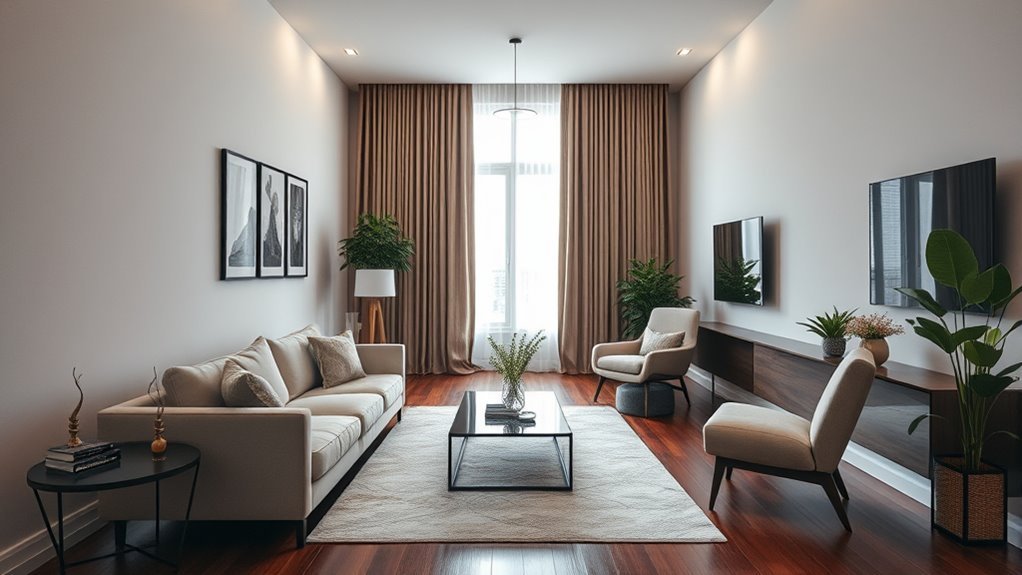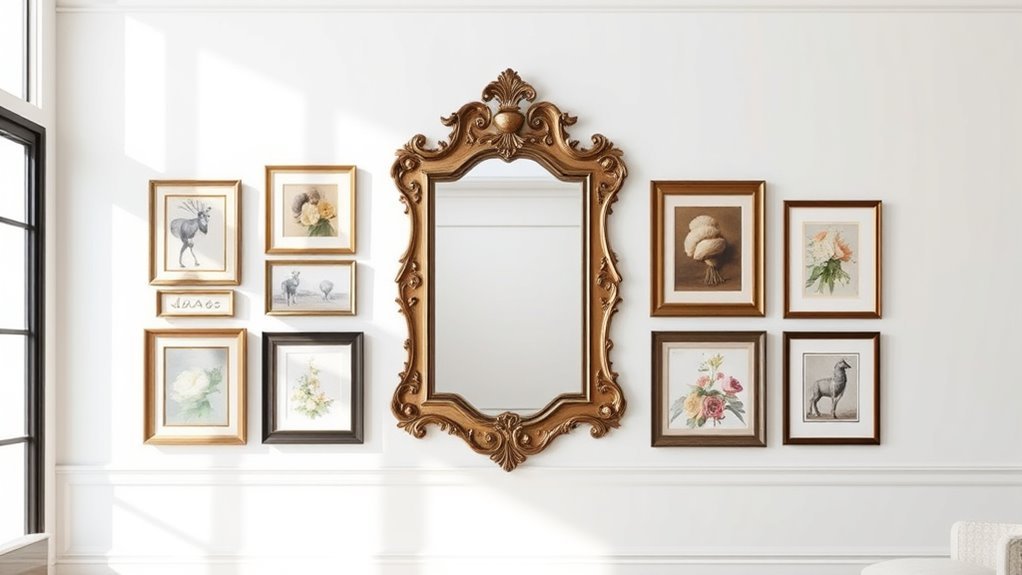
Layered wall decor makes a room feel taller when you build arrangements upward instead of spreading frames in a low horizontal line. By anchoring the wall with one vertical focal piece, stepping smaller accents above and beside it, and keeping gaps consistent, you draw the eye toward the ceiling. The right layout and weight-rated hardware let you create depth and height safely on any wall surface.
Quick Answer
To add visual height with layered wall decor, hang a portrait-oriented focal piece with its center 57 to 60 inches from the floor, or 6 to 8 inches above furniture. Stack smaller frames, slim mirrors, wall shelves, or textiles upward using consistent 2- to 4-inch gaps, leaving at least 6 inches of clearance below the ceiling.
At a Glance
| Time Required | 1 to 3 hours (30–45 minutes for floor planning and taping; 30–90 minutes for measuring and hanging) |
| Difficulty | Easy to moderate |
| Tools Needed | Tape measure, pencil, painter’s tape, spirit level, stud finder, hammer or drill, bathroom or kitchen scale, weight-rated hooks or anchors, and a step ladder |
| Cost | $0–$40 using existing art and basic hooks, strips, or anchors; $75–$300+ when adding new frames, mirrors, or shelves |
Start With a Focal Point: Choosing the Right Statement Piece
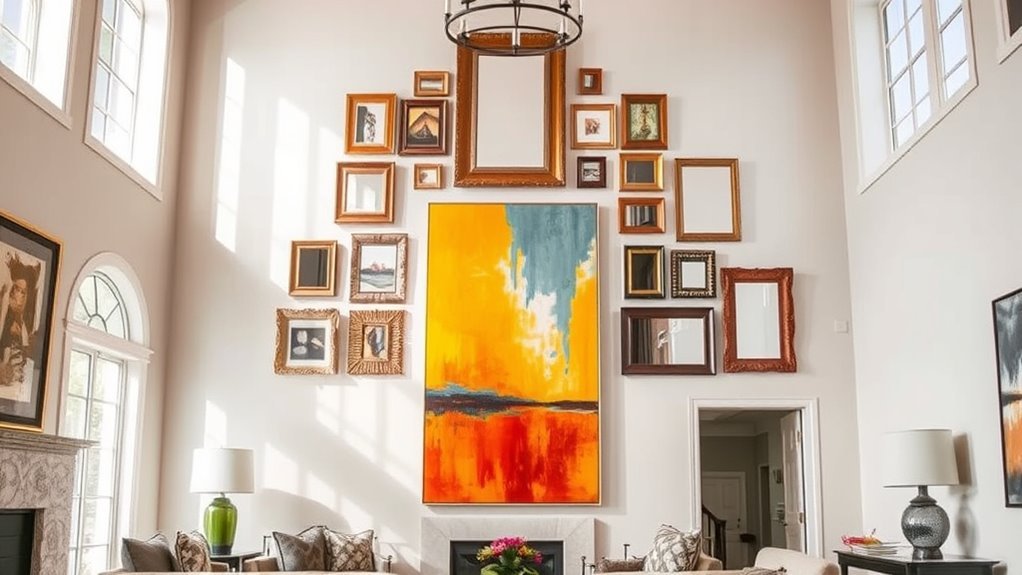
Every vertical wall arrangement starts with one dominant anchor piece that sets the scale and direction. Choose a large portrait-oriented canvas, framed print, arched mirror, woven textile, or sculptural object with enough visual presence to hold the center of the composition.
On an open wall, place the center of your focal artwork or overall grouping 57 to 60 inches from the floor to match gallery eye level. Better Homes & Gardens outlines this standard 57-inch art-hanging guideline for keeping displays comfortable to view without neck strain.
When hanging art above a sofa, bed, console table, or mantel, prioritize furniture clearance over the 57-inch rule. Position the bottom edge of the main frame 6 to 8 inches above the top of the furniture (or up to 10 inches in rooms with 9-foot or taller ceilings) so the arrangement looks anchored rather than floating.
To stretch the room vertically, pick an anchor piece with strong upward lines, such as botanical stems, architectural photography, vertical abstracts, or tall arched mirrors. If your main artwork is horizontal, flank or top it with narrower vertical frames and sconces to pull the viewer’s gaze toward the ceiling.
Pro Tip: To place your nail or hook at the exact right spot on the first try, divide the frame’s height by 2, subtract the distance from the top of the frame to the taut hanging wire, and add that number to 57 inches. For a 30-inch-tall frame whose wire pulls tight 5 inches below the top edge, mount the hook at 67 inches from the floor (15 minus 5 equals 10; 57 plus 10 equals 67).
Recommended Products

【Vintage Wildflower Landscape Wall Art】 This framed canvas landscape wall art features a peaceful countryside field filled with soft white wildflowers, meadow, and a quiet water scenery. The warm beige and muted brown tones bring a gentle vintage feeling to your living room, bedroom, entryway, or hallway. This vertical framed neutral wall art measures 24x36 inches

【Art Design】This framed wall artwork features classic black-and-white vertical stripe background paired with an elegant oval vintage border, inside comes delicate hand-drawn style cosmos floral sketch in monochrome tone. The retro botanical line drawing blends classic French country and gothic minimalist aesthetic, combining bold stripe contrast and refined vintage flower engraving craft to build timeless elegant visual appeal for wall decor.

Theme & Style:This wall art features a vintage oil painting style, depicting a person rowing a boat on a calm lake surrounded by autumn foliage trees and distant mountains. The warm earthy tones and soft brushstrokes create a serene, nostalgic autumnal atmosphere.
Measure Your Wall Space: Finding the Perfect Layout
Measuring the wall and furniture before picking up a hammer ensures your layered wall decor reads as one unified vertical column. Record your total width, ceiling height, and obstacles first so you know exactly how high the arrangement can climb.
Assess Wall Dimensions Accurately
Measure the full wall width and ceiling height with a steel tape measure, then log the positions of windows, door trim, light switches, thermostats, sconces, vents, and crown molding. These fixed features determine your usable vertical zone and visual centerline.
When decorating above a sofa, headboard, or buffet, measure from the top of the furniture to the ceiling or crown molding. Leave at least 6 to 8 inches of blank wall below the ceiling line so a tall arrangement elongates the wall without looking crammed against the top edge.
Visualize Art Placement Options
Roll out kraft paper or mark a rectangle on the floor matching your measured wall space, then arrange your anchor piece first and layer smaller frames, mirrors, and wall objects around it. Once the floor composition feels balanced, outline each piece on the wall with low-tack painter’s tape before making a single hole.
For maximum height, place your largest or darkest piece in the lower-to-middle two-thirds of the layout, then step smaller or lighter frames upward. This bottom-weighted pyramid structure draws the eye up while keeping the display visually grounded.
| Wall Area | Best Visual-Height Layout | Target Spacing & Proportions |
|---|---|---|
| Small or narrow wall (under 36 in. wide) | Two or three portrait frames in a vertical column, or one tall piece with a small upper accent | Keep vertical gaps tight at 2 to 3 inches so the column reads as a single unit |
| Medium wall or above a console (36–60 in. wide) | One statement piece anchored off-center with 3 to 5 supporting frames or a slim wall shelf | Span 60% to 75% of furniture width (24–40 in. wide) with 2 to 4 inches between pieces |
| Large wall or above a sofa/bed (60–96+ in. wide) | Vertical gallery grouping, arched mirror paired with stacked art, or multi-level picture ledges | Span roughly two-thirds of sofa/bed width (48–64 in. wide) with 3 to 6 inches between large frames |
Plan for Balance and Scale
Proper scale prevents a tall wall arrangement from looking sparse or top-heavy. Use the two-thirds furniture rule: multiply the width of your sofa, bed, or sideboard by 0.67 to find the ideal total width of your single artwork or multi-piece gallery cluster.
- Follow the two-thirds width target: An 84-inch sofa calls for an arrangement roughly 56 inches wide, while a 60-inch queen headboard pairs best with a 40-inch-wide display.
- Keep tight gallery spacing: Space small and medium frames 2 to 4 inches apart so the eye groups them together rather than seeing isolated boxes.
- Give oversized pieces breathing room: Leave 3 to 6 inches between large frames, mirrors, or dimensional objects like woven baskets and sconces.
- Stagger the upper skyline: Let one side of the arrangement climb higher than the other to create natural upward movement instead of a flat, boxy top edge.
- Repeat a unifying element: Echo at least one detail across the wall, such as matte black frames, warm oak ledges, white mats, or brass accents.
Essential Tools for Layering Wall Decor Successfully
Having measuring, leveling, and stud-locating tools ready before you start prevents crooked frames and unnecessary drywall patching. Gather your tools and weigh every piece on a household scale so you can match each item to the right fastener.
Recommended Products

This package includes 50 double-headed picture hanging nails, plus a convenient storage box for easy organization and storage when not in use.

Driftwood Jewelry Holder - This wall hanging jewelry organizers features a natural driftwood branch with a beautifully gnarled texture and shape. Elevate your home decor with our small yet stylish driftwood jewelry hanger. Perfect for organizing necklaces, bracelets, and other JEWELRY THINGS.

Tough steel hooks that dig deep into drywall - Hold up to 40 lbs each, built to last through all your hanging needs.
Essential Tools Checklist
- Steel tape measure: Measures wall dimensions, furniture width, 6-to-8-inch furniture clearance, and hook heights.
- Pencil and kneaded eraser: Marks exact drill and nail points that erase cleanly after hanging.
- Painter’s tape and kraft paper: Creates full-size wall templates to preview vertical proportions from across the room.
- Spirit level or laser level: Keeps multi-frame columns, picture ledges, and dual-hook frames plumb and level.
- Electronic stud finder: Locates wood or metal wall framing and warns of live AC electrical wiring.
- Household scale: Weighs mirrors, framed glass art, and loaded shelves so you never exceed hardware limits.
- Hammer, drill, and screwdriver: Installs picture hooks, wood screws, pilot holes, and hollow-wall anchors.
- Rated hanging hardware and rubber bumpers: Includes D-rings, braided picture wire, drywall anchors, French cleats, and adhesive corner bumpers to stop frames from tilting.
- Stable step ladder: Provides safe, balanced reach when placing upper frames near the ceiling.
Measuring Equipment Importance
Accurate measurements keep a multi-piece vertical wall from drifting off-center as you build upward. Mark the vertical centerline of your anchor piece first, check it with a level, and measure outward from that line for every surrounding piece.
When hanging above seating or a bed, always center the arrangement on the furniture rather than the entire wall if the furniture sits off-center. Measure both the left and right edges of your taped outline to confirm the total width stays within two-thirds to three-quarters of the furniture below.
Hanging Hardware Options
Choose hanging hardware by matching three factors: the exact weight of the item, the backing on the frame, and whether your wall is drywall over wood studs, plaster, brick, or tile. Sawtooth hangers suit only lightweight frames under 10 pounds, whereas dual D-rings or French cleats keep wider and heavier frames level against the wall.
For damage-free hanging on smooth painted drywall, 3M Command advises waiting at least 7 days after painting for fresh paint to cure, cleaning the spot with isopropyl rubbing alcohol rather than household cleaners, pressing strips firmly for 30 seconds, and waiting 1 hour before hanging art. Review their picture hanging strip guide for step-by-step application and slow-stretch removal instructions.
Choosing Art and Decor That Complements Your Layered Wall Decor
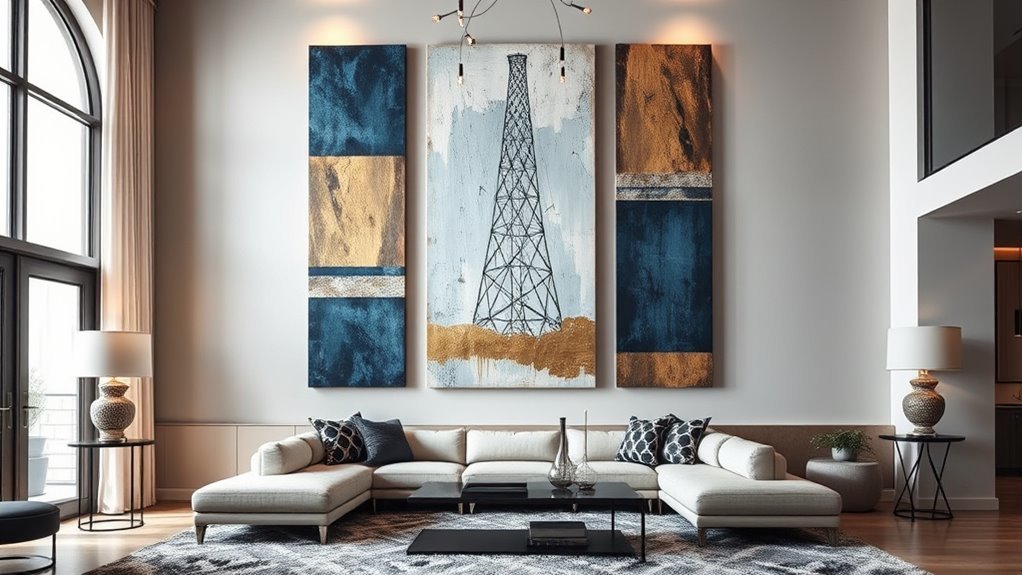
The best pieces for adding visual height feature elongated shapes, upward directional lines, or light-reflecting surfaces. Combine portrait-oriented prints, arched mirrors, narrow picture ledges, vertical sconces, and trailing wall planters to draw sightlines toward the ceiling.
Contrast in size and shape keeps a vertical wall dynamic, while a shared color palette or frame material holds it together. For instance, you can combine a tall oval brass mirror, two black-framed architectural sketches, and a natural linen wall hanging as long as the tones repeat across the grouping.
- For low-ceiling rooms (8 feet or under): Use slim portrait frames, frameless or thin-bezel mirrors, and wide light-colored mats that create vertical lift without visual bulk.
- For calm, minimalist rooms: Stack two or three oversized vertical prints in matching wood or metal frames with 3-inch gaps.
- For eclectic or bold rooms: Pair a large colorful canvas with sculptural ceramic wall art, a floating shelf, and varied frame profiles.
- For two-story or vaulted walls: Use oversized portrait canvases (such as 30×40 or 36×48 inches) stacked in two tiers so upper wall areas do not look bare.
Note: Layered wall decor does not require dozens of small frames. Just three well-scaled pieces—such as a tall mirror, a medium portrait print, and a small top accent—create strong vertical depth with minimal wall clutter.
Recommended Products

[Framed Wall Art]: This framed moon paintings wall decor set of 2, each measuring 8 x 56 inches, designed in a tall long narrow vertical format for a clean, modern, and more finished appearance. The black, white, and gold moon-over-the-sea design is paired with a sturdy frame that adds structure, support, and a display-ready look to the artwork

Capture Your Memories: From the faces of your loved ones to great times with friends and family get-togethers, this collage photo frame lets you display an array of wonderful moments. It features 12 frames, each perfectly sized for 4x6 photos
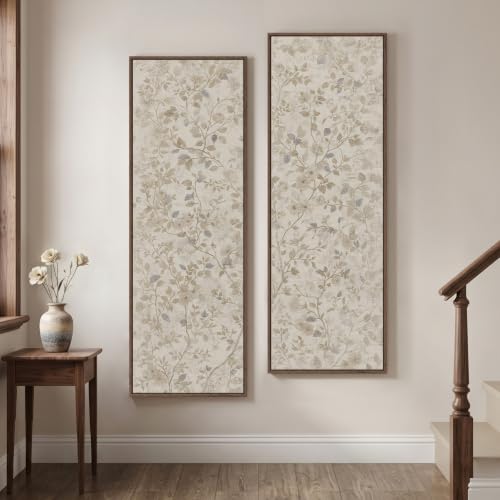
【Framed Vintage Wall Art】Bring soft vintage charm with this 60x20 inches framed vertical canvas wall art set of 2. The neutral beige palette and botanical design create a calm french feel for your living room, bedroom, hallway, entryway or home office
Experiment With Layering Heights and Arrangements
Varying the top and bottom edges of your frames creates a stair-step rhythm that guides the eye upward. Instead of aligning every top edge along a flat horizontal line, use staggered vertical columns or overlapping ledges to build height.
Follow these five steps to build a vertical layered arrangement:
- Select a vertical layout style: Choose a **vertical stack** (one large piece low with one or two smaller frames centered above it) for narrow walls, an **off-center climb** (a main anchor with smaller pieces stepping up one side) for sofas, or a **mirror-and-art pairing** (a tall mirror flanked by two stacked frames) for entryways.
- Mount or position the anchor piece first: Hang your primary statement piece at the 57-to-60-inch center mark or 6 to 8 inches above furniture, or lean a large frame on the back of a picture ledge.
- Build upward with smaller pieces: Place smaller frames, woven hangings, or floating shelves 2 to 4 inches above the anchor piece so the upper edge reaches toward the top third of the wall.
- Overlap edges on picture ledges (optional): If using 3.5- to 5-inch-deep picture ledges, lean a tall frame at the back and overlap a smaller frame of a contrasting material slightly in front of its bottom corner.
- Check sightlines from 8 to 10 feet back: Step across the room to verify your eye moves smoothly from the lower anchor to the highest frame without getting stuck on a heavy bottom row.
Add Textures and Materials for Enhanced Visual Interest
Mixing dimensional materials with flat framed prints prevents a tall wall arrangement from looking like a rigid poster display. Combining smooth glass, raw wood, woven fibers, and metal finishes creates natural shadows that give layered wall decor three-dimensional depth.
Aim for two to three distinct textures per wall grouping. Pair matte paper prints with a reflective brass mirror, hang a woven macrame or linen tapestry beside sleek black frames, or add a small wall-mounted ceramic planter with trailing pothos vines to soften sharp rectangular corners.
| Material / Texture | Best Wall Decor Pieces | How It Enhances Visual Height |
|---|---|---|
| Wood (oak, walnut, pine) | Picture ledges, vertical wood-slat panels, carved relief art, deep box frames | Adds warm architectural lines and strong vertical framing |
| Metal (brass, iron, bronze) | Slim gallery frames, tall candle or plug-in sconces, metal wall sculptures | Provides crisp vertical outlines and catches evening light |
| Textiles & woven fiber | Long woven tapestries, framed linen panels, shallow seagrass baskets | Softens boxy frame grids and adds lightweight vertical length |
| Glass & mirror | Arched or pill-shaped mirrors, glass-front shadow boxes | Bounces natural light upward and visually opens narrow walls |
| Greenery & ceramics | Mounted ceramic pockets, shelf vases with tall dried stems or trailing vines | Draws the eye up and down with organic vertical movement |
Hanging Tips for Lightweight and Heavy Decor
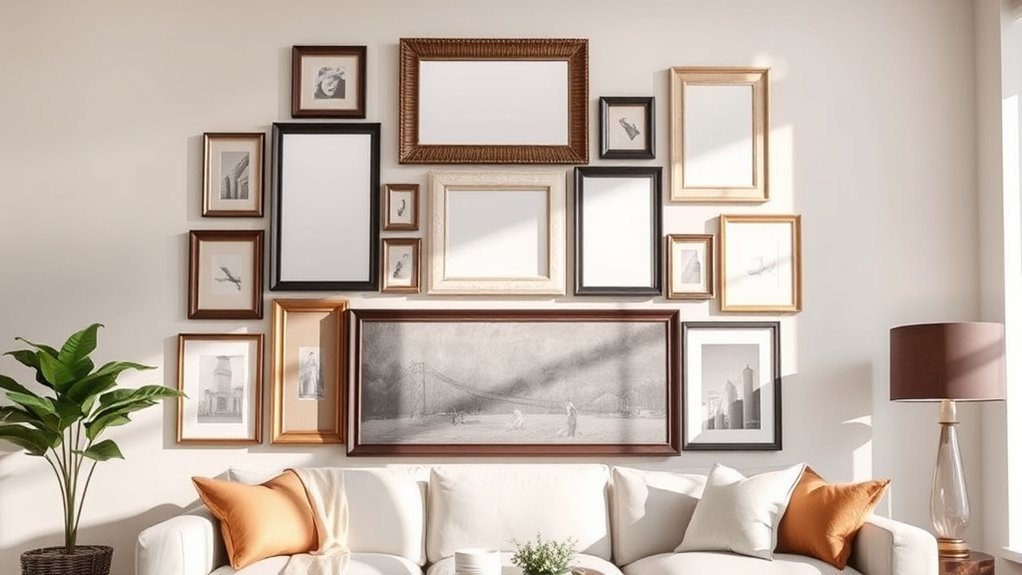
Safe installation depends on matching your fastener to the exact weight of the decor and your wall’s construction. Standard residential drywall (typically 1/2-inch thick) can hold light frames on hooks or adhesive strips, but heavy mirrors and loaded shelves require wood studs or heavy-duty hollow-wall anchors.
Warning: Before drilling into any wall, scan the area with an AC-detecting stud finder to avoid live electrical wiring, plumbing pipes, and HVAC ductwork. Never hang heavy glass frames, mirrors, or shelves on adhesive strips or unanchored nails—especially above beds, cribs, or sofas—and hire a qualified handyman or contractor if you are unsure of your wall structure.
| Decor Weight & Type | Recommended Fastener | Typical Rating & Safety Rule |
|---|---|---|
| Light frames & textiles (under 5 lbs) | Adhesive picture strips or small angled picture hooks | Command Small strips hold up to 4 lbs (8×10 in. max frame); angled pin hooks hold 5–10 lbs in drywall |
| Medium framed art (5–20 lbs) | Large adhesive strips, brass picture hooks with D-rings, or plastic expansion anchors | Command Medium (12 lbs), Large (16 lbs), and X-Large (20 lbs, up to 24×36 in.); expansion anchors rate 10–25 lbs |
| Heavy art & medium mirrors (20–50 lbs) | Wood stud screws, threaded self-drilling metal anchors, molly bolts, or French cleats | Self-drilling and molly anchors rate 25–50 lbs; use two mounting points to distribute load |
| Oversized mirrors & loaded wall shelves (50+ lbs) | Direct wood screws into wall studs, heavy-duty French cleats, or toggle bolts | Fasten into studs whenever possible; spring or strap toggle bolts rate 50–100+ lbs in hollow drywall |
In North American homes, wall framing typically uses standard 16-inch or 24-inch on-center framing studs, measured from the center of one 1.5-inch-wide wood stud to the center of the next. When a stud does not line up with your layout, Lowe’s notes in its drywall anchor guide that manufacturers recommend loading drywall anchors to only 25% of their maximum rated capacity for safe long-term support.
If you choose adhesive strips for lightweight frames, check Command’s product weight limits guide to match both the weight and maximum frame dimensions (for example, four pairs of Large strips hold up to 16 pounds on frames no larger than 24 by 36 inches). Never combine extra hooks on one wire to exceed the package weight limit.
When climbing to hang upper frames, set your step ladder on a flat, level floor with its spreaders fully locked and keep your belt buckle between the side rails so you never overreach. Under OSHA ladder requirements (29 CFR 1926.1053), portable self-supporting ladders must be rated to support at least four times the maximum intended load (or 3.3 times for extra-heavy-duty metal or plastic ladders) and kept free of structural damage.
Evaluating Visual Balance: Tips for Adjusting Your Art Arrangement
Before driving your final nails, step back to the doorway and evaluate the taped or partially hung grouping as a single vertical shape. A balanced arrangement has a clear eye-level focal point, distributed visual weight, and consistent spacing from bottom to top.
Assessing Art Heights
Check the vertical position of your anchor piece first, because every other frame depends on it. If the anchor sits too high, the grouping feels detached from the room’s furniture; if it sits too low without upper pieces, the wall loses its vertical lift.
- Confirm the center of the focal piece or overall grouping sits near 57 to 60 inches on open walls, or 6 to 8 inches above furniture backs.
- Step smaller frames upward above the anchor so the eye travels naturally toward the upper third of the wall.
- Maintain at least 6 to 8 inches of clear wall below the ceiling or crown molding so the top frame never looks pinched.
Balancing Visual Weight
Visual weight depends on color saturation, frame thickness, surface reflectivity, and depth—not just physical dimensions. A small print in a thick black frame or a heavy brass mirror carries more visual weight than a larger pastel watercolor in a thin white frame.
Counterbalance heavy pieces diagonally rather than symmetrically. If a dark, heavy frame sits on the bottom left of your layout, balance it with two lighter portrait frames stacked vertically on the right side to create height and equilibrium simultaneously.
Creating Harmonious Groupings
Cohesive layered walls rely on shared visual threads and odd-numbered groupings. Arranging pieces in groups of 3, 5, or 7 creates an asymmetrical, collected rhythm that feels less rigid than even-numbered grids.
Tie mismatched art styles together by keeping at least two variables constant—such as pairing vintage oil portraits, line drawings, and botanical pressings inside frames that all share warm brass or walnut tones and off-white mats.
Finishing Touches That Reinforce Vertical Height
Once your frames and shelves are mounted, style the surrounding wall and floor zone to extend the upward lines. Flanking the arrangement with a tall floor lamp, a narrow bookcase, or curtain rods mounted 4 to 6 inches above the window trim amplifies the room’s perceived ceiling height.
Add targeted lighting to highlight dimensional textures at night. A brass picture light mounted above the top frame or a pair of vertical plug-in wall sconces casts warm shadows across woven hangings, wood ledges, and matted prints.
Finish by pressing small self-adhesive rubber bumpers onto the bottom back corners of every frame. Bumpers keep air circulating behind the wall, protect paint from scuffs, and stop frames from tilting out of alignment when doors close.
What Makes a Good Statement Piece?
An effective statement piece acts as the visual gravity center of your layered wall decor, setting the scale, color palette, and vertical direction for every supporting accent. Look for these five qualities when choosing your anchor piece:
- Proportional scale: It should claim at least 40% to 50% of the grouping’s total area so smaller pieces clearly read as supporting accents.
- Vertical or arched geometry: Portrait rectangles (such as 24×36 or 30×40 inches), tall ovals, or arched mirrors naturally stretch the wall upward.
- Distinct contrast: High-contrast linework, rich color, deep shadow-box framing, or a reflective mirror surface sets the anchor apart from surrounding drywall.
- Room connection: It should repeat one or two colors already present in your sofa upholstery, area rug, throw pillows, or woodwork.
- Sightline placement: It belongs along the primary sightline you see first when walking into the room.
Troubleshooting Common Layered Wall Decor Problems
Even carefully measured walls can look slightly off once the frames go up. Use these targeted fixes to correct height, spacing, or balance issues without starting over:
- The wall still looks short and wide: Remove one outer side frame and move it above the main grouping, or replace a horizontal accent with a tall mirror, narrow print, or hanging textile.
- The arrangement feels cluttered: Remove the smallest or busiest piece, or widen tight gaps from 2 inches to 3.5 inches so each frame has breathing room.
- The display looks disconnected from the sofa or bed: Lower the bottom edge of the anchor frame to sit 6 to 8 inches above the furniture back, then shift the upper pieces down to match.
- The grouping looks lost on a large wall (“postage-stamp effect”): Swap small prints for wider matted frames or add a floating picture ledge underneath so the total width reaches about two-thirds of the furniture width.
- Pieces look random and unrelated: Unify the cluster by painting mismatched frames the same color, switching to matching mat boards, or repeating one metallic finish.
- Frames tilt crookedly after hanging: Switch from a single central wire hook to two level D-rings on wide frames, and press rubber bumpers onto the bottom back corners.
Key Takeaways
- Anchor your layout with one tall portrait print, arched mirror, or textile placed at a 57-to-60-inch center height (or 6 to 8 inches above furniture).
- Size arrangements above sofas, beds, and consoles to span roughly two-thirds (60% to 75%) of the furniture width below.
- Keep gaps consistent at 2 to 4 inches for tight gallery groupings and 3 to 6 inches for large frames, leaving at least 6 to 8 inches of open wall below the ceiling.
- Combine 2 to 3 textures—such as wood ledges, metal frames, mirrors, and woven fibers—in odd-numbered groupings of 3, 5, or 7 pieces.
- Weigh every item first: use Command strips only within package limits on cured paint, limit drywall anchors to 25% of their maximum rating, and mount heavy mirrors or shelves into 16- or 24-inch on-center studs.
Frequently Asked Questions
How do I add height to decor?
You add height to decor by emphasizing vertical lines and drawing the eye upward toward the ceiling. Hang portrait-oriented artwork, tall arched mirrors, stacked picture ledges, and vertical sconces on your walls, and pair them with high-mounted curtain rods and tall floor lamps nearby.
What is the 3-5-7 rule in decorating interior design?
The 3-5-7 rule is an interior styling guideline that groups decorative objects in odd numbers—three, five, or seven pieces—rather than symmetrical pairs. Odd-numbered groupings create a more natural, dynamic visual rhythm that helps vertical wall arrangements feel collected instead of boxy.
What is the 70/30 rule in art?
In wall decorating, the 70/30 rule means letting one dominant style, color palette, or focal piece carry about 70% of the visual weight while the remaining 30% comes from contrasting accent frames or textures. This balance keeps a layered wall cohesive without looking monotonous.
How do I add height to a wall?
To add height to a wall, hang a tall focal piece with its center 57 to 60 inches from the floor, then stack smaller frames, mirrors, or trailing wall plants upward above it. Leave at least 6 to 8 inches of open wall below the ceiling so the vertical column elongates the space without looking cramped.
How far apart should layered wall decor be?
Space small to medium frames 2 to 4 inches apart in gallery-style groupings, and leave 3 to 6 inches between large frames, mirrors, shelves, or dimensional wall objects. Keeping the gap measurements consistent across the entire arrangement is what makes the display look intentional.
Can renters create layered wall decor without nails?
Yes, renters can build layered wall decor without nails by using 3M Command Picture Hanging Strips (rated from 4 pounds for Small sets up to 20 pounds for X-Large sets) or by leaning overlapping frames atop a console table or mantel. Wait at least 7 days after fresh paint before applying adhesive strips, clean the wall with rubbing alcohol, and avoid hanging heavy mirrors or glass frames over beds and sofas with adhesive alone.
Conclusion
Well-planned layered wall decor stretches a room vertically when you anchor the wall with a strong portrait piece, build upward with staggered accents, and maintain consistent 2- to 6-inch spacing. Measure your wall and furniture width today, map your vertical layout on the floor and wall with painter’s tape, and weigh each frame so you can hang your arrangement safely and level on the first try.
Sources
- Better Homes & Gardens: How to Hang Pictures and Paintings Securely on Any Wall Surface: Supports the 57-inch eye-level center height, hook-height math, and furniture clearance guidelines.
- Command: How to Use Command Picture Hanging Strips: Supports surface cleaning with isopropyl alcohol, the 7-day paint cure wait time, 1-hour bond wait time, and removal steps.
- Command: Product Weight Limits Guide: Supports weight and frame-size limits for Small (4 lb), Medium (12 lb), Large (16 lb), and X-Large (20 lb) picture hanging strips.
- The Home Depot: 16 Inch vs. 24 Inch Framing Wall Studs: Supports standard 16-inch and 24-inch on-center residential wall stud spacing.
- Lowe’s: How to Use Drywall Anchors: Supports drywall anchor types, the 25% working-load capacity recommendation, stud preference, and behind-the-wall drilling cautions.
- OSHA: 29 CFR 1926.1053 Ladders: Supports portable ladder load-capacity standards (4x maximum intended load) and safe ladder positioning.