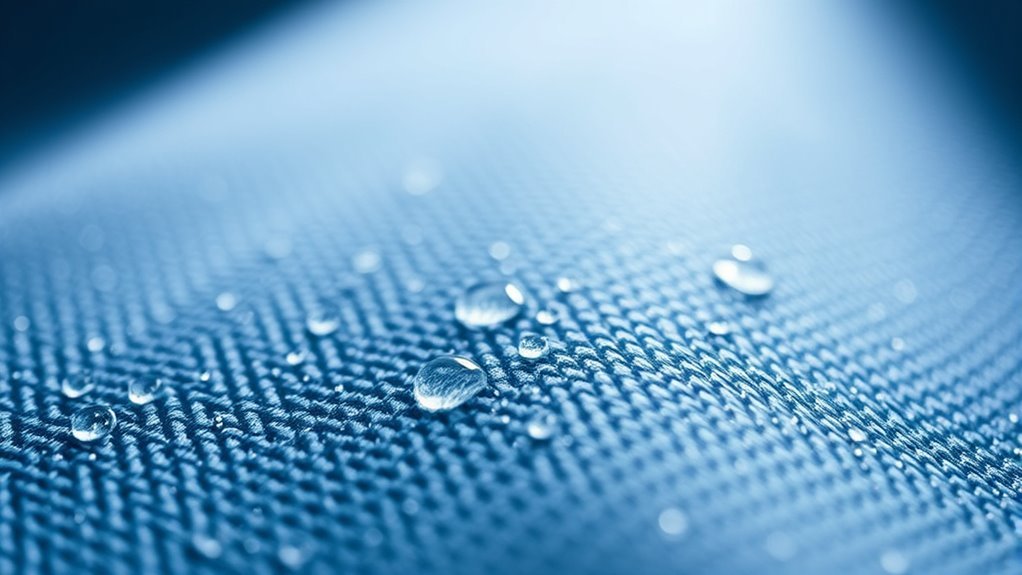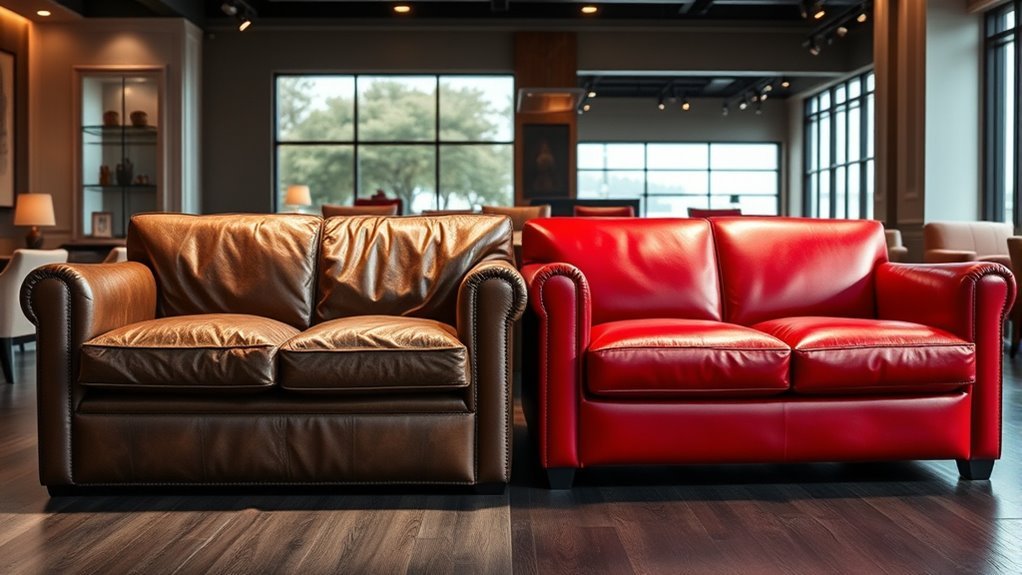
Choosing between an aniline vs. pigmented leather sofa comes down to whether you value natural hide character or everyday surface protection. Aniline and pigmented leather sofas use completely different finishing methods that control how the upholstery feels, breathes, handles spills, and ages over 15 to 25 years of use. While pure aniline showcases every pore and develops a rich patina, pigmented leather seals the surface against stains, fading, and active family wear, and semi-aniline leather bridges the gap between the two.
Quick Answer
Choose aniline leather for a soft, natural-looking sofa with visible pores and evolving patina in a low-traffic, sun-controlled room. Choose pigmented leather for maximum stain, scuff, and fade resistance in busy family rooms or homes with kids and pets. Choose semi-aniline leather for a balanced middle ground with visible grain and light surface protection.
Key Takeaways
- Hide rarity and cost: Pure aniline leather uses zero opaque pigment and requires pristine full-grain hides—only the top 5% of raw hides qualify, resulting in a lower cutting yield (65%–75%) and higher sofa price.
- Protective coating thickness: Pigmented leather uses an opaque polymer and pigment finish capped at 0.15 mm under international leather standards, while semi-aniline uses a micro-coating typically under 0.02 mm.
- Measurable durability: Pigmented upholstery leather typically scores Grade 4–5 on the ISO Blue Wool lightfastness scale and 1,000+ Taber abrasion cycles, compared with Grade 2–3 lightfastness for pure aniline.
- Aniline subtypes matter: Waxed or oiled “pull-up” aniline leather scratches easily but buffs out with a dry cloth, whereas pure “naked” aniline absorbs liquids rapidly and cannot be spot-rubbed.
- Grain vs. finish: “Full grain” and “corrected grain” describe how the hide surface was prepared, while “aniline,” “semi-aniline,” and “pigmented” describe how the surface was dyed and sealed.
Aniline vs. Pigmented Leather Sofa: Quick Comparison
Aniline and pigmented leather sit at opposite ends of the upholstery finishing spectrum, with semi-aniline positioned directly between them. Aniline maximizes breathability, softness, and natural grain visibility, while pigmented leather prioritizes color consistency, wipe-clean maintenance, and resistance to abrasion and UV light.
Use this side-by-side table to compare all three finishes across household performance and technical metrics.
| Decision Factor | Aniline Leather | Semi-Aniline Leather | Pigmented Leather | Best Choice |
|---|---|---|---|---|
| Surface treatment | Translucent dye only; no pigment coating (or clear drum treatment) | Aniline-dyed plus thin topcoat (under 0.02 mm) with light pigment | Opaque pigment and polymer topcoat (up to 0.15 mm) | Depends on use |
| Hide selection & cutting yield | Top 5% full-grain hides; 65%–75% usable yield | High-grade full or top grain; 75%–85% yield | Corrected or top grain; 75%–85% yield | Pigmented for budget; Aniline for rarity |
| Softness & breathability | Warmest, most supple; open pores breathe freely | Soft and supple; moderate pore breathability | Firmer, cooler initial touch; sealed surface | Aniline |
| Visible grain & markings | 100% visible pores, healed scars, and shade variation | Natural grain visible with slightly more even tone | Uniform color; often embossed with consistent grain | Aniline |
| Spill & stain resistance | Low; absorbs untreated liquids rapidly | Moderate; resists brief spills if blotted fast | High; liquids bead on the sealed surface | Pigmented |
| Scratch & abrasion resistance | Low; marks easily from fingernails and buckles | Moderate (~500 Taber abrasion cycles) | High (1,000+ Taber cycles), though not claw-proof | Pigmented |
| UV & sunlight resistance | Low (Blue Wool Scale Grade 2–3) | Moderate (Blue Wool Scale Grade 3–4) | Higher (Blue Wool Scale Grade 4–5) | Pigmented |
| Patina over time | Develops rich, pronounced patina and sheen | Develops subtle, gradual patina | Minimal patina; engineered to look consistent | Aniline |
| Routine maintenance | Delicate; dry dusting and finish-specific care | Moderate; gentle damp wiping with approved cleaner | Low; easiest wipe-clean household upkeep | Pigmented |
Recommended Products

WIDE APPLICATION: Our Angelus Cream Acrylic leather paint is perfect for any smooth leather goods, such as leather shoes, sneakers, sofas, leather jackets, handbags, leather bags, wallets, & more.
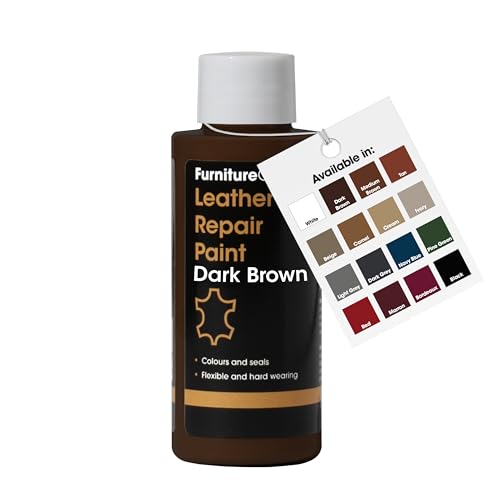
16 AVAILABLE COLORS: Available in 16 colors allowing you to restore faded leather, recolor worn and cracked leather, and even change the color of your leather surfaces completely.

LEATHER RECOLORING & RESTORATION BALM: Revive your faded, worn-out, scratched and sun-damaged leather to its original vibrancy. Our leather paint effortlessly brings old leather furniture back to life in just minutes.
Understanding Aniline Leather: Key Features and Advantages
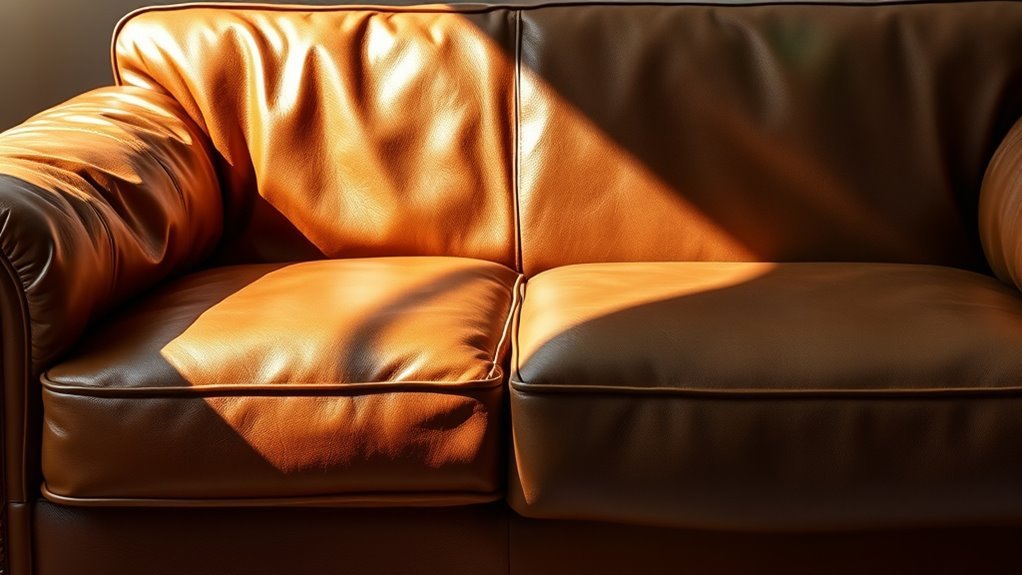
Aniline leather—often called full aniline or “naked” leather—is dyed in tumbling drums for roughly eight hours using transparent, soluble dyes without any opaque surface pigments. According to the Leather Research Laboratory definitions established with the International Union of Leather Technologists and Chemists Societies (IULTCS) and ISO, an aniline finish is completely transparent so the original grain pattern remains unobstructed. Depending on the tannery, the hide either receives zero surface coating or a microscopic, non-pigmented drum treatment for basic water or soil repellency.
Because there is no opaque paint layer to hide insect bites, barbed-wire scratches, or neck wrinkles, only the top 5% of raw hides globally are pristine enough to become pure aniline upholstery leather. According to Spinneybeck upholstery specifications, naked aniline hides yield only 65% to 75% usable cutting area compared with 75% to 85% on finished hides, which is why aniline sofas command a higher retail price.
Leaving the hair follicles and pores completely open gives aniline leather two distinct advantages: unmatched thermal comfort and authentic aging. The unsealed pores breathe freely and adjust to your body temperature within seconds, never feeling sticky in summer or clammy in winter. Over years of use, exposure to light, friction, and natural oils darkens and burnishes the surface into a sought-after patina.
Pure Aniline vs. Pull-Up (Waxed or Oiled) Aniline Leather
When shopping for an aniline sofa, ask the retailer whether the hide is pure aniline or pull-up aniline (also sold as waxed or oiled aniline). Both are dyed with transparent aniline dyes and skip opaque pigments, but they behave very differently in a living room.
- Pure (naked) aniline: Receives no heavy wax or oil topcoat. It has a matte, velvety-soft hand feel, absorbs liquids almost instantly unless drum-treated, and retains permanent dark spots from oil or grease.
- Wax or oil pull-up aniline: Infused or topped with natural waxes and oils that create a two-tone “pull-up” effect—when the leather is stretched over sofa cushions or pinched, the oils migrate and the color momentarily lightens. Pull-up leather shows surface scratches from fingernails immediately, but you can buff out minor scuffs simply by rubbing them with a warm finger or a soft, dry cloth to redistribute the wax.
Why Pigmented Leather Is a Smart Choice for Your Sofa
Pigmented leather (often labeled “protected” or “finished” leather) starts with an aniline drum-dyed hide and adds a polymer surface coating containing suspended opaque pigment particles. Under DIN EN 15987 leather labeling standards and ISO 15115, this protective surface coating must not exceed 0.15 mm in thickness (and cannot exceed one-third of the total thickness) for the material to be sold as genuine leather rather than “coated leather.”
This polymer shield creates a uniform color across every sofa panel and blocks liquids, food spills, and dust from sinking directly into the hide fibers. Because tanneries can buff away minor surface blemishes before applying the pigmented coat and embossing a consistent grain pattern, pigmented leather accounts for the vast majority of residential family sofas, sectionals, and commercial seating.
Pro tip: Pigmented leather is far more practical around dogs and cats because claws slide more easily off its sealed polymer topcoat, but no leather sofa is puncture-proof. Keep pet nails trimmed and place a throw blanket over your pet’s favorite cushion to prevent deep gouges.
Durability and Longevity Benefits
Pigmented leather outperforms lightly finished hides across every standardized laboratory upholstery test. While both full-grain aniline and quality pigmented leather hides are typically cut to an upholstery thickness of 1.0 mm to 1.4 mm and can last 15 to 25 years structurally, pigmented finishes withstand far heavier surface friction and UV light.
- Abrasion resistance (ASTM D7255): Commercial-grade pigmented upholstery leathers commonly withstand 1,000+ cycles on a Taber abrader (CS-10 wheel with a 1,000-gram weight), roughly double the 500-cycle rating typical of delicate semi-aniline hides.
- Fade resistance (ISO 105-B02 Blue Wool Scale): Evaluated on a 1-to-8 scale where higher numbers resist fading longer, pigmented leather typically achieves Grade 4 to 5, whereas pure aniline dyes often rate Grade 2 to 3 and fade noticeably within months of direct window exposure.
- Crocking resistance (ASTM D5053): Pigmented topcoats typically achieve Class 4 to 5 in wet and dry rub testing, meaning dark jeans or damp clothing are much less likely to transfer dye onto or pull color off the sofa.
Low Maintenance Requirements
Pigmented leather requires significantly less day-to-day caution than aniline leather because its polymer finish acts as a barrier against immediate liquid absorption. Coffee, juice, or wine spills bead up on the surface, giving you time to blot them away before they penetrate the hide.
Routine upkeep usually involves weekly dusting with a dry microfiber cloth and occasional wiping with a cool, lightly damp cloth or a manufacturer-approved pH-balanced leather cleaner. Never use bleach, baby wipes, dish soap, saddle soap, rubbing alcohol, or abrasive scrubbing pads, which chemically break down the polyurethane or acrylic topcoat and leave the surface sticky or peeling.
Aniline vs. Pigmented Leather: Pros and Cons
Choosing between aniline and pigmented leather is not a choice between “real” and “fake” leather—both are real animal hides that trade raw tactile authenticity for surface armor. Aniline rewards careful owners with unmatched suppleness and character, whereas pigmented leather delivers predictable color and stress-free cleanup.
| Feature | Aniline Leather | Pigmented Leather |
|---|---|---|
| Hand feel & temperature | Buttery-soft, warm, and highly breathable | Firmer, smoother surface film; cooler initial touch |
| Visual appearance | Organic depth, visible pores, scars, and dye variation | Uniform color and consistent grain across all panels |
| Stain & liquid resistance | Low; absorbs oils and water unless specially treated | High; sealed polymer barrier repels everyday spills |
| Long-term aging | Softens and darkens into an evolving patina | Retains showroom color longer; topcoat can wear after 7–10 years |
| Repair & restoration | Deep oil stains are permanent; pull-up scratches buff out | Scuffs and worn topcoats can be professionally recoated and color-matched |
| Relative sofa cost | Highest (typically 15%–30% more due to rare grade-1 hides) | More accessible due to higher 75%–85% hide cutting yields |
| Ideal room environment | Adult living rooms, dens, studies, and shaded spaces | Family rooms, eat-in lounges, rentals, and pet households |
Recommended Products
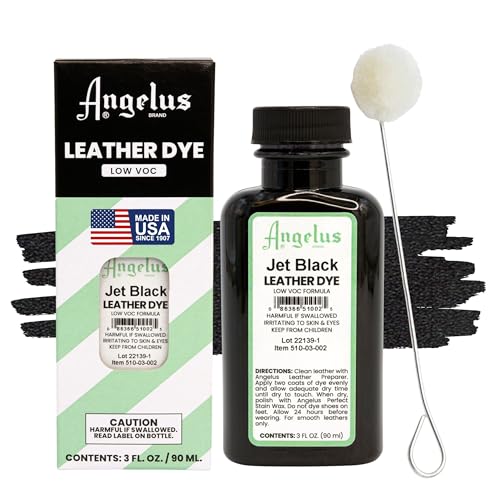
PERMANENT: Angelus Leather Dye is a permanent dye that is alcohol based and not water based. It is the most pigmented dye on the market today. If needed, it can also be diluted. Our dye penetrates deep into the leather for a permanent rich color
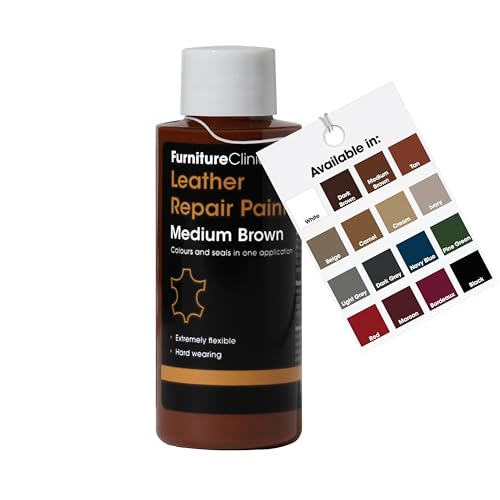
16 AVAILABLE COLORS: Available in 16 colors allowing you to restore faded leather, recolor worn and cracked leather, and even change the color of your leather surfaces completely.

Restore the beauty of your leather couches with our Leather Recoloring Balm, designed to effectively repair scratches and restore the color.
Choose Aniline Leather If…
Choose aniline leather if you want your sofa to look and feel like an organic material that tells a story over time. It is the ideal match when you love visible hair pores, subtle shade shifts from cushion to cushion, and a surface that warms immediately to your skin.
Aniline leather fits best in low- to moderate-traffic rooms where snacks, red wine, markers, rough pet play, and harsh afternoon sun are easy to control, and where you view scuffs and patina as desirable character rather than flaws.
Choose Pigmented Leather If…
Choose pigmented leather if you want a sofa that handles daily family life without constant vigilance. Its opaque protective finish makes it the smartest option for households with young children, dogs, frequent guests, or open-plan living areas where people eat and drink on the couch.
Pigmented leather is also the better fit if you want your sofa to match a specific color swatch uniformly from edge to edge and look nearly the same five years after delivery.
Consider Semi-Aniline Leather If…
Choose semi-aniline leather if pure aniline feels too risky for your household, but heavily pigmented leather feels too uniform or coated. Semi-aniline leather is drum-dyed like pure aniline and then sealed with an ultra-thin topcoat (typically under 0.02 mm) containing a light dose of pigment.
That micro-layer evens out extreme color variations and gives you a crucial window to blot away water or coffee spills while still allowing the hide’s natural pores and grain to show through. It excels in everyday adult living rooms that need moderate stain and UV protection (Blue Wool Grade 3–4) without sacrificing a soft, natural hand feel.
How to Identify Your Sofa’s Leather Type: Aniline vs. Pigmented
Always check the sofa manufacturer’s specification sheet, sewn-in care label, sales invoice, or leather swatch card first. If the paperwork only says “100% genuine leather” or “top-grain leather,” you can combine touch, a hidden fingernail or water check, and close visual inspection to narrow down the finish.
Touch Method Comparison
Press your palm against the cushion for five seconds and gently pinch a fold of the upholstery. Pure aniline leather feels warm almost immediately, drapes with a supple, glove-like softness, and often exhibits slight texture differences between the center of the cushion and the side panels.
Pigmented leather feels smoother, slightly firmer, and cooler for the first few seconds because your hand is touching the polymer topcoat rather than open pores. In an inconspicuous spot near the back skirt, lightly draw a fingernail across the surface: wax or oil pull-up aniline will leave a pale trail that rubs away with your finger, whereas pigmented leather resists light nail marks completely.
Water Drop Test: A Clue, Not Proof
Placing a single drop of distilled water on a hidden strip of leather (such as the underside of a cushion flap or back bottom edge) shows how porous the surface is, though it cannot definitively separate every modern finish. Never perform a water test if your manufacturer’s care tag prohibits moisture.
- Immediate absorption (within 5–10 seconds): If the drop soaks in quickly and leaves a temporary dark spot, the leather has an unsealed, porous surface characteristic of pure aniline or nubuck.
- Slow absorption (30–60 seconds): If the drop sits briefly before gradually darkening the spot, the leather likely has a very thin semi-aniline or light wax/oil finish.
- Tight beading (no darkening): If the drop sits like a bead on a waxed car hood and wipes off dry, the surface is sealed—most commonly a pigmented finish, though some modern pure aniline hides are drum-treated with fluorocarbon or silicone water repellents that also cause water to bead.
Warning: Only test water absorbency on an unseen back flap or underneath a removable cushion. Untreated aniline leather can develop permanent water rings if mineral-heavy tap water is applied to a visible seat cushion.
Visual Characteristics Analysis
Examine the sofa under bright natural light—or with a smartphone magnifying lens—to see how the surface grain and pores behave when you stretch the leather gently with two fingers.
- Hair follicles and pores: Under magnification, aniline and semi-aniline leathers show tiny, irregular pinprick pores. Heavy pigmented finishes fill or cover these pores under an opaque film.
- Natural markings: Healed scratches, subtle neck wrinkles, and tone variations across different hides point strongly to aniline or lightly finished semi-aniline leather.
- Grain repetition: If the pebble pattern looks identical across every square inch of the sofa—including the lower front rail and back panels—the hide was mechanically buffed (corrected grain) and stamped with an embossing plate over a pigmented finish.
- Stretch color shift: Press your thumb firmly from underneath an unbacked swatch or loose cushion corner; pull-up aniline leather will lighten noticeably where stretched, while pigmented leather stays the exact same shade.
How to Care for Aniline Leather Sofas: Essential Tips
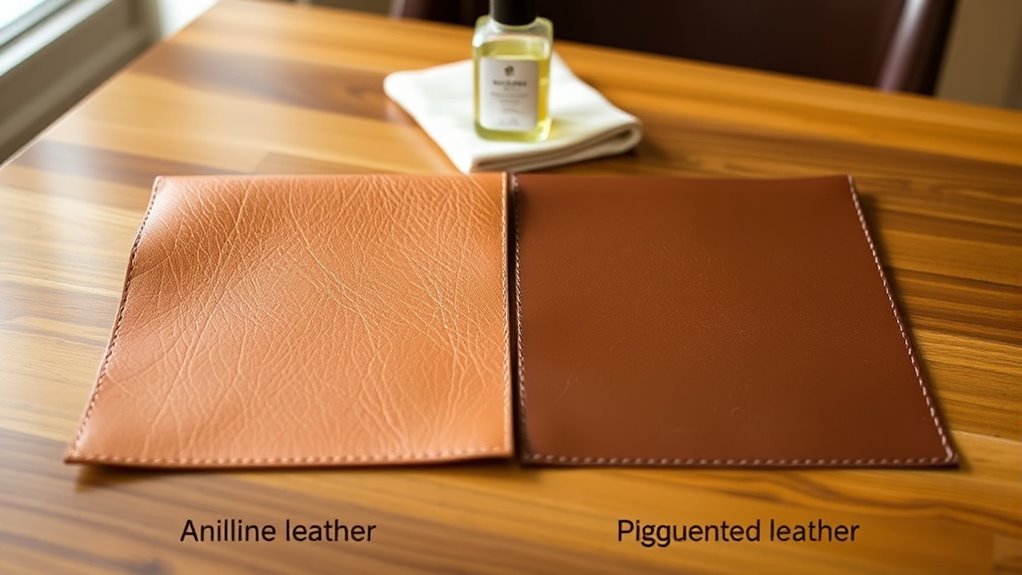
Caring for an aniline leather sofa requires a “less is more” approach because the open pores absorb whatever you put on them. Always verify your tannery’s exact cleaning code before applying any liquid or cream, as pure aniline and wax pull-up aniline require different treatments.
- Dust weekly with a dry microfiber cloth: Wipe seating cushions and crevices with a clean, dry, lint-free cloth and vacuum crumbs with a soft brush attachment so grit does not abrade the naked grain.
- Blot spills within seconds—never rub: Press a clean, dry microfiber towel or absorbent paper towel straight down onto liquid spills. According to Cortina Leathers, over-rubbing or over-wetting pure aniline leather spreads the stain and permanently alters the surface texture.
- Even out damp spots across the whole panel: If your manufacturer permits water dampening for a stubborn water-based smudge, never scrub a single coin-sized spot. Spinneybeck’s upholstery care guidelines advise wiping the entire cushion panel evenly from seam to seam with a cloth barely dampened in cool water so the leather dries to a uniform tone without a water ring.
- Treat grease and oil stains conservatively: For fresh butter, lotion, or food grease on porous leather, The Washington Post notes that dusting baking soda or cornstarch over the spot to draw out surface oil before brushing it off gently is safer than applying wet household stain removers; small oil marks on aniline will also gradually blend into the natural patina.
- Skip generic oils, saddle soap, and unapproved conditioners: Cortina Leathers explicitly warns owners never to apply oils, saddle soaps, cleaners, or generic conditioners to its pure aniline upholstery, as they can permanently darken and blotch the hide.
- Block direct UV light and heat vents: Position aniline sofas at least 2 feet (60 cm) away from radiators or fireplace hearths and use sheer curtains or UV-filtering window film to prevent rapid fading.
Note: Aniline leather naturally darkens, softens, and develops a burnished sheen where your head, arms, and hands rest most often. Rotate removable seat and back cushions monthly so this patina develops evenly across the sofa.
Best Practices for Maintaining Pigmented Leather Sofas
Pigmented leather sofas are much easier to clean than aniline upholstery, provided you protect the polymer topcoat from heat and harsh chemicals. While the sealed surface resists daily spills, built-up body oils and sweat on headrests and armrests can slowly soften and degrade the finish over several years if left uncleaned.
- Dust and vacuum weekly: Wipe down cushions with a soft, dry cloth and vacuum seams with a soft brush nozzle to remove abrasive dust and pet hair.
- Wipe with cool water—never hot: When damp-cleaning is allowed by your care label, wring out a clean white cloth in cool or lukewarm distilled water. Never use hot water, which causes the protective polymer finish to expand and open up, allowing dirt to become trapped beneath the topcoat.
- Use only pH-balanced leather cleaner: For sticky spills or headrest oils, apply a manufacturer-approved, water-based, pH-balanced leather cleaner onto a damp sponge or cloth—never spray cleaner directly onto seam stitching—and rinse away all soap residue with a clean damp cloth.
- Apply water-based protector twice a year: In busy family homes, applying an approved water-based protective cream every 6 to 12 months helps replenish slip agents on the surface so denim dye and dirt wipe off easily without rubbing through the topcoat.
- Avoid household solvents and silicone sprays: Never use glass cleaner, all-purpose sprays, bleach wipes, magic erasers, saddle soap, or silicone-heavy vinyl polishes, which strip the matte topcoat and cause cracking.
Choosing the Right Leather for Your Sofa: A Comprehensive Guide
The best leather sofa is the one whose surface finish matches the toughest conditions in your room—not the label that sounds most expensive in the showroom. Before falling in love with a swatch, evaluate daily foot traffic, natural window light, pet habits, and whether your household prefers a pristine uniform look or a lived-in vintage aesthetic.
Household Decision Guide
- Low traffic + shaded room + love of vintage patina: Choose pure aniline or wax pull-up aniline leather.
- Moderate adult use + natural grain wanted + occasional guests: Choose semi-aniline leather for balanced stain and fade resistance.
- Young children, dogs, cats, movie-night snacks, or rental properties: Choose pigmented leather (1.2 mm+ thickness) for wipe-clean durability.
- Sun-drenched room with south- or west-facing windows: Choose pigmented leather with a Blue Wool Scale rating of 4–5 and use UV window protection.
Recommended Products

Restore the beauty of your leather couches with our Leather Recoloring Balm, designed to effectively repair scratches and restore the color.
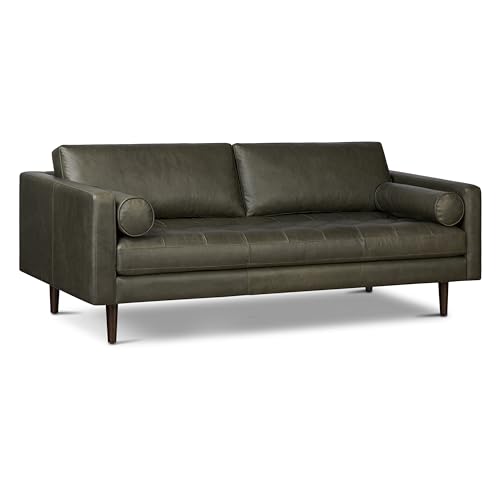
Make Good Living Gettable: The Napa Sofa by Poly and Bark is a premium leather couch featuring full-grain pure-aniline or semi-aniline dyed Italian leather upholstery. Our high-quality leather sofa is built to be the perfect living room centrepiece.
Leather Finish vs. Leather Grain: Do Not Confuse the Labels
One of the most common sofa-shopping mistakes is confusing leather grain terms with leather finish terms. According to the Leather Working Group leather terminology guide, grain labels describe which layer of the hide was used and whether it was mechanically sanded, whereas finish labels describe how the surface was dyed and coated.
Because retailers often use catch-all marketing phrases like “top-grain leather” without stating the finish, use this reference table to separate the two classifications when reading sofa spec sheets.
| Leather Term | Classification Type | What It Actually Tells You |
|---|---|---|
| Aniline Leather | Surface Finish | Dyed with transparent soluble dyes and zero pigment particles; natural pores remain fully visible |
| Semi-Aniline Leather | Surface Finish | Aniline-dyed with a thin topcoat (under 0.02 mm) containing light pigment for added stain protection |
| Pigmented Leather | Surface Finish | Sealed with an opaque pigment and polymer coating (up to 0.15 mm) for uniform color and maximum wear resistance |
| Full-Grain Leather | Hide Grain Layer | Outer hide layer retaining 100% of its natural grain without mechanical sanding or buffing; usually finished as aniline or semi-aniline |
| Corrected-Grain Leather | Hide Grain Layer | Outer hide layer lightly buffed to remove scars, then embossed with a uniform grain and sealed with a pigmented or semi-aniline finish |
| Split / Bi-Cast Leather | Hide Grain Layer | Lower fibrous layer left after splitting off the top grain; weaker and often laminated with a thick polyurethane film |
Questions to Ask Before You Buy
Never buy a sofa labeled simply as “genuine leather” or “100% leather” without getting the exact upholstery specifications in writing. Ask the salesperson or manufacturer these six questions before placing your order:
- What is the exact surface finish? Ask specifically whether the hide is pure aniline, wax/oil pull-up aniline, semi-aniline, or pigmented.
- What is the grain classification and hide thickness? Confirm whether it is full-grain or corrected top-grain leather (aim for 1.0 mm to 1.4 mm thickness) and verify that the sides and back are not matched with vinyl or split leather.
- What is the Blue Wool Scale lightfastness rating? For bright rooms, look for an ISO 105-B02 rating of Grade 4 or 5 rather than Grade 2 or 3.
- Can I request a Cutting for Approval (CFA) from the current dye lot? Especially for aniline and semi-aniline sofas, dye lots vary significantly from hide to hide.
- What is the official cleaning code and approved cleaner? Check whether the manufacturer specifies dry-blot-only care or permits damp wiping and water-based protectors.
- What does the upholstery warranty exclude? Most furniture warranties cover seam splitting and manufacturing defects for 1 to 5 years but exclude natural scars, patina, dye transfer from denim, body-oil darkening, and pet scratches.
Frequently Asked Questions
What Is the Difference Between Aniline and Pigmented Leather?
Aniline leather is dyed with transparent soluble dyes and has no pigmented surface coating, leaving natural pores, scars, and grain variations completely visible. Pigmented leather is sealed with a polymer finish containing opaque pigment particles (up to 0.15 mm thick), creating a uniform color and much stronger resistance to stains, scuffs, and fading.
What Are the 5 Types of Leather for Sofas?
There is no single official list of five sofa leathers because upholstery labels mix finish types and grain types. Most retailers group sofa upholstery into five common categories: pure aniline, wax or oil pull-up aniline, semi-aniline, pigmented (protected) top-grain leather, and nubuck (full-grain leather buffed on the grain side for a velvet nap).
What Are the Disadvantages of Aniline Leather?
Aniline leather absorbs untreated spills rapidly, shows fingernail scratches and body oils easily, and fades faster in direct sunlight (typically scoring Grade 2 to 3 on the ISO Blue Wool Scale). It also costs 15% to 30% more than pigmented leather because only the top 5% of raw hides are clean enough to use without opaque coatings.
Is Aniline Leather Good for Sofas?
Yes, aniline leather is an exceptional sofa material if you want buttery softness, breathable warmth, and a rich patina that deepens over 15 to 25 years. It performs best in adult living rooms, libraries, or dens where direct sunlight, food spills, and rough pet activity are minimal.
Is Pigmented Leather Real Leather?
Yes, pigmented leather is 100% real animal hide that has been sealed with a pigment-containing polymer topcoat for durability and color consistency. Under DIN EN 15987 and ISO 15115 leather standards, the surface coating must remain 0.15 mm or thinner to be classified as genuine leather.
Is Semi-Aniline Leather Better Than Pigmented Leather?
Semi-aniline leather is better when you want a softer, more breathable feel and visible natural pores while keeping light spill protection. Pigmented leather is better when maximum stain resistance, scratch resistance (1,000+ Taber abrasion cycles), uniform color, and easy damp-cloth cleaning are your top priorities.
How Can You Tell If Leather Is Aniline or Pigmented?
Check the manufacturer’s spec sheet or care tag first, then inspect the grain closely under bright light. Aniline leather shows tiny hair pores, natural scars, and shade variations that warm quickly to your touch, whereas pigmented leather feels smoother and more uniform and causes a hidden drop of water to bead up tightly.
Which Leather Sofa Is Better for Kids and Pets?
Pigmented leather is the best choice for homes with children and pets because its sealed polymer finish blocks sticky spills and resists light claw scuffs better than porous aniline hides. Because no real leather is completely puncture-proof, keep pet nails trimmed and wipe spills promptly with a cool, damp cloth.
Conclusion
Choosing the right leather sofa comes down to matching the surface finish to your daily household routine. Pick aniline leather when natural pores, breathable softness, and an evolving patina matter most in a controlled space; pick pigmented leather when kids, pets, sunlight, and easy spill cleanup dominate your living room; or choose semi-aniline leather for a balanced middle ground.
Before placing your order, request a physical leather swatch from the current dye lot and ask the retailer to confirm both the grain treatment (full grain vs. corrected grain) and the surface finish (aniline, semi-aniline, or pigmented) alongside the manufacturer’s official care instructions.
How this comparison was evaluated: We compared aniline, semi-aniline, and pigmented finishes by surface treatment, visible grain, stain and scuff resistance, care needs, sunlight exposure, patina, and household use. The terminology and care recommendations were checked against current leather-industry definitions and upholstery-care guidance rather than invented hands-on testing.
Sources
- Leather Research Laboratory (Leather Industries of America): International IULTCS and ISO definitions for aniline, semi-aniline, and pigmented leather finishes.
- Fritz Hansen Leather Care and Maintenance: Industry standard confirming that only 5% of raw hides qualify for pure aniline upholstery leather.
- Spinneybeck Leather FAQs and Specifications: Drum-dyeing saturation, hide cutting yields (65%–75% for naked aniline vs. 75%–85% for finished leather), and panel-wiping care methods.
- German Leather Federation (VDL) Designation Regulations: DIN EN 15987 standards capping genuine leather surface coating thickness at 0.15 mm.
- Cortina Leathers Care & Cleaning Guide: Finish-specific cleaning instructions and warnings against using oils, saddle soap, or conditioners on pure aniline leather.
- The Washington Post: Practical stain-removal methods for grease, ink, and liquid spills on leather upholstery.
- Leather Working Group Glossary: Industry definitions distinguishing full-grain and corrected-grain leather from surface finishes.