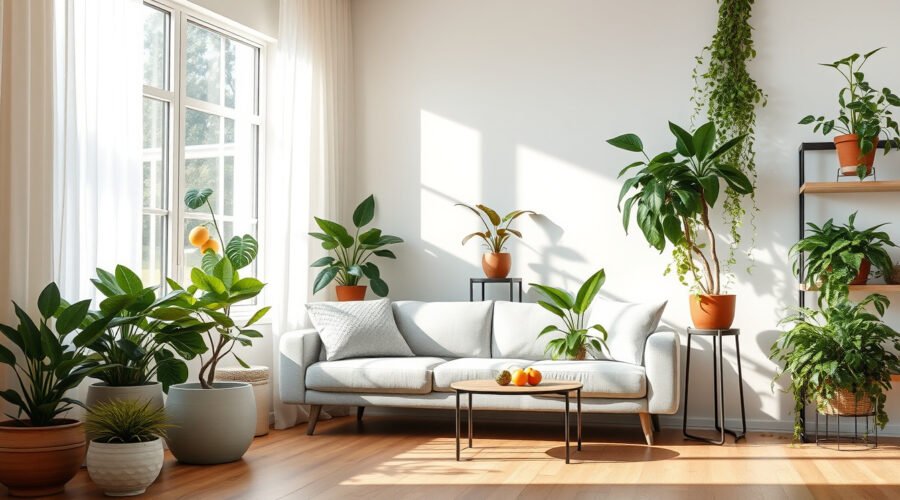
Arranging indoor plants for better light starts with one simple step: match each plant to the light your living room actually gets. Instead of placing plants only where they look good, check your windows, watch how sunlight moves through the room, and group plants by similar light needs first. Once the light is right, you can style the arrangement with height, texture, trailing plants, and decorative containers.
Quick Answer
To arrange indoor plants for better light, map your living room’s bright, medium, and low-light zones, then place each plant where its light needs fit. Put sun-loving plants near bright south or west windows, keep most tropical foliage in bright indirect light, and use shelves, stands, rotation, and grow lights to prevent uneven growth.
Key Takeaways
- Check light at several times of day before moving plants, because morning, noon, and late-afternoon sun can be very different.
- Group plants by light needs first, then style them by height, shape, and pot color.
- Most common foliage houseplants prefer bright indirect light, while cacti, succulents, citrus, and many flowering plants need stronger light.
- Watch for leggy stems, smaller new leaves, fading variegation, scorched leaves, or soil that stays wet too long after changing a plant’s location.
At a Glance
| Time Required | 30–60 minutes to map light and rearrange plants; 1–2 weeks to monitor results |
| Difficulty | Easy |
| Tools Needed | Notebook, phone camera, optional light meter, plant stands, shelves, saucers, and a timer if using grow lights |
| Cost | $0 if rearranging only; $10–$60+ if adding stands, meters, or LED grow lights |
Assess Natural Light Sources
Start by identifying the direction each living room window faces. In many Northern Hemisphere homes, south-facing windows bring the strongest overall light, west-facing windows can bring hot afternoon sun, east-facing windows offer gentler morning sun, and north-facing windows usually provide the lowest light. However, trees, roof overhangs, nearby buildings, curtains, window film, and the season can all change the actual light your plants receive.
Spend one day making a simple light map. Look at the room in the morning, at midday, and in late afternoon. Note which areas get direct sun, which areas stay bright without direct rays, and which corners remain dim. If you want a more accurate reading, use a handheld light meter or a reliable light meter app as a guide. University extension guidance explains that light is essential for photosynthesis and that plants should be matched to the light environment in the home or office; you can read more from University of Minnesota Extension.
Note: Light changes with the seasons. A plant that does well near a window in winter may need to move a few feet back in summer if the sun becomes hotter and more direct.
Understand Indoor Light Levels Before You Move Plants
Plant tags often say “low light,” “medium light,” or “bright indirect light,” but those labels are easy to misread. Low light does not mean no light. It usually means a bright enough spot for foliage plants that tolerate shade, such as a north window or a room corner that still receives daylight. Bright indirect light means the plant gets strong ambient light without harsh sun sitting directly on the leaves for long periods.
| Light Level | What It Looks Like | Good Plant Matches |
|---|---|---|
| Low light | A north window, shaded corner, or spot bright enough to read in during the day | Snake plant, pothos, ZZ plant, cast iron plant, peace lily |
| Medium light | Near an east window or several feet from a bright west or south window | Spider plant, philodendron, monstera, ferns, peperomia |
| Bright indirect light | A bright room where the plant sees plenty of sky but is protected from harsh midday sun | Fiddle leaf fig, rubber plant, hoya, many orchids, many trailing tropicals |
| Direct sun / high light | Several hours of direct sun, usually close to an unobstructed south or west window | Cacti, succulents, citrus, herbs, hibiscus, many flowering plants |
Select Plants That Thrive in Your Light Conditions
Choose plant placement by light need before you think about decoration. A low-light-tolerant snake plant can survive farther from a window, but it will usually grow more slowly there. A cactus or succulent, on the other hand, usually needs a brighter window to stay compact and healthy. Missouri Extension lists cactus and many succulents as bright-light plants and lists many foliage plants, such as pothos and philodendron, as filtered-light plants; its houseplant guide is a useful reference for matching common plants to light levels: Caring for Houseplants.
- Identify the light level: Decide whether each spot is low, medium, bright indirect, or direct sun.
- Read the plant’s tag: Match the plant’s stated light needs to the room, not just to the pot or decor.
- Group similar plants: Keep low-light-tolerant plants together and high-light plants closer to the strongest window.
- Check after moving: Give plants one to two weeks, then look for new growth, leaning, yellowing, scorched leaves, or soil that stays wet too long.
The best-looking plant arrangement is usually the one that starts with plant health: right plant, right light, then right style.
Recommended Products

LIVE INDOOR HOUSEPLANTS: Includes a rotating assortment of 6 popular indoor plants in 2 in. grower pots, ranging in height by variety - approximately 4 - 6 in. tall

HOUSE PLANT BOX: Includes a rotating assortment of 4 greenhouse-grown, low-maintenance plants in 4.25" nursery pots

FARM-DIRECT PACKAGING & ARRIVAL: Each Money Tree is hand-selected at the greenhouse and secured in breathable, reinforced transit-safe materials. This direct-from-nursery process maintains plant integrity and soil moisture, providing a healthy houseplant ready for immediate indoor display
Place Plants by Window Direction
Use window direction as a starting point, then adjust based on what you observe in your own room.
- East-facing windows: Often ideal for many houseplants because they provide morning sun and cooler light. Place foliage plants close to the window or slightly off to the side if leaves fade.
- South-facing windows: Best for high-light plants, but direct sun can be too strong for shade-loving foliage. Use sheer curtains or move sensitive plants back from the glass.
- West-facing windows: Bright afternoon light can be hot. Use this area for succulents and other sun-tolerant plants, or filter the light for tropical foliage.
- North-facing windows: Usually the lowest-light option. Use plants that tolerate low light, and avoid placing succulents or flowering plants here unless you add a grow light.
Warning: Do not move shade-grown plants straight into strong direct sun. Sudden exposure can scorch leaves. Shift plants gradually, or filter bright sun with a sheer curtain.
Use Height for Better Light
Height helps smaller plants reach light that furniture, sofas, and tables may block. Place taller plants near bright windows only if their leaves can handle the light. Put smaller plants on shelves, side tables, stools, or plant stands so they are not hidden behind larger pots.
Arrange plants in layers: taller plants toward the back or side, medium plants in the middle, and shorter plants in front. Leave enough space between leaves so one plant does not shade another. If a plant begins leaning hard toward the window, rotate it or move it closer to the light source.
Pro Tip: Before buying a new plant stand, test the height with a chair, box, or stack of books for a few days. If the plant perks up and the arrangement looks balanced, then choose a permanent stand.
Group Plants in Odd Numbers for Visual Appeal
Once the light needs are handled, style your plants in odd-numbered groups such as three or five. Odd numbers tend to look more relaxed and natural than perfectly even pairs. The key is to group plants that can share the same light zone.
- Start with light: Do not group a cactus, fern, and pothos together unless the spot works for all three.
- Vary heights: Mix one tall plant, one medium plant, and one trailing or compact plant.
- Mix textures: Pair broad leaves with fine, upright, or trailing foliage.
- Keep airflow: Avoid packing pots so tightly that leaves stay damp or pests are hard to spot.
Include Trailing Plants for Light and Aesthetics
Trailing plants make a living room feel fuller without taking up much floor space. Place pothos, philodendron, hoya, string of hearts, or English ivy on shelves, bookcases, wall planters, or hanging baskets where they receive the light they need. This draws the eye upward and keeps tabletops from feeling crowded.
Keep trailing stems from covering neighboring plants. Prune long vines when they block light, and turn the pot occasionally so growth stays even. If the plant is on a high shelf, make sure you can still water it safely and check it for pests.
Warning: Some popular trailing plants, including pothos, can be toxic to pets if chewed. Keep toxic houseplants out of reach of children, cats, dogs, and curious pets, and check plant safety before placing vines at floor level.
| Plant Type | Best Light | Best Placement |
|---|---|---|
| Pothos | Low to bright indirect light | High shelf, bookcase, or hanging basket away from pets |
| String of Hearts | Bright indirect light | Near a bright window, protected from harsh midday sun |
| Philodendron | Medium to bright indirect light | Plant stand, shelf, or wall planter |
| English Ivy | Bright indirect to bright light | Cool bright window, hanging basket, or shelf with airflow |
Monitor Plant Health for Thriving Greens
After you rearrange your indoor plants, watch how they respond. Plant problems can come from more than light, so look at the whole plant and the potting mix before moving it again.
- Signs of too little light: Long, thin stems, wide gaps between leaves, small new leaves, slow growth, leaning toward the window, fading variegation, or older leaves dropping.
- Signs of too much light: Bleached, scorched, crispy, or washed-out leaves, especially on shade-loving tropical plants.
- Watering changes: Plants in lower light usually dry out more slowly. Check soil before watering so you do not overwater after moving a plant away from a window.
- Dust and pests: Wipe broad leaves with a damp cloth so dust does not block light, and check undersides of leaves for pests while you clean.
For a deeper explanation of indoor plant growth factors, light levels, and symptoms of poor lighting, see University of Georgia Extension’s indoor plant guide.
Rotate Plants for Even Growth
Even in a bright spot, one side of a plant often receives more light than the other. Rotate pots a quarter turn every time you water, or at least every one to two weeks during active growth. This helps keep stems from leaning and encourages a more balanced shape.
Do not rotate every plant the same way forever. If a plant is actively leaning, turn the fuller side away from the window for a while. If a plant is flowering, avoid moving it too often during bud formation because some flowering plants are sensitive to sudden changes in light direction.
Use Grow Lights When Natural Light Is Not Enough
If your living room is dark, blocked by trees, or has only north-facing windows, rearranging may not be enough. Add a full-spectrum LED grow light to support plants that need more light than the room provides. LED grow lights are useful because they are efficient, long-lasting, and generally produce less heat than older incandescent-style lighting.
Place grow lights above or slightly in front of the plants so growth does not lean sideways. Use a timer for consistency. As a practical starting point, many foliage houseplants do well with about 12–14 total hours of light per day when supplemental lighting is needed, while flowering plants may need a longer bright period. Always adjust based on the plant species and its response.
Create a Seasonal Plant Care Routine
Review your living room plant layout at least four times a year. In winter, sunlight often reaches deeper into the room, and plants may need less water because growth slows. In summer, direct sun can be stronger and hotter near the glass, especially in south- and west-facing rooms.
- Spring: Move high-light plants closer to bright windows as growth speeds up.
- Summer: Pull sensitive foliage back from harsh direct sun or use sheer curtains.
- Fall: Check whether shorter days are causing leaning or slower growth.
- Winter: Reduce watering frequency and consider supplemental grow lights for plants that become leggy.
Frequently Asked Questions
How do you position plants in a living room?
Position plants by light need first. Put high-light plants near the brightest windows, keep most tropical foliage in bright indirect light, and place low-light-tolerant plants in dimmer corners that still receive daylight. Then style the arrangement with taller plants in back, smaller plants on stands, and trailing plants on shelves or hangers.
How do I make sure indoor plants get enough light?
Watch the plant for signs of low light, such as long leggy stems, small new leaves, slow growth, or leaning toward the window. Move the plant closer to a brighter window, raise it on a stand, clean dusty leaves, rotate it regularly, or add a full-spectrum LED grow light if the room stays too dim.
Which plant should be kept in front of the main door?
Choose a plant that fits the entry’s light, temperature, and traffic flow. If the doorway receives bright indirect light and has enough space, a fiddle leaf fig, rubber plant, parlor palm, or snake plant can work well. Avoid blocking the door, cold drafts, heating vents, and pet-accessible spots if the plant is toxic.
Can indoor plants get too much light?
Yes. Many tropical foliage plants prefer bright indirect light and can scorch in harsh direct sun. Signs of too much light include bleached patches, crispy brown areas, faded color, or leaves that curl away from the window. Move the plant back a few feet or filter the window with a sheer curtain.
Should plants be grouped together for better light?
Plants can be grouped together, but group them by similar light needs. A low-light pothos and a high-light cactus should not share the same dim corner. Keep enough space between pots so taller plants do not shade smaller ones and so air can move around the leaves.
Conclusion
Arranging indoor plants for better light is less about finding one perfect spot and more about matching each plant to the living room’s real conditions. Map your light, choose plants that fit each zone, use height to prevent shadows, rotate pots for even growth, and adjust the layout as the seasons change. With a little observation, your living room can look more balanced while giving each plant a better chance to grow well.
Sources
- University of Minnesota Extension: Lighting for indoor plants and starting seeds — backs light-level categories, supplemental lighting, grow-light types, and duration guidance.
- University of Georgia Extension: Growing Indoor Plants with Success — backs window-direction guidance, foot-candle concepts, seasonal light changes, and signs of inadequate light.
- University of Missouri Extension: Caring for Houseplants — backs common houseplant light preferences and diagnostic symptoms.
- ASPCA: Devils Ivy / Pothos toxicity listing — backs the caution about keeping pothos away from pets.