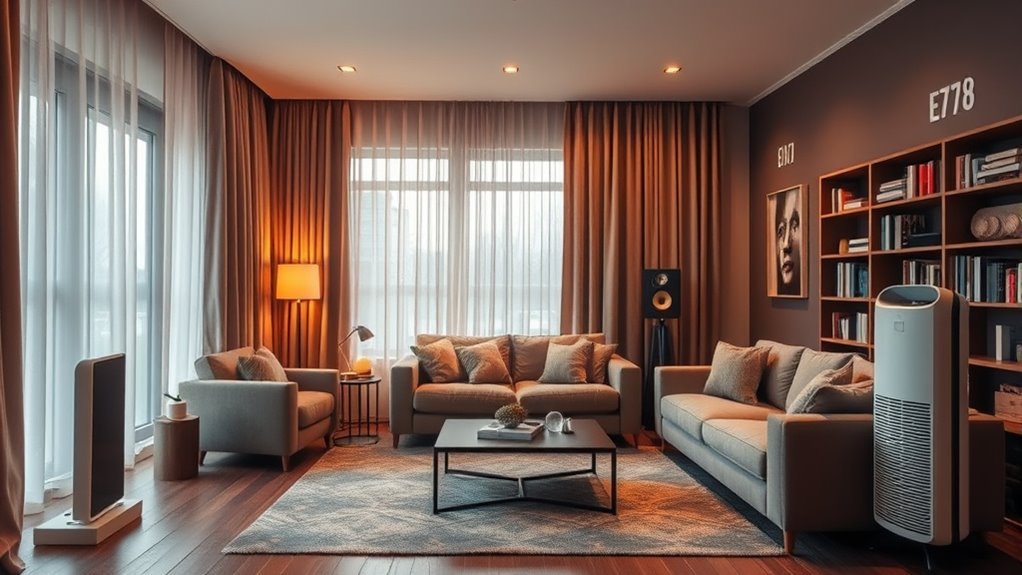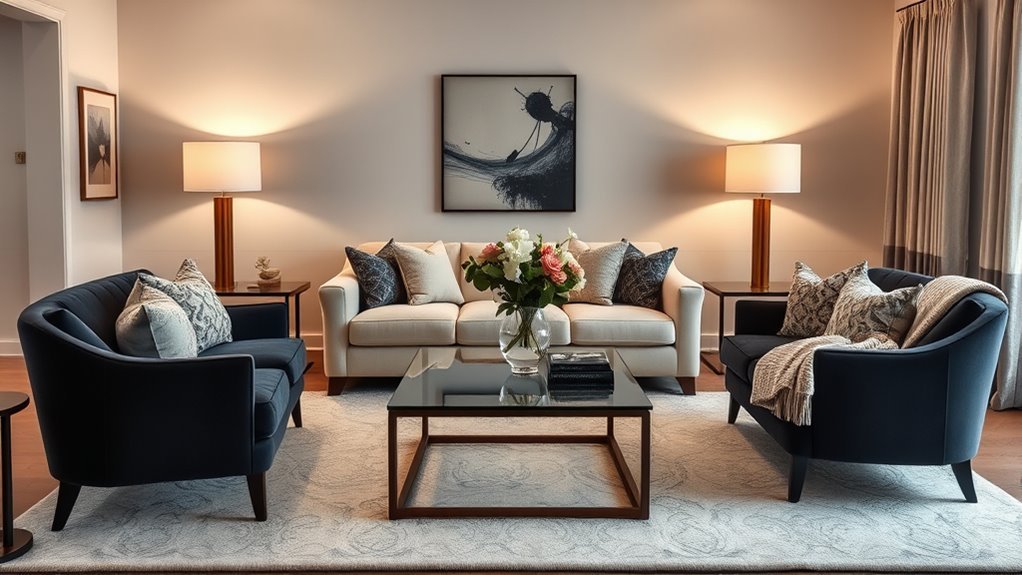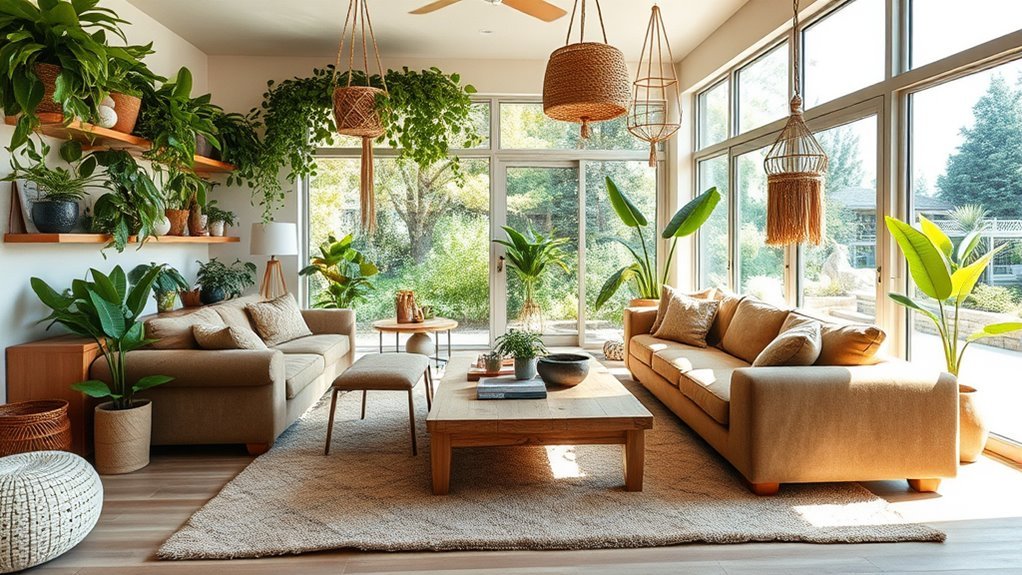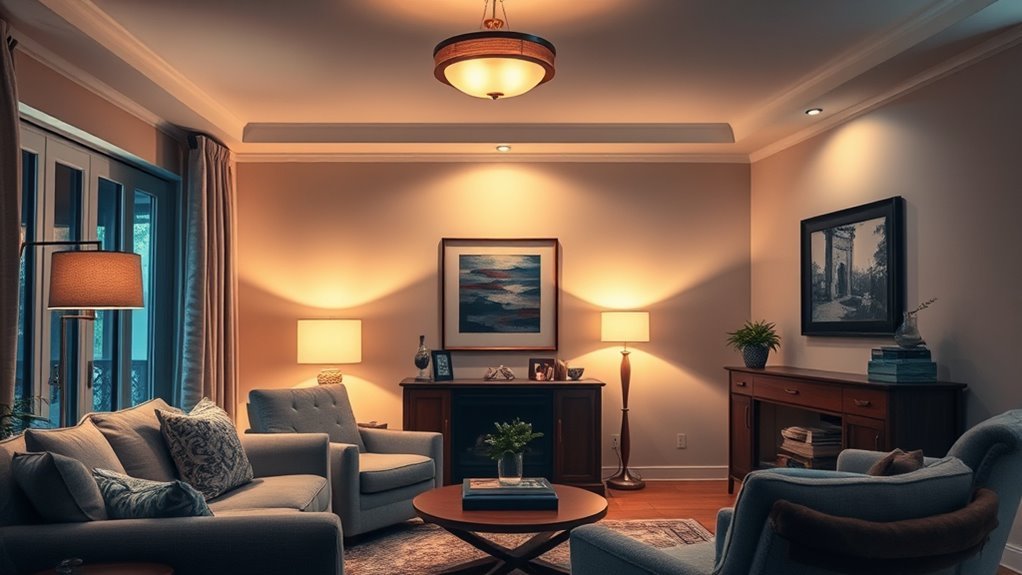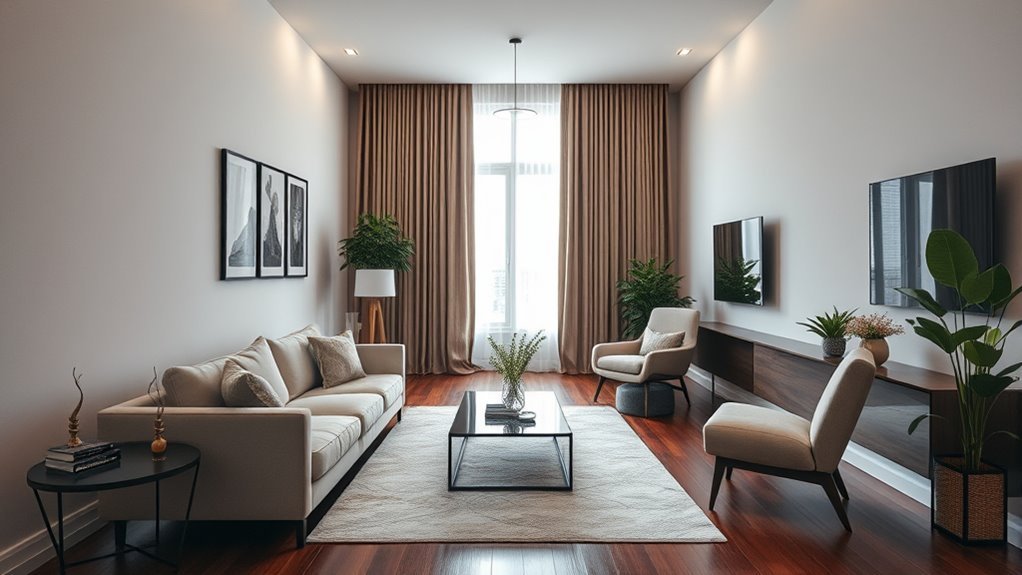
Arranging a long narrow living room is less about squeezing everything against the walls and more about creating a clear path, one strong focal point, and furniture zones that feel intentional. Start by measuring the room, choosing the main walkway, and building your seating around how you actually use the space: talking, watching TV, reading, working, or entertaining.
Quick Answer
To arrange a long narrow living room, keep the main walkway about 30–36 inches wide, place the sofa along one long wall or float it to divide zones, use a rug to anchor the seating area, choose slim furniture, and create one clear focal point so the room feels cozy instead of hallway-like.
Key Takeaways
- Keep the main traffic path clear; aim for 30–36 inches when possible and at least 24 inches for tight secondary paths.
- Choose one main focal point, such as a TV, fireplace, window, or conversation area, before moving furniture.
- Use rugs, lighting, and furniture backs to create zones instead of adding bulky dividers.
- Pick slim, multi-functional furniture so the room has storage and seating without feeling cramped.
- Avoid pushing every piece against the wall; floating one sofa, chair, or desk can make the room feel more planned.
At a Glance
| Time Required | 1–2 hours to measure, test layouts, and move light pieces; longer if moving large furniture. |
| Difficulty | Easy to moderate, depending on furniture size and room entry points. |
| Tools Needed | Tape measure, painter’s tape, paper or a floor-plan app, furniture sliders, and a notepad. |
| Cost | $0 if rearranging what you own; optional costs include rugs, lamps, slim tables, storage ottomans, or wall shelving. |
Identifying Common Challenges in Long Narrow Living Rooms
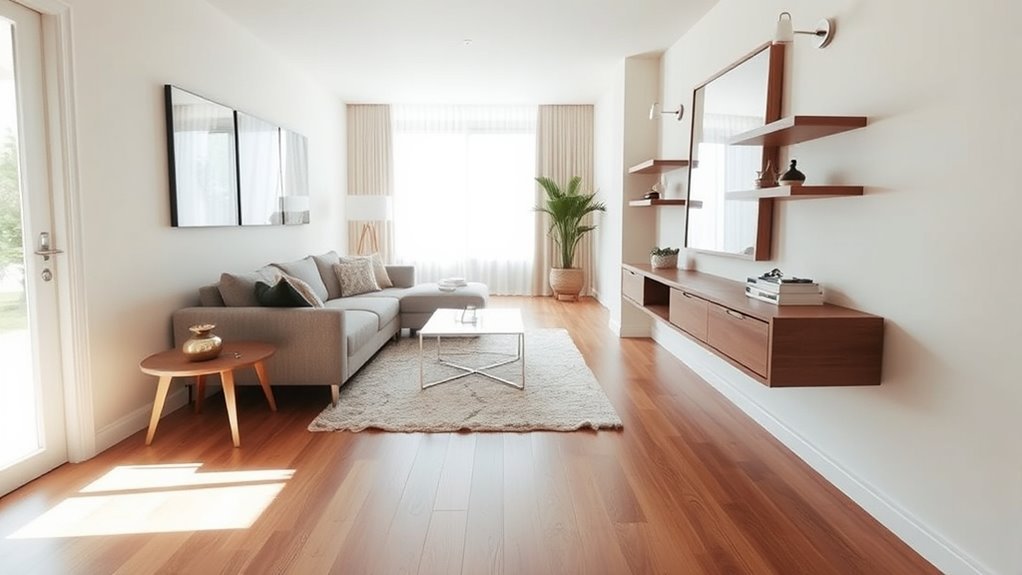
Long narrow living rooms often create a tunnel effect. The room may feel like a hallway instead of a place to sit, relax, and gather. This usually happens when all furniture is lined up along the walls, the walkway cuts through the middle of the seating area, or the room has several doors and windows competing for attention.
The most common layout problems include:
- Awkward traffic flow: People have to walk between the sofa and TV or through the conversation area.
- No clear focal point: The TV, fireplace, windows, and entryways all compete for attention.
- Furniture that is too deep: Oversized sofas, bulky recliners, and large coffee tables can swallow the width of the room.
- A rug that is too small: Small rugs make the seating area look disconnected.
- Unused ends of the room: One side becomes crowded while the far end feels empty.
The fix is to create one clear route through the room, then arrange furniture into one or two useful zones around that route.
How narrow is “narrow”? There is no official cutoff, but rooms people describe this way are usually about 10 to 13 feet wide with a length of roughly twice the width or more, such as 11 by 22 feet. Under about 10 feet of width, a standard-depth sofa, a coffee table, and a 30-inch walkway stop fitting across the room together, so at least one of the three has to shrink.
Measure Before Moving Furniture
Before you move a sofa or buy anything new, measure the room. A long narrow living room needs a simple plan because a few inches can decide whether the room feels open or crowded.
Write down these measurements:
- The full length and width of the room.
- Doorways, door swings, openings, and main walking paths.
- Window locations, low sills, radiators, vents, and outlets.
- The TV wall, fireplace, view, or other main focal point.
- The width and depth of your sofa, chairs, coffee table, console, and shelves.
For the main walkway, aim for 30–36 inches of clear space when possible. The top of that range lines up with the ADA accessible-route standard, which sets a 36-inch minimum continuous clear width and allows a narrowing to 32 inches only at short pinch points such as doorways. Thirty inches is a practical home target rather than a code figure. In very tight homes, 24 inches can work for a short secondary path — a furniture-planning rule of thumb, not an accessibility standard — and it should not be the main route through the room. Between a sofa and coffee table, 14–18 inches usually keeps the table close enough to use while leaving room for knees and movement.
Warning: Do not drag heavy sofas, sectionals, or bookcases alone. Empty storage pieces first, use furniture sliders, protect the floor, and get help for anything that blocks your view or strains your back.
Pro Tip: Use painter’s tape on the floor to mark the sofa, rug, TV stand, and walkway before moving furniture. If the taped layout feels tight when you walk through it, the real furniture will feel even tighter.
Choose the Best Layout for Your Room
The right layout depends on where people enter, where the focal point is, and how you use the room most often. Use one of these layout formulas as your starting point.
Recommended Products

Partner for Small Space: The console table with a size of 29.5”L x 9.4”W x 29.5”H is suitable to be placed behind the sofa, in the kitchen, study, meeting room, entrance and hallway. What’s more, you also can get larger storage space when you put these console tables together

【Suitable for Tight Spaces】The small end table for small spaces measures 19.76"D x 7.92"W x 25.21"H. With its compact design, this tall side table takes up little space and can effectively fit into the gaps between couches or in tight spots beside the bed
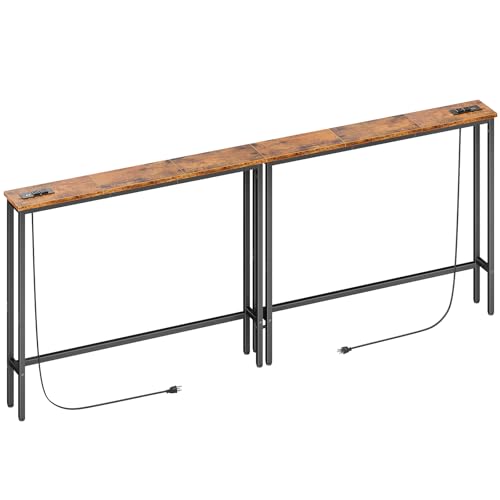
Smart Space Saver: With dimensions of 5.9"D x 78.8"W x 29.5"H, this sleek design fits easily into narrow gaps behind your sofa, while the integrated top shelf offers convenient storage for displaying your favorite items in the living room
Single Seating Zone
This works best for smaller long narrow living rooms. Place the sofa on one long wall or float it a few inches off the wall. Put one or two slim chairs opposite or angled toward it. Use a narrow coffee table, oval table, or storage ottoman in the center.
This layout is best when the room is mainly used for conversation, reading, or TV watching.
Two-Zone Layout
If the room is long enough, divide it into two zones. One end can hold the main sofa and TV. The other end can become a reading nook, desk area, game table, music corner, or small dining spot.
Use an area rug for each zone or use one large rug for the main seating area and a chair, lamp, and side table at the far end. The goal is to make the whole room useful without blocking the walkway.
TV and Conversation Layout
If the TV is the main feature, place the largest seat so viewers do not have to twist their necks. Keep the main walkway behind the seating whenever possible so people do not walk between the sofa and screen. If the room also has a fireplace or large window, use swivel chairs so the seating can turn toward different focal points.
Distance matters as much as angle. A common guideline is to sit about 1.5 to 2.5 times the screen’s diagonal away, which works out to roughly 7 to 11 feet for a 55-inch TV. Narrow rooms often force seating closer than that, and if you cannot move back, a smaller screen will look better than a larger one. Set the center of the screen near seated eye level, usually about 40 to 45 inches from the floor.
Pass-Through Layout
Some long narrow rooms connect one part of the house to another. In that case, keep the walkway on one side instead of through the middle. Float the sofa parallel to the path, place the rug under the seating group, and use low-profile furniture so the space still feels open.
The best long narrow living room layout does two things at once: it protects the walkway and makes each seating area feel like a destination, not an obstacle.
How to Arrange Furniture for a Smooth Flow
To create a smooth flow, begin with the largest piece of furniture, usually the sofa. Place it where it supports the room’s main purpose. In a TV room, face it toward the screen. In a conversation room, face it toward chairs. In a multipurpose room, use the sofa to separate the main seating area from a desk, reading chair, or dining nook.
Use these spacing rules for walkways and clearances as a guide:
- Main walkway: 30–36 inches when possible.
- Tight secondary path: about 24 inches for short distances.
- Sofa to coffee table: 14–18 inches.
- Seating for conversation: close enough to talk without raising your voice.
- Furniture near doors: leave enough space for the door to open fully and for people to enter without turning sideways.
Avoid placing the back of a tall sofa directly in front of the entry if it makes the room feel blocked. If the sofa must face away from the entrance, soften the view with a slim console table, lamp, basket, or low plant behind it.
Note: The 36-inch clearance standard comes from accessibility guidance for public spaces. Your private home may not be required to follow it, but it is a helpful target if you want the room to be easier for guests, children, older adults, or mobility devices to navigate.
Creating Functional Zones in Your Long Narrow Living Room
Functional zones make a long narrow living room feel balanced. Instead of treating the room as one stretched-out seating area, give each section a clear purpose.
Good zone ideas include:
- Main seating zone: sofa, chairs, rug, coffee table, and TV or fireplace.
- Reading nook: comfortable chair, floor lamp, side table, and small bookshelf.
- Work zone: slim desk, wall shelf, task lamp, and chair that tucks in fully.
- Game or puzzle zone: small round table with two chairs at the far end.
- Storage zone: tall bookshelves, closed cabinets, or a narrow console along one wall.
Use area rugs, lighting, furniture placement, and artwork to separate these spaces visually. You do not need screens or bulky dividers. In most long narrow rooms, heavy dividers make the space feel smaller and interrupt the flow.
Recommended Products

3-Tier Storage Spaces console table: The 3-tier narrow console table includes 2 dense mesh shelves and 2 spacious non-woven fabric drawers below the wooden tabletop. 2-tier open shelf design allows you to place books, vases, DVDs, storage boxes, etc. assuring your desktop is more tidy and satisfying your various needs

Fusion That Delights: From the BELLAH Collection, this console table fuses steel, engineered wood, and polyester gabardine for a perfect blend of strength, softness, and storage. Pair it with chest of drawers for a cohesive space that feels just right

Partner for Small Space: The console table with a size of 29.5"L x 9.5"W x 29.5"H. Use it as a slim sofa table behind your couch, a stylish entryway table in your hallway or entrance, or a practical console table in the kitchen, study, or meeting room. What's more, you also can get larger storage space when you put these console tables together
Choosing the Right Furniture and Decor
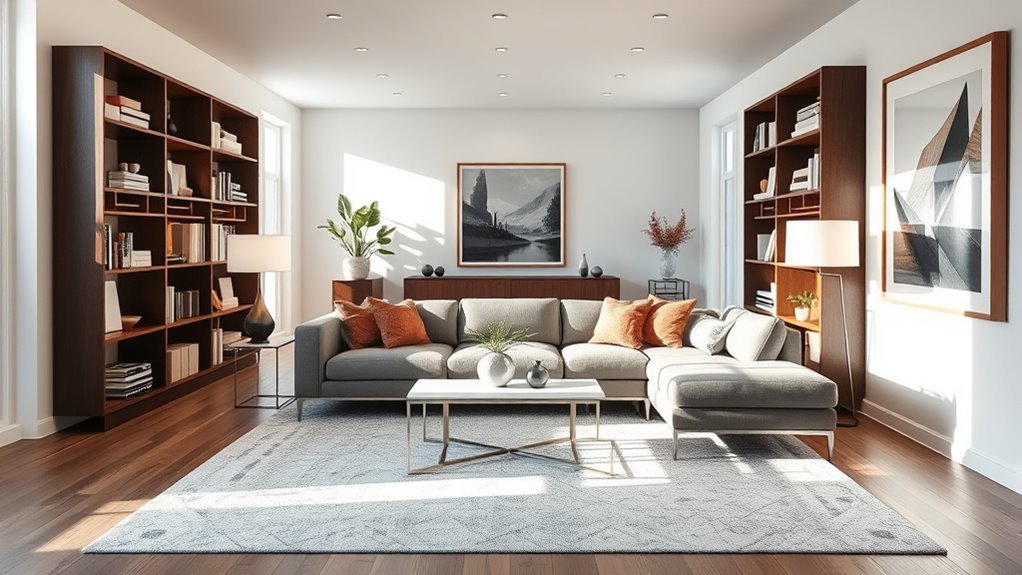
When choosing furniture and decor for a long narrow living room, focus on scale. The best pieces are comfortable but not bulky. Look for furniture that gives you function without stealing too much floor space.
Good choices include:
- Apartment-depth sofas: Usually about 30–34 inches deep, against 36–40 inches or more for a standard or deep-seat sofa. Those few inches of depth are often what turns a 24-inch walkway into a 30-inch one.
- L-shaped sectionals: Useful when the chaise does not block the main walkway.
- Armless or slim-arm chairs: They provide seating without adding extra width.
- Swivel chairs: Helpful in rooms with a TV, fireplace, and window view.
- Storage ottomans: They can work as a coffee table, footrest, hidden storage, or extra seat.
- Nesting tables: They can expand when guests visit and tuck away afterward.
- Tall shelves: Vertical storage uses wall height instead of floor width.
Choose fewer pieces with better proportions instead of many small pieces scattered around the room. Too many small tables, stools, and chairs can make the room feel cluttered even when each item is technically narrow.
Recommended Products

Multiple Package: Multiple packages may arrive separately. If you have any questions about your cloud couch sectional or need assistance, please reach out to us as soon as possible

Multiple Package: Multiple packages may arrive separately. If you have any questions about your cloud couch sectional or need assistance, please reach out to us as soon as possible

Flexible Modular Design: This boneless couch features two separate modules you can rearrange to fit your room. Create an L-shaped sectional, line them up as a straight sofa, or make a comfortable lounging spot for guests. The flexible layout adapts to everyday use in living rooms and apartments.
Use Rugs to Anchor, Not Clutter
An area rug is one of the easiest ways to make a long narrow living room feel intentional. The rug should be large enough to connect the main seating pieces. Ideally, all key furniture sits on the rug. If that is not possible, place at least the front legs of the sofa and chairs on it.
Common sizes make this easier to plan. A 5 x 8 rug suits a small single seating zone, 8 x 10 is the usual choice for a sofa plus two chairs with front legs on the rug, and 9 x 12 lets every leg sit on it in a wider room. A 2.5 x 8 or 2.5 x 10 runner suits the walkway side. Leave roughly 12–18 inches of bare floor between the rug edge and the walls so the room does not read as wall-to-wall carpet.
For a narrow room, a rectangular rug usually works best because it follows the shape of the space. A runner can help a walkway, but do not use a runner as the only rug in the seating area unless the furniture is very small. The seating zone still needs its own anchor.
If the room has two zones, use two rugs that coordinate but do not exactly match. This keeps each zone distinct while maintaining a cohesive look.
Enhancing Comfort and Aesthetic Appeal in Your Living Room
Comfort comes from more than furniture placement. Light, color, texture, and proportion all affect how open or cramped the room feels.
To make the room feel brighter and calmer, try these ideas:
- Use a cohesive color palette: Light neutrals, soft earth tones, and muted colors help the eye move smoothly through the room.
- Add mirrors carefully: A mirror across from a window can reflect light, but avoid placing it where it reflects clutter or glare.
- Layer lighting: Combine overhead light, table lamps, floor lamps, and accent lighting so the room works day and night.
- Choose warm LEDs: The U.S. Department of Energy explains that 2700–3000K light is considered warm, and warm light is often flattering in living spaces.
- Use dimmers and efficient bulbs: LED lighting uses far less energy than traditional incandescent bulbs and works well with many modern dimmable fixtures.
- Layer texture: Add pillows, throws, woven baskets, curtains, and a soft rug so the long shape feels cozy instead of bare.
- Add plants for atmosphere: Plants can make a room feel fresher and more relaxing, but do not rely on them as air purifiers. Research in the Journal of Exposure Science & Environmental Epidemiology found that potted plants do not meaningfully clean typical indoor air at practical home quantities. The real payoff is comfort rather than air quality: a study in the Journal of Physiological Anthropology found that actively tending an indoor plant lowered measured physiological and psychological stress compared with a screen-based task.
Artwork should match the scale of the wall and furniture below it. One large piece over a sofa often looks cleaner than several tiny frames scattered across a long wall. If you prefer a gallery wall, keep the frames visually connected with a consistent color palette, spacing, or frame finish.
Common Mistakes to Avoid
A few small mistakes can make a long narrow living room feel even longer. Watch for these common issues before you finalize the layout.
- Pushing every piece against the walls: This can leave an awkward empty strip in the middle. Pull at least one chair, sofa, or table inward when space allows.
- Blocking the natural path: Do not force people to zigzag around the coffee table or walk between the TV and sofa.
- Buying a rug that is too small: A tiny rug makes the furniture look like it is floating separately.
- Using oversized recliners: Deep reclining furniture can block walkways in narrow rooms.
- Ignoring the room’s ends: An empty far end makes the room feel unfinished. Add a reading chair, plant, cabinet, desk, or small table.
- Running cords across the walkway: Floating a sofa, lamp, or desk usually means a power cord crossing the main path. Route it along the baseboard, use a floor cord cover, or pick a rechargeable lamp instead of stretching an extension lead through the room.
- Using only overhead lighting: One ceiling light can make a long room feel flat. Add lamps at both ends to balance the space.
Frequently Asked Questions
What color schemes work best for long narrow living rooms?
Soft neutrals, warm whites, pale grays, muted greens, sandy beiges, and gentle earth tones work well because they keep the room feeling open. Use deeper colors on accents, pillows, art, or one focal wall instead of painting every long wall dark.
How can I maximize natural light in my living room?
Keep tall furniture away from windows, use light-filtering curtains, choose low-profile seating near the glass, and place a mirror where it reflects daylight without creating glare. If privacy is needed, try woven shades or sheer curtains instead of heavy dark drapes.
Are there specific lighting options for narrow spaces?
Yes. Use layered lighting instead of one bright overhead fixture. Add a floor lamp near a reading chair, table lamps near seating, wall sconces where floor space is tight, and dimmable warm LED bulbs for a cozy evening feel. Avoid placing bright lamps where they reflect directly on the TV.
What types of rugs are suitable for long narrow rooms?
Rectangular rugs usually work best in long narrow living rooms. Choose one large enough for at least the front legs of the sofa and chairs to sit on it. For two zones, use two coordinating rugs rather than one tiny rug in the middle of the room.
How can I incorporate artwork without overwhelming the space?
Choose one large piece over the sofa, a balanced pair of prints, or a tight gallery wall with consistent spacing. Avoid scattering many small frames down the entire long wall because that can make the room feel busier and even longer.
Should the sofa go against the long wall?
Often, yes. A sofa on the long wall can preserve the walkway and make the room easier to use. However, if the room is large enough, floating the sofa can divide the room into two zones and make the space feel less like a hallway.
What should I do if my long narrow living room has several doorways?
Mark the door swings and walking routes first. Keep the main path on one side of the room if possible, then arrange the seating outside that path. Use slim furniture, wall-mounted storage, and round or oval tables to reduce sharp corners in high-traffic spots.
Conclusion
A long narrow living room can feel warm, useful, and balanced when every piece has a reason to be there. Start with the walkway, choose one main focal point, and build the seating around it. Then use rugs, lighting, slim furniture, and vertical storage to create zones that feel connected instead of cramped. With a measured plan and a few smart adjustments, your narrow room can become a comfortable place to gather, relax, work, and enjoy daily life.
Sources
- U.S. Access Board — Guide to the ADA Accessibility Standards, Chapter 4 — supports the 36-inch minimum continuous clear width for accessible routes and the 32-inch allowance at short pinch points. The 30-inch and 24-inch figures in this guide are practical furniture-planning targets, not part of that standard.
- U.S. Department of Energy — Lighting Principles and Terms — supports lighting terms, color temperature, glare, ambient lighting, task lighting, and accent lighting.
- U.S. Department of Energy — Lighting Choices to Save You Money — supports LED energy-efficiency and lighting-control guidance.
- Cummings & Waring, Journal of Exposure Science & Environmental Epidemiology — supports the caveat that ordinary potted plants do not meaningfully improve indoor air quality in typical homes.
- Lee et al., Journal of Physiological Anthropology — supports the statement that active interaction with indoor plants may reduce physiological and psychological stress.