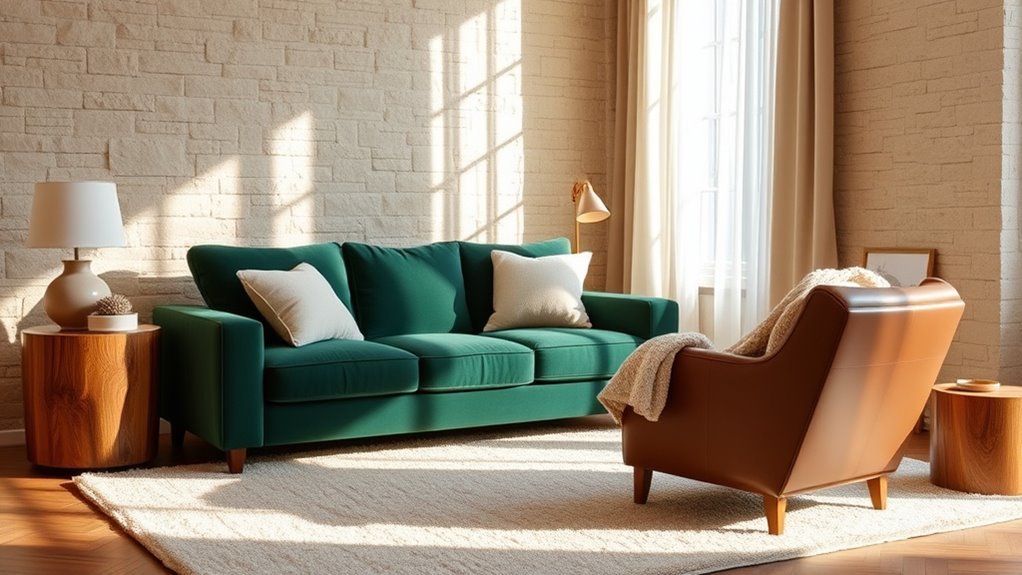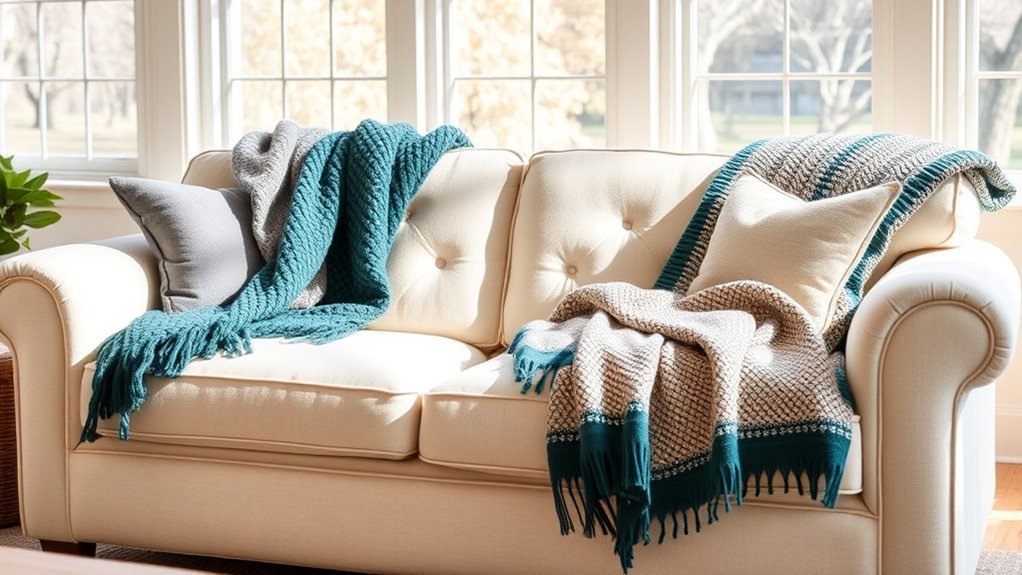
To layer throws and blankets in a living room, start with one larger, practical blanket as the base and add one smaller throw for color or texture. Keep the layers connected to the room’s existing palette, vary texture instead of piling on competing patterns, and place each piece where it can still be used comfortably. Most sofas look cleaner when you stop at one or two visible textile layers.
Quick Answer
To layer throws and blankets in a living room, use a larger neutral or solid blanket as the practical base, then add one smaller throw with a contrasting texture or subtle pattern. Drape it over a sofa arm, fold it across the back or chaise, or keep it in a basket nearby. Repeat one color already used in the room and stop before the seating starts to look crowded.
Key Takeaways
- Use a larger blanket as the practical base layer and a smaller throw as the decorative top layer.
- Mix textures before mixing patterns: cotton with knit, linen with wool, or a smooth weave with a chunkier texture.
- Keep the color palette simple by repeating one color already found in your rug, pillows, curtains, or artwork.
- Use one visible throw on a small sofa and usually no more than two textile layers on a standard sofa unless the furniture has enough space to stay comfortable.
- Check actual dimensions before buying: decorative throws should leave some upholstery visible, while daily-use blankets should comfortably cover the lap and legs.
- Store extra throws within reach in a basket, blanket ladder, ottoman, or nearby chair instead of piling them all onto the sofa.
At a Glance
| Typical Styling Time | About 10–20 minutes for one sofa or seating area |
| Difficulty | Easy |
| What to Gather | 1 practical blanket, 1 accent throw, plus optional pillows and nearby blanket storage |
| Buying Required | No; start with throws and blankets you already own |
What Is the Difference Between a Throw and a Blanket?
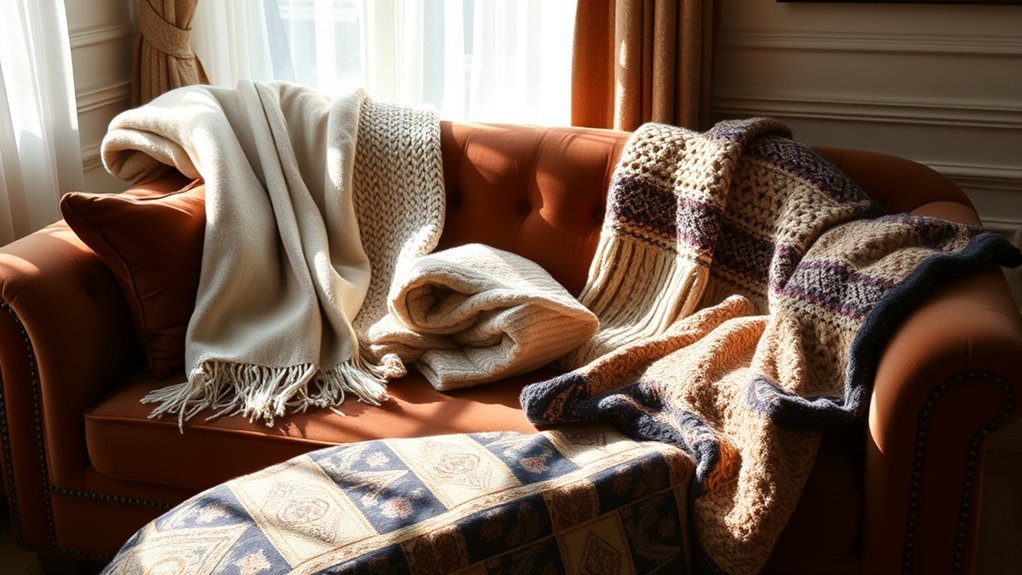
Throws and blankets overlap, but they usually serve different roles. A throw is commonly the smaller, more decorative layer used on a sofa, chair, bench, or basket. A blanket is generally chosen for broader coverage and warmth, although product names and dimensions vary.
For living room styling, think of the blanket as the comfort layer and the throw as the finishing layer. The blanket adds softness and usefulness; the throw adds color, texture, pattern, fringe, or seasonal personality.
Note: The terms are not strict. A lightweight blanket can work like a throw, and an oversized throw can act like a small blanket. Check the actual dimensions, fabric, and intended use instead of relying on the product name alone.
What Should You Use as the Base Layer?
The base layer should make the room feel grounded before you add decorative pieces. For most living rooms, start with a solid, neutral, or softly textured blanket that works with the sofa color and does not compete with your pillows or rug.
- Start with a calm color. Cream, oatmeal, gray, camel, taupe, navy, olive, and charcoal are flexible starting points because they work with many room palettes.
- Match the weight to the season. Use lighter cotton, linen, or waffle textures in warm months and heavier wool, fleece, faux fur, or chunky knits when you want more visual and physical warmth.
- Match the amount of fabric to the furniture. A loveseat may need only one visible throw. A long sofa or sectional can handle a practical base blanket plus one separate accent layer.
- Keep function in mind. If people actually use the blanket, choose something comfortable, suitable for your cleaning routine, and large enough for the intended user.
- Plan for real life. In family or pet-heavy rooms, washable, lower-snag fabrics are often easier to live with than loose fringe or delicate open knits.
Recommended Products

All-Season Comfort: This 50x60 inch brown throw blanket is perfect for use in spring, summer, fall, and winter. Lightweight but warm, it provides year-round comfort, making it ideal for any season

STAYS SOFT WASH AFTER WASH: Snuggle up under a generously sized 50x60" throw made from 100% high-quality woven cotton, with a 2.5" fringed edge that's built to hold up in the wash instead of fraying or unraveling over time.
How Do You Choose the Right Throw Size for a Couch?
Do not choose by the word throw alone. Check the product’s actual dimensions and decide whether the piece is mainly decorative or functional. For decorative styling, choose a size that can drape over an arm, back, or chaise while still leaving some upholstery visible. For everyday warmth, make sure the textile can comfortably cover the lap and legs without needing constant adjustment. On a small sofa, an oversized blanket can dominate the furniture; on a large sectional, a very small throw can look disconnected unless it is used as a deliberate accent.
Pro Tip: Repeat one color from your rug, artwork, curtains, or pillows in the throw. That small repeat makes the layering look intentional instead of random.
How to Layer Throws and Blankets in a Living Room
Use this simple formula: practical base + contrasting texture + one repeated accent color. For example, pair a smooth beige cotton blanket with a rust knit throw, or a charcoal wool blanket with a cream textured throw. The two layers should look related without becoming identical.
The table below is a starting framework rather than a rigid decorating rule. Always leave enough open seating for the furniture to remain comfortable to use.
| Furniture | Good Starting Point | Placement |
|---|---|---|
| Loveseat or compact sofa | 1 visible throw | Over one arm, one back corner, or folded across part of the back |
| Standard sofa | 1 practical blanket plus 1 accent throw if space allows | Keep one layer structured and the other looser or stored nearby |
| Sectional with chaise | 1 larger base layer plus 1 lighter accent | Place the larger layer on the chaise or one end and the accent away from it so the layers do not form one bulky pile |
| Accent chair | 1 throw | Back, arm, or seat depending on how often the chair is used |
Recommended Products

【3D Ribbed Design】:Designed with an elegant 3D ribbed texture, this fleece throw blanket adds depth and modern style to any space. The raised stripe pattern creates a soft, dimensional look that enhances couches, beds, accent chairs, and living rooms. Combining comfort with stylish design, it works beautifully as both a cozy blanket and a decorative home décor accent.

Nice home decor:The Linecooo Flannel Fleece Throw Blanket is an ideal addition to any living space, offering softness and lightweight convenience for all your needs. Its plush microfiber material provides a cozy, comfortable feel, making it perfect for relaxation on the couch, sofa, or bed

Gift-Ready for the Holidays: Thoughtful and cozy, this soft blanket makes a lovely gift for Christmas, Thanksgiving, birthdays, anniversaries, housewarmings, and other special occasions. A comforting birthdays gift for women, mom, her, grandma, teen girls, family, and friends during the chilly fall and winter season, making it a fantastic option when searching for halloween gifts, halloween gifts for women, and upcoming holiday gifts for your loved ones.
1. Fold the Base Blanket First
Fold the blanket lengthwise into thirds, then place it across the back of the sofa, over one arm, or across the chaise. This gives the arrangement structure and keeps the larger piece from swallowing the furniture.
2. Add a Softer, Looser Throw
Place the lighter throw on top or slightly to one side. Let one corner fall naturally over the cushion or arm. The goal is controlled softness rather than a perfect showroom fold.
3. Mix Texture, Not Just Color
Texture keeps neutral layers from looking flat. Try cotton with chunky knit, linen with wool, velvet with boucle, or a smooth fleece with a woven surface. If one piece already has strong fringe, loops, or a chunky weave, let the other layer stay simpler.
4. Stop Before the Sofa Looks Crowded
One throw looks clean. Two layers can add depth. Additional blankets are usually more useful in a basket or storage ottoman than stacked on the seating. If someone has to move several textiles before sitting down, reduce the number of visible layers.
How Do You Mix Throw Colors and Patterns?
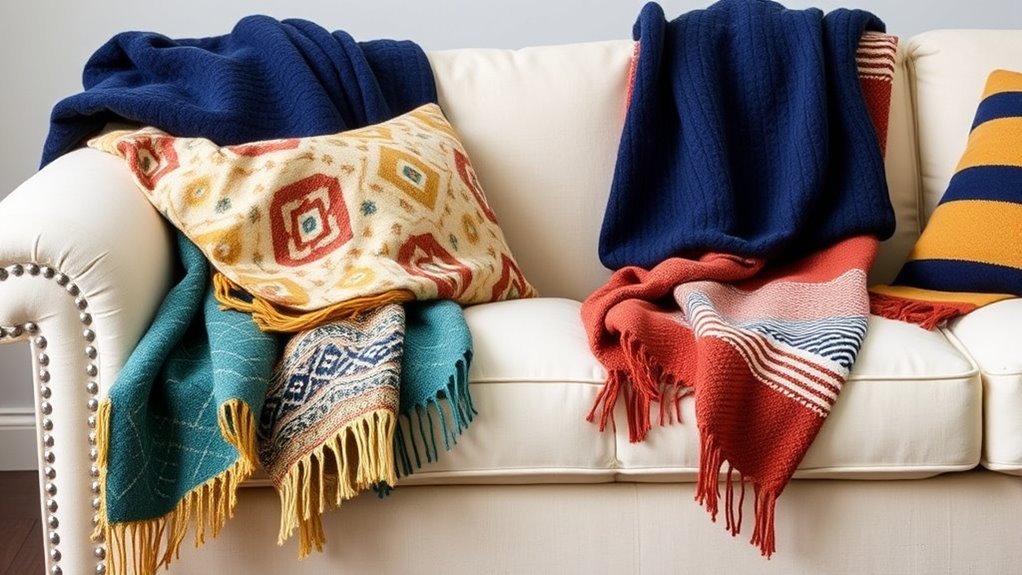
Mixing colors and patterns is easier when you set limits. Choose one main color, one supporting neutral, and one accent. If your sofa is gray, for example, you might use cream as the neutral and terracotta as the accent.
- Use one bold pattern at a time. If the throw has a strong stripe, plaid, or floral print, keep the larger blanket simple.
- Repeat a color already in the room. Pull one color from a pillow, rug, lampshade, artwork, or curtain panel.
- Watch the undertones. Warm woods and leather often sit comfortably beside cream, rust, olive, and camel, while cooler gray or black upholstery can support ivory, slate, navy, or muted blue.
- Vary pattern scale. If one textile has a large, obvious motif, pair it with a smaller-scale weave, subtle stripe, or plain texture.
- Add contrast somewhere. Two layers that match too closely in both color and texture can visually merge into one flat block.
Designer interviews published by Livingetc similarly emphasize working from a shared color thread, varying pattern scale, and using texture or color contrast to keep a layered room cohesive without making everything match exactly.
A layered sofa looks best when the colors feel connected, but the textures do not match perfectly.
Where Should You Place Throws in a Living Room?
Placement changes the mood of the room. A folded throw feels tailored and polished. A loose drape feels casual and lived-in. A basket of rolled or folded blankets feels practical and guest-friendly without filling every seat.
Sofa Styling Techniques
For a standard sofa, use one of these easy styling methods:
- Arm drape: Fold the throw lengthwise and drape it over one arm so the fringe or edge hangs neatly.
- Back drape: Fold a blanket into thirds and lay it across part of the sofa back for a structured look.
- Corner cascade: Place a throw over one back corner and let it fall diagonally onto the seat cushion.
- Chaise layer: On a sectional, fold the larger blanket across the chaise and place a lighter accent throw on another part of the sectional instead of stacking both pieces together.
For a small sofa, stop at one visible throw if a second layer starts to reduce usable seating. On a larger sofa or sectional, two separated textile layers can create balance without concentrating all the visual weight in one spot.
Accent Chair Options
An accent chair usually needs only one throw. Drape it over the back for softness, fold it over the arm for structure, or place it on the seat if the chair is mainly decorative. If the chair already has a strongly patterned pillow, choose a quieter throw so the two pieces do not compete.
How Do You Keep Throws Within Reach Without Clutter?
A throw works best when it is easy to use and easy to put back. Keep extra blankets in a woven basket beside the sofa, under a console table, inside a storage ottoman, or on a blanket ladder. Roll soft casual throws for an informal look, or fold heavier blankets so they remain tidy and easy to grab.
| Storage Option | Best Use | Style Effect |
|---|---|---|
| Decorative basket | Family rooms and casual spaces | Warm and relaxed |
| Draped on sofa | Daily-use throw | Inviting and accessible |
| Blanket ladder | Lightweight throws | Vertical texture |
| Storage ottoman | Extra or off-season blankets | Clean and uncluttered |
Recommended Products

XXL Capacity for All Your Storage Needs, Measuring 21.7"D x 13.8"H, this spacious basket effortlessly holds family clothing, blankets, pillows, toys, and laundry. One basket to declutter your entire home

Reinforced Built-in Handles - Features thickened seamless integrated handles with multilayer woven construction for strong load-bearing. Smooth edge design avoids snagging clothes. Soft grip allows easy carrying from room to room.

【Elegant Natural Charm】 Our Cotton Rope Laundry Hamper is stylishly designed and blends well with any room, bringing a touch of natural elegance to your home décor. It is the perfect gift choice to enhance the beauty of your home and add a touch of sophistication
How Should You Swap Throws by Season?
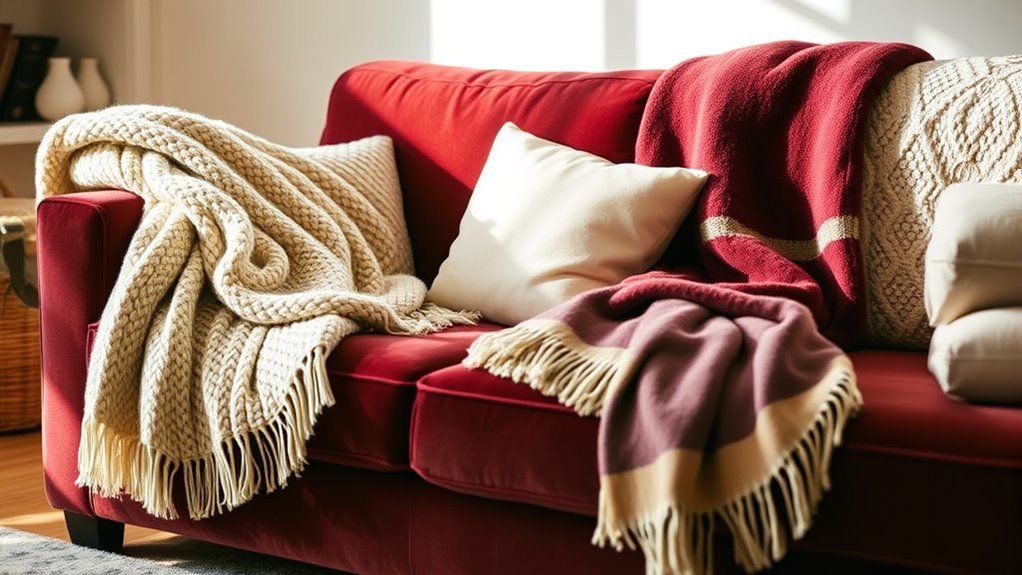
Seasonal swaps can change the comfort and visual weight of a living room without requiring new furniture. Adjust the fabric weight, color, and texture while keeping the rest of the room stable.
- Spring: Try cotton, linen, waffle weave, sage, cream, pale blue, or restrained floral accents.
- Summer: Use lightweight cotton or linen throws in white, sand, sky blue, muted green, or other airy tones that fit the room.
- Fall: Bring in rust, camel, olive, burgundy, plaid, wool, or chunkier knits when they suit the existing palette.
- Winter: Use heavier wool, fleece, faux fur, boucle, cable knit, deep navy, charcoal, chocolate, or warm ivory for more visual and physical warmth.
Before storing an off-season textile, clean and dry it according to its care instructions. Keep stored pieces clean, dry, protected from moisture, and arranged so thick knits or delicate textures are not unnecessarily stretched or crushed.
How Do You Clean and Care for Throws and Blankets?
Before washing or drying a throw or blanket, follow the manufacturer’s care label. GINETEX provides an overview of the ISO 3758:2023 care symbols for washing, bleaching, drying, ironing, and professional care. The American Cleaning Institute also recommends sorting textiles by color, fabric type, and washing instructions, then choosing washer and dryer settings appropriate for the item.
- Wash compatible fabrics together. Sort by color, fabric type, construction, and the care instructions on each item.
- Protect delicate textures. Loosely knitted, fringed, boucle, or otherwise delicate pieces should be cleaned only with methods permitted by their care labels.
- Follow the drying directions. Do not assume air drying is always appropriate. Some textiles may need flat drying, reshaping, tumble drying at a specified setting, or another labeled method.
- Use a lint roller before styling when needed. It can quickly remove visible lint, loose hair, and surface debris before you place the throw back on the furniture.
- Keep backups off the seating. Daily-use throws can stay visible; store extras nearby so the sofa remains comfortable to sit on.
Warning: Keep loose blankets, quilts, pillows, and other soft objects out of an infant sleep area. The American Academy of Pediatrics recommends keeping loose bedding out of a baby’s sleep space because it can increase the risk of entrapment, suffocation, or strangulation.
What Throw-Blanket Styling Mistakes Should You Avoid?
The most common mistake is using too many textiles at once. A sofa should still look comfortable to sit on. If guests need to remove several blankets before they can use the seating, move some of the layers into nearby storage.
- Using too many competing patterns: Pair one obvious pattern with solids, quieter weaves, or small-scale textures.
- Ignoring the sofa color: Give the throw enough contrast to remain visible while repeating something elsewhere in the room.
- Stacking every layer in one corner: On a large sectional, separate the practical blanket and accent throw to distribute visual weight.
- Draping bulky blankets everywhere: Heavy blankets usually look cleaner when folded, stored, or treated as one intentional anchor layer.
- Choosing style over comfort: Scratchy, heavily shedding, snag-prone, or difficult-care throws may be frustrating in high-use family rooms.
- Leaving heavy seasonal fabrics out all year: Rotate heavier textiles when they no longer suit the room’s comfort needs or visual weight.
- Folding everything too perfectly: Combine one structured layer with one softer placement so the sofa still feels usable and relaxed.
Frequently Asked Questions
What is the best way to layer blankets on a sofa?
Start with the larger or more practical blanket as the base, then add a smaller throw with a different texture. Keep the base simple and let the top throw provide the stronger color, fringe, pattern, or tactile contrast. Leave enough upholstery visible so the sofa still looks like seating rather than blanket storage.
How do you style two throw blankets on a sofa?
Give the two throws different jobs. Fold the first one neatly over the sofa back, arm, or chaise as the structured layer. Place the second one more loosely on another corner or keep it in a nearby basket. Avoid stacking two bulky throws in the same spot.
How many throws should be on a couch?
As a styling rule of thumb, one visible throw is often enough for a loveseat or compact sofa. A standard sofa can usually support one practical blanket and one accent throw if the seating still feels open. Large sectionals can use two separated layers, with additional blankets stored nearby instead of piled onto the cushions.
What size throw should I use on a couch?
Check the actual dimensions instead of relying on the product name. For decorative use, choose a throw that can drape over the arm, back, or chaise without hiding most of the sofa. For everyday warmth, choose one large enough to cover the user’s lap and legs comfortably. The best size depends on both the sofa and how the throw will be used.
How do you layer throws on a sectional?
Place the larger practical blanket across the chaise or one end of the sectional, then put a smaller accent throw on a different section or keep it in a nearby basket. Separating the layers distributes color and texture instead of creating one bulky pile in the corner.
Should throws match pillows?
They do not need to match exactly. A more flexible approach is to repeat one color, material, or visual detail from the pillows. For example, pair cream pillows with a cream-and-tan striped throw or repeat a rust accent from a patterned cushion while changing the texture.
Conclusion
Layering throws and blankets is easiest when every piece has a job: one practical base, one decorative accent, and a color or texture connection to the rest of the room. Start by removing the extra textiles from your sofa, add the most useful blanket first, then introduce one contrasting throw. If the seating still feels comfortable and the colors connect to the surrounding rug, pillows, curtains, or artwork, stop there. The goal is a living room that feels warmer and more finished without turning the sofa into storage.
Sources
- GINETEX — Care symbols under ISO 3758:2023 — supports the guidance on washing, bleaching, drying, ironing, and professional-care symbols.
- American Cleaning Institute — Laundry Basics — supports sorting textiles by color, fabric type, and care instructions and selecting appropriate wash and dry settings.
- HealthyChildren.org / American Academy of Pediatrics — Safe sleep guidance — supports the warning about loose blankets and other soft objects in infant sleep areas.
- Casper — Throw vs. Blanket — supports the common usage distinction between smaller decorative throws and larger blankets while noting their overlapping purpose.
- Livingetc — Designer guidance on layering living-room fabrics — supports the color-thread, pattern-scale, texture, and contrast principles used in the styling guidance.