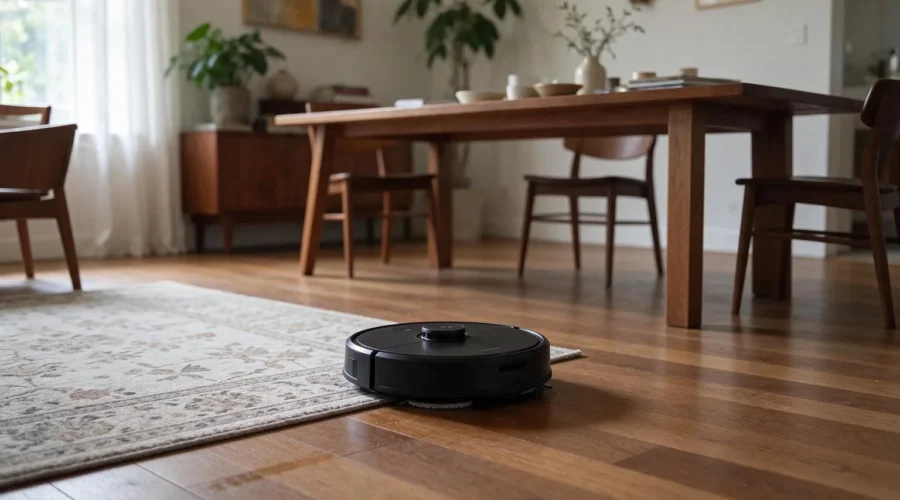
Roborock Q7 vs Q10 is a close call inside the same budget family. The current models are the Roborock Q7 M5+ and the Roborock Q10 S5+, and both pair 10,000 Pa HyperForce suction with a 2.7L self-emptying dock. The real differences sit in the details: the Q10 S5+ adds sonic mopping, automatic mop lifting and obstacle avoidance, while the Q7 M5+ carries a much larger water tank and broader smart home support. We reviewed the Roborock Q10 S5+ separately if you want a deeper look at that model.
Last updated: November 29, 2026
Affiliate disclosure: As an Amazon Associate I earn from qualifying purchases.
If you buy through the Amazon links on this page, we may earn a small commission at no extra cost to you. It never changes which product we recommend.
How we compared: We compared Roborock’s product information and the Amazon listings for both models, focusing on mopping systems, navigation, docks and app features. We did not test these robot vacuums ourselves.
Quick answer
Choose the Roborock Q7 M5+ if you mostly vacuum, use Home Assistant, or want the bigger water tank for large hard floors. Choose the Roborock Q10 S5+ if mopping quality and obstacle avoidance matter more.
Roborock Q7 M5+ vs Q10 S5+ at a glance
| Roborock Q7 M5+ | Roborock Q10 S5+ | |
|---|---|---|
| Suction | 10,000 Pa HyperForce | 10,000 Pa HyperForce |
| Mopping | Standard flat mop, 0.27L water tank | VibraRise 2.0 sonic mop, up to 3,000 scrubs/min |
| Mop lift on carpet | No | Yes, automatic with ultrasonic carpet detection |
| Obstacle avoidance | LiDAR navigation only | ReactiveTech obstacle avoidance |
| Self-empty dock | 2.7L bag, 7-9 weeks | 2.7L bag, up to 70 days |
| Anti-tangle | JawScrapers main brush + anti-tangle side brush | JawScrapers comb + anti-tangle side brush |
| Smart home | Alexa, Google Home, Home Assistant | Alexa, Google Home |
| Where to buy | See it on Amazon | See it on Amazon |
Mopping is the real divider
The Q10 S5+ uses VibraRise 2.0: a dual-zone plate vibrates up to 3,000 times per minute to scrub dried spills, and the module lifts automatically when ultrasonic sensors detect carpet, so rugs stay dry mid-run.
The Q7 M5+ drags a standard dampened mop pad. It freshens hard floors fine, but it cannot scrub, and because the mop never lifts you must pin the mop pad off or block carpeted rooms when mopping. Its 0.27L tank, though, covers far more floor per fill than the Q10’s small onboard reservoir.
Navigation and obstacles
Both robots map with PreciSense LiDAR and support room-by-room cleaning, no-go zones and schedules in the Roborock app.
Only the Q10 S5+ adds ReactiveTech obstacle avoidance, which helps it steer around shoes, bowls and cables instead of plowing through them. If your floors collect clutter between runs, that is a meaningful upgrade; in tidy homes the Q7 M5+ navigates just as confidently.
Docks and upkeep
Both ship with a 2.7L sealed-bag self-empty dock; Roborock quotes 7 to 9 weeks between bag changes for the Q7 M5+ and up to 70 days for the Q10 S5+, effectively the same class of hands-free running.
Both also share the anti-tangle JawScrapers brush design, so long hair and pet hair mostly end up in the bag rather than wrapped around the roller.
Best for vacuum-first homes
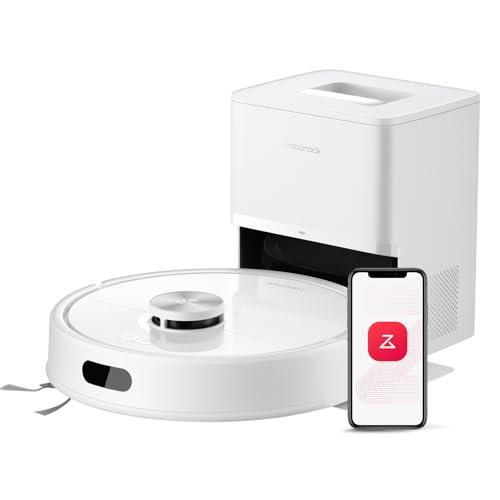
Roborock Q7 M5+
The simpler of the two: same 10,000 Pa suction and 2.7L dock, a big 0.27L water tank for light mopping, and Home Assistant support.
- Suction: 10,000 Pa
- Water tank: 0.27L
- Dock: 2.7L, 7-9 weeks
Pros
- Big water tank covers large hard-floor areas per fill
- Works with Home Assistant as well as Alexa and Google
- Same anti-tangle brushes and dock as the Q10
Cons
- Mop cannot lift, so it wets carpet if you let it roam
- No obstacle avoidance beyond LiDAR mapping
Skip it if: you want real scrubbing or have cluttered floors.

Best for mopping and clutter
Roborock Q10 S5+
The better cleaner of the pair on hard floors: sonic vibration mopping, automatic mop lift over carpet and ReactiveTech obstacle avoidance.
- Suction: 10,000 Pa
- Mop: VibraRise 2.0 sonic
- Dock: 2.7L, up to 70 days
Pros
- Sonic mop scrubs dried stains instead of smearing them
- Lifts the mop automatically over rugs and carpet
- Dodges everyday clutter with ReactiveTech
Cons
- Small onboard water tank needs more refills
- No Home Assistant integration listed
Skip it if: you rarely mop and want the bigger water tank.
Which one should you buy?
- Mostly hard floors with real mopping: the Q10 S5+.
- Mixed floors with rugs everywhere: the Q10 S5+, for the auto mop lift.
- Home Assistant household: the Q7 M5+.
- Large open hard-floor areas: the Q7 M5+ and its 0.27L tank.
FAQ
Are the Q7 M5+ and Q10 S5+ the same robot underneath?
They share a lot: 10,000 Pa suction, PreciSense LiDAR, JawScrapers anti-tangle brushes and a 2.7L self-empty dock. The mopping system and obstacle avoidance are the main differences.
Does the Q7 M5+ avoid obstacles?
It navigates by LiDAR mapping, which avoids walls and furniture, but it has no dedicated obstacle avoidance for small items like cables or socks. The Q10 S5+ adds ReactiveTech for that.
Can either robot wash its own mop?
No. These docks empty dust only; you rinse the mop pads yourself. Roborock’s Qrevo line adds mop washing.
Which model is newer?
Both are current models in Roborock’s 2025-2026 Q line sold side by side; the Q7 M5+ succeeds the Q5 Max+ and the Q10 S5+ succeeds the Q8 Max+.
Do they work with voice assistants?
Yes. Both support Alexa and Google Home; the Q7 M5+ also lists Home Assistant support.
Final verdict
The Q10 S5+ is the better all-round cleaner thanks to sonic mopping, auto mop lift and obstacle avoidance, and it is the one to buy for most mixed-floor homes. The Q7 M5+ wins narrower cases: vacuum-first routines, Home Assistant setups and big hard-floor areas where its larger water tank saves refills.
Sources
- Roborock Q7 M5+ vs Q10 S5+ spec comparison
- RTINGS Roborock Q7 M5 review data
- Amazon listings for both robot vacuums (linked above)