Robot vacuum clearance is often treated as a simple height check, but the real requirement is more exact. A unit needs at least 3.94 inches of vertical space, with about 0.2 inches of extra margin to avoid getting stuck. Furniture shape, docking room, and overhead clearance can change the outcome quickly. The difference between a fit and a failure is often smaller than expected.
How Much Clearance Does a Robot Vacuum Need?
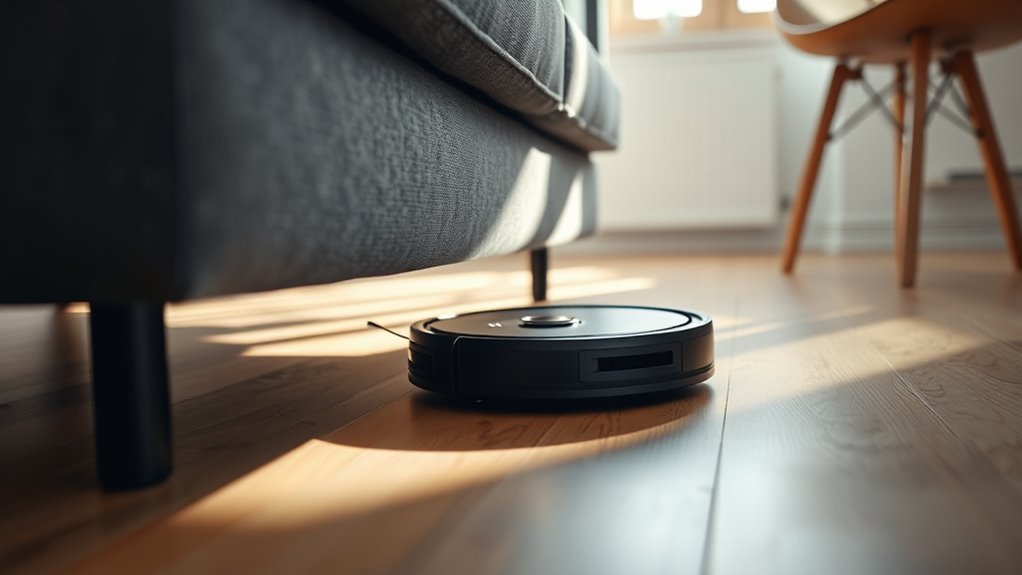
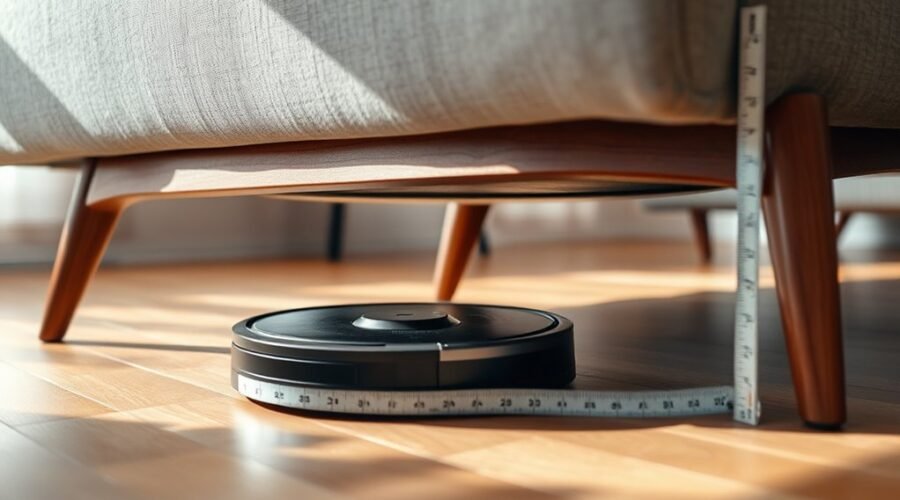
Most robot vacuums require a minimum clearance of 3.94 inches (100 mm) to operate effectively under furniture, with an ideal height of under 4 inches (105 mm) for smoother navigation. This clearance threshold determines whether a robot vacuum can pass freely or remain blocked by furniture frames.
Most robot vacuums need at least 3.94 inches of clearance to glide smoothly under furniture.
For practical furniture clearance, the vacuum height should be at least 0.2 inches (5 mm) below the underside of the object, reducing friction and contact risk. Low-profile models near 4 inches (100 mm) are engineered for constrained layouts and can access narrow zones that would otherwise remain untouched.
In many homes, the average robot vacuum height of 3.94 to 4.13 inches (100-105 mm) aligns with common furniture dimensions. Maintaining at least 10.2 cm of clearance supports stable movement, minimizes stalling, and preserves autonomous cleaning efficiency.
The result is a cleaner floor plan with fewer obstructions and less manual intervention.
What Robot Vacuum Height Fits Under Furniture?
Furniture clearance depends on a simple dimensional match: most robot vacuums fit best under spaces with at least 3.94 inches (100 mm) of vertical clearance, while many models measure 3.94 to 4.13 inches (100–105 mm).
A practical tolerance of about 0.2 inches (5 mm) above the vacuum height helps prevent contact or entrapment beneath low furniture.
Accurate measurement of both the vacuum height and the underside clearance of sofas, beds, and similar fixtures is thus essential before purchase.
Furniture Clearance Basics
A practical rule for robot vacuum clearance is to allow at least 0.2 inches (5 mm) above the unit’s height for reliable passage under furniture. For most homes, furniture clearance should exceed the robot vacuum height by this margin, since models under 3.94 inches (100 mm) fit best beneath standard sofas and beds.
Units in the 3.94-4.13 inches (100-105 mm) range remain common, but exact dimensions determine compatibility with low-profile frames. Small robot vacuums, at 4 inches or less, improve cleaning efficiency in confined zones.
Flat, even flooring supports smoother access, while uneven surfaces can block entry. Dark or reflective finishes may disrupt sensors, reducing navigation precision.
Precise clearance assessment preserves autonomous movement and expands usable floor space without constraint.
Measuring Robot Height
Robot vacuum height should be measured against the lowest point of the chassis, with an ideal profile under 3.94 inches (100 mm) to pass beneath most furniture. In measuring robot height, compare the stated dimension with real-world clearance, then add at least 0.2 inches (5 mm) margin to avoid entrapment. This calculation supports the freedom to clean under furniture without interruption.
| Height range | Fit likelihood | Access risk |
|---|---|---|
| Under 3.94 in | High | Low |
| 3.94–4.13 in | Moderate | Medium |
| Over 4.13 in | Low | High |
Standard models often fall in the middle band, while many low-profile units stay at 4 inches or less. Dynamic height should also be checked, because sensors may alter clearance during operation.
Will Your Robot Vacuum Fit Under Sofas And Beds?
Fit under sofas and beds depends first on measured clearance, which should exceed the robot vacuum height by at least 0.2 inches (5 mm) to allow reliable passage.
Furniture geometry also matters, since skirts, crossbars, and recessed bases can reduce usable space even when nominal clearance appears adequate.
Sensor housings and raised navigation modules must be included in the height assessment, as they often determine whether a low-profile unit can operate without contact.
Measure Clearance Height
Clearance height is the primary constraint determining whether a robot vacuum can pass beneath sofas and beds, with most models requiring less than 3.94 inches (100 mm) to match standard furniture gaps.
To measure clearance height, a user should record the lowest uninterrupted space under each target item and compare it with the robot vacuum’s body height. A minimum of 10.2 cm (4 inches) is recommended for reliable operation, while an extra 0.2 inches (5 mm) helps prevent entrapment.
Low-profile models, at or below 4 inches, expand access and reduce dependence on manual cleaning.
Precise measurement before purchase preserves autonomy, limits compatibility errors, and avoids returns. This calculation enables informed selection and frees floor space from inaccessible dust zones.
Check Furniture Shape
Furniture shape and underside geometry determine whether a robot vacuum can pass beneath sofas and beds without binding or stalling. Rectilinear bases usually preserve clearance, while skirts, crossbars, and center rails reduce access. A low-profile vacuum, at or below 4 inches, is the practical threshold for liberated cleaning under most furniture.
| Furniture shape | Effect |
|---|---|
| Flat apron | High compatibility |
| Tapered legs | Good clearance |
| Box base | Moderate risk |
| D-shaped frame | Bulkier fit |
| Low platform bed | Often restrictive |
Most robot vacuums fit under spaces 3.94 inches or less, but compatibility depends on exact dimensions. For ideal clearance, furniture should exceed vacuum height by 0.2 inches, preventing contact. Measuring both objects before purchase eliminates guesswork and supports autonomous cleaning.
Account For Sensors
Even when underside geometry appears compatible, onboard sensing can change the real-world result under sofas and beds.
Robot vacuums typically fit best below furniture when height stays under 3.94 inches (100 mm); 3.94–4.13 inches is the standard range, but a clearance margin of at least 0.2 inches improves navigation.
Low-profile models, at 4 inches or less, are purpose-built for tighter access. Some units use dynamic sensors that let the chassis lower slightly during operation, expanding usable clearance without sacrificing detection.
That adaptability matters where liberation depends on reaching confined zones cleanly.
Before purchase, the actual furniture gap should be measured, because uneven surfaces can reduce effective clearance and block navigation even when nominal dimensions appear adequate.
How Clearance Affects Cleaning And Docking
Adequate vertical space determines both cleaning reach and docking reliability, with low-profile robot vacuums at or below 3.94 inches (100 mm) generally able to operate under most furniture while maintaining effective access to tight areas.
Effective clearance is not optional; it governs navigation, prevents entrapment, and preserves docking performance. A minimum of 10.2 cm, or about 4 inches, above the unit is recommended for stable passage. For liberated household movement, the dock also requires open territory.
- Under-furniture access improves when clearance exceeds vacuum height by about 5 mm.
- Tight gaps support cleaning only when navigation sensors can move without obstruction.
- Docking requires at least 1 meter of open space in front of the station.
- Level flooring reduces misalignment and helps the robot return consistently.
Uneven surfaces degrade both route planning and charging alignment, making flat, unobstructed zones essential for predictable operation.
Are Small Robot Vacuums Worth It?
Small robot vacuums are often worth considering because their sub-4-inch height clearance lets them fit beneath most furniture, while a diameter of about 13.8 inches improves maneuverability in narrow corridors, around chair legs, and through tight passages.
Sub-4-inch height and a compact 13.8-inch diameter help small robot vacuums glide under furniture and through tight spaces
For a robot vacuum in small apartments, this compact geometry can reduce manual sweeping demands and expand usable floor coverage. Their low profile also supports edge cleaning, helping capture debris where larger machines cannot reach.
Many units add quiet operating modes, which suits shared living areas where noise control matters. Navigation and mapping systems further improve route efficiency, limiting repeated passes and unnecessary battery use.
The design is not universally superior, however. High thresholds can still constrain travel between rooms, and very uneven layouts may reduce gains from the smaller form factor.
Even so, when mobility, discretion, and spatial freedom are priorities, small models often deliver a technically balanced solution for constrained living environments.
How Dock Size And Placement Affect Robot Vacuum Clearance
Dock size and placement directly shape a robot vacuum’s usable clearance requirements, since the dock itself must have at least 4 inches of side clearance for ventilation and reliable operation, plus 12–20 inches of open space in front for unobstructed docking.
A compact dock size can preserve freedom in constrained rooms, but it still demands disciplined clearance planning for the robot vacuum to charge and depart without friction.
Overhead space must remain open for lids or tanks, and the dock should sit within a strong 2.4 GHz Wi-Fi field for dependable navigation.
- Verify 4 inches of side clearance.
- Reserve 12–20 inches in front.
- Keep overhead access unobstructed.
- Place the dock inside strong Wi-Fi coverage.
Precise placement reduces wasted floor area and improves autonomous reliability, allowing the robot vacuum to operate with minimal intervention and maximum spatial efficiency.
What Shape Works Best In Tight Spaces?
In tight spaces, robot vacuum geometry becomes a primary determinant of usable access and cleaning coverage. Round robot vacuums usually provide the best maneuverability in small spaces, because their continuous perimeter reduces snag points and permits tighter turns around chair legs and furniture bases.
For compact layouts, a typical 13.8-inch diameter often preserves enough clearance for motion without sacrificing cleaning efficiency. D-shaped machines, by contrast, are more specialized: their straight front edge improves wall tracking and corner extraction, but the added bulk can reduce freedom in confined passages.
Low-profile bodies, preferably at or below 4 inches, further extend access beneath beds, sofas, and cabinets. The most capable designs combine round agility with edge-cleaning features, producing a balanced solution that resists spatial restriction.
For users seeking liberation from cluttered interiors, shape should be selected for the obstruction pattern, not appearance alone.
How To Measure Robot Vacuum Clearance Before You Buy
Accurate clearance measurement begins with the furniture itself: the floor-to-underside height should be measured with a ruler or tape measure, then compared against the robot vacuum’s maximum height specification. A precise Robot vacuum fit depends on verifying clearances before purchase, not after delivery.
- Measure each target opening from floor to underside.
- Add at least 0.2 inches (5 mm) to the vacuum’s height.
- Prefer models under 3.94 inches (100 mm) for broad compatibility.
- Check whether dynamic sensors may reduce real-world clearance.
Standard units often range from 3.94 to 4.13 inches (100-105 mm), so published dimensions must be reviewed carefully. The resulting clearance margin indicates whether the machine can navigate freely without constraint.
For users seeking practical autonomy, this small measurement step preserves mobility, access, and efficient cleaning performance across low-profile furniture zones.
Common Robot Vacuum Clearance Mistakes To Avoid
Several clearance mistakes can undermine robot vacuum performance, starting with underestimating the minimum opening needed for reliable passage; a floor-to-underside gap of at least 10.2 cm (4 inches), plus roughly 0.2 inches (5 mm) above the vacuum’s height, is typically required to prevent contact and stalling. Measure before purchase, because robot vacuum height varies and hidden tolerances matter. Dark or reflective finishes can disrupt sensor navigation, especially in narrow corridors. Docking failures also occur when the docking station sits beneath low shelves or behind clutter, limiting return paths and charging efficiency.
| Mistake | Impact | Control |
|---|---|---|
| Too little height | Stalling | Verify minimum clearance |
| No pre-measurement | Poor fit | Compare robot vacuum height |
| Blocked dock path | Battery loss | Clear docking station access |
Analytical setup supports liberated movement: precise clearance data reduces friction, preserves autonomy, and keeps cleaning cycles predictable.
Frequently Asked Questions
How Much Clearance Does a Robot Vacuum Need?
A robot vacuum typically needs 3.94 inches of clearance, with 0.2 inches extra for safe obstacle navigation and carpet changeover. Furniture height above 4 inches better prevents snagging, enabling freer, more reliable cleaning access.
What Is the Recommended Height Clearance for a Robot Vacuum?
The recommended height clearance is 10.2 cm, ideally 11 cm or more. With precise robot design, varied floor types, and reliable obstacle navigation, performance improves, freeing spaces from manual intervention and obstruction.
Will a Robot Vacuum Go Over Molding Into Other Rooms?
Yes, most models cross molding into other rooms when molding types are modest and robot features include adequate ground clearance, traction, and sensing. Advanced units handle floor changes better, while irregular thresholds may still impede passage.
What Is the Recommended Clearance Height for a Roomba Vacuum Cleaner?
A Roomba vacuum cleaner should have at least 4 inches of clearance. Roomba design features favor standard furniture gaps, Best floor types improve traversal, and Maintenance tips include measuring spaces and removing obstacles regularly for reliable operation.
Conclusion
In practice, the theory is straightforward: a robot vacuum needs slightly more clearance than its body height to move freely and avoid becoming trapped. The stated 3.94-inch minimum, with about 0.2 inches of extra space, remains a reliable benchmark, while flat furniture geometry improves access. Vertical clearance above the unit and open docking space also matter. Accurate measurement, not assumption, determines whether a vacuum will clean efficiently or stall beneath furniture.