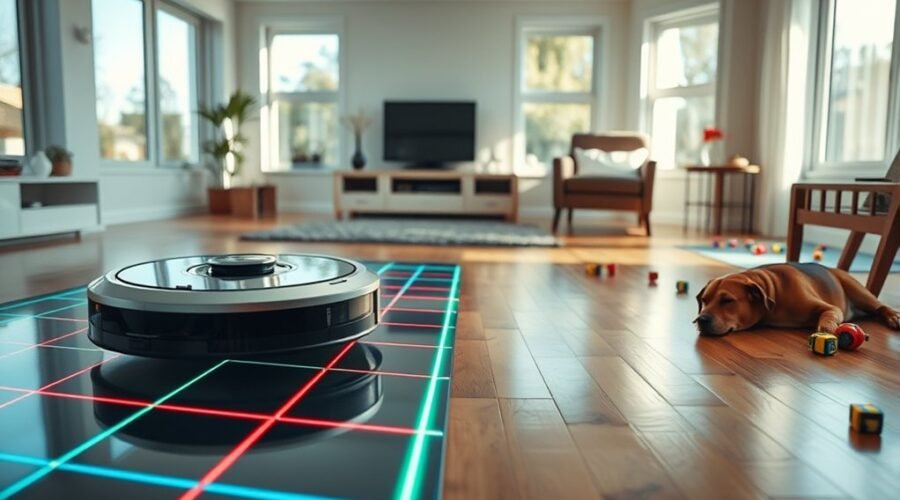
Robot vacuum mapping vs obstacle avoidance is an important comparison when choosing a cleaner for your home. Both technologies help a robot move around your floors, but they solve different problems. Mapping improves cleaning routes and room coverage, while obstacle avoidance helps prevent collisions and tangles. Understanding how they work together can help you choose a vacuum that needs less supervision.
Quick Answer
Robot vacuum mapping creates a digital floor plan for efficient cleaning and room-by-room navigation. Obstacle avoidance detects objects such as cords, shoes, and toys during cleaning and helps the robot move around them. Mapping is more useful for organized coverage, while obstacle avoidance matters most in cluttered homes. Many households benefit from both.
Key Takeaways
- LiDAR mapping usually works well in darkness, while camera-based mapping may need enough light to recognize visual landmarks.
- A robot with accurate mapping can still miss small cords, socks, and other low-profile obstacles.
- Advanced obstacle avoidance combines cameras, infrared sensors, and depth measurements to identify nearby hazards.
- Multi-floor maps and no-go zones are especially helpful in larger homes, while object recognition is more valuable around pets and children.
- Independent obstacle avoidance tests are more useful than relying on marketing labels such as AI navigation.
What Robot Vacuum Mapping Does
)
Robot vacuum mapping creates a digital floor plan that helps the machine understand your home’s layout. It identifies walls, large furniture, doorways, and accessible areas. The robot then uses this information to plan cleaning routes instead of moving randomly.
Most advanced mapping systems use LiDAR, visual simultaneous localization and mapping (vSLAM), or a combination of sensors. These technologies allow the robot to estimate its position while building or updating its map.
Once the map is ready, compatible models can remember rooms and follow more systematic cleaning patterns. This reduces unnecessary overlap and helps the robot return to areas it has not finished cleaning.
Mapping also gives you greater control through a companion app. Depending on the model, you may be able to:
- Select individual rooms for cleaning.
- Create no-go zones around fragile objects.
- Set virtual boundaries without physical barriers.
- Choose the order in which rooms are cleaned.
- Save separate maps for different floors.
- Review cleaning routes and coverage history.
These functions are described in the manufacturer’s Smart Maps guide, although availability depends on the specific robot.
A useful distinction is that mapping records the layout of your home, not necessarily every small object on the floor. A robot may accurately map your living room while failing to recognize a charging cable beneath a chair.
Mapping helps a robot remember where to clean. It does not guarantee that the robot will avoid every object along its route.
For households with several rooms, accurate mapping can make cleaning more predictable and reduce the need to guide the vacuum manually.
What Obstacle Avoidance Does
Obstacle avoidance helps a robot vacuum detect objects in its path and move around them. Instead of following a route without adjustment, the robot responds to nearby objects while cleaning.
Common obstacles include furniture legs, power cords, shoes, toys, pet bowls, and clothing. Advanced systems may also recognize pet waste, although their accuracy varies by model.
Obstacle avoidance systems use different combinations of sensors:
- Cameras: Capture images that software analyzes to recognize objects.
- Infrared sensors: Detect reflected infrared light from nearby surfaces.
- Time-of-flight sensors: Measure the distance to objects using reflected light signals.
- Structured light: Projects patterns to estimate object shapes and depth.
- Bump sensors: Detect physical contact after the robot touches an obstacle.
High-end models may combine several methods to improve detection. For example, camera-based obstacle detection documentation explains how compatible robots identify cables, toys, and pet waste during cleaning.
Object recognition is useful because ordinary navigation sensors may not detect items close to the floor. A cable can sit below the scanning height of a mapping sensor, even when the surrounding room is mapped correctly.
However, obstacle avoidance is not perfect. Thin wires, dark objects, reflective materials, shadows, and heavy clutter may still cause detection failures.
When the system works well, it reduces collisions, tangled brushes, interrupted cleaning sessions, and the need to rescue the machine.
Robot Vacuum Mapping vs. Obstacle Avoidance: Key Differences
The main difference between robot vacuum mapping and obstacle avoidance is planning versus immediate detection. Mapping helps the robot decide where to travel, while obstacle avoidance helps it respond to hazards along the way.
Both systems can use similar sensors, but their software performs different tasks. A robot may have excellent mapping without advanced small-object detection.
| Feature | Robot Vacuum Mapping | Obstacle Avoidance |
|---|---|---|
| Main purpose | Creates a floor plan and organizes cleaning routes. | Detects nearby hazards and adjusts movement. |
| Common technology | LiDAR, vSLAM, and position-tracking software. | Cameras, infrared, ToF, and structured light. |
| Best use | Large homes, room selection, and repeatable coverage. | Cluttered rooms, pet toys, cables, and small objects. |
| App controls | Room boundaries, virtual walls, and no-go zones. | Object alerts and avoidance settings on supported models. |
| Main limitation | May miss small objects or changes below sensor height. | Cannot guarantee detection of every object. |
| Biggest benefit | Less repeated movement and better route control. | Fewer collisions and cleaning interruptions. |
LiDAR mapping is particularly useful in dark rooms because its laser measurements do not depend on ordinary room lighting. Camera-based navigation may need visible landmarks or assisted illumination.
For example, some robot vacuums combine LiDAR navigation with structured-light obstacle detection. The two features are listed separately in the manufacturer’s navigation specifications.
This separation matters when comparing products. A vacuum advertised with LiDAR is not automatically equipped to recognize cords or pet waste.
Choose mapping first if your home has many rooms and usually stays tidy. Give advanced obstacle avoidance greater priority if small objects frequently remain on the floor.
Why Mapping Speeds Up Cleaning
Mapping speeds up cleaning by helping a robot follow organized routes instead of repeatedly covering the same areas. It allows the machine to track cleaned spaces and plan its next movement.
Traditional random-navigation robots often change direction after encountering furniture or walls. This can create repeated passes in some places and missed areas in others.
Mapping robots can follow structured paths, often moving in parallel rows before cleaning edges or entering another room.
Some comparisons report that mapping models can clean up to 30% faster than non-mapping vacuums. This original figure is not a universal result, however. Actual differences depend on room layout, cleaning settings, and how the machines are tested.
Several features support better cleaning efficiency:
- Room sequencing: The robot finishes selected rooms in a planned order.
- Coverage tracking: Previously cleaned areas are easier to identify.
- Route optimization: The robot can reduce unnecessary travel between rooms.
- No-go zones: Problem areas can be excluded from cleaning routes.
- Map updates: Compatible robots can adjust when furniture or room layouts change.
Mapping becomes especially useful in larger homes, where random navigation may waste more movement.
Still, a faster route does not always produce cleaner floors. Suction, brush design, debris type, and cleaning mode also affect the final result.
A well-mapped robot may finish sooner, but it still needs sufficient cleaning power to remove dirt and pet hair.
Why Obstacle Avoidance Matters in Clutter
Obstacle avoidance is especially valuable in homes where toys, cords, shoes, and pet accessories regularly appear on the floor. These objects can interrupt cleaning even when the robot has an accurate map.
Without reliable detection, a vacuum may push lightweight items, wrap a cable around its brush, or become trapped beneath furniture.
Advanced systems combine object recognition with depth measurements to avoid more difficult hazards.
For example, the Eufy Omni S2 uses a camera and three-dimensional sensing through its MatrixEye technology. Its official technical specifications describe recognition of more than 200 obstacle types.
The Omni S2 also achieved 24 out of 24 in an independent obstacle avoidance evaluation reported in a manufacturer-published comparison.
That is an impressive controlled result, but it does not mean the machine will avoid every object under every household condition.
High-end systems are sometimes described as achieving up to 98% avoidance efficiency in controlled conditions. That figure requires a clearly defined test method before it can be used to compare products reliably.
The most useful measures are how many objects a vacuum avoids, which objects it misses, and whether those mistakes interrupt cleaning.
Warning: Do not rely on obstacle avoidance to guarantee detection of pet waste, electrical cords, or sharp objects. Even advanced robots can miss hazards. Remove dangerous items before starting an unattended cleaning session.
For busy households, strong obstacle avoidance reduces the need to clear every harmless object before cleaning. It can also limit brush tangles, unnecessary contact with furniture, and repeated rescue alerts.
How LiDAR, vSLAM, and Cameras Map Rooms
LiDAR and vSLAM are two common approaches to robot vacuum mapping. LiDAR measures distances with laser light, while vSLAM uses camera images and visual landmarks to estimate the robot’s position.
Both can support systematic cleaning, but they behave differently in challenging environments.
LiDAR Mapping
LiDAR stands for Light Detection and Ranging. It sends out laser light and measures reflected signals to estimate the distance to surrounding objects.
The resulting measurements help the robot identify walls, furniture, and open spaces. Mapping software turns those measurements into a usable floor plan.
LiDAR generally works well in low light because it does not rely on visible room lighting. This makes it useful for overnight cleaning and rooms without strong natural light.
However, some reflective, transparent, or unusual surfaces can affect its readings. Standard LiDAR mapping also cannot guarantee detection of small objects below its scanning plane.
vSLAM and Camera Mapping
Visual simultaneous localization and mapping, or vSLAM, uses camera images to identify landmarks and track movement.
A robot may recognize features such as door frames, furniture outlines, and other visible room details. It compares these features as it moves to estimate its position and build a map.
Camera-based mapping can work efficiently in detailed rooms with sufficient light. Some implementations map quickly, although mapping speed varies by hardware and software.
Dim rooms, shadows, glare, and surfaces with few distinct visual features can make camera-based navigation less reliable.
Some models use infrared illumination or additional sensors to improve operation in difficult conditions.
Hybrid Mapping Systems
Hybrid systems combine multiple sensing methods to improve navigation. They may use laser or depth measurements for geometry and camera information for visual context.
Sensor fusion allows the robot to compare different readings and build a more useful picture of its surroundings.
Behind these technologies is SLAM software, which means simultaneous localization and mapping. It helps the robot estimate where it is while creating or updating its understanding of the room.
For buyers, the important question is not simply whether the vacuum has LiDAR or cameras. It is whether the complete navigation system works reliably in the conditions found at home.
How Cameras, IR, and ToF Detect Obstacles
Robot vacuums use cameras, infrared sensors, and time-of-flight technology to detect nearby objects. Each method measures different information, so combining them can improve obstacle recognition.
Cameras help classify objects, while infrared and depth sensors provide information about distance and shape.
Camera Object Recognition
Camera-based obstacle recognition uses images and trained software to identify items on the floor. The system looks for visual features associated with objects such as shoes, cables, toys, and pet accessories.
More advanced systems use artificial intelligence classifiers trained on different object categories.
Some manufacturers advertise recognition libraries containing hundreds of object types. However, the number of supported categories does not establish how accurately a robot detects them in real homes.
Recognition performance depends on several factors:
- Available lighting and image quality.
- Object size, shape, and color.
- Camera placement and viewing angle.
- Recognition software and training data.
- Whether objects are partly hidden beneath furniture.
Cameras may struggle with dark rooms or strong glare. A low-profile cable can also be difficult to distinguish from a floor pattern.
When supported, reviewing detected objects in the companion app can help users identify areas the robot skipped.
IR And ToF Sensors
Infrared sensors and time-of-flight sensors help robots measure nearby objects without relying entirely on ordinary camera images.
Basic infrared proximity sensors detect reflected infrared light. Time-of-flight sensors estimate distance by measuring how long a light signal takes to return.
| Sensor | Method | Constraint |
|---|---|---|
| IR sensors | Reflection sensing | Bright light can reduce range or reliability. |
| ToF sensors | Light pulse timing | Reflections must be strong and consistent enough for accurate readings. |
| Cameras | Visual classification | Low light, glare, and shadows can reduce recognition accuracy. |
Structured-light systems take another approach. They project a light pattern and analyze how it changes across nearby surfaces to estimate shape and depth.
These technologies help the robot understand whether an object is directly in its path and how much room is available to move around it.
However, sensor range, surface reflectivity, and object size still affect detection. Combining several sensor types reduces dependence on any single measurement method.
Why Sensor Fusion Improves Obstacle Detection
Sensor fusion improves obstacle detection by combining information from multiple sensors. Instead of relying on a single camera or laser measurement, the robot compares signals to make better movement decisions.
For example, a camera may recognize an object as a shoe while a depth sensor estimates its distance. The robot can then calculate a route around it.
This combination is useful when one sensor produces uncertain information.
A camera may struggle in dim lighting, but active depth sensors can still provide distance measurements. Likewise, visual recognition may identify an item that a mapping laser does not scan clearly.
Sensor fusion also improves the robot’s ability to detect low-profile obstacles, which ordinary bump sensors may only notice after contact.
The process usually involves three stages:
- Detection: Sensors gather information about nearby objects.
- Interpretation: Software estimates object location, size, and possible identity.
- Route adjustment: The robot changes direction or slows down to avoid contact.
Not every robot performs these steps equally well. Sensor placement, processing speed, software, and detection thresholds can affect the result.
A useful feature is the ability to return to areas skipped because of temporary obstacles. On compatible models, removing the obstruction may allow a later cleaning pass.
For hands-free cleaning, the strongest systems combine dependable sensing with accurate route planning rather than treating mapping and avoidance as separate tasks.
How Tests Measure Mapping and Avoidance
Mapping and obstacle avoidance need different tests because they measure different abilities. Mapping tests focus on floor-plan accuracy and coverage, while avoidance tests measure how well a robot recognizes and moves around hazards.
A robot can score well in one category and perform poorly in the other.
How Mapping Accuracy Is Tested
Mapping evaluations examine whether the robot creates a useful floor plan and follows efficient routes.
Common measures include:
- How accurately the map represents room boundaries.
- Whether the robot identifies doorways and accessible areas.
- How much cleaning coverage it achieves.
- How often it repeats already cleaned spaces.
- Whether it returns to its charging dock reliably.
- How well it responds to furniture changes.
Repeat testing is useful because a robot may complete one route successfully but become confused after objects move.
Multi-floor mapping should also be tested separately, since storing multiple maps does not mean the robot can physically travel between floors.
How Obstacle Avoidance Is Tested
Obstacle avoidance evaluations place common household objects along a robot’s cleaning path and record its response.
One testing method uses a 24-object course containing standard and more difficult obstacles. Testers count how many objects the vacuum avoids without contact.
For example, an Eufy Omni S2 achieved 24/24 in one published independent evaluation. Other premium models can also perform strongly, but results depend on the testing method.
A good evaluation should include different object sizes, lighting conditions, and floor surfaces.
Useful comparison questions include whether the robot:
- Recognizes thin charging cables.
- Avoids socks and small toys.
- Detects objects beneath furniture.
- Handles darker or low-contrast items.
- Completes the cleaning session without getting trapped.
Scores from different reviewers should not be treated as directly comparable unless the tests use similar conditions and scoring methods.
For everyday use, the most helpful result is not simply a high avoidance percentage. It is knowing which objects a robot can reliably detect and which ones still require manual removal.
Which Homes Need Both Features
Homes with complicated layouts, several floors, pets, or frequent clutter benefit most from combining mapping and obstacle avoidance.
Mapping improves room coverage, while obstacle detection helps the robot respond to unexpected objects.
The importance of each feature depends on how your home is arranged and what usually remains on the floor.
Cluttered Room Layouts
Homes with dense furniture arrangements, small tables, and scattered objects need accurate navigation and responsive obstacle detection.
Mapping helps the robot plan cleaning routes around furniture and through connected rooms. Obstacle avoidance helps it respond when toys, shoes, or other objects appear along those routes.
In some comparisons, systematic mapping is reported to improve cleaning speed by as much as 30% over random navigation. Real performance depends on the home and cleaning method.
Depth sensing is particularly useful for smaller objects that ordinary mapping sensors may not recognize.
However, avoiding an obstacle means the robot may leave part of the surrounding floor uncleaned. You may need to remove the item and run another pass.
For rooms where furniture rarely moves, a strong mapping system with carefully placed no-go zones may provide much of the needed control.
Multi-Level Homes
Multi-level homes benefit from robots that can save separate maps for different floors. This allows the vacuum to recognize each layout without creating a new floor plan every time.
Some models automatically identify the floor where they are placed, while others require selecting the correct map.
Before choosing a robot for a multi-story home, confirm that it supports:
- Multiple saved floor plans.
- Room-specific cleaning on each floor.
- Separate no-go zones for each map.
- Reliable location recognition after moving the robot.
- Cliff sensors for detecting stairs and drop-offs.
For example, the MOVA V70 Ultra Complete uses retractable DToF navigation, as described in its official product specifications. Its navigation hardware helps it map and move through rooms, but the exact multi-floor functions should be confirmed for the model being considered.
Remember that multi-floor mapping does not mean a robot can climb stairs. You must usually carry it between levels.
Note: Stair detection uses downward-facing cliff sensors, which serve a different purpose from front-facing object avoidance. Keep these sensors clean and never disable or cover them to improve dark-floor performance.
The manufacturer’s cliff sensor maintenance guidance recommends cleaning sensor openings with a dry, soft cloth.
Pet And Cord Hazards
Homes with pets, exposed cables, and scattered accessories benefit from both organized mapping and advanced obstacle detection.
Mapping helps the vacuum cover rooms consistently. Obstacle avoidance reduces the chance of colliding with bowls, dragging cords, or becoming trapped by toys.
The combination is particularly useful in homes where floor conditions change throughout the day.
Several advanced models illustrate this approach:
- Eufy Omni S2: Combines three-dimensional sensing, camera recognition, and adaptive mapping.
- Ecovacs T90 Pro Omni: Uses an advanced obstacle detection system designed for common household clutter.
- Ecovacs X12 OmniCyclone: Combines dToF navigation with RGBD obstacle avoidance, as listed in its official specifications.
These features support more dependable cleaning, but they do not directly increase suction or guarantee better pet hair pickup.
Hair removal depends on the vacuum’s brushes, airflow, suction system, and floor compatibility.
Some advanced vacuums also use retractable DToF sensors, which help them navigate beneath low furniture. However, small cables and accessories can still become trapped beneath the machine.
How to Choose the Right Combination
Choose a robot vacuum based on the problems you want it to solve, rather than the number of sensors advertised.
Use these practical priorities:
- Small, tidy apartment: Basic systematic navigation or mapping may be sufficient.
- Large single-floor home: Prioritize accurate mapping, room selection, and efficient routes.
- Multi-level home: Choose reliable multi-floor mapping and cliff detection.
- Home with children: Look for proven detection of toys, socks, and small objects.
- Home with pets: Combine obstacle avoidance with effective hair pickup and anti-tangle brushes.
- Home with exposed cables: Prioritize tested cord detection, but continue removing dangerous cables.
Camera-equipped robots may also offer image review or video functions. If privacy matters, examine the manufacturer’s camera controls, image storage policy, and offline processing options.
Before buying, compare independent navigation tests alongside cleaning performance, maintenance needs, battery life, and smart home compatibility.
Pro Tip: Compare the same robot’s results on open floors and cluttered floors. This reveals whether its strong mapping performance continues when cables, furniture legs, and everyday objects interrupt the planned route.
If you already own a mapping robot, first improve its saved map and no-go zones before replacing it. A carefully configured map may solve repeated navigation problems without additional hardware.
Frequently Asked Questions
Which Robot Vacuum Has the Best Obstacle Avoidance System?
The Eufy Omni S2 is a strong obstacle avoidance option, achieving 24 out of 24 in one independent test. Its camera and depth-sensing system detects many household objects. However, no single result guarantees the best performance in every home, and other premium models may perform similarly.
Which Robot Vacuum Has the Best Mapping System?
There is no universally established best robot vacuum mapping system. The MOVA V70 Ultra Complete offers advanced retractable DToF navigation, while the Eufy Omni S2 and Ecovacs X12 OmniCyclone also provide sophisticated navigation. Compare map accuracy, route efficiency, multi-floor support, and performance in your home’s lighting conditions.
What Are the Best Robot Vacuums With Obstacle Avoidance Features?
The Eufy Omni S2, Ecovacs T90 Pro Omni, and Ecovacs X12 OmniCyclone are strong options with advanced obstacle detection. Their suitability depends on floor types, household clutter, battery requirements, and smart home features. Compare model-specific test results before choosing, especially if avoiding cords or pet waste is your priority.
What Are the Downsides of Using a Robotic Vacuum Cleaner?
Robot vacuums can miss corners, become tangled in cables, and struggle with thick rugs or clutter. They also require brush cleaning, filter maintenance, and battery care. Some models offer limited smart home integration, and even advanced navigation cannot replace every task performed by a conventional vacuum.
Can a Robot Vacuum Have Mapping Without Obstacle Avoidance?
Yes, a robot vacuum can create accurate maps without advanced obstacle recognition. Basic mapping allows organized cleaning and room control, but the robot may still miss cords, socks, and small toys. Mapping sensors and dedicated obstacle avoidance systems perform different functions, even when they share some hardware.
Conclusion
Robot vacuum mapping and obstacle avoidance work best as complementary technologies. Mapping supports efficient routes, accurate room coverage, and repeatable cleaning. Obstacle avoidance helps the robot respond to cords, toys, furniture, and other hazards during operation.
Some original comparisons suggest that advanced navigation systems can provide up to 30% more floor coverage per charge, although this figure needs a directly comparable test to confirm it.
For a tidy home, reliable mapping may be enough. For busy households with pets, children, or frequent clutter, combining accurate mapping with tested obstacle avoidance usually offers the more practical cleaning setup.
Sources
- iRobot, Guide to Imprint Smart Maps: Mapping runs, room boundaries, no-go zones, and multi-floor functionality.
- iRobot, Camera, PrecisionVision, and Obstacle Image Review: Camera-based object detection, limitations, and privacy controls.
- Roborock, Q10 S5 Product Specifications: LiDAR navigation and structured-light obstacle avoidance.
- Eufy, Omni S2 Official Specifications: Three-dimensional sensing, mapping, and object recognition.
- Anker and eufy, Robot Vacuum With Obstacle Avoidance: Model comparison and reported independent obstacle avoidance results.
- ECOVACS, DEEBOT X12 OmniCyclone Specifications: dToF navigation and RGBD obstacle avoidance.
- MOVA, V70 Ultra Complete Specifications: Retractable DToF navigation and hardware features.
- iRobot, How to Clean Roomba Cliff Sensors: Cliff sensor maintenance and care.