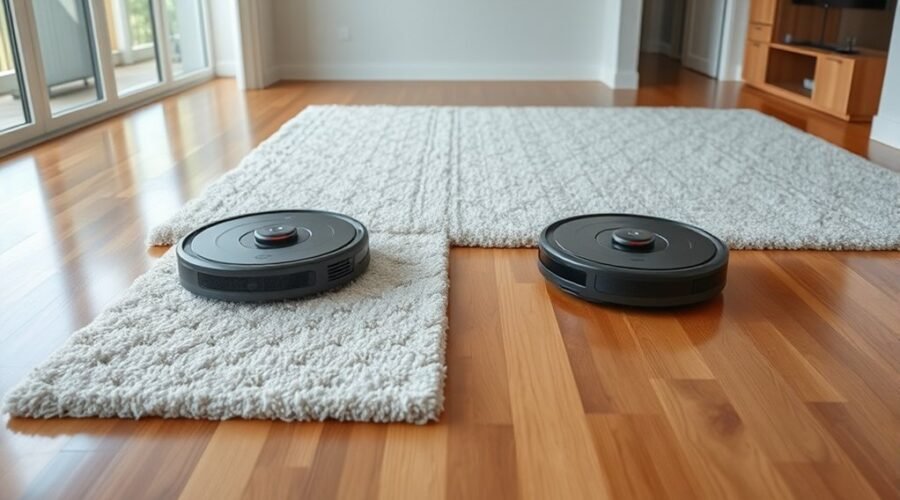
Mop lifting vs carpet avoidance is an important comparison when you choose a robot vacuum for mixed floors. Both features help protect carpets from wet mops, but they work differently. One allows the robot to keep vacuuming rugs, while the other tells it to stay away. Understanding these options helps you protect your flooring without leaving unnecessary areas uncleaned.
Quick Answer
Mop lifting is usually better for homes with hard floors and low-pile carpets. The robot raises its wet mop and continues vacuuming the carpet. Carpet avoidance is safer for delicate rugs, thick carpets, and moisture-sensitive materials because the robot skips those areas entirely. Choose based on carpet height, rug material, and cleaning needs.
Key Takeaways
- Carpet avoidance and carpet boost are different features. Avoidance skips the carpet, while boost increases vacuum suction.
- A raised mop does not guarantee that every carpet stays dry. Thick fibers and delayed detection can cause contact.
- Mop-lift clearance varies by model. Compare the actual lifting height with your carpet type.
- No-mop zones can protect rugs while still allowing vacuuming on compatible models.
- Carpet cleaning also depends on brush design, navigation, suction, and regular maintenance.
Mop Lifting vs Carpet Avoidance: What’s the Difference?
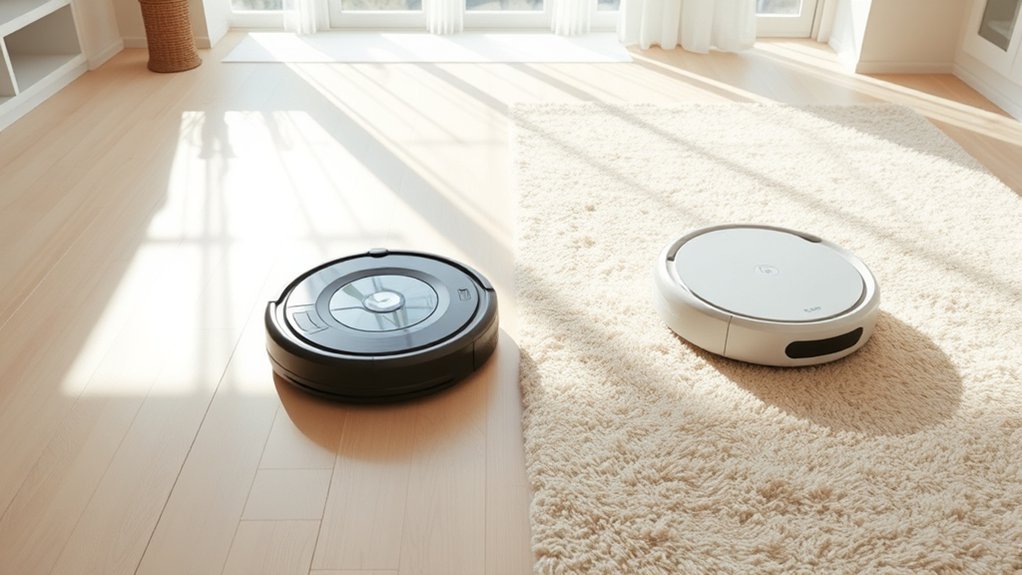
The main difference is what the robot does after detecting carpet. Mop lifting raises the wet cleaning pad so the vacuum can continue collecting dust and debris. Carpet avoidance directs the robot away from the carpet, leaving that area untouched during the selected cleaning task.
Both features are useful, but they solve different problems. Mop lifting improves cleaning coverage in mixed-floor homes. Carpet avoidance offers greater protection when a rug cannot safely handle robot traffic or possible moisture transfer.
| Feature | Mop Lifting | Carpet Avoidance |
|---|---|---|
| Carpet detection response | Raises the mop above the floor | Changes the route to skip carpet |
| Vacuuming on carpet | Continues if the mode supports it | Skipped during avoidance mode |
| Moisture protection | Depends on lift height and detection | Avoids wet-mop contact when the boundary is correct |
| Best suited for | Hard floors with low-pile rugs | Delicate rugs and thick carpets |
| Main drawback | Wet pads may still touch tall fibers | Carpet receives no cleaning during that pass |
Carpet boost is a separate function. It increases suction when the vacuum encounters carpet but does not automatically determine whether the mop lifts or the machine avoids the area.
For example, Roborock’s carpet mode guide explains four different responses: Rise, Avoid, Ignore, and Cross. Rise lifts the mop and stops water flow for vacuuming. Avoid skips carpets entirely, while Cross allows the robot to pass over a carpet without cleaning it.
These distinctions matter because two robot vacuums can detect the same rug but react differently based on their settings.
How Do Robot Vacuums Detect Carpets and Rugs?
Robot vacuums detect carpets using sensors that recognize changes between hard floors and textile surfaces. Depending on the model, these may include ultrasonic sensors, optical sensing, brush-resistance detection, or camera-based systems.
Ultrasonic sensors send sound waves toward the floor and examine the returning signal. The response helps compatible robots distinguish carpet from hard surfaces.
For example, Roborock confirms ultrasonic carpet recognition on several models, including the S7, S8, and Q Revo. These robots can use carpet detection to trigger automatic mop lifting.
Other machines can recognize carpet through increased brush resistance. Camera-based systems may also help identify floor boundaries and nearby obstacles.
LiDAR, which stands for Light Detection and Ranging, primarily helps a robot map rooms and navigate around objects. Having LiDAR does not automatically mean a vacuum can identify carpets accurately. Carpet recognition requires suitable sensing and software.
After detecting carpet, a compatible robot may:
- Raise the mop and stop water flow.
- Increase suction for embedded debris.
- Switch to vacuum-only cleaning.
- Avoid the area or cross without cleaning.
However, carpet sensors are not perfect. Dark rugs, thin mats, uneven edges, and thick fibers can affect recognition. That is why manual carpet zones in the app remain useful even on advanced models.
When Does Mop Lifting Work Better?
Mop lifting works best when your home has hard floors mixed with low-pile carpets or rugs. It allows the vacuum to move between surfaces without requiring you to remove the wet mop before every cleaning run.
For example, your robot can mop kitchen tile, lift its pad when it reaches a short hallway rug, and continue vacuuming. Once it returns to hard flooring, it lowers the mop again.
The lifting distance is important because models have different limits.
- eufy S1 Pro: Its roller mop lifts by 12 mm when carpet is detected. According to eufy’s carpet detection guidance, the S1 series is designed for carpets under 2.5 cm high. Taller carpets should be marked as no-go zones.
- ECOVACS X8 Pro OMNI: Its roller mop offers 10 mm of automatic lifting, according to the official ECOVACS specifications.
- 3i S10 Ultra: Its automatic mop-lifting system allows the robot to adjust when it detects carpet while continuing suitable vacuuming tasks.
These figures describe how far the mopping mechanism lifts. They do not guarantee that every carpet will remain dry.
For households with pets, mop lifting is especially convenient. The robot can clean muddy paw marks on hard floors and collect pet hair from nearby compatible rugs during the same routine.
However, if your rugs have thick fibers, raised edges, or loose tassels, carpet avoidance may provide better protection.
When Is Carpet Avoidance the Better Choice?
Carpet avoidance is better when preventing contact matters more than cleaning every surface automatically. It is especially useful for delicate rugs, very thick carpets, and areas where damp mop pads could cause problems.
Instead of relying on the mop to lift high enough, the robot changes its route and keeps the protected area outside its cleaning path.
Delicate Rug Protection
Delicate rugs need careful cleaning because some fibers, edges, and decorative details can be damaged by moisture or rotating brushes. Carpet avoidance keeps the robot away from these materials during automated cleaning.
For example, a handmade wool rug may require a different vacuuming method from an ordinary synthetic carpet. Some rugs also have loose fringe or raised edges that can catch in robot brushes.
Ruggable’s rug-care instructions advise against robot vacuums on its rugs because they can damage edges, loops, and fringe. This is a reminder that you should follow the care instructions for your particular rug rather than assume every floor covering is robot-safe.
For expensive or delicate rugs, a mapped no-go zone can prevent both mop contact and unwanted brush agitation. You can then clean the rug separately using a method approved by its manufacturer.
Wet Mop Safety
Carpet avoidance is often safer when a robot carries a wet mop between hard floors and textile surfaces. Even with automatic lifting, a small amount of water can reach carpet fibers if detection happens late.
ECOVACS explains that a robot may travel a short distance onto carpet before its mop finishes lifting. This delay can leave moisture on some medium-pile carpets.
Warning: Do not rely on automatic mop lifting alone for rugs that must remain completely dry. Use a no-go zone or a suitable carpet-protection mode. Damp fibers can retain moisture, and some delicate materials may stain or become damaged.
Models such as the ECOVACS X8 Pro OMNI, Roborock Saros 10R, and 3i S10 Ultra use automated carpet-handling features. However, their lifting mechanisms and cleaning options differ.
For better protection, some robots can vacuum carpet before beginning wet mopping. Others support automatic mop removal at the dock. These options reduce the need to carry wet pads across soft flooring.
High-Pile Carpet Needs
High-pile carpets are more difficult for robot vacuums because their long fibers can interfere with brushes, wheels, and mop-lifting systems. Carpet avoidance is usually safer when the pile exceeds the robot’s supported cleaning height.
A raised mop may still touch tall fibers, especially when the robot sinks slightly into a plush carpet. Strong suction also cannot solve every problem caused by long or loose fibers.
Some premium models have additional ways to handle carpet. For example, the Roborock Saros 10R supports a maximum mop lift of 22 mm and can automatically detach its mop mounts at the dock before carpet cleaning when the feature is enabled.
Its liftable chassis also improves movement across certain higher-pile surfaces and thresholds. However, the carpet’s construction and the robot’s supported limits still matter.
For shag carpets, deep plush rugs, or rugs with long fringe, avoiding the area entirely may be the more reliable choice. A suitable upright vacuum can handle the carpet separately, following its care instructions.
Which Features Matter Most for Carpet Cleaning?
The most useful carpet-cleaning features are effective suction, a suitable brush, accurate carpet recognition, and dependable mop protection. These features work together to remove debris while limiting moisture exposure.
Comparing mop lifting vs carpet avoidance also requires looking beyond those two settings. A robot may protect a rug from water but still struggle to remove deeply embedded dust or pet hair.
| Feature | Function | Benefit |
|---|---|---|
| Suction power | Pulls embedded debris from fibers | Stronger carpet cleaning when paired with an effective brush |
| Auto-lifting mop pads | Raises wet components above carpet | Reduces moisture transfer |
| Anti-tangle brushes | Resists hair wrapping | Less maintenance |
| Carpet detection sensors | Recognize changes in flooring | Automatic cleaning adjustments |
| Carpet boost | Increases suction on carpet | Helps remove debris from fibers |
| No-mop and no-go zones | Control which areas the robot can clean | Greater protection for sensitive rugs |
Suction ratings deserve careful attention. For example, the ECOVACS X8 Pro OMNI has a stated maximum suction power of 18,000 Pa. However, a higher pressure rating does not automatically mean better carpet cleaning.
Brush agitation, airflow, floor contact, and navigation can influence how much dirt the robot actually removes. Independent pickup tests are more useful than comparing suction numbers alone.
Obstacle avoidance is another valuable feature. If the robot recognizes cables, toys, shoes, and pet items, it is less likely to become trapped or drag objects across the floor.
Finally, routine maintenance matters. Remove wrapped hair, clear blocked brushes, clean dirty sensors, and maintain filters according to the manufacturer’s instructions.
What Floor Types Suit Each Approach Best?
Mop lifting is most useful for homes with hard floors and short carpets. Carpet avoidance is better for rugs that require special care or are too thick for the robot’s lifting mechanism.
The choice becomes easier when you consider each flooring material separately.
- Tile and sealed hard floors: A robot with wet mopping can remove fine dust and light marks. Mop lifting becomes useful when nearby rugs are part of the cleaning route.
- Hardwood and laminate: Use a compatible low-moisture setting where the flooring manufacturer allows wet cleaning. Mop lifting helps prevent damp pads from dragging across adjoining rugs.
- Low-pile synthetic carpets: Mop lifting is often practical when the robot provides sufficient clearance and reliable carpet detection.
- Medium-pile carpets: Compatibility depends on actual pile height, the robot’s mop lift, and the way its wheels travel across the carpet.
- High-pile and shag carpets: Carpet avoidance is often safer unless the robot is specifically designed and approved for that pile height.
- Delicate wool rugs and fringed rugs: Use carpet avoidance when the rug’s care instructions prohibit robot vacuuming or when brushes could damage the material.
In an open-plan living area with tile and a short rug, mop lifting can reduce the need for separate cleaning sessions.
In a bedroom dominated by thick carpeting, full carpet avoidance during mopping may be safer. You can then schedule a separate vacuum-only task if your robot and carpet are compatible.
Remember that carpet avoidance means the skipped areas remain uncleaned during that task. It is a protection feature, not a replacement for carpet vacuuming.
How Do You Choose the Right Robot Vacuum?
Choose a robot vacuum by matching its carpet-handling options to your actual flooring. Mop lifting vs carpet avoidance is only one part of the decision. You also need a machine that navigates reliably and removes debris effectively.
Use these steps to compare models before buying.
- Identify your flooring: Check which rooms contain tile, hardwood, laminate, low-pile carpet, high-pile carpet, or delicate rugs.
- Measure carpet pile height: Compare the height of your rugs with the robot’s supported carpet limits and mop-lift clearance.
- Check available carpet modes: Look for automatic mop lifting, carpet avoidance, carpet boost, vacuum-only cleaning, and editable carpet zones.
- Compare real cleaning results: Review carpet pickup, pet hair removal, obstacle avoidance, and mopping performance rather than relying only on advertised suction.
- Consider maintenance: Check whether the robot can wash and dry its mop, empty debris automatically, and keep brushes free of tangled hair.
- Test the setup before wet mopping: Confirm that the mapped rug boundaries and selected cleaning modes work correctly.
Also understand the difference between two common app settings.
- No-mop zone: Prevents wet mopping in a selected area. On supported models, the robot may still vacuum that space.
- No-go zone: Prevents the robot from entering the selected area during cleaning.
These options are useful when one room contains several flooring materials.
For example, you might allow vacuum-only cleaning on a durable bedroom carpet while excluding a delicate decorative rug from all robot traffic.
Finally, consider the cleaning schedule. Carpet-first vacuuming can reduce moisture risk before wet mopping begins. Models with automatic mop removal offer another option for carpet-heavy homes.
What If Your Robot Vacuum Still Wets the Carpet?
If your robot wets a carpet despite having mop lifting, the problem may involve incorrect settings, poor carpet detection, or insufficient lifting height. Start by checking the cleaning mode and mapped carpet boundaries.
Follow these troubleshooting steps in order.
- Stop wet cleaning: Prevent another pass over the affected rug and let the damp area dry according to its care instructions.
- Check carpet settings: Make sure automatic mop lifting or the appropriate carpet-protection mode is enabled.
- Review the saved map: Confirm that the carpet boundary matches the actual rug position. Add or correct the carpet area if the app supports it.
- Create a no-mop or no-go zone: Use a suitable exclusion setting when automatic recognition is unreliable.
- Clean the sensors: Remove dust from accessible sensors following the manufacturer’s cleaning instructions.
- Update the robot’s firmware: Install an available manufacturer-supported update if carpet recognition problems continue.
- Run a controlled test: Check whether the robot lifts its mop before it reaches the carpet and whether any damp contact occurs.
If the vacuum skips a carpet you want cleaned, check whether carpet avoidance is enabled. For example, 3i’s support guidance identifies this setting as a possible cause of missed cleaning areas.
If detection remains unreliable, schedule carpet vacuuming and hard-floor mopping separately. This is often more practical than repeatedly allowing a wet mop to approach a sensitive rug.
Frequently Asked Questions
Which Robot Vacuum Has the Best Object Avoidance Feature?
No single robot vacuum is best at avoiding every object in every home. The eufy Omni S2 is a strong candidate with advanced obstacle recognition. It scored 24 out of 24 in one independent obstacle course, but real performance can vary with cables, small objects, carpet edges, and lighting.
Is the Mop Feature Worth It on Robot Vacuums?
Yes, a robot vacuum with mopping is worthwhile if your home has plenty of suitable hard flooring. It can remove light dirt, dust, and everyday marks between manual cleanings. However, the mop requires maintenance, and homes dominated by carpet may benefit more from strong vacuuming performance.
What Are the Downsides of Using a Robotic Vacuum Cleaner?
Robot vacuum cleaners can struggle with thick carpets, stairs, tangled cords, and deeply embedded debris. They also require brush cleaning, filter maintenance, and occasional software or map adjustments. Premium models can be expensive, while basic models may have small dustbins, limited battery life, or fewer navigation features.
Which Robot Vacuum Has the Best Mopping Function?
The ECOVACS X8 Pro OMNI and eufy S1 Pro are strong options for hard-floor mopping. Both use roller-based systems that scrub floors and manage moisture during cleaning. The better choice depends on stain removal, edge coverage, carpet protection, water management, maintenance, and the results of independent cleaning tests.
Does Carpet Avoidance Also Vacuum Rugs?
No, full carpet avoidance prevents the robot from cleaning the selected carpet during that task. If you want it to vacuum rugs without mopping them, choose a compatible vacuum-only, mop-lifting, or no-mop-zone setting. The available options depend on the robot model and its software.
Can Mop Lifting Keep Thick Carpets Completely Dry?
Mop lifting cannot guarantee that every thick carpet stays dry. Tall fibers may reach a raised mop, and carpet detection can sometimes happen after the robot crosses the edge. For moisture-sensitive rugs, use carpet avoidance, a suitable exclusion zone, or a robot that removes its mops before carpet cleaning.
Conclusion
Mop lifting vs carpet avoidance comes down to balancing cleaning coverage with carpet protection. Mop lifting is usually the more convenient choice for homes with hard floors and low-pile rugs. Carpet avoidance is safer when delicate or thick carpets should not come into contact with wet mops.
Before choosing a robot, compare its mop-lift height, carpet detection, vacuum performance, and available cleaning modes. Match those features to your flooring, then use carpet zones to keep routine cleaning both effective and safe.
Sources
- Roborock Support: Carpet Avoidance Modes: Explains mop lifting, carpet avoidance, ignore, and crossing modes.
- Roborock Support: Automatic Carpet Recognition: Confirms ultrasonic carpet detection and automatic mop lifting on supported models.
- eufy Support: S1 Series Carpet Detection: Supports the 12 mm mop-lifting specification and carpet height guidance.
- ECOVACS: DEEBOT X8 Pro OMNI: Confirms suction specifications, mop lifting, and cleaning features.
- Ruggable: Rug Care Instructions: Supports guidance about rug materials, brushes, fringe, and robot vacuum compatibility.
- ECOVACS Support: Carpet Wetting During Mopping: Explains delayed mop lifting and possible carpet moisture transfer.
- Roborock: Saros 10R: Confirms mop lifting, automatic mop removal, and carpet-handling features.
- eufy: Omni S2: Provides manufacturer information on obstacle recognition and carpet-cleaning technology.