Disclosure: As an Amazon Associate I earn from qualifying purchases. If you click a link on this page and make a purchase, we may receive a small commission at no extra cost to you.
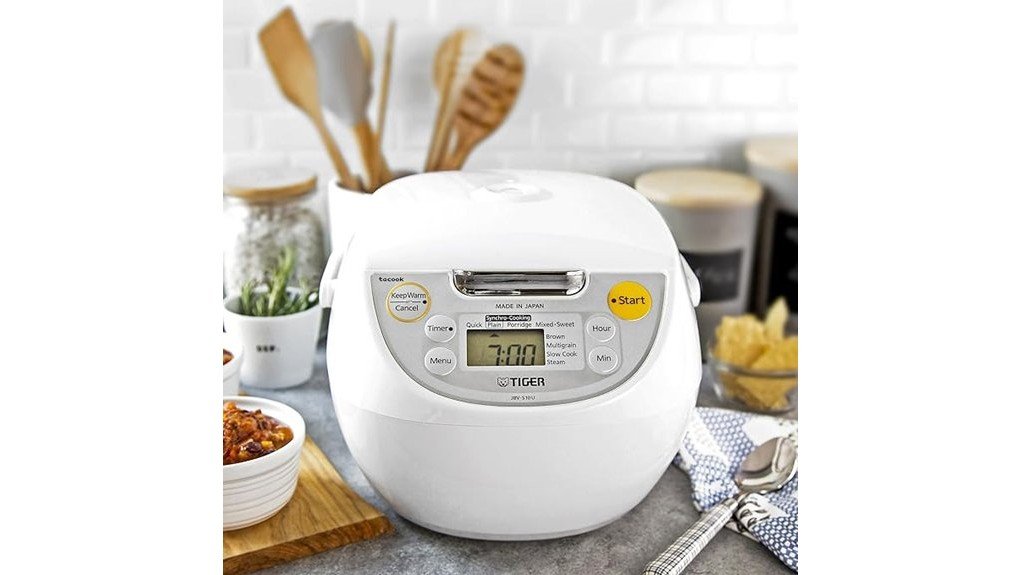
Cooking good rice is simple in theory, but inconsistent texture, limited menu options, and extra pans for side dishes can make everyday meals more work than they need to be. The TIGER JBV-S10U Micom Rice Cooker and Warmer tackles those problems with a 5.5-cup uncooked-rice capacity, microcomputer-controlled cooking, 10 computerized menu settings, and Tiger’s tacook synchronized cooking plate. Its strongest advantage is everyday versatility in a Made-in-Japan unit without paying a premium for a heavier induction-heating system, although its 5.5-cup capacity, tacook batch limits, and 120V electrical specification will not suit every kitchen. This review explains the verified specifications, practical strengths, real-world limitations, and key comparisons that matter before you buy.
Quick Verdict
Rating: 8.5/10, Recommended with caveats
Best For: Small to medium households (1 to 4 people) that want reliable Japanese Micom rice cooking plus steaming, slow cooking, and one-pot synchronized meal preparation.
Skip If: You regularly cook for 5 or more people, want induction heating (IH) or a detachable inner lid, or use a 220V–240V electrical supply outside North America.
Top Pros
- 10 computerized menus (6 more than the entry-level JBV-A10U)
- Included BPA-free tacook plate cooks a side dish over the rice
- Made in Japan with a 1.7 mm fluorine-coated non-stick inner pot
Top Cons
- Synchro-Cooking limits rice batches to 1–2 uncooked cups
- Uses a bottom heating plate rather than full-pot induction heating
- Fixed 120V/60Hz North American power rating
Bottom Line: The TIGER JBV-S10U pairs a practical 5.5-cup capacity with 10 automated cooking programs and Tiger’s tacook plate for preparing rice and a protein or vegetable side dish together. As long as its compact batch size and 120V/60Hz power rating fit your household, it is one of the most versatile mid-range Micom cookers available.
TIGER JBV-S10U Key Specifications
| Specification | Detail |
|---|---|
| Brand | TIGER |
| Model | JBV-S10U (White) |
| Product type | Micom rice cooker and warmer |
| Rice capacity | 5.5 rice-cooker cups uncooked (approx. 1.0 L / 34 oz; ~4.1 standard US cups uncooked), yielding up to 11 rice-cooker cups cooked |
| Heating system | Micom (microcomputer-controlled) bottom heating plate |
| Cooking menus | 10 computerized settings |
| Menu choices | Plain, Quick, Mixed, Brown, Slow Cooking, Porridge, Synchro-Cooking, Sweet, Steam, Multi-grain |
| Keep warm | Automatic, up to 12 hours |
| Inner pot | Scratch-resistant aluminum with non-stick fluorine coating (1.7 mm thickness) |
| Electrical rating | 672W |
| Rated power supply | 120V, 60Hz |
| Dimensions | Approximately 10.6 W × 13.9 D × 8.4 H inches (27.0 × 35.3 × 21.4 cm) |
| Manufacturer weight | Approximately 6.4 lb (2.9 kg) |
| Color | White |
| Country of production | Japan |
| Included accessories | BPA-free tacook cooking plate, non-stick spatula, ladle, 180 mL rice measuring cup, recipe cookbook |
| Warranty | Tiger 1-year limited warranty for qualifying 120V products purchased in the U.S. or Canada, subject to manufacturer terms |
Key Takeaways
- The 5.5-cup uncooked-rice capacity (measured using the included 180 mL Japanese rice cup) is an ideal size for singles, couples, and families of up to four people.
- Tiger includes 10 computerized cooking menus, offering six more specialized grain and cooking modes than the entry-level 4-menu TIGER JBV-A10U.
- The tacook synchronized cooking plate lets you steam a side dish or protein above the rice during the same cycle without dripping flavors into the grains below.
- An automatic keep-warm function maintains serving temperature for up to 12 hours after cooking finishes.
- Built in Japan, the cooker pairs a 1.7 mm fluorine-coated aluminum inner pot with a 672W, 120V/60Hz heating system.
What Is the TIGER JBV-S10U?
The TIGER JBV-S10U is a 5.5-cup Micom rice cooker and warmer built in Japan for everyday household meal preparation. “Micom” stands for microcomputer: instead of relying on a basic mechanical thermal switch that simply clicks off when water evaporates, an internal chip monitors temperature and adjusts heat output through pre-soaking, boiling, steaming, and resting stages.
Its signature hardware feature is the tacook synchronized cooking system. The included BPA-free cooking plate rests inside the top rim of the inner pot so rising steam from the rice cooks a side dish at the same time. Tiger vents the plate specifically to prevent cooking juices and seasonings from dripping into the rice below.
Unlike basic white-rice appliances or Tiger’s simpler 4-menu JBV-A10U, the JBV-S10U expands the control panel to 10 dedicated programs. It handles plain, quick, mixed, brown, porridge, sweet, and multi-grain rice, along with slow cooking, steaming, and synchronized cooking.
Who Should Buy It?
Best For
- Small to medium households (1 to 4 people) that regularly cook 1 to 5.5 cups of uncooked rice.
- Home cooks who switch between white, brown, sweet (sticky), mixed, and multi-grain rice varieties.
- Busy weeknight cooks who want to steam fish, chicken, dumplings, or vegetables on the tacook tray while 1 to 2 cups of rice cook underneath.
- Shoppers who value a compact, Made-in-Japan Micom appliance that doubles as a steamer and slow cooker.
Skip If
- You routinely cook for 5+ people or meal-prep more than 5.5 cups of uncooked rice in a single batch (choose a 10-cup model instead).
- You want full-pot Induction Heating (IH) or pressure cooking rather than a Micom bottom heating plate.
- You want to cook a full 5.5-cup pot of rice while using the tacook plate at the same time (synchronized cooking requires smaller rice batches).
- Your kitchen outlets do not use standard North American 120V, 60Hz power.
Before You Buy: The JBV-S10U is built strictly for 120V, 60Hz electrical systems and draws 672W. Do not plug it into 220V–240V outlets outside the United States or Canada without a heavy-duty step-down transformer rated well above 672W, as doing so can permanently damage the microcomputer board and void the warranty.
MICOM Cooking and Menu Flexibility
The JBV-S10U uses Tiger’s microcomputer chip to regulate cooking temperature and timing across each stage of the cycle. Different grains absorb water at vastly different rates: white jasmine rice cooks relatively quickly, whereas brown rice and multi-grain blends require extended pre-heating and gentler simmering so the bran layers soften without splitting the grains.
While some retailer listings mistakenly copy the 4-menu description from the entry-level JBV-A10U, the JBV-S10U provides 10 computerized menu settings. The table below breaks down how each setting works in everyday cooking:
| Menu Setting | Best Used For | How the Cycle Adjusts |
|---|---|---|
| Plain | Everyday long-, medium-, or short-grain white rice | Full soak, boil, and steam cycle for fluffy, balanced texture |
| Quick | White rice when you are short on time | Shortens the pre-soak and final steaming phases (yields slightly firmer grains) |
| Mixed | Takikomi gohan or rice cooked with vegetables, mushrooms, and seasonings | Modulates heat so added ingredients cook evenly without scorching the bottom |
| Brown | Short-, medium-, or long-grain brown rice | Extends warm-water absorption and simmer time to soften tough bran layers |
| Multi-grain | White rice blended with barley, millet, amaranth, or杂穀 (zakkoku) mixes | Balances moisture absorption across mixed grain sizes and densities |
| Sweet | Glutinous (sticky/mochi) rice, sweet rice dishes, or sticky rice with mix-ins | Controls gelatinization for chewy, cohesive sticky rice without mushiness |
| Porridge | Rice porridge (okayu / congee) or soft oatmeal | Maintains a gentle, low boil to prevent starchy liquid from foaming over |
| Synchro-Cooking | 1–2 cups of rice below + a protein/vegetable dish in the tacook plate above | Calibrates steam generation so both the upper tray and lower rice finish together |
| Steam Cooking | Steaming vegetables, dumplings, buns, seafood, or reheating dishes | Boils water in the lower pot to generate steady steam for the upper cooking plate |
| Slow Cooking | Soups, stews, braised meats, or simmered side dishes | Brings ingredients to a simmer and reduces heat for gentle, extended cooking |
TACOOK Synchronized Cooking
The tacook system is the feature that most clearly separates the JBV-S10U from a standard rice-only appliance. You place seasoned proteins or vegetables into the supplied BPA-free cooking plate, suspend the plate inside the inner pot above your uncooked rice and water, and select the Synchro-Cooking menu. Steam generated during the rice cycle cooks the dish in the upper tray simultaneously.
Because the tacook plate has a solid bottom with raised side vents rather than perforations across the base, liquids and marinades stay inside the upper tray instead of dripping down and discoloring or flavoring the plain rice underneath. This setup cuts down on stovetop pans when making weeknight dinners for one or two people.
However, buyers need to understand one key physical limitation: you cannot cook a full 5.5-cup batch of rice while using the tacook plate. Because rice expands significantly as it absorbs water and the plate takes up vertical space in the top half of the pot, Synchro-Cooking is designed for smaller batches—typically 1 to 2 rice-cooker cups of uncooked rice (check the inner pot’s dedicated synchro-cooking water lines and recipe book). Overfilling the pot underneath the plate will cause expanding rice to push against the tray and cook unevenly.
Pro Tip: Start with recipes from the included Tiger cookbook when learning the tacook function. Cut meats and dense root vegetables into thin, uniform pieces and arrange them in a single layer on the plate so steam circulates evenly during the rice cycle.
5.5-Cup Capacity and Family Use
The JBV-S10U holds up to 5.5 cups of uncooked rice, yielding up to 11 cups of cooked rice depending on grain type and water ratio. Before sizing the cooker for your family, keep in mind how Japanese rice cookers measure volume: a rice cooker “cup” is a traditional Japanese go cup measuring 180 mL (about 6.1 fl oz, or roughly 3/4 of a standard 8 oz US measuring cup).
Translated into standard US kitchen measurements, the JBV-S10U’s maximum 5.5-cup uncooked capacity equals approximately 4.1 standard US cups of dry rice (yielding about 8.2 standard US cups of cooked rice). Always use the clear 180 mL plastic cup included in the box so your grain amounts match the water-level lines stamped inside the inner pot.
At roughly 10.6 inches wide, 13.9 inches deep, and 8.4 inches high, the 5.5-cup size hits a sweet spot for singles, couples, and families of three or four. It handles everyday dinners and moderate meal prep without dominating your countertop. If your household regularly serves five or more large portions of rice at once, stepping up to a 10-cup (1.8 L) cooker is more practical than running back-to-back cycles.
Inner Pot and Build Quality
Tiger outfits the JBV-S10U with a 1.7 mm thick aluminum inner pot finished with a scratch-resistant fluorine non-stick coating. High-contrast water-level markings are printed along the interior wall for Plain, Brown, Sweet, Porridge, and Synchro-Cooking modes so you do not have to measure water separately with a liquid cup.
The fluorine coating releases sticky short-grain and sweet rice cleanly, reducing food waste and soaking time. To preserve the non-stick surface over years of daily use, rinse raw rice in a separate mesh strainer rather than swirling dry, abrasive grains directly inside the coated pot, and always serve with the included plastic spatula instead of metal spoons.
Unlike many budget rice cookers assembled overseas, the JBV-S10U is Made in Japan and weighs a manageable 6.4 lb. It features a built-in retractable carrying handle and a push-button lid release. Note that unlike Tiger’s higher-priced JAX-T10U, the JBV-S10U uses an integrated inner lid surface rather than a fully detachable stainless-steel inner lid plate, so you wipe the inside of the lid clean with a damp cloth after cooking.
Keep-Warm and Timer Convenience
As soon as a rice cycle finishes, the JBV-S10U automatically switches to Keep Warm for up to 12 hours, illuminating the keep-warm indicator light. Microcomputer sensors monitor the pot temperature to keep grains warm without burning the bottom layer. While it safely holds rice for up to 12 hours, serving within the first 4 to 6 hours preserves the best moisture and aroma; leaving rice on warm longer than 12 hours can dry out or yellow the grains.
Depending on the control configuration and selected program, Tiger’s JBV-S specification also notes timer functionality for scheduling supported menus around your routine (verify exact timer button controls and supported modes in the included manual for your unit). Never leave perishable ingredients—such as raw meat or seafood on the tacook plate, or broth in mixed rice—sitting unrefrigerated inside the cooker on a delayed start.
Cleaning and Maintenance
Keeping the JBV-S10U clean takes only a few minutes after each meal, provided you care for its electrical and coated parts properly:
- Inner pot and accessories: Unplug the unit and allow it to cool completely. Hand-wash the 1.7 mm fluorine-coated inner pot, BPA-free tacook plate, spatula, ladle, and measuring cup with warm water, mild dish soap, and a soft sponge. Do not put the coated inner pot in the dishwasher or use abrasive scouring pads.
- Inner lid and gasket: Wipe starch residue and condensation off the underside of the lid and the rubber seal with a clean, wrung-out cloth after every use so the lid continues to latch and seal tightly.
- Steam vent and condensation collector: Check the top steam vent pathways and empty, rinse, and dry the small plastic condensation collector (dew receiver) on the side of the body so starchy water does not collect and cause odors.
- Main exterior body: Wipe the white housing with a lightly dampened cloth; never immerse the electrical base in water or spray water into the heating plate well.
Setup and Safety Notes
The JBV-S10U operates at 672W on 120V, 60Hz power. Plug it directly into a grounded wall outlet rather than sharing an overloaded power strip with high-wattage appliances like microwaves or toaster ovens, and never operate the unit if the power cord or plug is damaged.
Proper steam clearance is essential for protecting kitchen cabinetry. Tiger’s operating manual advises maintaining at least 11.8 inches (30 cm) of open clearance above and around the cooker away from walls, hanging cabinets, or furniture so hot steam does not warp finishes or electronics. Keep hands and faces clear of the top steam vent during active boiling.
Always set the cooker on a flat, stable, heat-resistant counter out of children’s reach, and use only the supplied Tiger tacook cooking plate inside the pot.
What to Expect in Everyday Use
For Everyday Rice
With dedicated Plain, Quick, Brown, Mixed, Sweet, and Multi-grain settings, you do not have to guess water-to-time adjustments when switching from jasmine or basmati to Japanese short-grain sushi rice or brown rice. Matching the included 180 mL cup to the pot’s interior water lines produces consistent results from batch to batch.
For Weeknight Meals
When cooking for one or two people, pairing 1 to 2 cups of rice in the bottom pot with seasoned salmon fillets, chicken breast, or broccoli florets in the tacook plate turns the JBV-S10U into a true one-pot meal maker. You walk away during the cycle and return to hot rice and a steamed main course with only two washable inserts.
For Soups, Porridge, and Steaming
The Slow Cooking, Porridge, and Steam menus expand the cooker’s role in small kitchens or dorms. You can simmer morning congee or oatmeal without watching a pot on the stove, steam dumplings over water, or braise a simple soup without buying a separate slow cooker.
For Staggered Mealtimes
Because the automatic keep-warm mode runs for up to 12 hours, family members coming home at different times can dish up warm rice throughout the evening without reheating portions in the microwave.
Pros and Cons
Pros
- 10 computerized menus handle white, quick, mixed, brown, sweet, porridge, and multi-grain rice plus steaming and slow cooking.
- Included BPA-free tacook plate cooks a protein or vegetable side dish simultaneously without transferring flavors to the rice.
- Made in Japan construction featuring a durable 1.7 mm fluorine-coated non-stick aluminum inner pot.
- Compact 5.5-cup footprint (6.4 lb) fits easily on apartment counters and stores neatly with a carrying handle.
- Complete accessory bundle in the box (tacook plate, spatula, soup ladle, 180 mL measuring cup, and cookbook).
Cons
- Limited tacook batch size: Using the synchronized cooking plate restricts rice volume to 1–2 uncooked cups.
- Non-detachable inner lid: The interior lid surface must be wiped clean in place rather than popping off for sink washing like the JAX-T10U.
- Micom bottom heating plate rather than full-vessel Induction Heating (IH).
- 5.5-cup capacity (~4.1 US cups uncooked) can feel tight for large families or heavy weekly meal prepping.
- Fixed 120V/60Hz electrical rating limits use outside North America.
Check Current Price on Amazon →
Is It Worth the Price?
Without relying on temporary discounts, the TIGER JBV-S10U delivers its strongest value when you actually use its specialized grain settings and tacook plate. If you only ever cook plain long-grain white rice once a week, a basic one-switch mechanical pot costs less. However, basic cookers struggle with brown rice, sweet sticky rice, porridge, and multi-grain blends—areas where the JBV-S10U’s 10 microcomputer programs prevent boiled-over starch and undercooked centers.
Positioned in the mid-range Japanese Micom tier, the JBV-S10U costs noticeably less than high-end Induction Heating (IH) or pressure-IH rice cookers while still offering Made-in-Japan build quality, a 12-hour keep-warm mode, and synchronized meal cooking.
It is less compelling if you never plan to use the extra menu settings (where the 4-menu TIGER JBV-A10U often costs less) or if you want a removable inner lid and LCD screen layout (where the TIGER JAX-T10U or Zojirushi NS-TSC10 are strong contenders).
How It Compares to Alternatives
Before deciding on the TIGER JBV-S10U, it helps to see how it stacks up against its closest Tiger siblings and a popular 5.5-cup Micom competitor:
| Feature | TIGER JBV-S10U (Reviewed) | TIGER JBV-A10U | TIGER JAX-T10U | Zojirushi NS-TSC10 |
|---|---|---|---|---|
| Uncooked Capacity | 5.5 cups (1.0 L) | 5.5 cups (1.0 L) | 5.5 cups (1.0 L) | 5.5 cups (1.0 L) |
| Heating Type | Micom bottom heating (672W) | Micom bottom heating (672W) | Micom bottom heating (641W) | Micom + triple heater (bottom, side, lid; 610W) |
| Menu Settings | 10 settings | 4 settings (Plain, Brown, Synchro, Slow/Steam) | 10 settings | 8 settings (includes Cake & Steam) |
| Simultaneous Cooking | Yes (tacook plate) | Yes (tacook plate) | Yes (tacook plate) | Standard perforated steamer basket only |
| Inner Lid Cleaning | Fixed (wipe clean) | Fixed (wipe clean) | Detachable inner lid & steam cap | Detachable inner lid |
| Exterior & Origin | White body; Made in Japan | White body; Made in Japan (select batches) | Stainless steel & black; Made in China | Stainless brown; Made in China |
- Choose the TIGER JBV-S10U if: You want a Made in Japan 5.5-cup cooker that combines the non-drip tacook plate with all 10 specialized rice and grain menus (including Quick, Mixed, Sweet, Porridge, and Multi-grain).
- Choose the TIGER JBV-A10U if: You want the exact same 5.5-cup chassis and tacook synchronized cooking plate for a lower price, and only need the four core programs (Plain, Brown, Synchro-Cooking, and Slow Cook/Steam).
- Choose the TIGER JAX-T10U if: You want Tiger’s 10 menu settings and tacook plate, but prefer a stainless-steel exterior and a detachable inner lid and steam gasket for easier sink washing.
- Choose the Zojirushi NS-TSC10 if: You prioritize a detachable inner lid, triple-heater warmth (bottom, side, and lid heaters), and a retracting cord over Tiger’s flavor-separating tacook plate.
Frequently Asked Questions
How much rice can the TIGER JBV-S10U cook?
The JBV-S10U has a maximum capacity of 5.5 rice-cooker cups of uncooked rice (using the included 180 mL measuring cup, which equals roughly 4.1 standard 8 oz US cups of dry rice). That yields approximately 11 rice-cooker cups (about 8.2 US cups) of fully cooked rice, depending on the grain type and water ratio.
How many cooking settings does the JBV-S10U have?
Tiger equips the JBV-S10U with 10 computerized menus: Plain, Quick, Mixed, Brown, Slow Cooking, Porridge, Synchro-Cooking, Sweet, Steam Cooking, and Multi-grain Rice. That gives you six more dedicated programs than the 4-setting TIGER JBV-A10U.
Can the JBV-S10U cook rice and another dish at the same time?
Yes. Tiger’s BPA-free tacook synchronized cooking plate uses steam generated during the rice cycle to cook a compatible side dish above the rice without dripping juices into the grains below. When using Synchro-Cooking, keep the rice batch to 1–2 uncooked cups so the expanding rice does not press against the bottom of the plate.
How long does the automatic keep-warm function work?
Tiger specifies automatic keep-warm operation for up to 12 hours after cooking ends. This is convenient when family members eat at staggered times, though serving within the first several hours keeps the rice at peak texture and moisture.
What power does the TIGER JBV-S10U require?
The manufacturer rates the JBV-S10U at 672W and specifies a 120V, 60Hz North American power supply. Do not plug it directly into 220V–240V international outlets without an appropriately rated step-down transformer.
Can I cook quinoa in the JBV-S10U?
Tiger does not list a standalone quinoa button among the 10 menu settings, though rinsed quinoa can be prepared using standard water-to-grain ratios on the Plain or Multi-grain cycle. Always follow Tiger’s manual guidelines to avoid overfilling the pot.
How should I clean the JBV-S10U, and is the inner pot dishwasher-safe?
Unplug the cooker and let it cool completely before cleaning. Hand-wash the fluorine-coated inner pot, tacook plate, and utensils with warm soapy water and a soft sponge; avoid putting the coated inner pot in the dishwasher, as harsh detergents and heat can degrade the non-stick coating. Wipe the inner lid, empty the side condensation collector, and never immerse the main body in water.
Why is the included rice measuring cup smaller than a standard US cup?
Like all Japanese rice cookers, the TIGER JBV-S10U uses the traditional 180 mL (6.1 fl oz) rice-cooker cup, which is roughly 3/4 of a standard 240 mL (8 fl oz) US cup. Always measure dry rice with the included 180 mL cup so your portions align accurately with the water-level markings inside the pot.
What warranty does the TIGER JBV-S10U have?
Tiger states that qualifying 120V electric products purchased from authorized sellers in the United States or Canada carry a one-year limited warranty against defects in workmanship, subject to manufacturer terms and proof-of-purchase requirements.
The Bottom Line
The TIGER JBV-S10U is a smart buy if you want a Made-in-Japan, 5.5-cup Micom rice cooker with 10 versatile menu settings, 12-hour automatic keep-warm, and the ability to cook rice and a side dish together using the tacook plate. Shoppers who need a 10-cup family machine, a detachable inner lid, induction heating, or 220V–240V international voltage should look at another model.
For small and medium households in North America, its combination of reliable grain settings, durable 1.7 mm non-stick pot, and synchronized meal preparation earns our 8.5/10, Recommended with caveats verdict.
Ready to Buy?
Check the latest price, availability, and product details on Amazon before you decide.