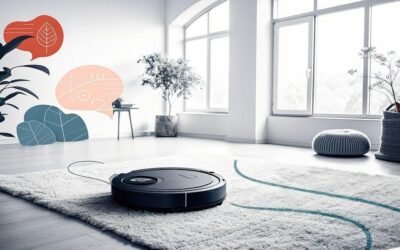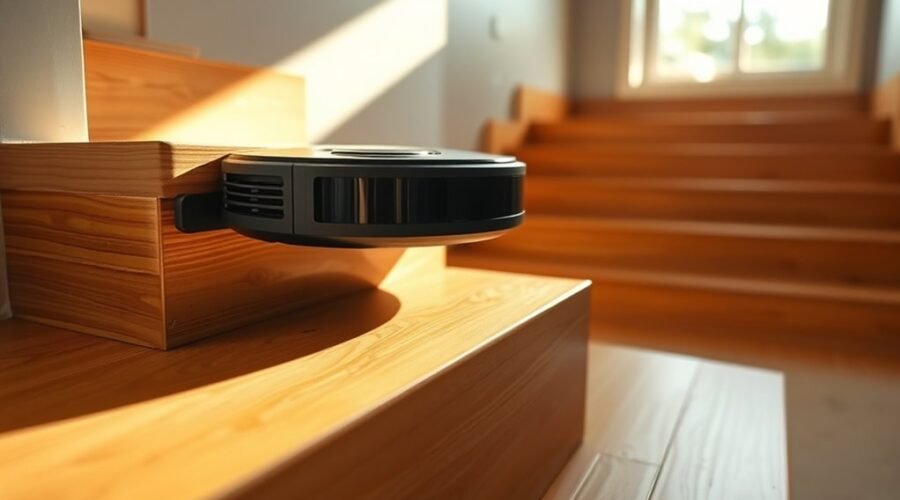
Cliff sensors are a core safety system on robot vacuums. They use infrared emitters and receivers to monitor the floor beneath the machine and estimate whether a drop-off is present. When the reflected signal changes sharply, the vacuum assumes a stair or ledge is ahead and changes course. Their design is simple, but their behavior can be less straightforward on certain surfaces, which raises a practical question.
What Robot Vacuum Cliff Sensors Do?
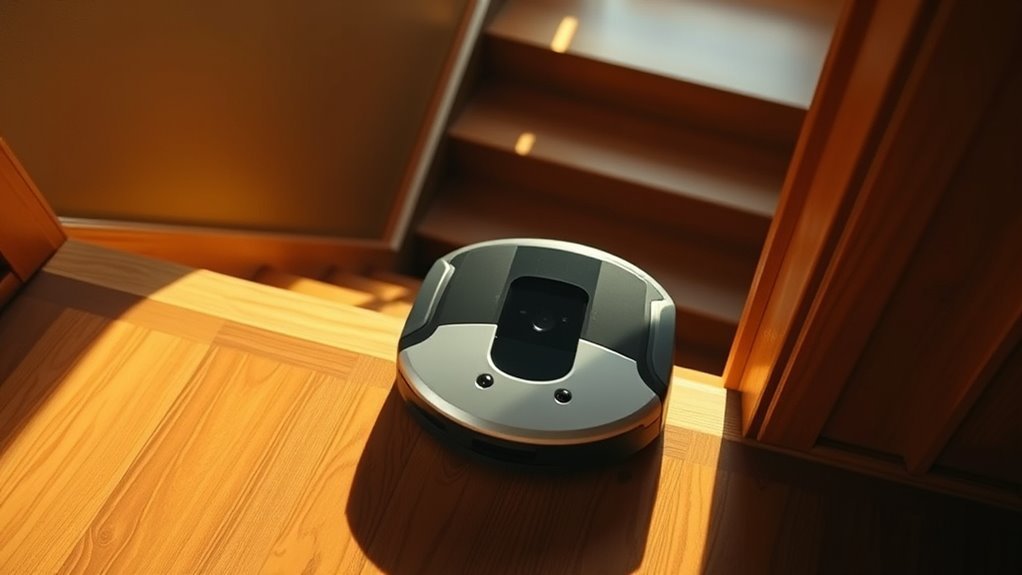
Cliff sensors are infrared detectors mounted on the underside of a robot vacuum to prevent falls from stairs, ledges, and other drop-offs. These cliff sensors serve as a protective control layer, continuously monitoring the floor beneath the machine for abrupt changes in distance.
When the reflected infrared signal indicates a sudden loss of surface, the vacuum interprets the condition as a drop-off and reverses course instead of proceeding into empty space. Most contemporary units, including models such as Roomba and Wyze, deploy several cliff sensors to widen coverage and improve navigation safety around stairs, thresholds, and elevated edges.
Their function is essential for autonomous operation because it reduces collision risk, equipment damage, and service interruption. Performance can be degraded by dark flooring that absorbs infrared light, causing false drop detection.
Routine cleaning and inspection help preserve accuracy, suppress unnecessary error messages, and support reliable, liberated movement through domestic environments.
How Cliff Sensors Detect Drops?
Using infrared emitters and receivers mounted along the vacuum’s underside, cliff sensors calculate the distance to the floor by measuring reflected light intensity.
These sensors work by projecting infrared pulses downward and reading the return signal from the floor beneath the chassis. When the floor remains close, the reflection is strong and stable. When an edge appears, the reflected signal drops sharply because the beam encounters open space, so the controller interprets a sudden increase in distance as a cliff.
Most units place four sensors along the front and sides, extending coverage across the robot’s perimeter. This arrangement allows the machine to detect stairs, ledges, and other drop-offs with minimal delay.
Once a drop is confirmed, the navigation system commands immediate backward movement, preserving mobility and preventing accidental descent. In this way, cliff sensors convert simple optical measurements into a protective boundary that supports autonomous movement and safer, more liberated floor coverage.
Why Cliff Sensors Misread Floors?
Although cliff sensors are designed to detect abrupt floor drops by measuring reflected infrared light, they can misread certain surfaces when reflectivity is too low. Cliff Sensors depend on a stable return signal; when the floor absorbs infrared energy, the robot interprets reduced reflection as empty space. This produces false navigation errors, often causing premature stops or reversals that interrupt autonomous cleaning and reduce spatial freedom in varied homes.
| Surface condition | Sensor response | Outcome |
|---|---|---|
| Dark carpet | Low reflection | False drop-off |
| Mixed flooring | Uneven return | Erratic routing |
| Pale tile | Strong reflection | Normal traversal |
Such misreads occur more often where surface color changes sharply, because contrast alters responsiveness. To preserve efficient movement, users may need to adjust cleaning paths or limit access to problematic zones. These measures reduce unnecessary hesitation and help the vacuum maintain steady coverage across diverse interiors, enabling more reliable and liberated operation overall.
When Dark Floors Confuse Cliff Sensors?
Dark floors can disrupt cliff sensor behavior because these infrared-based systems depend on reflected signal strength to judge distance beneath the robot. When the floor absorbs most infrared light, Cliff Sensors receive a weak return and may infer an abrupt drop rather than a continuous surface. That misclassification is common on black tiles, dark hardwood, and some low-pile carpets with muted reflectivity.
The result is conservative control: the vacuum may stop, reverse, or reroute, reducing coverage and interrupting autonomous cleaning. In practical terms, the machine trades throughput for safety, but the user bears the cost of incomplete cleaning. Adjusting schedules or excluding problematic zones can restore efficiency without surrendering automation.
Recognizing this limitation is useful for households that prioritize freedom from manual labor, because it enables informed placement and expectation management. Dark flooring does not break Cliff Sensors; it exposes the sensing threshold at which infrared interpretation becomes unreliable.
How to Clean Robot Vacuum Cliff Sensors?
Robot vacuum cliff sensors should be cleaned regularly to preserve accurate floor-detection performance.
These Cliff Sensors are infrared emitters and receivers mounted along the underside, where dust can obstruct their line of sight. A simple maintenance routine restores reliable readings and reduces false drop-off alerts.
The vacuum should be powered off, turned upside down, and placed on a stable surface. Using a clean, dry microfiber cloth or soft cotton cloth, each sensor opening should be wiped gently to remove lint, grime, and accumulated debris. No liquid cleaner is required, since moisture can introduce interference.
This procedure applies consistently to many Roomba models, including the 500, 600, and 800 series.
When cleaning is neglected, the unit may misread the floor, stop prematurely, or avoid safe areas unnecessarily. Regular attention to these sensors preserves navigation accuracy, protects operational autonomy, and supports uninterrupted cleaning across varied home surfaces.
Can You Disable Robot Vacuum Cliff Sensors?
Disabling cliff sensors on a robot vacuum is not officially supported, because those infrared floor-detection systems are integral to safe navigation and edge avoidance. These cliff sensors emit infrared light, measure floor distance, and trigger evasive behavior before a drop is reached.
Disabling cliff sensors isn’t officially supported; they’re essential infrared safeguards for safe navigation and edge avoidance.
No manufacturer offers a standard disable option, since removing this layer of protection would undermine routing logic and physical safety. Some users attempt to obscure the sensors with light-colored paper or tape, but this workaround is unstable and inappropriate in homes with stairs.
It may cause the robot to misread terrain, strike edges, fall, or damage internal components. Such modifications are effectively irreversible and can compromise additional functions that depend on accurate environmental sensing.
For users seeking greater autonomy over cleaning behavior, software scheduling or zone controls are safer avenues than disabling the cliff sensors. In practical terms, liberation from constraints should not come at the cost of equipment failure or preventable accidents.
Frequently Asked Questions
Can I Disable the Cliff Sensors on My Roomba?
No official option exists to disable them. Sensor Safety is intentionally enforced by Roomba navigation; bypassing it risks falls, damage, and voided function. A light-paper cover may work, but it is unsafe and technically invasive.
How Do I Clean the Cliff Sensors on My Roomba?
He cleans them by powering off the Roomba, flipping it over, and wiping each opening with a dry microfiber cloth. Sensor Maintenance prevents false errors; one study found 30% of navigation faults stem from dirty sensors.
What Are the Most Common Problems With Robot Vacuums?
The most common problems with robot vacuums are Battery Issues, sensor misreads on dark floors or carpets, dust-clogged cliff sensors, unexpected shutdowns, navigation errors, and hardware damage; each can disrupt autonomous cleaning and require maintenance.
How to Fix Roborock Cliff Sensor Error?
Clean the cliff sensors with a dry microfiber cloth, clear debris, and inspect for obstructions. Perform Sensor Calibration if the error persists. If false alarms continue, the device likely needs a reset or service.
Conclusion
In the quiet sweep beneath a robot vacuum, cliff sensors act like vigilant sentries, casting invisible infrared beams over floorboards and stair edges. When the reflected light vanishes into a drop, the machine halts its forward glide and retreats, avoiding a sudden fall. Yet dark carpets, dust, and glare can distort their judgment. Clean, calibrated sensors remain essential, preserving safe navigation and steady cleaning across a home’s shifting terrain.