
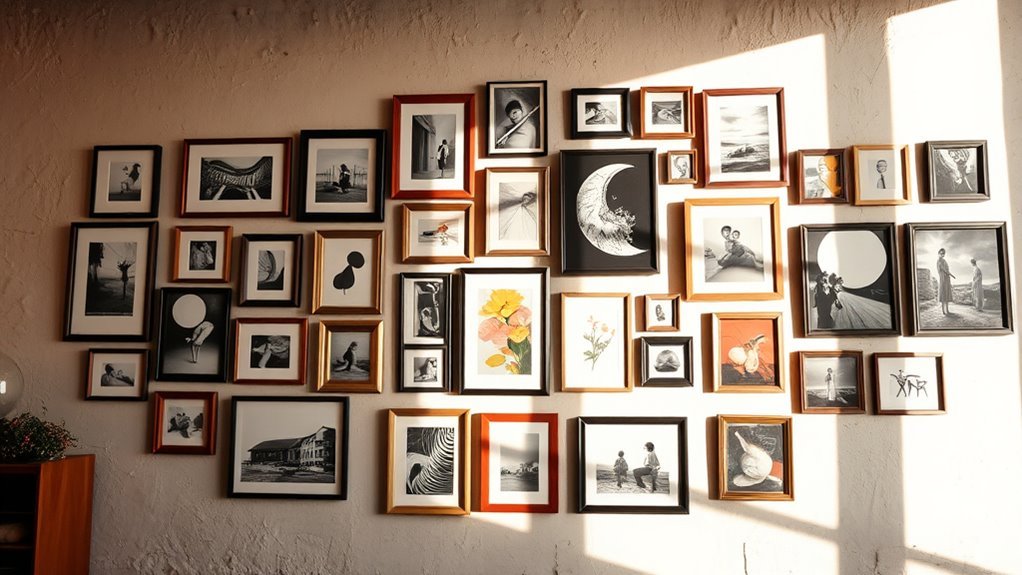
A well-planned gallery wall turns a blank expanse of drywall into a personal story told through art, photography, and meaningful objects. The best displays look collected over time rather than crowded because every frame has a clear role in the overall shape. In this guide, you’ll learn how to size your arrangement to your furniture, calculate exact nail heights, choose the right hanging hardware, and avoid the spacing mistakes that make wall displays feel messy.
Quick Answer
To create a balanced gallery wall, span about two-thirds of your wall or furniture width, leave 2 to 3 inches between frames, and position the midpoint of the entire grouping 57 inches from the floor (or 8 to 10 inches above furniture). Unify mixed artwork with a shared color palette or repeated frame finish.
Key Takeaways
- Follow the two-thirds rule: size your total arrangement to 66%–75% of the width of the sofa, bed, or console below it.
- Calculate exact nail placement by measuring from the top of each frame down to its taut wire or D-ring hardware.
- Match hardware to frame weight, using adhesive strips for light frames (up to 15 lbs) and wall studs or anchors for heavy glass pieces.
- Repeat each frame finish, wood tone, or accent color at least three times across the display so mixed pieces feel connected.
- Protect paper art, photos, and textiles by hanging them on interior walls away from direct sunlight, radiators, and HVAC vents.
How to Create a Stunning Gallery Wall
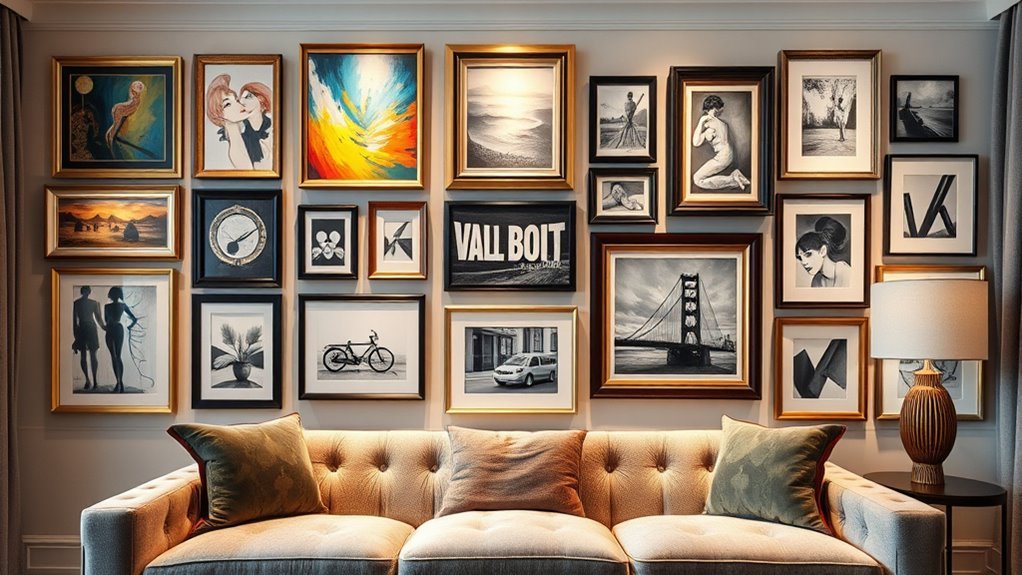
Creating a stunning gallery wall starts with a measuring tape, not a hammer. By measuring your wall space, selecting hardware rated for each frame’s weight, and testing your arrangement with paper templates first, you can hang a cohesive collection without extra nail holes. Set aside time to measure carefully before you start.
Estimated total time: 1 to 3 hours, depending on the number of pieces, wall type, and template prep.
Recommended Products

Versatile Sizes for Display: Vittanly 15-Pack Multi-Size Picture Frame Set includes 3x 8x10", 6x 5x7", and 6x 4x6" frames. Ideal for showcasing family photos, artwork in living rooms, bedrooms, and offices

Durable Material: YESKAY 11x14 picture frames made of MDF wood, stable structure, premium texture, and well-made quality. The HD plexiglass front also protects your treasured photos from damage and keeps them in good shape for years.

【Durable Material】Our collage frame is made of well made wood frame. Comes with a plastic cover, which provides a clear view of photos and is lighter than glass. No need to worry about hurt by glass broken.
Before You Begin
Gather all of your frames and tools before you start so you can test the full arrangement at once and match each frame to the proper wall fastener. You’ll need:
- Artwork, photographs, prints, or flat dimensional objects (typically 5 to 9 pieces for a medium wall)
- Frames in complementary sizes and finishes
- Steel measuring tape, pencil with an eraser, and a bubble or laser level
- Kraft or butcher paper, scissors, and painter’s tape for wall templates
- Electronic stud finder and rubbing alcohol (if using adhesive strips)
- Picture-hanging hardware matched to your frame weights (hooks, drywall anchors, screws, or adhesive strips)
Always weigh heavier glass-fronted frames before choosing fasteners. If you rent or want a no-tool option on smooth painted drywall, manufacturer guidelines for Command strips recommend that you clean the wall with rubbing alcohol and wait one hour after pressing the strips on the wall before hanging weight. When drilling into hollow drywall without a wood stud, hardware specialists advise that you stay within 25% of an anchor’s maximum rated capacity to ensure a safe hold.
| Hanging Hardware | Max Rated Capacity | Best Frame Size & Wall Type |
|---|---|---|
| Adhesive Picture Strips (Small to XL, 4 pairs) | 4 lbs (Small), 12 lbs (Medium), 15–16 lbs (Large), 20 lbs (XL) | Frames up to 24×36 in. on smooth, clean painted drywall (not textured or freshly painted walls) |
| Sawtooth Hanger & Angled Picture Hook | 5 to 20 lbs | Small to medium wood or metal frames (8×10 in. to 16×20 in.) on standard drywall or plaster |
| D-Rings or Picture Wire with Drywall Anchors | Up to 25 lbs (expansion), 75 lbs (self-drilling), 95 lbs (metal molly bolt) | Medium to large glass-fronted frames (18×24 in. and up) when no wall stud aligns with your mark |
| Wood Stud Screws or Interlocking French Cleat | 50 to 400 lbs | Oversized anchor pieces, heavy mirrors, and thick solid-wood frames anchored into studs (spaced 16 in. on center) |
Once your hardware is ready, choose a cohesive color palette that echoes your room. You might pair soft neutrals with black-and-white photography, warm oak frames, or two bold accent shades pulled from your rug or throw pillows. Mixing simple matte black frames with a few ornate brass or burled wood frames adds visual depth without feeling chaotic.
Pro tip: Repeat one color, mat style, or frame finish at least three times across the layout so your eye connects the pieces naturally.
Steps to Hang a Gallery Wall
Warning: Always scan your wall with an electronic stud finder that detects live AC voltage and metal before drilling or hammering. Drilling past 1.25 inches into drywall can puncture hidden electrical wiring, plumbing pipes, or HVAC ductwork.
- Measure and mark your target boundary. Measure the width and height of the wall area you want to fill, then outline those dimensions on the floor with painter’s tape.
- Arrange your frames inside the floor outline. Place your largest artwork slightly off-center as the anchor, balance it diagonally with your second-largest piece, and fill the perimeter with smaller frames.
- Trace paper templates and tape them to the wall. Trace each frame onto kraft paper, cut out the shapes, and mark the exact spot of the hanging hardware on each sheet. Tape the paper templates to the wall so the center of the whole group sits 57 inches off the floor (or 8 to 10 inches above furniture).
- Space every template 2 to 3 inches apart. Use a tape measure and bubble level to align adjacent edges and keep a uniform 2-to-3-inch gap between frames across the entire grouping.
- Calculate the hardware drop for each piece. Flip your first frame over and measure from the top edge of the frame down to the sawtooth slot, D-ring, or taut hanging wire pulled upward with your finger. Mark that exact distance below the top edge of your paper template on the wall.
- Install hardware and hang the anchor piece first. Drive your picture hook, drywall anchor, or screw directly through the mark on the template, tear the paper away, and hang the largest anchor piece. For heavy statement art or mirrors, use a two-piece interlocking French cleat rated for 50 to 400 pounds so the frame cannot shift.
- Hang the remaining frames and level the display. Work outward from the anchor piece, checking each frame with a level. If a single-hook frame tilts after hanging, press a pea-sized dab of removable museum putty or a self-adhesive silicone bumper pad onto both bottom back corners to lock it straight.
Essential Elements for a Cohesive Gallery Wall Design
Every strong gallery wall relies on four shared elements to unify diverse artwork: a controlled color palette, complementary frame profiles, consistent negative space, and varied textures. When you keep at least two of those elements consistent—such as uniform spacing and matching white mat boards—you can mix photography, paintings, and dimensional objects freely.
Mat boards do heavy lifting when your art styles vary. Wide white or cream mats give small postcards, sketches, and vintage snapshots breathing room inside larger frames. Adding one or two unframed items, such as a woven basket, brass sconce, or small round mirror, breaks up rigid rectangular edges and adds shadow and dimension.
Placement also protects your collection over time. Museum conservators at the Library of Congress advise homeowners to hang framed pieces on interior walls away from fireplaces, radiators, and air vents, since exterior walls and heat sources create temperature and moisture swings that warp wood frames and cockle paper. Similarly, Smithsonian conservation guidelines recommend that you limit light exposure on paper prints, photographs, watercolors, and textiles by keeping them out of direct window sunlight or framing them behind UV-filtering acrylic or glass.
| Element | Purpose | Example |
|---|---|---|
| Color Palette | Unifies diverse subjects into one visual story | 60% warm neutrals, 30% monochrome black/white, 10% terracotta accents |
| Frame Styles & Mats | Adds depth while bridging mixed media | Thin matte black and walnut frames paired with 2-inch archival white mats |
| Space Between Frames | Prevents visual clutter and defines the outer perimeter | 2–3 inches for small/medium frames; 4 inches for oversized pieces |
| Unframed & 3D Items | Breaks up flat glass rectangles and adds personal character | Framed textiles, round mirrors, ceramic plates, or flat vintage keepsakes |
Real-Life Gallery Wall Examples for Inspiration
A gallery wall works best when its scale, subject matter, and frame density match how you use the room. A quiet bedroom or reading corner calls for softer textures and fewer pieces, while a long hallway or staircase can carry a rhythmic, multi-frame story that draws you through the space.
Living Room and Reading Nook
Above a living room sofa or tucked beside an armchair in a reading nook, blend 5 to 9 pieces that combine personal photography with fine art prints and a tactile object. Pair two medium landscape prints (such as 16×20 inches) with smaller 8×10 family portraits and a framed linen textile or small brass mirror to reflect warm lamp light.
Home Office
In a workspace behind your desk chair, structure creates focus and looks sharp on video calls. Use a clean 4-piece or 6-piece grid of matching black or oak frames with wide mats, anchoring the display with one bold geometric or botanical print that brings energy without visual clutter.
Hallways and Staircases
Narrow pass-through spaces benefit from smaller, detail-rich pieces that invite close viewing—such as travel postcards, handwritten recipes, architectural sketches, or vintage maps. Along a stairway, stagger vertical and horizontal frames so the bottom and top edges step upward at the same angle as the handrail.
Plan and Arrange Your Gallery Wall Like a Pro
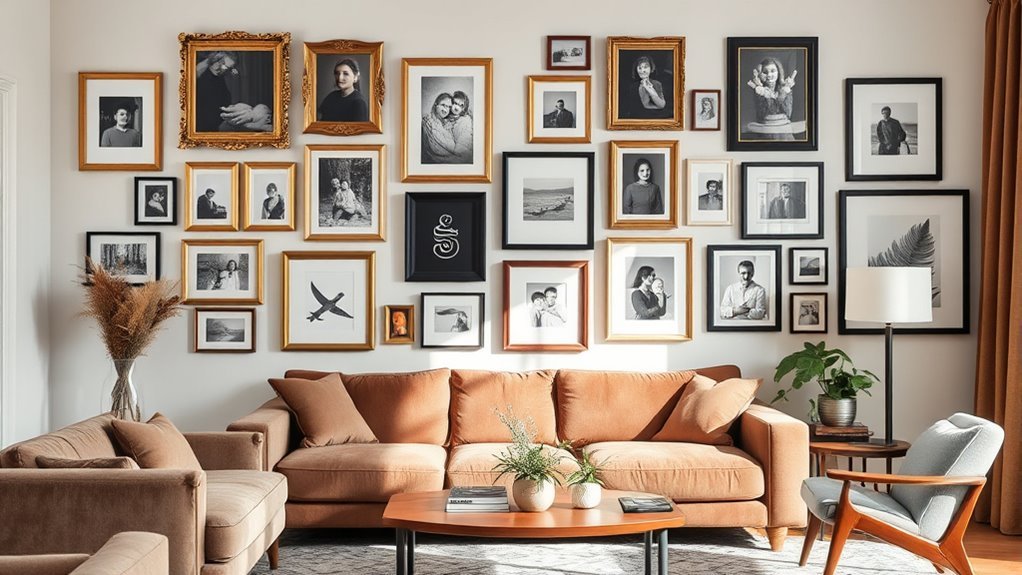
To plan your gallery wall like an interior designer, treat the entire collection of frames as one single piece of art. Sizing that combined footprint to your wall or furniture before you pick up a tool keeps your arrangement from looking like a tiny “postage stamp” floating in empty space.
On an open wall without furniture, your complete grouping should fill roughly 60% to 75% of the wall’s width. When hanging art above furniture, apply the designer two-thirds (2/3) rule: measure the width of the furniture piece and multiply by 0.66 to 0.75 to find the ideal total width of your gallery wall (including the 2-to-3-inch gaps between frames):
- 48-inch console table: Aim for a gallery grouping 32 to 36 inches wide.
- 60-inch loveseat, sideboard, or queen headboard: Aim for a grouping 40 to 45 inches wide.
- 72-inch standard sofa: Aim for a grouping 48 to 54 inches wide.
- 84-inch large sofa: Aim for a grouping 56 to 63 inches wide.
Once you know your target width, interior design guides at IKEA recommend that you tape paper templates of each frame to the wall so you can step back 8 to 10 feet and view the proportions from both standing and seated angles before making a single hole.
Note: The 57-inch eye-level rule applies to open walls. Above a sofa, bed, or console, hang the bottom edges of the lowest frames 8 to 10 inches above the furniture back; on a staircase, mark 57 inches vertically up from the nose of every third stair tread to create an angled guideline that follows the stairs.
Recommended Products

MULTIPLE FRAMES COLLAGE: Bulk of 5 pieces picture frames set in the same sizes. Perfect for pictures 8x10 with mat or 11x14 without mat. The frame opening display size will be 0.5 in smaller than the photo to hold the photo in place

CLEAR ACRYLIC & SOLID BUILD: Crafted from engineered wood that is lightweight yet sturdy for effortless handling. It features a clear acrylic cover instead of traditional glass, offering a safe, crystal-clear view of your cherished memories. Each frame measures 12.86 x 12.86 x 0.47 inches and weighs just 13.1 oz, while the 9-piece set has a net weight of 7.4 lbs. This thoughtful design significantly reduces weight pressure on your wall, allowing for easy and secure hanging
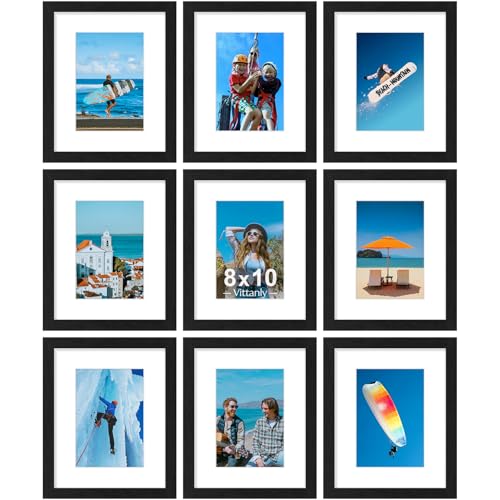
Premium Materials: Made of sturdy composite wood material, our 8x10 frames are lightweight and built to last. With a high-definition plexiglass front that resists breaking, simply remove the protective film before use to reveal crystal-clear clarity
Avoid These Common Gallery Wall Mistakes
Even great artwork can look scattered if the proportions, alignment, or hardware calculations are slightly off. Most crooked or unbalanced displays come down to five preventable planning errors. Check your paper templates against these common pitfalls before you drive nails into the wall:
- Measuring to the top of the frame instead of the hardware: If you place your nail at the top edge mark without subtracting the hardware drop (typically 1.5 to 4 inches down the back of the frame), every piece will hang too high and throw off your 2-to-3-inch spacing.
- Undersizing the grouping (“the postage-stamp effect”): Hanging three or four small 8×10 frames above an 84-inch sofa leaves too much blank drywall. Expand the footprint by adding wider mat boards, mixing in a 24×36 anchor piece, or grouping at least 5 to 9 frames until the display spans two-thirds of the sofa width.
- Clustering dark or heavy frames on one side: A black frame or dark oil painting carries more visual weight than a light watercolor in a thin oak frame of the same size. Spread dark, bold, and thick frames diagonally across the arrangement so one side doesn’t feel lopsided.
- Varying the gaps between frames: Letting spacing drift from 1 inch on the left to 5 inches on the right makes an organic layout look accidental. Keep gaps locked between 2 and 3 inches across the entire display.
- Letting frames tilt forward or rock crooked: Single-nail wire hangers shift whenever a door closes or walls vibrate. Use two D-rings for wide frames and press removable museum putty onto the bottom corners of lighter frames so they sit flush and level.
How to Choose the Right Gallery Wall Layout
The right gallery wall layout depends on the architecture of your room and whether your frames match in size. Formal rooms and matching frame sets shine in structured grids, while eclectic collections of varied sizes look best when anchored along a shared horizontal, vertical, or diagonal axis.
- Symmetrical Grid: Uses 4, 6, or 9 identical frames spaced exactly 2 inches apart horizontally and vertically. Best for modern living rooms, dining rooms, and home offices using a unified photo series or botanical prints.
- Organic Salon-Style: Radiates outward from an off-center large anchor frame, mixing vertical and horizontal orientations with varied frame finishes. Best for large living room walls, stairways, and creative spaces.
- Axis-Aligned (Bottom, Top, or Center Line): Aligns all frames along one imaginary horizontal centerline (or aligns their bottom edges in a row above a wainscoting chair rail or sofa back) while allowing heights to stagger above and below.
- Picture Ledge Display: Mounts one or two shallow wall ledges (3.5 to 4 inches deep) anchored into studs, letting you overlap frames and swap art anytime without patching holes.
Recommended Products

【Durable Material】Our collage frame is made of well made wood frame. Comes with a plastic cover, which provides a clear view of photos and is lighter than glass. No need to worry about hurt by glass broken.

Modern Minimalist Style: Our Picture frames are carefully packaged with minimalist art in mind, featuring natural colors such as black, white, and brown. Whether used as wall hangings or desk decorations,the gallery wall frame set is suitable for all seasons. We prioritize the perfect balance of aesthetics and functionality, ensuring a comfortable and natural experience for our customers.

[Embellish Your Space] Incorporating two 8x10, four 5x7, and four 4x6 photo frames, this set, accentuated by its rustic brown finish, lends a modern yet vintage appeal that complements any wall decor. It also serves as an ideal gift for loved ones
Related Guides
Frequently Asked Questions
What Is Considered a Gallery Wall?
A gallery wall is a curated collection of framed artwork, photographs, prints, and dimensional objects arranged together as a single visual unit on one wall. The pieces connect through a shared color palette, theme, consistent 2-to-3-inch spacing, or repeated frame styles.
What Are the Rules for a Gallery Wall?
The core rules are to center the overall arrangement at 57 inches from the floor on open walls, leave 8 to 10 inches above furniture, span two-thirds of the furniture width below, and keep 2 to 3 inches between frames. Repeat each frame finish or accent color at least three times for cohesion.
Are Gallery Walls Still a Thing?
Yes, gallery walls remain a staple of interior design because they adapt to any room style, from minimalist grids to relaxed salon groupings. Using original pieces, textiles, and personal photos rather than mass-produced matching sets keeps the look timeless.
Are Gallery Walls Out of Style in 2026?
Gallery walls are not out of style in 2026, though tastes have shifted away from crowded, store-bought filler signs toward curated, personal collections. Wider mat boards, mixed wood and metal frames, and breathing room of 2 to 3 inches between pieces define the current look.
How Far Apart Should Frames Be on a Gallery Wall?
Frames on a gallery wall should sit 2 to 3 inches apart for most small and medium pieces. For tightly structured grids of small frames you can narrow the gap to 1.5 to 2 inches, and for oversized statement pieces you can widen the spacing to 4 inches.
How Many Pieces Should Be in a Gallery Wall?
Most balanced gallery walls include 5 to 9 pieces, though a symmetrical grid works well with an even 4, 6, or 9 frames. Rather than counting frames alone, focus on total coverage so the arrangement spans 60% to 75% of your open wall or two-thirds of the furniture beneath it.
How Do You Hang a Gallery Wall Without Nails?
You can hang a gallery wall without nails by using interlocking adhesive picture-hanging strips on smooth, clean painted drywall. Four pairs of large strips hold frames up to 15 to 16 pounds, provided you clean the wall with rubbing alcohol first and wait one hour before hanging the frames.
Conclusion
A standout gallery wall comes down to simple math and personal curation: span two-thirds of your furniture width, center the grouping at 57 inches on open walls, and keep a steady 2-to-3-inch gap between every frame. Measure your wall today, tape out those dimensions on your floor, and arrange your anchor piece first to see your display come together before you make a single hole.
Sources
- Command Brand (3M) FAQs: Surface preparation with rubbing alcohol, one-hour adhesive cure time, and damage-free removal guidelines.
- Lowe’s Drywall Anchor Guide: Weight ratings for expansion, self-drilling, and hollow-wall molly anchors, plus the 25% safe working load guideline.
- The Home Depot Picture Hanging Guide: The 57-inch eye-level standard, 8-to-10-inch clearance above furniture, two-thirds width proportion, and French cleat capacities (50–400 lbs).
- Library of Congress Preservation Guidelines for Matting and Framing: Hanging framed works on interior walls away from fireplaces, radiators, vents, and moisture extremes.
- Smithsonian National Museum of Asian Art Conservation Guide: Protecting light-sensitive photographs, prints, watercolors, and textiles from UV and humidity damage.
- IKEA Gallery Wall Guide: Using paper wall templates and aligning frame edges to test layouts before hanging.





[…] What Is a Gallery Wall? Definition, Examples & Tips […]