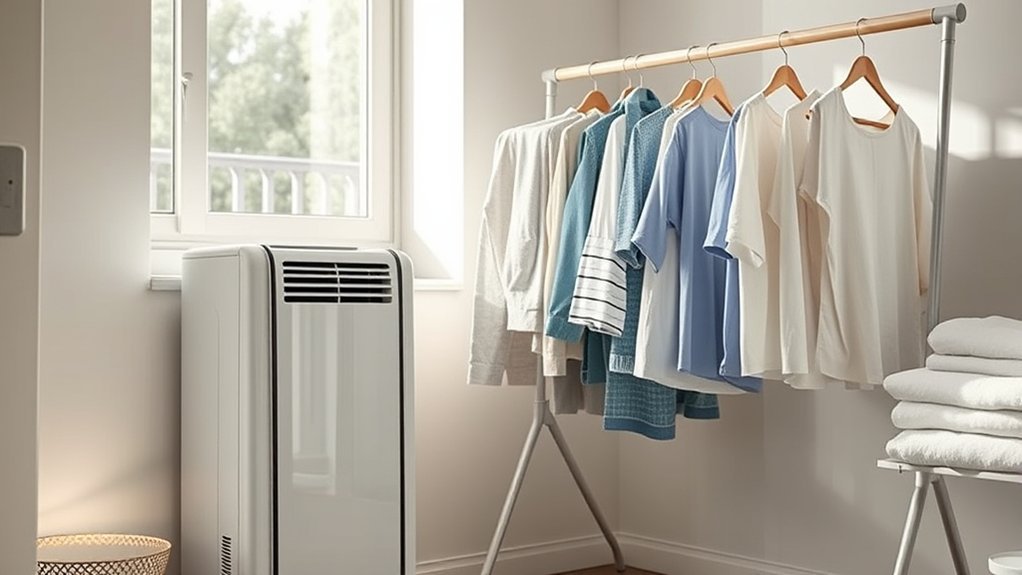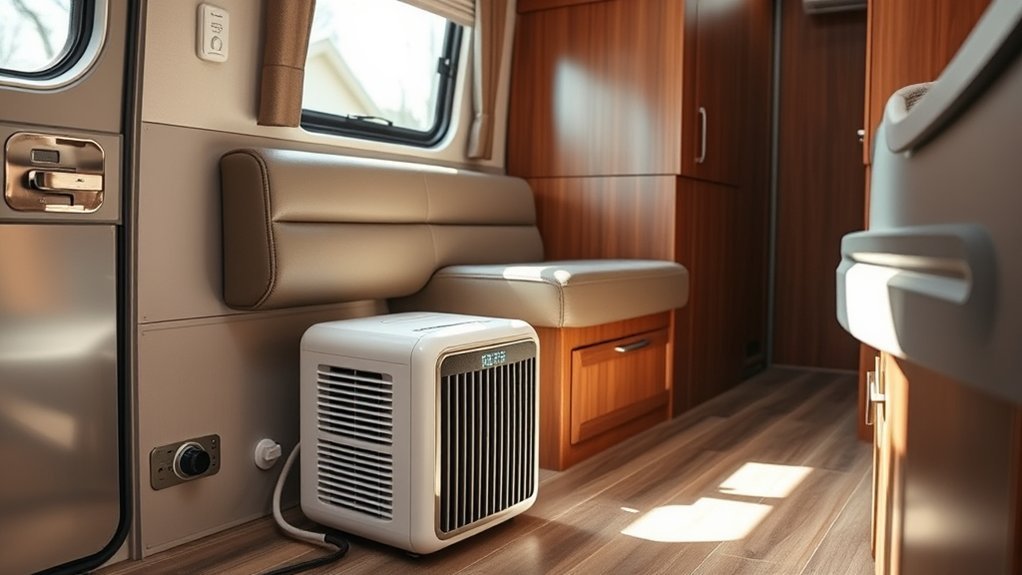
Are dehumidifiers bad for the environment? Not necessarily. A dehumidifier has a real footprint from electricity, refrigerant, manufacturing, and disposal, but it can be a reasonable trade-off when it prevents mold and moisture damage. The lowest-impact approach is to fix leaks and drainage first, run an efficient unit only when humidity is high, and recycle it through a program that recovers the refrigerant.
Last updated: August 19, 2026
Key Takeaways
- Electricity use is usually the biggest day-to-day impact. ENERGY STAR says certified dehumidifiers use 20% less energy than conventional units.
- Humidity control can prevent material waste. Keeping damp spaces dry helps protect drywall, wood, fabrics, books, furniture, and stored belongings from moisture and mold damage.
- Refrigerant matters. Lower-impact refrigerants can reduce climate consequences if leaks occur, but proper handling and end-of-life recovery still matter.
- Do not overuse the appliance. Fix leaks, vent moisture outdoors when appropriate, and use a hygrometer and humidistat so the unit operates only when needed.
At a Glance: What Makes a Dehumidifier Greener?
| Impact area | Why it matters | Lower-impact move |
| Electricity | Long runtime increases operating energy use. | Choose ENERGY STAR, use the humidistat, and reduce the underlying moisture load. |
| Refrigerant | Refrigerant releases can contribute to climate impact. | Prefer lower-impact refrigerants when buying new and use proper service and disposal channels. |
| Manufacturing and replacement | Every replacement requires another appliance to be manufactured and eventually discarded. | Maintain a safe, efficient working unit rather than replacing it prematurely only for a newer label. |
| Moisture damage avoided | Persistent dampness can damage building materials and belongings. | Use dehumidification where it genuinely prevents recurring moisture and mold damage. |
Are Dehumidifiers Bad for the Environment? How the Impact Adds Up
A dehumidifier’s environmental impact comes from four practical areas: electricity use, refrigerant, manufacturing and replacement, and end-of-life disposal. A compressor-based dehumidifier removes moisture by running a fan and refrigeration system. If it operates for long periods in a damp basement, electricity use adds up. If the same unit prevents repeated moisture damage to drywall, wood, furniture, books, or stored belongings, it can also prevent material waste.
The most responsible approach is to treat the dehumidifier as one part of a moisture-control plan. First, reduce the source of moisture. Repair leaks, improve exterior drainage, vent dryers outdoors, use bathroom and kitchen exhaust fans, and keep muggy outdoor air from entering unnecessarily. Then use the dehumidifier to hold indoor relative humidity in a healthier range instead of trying to make an already-dry room even drier.
ENERGY STAR states that certified dehumidifiers use 20% less energy than conventional units while removing the same amount of moisture.
For mold prevention, the U.S. EPA recommends keeping indoor humidity below 60% and ideally between 30% and 50%. The CDC recommends keeping home humidity no higher than 50% all day long for mold prevention. In practice, a dehumidifier setting around 45% to 50% is a useful starting point for many damp homes. For more detail on the control setting itself, see our guide to what RH means on a dehumidifier.
Why Energy-Efficient Dehumidifiers Matter
Energy-efficient dehumidifiers matter because they remove moisture with less electricity. That lowers operating cost and reduces the indirect emissions associated with electricity generation. According to ENERGY STAR, certified dehumidifiers use more efficient refrigeration coils, compressors, and fans to remove the same amount of moisture while using 20% less energy than conventional models.
The most useful efficiency number to compare is Integrated Energy Factor, or IEF. ENERGY STAR defines IEF in liters of water removed per kilowatt-hour of electricity consumed, including the applicable test treatment of dehumidification and standby or off-mode energy. In simple terms, a higher IEF means better moisture removal for the electricity used.
- Look for ENERGY STAR certification. It is the simplest first filter for lower electricity use.
- Compare IEF, not just pint capacity. Capacity tells you how much moisture a unit can remove under its test conditions; IEF describes energy efficiency.
- Follow current capacity guidance. A unit with too little capacity may struggle and operate for long periods in a damp space. ENERGY STAR notes that it is better to oversize than undersize when estimating portable-dehumidifier capacity.
- Use the humidistat. Let the unit cycle off when the room reaches the target humidity.
Pro Tip: Buy a simple hygrometer if your unit does not show the room’s humidity. Place it near the problem area, not directly in the dehumidifier’s airflow, so you can set the unit based on the room rather than guesswork.
Recommended Products

True ENERGY STAR Most Efficient 2025 Compressor Dehumidifier (2600 Sq.Ft) - High-Efficiency Dehumidifier - Dr.Prepare dehumidifier features a high-performance and quiet compressor that removes up to 38 pints of moisture per day (at 95°F, 90% RH). Ideal for basements, living rooms, bathrooms, bedrooms, garages, or travel trailers. Being able to adjust humidity from 30%RH to 80%RH, and cut costs bills year-round. (You can verify Dr. Prepare models DDH12LA on the official ENERGY STAR Product Finder.)

【Compact Size, Big Efficiency】 The upgraded 2025 Waykar dehumidifier features cutting-edge rotary compressor technology. It’s more compact but still powerful, capable of removing up to 34 pints of moisture per day (at 95℉, 90% RH), ideal for spaces up to 2,000 sq. ft. such as living rooms, basements, bedrooms, and offices. The adjustable humidity range from 30% to 80% helps you easily maintain the ideal indoor humidity

【Ideal for Large Homes & Basements (Up to 5,000 Sq. Ft)】The Waykar 80 pint dehumidifier efficiently removes up to 80 pints of moisture per day in high-humidity conditions (95°F, 90% RH). In warmer, damp spaces like basements (86°F, 80% RH), it removes 62 pints/day. This dehumidifier for basement is perfect for large areas such as basements, bathrooms, bedrooms, and living rooms. Customize your space by adjusting the humidity level from 30% to 80%, creating a drier and healthier environment
Do Dehumidifiers Use a Lot of Electricity?
Dehumidifiers can use a meaningful amount of electricity because the compressor and fan may operate for hours in a damp room. Actual use depends on the unit’s electrical input, capacity, efficiency, humidity level, room temperature, air leakage, drainage setup, and how low you set the humidistat. A basement with ongoing seepage or poor drainage can make a dehumidifier work much harder than a room with a short seasonal humidity problem.
Simple energy check: Electricity use in kilowatt-hours (kWh) = rated watts ÷ 1,000 × runtime hours. Use the wattage shown on your appliance or documentation and the hours it actually operates. This gives you a better estimate than assuming every dehumidifier uses the same amount of electricity.
To cut electricity use, start with the cause of the moisture. Extend downspouts away from the foundation, clear gutters, repair plumbing leaks, vent the dryer outdoors, and use exhaust fans while showering or cooking. Reducing the moisture load lets the dehumidifier reach its target sooner and spend more time cycled off.
Also avoid setting the humidity target unnecessarily low. A target around 45% to 50% is often a practical starting point for mold prevention in a damp home while remaining within EPA’s preferred 30% to 50% range and CDC’s recommendation to stay no higher than 50%. Trying to force a humid basement to 35% can increase runtime without being necessary for ordinary mold prevention.
Recommended Products

Semiconductor dehumidifiers use thermoelectric cooling to remove moisture from the air. They create a drier, more comfortable environment by reducing humidity and improving air quality.

1600 Sq.Ft High Capacity Dehumidifier- The GoGuess basement dehumidifier is equipped with a quiet yet powerful compressor that efficiently extracts up to 21 pints of moisture per day (tested at 95°F and 90% RH). Perfect for use in basements, offices, bathrooms, bedrooms, kitchens, storage areas, living rooms, laundry spaces, garages, crawl spaces, and RVs. It helps maintain a healthy humidity level between 30% and 70%, promoting a more comfortable and healthier indoor environment
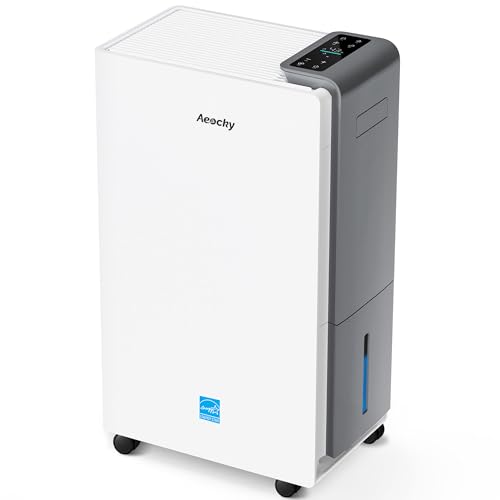
【ENERGY STAR 25 ≠ ENERGY STAR Most Efficient 2025】Don't fall for competitors' word games. With only 2.6% of ENERGY STAR models earning "Most Efficient 2025" title, these options are exceptionally rare on the market. RHEA-001 is one of the few to truly hold this top-tier certification. Many brands use misleading phrases like "Energy Star Efficient 25" or "Energy Star 25" to imply a standard they haven't met. Choosing them is a risk.With AEOCKY, you get verified performance and the peace of mind of authentic, top-tier efficiency.
Low-GWP Refrigerants in Modern Dehumidifiers
Refrigerant choice matters because compressor dehumidifiers use a refrigerant loop to condense water from the air. If refrigerant escapes during use, service, or disposal, it can contribute to climate impact. Lower-impact refrigerants can reduce that consequence compared with higher-impact HFCs, but proper containment, service, and recovery still matter.
The EPA explains that hydrofluorocarbons, or HFCs, are potent greenhouse gases and that the AIM Act requires an 85% phasedown in U.S. HFC production and consumption from historic baseline levels by 2036. The transition makes refrigerant choice and responsible refrigerant management increasingly important.
Low-GWP Refrigerant Choices
When shopping for a new compressor dehumidifier, check whether the manufacturer identifies the refrigerant. For regulatory comparison, Appendix A to 40 CFR Part 84 lists an exchange value of 675 for HFC-32, commonly called R32. The same table lists HFC-134a at 1,430 and HFC-125 at 3,500. That makes R32 lower on this climate-impact measure than those two HFCs, although it is not impact-free.
Refrigerant is only one part of the decision. Efficiency, durability, leakage prevention, maintenance, and end-of-life recovery still matter. Do not replace a safe, efficient, working dehumidifier prematurely only because a newer unit has a different refrigerant. Manufacturing and disposing of another appliance also uses materials and resources.
Why R32 Matters
R32 matters because its listed exchange value is lower than those of HFC-134a and HFC-125 under 40 CFR Part 84. That can reduce the climate consequence of a comparable refrigerant release, but it does not eliminate the need to prevent leakage or recover refrigerant properly. A greener buying decision therefore combines lower-impact refrigerant with strong energy efficiency, appropriate capacity, maintainability, and responsible disposal.
Warning: Do not puncture, crush, or scrap a compressor dehumidifier yourself. EPA appliance-disposal guidance states that refrigerant must be recovered before covered appliances are dismantled or disposed of. Use an appropriate appliance recycler, retailer take-back service, municipal program, or qualified service provider that can handle the refrigerant correctly. Our guide on how to recycle a dehumidifier covers the options.
How Dehumidifiers Help Prevent Mold Damage
Dehumidifiers help prevent mold damage by lowering indoor humidity and reducing the moisture mold needs to grow. They are especially useful in basements, crawl-space-adjacent rooms, laundry areas, and other spaces that remain damp after leaks, drainage, and ventilation problems have been addressed.
There is one important limit: a dehumidifier does not remove existing mold. If mold is already visible or you smell a persistent musty odor, clean up the mold and fix the moisture problem. EPA and CDC guidance both emphasize that moisture control is central to preventing mold from returning.
- Lower indoor humidity: keep conditions less favorable for mold and dust mites.
- Reduce material damage: protect wood, drywall, fabrics, books, and stored items from persistent dampness.
- Reduce repeated remediation: preventing recurring dampness can avoid repeated cleaning and replacement of damaged materials.
- Improve comfort: damp air can feel sticky even when the room temperature is not especially high.
For small mold areas, follow EPA and CDC cleanup guidance. For extensive or recurring mold, sewage-contaminated water, HVAC contamination, or health concerns, use qualified professional guidance rather than relying on a dehumidifier alone.
Do Dehumidifiers Remove Moisture Efficiently?
Yes. A well-chosen dehumidifier can remove moisture efficiently, especially when it is ENERGY STAR certified, suitable for the space, and maintained properly. ENERGY STAR lists capacity in pints per day and uses IEF to describe how efficiently the appliance removes moisture relative to electricity consumption under standardized test conditions.
Temperature also matters. ENERGY STAR advises that if a space typically falls below 65°F, shoppers should consider a product specified for lower-temperature operation. Frost can form on condensing coils below that range and can reduce performance by making the compressor cycle without effectively removing moisture. In a consistently cool room, check the manufacturer’s stated operating-temperature range before choosing a unit.
Maintenance makes a real difference. A clogged filter or blocked intake reduces airflow and can make the unit operate longer. Clean the filter on the schedule in the owner’s manual, keep the intake and discharge clear, wash the bucket, and make sure a continuous-drain hose is routed correctly if you use one.
How to Choose a Greener Dehumidifier
To choose a greener dehumidifier, start with the room’s actual moisture problem and then compare efficiency, capacity, operating temperature, and usability. The best choice is a unit that can reach and maintain the needed humidity level efficiently, shut itself off when the target is reached, and remain serviceable for years.
| Feature | Why it matters |
| ENERGY STAR certification | Reduces electricity use compared with conventional models while meeting current efficiency requirements. |
| Higher IEF | Shows better moisture-removal efficiency per kilowatt-hour under the applicable test procedure. |
| Built-in humidistat | Lets the unit cycle off when the target humidity is reached instead of operating continuously. |
| Suitable capacity | Helps the unit handle the actual moisture load. ENERGY STAR advises that it is better to oversize than undersize when estimating portable-dehumidifier capacity. |
| Drain option | Continuous drainage reduces bucket-emptying interruptions and allows humidity control to continue when properly installed. |
| Washable, accessible filter | Makes regular maintenance easier and helps preserve airflow and efficiency. |
Before buying, ask these questions:
- Is there a leak or drainage problem? Fix that first. A dehumidifier should not be used as a permanent substitute for repairing water intrusion.
- How damp is the space? Use a hygrometer for several days. Repeated readings above 50% deserve attention, while persistent humidity near or above 60% is outside EPA’s preferred range and increases the importance of moisture-source control.
- How cold is the room? Check the manufacturer’s operating-temperature range if the space often falls below 65°F.
- Can the unit drain safely? A properly installed hose to a suitable drain or condensate pump can prevent frequent bucket-full shutdowns.
- Will you maintain it? A neglected filter, intake, bucket, coil area, or drain setup can reduce effective operation.
Recommended Products

Efficient ENERGY STAR Certified Dehumidifier - The Glowells dehumidifier isn't just powerful—it's "Energy Srar" certified. Effectively absorb moisture and energy saving up to 45% than non-cetificated dehumidifier. Max Dehumidification of 52 Pint/D (95℉, 95% RH) Perfect for large spaces 4500 sq.ft like basements, garages, and living rooms. (Note: 52 Pints ≠ Tank Capacity)
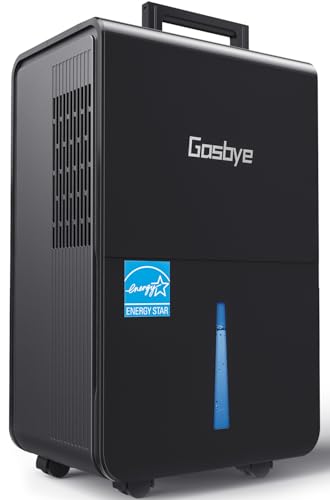
[43-Pound Solid Build] Gasbye DryPrime dehumidifier pulls up to 115 pints/day at 86°F, 80% RH, 73 pints/day at 80°F, 60% RH, and 50 pints/day at 65°F, 60% RH. Since we don’t inflate the pints/day performance figures, what you see is what you get. Dimensions: 11" D × 15" W × 24" H, which may be larger compared to some other "mini" models with inflated pints/day ratings
Greener Ways to Reduce Humidity Before Running a Dehumidifier
The lowest-impact humidity control often starts by reducing the amount of moisture entering the room. These steps can reduce the load on a dehumidifier and shorten its runtime:
- Repair leaks quickly. Plumbing, roof, window, and foundation leaks keep feeding moisture problems.
- Improve exterior drainage. Clear gutters, extend downspouts, and slope soil away from the foundation where appropriate.
- Vent moisture outdoors. Use bathroom fans, kitchen exhaust, and properly vented clothes dryers.
- Keep doors and windows closed during muggy weather. Bringing humid outdoor air inside can make the dehumidifier work harder.
- Use outdoor ventilation when conditions favor it. Opening windows can help when outdoor air is genuinely drier, but it can make the problem worse when outdoor humidity is high.
- Increase airflow. Move furniture away from cold exterior walls and keep interior air paths open when safe and practical.
- Air seal and insulate problem areas. Condensation often forms where warm, moist air reaches cold surfaces.
Note: If humidity is already in the lower part of EPA’s recommended range and the room feels dry, a dehumidifier is probably not the right tool. Measure the room first instead of running one automatically.
Frequently Asked Questions
Are dehumidifiers environmentally friendly?
They can be. A dehumidifier is a more responsible choice when it solves a real moisture problem, prevents material damage, uses electricity efficiently, and runs only when humidity is high. It is not impact-free, because manufacturing, electricity, refrigerant, and disposal all have environmental consequences.
What are the downsides of using a dehumidifier?
The downsides include electricity use, noise, heat released into the room, filter and bucket upkeep, purchase cost, appliance waste, and refrigerant impact if the unit leaks or is discarded improperly. It can also over-dry a room if the humidistat is set too low.
Do dehumidifiers kill mold?
No. A dehumidifier makes conditions less favorable for mold by lowering moisture, but it does not clean existing mold or remove every spore. Clean visible mold safely and fix the leak, condensation, or humidity problem behind it.
What humidity should I set my dehumidifier to?
A practical starting target is often 45% to 50% relative humidity. EPA recommends keeping indoor humidity below 60%, ideally between 30% and 50%, and CDC advises no higher than 50% all day for mold prevention. Use a hygrometer and avoid forcing the room lower than necessary.
Is it better to use an air conditioner or a dehumidifier?
Use the appliance that matches the problem. An air conditioner removes some moisture while cooling, so it may be enough when the home also needs cooling. A dehumidifier is built to lower humidity and suits a damp space that does not need extra cooling.
How should I dispose of an old dehumidifier?
Do not scrap a compressor dehumidifier yourself, because the refrigerant must be recovered before the appliance is dismantled. Use a retailer take-back service, municipal appliance program, or qualified recycler that handles refrigerant correctly.
Conclusion
A dehumidifier can be a sensible environmental tradeoff when it prevents a real moisture problem without running more than necessary. Start by measuring the room’s RH and repairing leaks, drainage, ventilation, or condensation problems. If dehumidification is still needed, choose an ENERGY STAR certified model, compare IEF, use suitable capacity and operating-temperature guidance, set the humidistat around the level actually needed, and keep the filter and airflow path clean. At end of life, use a disposal or recycling channel that recovers refrigerant properly. That combination reduces energy waste while helping protect the home from recurring dampness and mold damage.
How this guide was checked: This update was reviewed against current ENERGY STAR dehumidifier guidance and Version 6.0 efficiency criteria, EPA and CDC mold and humidity guidance, EPA HFC phasedown information, 40 CFR Part 84 refrigerant exchange values, and EPA appliance-disposal guidance on October 13, 2026.
Sources
- ENERGY STAR: Dehumidifiers — current energy savings, capacity guidance, operating temperature, humidity controls, and operating tips.
- ENERGY STAR: Dehumidifiers Key Efficiency Criteria — Version 6.0 criteria, effective October 1, 2025, and Integrated Energy Factor definitions.
- U.S. EPA: A Brief Guide to Mold, Moisture and Your Home — mold prevention, humidity guidance, cleanup principles, and moisture control.
- CDC: Mold — mold health effects, chronic lung disease cautions, cleanup, and prevention guidance.
- U.S. EPA: Frequent Questions on the Phasedown of Hydrofluorocarbons — AIM Act HFC phasedown and refrigerant-management context.
- eCFR: Appendix A to 40 CFR Part 84 — regulated HFC substances and exchange values, including HFC-32, HFC-134a, and HFC-125.
- U.S. EPA: Appliance Disposal — refrigerant recovery and responsible appliance-disposal guidance.