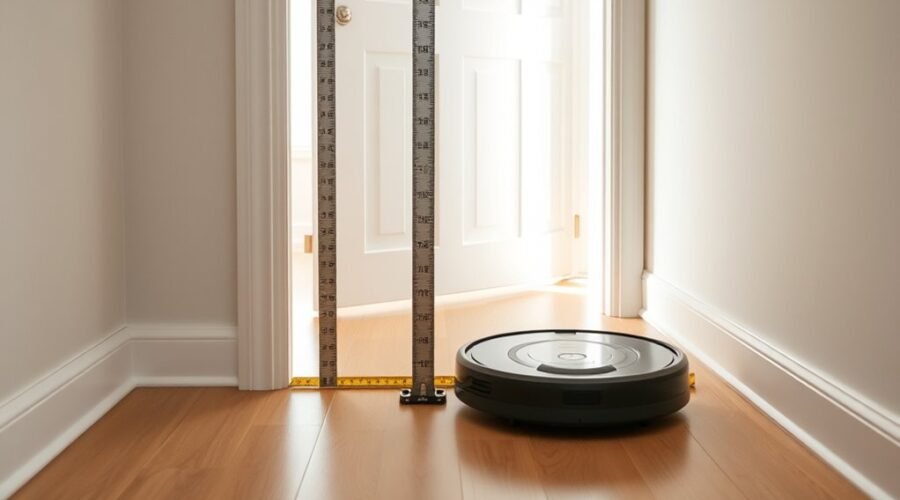
Measuring a door threshold for a robot vacuum starts with the height from the lower floor to the top edge of the threshold, then checks both sides for any difference. The ramp length matters too, along with floor level changes and wood expansion. A careful measurement can determine whether a straight ramp, slanted ramp, or pedestal is needed. The final step is matching that result to the vacuum’s climbing limit, which is where the real decision begins.
How Do You Measure a Door Threshold?
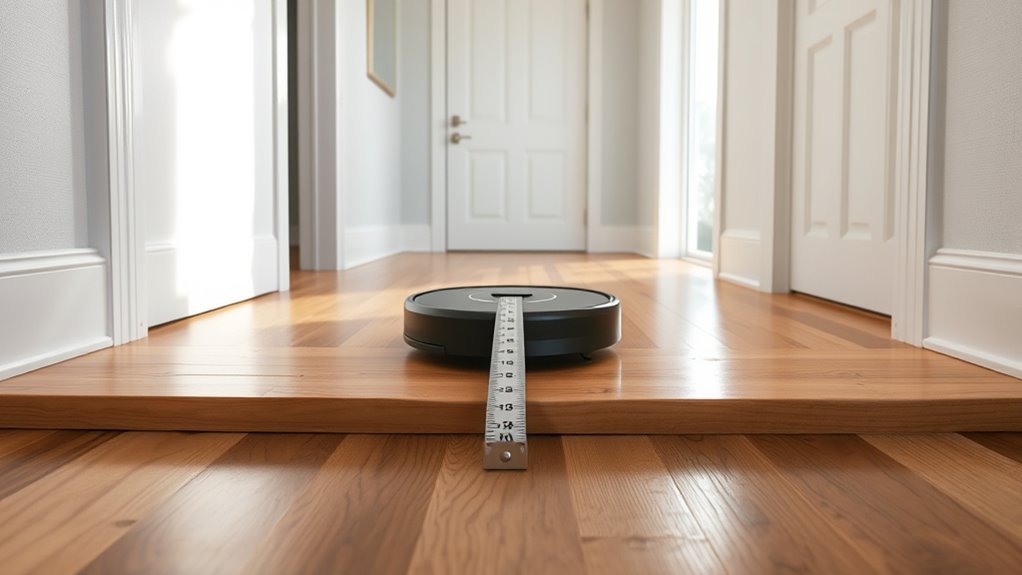
To measure a door threshold accurately, use a measuring tape to record the height from the lower floor to the top edge in millimeters. This direct method gives a precise measure for a robot vacuum and avoids guesswork that can limit movement.
The threshold should be checked on both the left and right sides, because height changes may occur across the opening. The larger reading is the one that matters for judging climbing ability. Any result should be rounded down to the nearest millimeter, since a smaller figure is safer for compatibility than an optimistic estimate.
If a threshold ramp is being planned, the length should be taken from the inner or outer frame edge according to which floor level it meets. Wood expansion should also be allowed for, so the ramp is configured 2 mm shorter than the measured length.
This careful approach supports practical freedom of movement.
Measure the Threshold Height
To measure the threshold height, a ruler or tape measure should be used to find the floor difference from the lower floor to the top edge of the threshold in millimeters.
The measurement should be taken on both sides to capture any variation, and mounting tape should not be included.
If the result is a decimal, it should be rounded down to the nearest millimeter for accuracy.
Find Floor Difference
Measure the height difference at the doorway by placing a ruler or measuring tape from the lower floor to the top edge of the threshold. This threshold height should be measured carefully so the robot vacuum can cross thresholds without obstruction.
The reading should be recorded in millimeters, since most robot vacuum specifications use mm for comparison across floor types. If the value falls between marks, round down to the nearest millimeter to keep the measurement accurate.
No allowance is needed for mounting tape, because it does not change the true floor difference. A precise measure helps identify whether a model can move freely between rooms or remain trapped at the boundary.
Accurate measurement supports a practical choice and greater ease of movement.
Measure Top Edge
The next step is checking the top edge of the threshold itself. To measure threshold height, place a ruler or tape measure from the lower floor to the top edge. Record the result in millimeters for exact compatibility with a robot vacuum. This practical step supports informed choice without waste.
Standard robot vacuums usually clear up to 20 mm, while high-end models may manage 40 mm.
- Measure both left and right sides.
- Note any variation in height.
- Use no allowance for mounting tape.
- Keep the reading in millimeters.
A precise threshold height reading clarifies whether the passage is open to standard robot vacuums or better suited to high-end models.
Round Down Millimeters
When the threshold height falls between whole millimeters, it should always be rounded down to the nearest millimeter for recording. This protects accuracy when a person measure thresholds for a robot vacuum, because a slight overstatement can distort fit. The height should be taken from the lower floor to the top edge with a ruler or tape measure, then the result should round down before being saved.
| Measurement | Record |
|---|---|
| 32.6 mm | 32 mm |
| 18.9 mm | 18 mm |
This method keeps threshold data precise and practical. Even a small error may stop a robot vacuum from crossing freely. Clear measurement supports reliable performance and helps users avoid unnecessary restrictions.
Measure the Ramp Length
A measuring tape should be used to determine the full left-to-right length of the threshold so the ramp fits accurately. To measure the ramp length, the reader should record the door threshold width carefully and keep accurate measurements that support precise results.
If the frame meets the lower floor, the inner sides are used; if it meets the upper floor, the outer sides are used. The ramp length is then set 2 mm shorter to allow for wood expansion and preserve movement freedom.
- Use a rigid measuring tape, not a flexible estimate.
- Note the exact span in millimeters.
- Confirm the chosen edge aligns with the frame position.
- Keep the ramp length slightly short for a clean fit.
A small variation in threshold height across the opening can affect the final build, so both sides should be checked before cutting.
Check Left and Right Threshold Heights
After establishing the ramp length, the next step is to check the threshold height on both sides of the doorway. Each side should be measured separately because threshold heights may differ, affecting robot vacuum movement and threshold ramps. A measuring tape should run from the lower floor to the top edge of the threshold on the left side, then repeat on the right. Record all measurements in millimeters for exact navigation planning and to respect climbing limits.
| Side | Height (mm) |
|---|---|
| Left | ___ |
| Right | ___ |
If one side is higher, that side becomes the controlling value for access. Comparing both measurements helps confirm whether the robot vacuum can cross freely or needs assistance. Accurate numbers support safer navigation, cleaner passages, and better fit for any ramp solution.
Round Down for an Accurate Fit
The threshold height should always be rounded down to the nearest millimeter so the ramp fits accurately.
Millimeter precision matters because even a small overestimate can affect performance and prevent smooth crossing.
Before mounting, the fit should be checked against the rounded measurement to confirm proper configuration.
Why Round Down
Rounding down helps guarantee the ramp height does not exceed the actual threshold, which keeps the fit accurate and the change reliable.
In a threshold test, rounding down gives a safer baseline for building thresholds without guesswork and supports accurate measurements. A 32.6 mm reading becomes 32 mm, helping the robot vacuum cross cleanly and reducing drag.
- It keeps the ramp below the measured limit.
- It supports snug installation despite material movement.
- It lowers the chance of sticking or tipping.
- It preserves cleaning efficiency across rooms.
This practice gives users practical control over access, especially where independence matters.
Millimeter Precision Matters
Millimeter precision matters when measuring a door threshold for a robot vacuum, so a ruler or tape measure should be used and every reading recorded in millimeters (mm).
This threshold measurement should be handled with care, because precision determines whether the robot vacuum can move freely or meet an obstruction. If the height lands between two marks, the value should be rounded down to the nearest millimeter. For example, 32.6 mm becomes 32 mm, which gives a more accurate fit.
A tape measure helps capture the exact threshold height and supports seamless travel across the doorway. Clear millimeter recording removes guesswork, reduces error, and gives the robot vacuum the best chance to pass without getting stuck.
Fit Before Mounting
A slight undercount is safer when fitting a ramp before mounting, so the threshold height should always be rounded down to the nearest millimeter. For door thresholds, this rule supports an accurate fit and preserves threshold-crossing ability. A measured height of 32.6 mm becomes 32 mm, leaving room for installation variables without weakening the ramp configuration.
A reliable measuring tape should be used, and both the left and right sides should be checked because uneven surfaces can change the result. The ramp length should remain about 2 mm shorter than the measured height to allow for wood expansion and small discrepancies.
- Round down before cutting.
- Verify each side separately.
- Allow clearance for expansion.
- Match the ramp to the lowest reading.
Choose a Straight or Slanted Ramp
The threshold’s left and right sides should be checked for height consistency before selecting a ramp type. When the threshold height is uniform across both sides, a straight ramp is usually the best choice. It creates a steady incline, helping the robot vacuum move across the crossing without hesitation. This simple setup preserves functionality and keeps the passage efficient.
If the left and right sides differ, a slanted ramp is more suitable. Its angled profile matches the changing height and supports a gradual shift. That reduces abrupt changes that can disrupt movement or limit access. The exact height difference should be measured before ordering or configuring the ramp, since the correct geometry depends on that value.
Choosing the proper ramp in the configurator allows the threshold solution to fit the actual opening. A precise selection improves performance, supports independent movement, and helps the robot vacuum cross with less resistance.
Check Door Frame and Floor Levels
Door frame and floor levels should be identified before any threshold measurement is taken, because the frame position determines where the measurement starts. The door frame must be examined to see whether it reaches the lower floor level or the upper floor level, since that choice decides where to measure.
If the frame extends to the lower level, measure from the inner sides; if it extends to the upper level, measure from the outer sides. This simple check protects accuracy and supports vacuum compatibility.
- Confirm the frame type before taking any threshold height reading.
- Measure the threshold from the lower floor to the top edge with a tape.
- Check left and right sides for uneven floor levels or variation.
- Round down between millimeter marks to improve ramp fit and function.
Precise measurement preserves freedom of movement for the robot vacuum and reduces avoidable errors.
When to Add a Pedestal
When a threshold ramp needs extra stability or a cleaner fit, a pedestal can be added to connect horizontally with the ramp, especially if the door frame protrudes into the lower room. This addition improves support and creates a more finished edge at thresholds.
A pedestal is especially useful when the height difference between rooms is substantial, because it helps the robot vacuum meet the ramp at a more manageable angle and supports a smooth passage.
The standard ramp incline is often 15°, but some models perform better with a 10° slope. In those cases, a pedestal can help preserve the needed geometry while keeping the install secure.
Some models work better with a 10° slope, and a pedestal helps maintain the right geometry.
Accurate height measurement remains essential, since the pedestal must account for any extra rise. Custom ramps with pedestals can be made to measure for unique doorway layouts, giving each passage a practical, accessible solution that supports mobility and reduces friction at the threshold.
Confirm the Robot Vacuum Fit
With the ramp or pedestal concept established, the next step is to confirm that the robot vacuum can actually clear the threshold. A measuring tape should be used to measure the height from the lower floor to the top edge, recording the result in millimeters. That figure must be rounded down to the nearest millimeter, because even a small difference can change compatibility.
Both sides of the threshold should be checked for variance, since uneven edges can hinder a smooth passage.
- Standard robot vacuum models usually clear up to 20 mm.
- High-end models may manage up to 40 mm.
- Compare the measured height with the vacuum’s climbing capabilities.
- Confirm that the machine can move freely without scraping or stalling.
This simple check protects autonomy and prevents wasted effort.
Accurate measurement makes the selection clear and allows a robot vacuum to move through the home with confidence and freedom.
Frequently Asked Questions
What Is a Good Door Threshold Ramp for a Robot Vacuum Cleaner?
A good threshold ramp for a robot vacuum cleaner uses threshold ramp materials like rubber, aluminum, or wood, with gentle ramp design features, strong robot vacuum compatibility, threshold height limits, and flooring alteration solutions that aid vacuum navigation technology.
Can Robot Vacuums Get Over Thresholds?
Yes—many robot vacuums can clear thresholds, but performance depends on threshold types, vacuum compatibility, robot design, and floor surfaces. Stronger models improve cleaning efficiency. User reviews often reveal which changes cause sticking or smooth passage.
What Is a Threshold for a Robot Vacuum?
A threshold is the raised strip at a doorway that creates floor changes; threshold types affect vacuum compatibility, cleaning efficiency, home layout, and robot design, especially when heights exceed a robot vacuum’s crossing limit.
How High of a Threshold Can a Roomba Go Over?
Standard Roomba models clear about 0.8 inches, while premium versions reach 1.8 inches; what doorway barrier stands between rooms? Threshold height affects robot vacuum capabilities, cleaning efficiency, floor changes, obstacle navigation, and home automation.
Conclusion
To sum up, measuring a door threshold for a robot vacuum requires careful attention to height, ramp length, and side-to-side variation. He or she should round down to the nearest millimeter, verify floor levels, and account for wood expansion before choosing a straight or slanted ramp. If needed, a pedestal can improve stability. Above all, confirming the vacuum’s climbing limit is the make-or-break step for reliable, seamless passage between rooms.