Affiliate Disclosure: This article contains Amazon affiliate links. If you buy through these links, we may earn a commission at no extra cost to you.
If you need a small crawl space dehumidifier in 2026, focus on compact units that fit tight spaces, remove moisture steadily, and offer simple drainage. Some homes only need a quiet 70-pint model with gravity drainage, while wetter crawl spaces may need a stronger commercial unit with a built-in pump. Below, you can compare options such as the ALORAIR 70 PPD, CADPXS pump models, CREWORKS 130 PPD, Airecoler Stellar S10, Abestorm Guardian SN35P, and other compact crawl space dehumidifiers. Look for Energy Star efficiency, auto-defrost, ETL or cETL safety certification, washable filters, and clear drainage options before you buy.
Quick Verdict
For most crawl spaces, start with drainage first. If your drain point is lower than the unit, a compact gravity-drain model like the ALORAIR 70 PPD or Airecoler Stellar S10 can be simple and low-maintenance. If water must move upward or across a longer route, a pump model like the CADPXS pump version, Abestorm Guardian SN35P, or MOISWELL Defender ME-7S will usually make more sense.
Best simple rule: choose 70 PPD for smaller or moderate crawl spaces, 120 to 130 PPD for wetter or larger spaces, and a built-in pump when gravity drainage will not work.
Quick Comparison: Small Crawl Space Dehumidifiers
| Product | Best For | Key Feature | CTA |
|---|---|---|---|
| Quiet Dehumidifier for Home Bedroom Basement, 95oz Tank | Bedrooms, closets, RVs, and moderate humidity spaces | Quiet under 30 dB with 95 oz tank | Check Price on Amazon ➜ |
| ALORAIR 70 PPD Crawl Space Dehumidifier | Compact crawl spaces up to 1,000 sq. ft. | Auto-defrost, ETL listing, gravity drainage | Check Price on Amazon ➜ |
| CADPXS Crawl Space Dehumidifier with Pump | Damp crawl spaces needing pump drainage | 125 PPD capacity with 19.6 ft pump lift | Check Price on Amazon ➜ |
| CREWORKS 130 PPD Crawl Space Dehumidifier | Larger damp crawl spaces and basements | 130-pint saturation capacity and remote display | Check Price on Amazon ➜ |
| Airecoler Stellar S10 Commercial Dehumidifier with Hose | Energy-conscious buyers with smaller spaces | Energy Star certification and compact body | Check Price on Amazon ➜ |
| Abestorm Crawl Space Dehumidifier with Pump and Hose | Compact crawl spaces needing flexible drainage | Built-in pump and gravity drain option | Check Price on Amazon ➜ |
| CADPXS Crawl Space Dehumidifier, 125 Pint Commercial Dehumidifier | Large damp areas needing gravity drainage | 125-pint commercial design with MERV-1 filter | Check Price on Amazon ➜ |
| ALORAIR 120 PPD Wi-Fi Dehumidifier for Crawl Space | Smart humidity monitoring in crawl spaces | Wi-Fi app control and auto-defrost | Check Price on Amazon ➜ |
| MOISWELL Commercial Dehumidifier with Pump (70 Pints) | Energy-efficient pumped drainage | 70-pint saturation capacity with 16.4 ft pump lift | Check Price on Amazon ➜ |
| Crawl Space Dehumidifier with Pump, 70 Pints Energy Star | Small commercial areas, crawl spaces, and attics | 410-watt Energy Star operation with pump | Check Price on Amazon ➜ |
Before You Buy Checklist
- Measure your crawl space entrance before choosing a heavy or wide unit.
- Confirm whether you need gravity drainage or a built-in pump.
- Compare AHAM capacity when possible, not only saturation-rated pint numbers.
- Check filter access, drain hose routing, outlet location, and clearance for airflow.
- Choose auto-defrost if your crawl space gets cool during part of the year.
Quiet Dehumidifier for Home Bedroom Basement, 95oz Tank
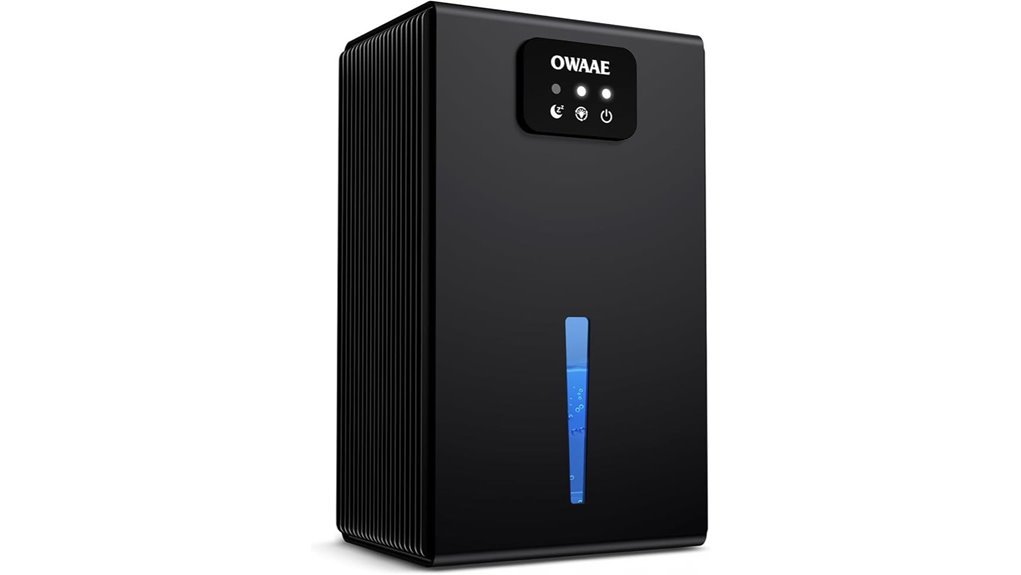
Best Small-Room Helper: If you want a quiet dehumidifier for a small room, closet, bathroom, RV, or lightly damp basement corner, the OWAAE TZ-C4S may fit your needs. It is not the strongest choice for a wet crawl space, but it can help in compact areas where low noise matters more than heavy-duty moisture removal. You get coverage for up to 1,000 sq. ft., a 95 oz tank, and dehumidification up to 1 liter per day. It runs under 30 dB, so it should not disturb sleep, and you can switch between Comfort and Sleep modes. The unit shuts off automatically when the tank is full or misaligned. You can move it with the handle, and the 7-color LED adds a soft glow.
Why You’ll Like It: This model is easy to understand, quiet enough for living areas, and useful when you only need light moisture control rather than a full crawl space drying system.
Best For: People who want a quiet, compact dehumidifier for bedrooms, basements, bathrooms, closets, or RVs, especially in moderate-to-high humidity spaces.
Who Should Skip It: Skip this model if your crawl space has standing dampness, musty odors, or year-round moisture problems. A commercial crawl space unit with continuous drainage will usually be a better fit.
Pros:
- Runs under 30 dB, making it suitable for sleep areas and nurseries
- Covers up to 1,000 sq. ft. with a 95 oz tank and 1 liter/day dehumidification
- Includes Comfort and Sleep modes, auto shut-off, and a portable handle
Cons:
- 1 liter per day is modest for very damp or large spaces
- 220V AC power may limit compatibility in some homes
- No mention of a drain hose or continuous drainage option
Buying Note: This is best treated as a small-space moisture helper, not a full crawl space moisture-control system.
ALORAIR 70 PPD Crawl Space Dehumidifier
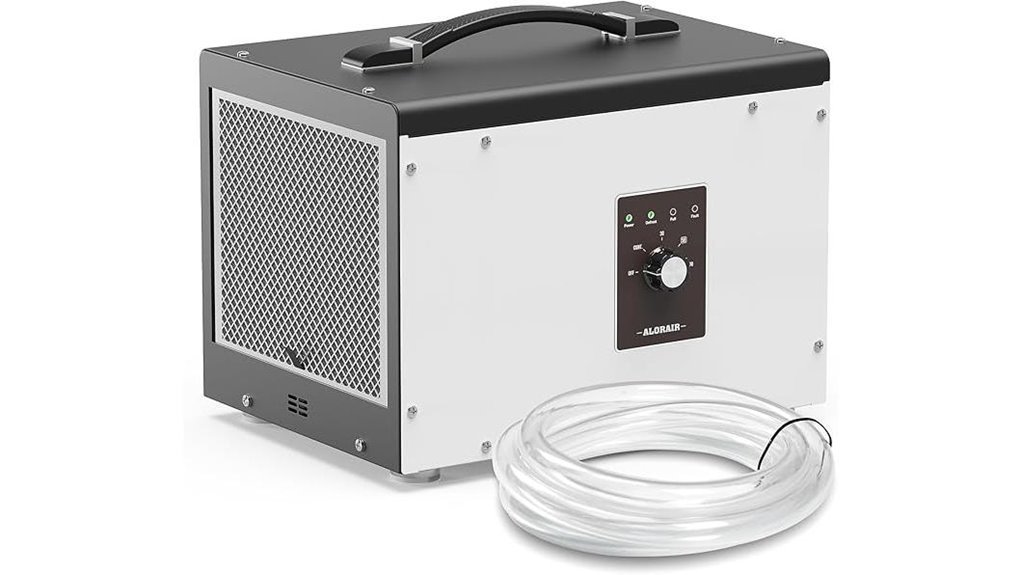
Best Compact Gravity-Drain Pick: The ALORAIR 70 PPD Crawl Space Dehumidifier suits you if you need compact, quiet moisture control under your home. You get a portable commercial unit that covers up to 1,000 sq. ft. and moves air at 115 CFM. It removes 35 pints per day under AHAM conditions, or up to 70 pints at saturation, so it handles many damp crawl spaces and basements well. The ergonomic handle and 6.5-foot drain hose make setup easier, while gravity drainage keeps maintenance low. You also get auto-defrost, a washable MERV-1 filter, memory restart, ETL safety listing, and a 6-year limited warranty.
Why You’ll Like It: It gives you crawl-space-specific features without overcomplicating the setup. If your space has a nearby low drain or sump, the gravity-drain design can keep water moving without bucket emptying.
Best For: Homeowners or property managers who need a compact, quiet dehumidifier for crawl spaces or basements up to 1,000 sq. ft.
Who Should Skip It: Skip it if your crawl space has no nearby drain point or if you need pump drainage to move water upward.
Pros:
- Removes up to 70 pints per day at saturation, with 35 pints per day under AHAM conditions.
- Quiet operation under 50 dB with useful features like auto-defrost and memory restart.
- Easy to use and maintain with a handle, continuous gravity drainage, and a washable MERV-1 filter.
Cons:
- Best suited for smaller areas, so it may not be enough for larger or very wet spaces.
- Manual humidity controls are less precise than digital settings.
- Requires a drain setup for continuous operation, so placement options are more limited.
Buying Note: Choose this model when you want a crawl-space-ready unit but do not need a built-in pump.
CADPXS Crawl Space Dehumidifier with Pump
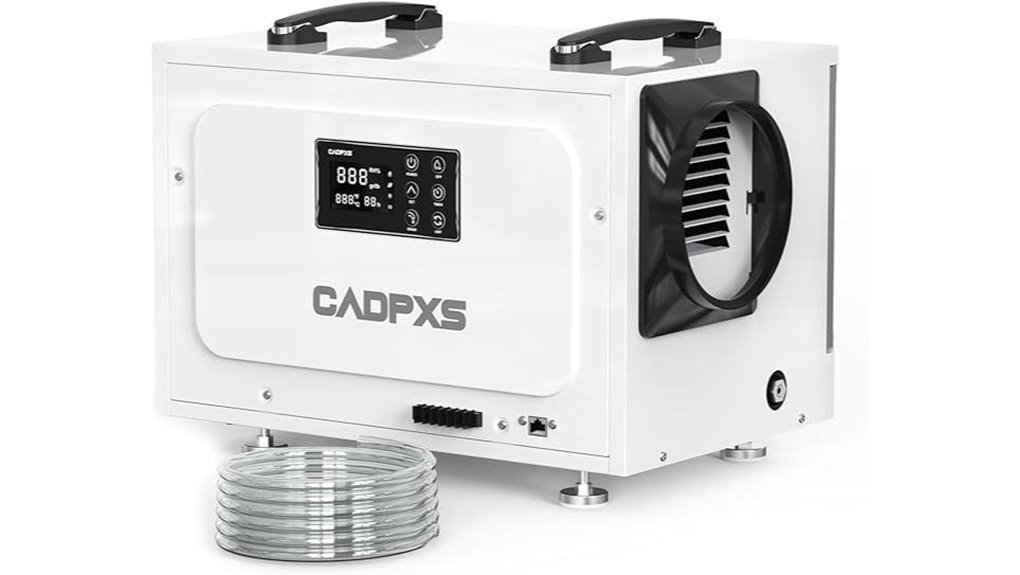
Best High-Capacity Pump Pick: Need a crawl space unit that can handle constant moisture? The CADPXS Remois XP125 gives you 125 pints per day and covers up to 1,300 sq. ft., so it tackles damp crawl spaces with more power than many compact 70-pint models. You can run it continuously, and the built-in pump moves water up to 19.6 feet or lets you drain by gravity. You’ll also appreciate the adjustable feet, handles, and 6-inch exhaust outlet for easier setup. It runs quietly, includes a MERV-1 filter, 24-hour timer, GPP mode, and memory restart. It’s cETL certified and backed by a 5-year warranty.
Why You’ll Like It: This model solves one of the biggest crawl space problems: drainage. The pump makes it easier to send condensate upward or away from the unit when a simple downhill hose path is not available.
Best For: Homeowners or property managers needing a reliable crawl space dehumidifier for large, high-moisture areas with flexible drainage options and continuous operation.
Who Should Skip It: Skip it if your crawl space is small and only mildly damp, because a lower-capacity unit may be easier to place and more cost-effective.
Pros:
- Handles up to 1,300 sq. ft. and removes up to 125 pints per day for strong moisture control.
- Built-in pump with 19.6 ft lift plus gravity drainage makes installation flexible.
- Includes useful conveniences like a MERV-1 filter, memory restart, timer, and quiet operation.
Cons:
- Best suited for crawl spaces and similar environments, so it may be more than needed for smaller rooms.
- No internal water tank, so it requires continuous drainage setup.
- Bulkier unit design may make placement and handling less convenient in tight spaces.
Buying Note: This is one of the better fits in the list if your drain outlet is above the unit or too far for gravity drainage alone.
CREWORKS 130 PPD Crawl Space Dehumidifier
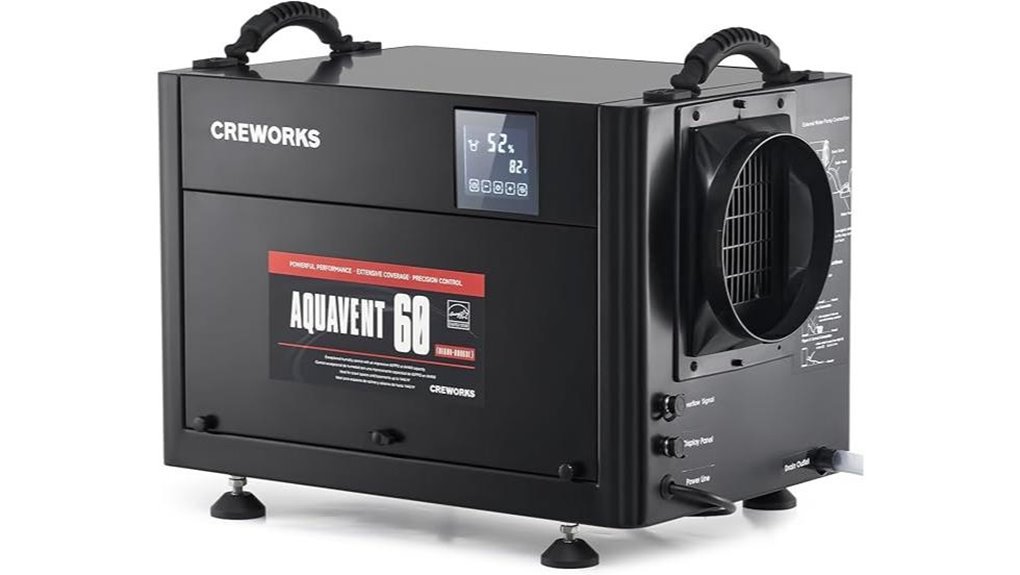
Best for Larger Damp Areas: With 130 pints of saturation capacity, the CREWORKS 130 PPD works well for damp crawl spaces that need more than entry-level moisture removal. You can use it in spaces from 500 to 1,440 square feet, and it removes 60 pints per day under AHAM conditions. Its 265 ccm airflow helps move moisture out efficiently. You get manual, continuous, and night modes, plus automatic shutoff when it reaches your set humidity or timer. The detachable panel lets you adjust settings from 32.8 feet away. Built-in drain, auto defrost, and overflow alarm make it practical for year-round basement or crawl space use.
Why You’ll Like It: This unit is a stronger fit when a smaller 70-pint model may run too often. The detachable panel is also helpful if the unit sits in an awkward crawl space location.
Best For: Homeowners and property managers who need a powerful crawl space or basement dehumidifier for spaces up to 1,440 sq. ft. with flexible remote controls and year-round moisture management.
Who Should Skip It: Skip it if you need a lightweight unit you can move often, because this model is heavier than several compact choices.
Pros:
- Handles both large and damp spaces with 130 pints of saturation capacity and 60 pints per day at AHAM.
- Detachable display panel allows easy control from up to 32.8 feet away.
- Built-in drain, auto defrost, and overflow alarm support low-maintenance, continuous operation.
Cons:
- At 61.7 pounds, it may be bulky and harder to move or install.
- Designed mainly for basements and crawl spaces, so it’s less versatile for general room use.
- 265 ccm airflow is modest compared with some higher-end commercial units.
Buying Note: This model makes the most sense when capacity matters more than easy lifting or frequent relocation.
Airecoler Stellar S10 Commercial Dehumidifier with Hose
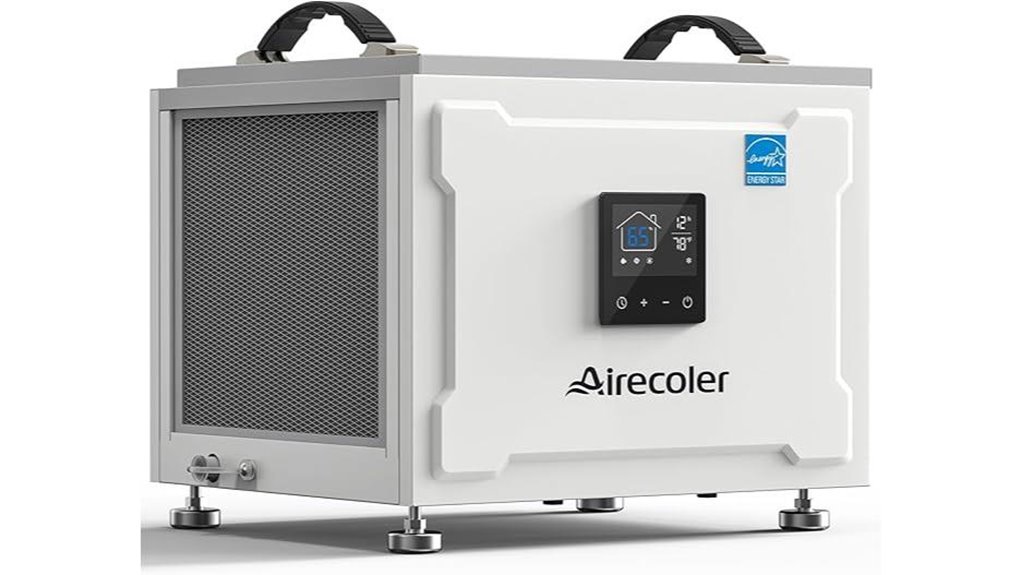
Best Energy-Conscious Compact Pick: Airecoler Stellar S10 suits you if you need powerful crawl space drying in a compact unit. You get up to 70 pints of moisture removal per day, with 34 pints at AHAM, and it can handle areas up to 1,000 square feet. Its Energy Star certification and 450-watt draw help you manage operating costs. You can rely on gravity drainage, so you won’t keep emptying buckets. The remote control, adjustable humidity, automatic defrost, and restart features make it easy to manage. At 15.51 x 13.15 x 12.28 inches, it fits tight spaces, and the 5-year warranty adds peace of mind.
Why You’ll Like It: It combines a small footprint with efficient operation, making it useful for crawl spaces where access and power cost both matter.
Best For: Homeowners, contractors, and property managers who need a compact, energy-efficient dehumidifier for crawl spaces, basements, garages, or other areas up to 1,000 sq ft.
Who Should Skip It: Skip it if you need pumped drainage, because this section describes gravity drainage.
Pros:
- Removes up to 70 pints of moisture per day and covers spaces up to 1,000 sq ft.
- Energy Star certified with a low 450-watt power draw for better efficiency.
- Gravity drainage, remote control, and auto-defrost/restart features make operation easy and low-maintenance.
Cons:
- Best suited for smaller to medium spaces, not large commercial areas.
- At 40.54 pounds, it may still be cumbersome to move for some users.
- Requires a gravity drainage setup, so placement options depend on available slope or drain access.
Buying Note: Pick this one if compact size and energy efficiency are higher priorities than pump drainage.
Abestorm Crawl Space Dehumidifier with Pump and Hose
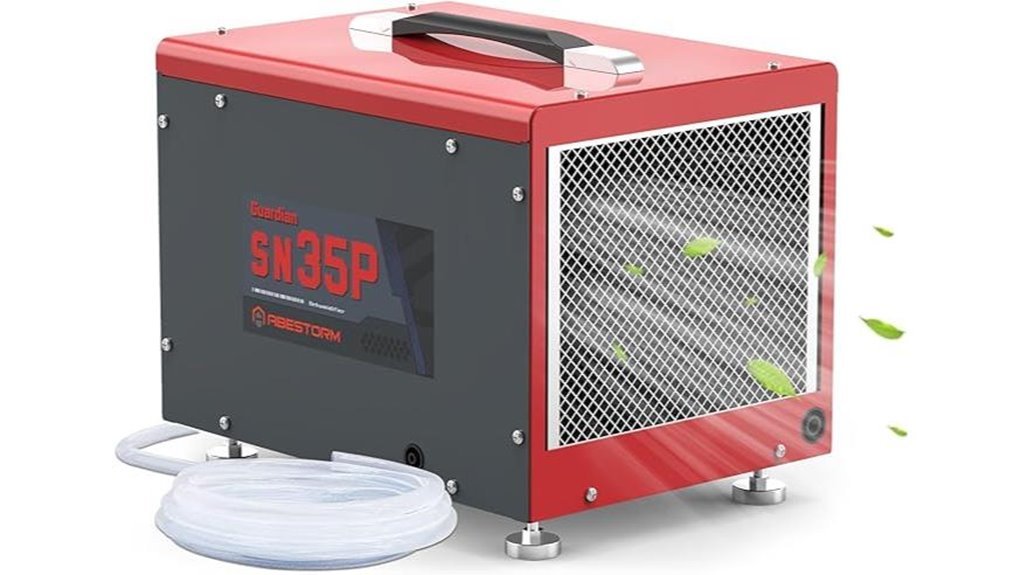
Best Compact Pump Option: The Abestorm Guardian SN35P suits crawl spaces up to 1,000 sq. ft. You get 70 pints of moisture removal per day, so it can help hold humidity near 45% to 55% with less hassle. Its built-in pump lifts water up to 19.6 feet, and you can also use gravity drainage with a hose. Setup is simple: plug it in, set your target, and let it work. It auto-stops at the right level, restarts after humidity rises, and defrosts itself to protect performance. At 15.2 by 11.4 by 11.2 inches, it stays compact.
Why You’ll Like It: This is a practical middle-ground pick if you want a compact body but do not want to depend only on gravity drainage.
Best For: Homeowners or contractors needing a compact crawl space dehumidifier for spaces up to 1,000 sq. ft. with convenient pump or gravity drainage.
Who Should Skip It: Skip it if you have a larger crawl space or a very wet basement that needs higher AHAM-rated removal.
Pros:
- Removes up to 70 pints of moisture per day to help maintain a 45%–55% humidity range.
- Built-in pump can lift water up to 19.6 ft, with an option for gravity drainage through a hose.
- Auto-stop, auto-restart, and auto-defrost features make operation low-maintenance and reliable.
Cons:
- Best suited for smaller areas, so it may not be enough for larger or more open spaces.
- At 38.18 pounds, it may be a bit heavy for frequent moving or repositioning.
- Requires access to a drain setup for the most convenient continuous operation.
Buying Note: This is a practical choice if you want both pump and gravity drainage in a compact crawl space unit.
CADPXS Crawl Space Dehumidifier, 125 Pint Commercial Dehumidifier
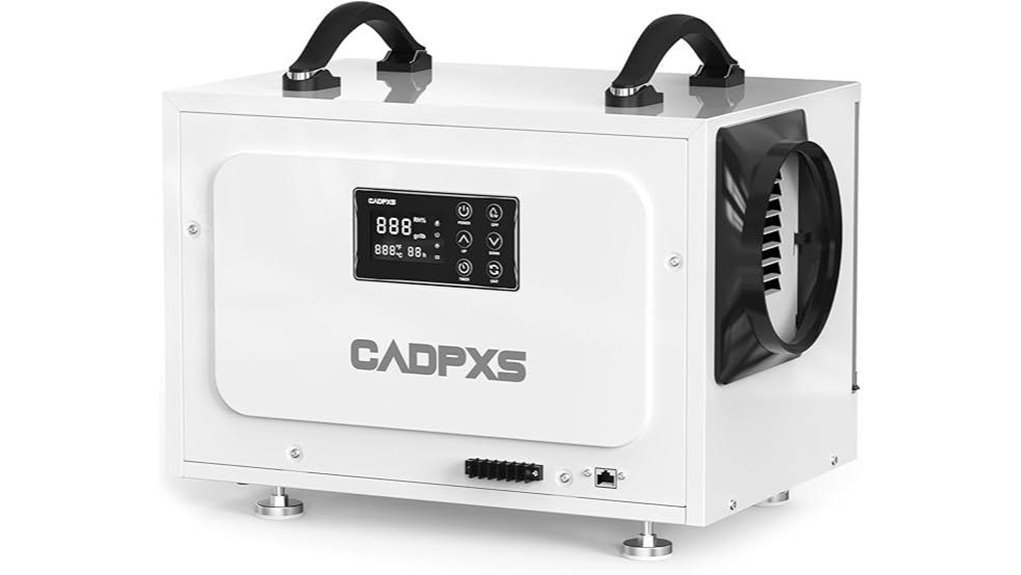
Best 125-Pint Gravity-Drain Pick: If you need serious moisture control in tight spaces, CADPXS fits the job. You can use this 125-pint commercial unit in crawl spaces, basements, garages, warehouses, and other large areas up to 1,300 sq. ft. Its compact body, adjustable feet, and ergonomic handles make placement easier, while the built-in gravity drain and 6.56-foot hose support nonstop water removal. You’ll also get adjustable humidity control, a 24-hour timer, low-noise operation, and a MERV-1 filter. Automatic defrost, cETL certification, and a five-year warranty add confidence.
Why You’ll Like It: It gives you stronger moisture removal without forcing you into a pump setup. For crawl spaces with a reliable downhill drain path, that can mean simpler long-term operation.
Best For: Homeowners and property managers who need a powerful, continuous-drain dehumidifier for crawl spaces, basements, garages, or other large damp areas up to 1,300 sq. ft.
Who Should Skip It: Skip it if your drainage route requires lifting water upward, since this version is described around gravity drainage rather than pump drainage.
Pros:
- Strong moisture removal for commercial and large-space use
- Compact design with adjustable feet and ergonomic handles for easier placement
- Continuous gravity drainage, plus useful features like a timer, humidity control, and automatic defrost
Cons:
- No internal water reservoir, so it must be set up for drainage
- Heavier than smaller portable dehumidifiers at 49.1 pounds
- MERV-1 filtration is basic compared with higher-grade filter options
Buying Note: Choose this over the pump version only if your crawl space has a good gravity-drain path.
ALORAIR 120 PPD Wi-Fi Dehumidifier for Crawl Space
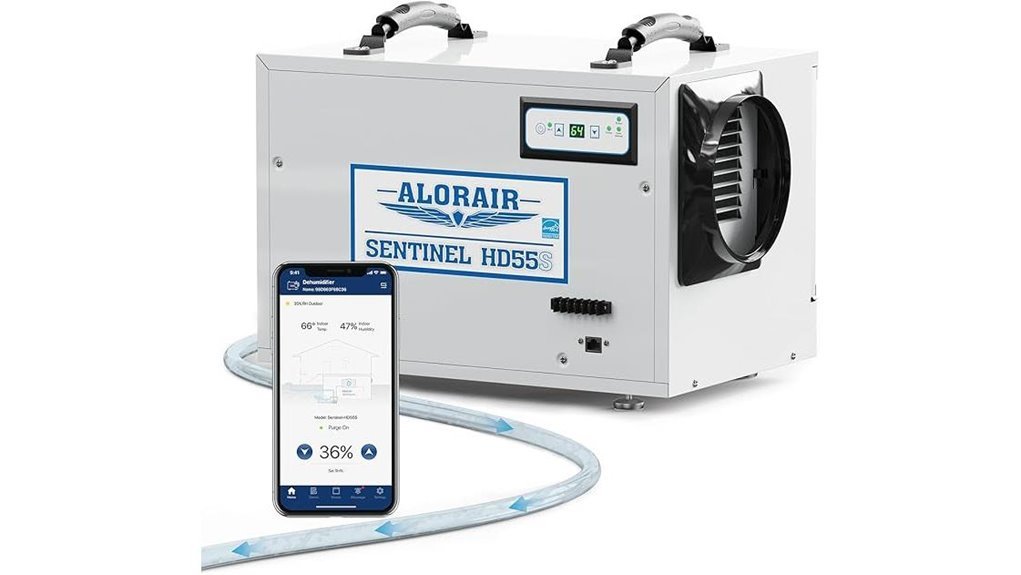
Best Smart Monitoring Pick: ALORAIR’s 120-PPD dehumidifier fits crawl spaces up to 1,300 square feet with smart Wi-Fi control. You can monitor humidity, change settings, and track progress from your phone, and it works with smart home systems too. Its auto-defrost system checks ambient temperature to help stop frost buildup, which may save energy and support longer service life. Internal corrosion protection also reduces coil damage and freon leak risk. You get low-temperature operation, a MERV-1 filter, ETL-listed safety, and a 15-gallon tank. At 41.7 pounds, it’s compact, and the 6-year limited warranty adds confidence.
Why You’ll Like It: Wi-Fi monitoring is useful when you dislike crawling under the home just to check humidity. It can help you spot humidity changes sooner and adjust settings without entering the crawl space as often.
Best For: Homeowners or property managers needing a smart, energy-efficient dehumidifier for crawl spaces or basements up to 1,300 square feet.
Who Should Skip It: Skip it if you prefer simple manual controls or do not need app-based monitoring.
Pros:
- Wi-Fi app control lets you monitor humidity and adjust settings remotely.
- Auto-defrost and internal corrosion protection help improve durability and efficiency.
- Compact, ETL-listed unit with low-temperature operation and a 6-year limited warranty.
Cons:
- 41.7 pounds may still be heavy for some users to move or install alone.
- Best suited for spaces up to 1,300 square feet, so it may be undersized for larger areas.
- Smart features may be unnecessary for users who only need basic dehumidification.
Buying Note: This model is strongest for buyers who want to check crawl space humidity without entering the space often.
MOISWELL Commercial Dehumidifier with Pump (70 Pints)
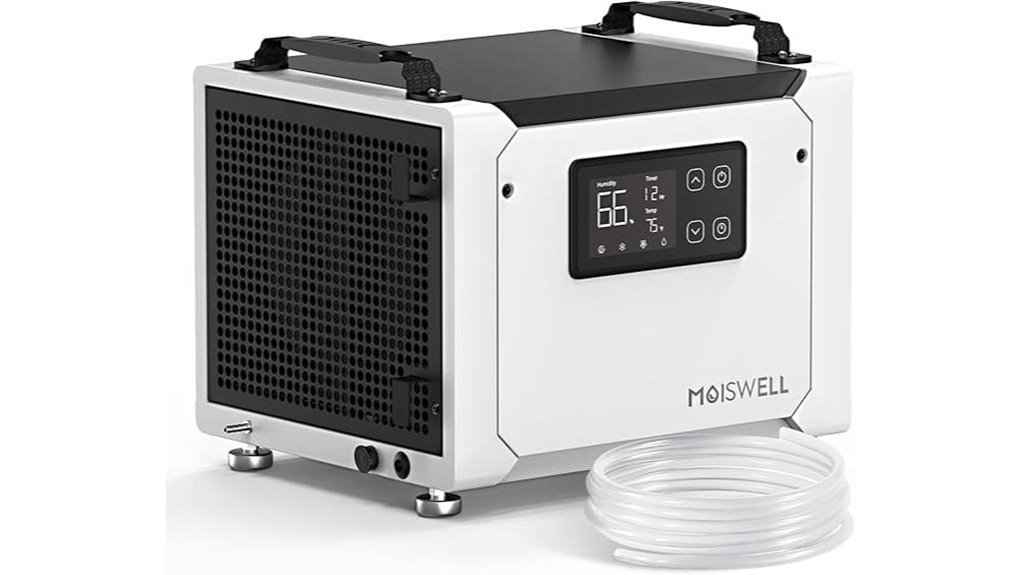
Best Efficient 70-Pint Pump Pick: Moiswell’s Defender ME-7S fits crawl spaces up to 1,000 square feet. You get a commercial dehumidifier that removes up to 70 pints at saturation, or 35 pints per day under AHAM conditions. Its Energy Star design uses just 450 watts, helping you manage power use over time. The built-in pump pushes water up to 16.4 feet, so you can drain it where gravity won’t help. You also get a clear display, adjustable humidity control, a 24-hour timer, automatic defrost, and shutoff. At 40 pounds, it’s easy to carry with the dual handles, too.
Why You’ll Like It: This model focuses on the practical basics: pumped drainage, efficient operation, and controls that are easy to read. It is a good match when you want a pump but do not need a 125-pint unit.
Best For: Homeowners or contractors needing a portable, energy-efficient commercial dehumidifier for crawl spaces, basements, or other areas up to 1,000 sq. ft. with easy pumped drainage.
Who Should Skip It: Skip it if your crawl space is larger than 1,000 sq. ft. or needs more AHAM-rated drying power.
Pros:
- Energy Star efficient with low 450-watt power use for better long-term savings
- Built-in pump can push water up to 16.4 feet, making drainage easier in tough spots
- Portable 40-pound design with dual handles and useful features like a timer, defrost, and shutoff
Cons:
- Coverage is limited to relatively small spaces compared with larger commercial units
- 35 pints per day AHAM capacity may not be enough for very damp or oversized areas
- Metal construction adds durability, but the unit may still be bulky for some users to move frequently
Buying Note: This model is a good fit when you need pump drainage but do not need a 120- or 130-pint unit.
Crawl Space Dehumidifier with Pump, 70 Pints Energy Star
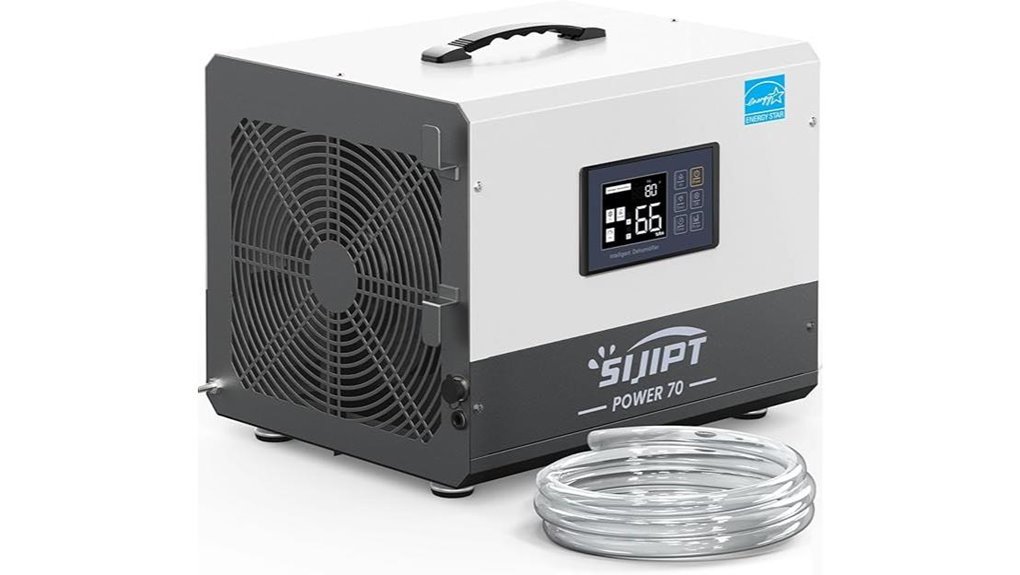
Best Low-Watt Pump Option: This 70-pint Energy Star dehumidifier suits spaces up to 1,000 square feet. You can use it in crawl spaces, basements, attics, warehouses, or other commercial areas. It removes up to 70 pints at saturation and 36 pints under AHAM conditions, while moving 125 CFM. The built-in pump lifts condensate 16.4 feet, so you don’t need a floor drain. You get adjustable humidity control, a 24-hour timer, smart defrost, auto-drain, and auto-restart. At 410 watts, it’s Energy Star certified and runs efficiently. Portable handles make relocation easier, and the included hoses simplify setup.
Why You’ll Like It: This unit is appealing if you want pumped drainage, included hoses, and lower listed wattage in a crawl-space-friendly design.
Best For: Homeowners, landlords, and facility managers who need an energy-efficient, high-capacity dehumidifier for crawl spaces, basements, attics, or small commercial areas up to 1,000 sq ft.
Who Should Skip It: Skip it if you need a dehumidifier for a large commercial space or a crawl space above the stated coverage range.
Pros:
- Built-in pump lifts condensate up to 16.4 ft, allowing continuous operation without a floor drain.
- Energy Star certified with efficient 410-watt operation and useful features like auto-restart, smart defrost, and a 24-hour timer.
- Portable design with integrated handles and included drain hoses makes setup and relocation easier.
Cons:
- Best suited for spaces up to 1,000 sq ft, so it may be undersized for larger areas.
- At 40 lbs, it may still be somewhat heavy to move frequently.
- Warranty details are not clearly specified upfront and must be requested.
Buying Note: Consider this if you want a 70-pint pumped unit with lower listed wattage and included hoses.
Factors to Consider When Choosing a Small Crawl Space Dehumidifier
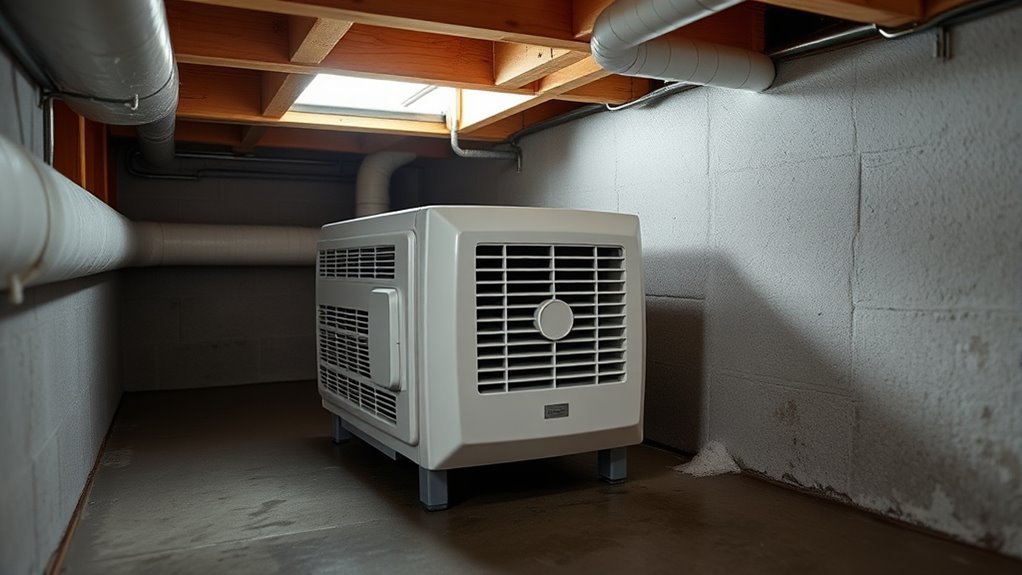
When you choose a small crawl space dehumidifier, start by matching its coverage area and moisture removal rate to your space’s needs. Then check the drainage options, noise level, and energy efficiency so the unit fits your setup and will not create extra upkeep. The right balance of these factors helps you keep your crawl space dry without constant attention.
Coverage Area
Coverage starts with the size of your crawl space, so choose a small dehumidifier rated for the area you need to cover, typically about 500 to 1,300 square feet for residential spaces. You’ll get better results when the unit matches your crawl space’s actual footprint instead of relying on guesswork. Check the manufacturer’s rating and make sure it fits your layout, especially if the space has tight corners or segmented sections. If your crawl space sits in a damp climate, pick a model built for moderate to high humidity so it can keep up year-round. Also confirm it can handle your region’s highest moisture levels. When you size the coverage correctly, you help protect against mold, wood damage, and musty odors.
Moisture Removal Rate
Once you’ve matched the dehumidifier to your crawl space size, check how much moisture it can pull from the air each day. Look for the moisture removal rate, usually listed in pints per day, or PPD. That number tells you how much water the unit can extract under specific temperature and humidity conditions. A 70-PPD model can handle moderate dampness, while a 120-PPD unit suits wetter spaces. Check AHAM ratings, too, because standardized test conditions help you compare real performance more accurately. If your crawl space runs humid or has a larger footprint, you’ll usually need a higher extraction rate to keep moisture in check and protect the space effectively.
Drainage Options
Drainage options can make or break a crawl space dehumidifier’s convenience. If you want hands-off operation, choose a model with a built-in pump. It can push water vertically, so you do not need a nearby floor drain. Gravity drainage also works well when your setup lets water flow naturally to an outlet, and it can keep moisture moving without your help. A drain hose adds another layer of ease by connecting directly to existing plumbing or a sump. If your crawl space layout is tricky, adjustable drainage height gives you more installation flexibility. You should also check for auto shut-off, because it helps prevent overflow if the hose clogs or the drain backs up.
Noise Level
Noise matters more than you might think when choosing a small crawl space dehumidifier, especially if the space sits under a bedroom or living area. You’ll usually see noise ratings from under 30 dB to about 50 dB, so aim low if you want peace upstairs. A unit around 30 dB sounds like a whisper, making it a smart pick for bedrooms, nurseries, and other quiet spaces. Many models include sound-dampening features that help them run without noticeable hum. Look for products explicitly labeled for quiet operation, since that’s the clearest sign they’re suited to residential use. When you choose a quieter model, you’ll feel less stress, notice less distraction, and stick with it more consistently.
Energy Efficiency
Energy efficiency can make a big difference in what you spend over time, so pay attention to a dehumidifier’s certification, wattage, and output. Look for Energy Star certification, since it shows the unit meets recognized efficiency standards. You should also check operating wattage; many models use about 410 to 450 watts, and lower draw can help trim costs. Match moisture removal capacity to your crawl space’s humidity level too. When a dehumidifier handles the load well, it runs less wastefully. Continuous drainage, especially with a built-in pump, can also support efficient operation by reducing stop-and-start cycling.
Safety Features
Safety features matter just as much as performance when you’re choosing a small crawl space dehumidifier. You should look for automatic shut-off protection so the unit stops before the tank overflows or sits improperly, helping you avoid water damage. An auto-defrost system is another smart pick because it prevents frost buildup, keeps the dehumidifier running in cold spaces, and can extend its life. Check for ETL or cETL certification to confirm it meets safety standards. Built-in filters also help by catching dust and airborne particles, which protects the internal parts and supports cleaner air. Finally, choose a model with memory restart, so after a power outage it returns to your previous settings and keeps humidity under control without extra effort.
Crawl Space Access and Installation
Before buying, measure the crawl space entry, the height under joists, and the distance to your drain or sump. A compact dehumidifier still needs enough clearance for airflow, filter access, and hose routing. If the unit weighs 40 pounds or more, plan how you will carry it safely into position. Also check whether your electrical outlet is grounded and close enough for the cord. Avoid setups where the hose can kink, freeze, or slope the wrong way.
Pro Tips for Better Crawl Space Drying
- Do not oversize blindly: A larger unit can help in wet spaces, but correct drainage and air sealing matter too.
- Keep the filter reachable: A hard-to-access filter is more likely to be ignored, which can hurt airflow and performance.
- Watch hose slope: Gravity drains need a steady downhill route. A small dip in the hose can cause water to sit.
- Use a separate hygrometer: A small humidity monitor can help confirm whether the crawl space stays in your target range.
Safety Note
A dehumidifier helps control humidity, but it does not fix every crawl space problem. If you see standing water, damaged wiring, heavy mold growth, sagging wood, pest damage, or drainage problems around the foundation, address those issues before relying on a dehumidifier alone. Use a grounded outlet, avoid extension cords unless the manufacturer allows them, and keep drain hoses routed where they cannot freeze, kink, or back up.
Frequently Asked Questions
How Often Should I Service a Crawl Space Dehumidifier?
You should service your crawl space dehumidifier every 6 to 12 months, and you’ll want to check filters, drain lines, and coils monthly. If humidity rises or it runs nonstop, service it sooner.
Can One Dehumidifier Handle Multiple Small Crawl Spaces?
Yes, you can sometimes use one dehumidifier for multiple small crawl spaces, but you’ll need enough airflow, proper ducting, and balanced humidity loads. If spaces vary much, you’ll likely need separate units.
What Humidity Level Is Ideal for a Crawl Space?
You should keep your crawl space humidity between 45% and 55%. That range helps you limit mold, protect framing, and avoid excess moisture. If it stays above 60%, you’ll want dehumidification.
Do Crawl Space Dehumidifiers Work in Uninsulated Spaces?
Yes, you can use them, but they’ll work harder in uninsulated spaces. You’ll need a properly sized unit, good drainage, and air sealing; otherwise, moisture keeps sneaking back like a thief.
How Much Energy Does a Small Crawl Space Dehumidifier Use?
You’ll usually use 300 to 700 watts while it runs, so monthly energy depends on runtime. In a damp crawl space, you may spend about 5 to 15 dollars per month.
Is a Pump Worth It for a Crawl Space Dehumidifier?
Yes, a pump is worth it if the water needs to move upward or across a long route to reach a drain. If your crawl space already has a nearby low drain or sump, gravity drainage may be enough.
What Size Dehumidifier Do I Need for a Small Crawl Space?
For many small crawl spaces, a 70-pint saturation-rated unit may be enough. Wetter or larger spaces may need a 120- to 130-pint model, especially if humidity stays high after air sealing.
Should I Choose a Tank or Continuous Drainage for a Crawl Space?
Continuous drainage is usually better for crawl spaces because you do not need to crawl in and empty a tank. A tank-style unit is more useful for rooms, closets, RVs, and smaller areas where you can check it often.
Is Auto-Defrost Important in a Crawl Space Dehumidifier?
Yes, auto-defrost is important if your crawl space gets cool. It helps reduce frost buildup on the coils, protects drying performance, and supports more reliable year-round operation.
Conclusion
The best small crawl space dehumidifier depends on your moisture level, square footage, and drainage path. If you want a compact gravity-drain unit, the ALORAIR 70 PPD and Airecoler Stellar S10 are practical options. If you need pumped drainage, compare the CADPXS pump model, Abestorm Guardian SN35P, MOISWELL Defender ME-7S, and the 70-pint Energy Star pump model. For larger or wetter spaces, the CREWORKS 130 PPD or ALORAIR 120 PPD Wi-Fi model may make more sense. Choose the unit that fits your crawl space access, drain setup, and humidity load, and you’ll give your home a drier, steadier foundation.
Final Recommendation
Choose ALORAIR 70 PPD if you want a simple compact crawl space unit with gravity drainage. Choose CADPXS with Pump if you need stronger drying and the water must move upward. Choose Airecoler Stellar S10 if compact size and energy efficiency are top priorities.
For most buyers, the right product is not only the one with the highest pint rating. The best choice is the one that fits your crawl space entrance, has the drainage method your layout requires, and can maintain steady humidity without constant attention.