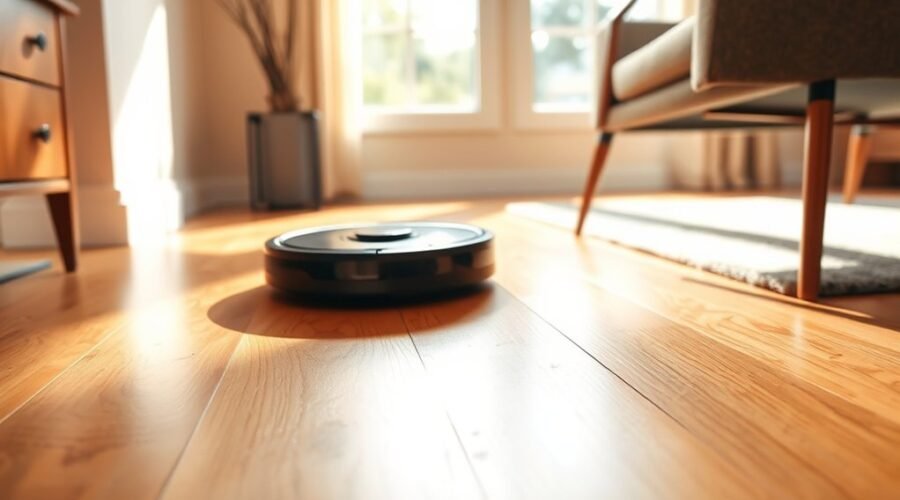
Robot vacuums can scratch hardwood floors, but most damage is preventable. A robot that moves smoothly and stays clean is generally safe for finished wood. Problems begin when trapped grit, tangled hair, or worn parts drag across the surface. Knowing which components cause scratches helps you protect your floor without giving up automatic cleaning.
Quick Answer
Yes, robot vacuums can scratch hardwood floors, especially when grit gets trapped beneath their wheels or the front caster stops rotating. However, scratching is uncommon with a properly maintained machine. Choose a model with floor-friendly brushes and wheels, remove trapped debris regularly, and avoid running a damaged vacuum on delicate wood finishes.
Key Takeaways
- A jammed front caster is a major source of floor damage because it can drag abrasive particles across the finish.
- Pine and other relatively soft woods are more vulnerable to dents, while Brazilian cherry is much harder than common oak.
- Matte and satin finishes generally hide minor scratches better than glossy finishes, although coating durability also matters.
- Pet hair increases maintenance needs because it can wrap around wheels and brush axles.
- Gentle components and smart navigation help, but no robot vacuum can guarantee scratch-free cleaning.
Can a Robot Vacuum Scratch Hardwood Floors?
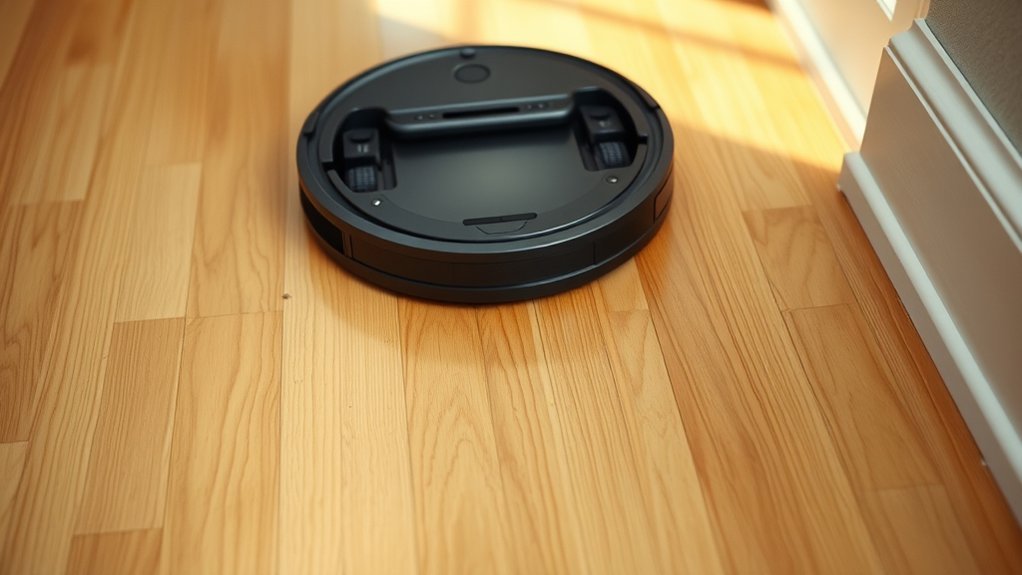
Yes, a robot vacuum can scratch hardwood floors when abrasive debris becomes trapped in its moving parts. However, most modern models are designed to travel across hard surfaces without damaging them during normal use.
The main concern is not suction power. It is unwanted friction between the vacuum and the floor.
For example, a small grain of sand lodged beneath a wheel can scrape the finish as the robot moves. Hair wrapped around the front caster can stop it from turning freely, causing it to drag.
Many visible marks affect the protective finish rather than the wood underneath. Deeper scratches may reach the wood, especially on older or softer flooring.
Hardwood floors also vary in sensitivity. A durable factory-finished floor may tolerate routine robot cleaning better than an older floor with a worn protective coating.
The safest approach is to use a suitable machine, keep its moving parts clean, and watch for unusual scraping sounds or changes in movement.
What Causes Robot Vacuums to Scratch Hardwood?
Robot vacuums usually scratch hardwood because of trapped dirt, jammed wheels, damaged brushes, or exposed hard components. These problems can turn ordinary cleaning into repeated contact with abrasive material.
Understanding the causes makes it easier to identify a problem before it damages a larger area.
Wheel Jamming Risks
A jammed front caster is one of the clearest risks to hardwood flooring. This small wheel helps the robot change direction while its main wheels drive it forward.
When hair, dust, or grit collects around the caster axle, the wheel may stop rotating normally. The robot can then drag the wheel instead of rolling smoothly.
Rear drive wheels can also collect grit in their tread. Even rubber wheels may leave marks if hard particles become trapped against the finish.
| Risk | Possible Effect |
|---|---|
| Front caster jam | Dragging and straight scratches |
| Debris buildup | Uneven movement and scuffing |
| Dirty wheel assembly | Abrasive particles rubbing against the finish |
| Clogged rear wheels | Skidding or curved marks during turns |
A healthy caster should spin freely without grinding or sticking. If the robot drags, squeaks, or leaves repeated tracks, stop the cleaning cycle and inspect the wheels.
Dirty Brush Assembly
A dirty brush assembly can scratch hardwood when hard debris becomes caught in the brush or its surrounding housing. Hair wrapped tightly around the roller may also interfere with normal rotation.
Most robot vacuums use a main roller brush to collect debris and a side brush to sweep dirt away from edges.
During normal operation, these parts should move without scraping the floor.
Problems can develop when:
- Sand or small stones become trapped between brush components.
- Hair wraps around the roller ends or bearings.
- A brush becomes bent, damaged, or incorrectly installed.
- The brush housing contains dirt that rubs against the floor.
Embedded grit can act like sandpaper during repeated cleaning passes. This is especially concerning when the machine travels over the same area every day.
Cleaning the brushes and checking that they rotate normally helps prevent this type of damage.
Hard Plastic Components
Hard plastic parts can scuff delicate hardwood finishes if they make direct contact with the floor. However, plastic does not automatically cause scratches simply because it is harder than rubber.
The greater danger comes from damaged components, trapped grit, and parts that sit lower than intended.
| Component | Risk | Fix |
|---|---|---|
| Rear wheels | Embedded dirt may scrape the finish | Remove grit from the tread |
| Front caster | May drag when blocked | Clear hair and debris |
| Wheel housing | Damaged or exposed plastic may scuff wood | Inspect for cracks and wear |
Rubber-covered wheels are often a good choice for finished hardwood because they provide traction and softer contact.
However, they still require cleaning. A piece of grit caught in rubber can damage a finish just as an abrasive particle caught in plastic can.
Which Hardwood Floors Show Damage Fastest?
Soft woods, worn finishes, and older flooring with limited surface protection tend to show damage more easily. However, wood hardness and finish durability are different factors.
A hard wood species can still develop surface scratches if its protective coating is damaged.
Soft Wood Risks
Pine and cedar are relatively soft woods, making them more vulnerable to dents and indentation. Harder species such as oak, maple, and hickory generally resist denting better.
One important distinction concerns Brazilian cherry, also called jatoba.
Despite its name, Brazilian cherry is a very hard wood. It is substantially harder than common red oak on the Janka hardness scale.
The Janka scale measures how much force it takes to press a steel ball into wood. It helps compare dent resistance, but it does not directly measure how easily a floor finish scratches.
The National Wood Flooring Association’s wood hardness guide provides these values for solid wood species.
| Wood Species | Janka Hardness | Relative Dent Resistance |
|---|---|---|
| Southern yellow pine (loblolly/shortleaf) | 690 lbf | Lower |
| Northern red oak | 1,290 lbf | Moderate |
| Hard maple | 1,450 lbf | Higher |
| Hickory/pecan | 1,820 lbf | High |
| Brazilian cherry (jatoba) | 2,820 lbf | Very high |
These figures explain why soft pine can dent more easily than oak or Brazilian cherry.
Still, no wood species is scratch-proof. Even hard woods may show circular scuffs when a robot drags grit across their finish.
Engineered hardwood also deserves attention. Its wear resistance depends on the top wood layer and protective coating. The Janka ratings for solid wood should not be applied directly to every engineered flooring product.
Antique flooring may need extra care because its finish can be worn, thin, or uneven.
Finish Type Matters
The finish on a hardwood floor affects both durability and how noticeable scratches appear. A strong protective coating can reduce surface wear, while its sheen changes how clearly small marks are seen.
Lower-sheen finishes usually conceal fine scratches better than glossy ones because they reflect less light.
| Finish Type | Appearance of Minor Scratches |
|---|---|
| Matte | Often less noticeable |
| Satin | Usually less noticeable than gloss |
| Glossy | Often more noticeable in reflected light |
| Antique finish | Depends on age, coating, and existing wear |
| Low-quality or worn finish | May offer reduced protection against damage |
A glossy floor is not necessarily weaker than a matte floor. A durable glossy coating may resist abrasion better than a poorly maintained matte one.
Likewise, a satin-finished oak floor can develop permanent scratches if grit becomes trapped under a robot’s wheels.
If your hardwood has an older oil, wax, or delicate surface finish, confirm that your robot’s cleaning method suits the flooring.
How Does Pet Hair Increase Scratch Risk?
Pet hair increases scratching risk when it wraps around a robot vacuum’s wheels and brush axles. The hair itself is usually not abrasive enough to scratch a sound hardwood finish.
The problem develops when hair restricts movement or traps other debris.
For example, long strands can wind tightly around the front caster axle. As the buildup grows, the caster may resist turning and eventually drag across the floor.
Hair can also collect around the main brush bearings, reducing cleaning performance and putting extra strain on moving components.
Households with shedding pets may experience several related problems:
- More frequent wheel tangles.
- Extra dirt and grit carried into the home.
- Reduced brush rotation from wrapped hair.
- Repeated cleaning passes over areas with stubborn debris.
Pets’ nails can also scratch hardwood independently of the robot vacuum. Keeping nails trimmed and limiting tracked-in grit helps reduce both sources of wear.
Homes with long-haired pets generally need more frequent inspections than homes with little hair or dust.
Which Robot Vacuums Are Safest on Hardwood?
The safest robot vacuums for hardwood floors combine effective debris pickup, suitable wheel and brush materials, and reliable navigation. However, no model is guaranteed to prevent scratches.
Several models offer features that make them worth considering for homes with hard flooring.
Roborock Qrevo Curv
The Roborock Qrevo Curv uses a DuoDivide main brush and an anti-tangle side brush to help manage hair.
It also has a liftable chassis for moving between different floor levels and LiDAR-based mapping for planned cleaning routes.
These features are useful for homes with pets and mixed flooring. However, its wheels and brushes still need regular inspection.
Roborock Qrevo Curv 2 Flow
The Roborock Qrevo Curv 2 Flow includes anti-tangle brushes and a self-cleaning roller mop.
Its obstacle recognition system helps it move around everyday objects, while the dock handles much of the mop maintenance.
This model may suit households that want both vacuuming and mopping. Use its wet-cleaning functions only when your hardwood finish permits them.
Dreame X60 Max Ultra Complete
The Dreame X60 Max Ultra Complete combines a detangling dual-brush system with camera-based obstacle detection.
Its brushes are designed to remove dust and hair from different surfaces, while its navigation system helps it avoid objects during cleaning.
Advanced obstacle detection can reduce accidental collisions, but it does not eliminate the risk of trapped grit.
Shark PowerDetect UV Reveal
The Shark PowerDetect UV Reveal combines robotic vacuuming, mopping, and advanced navigation.
It includes UV stain detection and edge-cleaning features that help identify and clean difficult areas.
These features may improve floor coverage. However, they are not proof that the machine is more scratch-resistant than competing models.
eufy Omni C28
The eufy Omni C28 features DuoSpiral detangling brushes, smart navigation, and a self-cleaning roller mop.
Its brush design aims to reduce hair wrapping, which can lower the amount of maintenance needed around the cleaning rollers.
For hardwood owners, that is helpful, although the wheels must still remain free of grit.
Which should you choose? Prioritize the model that cleans your flooring effectively and is easy to maintain. Anti-tangle brushes and obstacle avoidance are useful, but the condition of the wheels matters just as much.
For hardwood floors, clean wheels and brushes provide more reliable protection than any manufacturer’s promise of gentle cleaning.
What Features Protect Hardwood Floors?
The most useful hardwood-protection features are gentle floor-contact parts, effective debris pickup, and navigation that limits unnecessary contact with obstacles.
Look beyond suction ratings when comparing robot vacuums.
- Rubber-covered drive wheels: Provide traction and softer contact with the floor.
- Floor-friendly brushes: Help collect dust without relying on harsh, exposed components.
- Anti-tangle brush systems: Reduce the chance of hair interfering with brush rotation.
- Smart navigation: Helps the vacuum follow planned routes and avoid some obstacles.
- Soft bumpers: Reduce harsh contact with furniture and surrounding surfaces.
- Adjustable cleaning modes: Allow you to use settings suited to hard floors rather than aggressive carpet cleaning.
- No-go zones: Let you exclude delicate flooring or areas where the robot repeatedly becomes stuck.
A removable front caster and accessible brush assembly also make maintenance easier.
For vacuum-mop combinations, water control is another important feature. Hardwood does not tolerate excessive moisture, especially around seams or areas with damaged finishes.
If your flooring manufacturer does not recommend wet robotic cleaning, use vacuum-only mode.
How Do You Clean the Front Wheel Assembly?
Cleaning the front wheel assembly removes hair, dust, and grit that can cause dragging. It is one of the most useful maintenance tasks for protecting hardwood floors.
The exact removal method depends on your robot vacuum model.
According to iRobot’s front caster wheel maintenance instructions, a caster clogged with hair and debris may damage floors. The company recommends cleaning the caster every two weeks and replacing it every 12 months or as needed for applicable Roomba models.
Warning: Not every robot vacuum has a removable front wheel. Some Roomba models have fixed caster assemblies. Never force a wheel out or pry against the housing unless the manufacturer’s instructions specifically allow removal.
Step 1: Turn Off the Robot Vacuum
Stop the cleaning cycle and switch off the machine according to its instructions. Remove it from the charging dock before inspecting its underside.
Step 2: Inspect the Front Caster
Carefully turn the robot over on a clean, soft surface. Look for hair, grit, or other material caught around the caster and its housing.
Spin the wheel gently by hand to check whether it moves freely.
Step 3: Remove the Wheel if Supported
If your model allows caster removal, follow the manufacturer’s instructions to take it out.
On many compatible Roomba models, the caster module can be pulled from its housing. Other designs use different removal methods.
Step 4: Clear Hair and Debris
Remove wrapped hair and trapped particles from the wheel, axle, and surrounding cavity.
Wipe the components with a soft cloth. Use a suitable cleaning brush to loosen dirt in narrow areas.
Do not use excessive force or sharp tools that could damage plastic parts or bearings.
Step 5: Reinstall and Check Rotation
Reassemble the caster as directed by the manufacturer. Make sure all parts are seated securely.
Spin the wheel again. It should move without sticking, grinding, or wobbling excessively.
If it remains stiff after cleaning, the caster or its housing may need replacement.
Step 6: Test the Robot on a Safe Surface
Place the robot on a clean area of flooring and run a short cleaning cycle while watching its movement.
It should travel and turn without dragging, scraping, or leaving unusual marks.
If the problem continues, stop using the machine until the affected part is repaired.
What Maintenance Prevents Hardwood Damage?
Regular maintenance helps prevent scratches by removing abrasive debris before it becomes trapped in the vacuum. A simple routine is more useful than waiting for obvious damage to appear.
The National Wood Flooring Association’s maintenance guidance recommends sweeping, dust mopping, or vacuuming with a bare-floor setting to remove dirt from wood floors.
For a robot vacuum, use this practical checklist:
- Before cleaning: Remove visible stones, coarse grit, cords, and small objects that may become trapped beneath the robot.
- After cleaning: Check for unusual hair buildup, debris around the wheels, and signs of brush damage.
- Regularly: Clean the main brush, side brushes, and wheel assemblies using your model’s instructions.
- When parts wear: Replace cracked wheels, damaged brush components, or a caster that no longer rotates correctly.
- When changing surfaces: Select appropriate hard-floor settings and confirm that any mopping feature is safe for the finish.
Also keep the charging dock area clean. Dirt collected around the dock can be picked up by the robot’s wheels during repeated departures and returns.
Place breathable mats near entrances to reduce sand and outdoor grit brought into the home.
If the robot repeatedly becomes stuck in one location, adjust its cleaning area or set a no-go zone rather than allowing it to scrape the same spot.
Pro Tip: After cleaning the robot’s wheels, test them over a clean sheet of white paper. Dark streaks, loose grit, or other residue can reveal dirt that was difficult to see against the wheel surface. This does not replace checking that the wheels spin freely.
What Should You Do if the Robot Already Scratched the Floor?
Stop the vacuum first and inspect its underside. Running it again before removing the cause could make the damage worse.
Next, identify whether the mark is a surface scuff or a scratch in the finish.
- Gently remove loose dirt with a soft cloth.
- Use a cleaning product approved for your hardwood finish to see whether the mark is removable residue.
- Inspect the mark under normal lighting after cleaning.
- If the finish is scratched, follow the flooring manufacturer’s repair guidance.
- For deeper damage, consult a wood flooring professional before attempting sanding or refinishing.
Some minor marks affect only the protective coating and may be suitable for professional touch-up or recoating.
Deep scratches, exposed wood, or damaged engineered flooring may require more specialized repair.
Avoid applying abrasive pads or unapproved polishing products. They can change the sheen and make the repaired area more noticeable.
When Is a Robot Vacuum Worth It?
A robot vacuum is worth considering if you want regular hardwood cleaning without manually sweeping every day. It is especially helpful in busy homes where dust, crumbs, and pet hair collect quickly.
Hardwood provides a relatively even surface for robotic cleaning, making routine debris pickup easier than on many thick carpets.
However, convenience should not come at the expense of delicate flooring.
A robot vacuum is generally a good fit when:
- Your hardwood has a sound protective finish.
- You regularly deal with dust, crumbs, or pet hair.
- You can keep the wheels and brushes clean.
- Your floors have few obstacles that repeatedly trap the machine.
- You want consistent upkeep between deeper cleaning sessions.
Manual cleaning may be preferable when:
- The wood has a fragile or deteriorating finish.
- The floor has exposed nails, splinters, or uneven boards.
- The robot regularly drags its wheels or becomes stuck.
- Your flooring manufacturer advises against robotic cleaning.
For most finished hardwood floors, a well-maintained robot can be a useful cleaning tool. It reduces everyday work, but it does not replace occasional detailed cleaning or floor inspection.
Frequently Asked Questions
What Are the Downsides of Using a Robotic Vacuum Cleaner?
Robot vacuums can get stuck, miss corners, and require regular brush and wheel maintenance. They may struggle with thick rugs, stairs, and large debris. On hardwood floors, trapped grit or damaged wheels can cause scratches. Most models also need occasional manual cleaning to reach areas they cannot access.
What Vacuum Will Not Scratch Hardwood Floors?
No vacuum can guarantee that it will never scratch hardwood floors. Models with suitable rubber-covered wheels, gentle brushes, and reliable navigation may reduce the risk. Roborock, Dreame, and eufy offer models with features designed for hard-floor cleaning. Keeping wheels free of grit remains essential regardless of brand.
Is It Normal for Hardwood Floors to Get Scratched?
Yes, minor scratches are common on hardwood floors over time. Foot traffic, furniture, pets, and tracked-in grit can all affect the finish. Protective pads, entrance mats, and appropriate cleaning help limit damage. Visible deep scratches are different from ordinary surface wear and may need professional repair.
Can Roomba Scratch Hardwood Floors?
Yes, a Roomba can scratch hardwood floors if debris becomes trapped around its wheels or other moving parts. iRobot specifically warns that a front caster clogged with hair and debris may cause floor damage. Routine caster cleaning and timely replacement of worn parts help reduce this risk.
Conclusion
Robot vacuums can scratch hardwood floors, but the risk is generally manageable. Trapped grit, jammed casters, and worn components create more concern than normal robotic cleaning.
Choose a suitable model, protect delicate finishes, and keep the wheels and brushes in good condition. With consistent care, a robot vacuum can help maintain clean hardwood floors without causing unnecessary damage.
Sources
- National Wood Flooring Association: Homeowner’s Handbook to Real Wood Floors: Solid wood hardness ratings, finish types, and scratch visibility.
- iRobot: How to Clean or Replace Your Front Caster Wheel: Caster maintenance, cleaning steps, replacement guidance, and floor damage warnings.
- National Wood Flooring Association: Maintenance: Recommended hardwood cleaning methods, floor care, and moisture precautions.
- Roborock: Qrevo Curv: Anti-tangle brushes, navigation features, and liftable chassis.
- Roborock: Qrevo Curv 2 Flow: Roller mop, obstacle recognition, and cleaning technology.
- Dreame: X60 Max Ultra Complete: Official product name, brush design, and obstacle detection.
- SharkNinja: PowerDetect UV Reveal: UV stain detection, navigation, and edge-cleaning features.
- eufy: Robot Vacuum Omni C28: Detangling brushes, navigation, and roller mop technology.