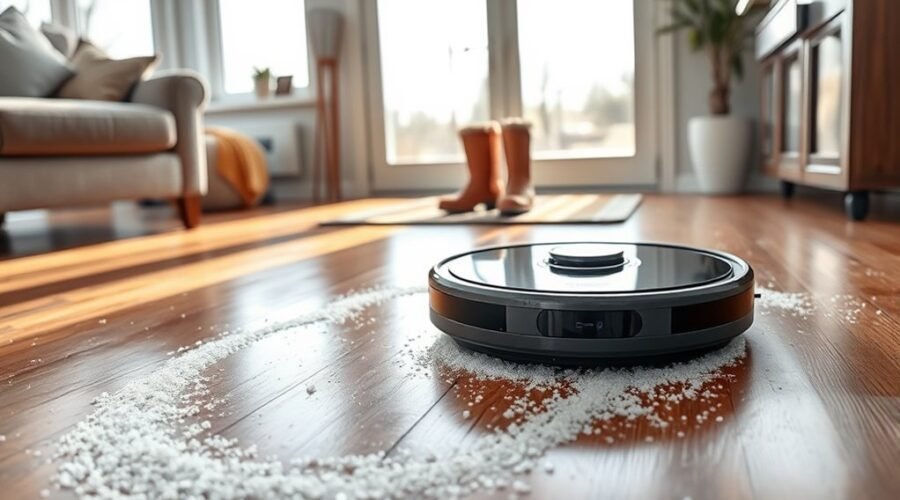
Can robot vacuums clean salt from hardwood, tile, and other hard floors? Yes, but the amount of salt, its moisture level, and your floor’s finish determine how well they work. Dry salt granules are easier to collect than wet residue or hardened deposits. Knowing when to vacuum, mop, or clean by hand helps you avoid scratched floors and unnecessary robot maintenance.
Quick Answer
Robot vacuums can clean small amounts of dry salt from hard floors, especially with strong suction and suitable brushes. Vacuum loose crystals first, then use a lightly damp mop for remaining residue. Clean heavy deposits, wet road salt, and hardened spots by hand to protect your floors and vacuum.
Key Takeaways
- Remove dry salt before mopping to avoid spreading gritty residue.
- Hardwood and laminate need less moisture than ceramic or porcelain tile.
- Strong suction helps, but brush design and floor condition matter just as much.
- Use only cleaning solutions approved for your robot’s water system.
- Clean robot brushes, wheels, and mop pads more often during winter.
Are Robot Vacuums Good for Salt?
)
Robot vacuums are useful for cleaning light, dry salt deposits from hardwood, laminate, vinyl, and tile. Their suction systems collect loose grains before foot traffic spreads them across the floor.
However, they work best as maintenance tools rather than replacements for manual cleaning after major salt buildup.
Three factors make the biggest difference:
- Suction power: Adjustable suction helps collect fine crystals and heavier particles from hard surfaces.
- Brush design: Clean, floor-safe brushes move loose salt toward the suction opening without dragging trapped grit across the finish.
- Cleaning pattern: Reliable navigation helps the robot cover entryways and other areas where salt gathers.
A vacuum-and-mop combination can also remove the thin white film that remains after dry salt is collected. However, vacuuming should come first whenever possible.
Roborock’s winter robot vacuum guidance specifically recommends increased suction and cleaning frequency for tracked-in salt and dirt. It also advises keeping robots away from excessively wet conditions.
For routine household salt, a properly maintained robot can reduce manual work. Large piles, gritty road debris, and wet slush still need direct attention.
Why Salt Can Scratch Hard Floors
Salt can damage hard floors because its crystals and accompanying road grit act as abrasive particles. Walking over them or dragging them under cleaning equipment can wear protective finishes.
Winter moisture creates another problem. Dissolved salt may leave a visible film as water dries, while moisture entering vulnerable seams can damage wood-based flooring.
The exact risk depends on the surface:
| Surface | Salt Effect | Result |
|---|---|---|
| Hardwood | Abrasive grit and moisture | Scratched finish or moisture damage |
| Laminate | Trapped crystals and damp seams | Surface dulling or edge swelling |
| Tile | Grit and residue in grout | Surface wear or visible film |
| Sealed wood | Repeated abrasion and moisture exposure | Worn finish and greater damage risk |
Salt does not automatically etch glazed ceramic or porcelain tile. These surfaces are generally more moisture-resistant than wood, although grout and certain finishes need appropriate care.
The National Wood Flooring Association’s maintenance recommendations advise removing debris with a broom, dust mop, or vacuum on its bare-floor setting. They also recommend cleaning spills promptly without leaving floors wet.
Warning: Do not run a regular robot vacuum through standing saltwater, wet slush, or large deposits of road grit. Moisture can enter components not designed for liquid pickup, while trapped particles may scratch delicate flooring. Remove these messes manually before restarting the robot.
Keeping the robot’s wheels and brush housing clean matters, too. Even a soft brush cannot protect a floor if hard particles become trapped underneath it.
Which Robot Vacuums Handle Salt Best
The best robot vacuums for salt combine strong pickup, floor-safe brush systems, and controlled mopping. However, maximum suction alone does not prove a model will remove salt better than competing machines.
Several models from the original comparison offer features worth considering.
Dreame X60 Max Ultra Complete
The Dreame X60 Max Ultra Complete advertises a maximum suction rating of 35,000 Pa. It also uses the HyperStream Detangling DuoBrush 2.0 and dual rotating mops.
These features make it a reasonable option to consider for loose debris and routine hard-floor maintenance. Its high suction rating is a manufacturer specification, not a verified salt-cleaning test result.
Roborock Qrevo Curv 2 Flow
The Roborock Qrevo Curv 2 Flow combines 20,000 Pa maximum advertised suction with a continuously refreshed roller mop.
Its SpiraFlow system supplies fresh water to the roller and removes dirty water during mopping. This design can help manage light floor residue without repeatedly dragging the same dirty mop across a room.
It may be useful for entryways that develop salt film, provided the floor tolerates damp mopping and larger debris has already been removed.
Shark PowerDetect UV Reveal
The Shark PowerDetect UV Reveal combines vacuuming, mopping, and UV-assisted stain detection. Its cleaning system is designed to recognize certain dried-on spills and target them for mopping.
However, stain detection does not guarantee that the robot will recognize individual salt crystals or avoid scratching a floor covered with grit.
For salt cleanup, assess each robot by its pickup performance, maintenance access, and compatibility with your floor. None of these advertised features alone establishes superior salt-removal performance.
When You Should Clean Salt by Hand
Clean salt manually when deposits are thick, wet, compacted, or stuck along floor edges. A robot may scatter heavy grit, smear residue, or miss deposits that have hardened onto the surface.
Manual cleaning also gives you more control over how much pressure and moisture reach the floor.
Heavy Salt Buildup
Large amounts of road salt often collect near doors, boot trays, and frequently used walkways. These deposits can contain small stones, sand, and other abrasive debris.
If the salt is dry, remove loose material before introducing water. If it is already wet, blot the area and prevent liquid from spreading into nearby flooring seams.
Use this cleaning sequence:
- Remove large debris. Pick up larger crystals and stones carefully, or use a suitable broom and dustpan.
- Collect remaining dry grit. Use a vacuum with a hard-floor attachment or a soft microfiber dust mop.
- Loosen residue. Wipe the affected area with a slightly damp microfiber cloth or a cleaner approved for the floor.
- Remove dissolved salt. Use a clean cloth rather than spreading dirty moisture across the surface.
- Dry the floor. Finish with a dry microfiber cloth, especially around wood joints and laminate seams.
Never force a hardened salt crust loose with a sharp scraper. This can damage the protective finish underneath.
Stubborn Residue Spots
Stubborn salt spots usually need manual treatment because vacuum suction cannot remove material that has bonded to the surface or formed a damp film.
Water can dissolve ordinary salt, but the dissolved residue must then be wiped away. Otherwise, it may leave another white mark after drying.
| Situation | Best response | Risk |
|---|---|---|
| Dry crystals | Remove grit before wiping | Surface scratches |
| Moist film | Wipe with a floor-safe cleaner and dry | Slippery residue or moisture damage |
| Tight edges | Clean corners manually | Missed buildup |
For tile, use a suitable nonabrasive cleaning pad if the manufacturer permits it. For hardwood and laminate, use a soft microfiber cloth with minimal moisture.
Persistent white marks may be residue from other components of an ice-melt product, rather than ordinary table salt. Select a cleaner suitable for both the flooring material and the type of deposit.
How Robot Mop Combos Remove Salt Safely
Robot mop combinations can remove light salt residue by collecting loose debris and then wiping the remaining film with controlled moisture. This works best when dry vacuuming happens before damp mopping.
Water helps dissolve salt, while a clean microfiber or roller mop collects the resulting residue.
Follow these practices for safer cleaning:
- Start with dry cleaning. Use vacuum-only mode to remove loose salt and grit.
- Choose a suitable mop setting. Use low moisture on water-sensitive floors and an appropriate setting on tile.
- Clean the affected area. Select an entryway or room-cleaning cycle rather than repeatedly washing the entire house.
- Check for streaks. If white residue remains, wipe it manually or repeat with a clean pad where appropriate.
- Maintain the mop. Empty dirty water and wash removable pads or rollers according to the manufacturer’s instructions.
Some advanced robots can wash their mop pads during cleaning. This reduces the chance of carrying dirty residue into another room.
However, navigation systems do not necessarily identify salt as a separate kind of dirt. Spot cleaning and user-selected zones remain useful for areas that repeatedly collect winter debris.
Pro Tip: Create a separate cleaning zone for your entryway if your robot supports room or zone cleaning. This lets you clean the area where salt accumulates without unnecessarily mopping moisture-sensitive rooms.
Cleaning solutions also require care. Roborock’s official water-tank guidance recommends its own approved cleaning solution and warns that other products may damage the tank or interfere with mopping.
Use plain water where allowed, or follow the exact cleaner instructions for your robot. Do not pour vinegar, homemade salt removers, or ordinary floor detergents into the tank without manufacturer approval.
Features That Prevent Scratches on Hard Floors
Robot vacuums reduce scratch risks through gentle floor contact, effective debris pickup, and controlled navigation. However, no brush or wheel design can guarantee a scratch-free result when sharp grit remains underneath the machine.
Look for features that help the robot collect debris rather than push it around.
| Feature | Benefit | Surface effect |
|---|---|---|
| Soft rubber wheels | Gentle floor contact | Lower scuffing risk when clean |
| Gentle brush bars | Controlled debris pickup | Less aggressive surface contact |
| Intelligent navigation | Planned cleaning routes | More consistent coverage |
| Adjustable suction power | Cleaning matched to debris | Better pickup control |
| Debris management | Captures and contains grit | Less loose debris left behind |
Strong suction is helpful, but it does not directly make a floor safer. Effective debris pickup, clean brushes, and suitable wheels are more relevant to preventing abrasion.
A low-profile robot may also reach beneath furniture where tracked-in grit collects. Still, it cannot remove salt lodged tightly against every baseboard or under every threshold.
During winter, inspect the main brush, side brushes, caster wheel, and dustbin more often. Remove trapped crystals before they accumulate or interfere with cleaning.
How to Prevent Salt Buildup on Floors
Preventing salt buildup is easier than removing thick deposits after they spread throughout your home. The most effective approach combines entryway protection, prompt dry cleaning, and occasional floor-safe mopping.
Use these habits to reduce winter salt indoors:
- Protect entryways. Place durable mats outside and inside exterior doors to capture grit and moisture.
- Remove outdoor shoes. Keep salty boots on a tray rather than walking across finished floors.
- Vacuum regularly. Schedule the robot to clean dry entryway debris before it spreads into other rooms.
- Remove residue promptly. Use a slightly damp microfiber mop on suitable floors after loose salt has been collected.
- Protect floor finishes. Follow the flooring manufacturer’s recommendations for sealing, cleaning, and controlling indoor moisture.
Dehumidifiers can help control excess indoor humidity, but they do not remove salt already deposited on a floor. Cleaning remains necessary.
For ceramic and porcelain tile, Marazzi’s care guidance recommends appropriate mild cleaners, clean-water rinsing, and drying. Its advice also warns against harsh acidic cleaning products that may affect grout or glazed surfaces.
For hardwood, avoid leaving damp mats or wet boots directly against the finish. Drying the entryway promptly helps limit moisture exposure.
Keeping salt near the entrance also means your robot has less debris to collect during each cleaning cycle. This reduces the need for repeated passes and heavy manual cleanup.
Frequently Asked Questions
What Removes Salt Residue From Floors?
A slightly damp microfiber cloth and a cleaner approved for your floor can remove salt residue. Water dissolves ordinary salt, but you must wipe away the dissolved material to prevent new white marks. Remove dry grit first, avoid excess moisture on wood or laminate, and dry the cleaned area.
What Are the Downsides of Using a Robotic Vacuum Cleaner?
Robot vacuums can miss corners, struggle with heavy debris, and require regular brush and filter maintenance. Some models have limited suction, imperfect navigation, or short battery life. They may also cost more than basic manual vacuums and cannot safely collect standing liquids unless specifically designed for that task.
What Is a Good Floor Cleaner That Neutralizes Salt?
A floor-compatible salt residue remover or pH-neutral floor cleaner can help remove winter deposits. Ordinary sodium chloride does not need acid-base neutralization; it needs to be dissolved and physically removed. Some commercial products are marketed as salt neutralizers, but compatibility with your flooring matters more than the label. Enzyme cleaners are not necessary for ordinary salt.
What Is a Good Floor Cleaning Solution for Robot Vacuums?
Plain water or a manufacturer-approved cleaning solution is the safest starting point for a compatible robot mop. Bona Hard-Surface Floor Cleaner is available in formulations for manual cleaning and mopping robots, but not every formula is approved for every machine. Check your model’s instructions before filling the tank.
Can a Robot Vacuum Pick Up Wet Road Salt?
A standard robot vacuum should not be used to collect wet road salt or slush. Liquid and dissolved salts can reach components that are not designed for wet pickup. Blot the moisture, remove any grit manually, and dry the floor before running a vacuum. A compatible mop function can handle light remaining film afterward.
Conclusion
Robot vacuums can handle light, dry salt on hard floors, making them useful for routine winter cleaning. Strong suction, gentle brushes, and controlled mopping help, but heavy deposits and wet salt still need manual removal.
For the best results, vacuum dry grit first, remove remaining residue with a floor-safe cleaning method, and maintain your robot regularly. Protecting entryways from tracked-in salt will also make every cleaning session easier.
Sources
- Roborock: Winter Robot Vacuum Care: Salt and winter debris cleaning, suction settings, and maintenance.
- National Wood Flooring Association: Maintenance: Safe hardwood vacuuming, moisture control, and routine care.
- Bona: Avoid Water and Vinegar on Hardwood: Wood finish protection and recommended cleaning methods.
- Dreame: X60 Max Ultra Complete: Maximum suction specification and brush and mop features.
- Roborock: Qrevo Curv 2 Flow: Roller mop cleaning system and suction specifications.
- SharkNinja: PowerDetect UV Reveal: UV-assisted stain detection and vacuum-mop functionality.
- Roborock Support: Cleaning Solutions: Approved detergent guidance and water-tank compatibility.
- Bona: Hard-Surface Floor Cleaner for Mopping Robots: Floor cleaner formulation and robot compatibility precautions.
- Marazzi USA: Tile Care and Maintenance: Safe ceramic and porcelain tile cleaning methods.