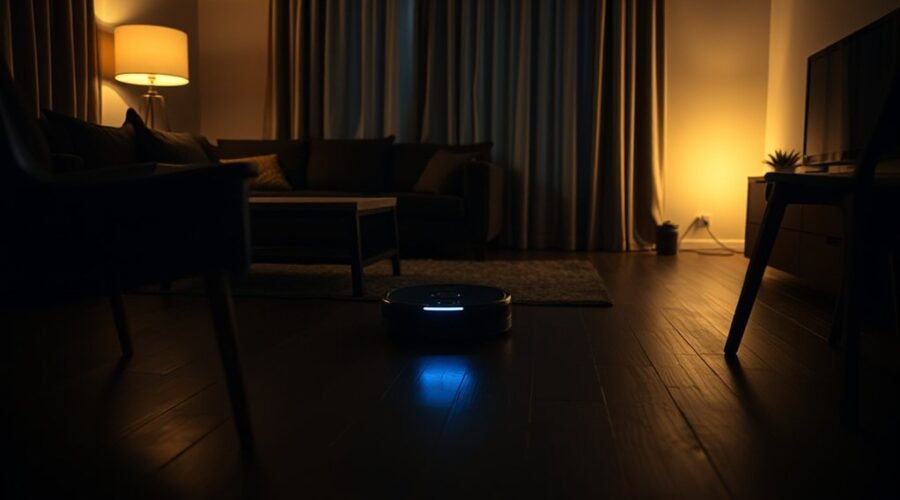
Robot vacuums can usually clean in the dark, but the result depends on the sensors they use. LiDAR and infrared systems can map a room without light, while camera-based models may struggle when visibility drops. Dark floors can create another problem by confusing cliff sensors and stopping the robot early. The real question is not only whether it works, but how well it handles low-light conditions and floor type.
How Do Robot Vacuums Work in the Dark?
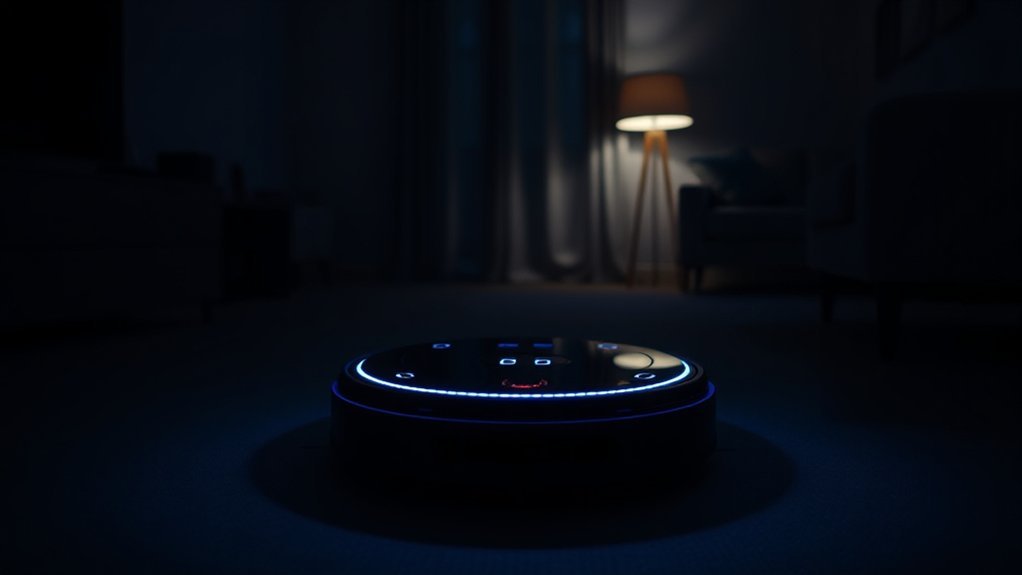
Robot vacuums can work effectively in the dark because they rely on navigation systems such as LiDAR sensors and infrared cameras rather than ambient light.
In low light conditions, Robot vacuums use these sensors to build maps, track walls, and guide movement with little dependence on room brightness.
LiDAR supports precise navigation by measuring distance, while infrared tools help with obstacle detection when visibility is poor.
High-end units, including models with TrueMapping 2.0 and fully embedded dToF LiDAR, can chart rooms accurately even in complete darkness.
High-end robot vacuums with TrueMapping 2.0 and embedded dToF LiDAR can map rooms accurately in complete darkness.
AI algorithms then refine cleaning routes in real time, reducing wasted passes and improving coverage.
Reflective floors usually do not stop performance because the sensor stack is designed to handle glossy surfaces.
For reliable operation, the sensors should stay clean, since dust or debris can weaken accuracy and slow navigation.
Which Sensors Matter Most in Low Light?
In low light, the most important sensors are the ones that do not depend on visible light. LiDAR navigation stands out because it uses lasers to build precise mapping without needing room lighting, so the robot can vacuum clean with steady direction and strong obstacle avoidance.
Infrared sensors also matter in low-light conditions, since they can detect furniture, walls, and other objects when optical sensors lose detail. By contrast, optical sensors are less reliable in darkness and may miss small debris or weak contrast on dark surfaces.
Cliff sensors remain useful for safety, but their readings can be less stable when the floor is very dark. For practical performance, the best systems combine LiDAR navigation, infrared sensors, and cliff sensors so movement stays controlled while cleaning continues.
In low light, that combination gives the robot more independence and fewer blind spots, helping it work with less dependence on the environment’s brightness.
Why Do Dark Floors Confuse Cliff Sensors?
Dark floors can confuse cliff sensors because those sensors are designed to read changes in reflected light as signs of a drop-off. On dark floors, the signal may be so weak that robot vacuums treat the surface like open space, even when the path is level.
This lack of contrast creates low visibility for optical systems used in detecting obstacles, so the machine may hesitate, stop, or back away from rugs and carpets. Older models are especially prone to these navigation errors because their sensors depend heavily on light-based cues.
Reflection surfaces can make the problem worse by scattering light in ways that distort the reading. Regular cleaning cliff sensors helps maintain accuracy and reduces false alarms on darker surfaces.
In practice, careful maintenance gives robot vacuums a better chance of moving confidently, instead of avoiding usable areas or wasting time on incorrect edge detection.
What Are the Best Robot Vacuums for Dark Rooms?
The best robot vacuums for dark rooms typically use LiDAR or infrared navigation, which helps them map spaces and avoid obstacles without ambient light.
Models such as the DEEBOT T50 PRO OMNI, Narwal Flow, and Freo Z10 Ultra are strong options because they maintain accurate routing in low-light conditions.
Quiet operation is also important at night, making low-noise models like the Narwal Flow especially practical for dark-room cleaning.
LiDAR And Infrared Navigation
LiDAR and infrared navigation give robot vacuums a clear advantage in fully dark rooms because they can map spaces and detect obstacles without ambient light.
In practice, this lidar setup supports reliable navigation, obstacle detection, and mapping technology in homes where light is absent. Infrared sensors help the robot read furniture and walls, while dToF LiDAR, as seen in DEEBOT T50 PRO OMNI, improves precision.
High-end models using AIVI 3D add stronger real-time recognition for cluttered layouts.
- Dark rooms do not block path planning.
- Infrared sensors reduce collisions around obstacles.
- Cleaning efficiency stays steady on many dark or glossy floors.
Performance on very reflective surfaces can vary, but the best systems keep movement controlled, consistent, and independent from ambient light.
Quiet Models For Nighttime
For nighttime cleaning, quiet robot vacuums with strong dark-room navigation offer the best balance of performance and disruption control.
Models such as the Narwal Flow and Freo Z10 Ultra keep noise under 60 dB, supporting quiet operation during sleeping hours.
High-end options like the DEEBOT T50 PRO OMNI use LiDAR technology and TrueMapping 2.0 for advanced navigation in low-light conditions, while the Dreame X40 Ultra improves obstacle detection and mapping accuracy.
iRobot Roomba i, j, and s Series handle dark surfaces well with dual beam cliff sensors, reducing missteps and interruptions.
For efficient performance, scheduling cleaning sessions during low foot traffic hours gives these systems room to work freely.
Together, these features make dark-room cleaning practical, predictable, and less intrusive for nighttime cleaning.
How Can You Improve Robot Vacuum Cleaning at Night?
Night cleaning can work well when a robot vacuum is set up for low-light conditions and minimal disruption. A robot vacuum need not require light everywhere, but some models use sensors to navigate better when a small lamp stays on. This can reduce difficulty detecting obstacles and help them clean without disturbing the household.
Night cleaning can work well when a robot vacuum navigates low-light spaces with minimal disruption.
- Leave a small light on to support camera-based navigation and improve object recognition.
- Schedule cleanings wisely for late-night hours when foot traffic is low and paths stay clear.
- Do regular sensor maintenance so dust does not impair low-light performance.
Tidy floors also help non-AI units move freely, since small items can confuse them in darkness. Quiet mode adds another layer of calm, making it easier to improve cleaning at night without sacrificing rest or autonomy.
What Should You Check Before Running It in the Dark?
Before running a robot vacuum in the dark, it is important to verify that its navigation system is suited for low-light use, especially if it relies on LiDAR, infrared sensors, or camera-based mapping. Check whether the robot vacuums use navigation technology that can read dark surfaces without hesitation. Clean all sensors first, since dust can weaken infrared performance and mislead mapping. Confirm cliff sensors are not overly sensitive to shadows, edges, or black flooring. Review battery life too, because low-light operation may draw more power and shorten cleaning cycles. If the unit depends on vision, leave a small light to operate during use; this can restore stable tracking in dim rooms.
| Check | Why it matters | |
|---|---|---|
| LiDAR or infrared | Supports low-light navigation | |
| Cliff sensors | Prevents drops and false avoidance | |
| Sensor cleanliness | Preserves accurate readings | |
| Battery life | Avoids incomplete cleaning cycles | |
| Room lighting | Helps camera-based systems |
Frequently Asked Questions
What Are the Downsides of Using a Robotic Vacuum Cleaner?
Navigation issues, obstacle detection gaps, reduced cleaning efficiency, and limited floor types can hinder results. Battery life and dustbin capacity may be insufficient, maintenance costs can rise, noise levels may disturb, despite helpful smart features.
Can I Run My Roomba in the Dark?
Yes, a Roomba can run in the dark, but Roomba performance depends on sensor technology and navigation systems. In a dark environment, cleaning efficiency, obstacle avoidance, carpet detection, battery life, and user settings may vary.
Will My Shark Robot Work in the Dark?
Yes, a Shark robot usually works in the dark, much like a night courier with a map. Its Shark features, Navigation sensors, Floor types, Battery life, Cleaning modes, Obstacle detection, Maintenance tips, Performance comparison, User reviews matter.
Do Robot Vacuums Need Light to Work?
No; most robot vacuums do not need light. Robot navigation depends on sensor technology, not light sensitivity. Good mapping accuracy, obstacle detection, and cleaning efficiency vary by floor types, battery performance, and user preferences.
Conclusion
In dark rooms, a robot vacuum can still clean effectively if it uses LiDAR, infrared sensors, or other advanced mapping tools. The main limitation is not the lack of light, but surfaces that confuse cliff sensors, especially very dark floors. To get better results, keep sensors clean, remove obstacles, and choose a model built for low-light use. With the right setup, nighttime cleaning is not only possible, but often reliable.