
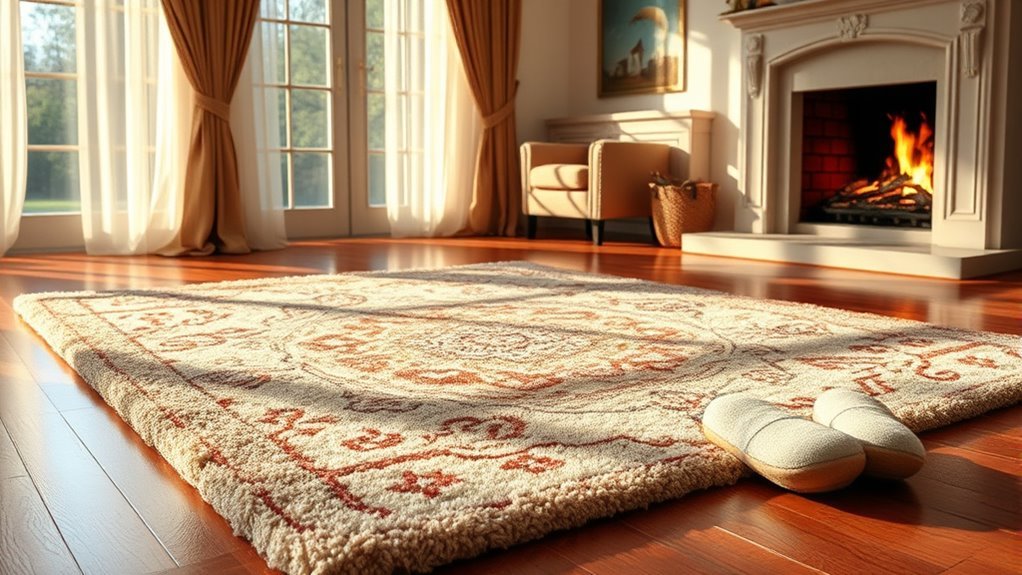
Stepping out of bed onto bare tile, stone, concrete, laminate, or hardwood can make an otherwise comfortable room feel freezing. So do area rugs make a room warmer in a way you can actually feel? While a rug cannot generate heat or replace subfloor insulation, the right rug and pad combination slows heat loss from your feet and takes the chill off cold floors right away.
Quick Answer
Yes, area rugs make a room feel warmer underfoot by placing a low-conductivity thermal buffer between your skin and cold hard flooring. A dense pile rug paired with a felt pad provides roughly R-2.0 of surface thermal resistance, compared with R-0.05 for bare tile. However, rugs cannot stop structural drafts or replace subfloor insulation.
Key Takeaways
- Construction beats fiber name: Pile density, total thickness, and a cushioned felt pad affect thermal resistance more than whether the label says wool or synthetic.
- Pads multiply warmth: Adding a fibrous felt pad beneath a rug boosts total surface R-value to around R-2.08, compared with R-0.68 for bare 3/4-inch hardwood.
- Coverage determines comfort: Large rugs that extend under sofas, beds, and main walkways eliminate cold shock across daily traffic zones.
- Radiant heat reverses the rule: On heated floors, thick rugs and foam or rubber pads trap heat below the surface; keep combined thermal resistance under 2.5 tog (about R-1.0).
- Never cover damp floors: Trapped moisture breeds mold within 24 to 48 hours; fix leaks and dry subfloors completely before laying a rug.
Warmest Area Rug Setup at a Glance
To get the fastest warmth upgrade, match your rug and pad combination to your specific flooring and room layout. An uninsulated concrete basement slab needs a very different setup from a finished hardwood floor or a radiant-heated bathroom.
| Room Problem | Best Rug Setup | Typical Thermal / Comfort Effect |
|---|---|---|
| Cold tile, stone, or dry concrete slab | Large, dense high- or medium-pile rug + 1/4-inch to 3/8-inch felt/natural-rubber pad | Raises surface resistance from ~R-0.05 (bare tile) to ~R-2.08 and blocks rapid conductive heat loss from bare feet |
| Chilly hardwood or laminate | Dense wool or synthetic pile rug + finish-safe felt or natural-rubber hybrid pad (no PVC) | Triples surface thermal resistance over bare wood (~R-0.68) while protecting polyurethane and LVP topcoats |
| Bedroom morning cold spots | Large area rug extending 24–36 inches around the bed, or plush runners on both sides | Places soft, low-conductivity fibers exactly where bare feet land first |
| Echoes and sharp footsteps | Cut-pile rug + breathable felt pad | Absorbs roughly 35% to 50% of airborne floor reflections (NRC 0.35–0.50) and cushions impact noise |
| Radiant-heated floor | Thin flatweave or low-pile rug with jute or woven backing (combined rating under 2.5 tog / R-1.0) | Allows heat to radiate into the room without overheating floor sensors or cables |
How Do Area Rugs Add Warmth?
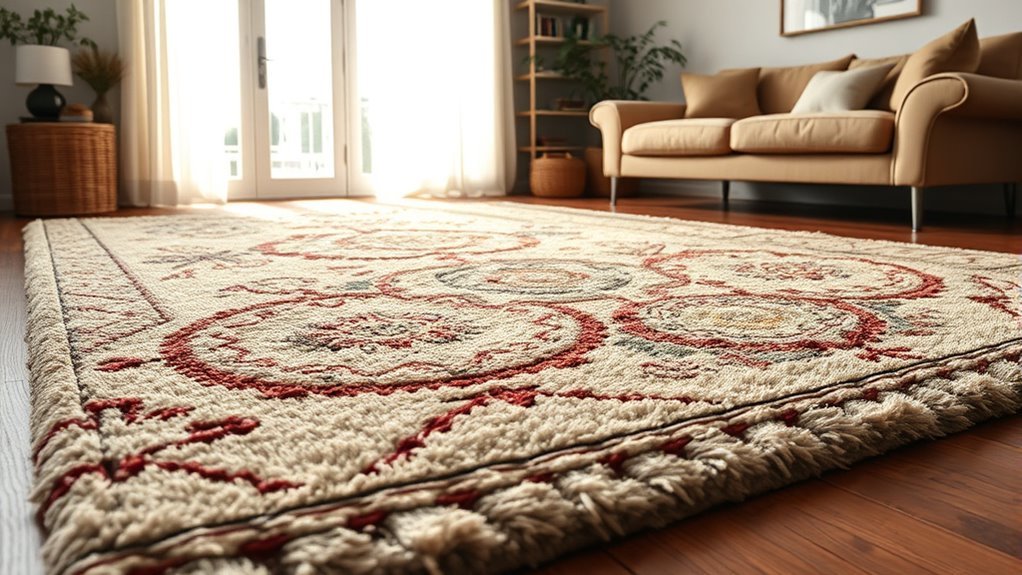
Area rugs make a room feel warmer primarily by slowing conductive heat transfer from your feet into the floor. Hard surfaces like ceramic tile, stone, and concrete are dense thermal conductors that pull heat rapidly out of warm skin, even when the room air is set to 70°F (21°C). A woven or tufted rug traps tiny pockets of still air between its fibers, creating an insulating barrier that keeps heat at your skin surface.
In building science, a material’s ability to slow heat flow is measured as thermal resistance, or R-value. As the U.S. Department of Energy insulation guide explains, thermal resistance depends on material type, thickness, and density. According to standard building-material tables published by the Alaska Housing Finance Corporation (AHFC), common floor layers compare as follows:
- Bare ceramic tile or linoleum: R-0.05
- Bare 3/4-inch hardwood flooring: R-0.68
- Carpet or rug with a dense rubber pad: R-1.23
- Carpet or rug with a fibrous felt pad: R-2.08
While jumping from R-0.05 to R-2.08 creates an immediate difference under bare feet, an area rug is still only a surface layer. Individual rugs are rarely laboratory-tested for official FTC R-value labels, and their real-world performance varies with pile height, knot density, backing, and subfloor assembly. Even a thick rug and pad (~R-2.0) cannot replace structural underfloor fiberglass or foam insulation, which typically provides R-13 to R-30.
Do Area Rugs Make a Room Warmer Overall, or Just Underfoot?
Area rugs make a big difference in perceived underfoot warmth, but they have a modest effect on whole-room air temperature. Because human thermal comfort depends heavily on direct contact with surfaces and radiant heat exchange, covering a cold floor makes you feel warmer right away—even if a wall thermometer barely budges.
Note: If your room feels chilly because cold air is blowing around baseboards, exterior doors, window trim, or pipe penetrations, a rug will not fix the problem. Follow the DOE air-sealing guidelines to seal gaps with caulk and weatherstripping, which along with proper insulation can cut heating and cooling costs by up to 15% to 20%.
To tell whether your cold room needs a thicker rug or envelope repairs, run a quick perimeter check on a windy or cold day. Hold a damp hand or a lit incense stick near baseboards, floorboard seams, and exterior door thresholds. If the smoke wavers or you feel moving air, air leakage is the culprit; if the air is still but the floor feels icy to the touch, a dense rug and cushioned pad will solve the comfort problem.
Cold-floor rule: On an unheated floor, thicker rugs and felt pads maximize warmth. On a radiant-heated floor, the rule reverses: keep the combined rug and pad thermal resistance below 2.5 tog (about R-1.0) and thickness under 1 inch (25 mm). As Warmup radiant-floor guidance notes, thick wool rugs, foam pads, and rubber backings trap heat and prevent it from warming the room.
What Matters Most for Rug Warmth?
When shopping for a rug to warm up a cold floor, evaluate construction density, pad thickness, and floor coverage before looking at the fiber label. A loosely woven wool flatweave lets cold from tile bleed through quickly, whereas a tightly tufted synthetic pile over a felt pad blocks conductive heat loss effectively.
- Pile density and face weight: Closely packed yarns trap more stationary air and resist crushing underfoot. Press your thumb into the rug surface; if you immediately feel the hard backing through sparse yarns, it will offer little thermal protection.
- Rug pad material: A 1/4-inch to 3/8-inch needle-punched felt pad adds nearly R-1.0 to R-1.5 of thermal resistance on its own, doing more work than a thin decorative rug.
- Floor coverage: Covering 60% to 75% of the exposed floor in a seating or sleeping zone reduces radiant heat loss to bare tile or wood and eliminates cold walkways.
- Fiber structure: Natural wool has a crimped, scaly fiber structure that traps air pockets well, while high-bulk synthetic microfibers (polypropylene, polyester, and nylon) mimic this loft at a lower cost.
- Color and visual warmth: Rich terracotta, ochre, warm neutrals, and deep patterns make a room feel psychologically cozier, even though color has zero effect on conductive heat flow.
Which Rug Materials Feel Warmest?
Dense wool and high-pile plush synthetics feel warmest underfoot because their lofty, closely packed fibers trap the most insulating air. Flatweaves, thin cotton dhurries, and plant fibers like jute or sisal sit much flatter and transfer floor chill faster unless paired with a thick pad.
| Rug Material / Construction | Why It Feels Warm (or Cool) | Best Rooms | Watch Out For |
|---|---|---|---|
| Hand-knotted or hand-tufted wool (medium to high pile) | Crimped fibers trap microscopic air pockets and resist compression over years of foot traffic | Living rooms, bedrooms, chilly hardwood, tile, and stone floors | Higher upfront price, initial shedding, and often restricted over electric radiant floor heating |
| Plush or high-pile synthetic (polypropylene, polyester, nylon) | Deep pile (0.5–1.5 inches) creates a thick thermal buffer at a budget-friendly price | Bedrooms, finished basements, family rooms, reading corners | Loose shags flatten faster in walkways and trap crumbs if pile exceeds 1 inch |
| Cotton flatweave or washable rug | Takes the initial bite off bare tile, but low thickness (often under 0.25 inches) limits insulation | Kitchens, kids’ rooms, dining spaces, radiant-heated floors | Needs a cushioned felt pad underneath if cold-floor warmth is a priority |
| Jute, sisal, or seagrass | Coarse, basket-like plant weave offers structural thickness and works well as a base layer | Sunrooms, dry living areas, base layer beneath softer wool or plush rugs | Feels coarse on bare feet and absorbs moisture easily; avoid in damp basements or baths |
| Wool or synthetic flatweave (kilim, dhurrie) | No upright pile means minimal trapped air (~0.15–0.25 inches thick), regardless of fiber | Dining rooms, entryways with low door clearance, radiant-heated floors | Pair with a 1/4-inch felt pad on unheated floors to avoid feeling the hard subfloor |
Recommended Products

Serene Forest Design: Transform any room with a lush green forest rugs, featuring rich botanical details and calming vintage accents. This 8x10 washable area rug elegant design brings the tranquility of the forest into your living room, bedroom, or kitchen

WASHABLE RUG: This is a fully machine washable area rug for extra convenience. machine wash this living room rug in cold water alone for a deeper clean. regular vacuuming and spot cleaning will keep the rug looking fresh while the colors stay vibrant and won't fade, perfect for busy households with kids and pets
Practical Tips for Selecting Warm Rugs
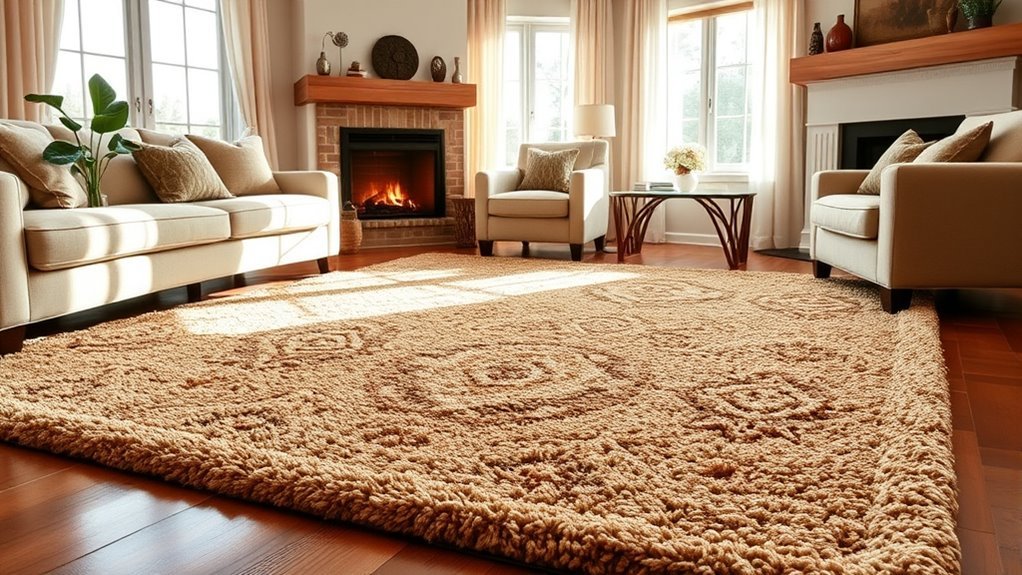
Picking the warmest rug means balancing pile thickness against daily wear, door clearance, and cleaning demands. A deep 1.5-inch shag feels luxurious in a low-traffic bedroom, but a dense 0.4-inch to 0.6-inch medium-pile rug holds its loft and insulating value much better in a busy living room.
Material Selection Matters
Wool remains the benchmark for cold bedrooms and living rooms because its natural crimp springs back after footsteps, keeping air pockets open. However, high-density heat-set polypropylene or triexta rugs offer nearly identical warmth underfoot for less money and resist pet stains and moisture in finished basements.
If your household includes pets, kids, or frequent spills, choose a dense medium cut-pile or tight loop-pile rug over a loose high shag. Dense medium piles keep dirt near the surface where weekly vacuuming can lift it out before grit breaks down the fibers.
Thickness and Density Enhance Insulation
Total thickness determines how far your feet sit above the cold floor, while yarn density prevents your body weight from pressing the fibers flat against the subfloor. A sparse shag rug compresses down to its thin canvas backing the moment you stand on it, losing most of its thermal buffer.
Pro Tip: Love the clean look of a thin flatweave or vintage low-pile rug? Pair it with a 3/8-inch dense needle-punched felt pad (with a natural rubber grip layer) to get the thermal comfort of a thick pile rug without changing your decor style.
Color and Pattern Choices
Warm undertones—such as rust, camel, olive, charcoal, and creamy oatmeal—trick the eye into perceiving a room as cozier, especially in spaces with cool northern light or gray flooring. While color does not alter thermal resistance, multi-toned patterns hide winter boot tracks and lint far better than solid ivory rugs.
Best Rug Sizes and Placements for a Warmer Room
A small “postage-stamp” rug floating in the middle of a cold room leaves your feet resting on bare flooring whenever you sit on the sofa or walk past the bed. Sizing up so the rug extends beneath key furniture anchors both the visual layout and your thermal comfort.
- Living room (8×10 ft or 9×12 ft): Size the rug so at least the front legs of the sofa and accent chairs sit 8 to 12 inches onto the rug, covering the entire foot-resting zone.
- Bedroom (8×10 ft for a Queen, 9×12 ft for a King): Place the rug perpendicular to the bed, starting in front of the nightstands so you have 24 to 36 inches of warm landing space on both sides and at the foot. Alternatively, place two 2.5×8 ft plush runners along the sides.
- Dining room (at least 8×10 ft): Add 24 to 30 inches beyond all sides of the dining table so chair legs stay on the rug when diners sit down, keeping feet off cold tile or wood.
- Hallways and kitchens: Lay continuous runners along daily bare-foot paths—especially between the bedroom, bathroom, and coffee maker—where morning floor chill is most noticeable.
- Entryways: Choose a dense, low-profile wool or synthetic rug (under 3/8 inch thick) with a thin non-slip pad so exterior doors swing freely without scraping the weatherstripping.
Leave 12 to 18 inches of bare floor around the perimeter of standard rooms (or 6 to 8 inches in small rooms) so the space feels balanced and floor vents or baseboard heaters remain completely uncovered.
How Rugs Absorb Sound and Reduce Echoes
Along with adding warmth, area rugs quiet a room in two distinct ways: absorbing airborne echo and cushioning impact footsteps. In rooms with hard floors, bare drywall, and large glass windows, sound waves bounce repeatedly between parallel surfaces, creating a harsh, hollow feel that makes a space seem colder and less inviting.
According to acoustic testing guidance from the Carpet and Rug Institute (CRI), soft floor coverings improve room acoustics across two metrics:
- Airborne sound absorption (NRC): Hard floors reflect nearly all airborne sound, with a Noise Reduction Coefficient (NRC) around 0.01 to 0.05. A cut-pile rug paired with a breathable felt pad typically achieves an NRC of 0.35 to 0.50, absorbing 35% to 50% of sound energy hitting the floor.
- Footstep and impact noise (IIC): Cushioned rugs and felt pads absorb the mechanical shock of heels, pet claws, dropped toys, and sliding chairs, sharply reducing downstairs impact transmission.
Laboratories measure sound absorption using ASTM C423 reverberation-room testing across frequencies from 200 to 2,500 Hz. Note that a rug backed with an impermeable latex or solid rubber coat blocks air from entering the pad beneath it; to get the acoustic boost of a felt pad, choose a rug with a porous woven backing.
For whole-room sound control beyond the floor, see our guide to managing echo and noise in an open-concept living room.
Do Rug Pads Make Rugs Warmer?
Yes—a quality rug pad often adds as much or more thermal resistance than the rug itself. Standard building data shows that switching from a thin rubber pad to a dense fibrous felt pad raises a carpet-and-pad assembly’s thermal resistance from R-1.23 to R-2.08, a nearly 70% increase in insulating power.
Recommended Products

NON-SLIP GRIP FOR SAFETY: Durable latex rubber backing prevents slipping, sliding, bunching, and wrinkles on hardwood, tile, carpet, or any floor—superior hold compared to basic foam pads for everyday use.

Helps Prevent Rug Slippage: Designed with a unique high-density cross-bar texture and silicone backing, this carpet underlay provides a powerful anti-slip grip. Keeps area rugs securely in place, preventing sliding, bunching, and wrinkling.

STRONG NON-SLIP GRIP: Designed with a powerful double-sided grip, this rug pad effectively secures your carpet, preventing slipping, bunching, or shifting. Whether in high-traffic areas or for daily use, it keeps your carpet flat and stable, providing a safer experience.
Choosing a Floor-Safe Insulating Pad
For maximum warmth on an unheated floor, choose a 100% recycled needle-punched felt pad (for large rugs anchored by heavy furniture) or a felt-and-natural-rubber hybrid pad (for smaller rugs that need grip). Avoid cheap waffle-style PVC or synthetic vinyl pads on hardwood, laminate, or luxury vinyl plank (LVP).
PVC pads contain chemical plasticizers that migrate out over time, reacting with polyurethane wood finishes and vinyl wear layers to cause permanent yellowing, hazy stains, or sticky residue. Always verify that the pad manufacturer explicitly guarantees compatibility with your floor finish, and trim the pad 1 to 2 inches smaller than the rug perimeter so the rug edges taper smoothly to the floor.
Enhanced Comfort Underfoot
A 1/4-inch to 3/8-inch felt pad (weighing 28 to 40 oz per square yard) prevents foot pressure from bottoming out against hard subfloors. In standing zones like kitchen sinks, standing desks, and bedside areas, that extra cushion reduces joint fatigue while keeping feet separated from the cold slab or joists below.
Draft Prevention vs. True Air Sealing
Laying a dense rug and felt pad over old tongue-and-groove floorboards can slow minor upward air movement through tiny floorboard seams. However, a rug cannot stop perimeter drafts entering where walls meet floors. Where cold outside air leaks in around baseboards, thresholds, or radiator pipes, follow the U.S. Department of Energy air-sealing guide to caulk stationary cracks and weatherstrip moving doors first.
Warning: Never lay rugs or pads over damp basement concrete, active leaks, or musty floors. According to U.S. EPA mold cleanup guidance, wet porous materials must be dried completely within 24 to 48 hours to prevent mold growth, and moldy rugs or pads often have to be discarded.
Does Layering Rugs Add More Warmth?
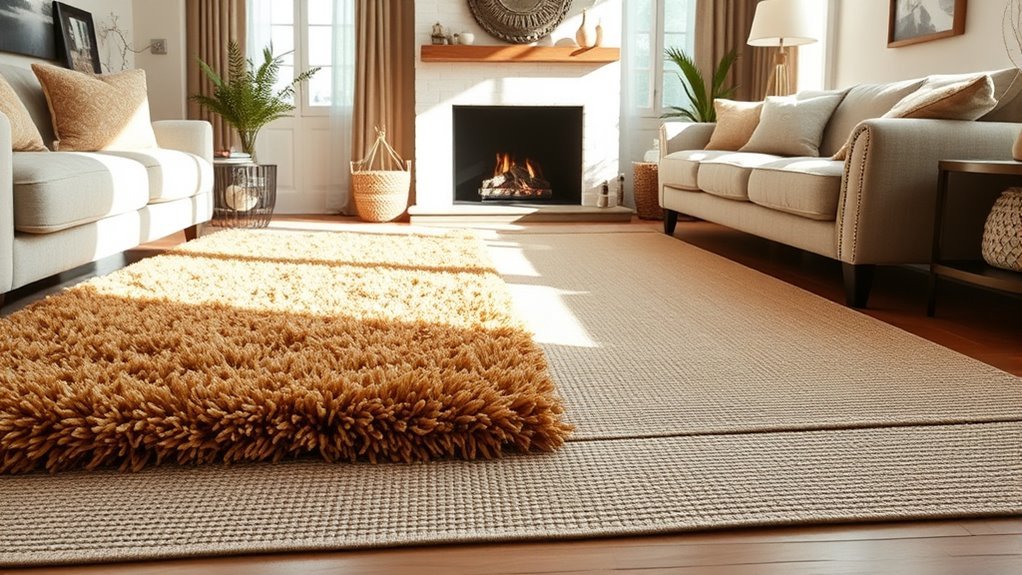
Yes, layering a smaller plush rug on top of a large flatweave or natural-fiber base rug doubles the material barrier over an unheated floor and boosts localized warmth. It is also a cost-effective way to cover a huge room: you can buy an affordable 9×12 ft jute or flatweave base rug and center a luxurious 5×8 ft or 6×9 ft wool or sheepskin rug right under the coffee table or bedside.
To prevent tripping, keep the base rug flat with a non-slip pad and use carpet-to-carpet grip tape or a thin rug-on-carpet pad under the top rug if it creeps. Skip multi-rug layering in narrow hallways, at the top or bottom of stairs, under low-clearance doors, and over radiant-heated floors.
| Layering Combination | Best Use for Warmth & Comfort |
|---|---|
| Large flatweave base + dense wool pile top rug | Covers a wide cold floor affordably while concentrating thick insulation under the sofa seating zone |
| Jute or sisal base + high-pile plush or sheepskin top layer | Eliminates the scratchy feel of plant fibers and adds deep warmth beside beds or reading chairs |
| Plush runner over wall-to-wall low-pile carpet | Adds extra cushioning and reduces wear along chilly basement or hallway paths |
| Thin vintage flatweave + 3/8-inch felt/rubber pad | Delivers hidden two-layer thermal resistance (~R-2.0) with a single visible rug |
Best Rugs for Different Floor Types
Your subfloor and finish dictate both how much insulation you need and which backing materials are safe to use. Matching the rug and pad to the floor prevents finish discoloration and heating problems.
- Ceramic tile, stone, and dry concrete: Because bare tile has almost zero thermal resistance (R-0.05), use a dense medium- or high-pile wool or synthetic rug paired with a 3/8-inch felt-and-natural-rubber pad. On basement slabs, verify the concrete is bone dry before laying any breathable rug.
- Finished hardwood: Bare 3/4-inch hardwood offers modest insulation (R-0.68). Pair a wool or dense synthetic rug with a breathable 100% felt or natural-rubber pad explicitly certified safe for polyurethane or oil finishes; never use PVC, latex, or adhesive-backed pads.
- Laminate and luxury vinyl plank (LVP): Floating floors over concrete or crawlspaces often feel chilly. Use a dense pile rug with a non-staining felt or 100% natural rubber pad approved by the vinyl manufacturer to prevent plasticizer yellowing.
- Wall-to-wall carpet: Adding an area rug over thin basement carpet boosts warmth further; secure it with a thin polyester-with-adhesive-tack pad designed specifically for rug-over-carpet use.
- Radiant-heated floors: Do not insulate a floor that is trying to heat your room. Choose a thin flatweave or low-pile cotton or synthetic rug with a woven jute/hessian backing and a combined rating under 2.5 tog (R-1.0); Warmup underfloor heating guidelines specifically warn against rubber backings and thick wool rugs over heated floors.
Recommended Products

Upgraded Cushioning and Grip: Unlike other pure felt pads, our pad has a durable natural rubber backing to increase gripping and durability. 1/4" thick felt forming a dense, cushioned surface, aims to make your rugs cozier and provide extra comfort underfoot, even the thinnest rugs can feel soft and comfortable. Dense fibers surface securely holds rugs in place without bunching, while offering noise reduction and insulation

Unique Design: Do you still worry about the traditional glue rug tape harm your floor ? This gripper uses VACUUM TECH design which grips hard smooth floors firmly and easily, this design can protect your floor perfectly as no glue used on floor. But it does not work for rug on carpeted floor. It does not work for rubber backed rug ,jute rug or fluff backing rug.
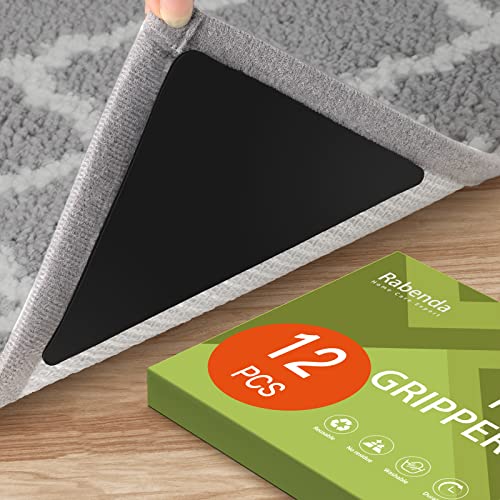
Advantaged Triangle Design: The Triangle Design grippers for area rugs and hardwood floors will maximum increase the contact surface. The strong adhesion will help stick firmly and keep your area rugs in place. Moreover, the rug stickers for wood floors will prevent the rug corners and edges curling and always keep your rugs steady and safe
Quick At-Home Warmth Check
You can test how well a rug setup blocks floor chill in five minutes using bare feet—or an inexpensive infrared thermometer if you have one. While this check does not measure whole-house energy savings, it immediately highlights cold gaps in your layout.
- Compare bare floor vs. rug after 30 seconds: Stand barefoot with one foot on the bare floor and one foot on the rug for 30 seconds. A good setup stays neutral and warm, whereas a thin rug without a pad lets subfloor chill creep through within half a minute.
- Test the pad difference: Fold back one corner of the rug so part of it rests directly on the bare floor and part rests on the felt pad. Step on both spots to feel how much cushioning and thermal separation the pad provides.
- Walk your morning route: Walk barefoot from your bed to the bedroom door and from the sofa to the hallway. If more than half of your steps hit bare icy flooring, shift the rug forward or add a runner.
- Check edges and door swings: Swing every room and closet door across the rug and inspect walkway corners. If a door drags on the pile or an edge curls up, switch to a thinner pad or reposition the rug to eliminate trip hazards.
Maintenance Tips for Effective Rug Insulation
Matted fibers and grit-packed pile lose the tiny air pockets that give a rug its thermal resistance. Following the Carpet and Rug Institute (CRI) maintenance guidelines keeps the pile lofty, clean, and insulating for years.
- Vacuum at least once a week: Slow, steady passes lift compacted yarns and pull out abrasive grit before it cuts fibers down; vacuum high-traffic halls and entryways twice a week.
- Rotate 180 degrees every 6 months: Turning your rug equalizes foot-traffic compression and sun fading so walkway sections do not flatten into thin, cold paths.
- Blot spills immediately with white towels: Press liquids up using a dry, unprinted white cloth or paper towel; never scrub with stiff bristles, which fray yarns and destroy pile loft.
- Dry wet rugs within 24 to 48 hours: After a pet accident, plant overflow, or plumbing leak, prop the rug and pad up with fans so the subfloor and fibers dry completely before mold can start.
- Replace flattened or crumbly pads: Inspect your rug pad once a year; when a felt or rubber pad compresses permanently flat or starts shedding powder, replace it to restore thermal resistance and grip.
- Deep clean every 12 to 18 months: Have wool, thick pile, and high-traffic rugs professionally cleaned every 12 to 18 months to remove embedded oils that weigh fibers down.
Frequently Asked Questions
Do area rugs make a room warmer?
Yes, area rugs make a room feel noticeably warmer underfoot by placing an insulating layer of trapped air between your feet and cold hard flooring. While a rug does not generate heat like a radiator, a dense rug paired with a felt pad raises surface thermal resistance to roughly R-2.08, compared with R-0.05 for bare tile.
What type of rug is best for warmth?
A densely woven or tufted medium- to high-pile rug made of wool or high-bulk synthetic fibers (such as polypropylene or triexta) is best for warmth. Construction density, pile thickness, floor coverage, and a felt rug pad matter more than fiber name alone, as a thick synthetic pile warms better than a thin wool flatweave.
What should you put under a rug to make it warmer?
Put a 1/4-inch to 3/8-inch needle-punched felt pad or a felt-and-natural-rubber hybrid pad under your rug on unheated floors. Standard building tables rate carpet with a fibrous felt pad at R-2.08 versus R-1.23 with a rubber pad, and finish-safe felt or natural rubber avoids the plasticizer stains caused by cheap PVC pads.
How much warmer does a rug make a room and does it retain heat?
There is no fixed number of degrees an area rug will raise room air temperature, because rugs primarily reduce conductive heat loss at the floor surface (~R-1.2 to R-2.1). Whole-room heat retention depends on how much floor is covered, whether the subfloor is insulated, and how well baseboards and windows are sealed.
Can rugs stop drafts?
A thick rug and felt pad can block minor upward air movement through small gaps between old wooden floorboards, but they cannot stop perimeter drafts. If you feel moving cold air along baseboards, exterior doors, windows, or pipe penetrations, seal those openings with caulk or weatherstripping.
Do rugs make rooms quieter?
Yes, a pile rug paired with a breathable felt pad typically absorbs 35% to 50% of airborne sound hitting the floor (an NRC rating of 0.35 to 0.50, compared with 0.01 to 0.05 for bare hard floors). It also cushions footsteps, pet claws, and dropped items to reduce impact noise in rooms below.
Can rugs lower heating bills?
Area rugs rarely produce large direct heating-bill savings on their own because their R-value (~R-2.0 with a pad) is small compared with structural insulation (R-13 to R-30+). However, warming up cold floors underfoot often lets you feel comfortable at a slightly lower thermostat setting while air sealing and attic or crawlspace insulation tackle major heat loss.
Can you use an area rug over radiant floor heating?
Yes, provided you choose a thin, breathable rug with a combined rug-and-pad thermal resistance below 2.5 tog (roughly R-1.0) and thickness under 1 inch (25 mm). Avoid rubber or foam backings, felt pads, and thick wool rugs, which trap heat in the floor and block warmth from reaching the room.
Conclusion
Area rugs are the fastest way to turn cold tile, concrete, laminate, or hardwood into a warm, quiet, and comfortable surface underfoot. To get the best results on an unheated floor, prioritize a dense medium- or high-pile weave, pair it with a finish-safe 1/4-inch to 3/8-inch felt pad, and size the rug to cover your main seating or bedside zones. Next, check your baseboards and thresholds for moving air and seal any gaps so drafts do not undo your comfort upgrade.
Sources
- U.S. Department of Energy — Insulation: Heat-flow, R-value, thickness, density, and whole-home insulation savings (up to 15%–20%).
- Alaska Housing Finance Corporation (AHFC) — R-Value of Building Materials: Thermal resistance values for tile (R-0.05), 3/4-inch hardwood (R-0.68), carpet with rubber pad (R-1.23), and carpet with fibrous pad (R-2.08).
- U.S. Department of Energy — Air Sealing Your Home: Air-leak detection, caulking, and weatherstripping guidance.
- Warmup — Area Rugs With Underfloor Heating: Radiant-floor restrictions on rubber backings, wool rugs, and high-resistance floor coverings.
- The Carpet and Rug Institute (CRI) — Finding the Right Carpet: Noise Reduction Coefficient (NRC) sound absorption and impact noise performance of soft floor coverings and pads.
- ASTM International — ASTM C423-23e1: Standard test method for measuring sound absorption coefficients in a reverberation room.
- U.S. Environmental Protection Agency — Mold Cleanup in Your Home: 24-to-48-hour drying requirement and moisture precautions for porous floor coverings.
- The Carpet and Rug Institute (CRI) — Cleaning and Maintenance: Weekly vacuuming, stain-blotting method, and 12-to-18-month professional deep-cleaning schedule.





[…] How Area Rugs Improve Warmth & Sound Absorption: Step-by-Step Guide […]