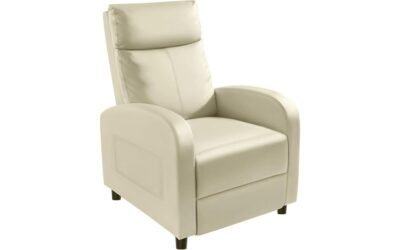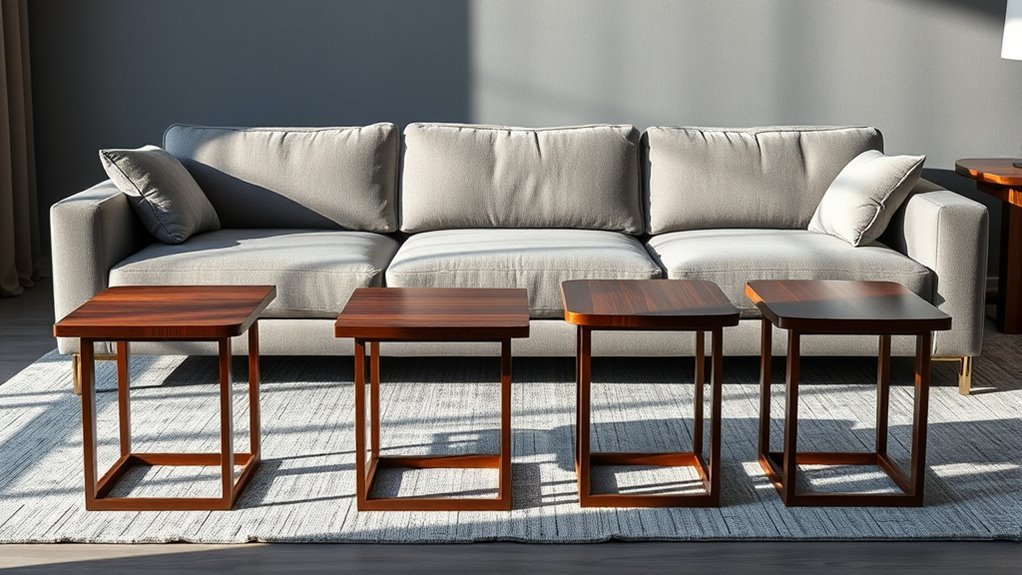
For most sofas and chairs, the right living room side table height sits within 1 to 2 inches of the armrest height. That alignment keeps drinks, books, remotes, and light switches within effortless reach while visually connecting the table to your seating. Most retail end tables measure 18 to 24 inches tall, though low-profile modern couches, high-arm traditional sofas, and armless chairs call for tailored measurements.
Quick Answer
Choose a living room side table that sits within 1 to 2 inches of your sofa or chair arm height—or level with to 2 inches below the arm if you are between sizes. Standard end tables measure 18 to 24 inches tall, while armless seating pairs best with tables 17 to 22 inches high near cushion level.
At a Glance
| Primary Height Reference | Floor to the top of the sofa or chair armrest (or seat cushion if armless) |
| Target Tabletop Height | Within 1 to 2 inches above or below the armrest (18 to 24 inches for most sofas) |
| Ideal Width & Depth | 16 to 22 inches wide on average; depth should never exceed the seating depth |
| Lamp & Spacing Targets | 58 to 64 inches combined table-and-lamp height; 1 to 3 inches from the arm; 30+ inches for walkways |
Understanding the Importance of Side Table Height
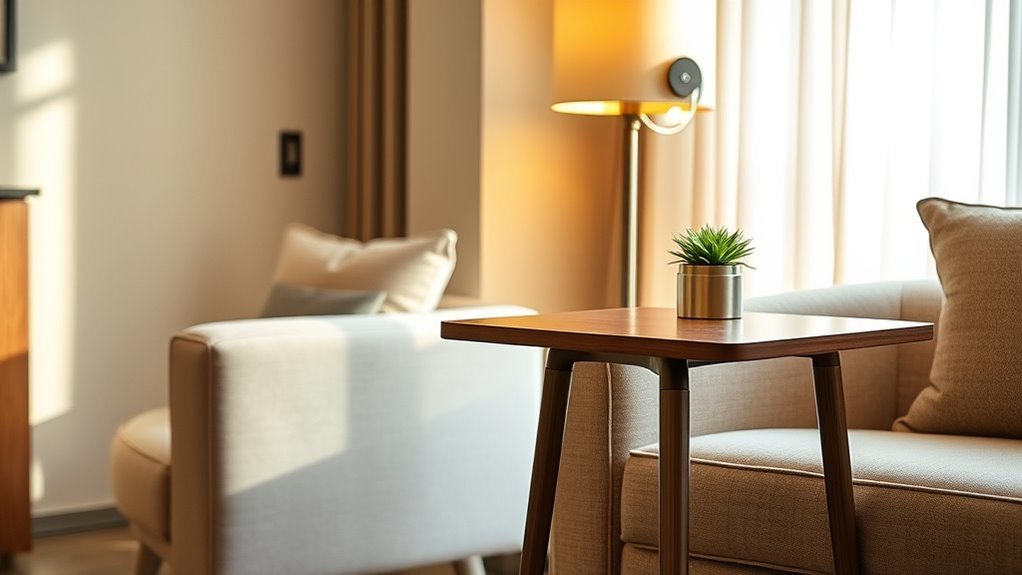
Side-table height governs both everyday ergonomics and room proportion. When a tabletop aligns closely with the arm of your sofa or accent chair, your forearm clears the armrest naturally so you can set down a mug, grab a remote, or switch on a reading lamp without hunching or lifting your shoulder.
Occasional-table sizing guidance from Ethan Allen advises keeping an end table within 1 to 2 inches, higher or lower, of your sofa or sectional arm. Bassett Furniture shares the same arm-height principle and notes 18 to 24 inches (46 to 61 cm) as the standard retail height range for end tables.
In furniture design, side table and end table are used interchangeably for a small surface placed beside seating. Retailers also use the term accent table or drink table for compact decorative stands that hold a single glass or small plant.
Note: Retail tables vary widely outside category averages. For instance, IKEA lists the LACK side table at 17 3/4 inches (45 cm) high with a 21 5/8-inch square top, while the round GLADOM tray table stands 20 5/8 inches (52.4 cm) high with a 17 1/2-inch diameter. Always measure your seating before ordering.
How to Measure Your Sofa and Chair Heights
To find the exact table dimensions your room needs, measure your seating from the floor straight up with a rigid tape measure before browsing stores. Record four numbers so you can filter online listings accurately:
- Armrest height: Measure vertically from the floor (or top of the area rug) to the highest point of the sofa or chair arm. For any piece with arms, this number is your primary target.
- Seat cushion height: Measure from the floor to the crown of the uncompressed seat cushion, typically 17 to 20 inches on standard couches. Use this measurement when sizing tables for armless sofas, chaises, or ultra-low track arms.
- Usable tabletop height: Check product specifications for the height of the actual tray or resting surface, excluding raised gallery rims or decorative handles that stand higher than the top.
- Seated eye level (for lamp tables): Sit naturally on the sofa and measure from the floor to your eye level—usually 40 to 44 inches—so you can pair the table with a lamp that hides the bare bulb.
While the Canadian Centre for Occupational Health and Safety focuses on workplace seating rather than living rooms, its ergonomic research explains why arm alignment feels comfortable: supports should meet the elbow when your upper arms hang naturally at a 90-degree angle without elevating your shoulders. When a table sits too high or too far away, your shoulder blades hike upward every time you reach for a glass.
Pro Tip: Sit in your usual spot with your shoulders relaxed and extend your hand over the sofa arm. Hold a hardcover book flat at the level where your hand naturally stops, and measure from the floor to the book—that number is your ideal tabletop height.
How High Should a Living Room Side Table Be?
A living room side table should match your sofa arm height plus or minus 1 to 2 inches. Because sofa arms range from 16 inches on low modern sectionals to 30 inches on traditional English roll-arm or tuxedo couches, use your measured arm height rather than a generic “standard” label.
| Seating Type | Typical Arm or Seat Height | Ideal Side Table Height | Sizing & Fit Guidance |
|---|---|---|---|
| Low-profile modern sofa or lounge chair | 16 to 19 in (41 to 48 cm) | 15 to 20 in (38 to 51 cm) | Choose a low drum, cube, or short side table so the surface does not tower over low track arms. |
| Standard contemporary sofa | 20 to 24 in (51 to 61 cm) | 18 to 24 in (46 to 61 cm) | Fits the standard retail end-table range; pick a height within 1 to 2 inches of your exact arm measurement. |
| High-arm traditional, rolled-arm, or tuxedo sofa | 25 to 30 in (64 to 76 cm) | 24 to 28 in (61 to 71 cm) | Look for tall end tables, chairside chests, or bedroom nightstands so you do not have to reach down past a tall arm. |
| Armless sofa, slipper chair, or chaise | 17 to 20 in seat (43 to 51 cm) | 17 to 22 in (43 to 56 cm) | Start at seat-cushion height and add up to 2 inches so your hand meets the top without leaning sideways. |
| Recliner, swivel chair, or deep sectional | 22 to 26 in (56 to 66 cm) | 21 to 26 in (53 to 66 cm) | Match the resting arm height, then set the table far enough back or aside to clear the full swivel and footrest arc. |
Treat retail height filters as a starting point: measure your sofa arm first, lock in a 2-inch target window, and shop by exact dimensions.
Recommended Products

Floor Lamp with 3-Tier Side Table: More than just a floor lamp, this space-saving lamp and table combo provides 3 open shelves for books, drinks, décor, electronics and everyday essentials. Each shelf easily supports up to 60 lbs, providing sturdy and reliable storage for your daily items. Measuring 18.9"D x 13.39"W x 59.45"H, it fits naturally beside a sofa, bed or reading chair while adding useful storage without requiring a separate end table.

Modern Form, Lasting Appeal: Clean lines and balanced simplicity define this end table, combining a steel frame with rustic panels to create visual depth and pair effortlessly with matching storage units for a cohesive, modern interior

👍𝗦𝗧𝗬𝗟𝗜𝗦𝗛 & 𝗦𝗔𝗙𝗘 𝗥𝗢𝗨𝗡𝗗𝗘𝗗 𝗗𝗘𝗦𝗜𝗚𝗡 — Prioritizing safety and style, this small round end table features smooth, rounded edges to prevent injuries, particularly in homes with children or elderly family members. Its contemporary aesthetic complements any living space while offering peace of mind.
Should Your Side Table Be Higher or Lower Than the Sofa Arm?
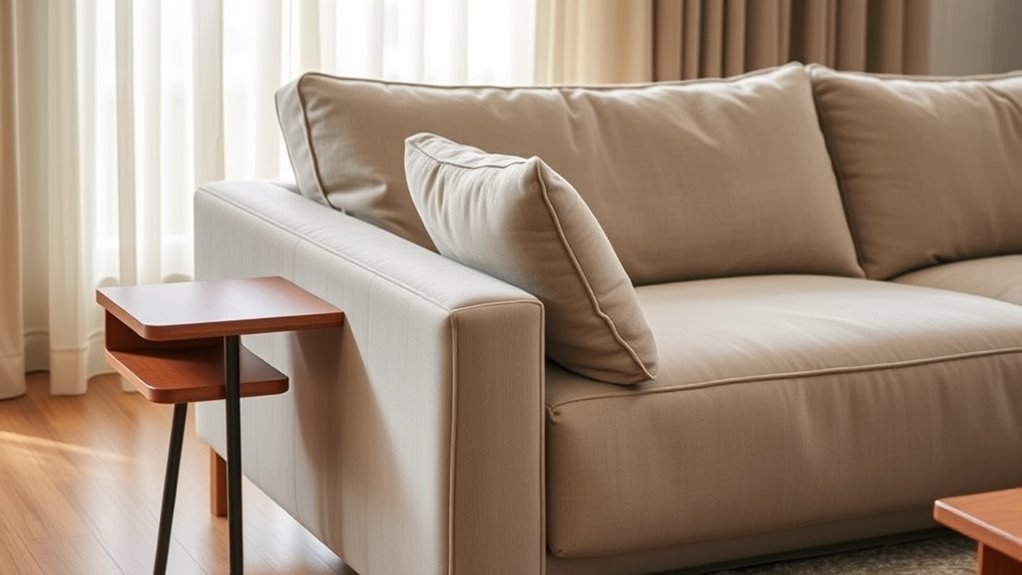
A side table looks and works best when it sits level with the sofa arm or within 1 to 2 inches above or below it. If you are choosing between a table that is slightly too tall and one that is slightly too short, interior designers generally favor going 1 to 2 inches lower than the arm so the tabletop does not feel like a wall beside your seat.
Apply these four checks when deciding between a higher or lower surface:
- For a 24-inch sofa arm: Shop for tables between 22 and 26 inches high, with 22 to 24 inches giving the cleanest visual line from across the room.
- For ultra-low bolster or pillow arms: Measure the compressed arm height where your forearm actually rests, and keep the table within 2 inches of that point rather than forcing a 24-inch table beside a 17-inch arm.
- For lamp placement: A slightly shorter table (18 to 21 inches) pairs well with tall table lamps of 36 inches and up, whereas a 25-to-27-inch table needs a shorter lamp so the bulb stays hidden.
- For armless seating: Keep the tabletop level with the seat cushion or up to 2 inches higher; going taller than 4 inches above an open seat creates a sharp corner at elbow height.
Warning: Avoid placing a side table more than 2 inches above the sofa arm when it will hold hot drinks, stemware, or a top-heavy lamp. Reaching up and over an armrest makes it easy to knock tall vessels off a narrow surface with your elbow.
Recommended Products
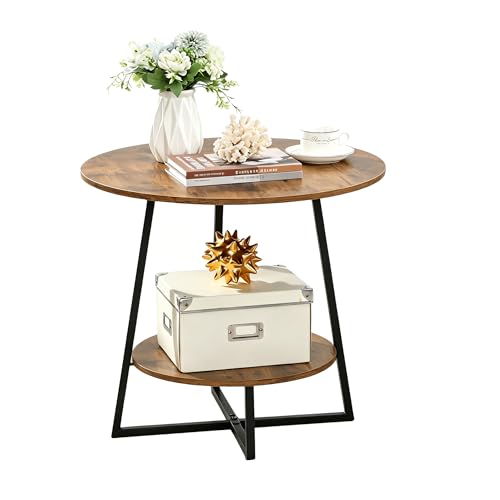
【Small Size and Lightweight】- D&H FURNIMMT 20" stylish round living room side tables is designed compact and lightweight, can widely used in living room, bedroom, office, balcony and outdoors.

Spacious square tabletop: Measures 20" L x 20" W x 22" H, offering a significantly larger surface than standard small tables to comfortably hold oversized lamps, coffee trays, or decorative centerpieces.

Spacious square tabletop: Measures 20" L x 20" W x 22" H, offering a significantly larger surface than standard small tables to comfortably hold oversized lamps, coffee trays, or decorative centerpieces.
Choose the Right Width and Depth for Your Side Table
Once height is settled, match the table’s width and depth to your seating footprint and floor space. Most standard end tables measure 16 to 22 inches wide and 18 to 24 inches deep, while compact chairside tables narrow down to 10 to 15 inches for tight corners.
For depth, Ethan Allen advises that an end table should never be deeper than the sofa or chair beside it. Measure your sofa from the back frame to the front edge of the seat cushion (typically 34 to 40 inches overall, or 20 to 26 inches along the recessed arm panel) so the front edge of the table does not jut out into the room and create a tripping hazard.
Tailor your width and depth to the layout:
- Small living rooms and apartments: Choose a 12-to-16-inch round drink table, a slim rectangular chairside table, or a C-table that tucks partially over the cushion.
- Full-size sofas (84+ inches long): Pick a 20-to-24-inch wide table so a lamp base (taking up no more than one-third of the top) still leaves room for a coaster and book.
- Shared table between two accent chairs: Select a 20-to-26-inch round or square table so both sitters can reach the surface without leaning across an empty gap.
- Beside a recliner or swivel chair: Check the chair’s fully reclined length and 360-degree swivel radius before picking the table’s depth.
Avoid These Common Side Table Height Mistakes
Shopping by style or category label alone often leads to tables that look awkward once placed beside your couch. Watch out for two frequent sizing errors before you buy.
Ignoring Sofa Arm Height
Buying a table labeled “standard height” without checking your sofa’s arm is the single most common living room sizing mistake. A 24-inch table works beautifully next to a classic rolled-arm couch but towers 6 inches above a 18-inch modern lounge sofa.
Run through three quick checks before ordering:
- Stick to the 1-to-2-inch window: Measure the arm height and filter out tables that miss it by 3 inches or more.
- Account for rug pile: If the sofa sits on a thick rug while the side table sits on bare hardwood, subtract the rug’s thickness (often 0.5 to 1 inch) from your target table height.
- Check sloped or flared arms: On a sloped-arm chair, measure the midpoint of the arm where your forearm rests rather than the tall backrest junction.
Prioritizing Aesthetics Over Function
A sculptural silhouette or stone finish cannot make up for a table that tips easily or lacks room for daily essentials. Match the table’s build and surface area to how your household uses the room.
For example, a 12-inch pedestal martini table holds one cocktail glass nicely but lacks the footprint and stability for a ceramic reading lamp. Likewise, a heavy solid-wood cabinet table hides clutter well, but placing it beside a delicate mid-century chair on hairpin legs can visually overwhelm the seating.
The Functionality of Side Tables: What Will You Use It For?
Your daily habits should dictate the exact height offset, tabletop diameter, and base construction you choose. A dedicated reading corner needs different proportions than a family TV lounge.
- Holding everyday drinks: Keep the tabletop level with or 1 inch below the sofa arm so you can set down a glass without looking away from a conversation or screen.
- Supporting a reading lamp: Follow the Lamps Plus table lamp buying guide and aim for the bottom of the lampshade to sit at or slightly below seated eye level (a combined table-and-lamp height of roughly 58 to 64 inches, using a 24-to-34-inch lamp).
- Storing books, chargers, and remotes: Choose a table 18 to 24 inches wide with a single top drawer or lower shelf so the main surface stays clear.
- Displaying plants or tall vases: Verify the manufacturer’s maximum load rating (for instance, 55 pounds on an IKEA LACK vs. 10 to 15 pounds on lightweight metal trays) and keep foliage below seated sightlines.
- Working on a laptop or eating snacks: Use a C-table that slides over the seat cushion, making sure the bottom frame (usually 1 to 2 inches thick) fits cleanly under the sofa skirt or legs and the top clears the cushion by at least 2 inches.
OSHA’s workstation guidance explains the physical cost of poor reach alignment: supports that sit too low force you to lean sideways, while supports placed too high or wide pull the arm away from the torso and strain the neck and shoulders. Keeping high-use items within a relaxed 14-to-18-inch forearm reach prevents that strain.
Tips for Styling Your Side Table Alongside Your Furniture
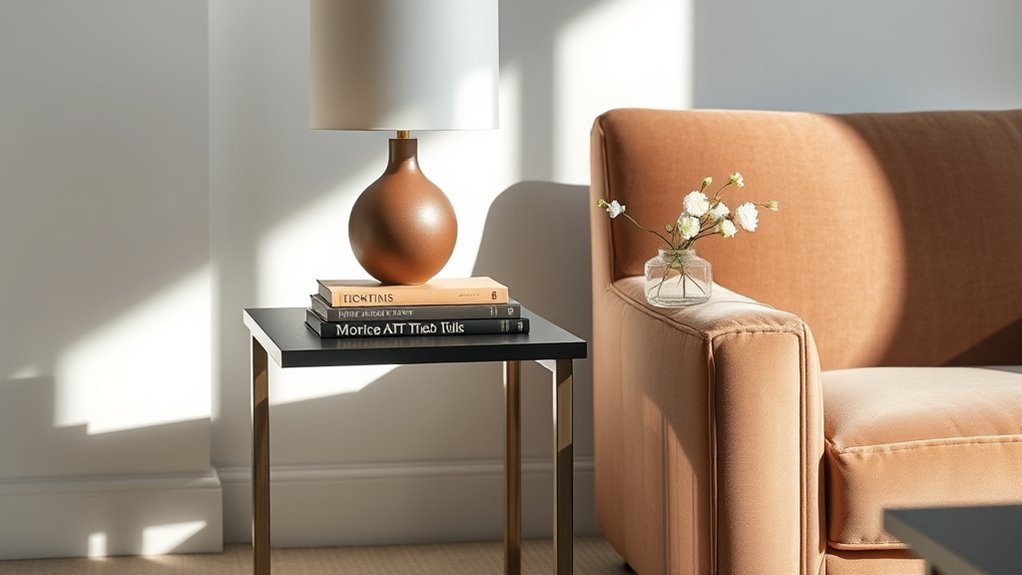
Once your side table sits at the right height, style the top so it looks cohesive with your sofa and coffee table while leaving at least one-third of the surface open for daily use.
Harmonize Heights With Furniture
Designers balance a living room by contrasting visual weight across the sofa, coffee table, and side tables rather than buying an identical matching set. Focus on three proportion rules:
- Contrast leg and base styles: If your sofa is upholstered to the floor with a skirt or block base, pair it with an open-legged side table; if your sofa sits on tall exposed legs, ground it with a solid drum or block table.
- Step your table heights intentionally: Your coffee table should sit 1 to 2 inches below the seat cushion (typically 16 to 18 inches high), while your side table steps up to match the armrest (typically 20 to 24 inches high).
- Match table pairs by height, not necessarily twin frames: When placing mismatched tables on either end of a sofa, keep their tabletop heights within 1 inch of each other or equalize the visual height with matching table lamps.
Balance Decorative Elements Carefully
Keep tabletop styling functional by limiting decor to a simple three-part grouping: one vertical anchor, one low horizontal element, and one practical catch-all. Ensure the lamp base occupies no more than one-third of the tabletop width, with a lampshade roughly 1.5 to 2 times wider than the base.
For a 20-inch table, a lamp, a pair of stacked books topped with a small candle, and a coaster tray add varied height while leaving an open 8-inch landing zone for your coffee mug or phone.
What Shape Should Your Side Table Be?
The best side table shape depends on your room’s traffic flow, corner space, and seating layout. Match the silhouette to the job it needs to perform:
- Round or oval (14 to 24 inches across): Softens boxy sectionals and eliminates sharp corners in tight walkways or homes with young children.
- Square (18 to 24 inches wide): Fits neatly into the right-angle corner between two perpendicular sofas or flush against a wide track arm.
- Rectangular (12 to 18 inches wide by 22 to 26 inches deep): Ideal for narrow gaps beside deep sofas where you need front-to-back surface space for both a lamp and a drink.
- C-table (10 to 16 inches wide): Slides under a sofa with at least 2 inches of floor clearance to bring a work or snack surface directly over your lap.
- Nesting tables: Expands into two or three tiered surfaces when guests visit and tucks into a single footprint afterward.
- Pedestal or drum table: Offers a compact footprint between a pair of angled accent chairs; choose a weighted base if placing a lamp on top.
How to Position Your Side Table for Maximum Accessibility
Position your side table 1 to 3 inches away from the outer edge of the sofa arm, with the front edge of the table aligned with or slightly behind the front edge of the seat cushion. Do not apply the 14-to-18-inch coffee-table legroom gap to a side table—placing an end table 15 inches away from the arm forces an uncomfortable sideways lean.
Ideal Height Alignment
Test the table’s position while seated rather than judging it from across the room:
- Forearm reach check: With your elbow resting on the sofa arm, the front half of the tabletop should sit 14 to 18 inches from your elbow so your hand lands flat on the surface.
- Front-to-back alignment: Line up the front of a shallow table near the front half of the armrest so you never have to twist backward to grab a glass.
- Lamp switch access: Rotate the lamp socket or cord switch toward the seat so you can turn the light off without rising.
Clear Path Clearance
Preserve open walkways around your seating arrangement so nobody clips a table corner when entering the room. Crate & Barrel’s furniture layout guide recommends leaving at least 30 inches of clearance (and ideally 30 to 36 inches) between furniture pieces wherever people walk through the space.
Manage lamp and charger cables safely as well. Route cords behind the sofa frame or along the baseboard, and never run power or extension cords underneath area rugs—the National Fire Protection Association (NFPA) warns that covering flexible cords with rugs or floor coverings traps heat and causes dangerous cord damage under foot traffic.
Functional Placement Considerations
Before locking in the final spot, verify three layout details:
- Seated reach test: Sit in the corner cushion and mimic setting down a full mug with one hand.
- Moving-part clearance: Open table drawers, pull out nesting tables, and extend recliner footrests or swivel bases through their full range of motion.
- Outlet proximity: Confirm that any table holding a lamp or phone charger sits within reach of a wall or floor receptacle without stretching a cord across a doorway.
Before You Buy: Side Table Checklist
Keep this sizing checklist on your phone when comparing side tables online or in a showroom:
- Sofa arm height measured: Target a tabletop within 1 to 2 inches of your armrest (or 17 to 22 inches high for armless seats).
- Depth checked against seating: Confirm the table is no deeper than your sofa or chair (usually 18 to 24 inches deep).
- Width matched to function: Allow 16 to 24 inches of width for a lamp plus drinks, or 10 to 15 inches for a compact drink stand.
- Lamp proportion verified: Aim for a 58-to-64-inch combined table-and-lamp height so the bottom of the shade sits near seated eye level (40 to 44 inches off the floor).
- Side gap and walkway planned: Leave 1 to 3 inches between the sofa arm and table, plus at least 30 inches for main room walkways.
- Base stability and load checked: Pick a weighted or four-legged base around children, pets, and heavy ceramic lamps.
- C-table or recliner clearance confirmed: Measure under-sofa gap height (usually 1.5 to 3 inches needed) and full recliner or swivel arcs.
Key Takeaways
- Match the arm within 1 to 2 inches: Measure from the floor to the top of your sofa or chair arm first; when torn between two sizes, pick the table 1 to 2 inches shorter than the arm.
- Size by seating style: Low-profile modern sofas need 15-to-20-inch tables, standard couches use 18-to-24-inch tables, and tall traditional arms (25 to 30 inches) pair best with 24-to-28-inch tables or nightstands.
- Use the 58-to-64-inch lamp rule: Pair your side table with a 24-to-34-inch lamp so the bottom rim of the shade sits around seated eye level (40 to 44 inches) and hides bulb glare.
- Respect depth and clearance limits: Keep table depth shorter than your sofa depth, set the table 1 to 3 inches from the arm, and preserve at least 30 inches for walkways.
Recommended Products

Modern Form, Lasting Appeal: Clean lines and balanced simplicity define this end table, combining a steel frame with rustic panels to create visual depth and pair effortlessly with matching storage units for a cohesive, modern interior

𝐀𝐥𝐰𝐚𝐲𝐬 𝐛𝐲 𝐘𝐨𝐮𝐫 𝐒𝐢𝐝𝐞. 𝐎𝐯𝐞𝐫𝐚𝐥𝐥 𝐃𝐢𝐦𝐞𝐧𝐬𝐢𝐨𝐧𝐬: 𝟐𝟑.𝟔"𝐋 𝐱 𝟏𝟏.𝟖"𝐖 𝐱 𝟐𝟑.𝟖"𝐇

Hassle-Free Storage: With 2 non-woven drawers and 2 open shelves, this side table measures 11.8"L x 18.9"W x 23.6"H and offers sufficient space for you to store different life supplies and household gadgets tidily, keeping home neat and organized
Related Guides
Frequently Asked Questions
How high should a living room side table be?
A living room side table should sit within 1 to 2 inches of your sofa or chair armrest height. While most retail end tables measure 18 to 24 inches tall, always measure your actual armrest from the floor so the tabletop stays effortless to reach.
What is the standard end table height?
Standard end table height is 18 to 24 inches (46 to 61 cm), with an average width of 16 to 22 inches and a depth of 18 to 24 inches. Treat this range as a shopping filter rather than a strict rule, since low modern couches and tall traditional sofas need shorter or taller tables.
Should a side table be higher or lower than the couch arm?
A side table can sit 1 to 2 inches lower, level with, or 1 to 2 inches higher than the couch arm. When you cannot match the arm height exactly, choose a table 1 to 2 inches lower than the arm so it looks visually lighter and prevents you from bumping tall glasses with your elbow.
How much lower should a side table be than a couch?
A side table should be no more than 1 to 2 inches lower than the couch arm, whereas a coffee table sits 1 to 2 inches lower than the seat cushion. Dropping a side table 4 or more inches below the armrest forces you to lean sideways every time you set down a drink.
What if my sofa or chair has no arms?
For an armless sofa, slipper chair, or chaise, choose a side table that is level with the seat cushion or up to 2 inches higher—typically 17 to 22 inches tall. This height lets your hand reach the surface naturally without lifting your shoulder or leaning downward.
What is the 2:3 rule for furniture?
The 2:3 rule is a proportion guideline stating that a coffee table or artwork above a sofa should span roughly two-thirds (or one-half to two-thirds) the length of the sofa. It does not apply to side table height, which is determined by armrest height and seated reach.
Can I use a nightstand as a living room side table?
Yes, you can use a nightstand as a living room side table if its height and depth fit your sofa. Because nightstands usually stand 24 to 28 inches tall, they work well beside high-arm traditional sofas (25 to 28 inches) but often look too tall and bulky next to low-profile modern couches.
What are the rules for sofa side tables?
Keep the tabletop within 1 to 2 inches of the sofa arm height, choose a depth shorter than the sofa’s depth, and place the table 1 to 3 inches from the arm. When adding a lamp, keep the base under one-third of the tabletop width and aim for a 58-to-64-inch combined height.
Conclusion
The right living room side table height always starts with the furniture right beside it. Grab a tape measure, record your sofa or chair arm height (or seat height for armless pieces), and filter for tables within 1 to 2 inches of that number. Before ordering, confirm that the table is no deeper than your seat, leaves at least 30 inches for walkways, and pairs with your lamp to keep the bottom of the shade near seated eye level.
Sources
- Ethan Allen: Coffee Tables, End Tables & Consoles Buying Guide: Supports keeping an end table within 1 to 2 inches of the sofa or sectional arm and never exceeding seating depth.
- Bassett Furniture: Occasional and Accent Tables: Supports the common 18-to-24-inch end-table height range, 16-to-22-inch width range, and arm-height alignment.
- Canadian Centre for Occupational Health and Safety: How to Adjust Office Chairs: Supports relaxed shoulder positioning and 90-degree elbow alignment without elevating the shoulders.
- Occupational Safety and Health Administration: Computer Workstations – Chairs: Supports guidance on avoiding awkward reaching, sideways leaning, and raised shoulders.
- Lamps Plus: Table Lamp Eye-Level Guidance: Supports pairing lower side tables with taller table lamps to maintain proper shade height.
- Lamps Plus: How to Find the Perfect Table Lamp: Supports keeping the base of a living room table lampshade no higher than seated eye level.
- Crate & Barrel: How to Arrange Living Room Furniture: Supports allowing at least 30 inches of walkway clearance between furniture pieces.
- National Fire Protection Association (NFPA): Electrical and Fire Safety Considerations at Home: Supports keeping flexible power and extension cords out from under rugs and floor coverings.
- IKEA LACK Side Table Measurements: Supports the 17 3/4-inch (45 cm) height and 21 5/8-inch square footprint example.
- IKEA GLADOM Tray Table Measurements: Supports the 20 5/8-inch (52.4 cm) height and 17 1/2-inch diameter tray-table example.