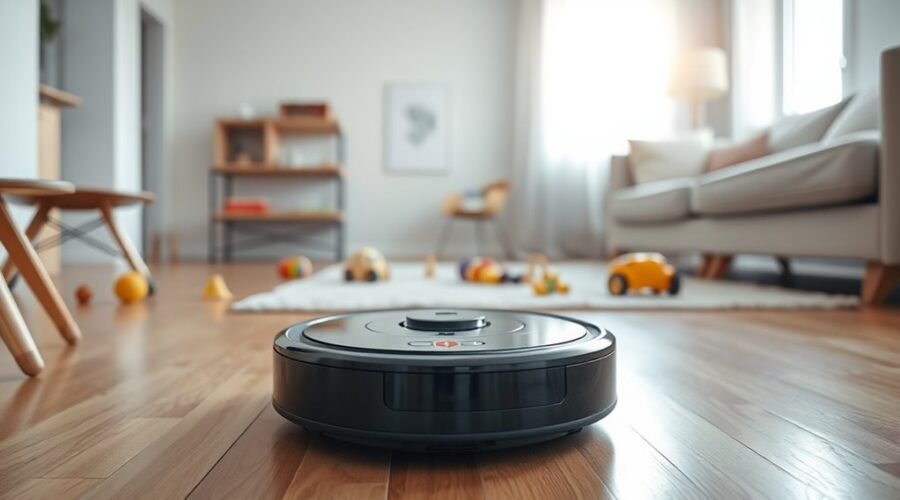
VSLAM in a robot vacuum is a camera-based navigation system that estimates position while building a map of the home in real time. It tracks visual landmarks, compares frame changes, and adjusts movement as the environment changes. Compared with LiDAR, it can be compact and cost-effective, but its accuracy depends on light and visible features. That tradeoff becomes more important when mapping starts to drift, and the next question is how it behaves in different rooms.
VSLAM vs LiDAR: Which Is Better?
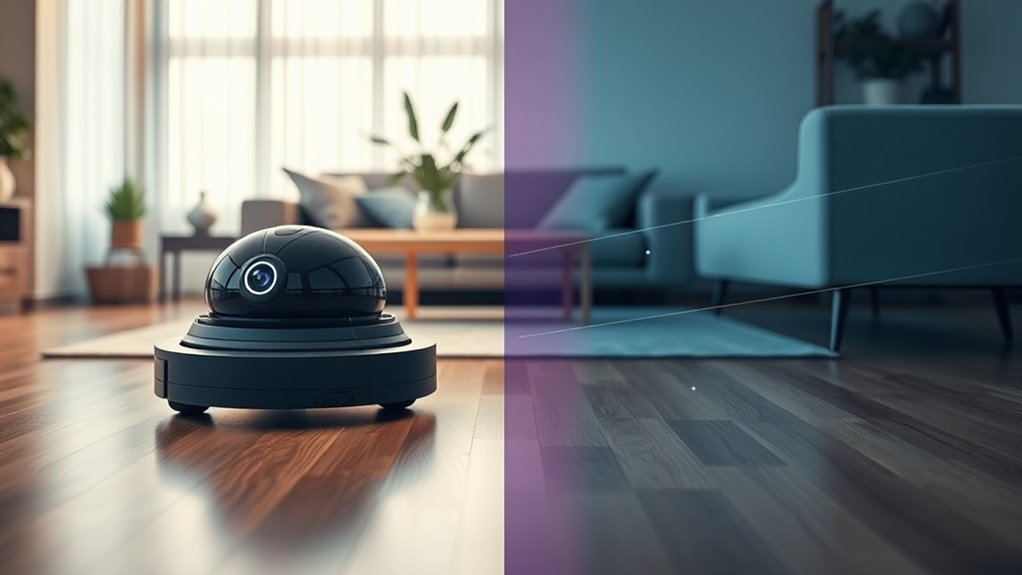
When comparing VSLAM and LiDAR in a robot vacuum, the better option depends on the operating environment and performance priorities.
vSLAM uses camera-based feature mapping, so it is typically faster and more affordable, which supports access for budget-conscious households. It performs best in feature-rich spaces with adequate lighting, where visual data is abundant and navigation can remain efficient.
By contrast, LiDAR uses laser distance measurements to produce highly accurate 3D maps, and it remains effective in complete darkness and complex layouts. This makes LiDAR stronger for large homes and low-light conditions, but its higher cost can limit wider adoption.
For obstacle detection, vSLAM often identifies small objects such as toys and cables more effectively, while LiDAR may miss fine clutter.
The better system is consequently contextual: vSLAM favors affordability and detail, whereas LiDAR favors precision and environmental independence.
How VSLAM Works in Robot Vacuums
VSLAM in robot vacuums processes camera frames to detect and track visual features such as corners and edges, using their spatial relationships to estimate motion.
As the device moves, it updates a real-time map of the environment while refining its position within that map.
This continuous feature-based mapping allows navigation to remain adaptive as room layouts and obstacles change.
Visual Feature Tracking
Visual feature tracking in vSLAM relies on onboard cameras to continuously capture video frames and identify stable landmarks such as corners, edges, and textured surfaces. Through visual feature tracking, vSLAM uses these points to estimate motion and support accurate mapping without external markers.
As the vacuum advances, it triangulates observations from successive frames, deriving spatial relationships that sustain navigation in real time. In feature-rich rooms, the method can distinguish furniture shifts and newly placed obstacles, preserving operational autonomy.
Loop closure logic later compares current views with earlier ones to reduce drift and stabilize position estimates during long cleaning cycles. Performance remains dependent on illumination; adequate lighting improves feature recognition, while poor light degrades precision and limits the system’s capacity to map freely.
Real-Time Map Building
Real-time map building in a robot vacuum depends on continuous camera-based image capture and processing to construct and refine an internal representation of the cleaning area as the machine moves.
It converts visual data into coordinates that support navigation without fixed routes.
- Identifies landmarks
- Estimates position via visual odometry
- Updates maps when furniture shifts
- Improves obstacle detection
- Optimizes coverage patterns
How VSLAM Maps Your Home
By capturing continuous camera frames, this navigation method identifies visual features in the environment and uses them to estimate the robot’s position while building a detailed map of the home.
VSLAM combines mapping with localization by triangulating repeated landmarks, then refining each pose estimate as new visual features appear. The result is a structured floor plan that updates in real time as the vacuum moves through rooms, hallways, and around furniture.
Because the system compares successive frames, it can register relocated chairs, boxes, and other small objects without losing orientation.
Loop closure further constrains accumulated error, correcting drift when the robot revisits known areas and restoring geometric consistency across long sessions.
In feature-rich spaces, this process supports efficient navigation and broader coverage, reducing dependence on preexisting boundaries.
The method thus enables a vacuum to translate visual evidence into operational freedom, sustaining autonomous movement through changing domestic layouts with measured precision.
Why VSLAM Needs Good Lighting
VSLAM depends on sufficient light so its cameras can detect stable visual features such as corners, edges, and textures for mapping and localization.
In darkness, feature extraction degrades, reducing the system’s ability to track movement and identify obstacles accurately.
Under low or changing light, the resulting tracking errors can cause drift and map inconsistency.
Light For Feature Detection
Good illumination is critical for visual feature detection because a robot vacuum’s camera-based VSLAM system must clearly identify edges, corners, textures, and other landmarks to estimate position and build an accurate map. Sufficient light strengthens feature detection and stabilizes vSLAM navigation.
- Bright scenes improve landmark recognition.
- Natural or artificial light increases mapping precision.
- AI can assist, but not replace illumination.
- Weak light reduces edge and texture visibility.
- Poor input can increase drift and path inefficiency.
Under robust lighting, the system can extract more reliable visual cues, reducing localization error and supporting cleaner, more independent movement.
In technical terms, illumination expands the usable feature set, enabling the robot to navigate with greater confidence and less dependence on corrective motion.
Camera Dependence In Darkness
Because visual SLAM depends on camera imagery to detect landmarks, its performance drops sharply in darkness, where edges, textures, and other navigational cues become harder to distinguish. This camera-based navigation method consequently requires adequate illumination to maintain reliable mapping.
In low-light conditions, the vision pipeline receives fewer stable features, reducing object recognition quality and slowing route planning. As a result, the robot vacuum may move cautiously, miss obstacles, or clean less efficiently.
Good lighting restores image contrast, improving landmark extraction and supporting more precise localization. Compared with LiDAR systems that use laser measurements, visual SLAM is more vulnerable when the environment is dim.
For users seeking greater autonomy in home cleaning, illumination is not cosmetic; it is a functional requirement for dependable perception and navigation.
Low-Light Drift And Errors
Low illumination does more than reduce image quality; it can destabilize the robot’s localization itself. In low light, visual SLAM uses fewer reliable features, so corners, edges, and textures vanish from the map. That loss increases drift, because the system cannot anchor motion to stable reference points.
Visual odometry then estimates movement with less certainty, producing positional errors and distorted maps.
- feature detection weakens
- frame matching becomes inconsistent
- drift accumulates across turns
- map updates lose precision
- navigation confidence drops
Good lighting restores feature density and improves tracking fidelity. Additional sensors can buffer failure modes, yet illumination remains the primary condition for accurate, autonomous movement.
For users seeking cleaner routes and less dependence on correction, bright, even lighting supports freer, more reliable operation.
Where VSLAM Works Best at Home
VSLAM performs best in homes that offer abundant visual landmarks, such as furniture, corners, and other fixed features that support accurate mapping and navigation. In such settings, VSLAM navigation uses camera input and advanced sensors to build a reliable map of your home, giving the vacuum structured spatial reference. Well-lit rooms improve object recognition, while cluttered areas add usable detail for tracking toys, cables, and other obstacles. Open layouts also help, because uninterrupted visual data supports broader coverage and cleaner route planning. Smaller homes and apartments often benefit most, since the system can map spaces quickly and complete cleaning with less delay.
| Home condition | VSLAM performance | Result |
|---|---|---|
| Well-lit, feature-rich | Strong | Efficient mapping |
| Open, cluttered spaces | Strong | Adaptive navigation |
| Small apartments | Strong | Faster cleaning |
This configuration favors occupants seeking automated coverage with less manual control and more spatial freedom.
VSLAM Limitations and Mapping Drift
Although VSLAM can deliver accurate navigation in structured spaces, its mapping can drift over time as accumulated position estimates gradually lose precision, especially in rooms with sparse visual detail. This mapping drift reduces spatial fidelity and can distort route planning in ways that limit autonomous freedom.
- Weak visual cues lower feature matching reliability.
- Lighting conditions directly affect frame quality and pose estimation.
- Moving objects can interrupt consistent scene interpretation.
- Reflective or transparent surfaces provide unstable reference points.
- Loop closure may correct errors, but it is computationally demanding.
In practice, the system depends on stable visual cues to anchor location estimates. When illumination is uneven, shadows and glare degrade map quality, while object motion introduces ambiguity.
Loop closure can restore coherence by revisiting known areas, yet complex layouts may still defeat correction. As a result, performance remains contingent on environmental stability rather than guaranteed precision.
Can Robot Vacuums Use Both Systems?
Yes—robot vacuums can integrate both vSLAM and LiDAR into a single navigation stack, using each system where it is most effective. In such architectures, vSLAM handles rapid visual mapping and obstacle recognition in bright interiors, while LiDAR supplies distance measurements and stable localization when illumination falls.
The result is a more resilient navigation model that reduces drift, improves map fidelity, and supports freer movement through constrained domestic spaces.
Devices such as the Dreame L60 Pro Ultra illustrate this dual-sensor approach. By fusing visual and laser inputs, the vacuum can update maps in real time, revise routes around furniture, and maintain coverage across irregular room layouts.
This combination also strengthens obstacle avoidance, since each modality compensates for the other’s weaknesses. For users seeking autonomy from manual cleaning, the paired use of vSLAM and LiDAR yields cleaner paths, better efficiency, and more reliable performance across varied lighting and floor plans.
Frequently Asked Questions
What Is the Difference Between SLAM and vSLAM?
SLAM uses multiple sensor technology types for robot navigation and mapping accuracy, while vSLAM depends only on cameras and visual features. The latter needs more processing, but both enable real-time localization and mapping.
What Are the Downsides of Using a Robotic Vacuum Cleaner?
Like a tireless but constrained metal servant, a robotic vacuum’s downsides include limited battery life, reduced navigation accuracy in low light, difficulty with obstacles, recurring maintenance costs, and high upfront prices, restricting dependable, autonomous floor-cleaning liberation.
What Is the Absolute Best Robot Vacuum Right Now?
The absolute best robot vacuum is generally the Dreame L60 Pro Ultra, combining smart features, advanced navigation technology, and strong cleaning efficiency. It offers precise mapping, obstacle avoidance, auto-emptying, and app control for liberated, low-effort maintenance.
Is Lidar Better for Robot Vacuums?
Yes—Lidar technology is often better for robot vacuums, delivering superior Navigation accuracy and Obstacle detection, especially in low light and complex layouts. It typically costs more, but its precision can increase cleaning autonomy and reliability.
Conclusion
In the house of autonomy, VSLAM is the watchful scribe, sketching walls from passing light and memory, while LiDAR is the surveyor, measuring distance with disciplined certainty. Each serves the same estate differently: one thrives in brightness and texture, the other in structure and range. Yet both remain vulnerable to the terrain they record. Understanding their strengths and limits reveals the true map: not a perfect copy of home, but a living approximation, continually revised by motion.