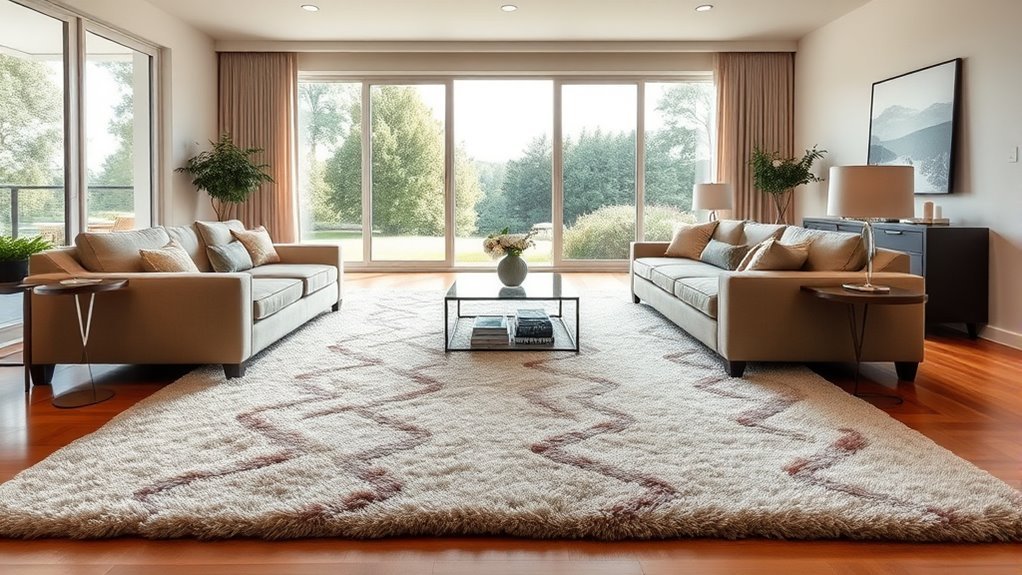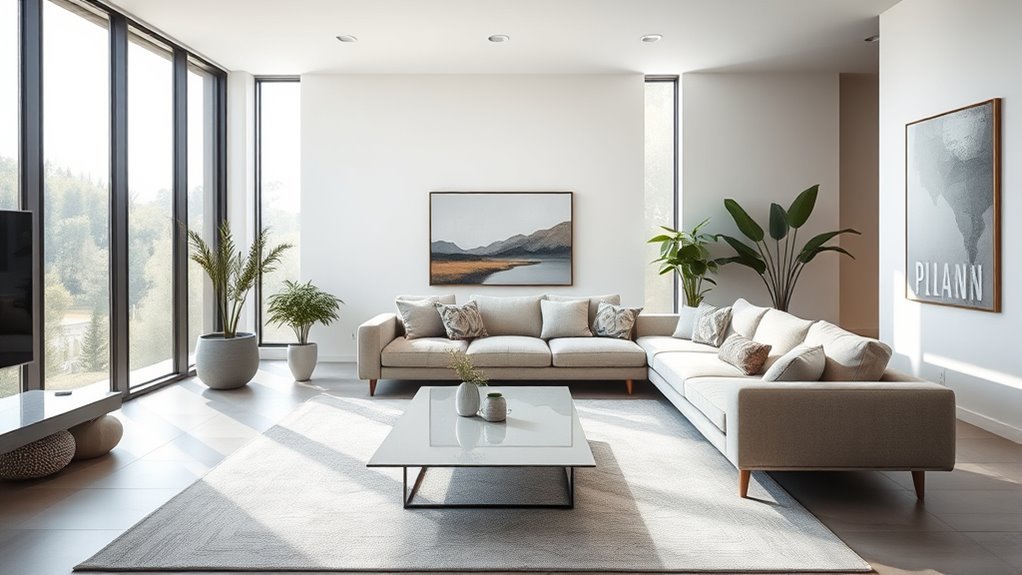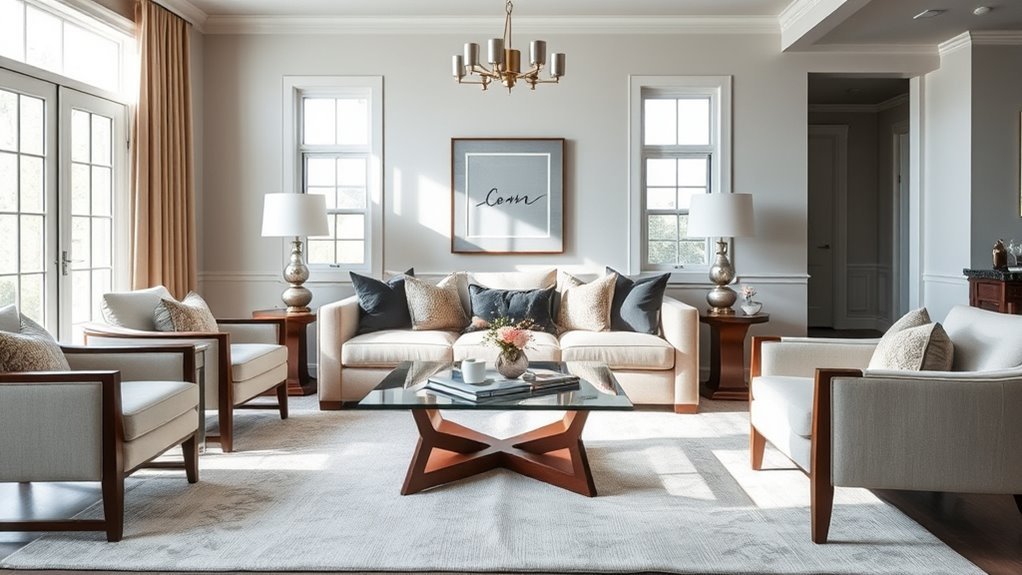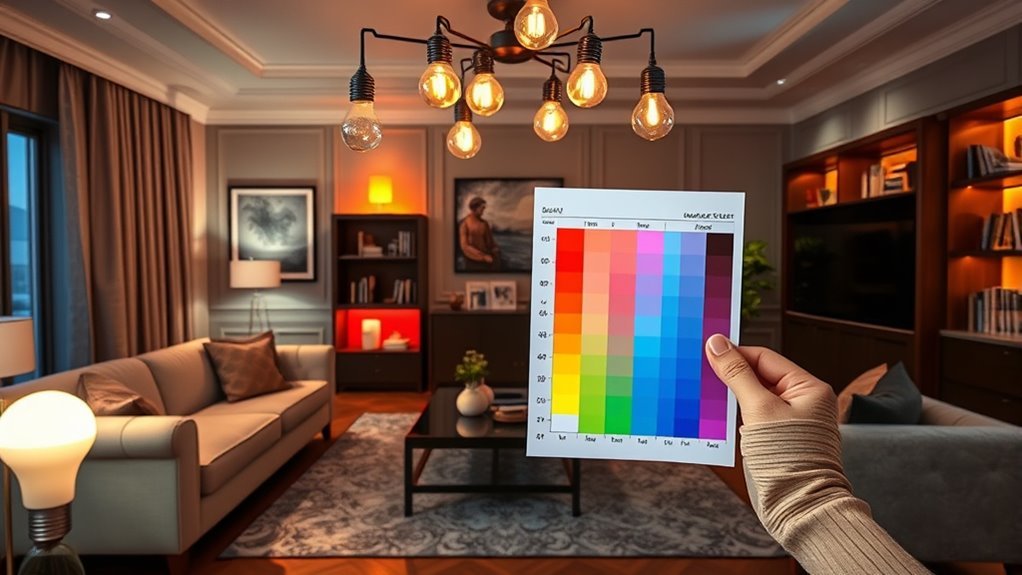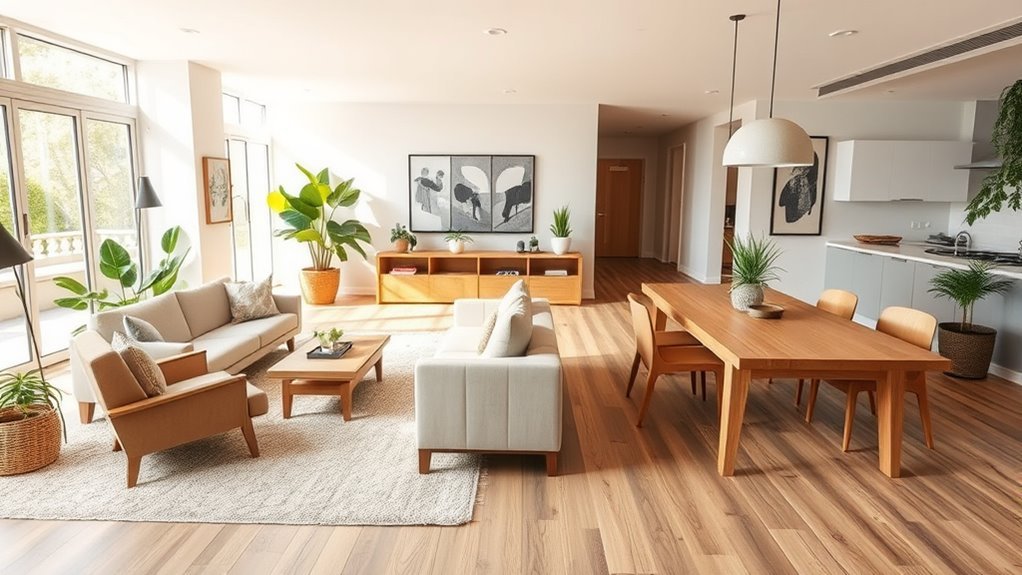
Zoning in an open concept living room means arranging one large shared room so each area has a clear job: relaxing, dining, working, reading, playing, or entertaining. Instead of adding walls, you use furniture placement, rugs, lighting, color, storage, and architectural details to create separation while keeping the room bright, open, and easy to move through.
Quick Answer
To zone an open concept living room, decide what each area must do, anchor each zone with a rug or furniture grouping, keep clear walking paths, repeat colors for cohesion, and layer ambient, task, and accent lighting so every zone feels intentional without closing off the room.
Key Takeaways
- Start with function first: decide where you will relax, eat, work, read, store items, and entertain.
- Use area rugs, sofa backs, console tables, bookcases, plants, and lighting to create soft boundaries without blocking light.
- Keep pathways open. Aim for about 30 to 36 inches where people regularly walk through the room.
- Repeat at least one color, wood tone, metal finish, or texture across zones so the room feels connected.
- Layer lighting by zone: general light for the whole room, task light for work or reading, and accent light for art, shelves, or architectural details.
At a Glance
| Time Required | 1 to 3 hours for planning and rearranging; longer if buying rugs, lighting, or storage |
| Difficulty | Easy to moderate |
| Tools Needed | Tape measure, painter’s tape, floor plan sketch, rug pad, lamps, extension-safe cord management, storage baskets |
| Cost | $0 if rearranging only; $50 to $500+ if adding rugs, lamps, shelves, or dividers |
What Is Zoning in an Open Concept Living Room?
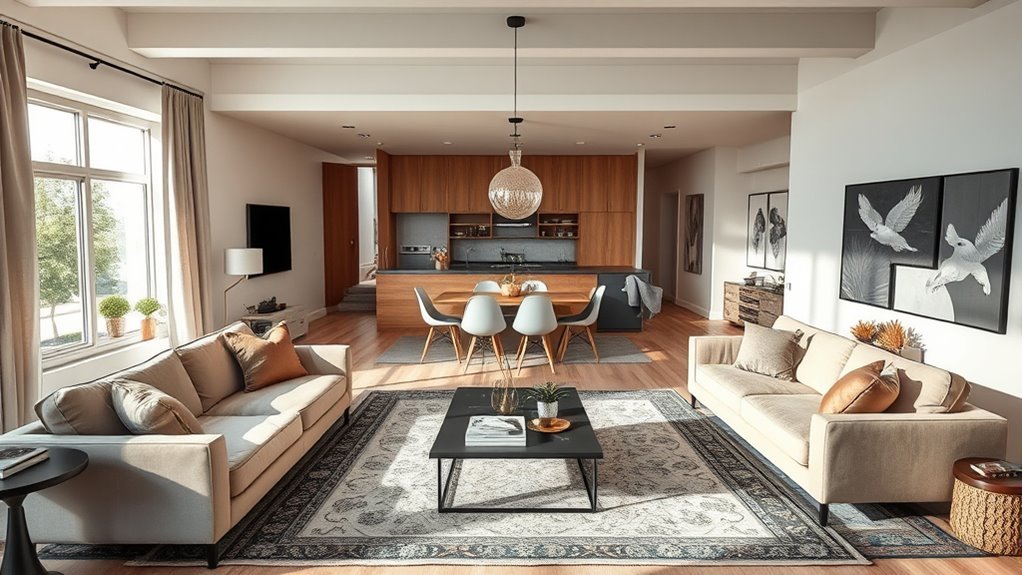
When you think about zoning in an open concept living room, imagine turning one large, flowing space into smaller areas that each feel useful and easy to understand. One corner might become a quiet reading nook, the center might become the main conversation area, and the area near the kitchen might become a dining zone.
The goal is not to make the room feel chopped up. The goal is to give every part of the space a purpose while keeping the openness that makes the layout appealing. Good zoning helps you know where to sit, where to walk, where to store things, and where each activity naturally belongs.
You can create zones with furniture placement, area rugs, lighting, color, built-ins, ceiling details, plants, screens, and storage. Sofas and sectionals can act as natural dividers. Rugs can visually ground each activity area. Lighting can shift the mood from bright work mode to relaxed evening mode. Color and texture can make each zone feel distinct while still connected to the whole room.
Why Is Zoning Important for Open Layouts?
Zoning matters because an open layout can feel spacious but confusing. Without clear zones, furniture may float awkwardly, traffic paths may cut through seating, and one activity can easily interrupt another. A thoughtful layout keeps the room open while making daily life easier.
Enhanced Functionality and Flow
Creating a sense of order in an open concept living room improves how the space works. Instead of one large area doing everything at once, each zone supports a specific activity. A sofa and chairs can create a conversation zone. A table near the kitchen can mark the dining zone. A small desk behind the sofa can become a work zone without taking over the room.
| Zoning Element | Purpose | Best Use |
|---|---|---|
| Furniture Placement | Defines activity areas | Conversation, TV, dining, work |
| Area Rugs | Creates visual separation | Living zone, reading nook, dining area |
| Lighting Variations | Sets the right mood and function | Reading, dining, relaxing, entertaining |
| Storage | Reduces visual clutter | Toys, books, blankets, media, office supplies |
Clear Activity Differentiation
An open concept living room often has to support more than one part of life. You might watch TV, host friends, eat dinner, help with homework, answer emails, or let kids play in the same room. Zoning gives each activity a home.
For example, placing a console table behind a sofa can signal the end of the lounge area and the beginning of a walkway or work area. A low bookcase can separate a reading corner from a dining area while still letting light pass over it. A pendant over a dining table can make the table feel like its own room, even when there are no walls.
Improved Visual Harmony
Zoning also improves how the room looks. When each area has an anchor, the furniture feels intentional instead of scattered. The trick is to create definition without making the open room feel busy.
- Use furniture placement to form natural boundaries.
- Choose rugs large enough to connect the main furniture pieces in each zone.
- Repeat colors, woods, metals, or fabrics across the whole room.
- Use different lighting for different activities.
- Keep walking paths clear and easy to follow.
When done well, each zone has its own purpose, but the whole room still feels like one connected space.
Essential Elements for Zoning Your Open Concept Living Room
Before moving furniture, make a simple plan. Write down the activities your room needs to support. Then rank them by importance. Most open concept living rooms need a main seating zone, but yours may also need a dining area, home office, play corner, music area, workout space, entry drop zone, or reading nook.
Once you know the functions, use these core elements to shape the room:
- Anchors: Rugs, tables, sofas, pendants, and shelving give each zone a visual center.
- Boundaries: Sofa backs, console tables, open shelving, plants, curtains, and screens separate areas without closing them off.
- Pathways: Leave clear routes between the kitchen, seating, doors, stairs, and dining area. A 30-inch path can work in tight spaces, but 36 inches feels more comfortable where people walk often.
- Lighting: Use general lighting for the whole room, task lighting for reading or work, and accent lighting for shelves, art, or architectural details. The U.S. Department of Energy explains these as ambient, task, and accent lighting in its lighting principles and terms.
- Repetition: Repeat one or two design details across zones so the room feels coordinated.
Note: Private homes are not always required to follow public accessibility standards, but using a wider clear path makes an open layout easier for guests, kids, pets, strollers, and mobility aids. The U.S. Access Board lists 36 inches as the minimum clear width for accessible walking surfaces, which is a helpful planning benchmark.
Recommended Products

Privacy & Blackout: AJAZZ room divider curtain 100 % blackout curtains, studio or office into an instant private zone without drilling walls.


Decorative Arched Room Divider : This arched room divider combines a Shoji screen look with diamond wood accents, making it useful as a privacy screen and decorative accent for living rooms, bedrooms, or apartment corners
Step-by-Step: How to Zone an Open Concept Living Room
If your open room feels unfinished, start with the layout instead of the decor. Zoning works best when the room’s function leads the design.
1. Map Your Main Activities
List every activity that happens in the room. Common zones include:
- Main seating and conversation area
- TV or media area
- Dining nook
- Home office or homework station
- Reading corner
- Kids’ play area
- Entry drop zone for shoes, bags, and keys
- Storage zone for books, toys, blankets, games, or media
Pick the top three or four. Too many zones can make the room feel crowded.
2. Place the Largest Furniture First
Start with the sofa, sectional, dining table, or media console. These pieces create the strongest boundaries. A sofa facing a fireplace or TV can anchor the lounge. A sectional can form an L-shaped edge around the seating area. A dining table under a pendant can become its own zone near the kitchen.
Avoid pushing every piece against the walls by default. Floating a sofa or pair of chairs can make the center of the room feel more intentional and create a clearer walkway behind the seating.
3. Anchor Each Zone
Every zone needs an anchor. In the lounge, that might be a rug and coffee table. In the dining area, it might be the table and pendant light. In a reading nook, it might be a chair, floor lamp, and small side table.
If a zone feels like it is “floating,” it usually needs a stronger anchor or a clearer boundary.
4. Check the Walkways
Walk through the room the way you use it every day. Can you reach the kitchen without cutting through the middle of the seating group? Can you pull out dining chairs without bumping into a console? Can someone pass behind the sofa while others are seated?
Use painter’s tape on the floor to test furniture and rug sizes before moving heavy pieces or buying anything new.
5. Repeat Materials for Cohesion
To keep zones connected, repeat a few details. You might use black metal in the floor lamp, curtain rod, and dining pendant. You might repeat warm oak in the coffee table and dining chairs. You might use similar woven textures in the rug, baskets, and pillows.
Repetition keeps the room from looking like several unrelated mini-rooms.
How to Use Area Rugs for Zoning Your Space
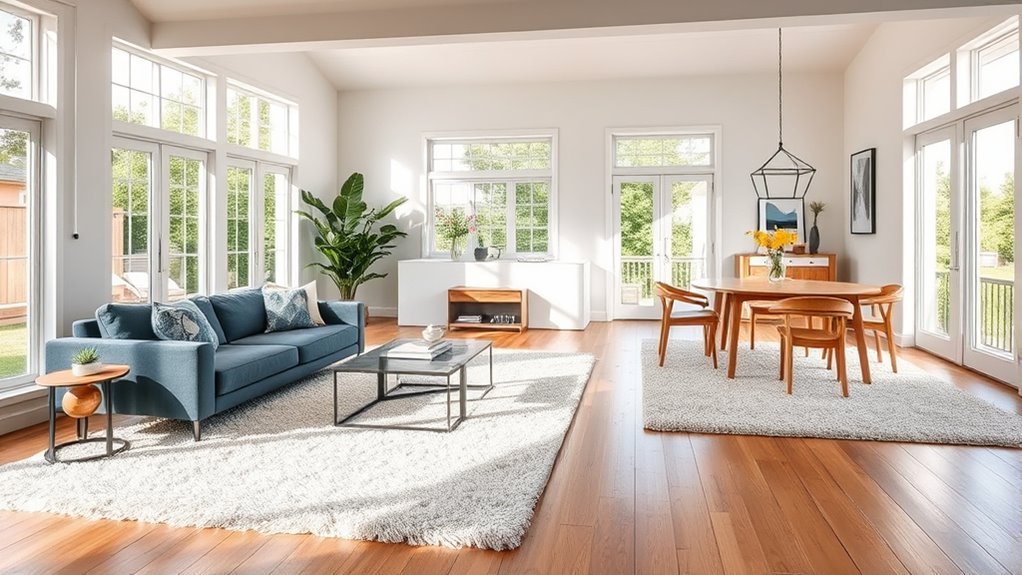
Area rugs are one of the easiest ways to zone an open concept living room because they create a visual boundary on the floor without blocking light or movement. A rug tells the eye, “this is the seating area,” “this is the reading corner,” or “this is the dining space.”
Here’s how to make rugs work well:
- Choose the right size: In the main living zone, the front legs of the sofa and chairs should usually sit on the rug. If the rug is too small, the furniture can feel disconnected.
- Use a rug pad: It adds comfort, keeps the rug safer underfoot, and helps prevent slipping.
- Match the rug to the activity: Use soft rugs for lounge areas, flat-weave rugs under dining tables, and durable low-pile rugs in high-traffic paths.
- Coordinate, don’t clone: Multiple rugs in one open room do not need to match exactly, but they should share a color, texture, pattern scale, or material.
- Watch the edges: Keep rug corners out of main walkways when possible to reduce tripping and visual clutter.
Pro Tip: If two rugs are visible at the same time, let one be the statement rug and keep the other quieter. Two bold patterns can work, but only if they share a tight color palette and different pattern scales.
Recommended Products

Machine Washable Area Rugs: Our living room rug, one of the 8x10 area rugs, surfaces is resistant to stains and dirt, and can be easily cleaned with a rag or vacuum cleaner; for deep cleaning, use a washing machine

Machine Washable & Easy to Clean: The surface features water-repellent performance for simple cleanup when drinks spill accidentally, reducing the chance of liquid soaking deep into fibers. You can wipe spills quickly with a towel, remove local stains via spot cleaning with a damp cloth, or regularly vacuum for daily upkeep. The whole rug supports machine washing for deeper cleaning

Ultra Soft & Non-slip: Featuring a shaggy carpet surface, the Ophanie soft area rug is highly soft with a high-density sponge interlayer. This rug effectively reduces shedding, and the non-slip bottom with small, durable anti-slip dots enhances friction to prevent sliding.
Using Creative Furniture Arrangements to Define Distinct Areas
Creative furniture arrangements are essential for defining distinct areas in an open concept living room. The back of a sofa, the edge of a sectional, a row of chairs, or a console table can act like a soft wall.
Try these furniture zoning ideas:
- Float the sofa: Place the sofa away from the wall to separate the lounge from a dining area, walkway, or office zone.
- Use a console table: A narrow console behind a sofa creates a boundary and adds storage or lamp space.
- Angle two chairs: Angled chairs can create a conversation area without making the layout feel rigid.
- Use open shelving: A bookcase with open backs can divide a room while still allowing light and sightlines through.
- Create a corner zone: A chair, small table, lamp, and plant can turn an unused corner into a reading nook.
Keep the furniture scale consistent. A tiny desk next to a huge sectional may look accidental. A bulky bookcase in a narrow walkway may make the room feel cramped. The best arrangement feels balanced from every angle because open rooms are often visible from the kitchen, entry, and dining area.
Recommended Products

3-Tier Storage Spaces console table: The 3-tier narrow console table includes 2 dense mesh shelves and 2 spacious non-woven fabric drawers below the wooden tabletop. 2-tier open shelf design allows you to place books, vases, DVDs, storage boxes, etc. assuring your desktop is more tidy and satisfying your various needs

Fusion That Delights: From the BELLAH Collection, this console table fuses steel, engineered wood, and non-woven fabric for a perfect blend of strength, softness, and storage. Pair it with chest of drawers for a cohesive space that feels just right

Farmhouse Flair: This entertainment center features a wood-look finish, charming barn doors, and sleek metal knobs, creating a cozy and inviting atmosphere in your living space
How Color Can Help Define Your Open Spaces
Color can help define open spaces, but it works best when used with restraint. You do not need to paint every zone a different color. In fact, too many strong color changes can make the room feel smaller and more chaotic.
Choose a Connected Color Palette
Start with one main neutral or foundation color, then choose two or three accent colors. Use those accents differently in each zone. For example, the living area might use blue pillows, the dining area might use blue artwork, and the office zone might use a blue desk lamp.
This creates identity without breaking the room apart.
Use Bold Accent Shades Carefully
Bold accent shades can help a dining nook, media wall, or reading corner stand out. Try bold color in smaller, flexible elements first, such as cushions, art, lampshades, curtains, or a painted bookcase. These are easier to update than a full wall.
If you use color-blocking, keep it intentional. A painted arch around a desk or a deeper color behind built-ins can work beautifully, but random blocks of color may look busy in an already open room.
Use Subtle Hue Variations
Subtle hue variations can create quiet separation. You might use warm beige in the lounge, a slightly deeper taupe near the dining area, and soft white on connecting walls. You can also shift texture instead of color: linen curtains in one zone, a wool rug in another, and woven baskets in a storage area.
Lighting color temperature also affects how colors feel. The U.S. Department of Energy notes that lower color temperatures around 2700K to 3000K are considered warm, while higher temperatures such as 3600K to 5500K are considered cool. Warm light usually feels more relaxed in living areas, while cooler light can help with visual tasks.
Using Lighting for Zoning Your Space
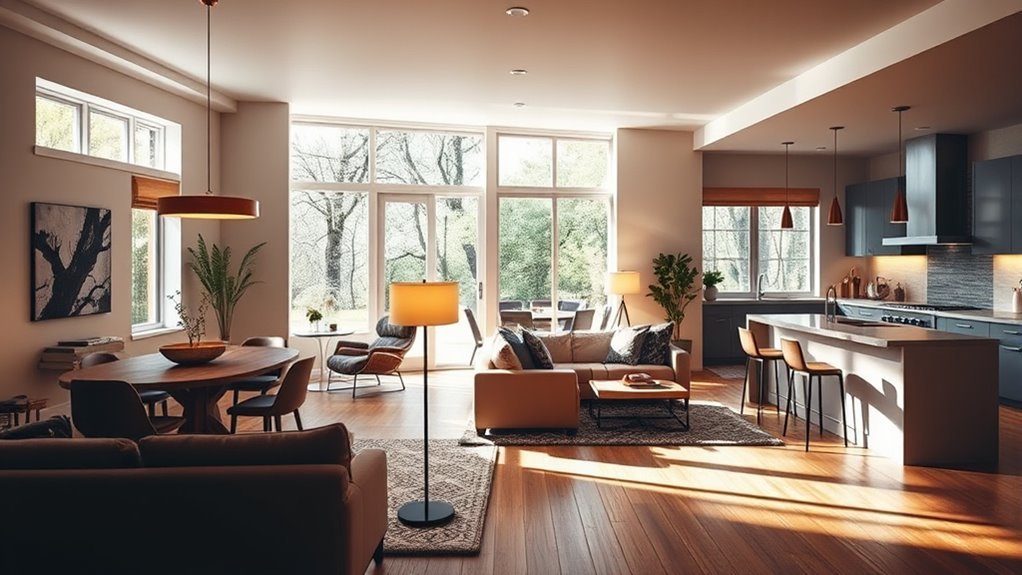
Lighting is one of the strongest tools for zoning an open concept living room. It can define where people gather, where they eat, where they read, and where the room becomes calm at night.
The most effective plan uses three layers:
- Ambient lighting: General light for the whole room, such as recessed lights, ceiling fixtures, or broad lamps.
- Task lighting: Focused light for reading, working, games, homework, or food prep nearby.
- Accent lighting: Light that highlights shelves, art, plants, beams, niches, or textured walls.
The Department of Energy’s lighting design guidance recommends matching the amount and quality of light to the function being performed. That is exactly what zoning requires: each area gets the light it needs.
Use a pendant or chandelier to anchor a dining table. Place a floor lamp beside a reading chair. Add a table lamp to a console behind the sofa. Use picture lights, shelf lights, or wall sconces to highlight built-ins and create depth.
Warning: If you add dimmers or smart bulbs, check compatibility first. The Department of Energy notes that many LED bulbs can work with dimmers, but they must be designed for dimming and matched with compatible controls.
Leveraging Architectural Features for Effective Zoning
Architectural features can create natural zoning. Look for details that already exist in the room: beams, columns, ceiling changes, fireplace walls, windows, alcoves, built-ins, flooring transitions, or changes in ceiling height.
Utilizing Ceiling Beams Strategically
Ceiling beams can act as overhead boundaries. A beam above the dining area or seating group helps the zone feel framed without adding a wall. If the beams are already present, use furniture placement below them to reinforce the layout.
- Place the dining table under the strongest ceiling detail.
- Center the living room rug with the fireplace, beam, or ceiling feature.
- Use pendant lights or chandeliers to draw attention to the zone below.
- Repeat the beam color in furniture legs, frames, or shelving for cohesion.
Creating Visual Interest With Lighting
Lighting can highlight the architecture you already have. Recessed lights can wash a stone fireplace, sconces can frame built-ins, and a picture light can make an art wall feel like its own zone. Accent lighting adds depth, which is especially helpful in open rooms where everything is visible at once.
For living rooms, avoid relying on one bright overhead fixture. One light source usually creates flat light and harsh shadows. Several softer light sources make the room easier to adapt throughout the day.
Incorporating Built-In Storage Solutions
Built-in storage solutions can separate zones while solving clutter. In an open concept space, clutter is always visible, so storage is part of the design.
- Use built-in shelves to frame a media zone.
- Add lower cabinets beneath shelves to hide toys, games, cords, and blankets.
- Use a storage bench to define an entry or window zone.
- Try a low bookcase behind a sofa to create separation without blocking sightlines.
- Use baskets and lidded boxes so open shelving does not become visual noise.
Renter-Friendly Zoning Ideas
You do not need permanent construction to zone an open concept living room. Renters can create strong zones with pieces that move easily.
- Freestanding bookcases: Use open shelving as a divider between a living area and desk zone.
- Folding screens: Place one behind a desk, reading chair, or play area for flexible privacy.
- Curtains: A ceiling-track curtain can soften a work zone or guest-sleeping area if your lease allows it.
- Large plants: Tall plants create a natural visual break without adding heaviness.
- Plug-in sconces and floor lamps: These create lighting zones without electrical work.
- Peel-and-stick wallpaper: Use it on the back of a bookcase or in a small nook rather than across the whole room.
The best renter-friendly pieces are useful in more than one home: rugs, lamps, shelves, folding screens, baskets, and slim console tables.
Tips for Keeping Flow in Your Zoning
While designing distinct zones in an open concept living room, keep the room easy to cross and easy to understand. A beautiful layout will not work if people constantly bump into furniture or walk through the middle of conversations.
| Tip | Purpose | How to Do It |
|---|---|---|
| Consistent Color Palette | Creates visual continuity | Repeat one or two colors across zones |
| Large Enough Rugs | Anchors each space | Keep at least front furniture legs on the main rug |
| Varying Heights | Guides the eye | Use tall plants, shelves, pendants, and floor lamps |
| Layered Lighting | Delineates areas | Use different lights for lounging, dining, reading, and work |
| Clear Pathways | Improves movement | Keep main walkways open and avoid rug corners in traffic routes |
Common Mistakes to Avoid While Zoning Your Living Room
When zoning your living room, small mistakes can make the space feel busy, cramped, or disconnected. Avoid these common problems:
- Using rugs that are too small: A tiny rug can make furniture look like separate islands instead of one zone.
- Blocking natural pathways: Do not place a sofa, chair, or table where people naturally walk from one area to another.
- Overcrowding every zone: Each area needs breathing room. A reading corner may only need a chair, lamp, table, and plant.
- Choosing clashing colors and patterns: Use contrast, but repeat enough elements to keep the open room calm.
- Ignoring lighting: Without separate lighting, zones can disappear at night.
- Creating too many zones: A small open room may only need a lounge zone and a dining or work zone.
- Forgetting storage: Open layouts show everything, so hidden storage is essential.
Troubleshooting Zoning Problems
If the room still feels off after rearranging, use the problem to find the fix.
| Problem | Likely Cause | Fix |
|---|---|---|
| The room feels cluttered | Too many small pieces or visible storage | Remove one piece per zone and add closed storage |
| Zones feel disconnected | No repeated color, finish, or texture | Repeat one accent color and one material across the room |
| The seating area feels awkward | Furniture is too far apart or pushed to the walls | Pull seating closer and anchor it with a larger rug |
| The room feels dark at night | Only one overhead light | Add floor lamps, table lamps, sconces, or shelf lighting by zone |
| Walkways feel tight | Furniture edges are too close to traffic paths | Shift large pieces first and remove extra accent tables |
Frequently Asked Questions
How do you zone an open plan living space?
Start by deciding what the room needs to do. Then group furniture around each activity, anchor each zone with a rug or lighting fixture, keep clear walking paths, and repeat colors or materials so the zones feel connected. Use soft dividers such as sofa backs, console tables, open shelving, curtains, screens, and plants instead of solid walls.
What does zoning mean in interior design?
Zoning in interior design means dividing a room into functional areas without necessarily adding walls. In an open concept living room, zoning might separate a lounge area from a dining table, desk, reading chair, or play corner using furniture placement, rugs, lighting, color, texture, storage, or architectural features.
What is the 2/3 rule for living rooms?
The 2/3 rule is a simple proportion guideline. A coffee table, rug, sofa table, or art piece often looks balanced when it is about two-thirds the length of the sofa or furniture it relates to. It is not a strict rule, but it helps open concept rooms feel more proportional and less random.
Why are some builders and designers moving away from fully open-concept homes?
Many homeowners still like open layouts, but they also want more privacy, better sound control, flexible work areas, and places to hide clutter. That is why many newer designs use a “broken concept” approach: still open and connected, but with clearer zones created by partial walls, built-ins, ceiling details, furniture placement, or glass partitions.
Can you zone a small open concept living room?
Yes. In a small open concept room, use fewer zones and lighter boundaries. Try one main rug for the seating area, a slim console behind the sofa, a wall-mounted desk, nesting tables, vertical shelves, and plug-in lamps. Avoid bulky dividers that block light or make walkways feel tight.
Conclusion
Zoning your open concept living room can make the entire space feel calmer, more useful, and more comfortable. Start with the way you actually live, then use furniture, rugs, lighting, color, storage, and architectural details to give each activity a clear place. Keep the pathways open, repeat finishes for flow, and avoid overcrowding. With a thoughtful plan, your open room can feel spacious and connected while still giving every zone a purpose.
Sources
- U.S. Department of Energy — Lighting Principles and Terms — backs up ambient, task, and accent lighting definitions, color temperature, glare, and light quality.
- U.S. Department of Energy — Lighting Design — supports matching lighting quality and quantity to room function.
- U.S. Department of Energy — Lighting Controls — supports dimmer, sensor, timer, and LED compatibility guidance.
- U.S. Access Board — ADA Chapter 4: Accessible Routes — supports the 36-inch clear-width benchmark for accessible walking surfaces.
- PLOS ONE — Effect of Illumination on Perceived Temperature — supports careful wording about illumination affecting perceived warmth or coolness.