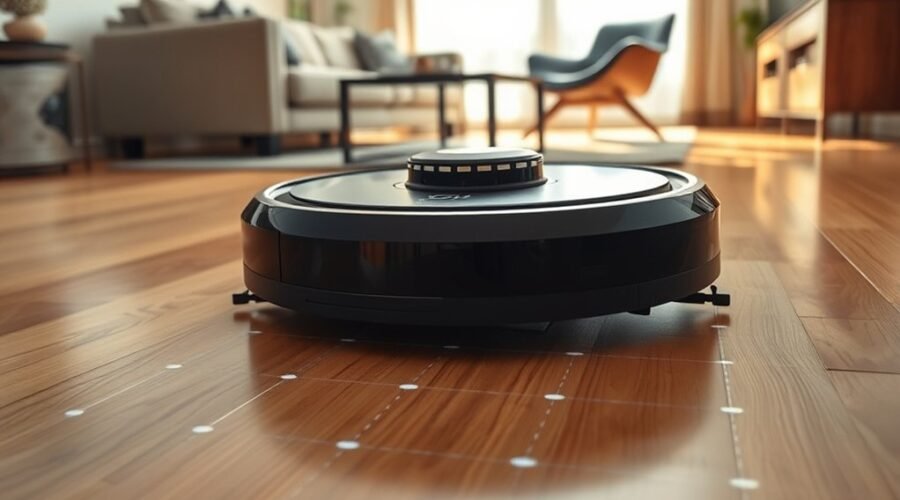
Robot vacuums use cameras to turn raw visual input into usable navigation data. The system detects walls, furniture, cords, and open floor space, then updates its internal map as conditions change. That allows route planning, obstacle avoidance, and cleaner coverage in real time. In some models, the camera also supports live monitoring, raising a separate question: how much visibility is necessary, and what gets recorded?
What Robot Vacuum Cameras Do?
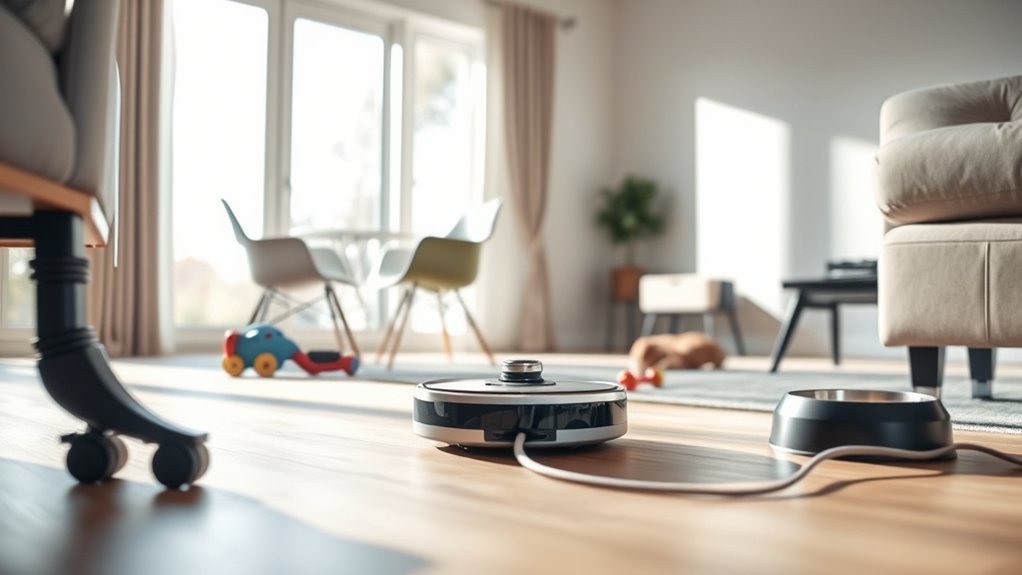
Robot vacuum cameras use visual recognition technology to detect obstacles more accurately, helping the device navigate around furniture and other objects with fewer collisions.
Robot vacuum cameras improve obstacle detection, helping devices navigate around furniture and objects with fewer collisions.
In practice, robot vacuum cameras support obstacle detection by feeding visual data into AI-powered algorithms that classify items such as cords, pet bowls, and low furniture. This improves navigation systems, reduces entanglement, and raises cleaning efficiency in constrained environments.
The same sensing pipeline also enables real-time mapping, allowing the machine to infer the home layout and adapt their cleaning routes when conditions change. Some models provide live video streaming, giving users remote oversight while the unit operates.
The result is a more autonomous system that lowers friction in domestic labor, increases control, and supports orderly movement through occupied spaces.
How Cameras Map Your Home?
Using onboard cameras, a robot vacuum captures continuous visual data that AI algorithms convert into a real-time map of the home’s layout, including walls, furniture, and temporary obstacles.
This mapping process supports navigation by updating spatial models as rooms change, allowing the machine to preserve efficient cleaning paths without relying on rigid preprogrammed routes.
The camera stream gives the system a measured view of distances, openings, and surface boundaries, which improves obstacle avoidance and reduces route conflicts.
Over time, AI refines the map as objects move, enabling more accurate scheduling of coverage across zones.
The same visual record can be exposed through a smartphone app, where live status and mapped areas provide users direct oversight of the cleaning process.
In practice, the camera-based approach frees the vacuum from blind movement, replacing guesswork with adaptive navigation and disciplined mapping suited to dynamic households.
How Cameras Spot Obstacles?
Cameras on robot vacuums use visual recognition to detect obstacles in real time, distinguishing furniture, walls, and smaller objects from the surrounding floor.
Continuous image processing enables the system to update its navigation decisions immediately as new items enter the field of view. This supports direct obstacle avoidance while maintaining efficient cleaning paths.
Visual Recognition
Through visual recognition, camera-equipped robot vacuums identify obstacles by processing live image data with AI-based algorithms that detect shapes, edges, and object categories. This camera technology supports visual recognition for obstacle detection, using AI-driven image processing to classify furniture, cords, and other hazards.
The resulting advanced mapping improves accurate mapping of rooms, which strengthens real-time navigation and reduces wasted motion. Object recognition can distinguish pet bowls, cables, and similar items, enabling more intelligent cleaning across changing layouts.
Real-Time Obstacle Avoidance
Building on visual recognition, camera-equipped robot vacuums extend perception into real-time obstacle avoidance by analyzing live image streams and adjusting movement as hazards appear. The robot vacuums use cameras to classify furniture, pets, cords, and scattered objects through advanced algorithms, enabling navigation choices that limit collisions.
In well-lit rooms, visual recognition can improve obstacle detection by up to 40% versus traditional sensors, producing smoother paths and fewer interruptions. AI-driven models refine this process continuously, learning new layouts and adapting to changed environments without human supervision.
This real-time response also reduces tangling and rerouting, preserving cleaning efficiency while maintaining precise motion. By coupling cameras with adaptive control, the system turns passive sensing into active obstacle avoidance, supporting more autonomous domestic movement and greater spatial freedom.
How Cameras Plan Better Routes?
Camera-equipped robot vacuums use real-time path planning to map room geometry as they clean, updating routes from live visual data rather than relying on static assumptions.
Their obstacle-aware routing adjusts trajectories around furniture, clutter, and newly detected objects to reduce collisions and maintain coverage efficiency.
With continuous camera input, the navigation system can revise cleaning paths during operation and adapt future routes to changing layouts.
Real-Time Path Planning
Robot vacuums with cameras use real-time visual input to generate dynamic maps of their surroundings and adjust navigation paths as conditions change.
Their path planning depends on cameras feeding adaptive algorithms that interpret layouts, detect obstacles, and compute efficient cleaning routes without fixed assumptions. This real-time process supports optimization by reducing unnecessary travel and improving efficiency across varied rooms.
When furniture shifts or new objects appear, the system can reroute immediately, preserving continuity in navigation and limiting delay.
Computer vision also enables classification of scene elements, allowing more precise route selection. Over repeated cycles, the vacuum learns from visual input, refining its navigation strategy and producing cleaner coverage with less wasted motion.
The result is a more autonomous system, less constrained by static programming.
Obstacle-Aware Routing
Obstacle-aware routing relies on camera-based visual recognition to detect furniture, clutter, pets, and other transient obstacles before contact occurs.
In robot vacuums, cameras generate detailed maps that support obstacle navigation and continuous route selection. AI algorithms process visual data to enable real-time adjustments, shifting cleaning paths around moved chairs, toys, or open doors.
This object avoidance reduces collisions and preserves motion through complex environments, where static sensors alone may fail. Since the system updates its model during each pass, the vacuum learns from prior sessions and improves efficient cleaning over time.
The result is a more autonomous platform: less intervention, fewer entanglements, and greater freedom from manual cleanup burdens. Cameras consequently function not as passive observers, but as operational instruments for adaptive routing.
What Live Video Lets You See?
Live video from a robot vacuum provides real-time visibility into the cleaning process, allowing users to assess progress as it happens. It lets users monitor cleaning progress, verify coverage, and identify obstacles or missed zones without waiting for completion.
Through smartphone apps, live video can be viewed remotely, extending control beyond the home and supporting practical home security oversight.
- Detect spills, clutter, or cords immediately and trigger targeted cleaning before dirt spreads.
- Observe route quality in real time, revealing whether advanced models are improving navigation or stalling.
- Use AI-driven object recognition to distinguish furniture, pets, and debris, which reduces false alarms and wasted motion.
For users who value autonomy, this visibility reduces dependence on guesswork. It exposes what the machine sees, enabling direct decisions about intervention, rerouting, or pause commands.
The result is a cleaner floor, fewer blind spots, and tighter control over household maintenance.
When Cameras Beat LiDAR?
When does camera guidance outperform LiDAR? In well-lit environments, cameras can deliver superior navigation by converting visual data into detailed maps and stronger obstacle recognition.
Their advantage becomes clearer in homes packed with furniture, where real-time learning supports adaptive cleaning paths that respond to shifting layouts. Advanced navigation benefits from object recognition, allowing the system to distinguish chairs, cords, and toys more reliably in certain scenarios, reducing collisions.
Cameras also provide live video streaming for remote monitoring, which adds user engagement and practical home security value without extra hardware. In simpler spaces, their cost-effectiveness can outweigh LiDAR, especially when user-friendly features matter more than maximal range.
Yet performance depends on conditions: low-light conditions and highly complex layouts can limit vision-based sensing. Even so, for households seeking efficient, flexible, and less expensive automation, cameras can outperform LiDAR when visibility is adequate and the environment rewards adaptive interpretation.
How to Protect Your Privacy?
Privacy protection in camera-equipped robot vacuums depends on layered controls that limit data exposure at every stage. For robot vacuums with cameras, encrypted data transmission and secure connections reduce interception risk, while a clear privacy policy should state how data is used and whether footage leaves the device.
Users gain control over information by disabling camera features, restricting cloud sharing, and selecting offline operation when mapping does not require remote access.
- Limit camera access to rooms where visual navigation is necessary.
- Verify software updates to close security gaps and protect user data.
- Prefer models that avoid long-term storage of footage.
A disciplined configuration preserves autonomy without sacrificing cleaning performance. Brands that maintain strong privacy policy standards and provide regular software updates are better positioned to protect user data.
In practice, privacy is strongest when access is minimized, transmission is encrypted, and retention is brief.
Frequently Asked Questions
Do Robot Vacuums Have Cameras on Them?
Yes; some robot vacuums have cameras, while others rely on lidar or infrared. Camera technology improves navigation systems, mapping capabilities, and obstacle detection, shaping performance comparison, user preferences, design innovations, maintenance tips, battery efficiency, smart home integration.
Which Robot Vacuum Has No Camera?
Neato D7 and Roborock S6 are camera-free robots, a delightfully liberated choice. Their Robot vacuum features, Camera technology absent, Navigation systems use LiDAR, Mapping capabilities stay strong, Indoor safety improves, with Consumer reviews favoring Maintenance tips and Cleaning efficiency.
What Are the Privacy Risks Associated With Robot Vacuums?
Privacy risks include data security failures, weak user consent, surveillance concerns, software vulnerabilities, inadequate image encryption, location tracking, opaque manufacturer transparency, lax privacy regulations, and ethical implications; consumer awareness remains essential for liberation and control.
What Are the Downsides of Using a Robotic Vacuum Cleaner?
Downsides include limited suction power, reduced battery life, imperfect navigation accuracy, higher maintenance needs, elevated noise levels, inconsistent floor types performance, weak smart home integration, poor price comparison value, variable brand reliability, and mixed user reviews.
Conclusion
In the robot vacuum’s camera, a small lens becomes a silent cartographer, translating scattered rooms into measurable routes. Its vision does more than avoid chairs or walls; it turns domestic clutter into a navigable system, where each object is a signal and each pass is an adjustment. Yet the same eye that improves autonomy also raises privacy concerns, reminding observers that intelligence at home is built from observation, and observation always carries a cost.