Affiliate disclosure: This article contains Amazon affiliate links. If you buy through these links, we may earn a commission from qualifying purchases at no extra cost to you. Our recommendations are based on product fit, stated features, maintenance needs, spill risk, and storage use—not commissions.
Last updated: August 1, 2026
Storage spaces need a different moisture-control approach than living rooms. This guide compares passive storage moisture absorbers, including rechargeable silica gel packs, calcium chloride buckets, hanging bags, compact boxes, and the renewable Eva-Dry E-333. They are designed for closets, cabinets, storage totes, safes, parked RVs, and other enclosed spaces. They can help manage everyday humidity and musty conditions, but they cannot repair leaks, remove standing water, or replace a properly sized powered dehumidifier in a persistently damp room.
Key Takeaways
- Choose silica gel for sealed totes, safes, cases, electronics boxes, and areas where a liquid spill could damage stored items.
- Choose calcium chloride for closets and larger enclosed storage areas where the container can stay upright and away from valuables.
- Choose a powered dehumidifier when the entire room remains humid, passive products fill quickly, or condensation returns continuously.
How We Chose
We compared each option by storage-space fit, absorber type, stated capacity, recharge or replacement method, spill risk, monitoring features, placement requirements, and the clarity of its current product information. We did not treat passive absorbers as substitutes for powered room dehumidifiers.
Quick Verdict
- Best Overall for Small Storage: Eva-Dry Wireless Mini Dehumidifier E-333
- Best High-Capacity Reusable Bags: Wisedry Rechargeable Silica Gel Pack
- Best for Larger Enclosed Storage: DampRid Hi-Capacity Moisture Absorber Bucket
- Best Hanging Option: Vacplus Hanging Closet Dehumidifier Bags
- Best for Storage Totes: DryTote Rechargeable Desiccant Pack
Before You Buy
Use silica gel for sealed containers and areas where liquid collection would create unacceptable spill risk. Use calcium chloride buckets, boxes, or hanging bags only where they can remain upright or securely hung and kept away from children, pets, food, leather, bare metal, finished wood, fabrics, paper, and electronics. For an open room with persistent humidity, use a hygrometer and choose a properly sized powered dehumidifier instead.
Quick Comparison
| Product | Type | Best For | Reusable | Main Limitation | Amazon |
|---|---|---|---|---|---|
| Eva-Dry Wireless Mini Dehumidifier, White (E-333) | Renewable silica-gel unit | Closets, cabinets, safes | Yes | Small-space coverage only | Check Current Amazon Availability |
| Wisedry Rechargeable Silica Gel Dehumidifier Pack (2 x 500g) | Rechargeable silica bags | Enclosed storage and parked vehicles | Yes | Needs microwave or oven | Check Current Amazon Availability |
| DampRid Hi-Capacity Moisture Absorber Bucket (2 Pack) | Calcium chloride bucket | Larger enclosed storage | No | Must stay upright | Check Current Amazon Availability |
| Vacplus Hanging Closet Dehumidifier Bags (10 Pack) | Hanging calcium chloride bags | Closets and wardrobes | No | Single-use and must hang | Check Current Amazon Availability |
| Vacplus Moisture Absorber Buckets (4 Pack) | Calcium chloride buckets | High-capacity shelf placement | No | Large footprint | Check Current Amazon Availability |
| FURWEY 12 Pack Rechargeable Silica Gel Dehumidifier Bags | Rechargeable silica bags | Multiple bins and drawers | Yes | Small bags may saturate quickly | Check Current Amazon Availability |
| DryTote Rechargeable Desiccant Pack (100g, Yellow) | Rechargeable desiccant pack | Storage totes | Yes | Best in sealed totes | Check Current Amazon Availability |
| Color-Indicating Silica Gel Packets (50 Pack) | Indicating silica packets | Small sealed cases | Yes, if current directions permit | Tiny per-packet capacity | Check Current Amazon Availability |
| Wisesorb Silica Gel Packets (20g, 15 Packs) | Disposable silica packets | Document and electronics boxes | Check current directions | No indicator described | Check Current Amazon Availability |
| Vacplus Portable Humidity Absorber Boxes (6 Pack) | Calcium chloride boxes | Small shelf spaces | No | Must stay upright | Check Current Amazon Availability |
| Ksend Compact Dehumidifier Moisture Absorbers (12 Pack) | Calcium chloride cups | Several cabinets or closets | No | Limited per-cup capacity | Check Current Amazon Availability |
Eva-Dry Wireless Mini Dehumidifier, White (E-333)
Best Overall for Small Storage
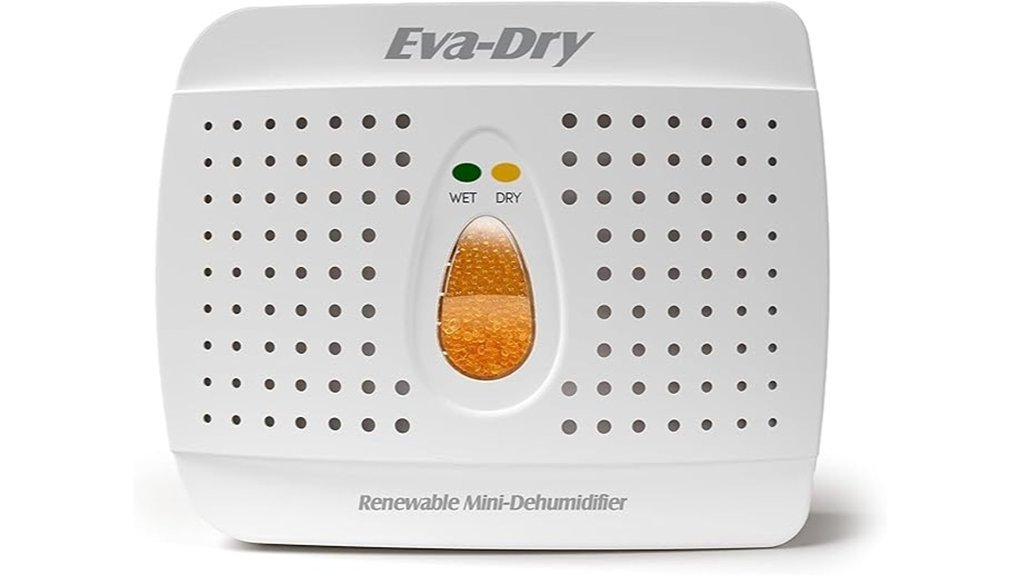
The Eva-Dry E-333 is a strong all-around choice for closets, cabinets, safes, and other small enclosed storage areas. It uses renewable desiccant beads, so it works without a cord while absorbing moisture. The listing describes coverage up to 333 cubic feet and a collection capacity of about 4 to 6 ounces before recharging. It is best for localized moisture control, not an open basement or a room with an active water problem.
Best For: Small closets, cabinets, safes, and storage compartments where a self-contained rechargeable unit is easier than loose packets.
Why You’ll Like It: It is cordless during use, easy to hang or place on a shelf, and has an indicator that shows when renewal is needed.
Who Should Avoid It: Skip it for open rooms, active leaks, or spaces that remain humid despite regular renewal.
Pros:
- Cordless during moisture absorption.
- Reusable design reduces disposable waste.
- Clear saturation indicator simplifies maintenance.
Cons:
- Too small for open rooms or severe humidity.
- Must be removed and plugged in for the renewal cycle.
- Performance depends on enclosure size and how often the space is opened.
Wisedry Rechargeable Silica Gel Dehumidifier Pack (2 x 500g)
Best High-Capacity Reusable Bags
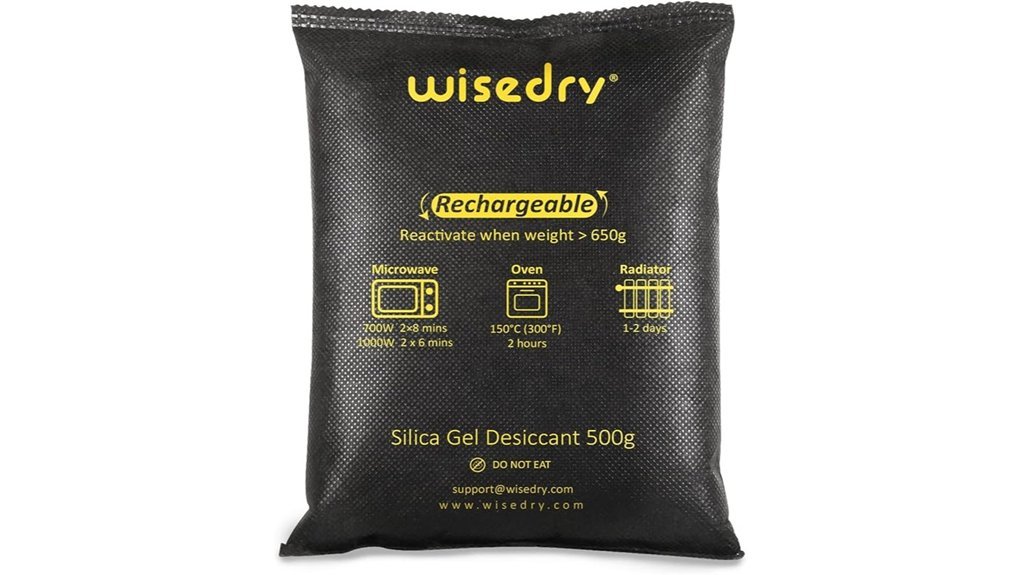
This two-pack is useful when you want more silica gel capacity than small packets can provide. Each bag contains 500 grams of silica gel, and the listing states that each can absorb up to about 150 grams of moisture before reactivation. The bags can be recharged in a microwave or oven according to the product directions. Their large size suits storage cabinets, parked vehicles, RV compartments, and other enclosed spaces where loose liquid collectors would be inconvenient.
Best For: Buyers who want reusable, higher-capacity desiccant bags for enclosed storage, parked vehicles, or seasonal gear.
Why You’ll Like It: The bags are reusable, do not create a liquid reservoir during normal use, and can be moved between storage areas.
Who Should Avoid It: Skip it if you do not have a suitable microwave or oven, or if you are unlikely to follow the stated reactivation instructions.
Pros:
- Large silica gel quantity for a passive absorber.
- Reusable after proper reactivation.
- No collected brine to spill around stored items.
Cons:
- Requires access to a microwave or oven for recharging.
- Needs regular weight or indicator checks in humid conditions.
- Not a substitute for a powered unit in a wet basement.
DampRid Hi-Capacity Moisture Absorber Bucket (2 Pack)
Best for Large Enclosed Storage Areas
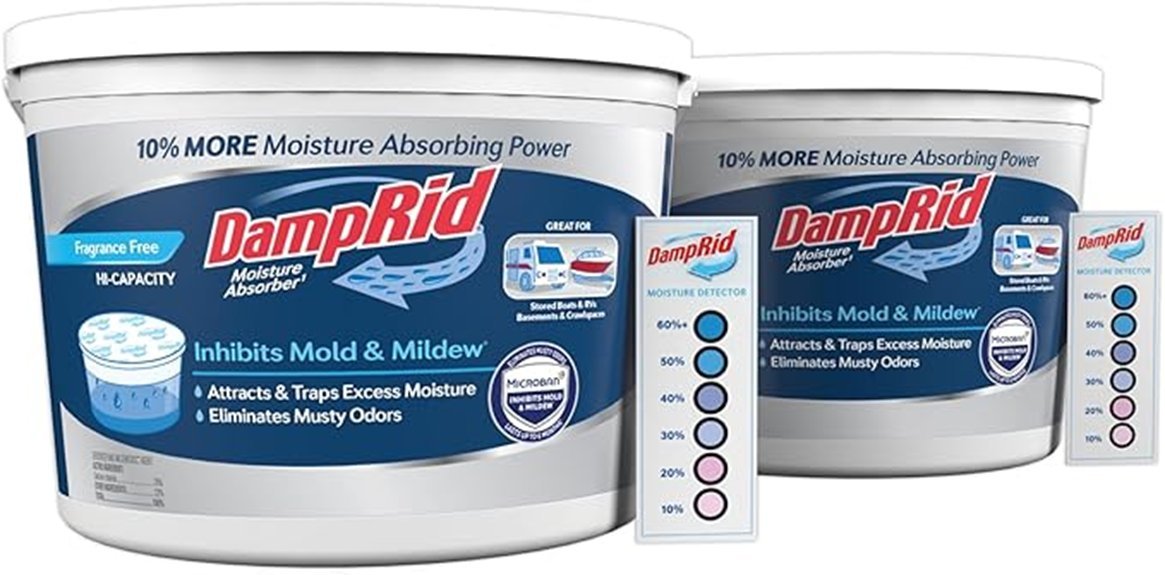
The DampRid Hi-Capacity bucket uses calcium chloride to pull moisture from the air and collect the resulting liquid in the container. It is better suited to larger enclosed areas such as a storage room, garage cabinet, stationary RV, or basement storage zone than tiny silica packets. Actual service life depends on temperature, humidity, airflow, and the size of the space.
Best For: Larger enclosed storage areas that need a set-and-monitor disposable moisture absorber.
Why You’ll Like It: The bucket offers more collection capacity than small hanging bags or packet-style desiccants and gives a visible sign of moisture removal.
Who Should Avoid It: Skip it where children, pets, movement, unstable shelving, or valuable materials make a liquid collector risky.
Pros:
- Higher capacity than small packets and cups.
- No electricity or recharge cycle required.
- Can help reduce damp, musty conditions in enclosed storage.
Cons:
- Creates liquid brine and must remain upright.
- Keep away from children, pets, leather, and metal surfaces.
- Requires replacement when the crystals dissolve or the reservoir fills.
Vacplus Hanging Closet Dehumidifier Bags (10 Pack)
Best Hanging Option
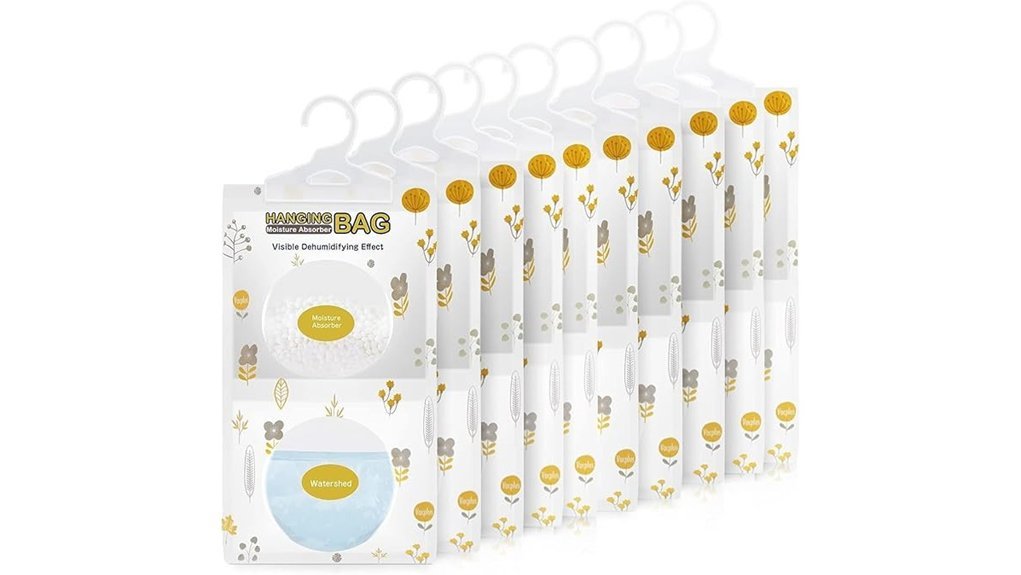
These hanging bags are designed for closets and other narrow storage spaces where floor or shelf space is limited. Calcium chloride crystals absorb moisture, while the lower transparent reservoir shows the collected liquid. The listing states a capacity of up to 500 milliliters per bag, although real-world life varies with humidity and temperature.
Best For: Closets, wardrobes, laundry storage, and stationary RV compartments with a secure hanging point.
Why You’ll Like It: The vertical design saves shelf space and makes it easy to see when a bag is nearing the replacement line.
Who Should Avoid It: Skip it where the bag could swing, be punctured, or hang directly above clothing, electronics, leather, metal, or paper.
Pros:
- Convenient hanging format for tight spaces.
- Visible reservoir makes monitoring simple.
- No power or recharging required.
Cons:
- Single-use after the reservoir fills.
- Must hang securely and remain vertical.
- Should not be placed directly over clothing, electronics, leather, or metal.
Vacplus Moisture Absorber Buckets (4 Pack)
Best High-Capacity Bucket Pack
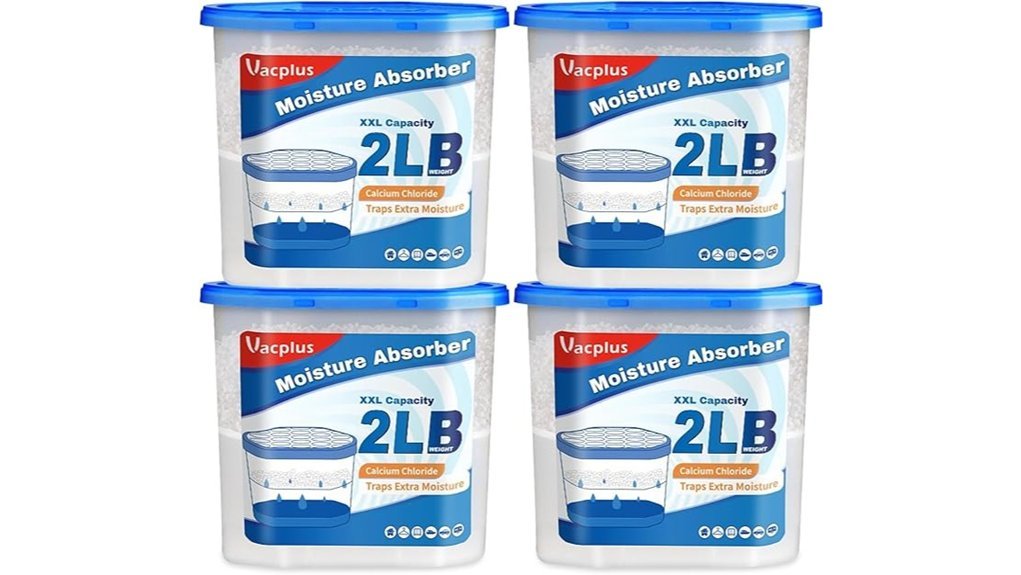
Vacplus Moisture Absorber Buckets are intended for damp-prone enclosed spaces that need more capacity than a small cup. The listing identifies a 2200-milliliter container capacity and a clear tank for checking the liquid level. The fragrance-free design is useful around stored clothing and household items, but the calcium chloride solution still requires careful placement.
Best For: Closets, utility storage, bathroom cabinets, and garage storage zones where a large upright container fits safely.
Why You’ll Like It: The clear reservoir and larger container reduce the need to replace many small absorbers.
Who Should Avoid It: Skip it if you lack a wide, level surface with clearance from stored valuables.
Pros:
- Large listed collection capacity.
- Fragrance-free for odor-sensitive storage.
- Simple peel-and-place setup.
Cons:
- Single-use rather than refillable.
- Must stay upright on a stable surface.
- Keep away from children, pets, food, leather, electronics, and bare metal.
FURWEY 12 Pack Rechargeable Silica Gel Dehumidifier Bags
Best Bulk Rechargeable Set
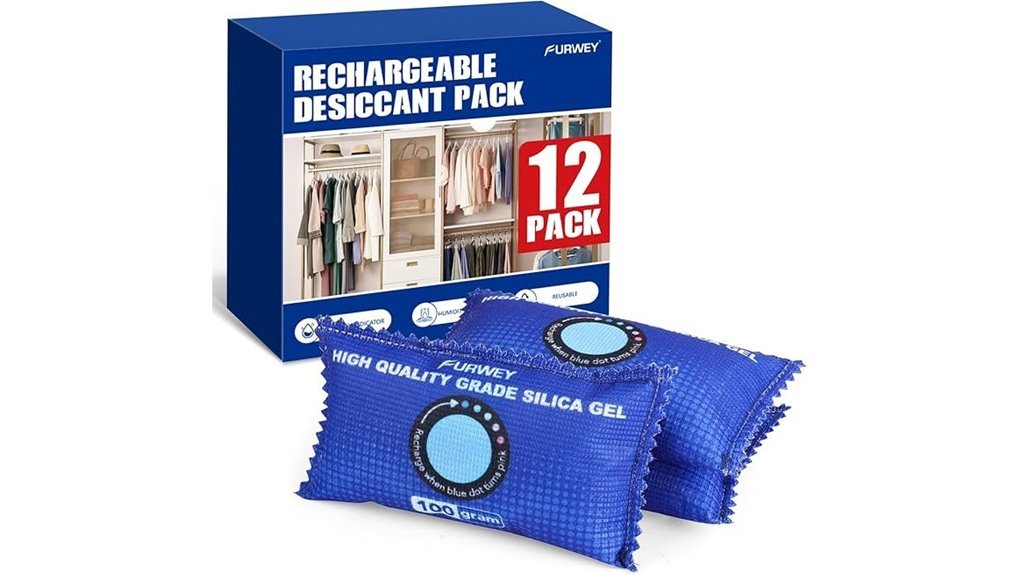
The FURWEY 12-pack gives you enough small reusable bags to spread across several storage bins, drawers, cabinets, or cases. Each bag includes a color window that indicates when the desiccant is saturated. Follow the product directions for microwave reactivation and allow each bag to cool before returning it to storage.
Best For: Homes with several small storage locations that need separate reusable absorbers.
Why You’ll Like It: A multi-pack makes it easier to rotate bags, recharge several at once, and cover multiple containers without using liquid-producing calcium chloride.
Who Should Avoid It: Skip it for large open rooms or when frequent reactivation would be inconvenient.
Pros:
- Twelve individually packaged reusable bags.
- Color indicator helps show recharge timing.
- Compact size works in bins, drawers, and cases.
Cons:
- Small bags may saturate quickly in very damp spaces.
- Microwave reactivation must follow the stated time and temperature limits.
- Periodic replacement may still be needed after repeated cycles.
DryTote Rechargeable Desiccant Pack (100g, Yellow)
Best for Storage Totes
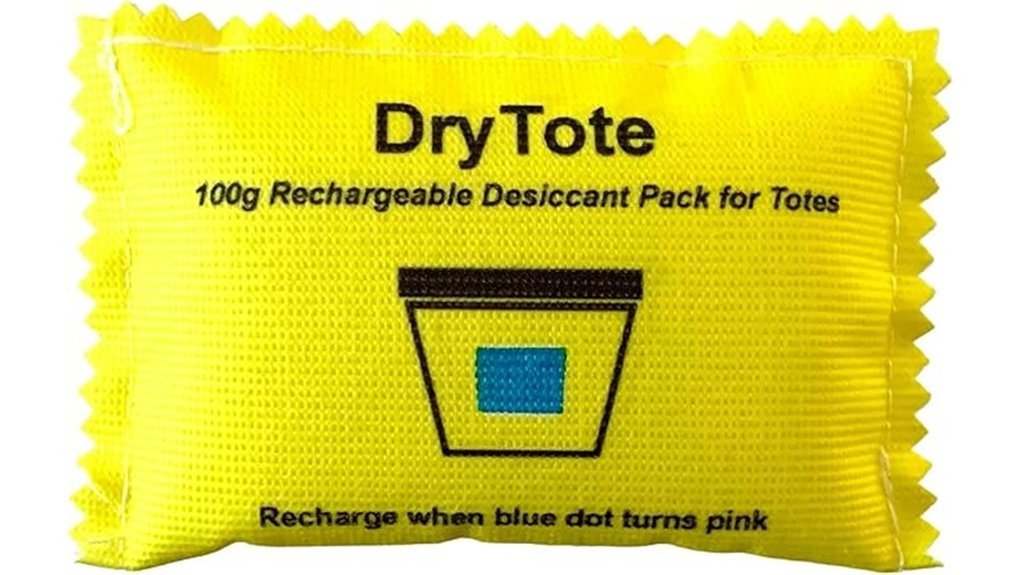
The DryTote 100-gram pack is a compact reusable desiccant designed for storage totes, bins, and similar enclosed containers. Its indicator dot changes when the pack has absorbed moisture, helping you decide when to reactivate it. It is a practical choice for documents, clothing, collectibles, and small electronics stored inside a reasonably sealed container.
Best For: Plastic storage totes and bins holding moisture-sensitive belongings.
Why You’ll Like It: The flat pack fits beside stored items without taking much room, and the visible indicator reduces guesswork.
Who Should Avoid It: Skip it for unsealed storage areas or very large totes that may need more capacity.
Pros:
- Compact 100-gram reusable format.
- Indicator dot shows when reactivation is needed.
- No liquid reservoir inside the storage tote.
Cons:
- Coverage depends heavily on container sealing and humidity.
- Requires periodic recharging.
- One pack may not be enough for a very large or frequently opened tote.
Color-Indicating Silica Gel Packets (50 Pack)
Best for Tiny Sealed Containers
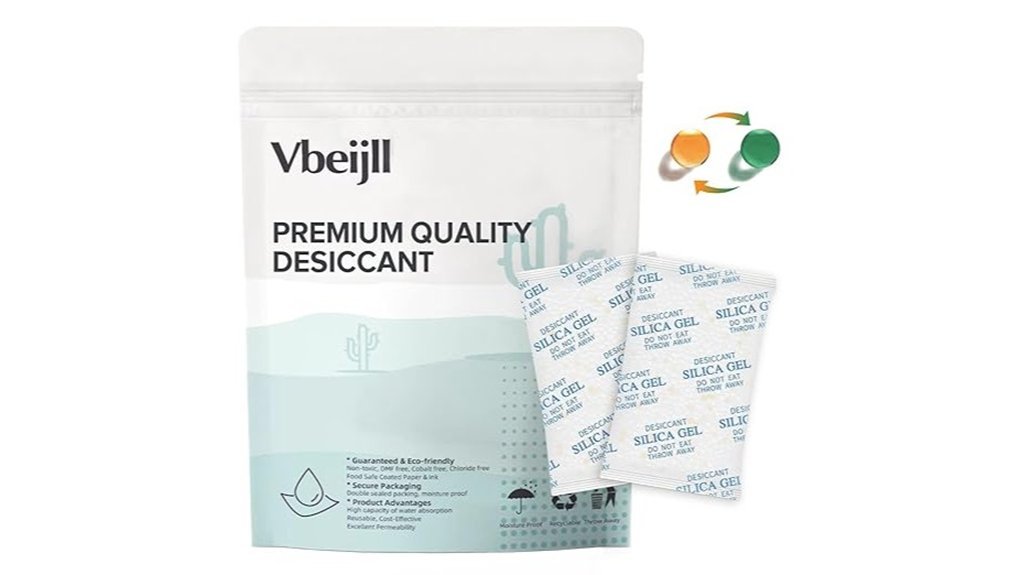
This 50-pack of 5-gram silica gel packets is aimed at small sealed containers rather than closets or rooms. The indicator beads change color as the packets absorb moisture, which makes replacement or reactivation easier to time. Reactivate them only when the current package directions explicitly allow it. They are useful for camera cases, tackle boxes, tool cases, seed containers, and small electronics boxes.
Best For: Small sealed cases and containers where a large bag or bucket will not fit.
Why You’ll Like It: The tiny size and visible indicator make it easy to distribute packets among many small containers.
Who Should Avoid It: Skip it for closets, rooms, or any container that needs more than a few grams of desiccant.
Pros:
- Fifty packets for multiple storage cases.
- Color indicator provides a saturation cue.
- Compact and free of liquid collection.
Cons:
- Very limited capacity per 5-gram packet.
- Not suitable for room-scale humidity control.
- Do not assume direct food or medicine contact is safe unless the packaging specifically permits it.
Wisesorb Silica Gel Packets (20g, 15 Packs)
Best for Document and Electronics Boxes
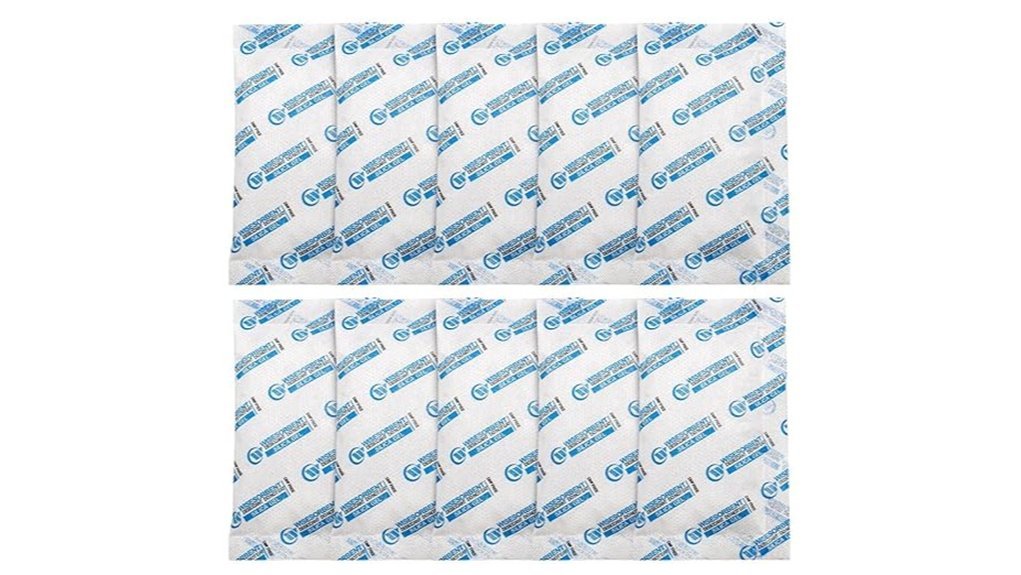
Wisesorb 20-gram packets offer more desiccant per packet than tiny 5-gram options while remaining compact enough for document boxes, safes, toolboxes, and electronics cases. The listing identifies pure silica gel and does not describe a visible saturation indicator. Reactivation instructions were not consistently clear across the product information reviewed, so follow the current package directions and do not heat the packets unless the manufacturer explicitly permits it.
Best For: Document boxes, safes, toolboxes, and sealed electronics storage.
Why You’ll Like It: The medium packet size is easier to use in storage boxes than many tiny sachets, and there is no liquid reservoir.
Who Should Avoid It: Skip it if you need a color indicator or clearly documented recharge instructions.
Pros:
- Useful 20-gram size for enclosed boxes.
- Compact enough for safes and cases.
- No liquid reservoir around stored items.
Cons:
- No visible saturation indicator described.
- Reactivation instructions should be confirmed before heating.
- Multiple packets may be needed in larger or poorly sealed containers.
Vacplus Portable Humidity Absorber Boxes (6 Pack)
Best Compact Disposable Boxes
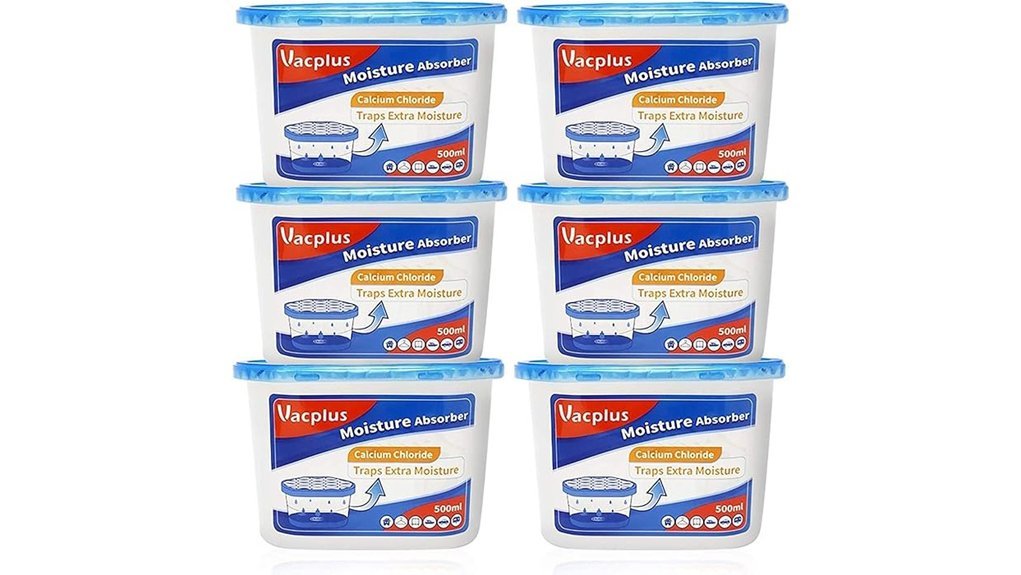
Vacplus Portable Humidity Absorber Boxes use calcium chloride crystals and a separate water-collecting layer. Their low, compact shape works on closet shelves, under sinks, or inside stationary storage cabinets. The transparent section makes it easier to see how much liquid has accumulated.
Best For: Small enclosed spaces with a flat, stable shelf and no convenient hanging point.
Why You’ll Like It: The box format is easy to place, needs no electricity, and lets you monitor collected moisture.
Who Should Avoid It: Skip it where the box could tip, slide, or sit against a moisture-sensitive surface.
Pros:
- Compact shelf-friendly shape.
- Visible water collection layer.
- No recharge equipment required.
Cons:
- Absorption can be gradual rather than immediate.
- Single-use after the crystals dissolve.
- Must remain upright and away from valuable surfaces.
Ksend Compact Dehumidifier Moisture Absorbers (12 Pack)
Best Multi-Location Disposable Cup Set
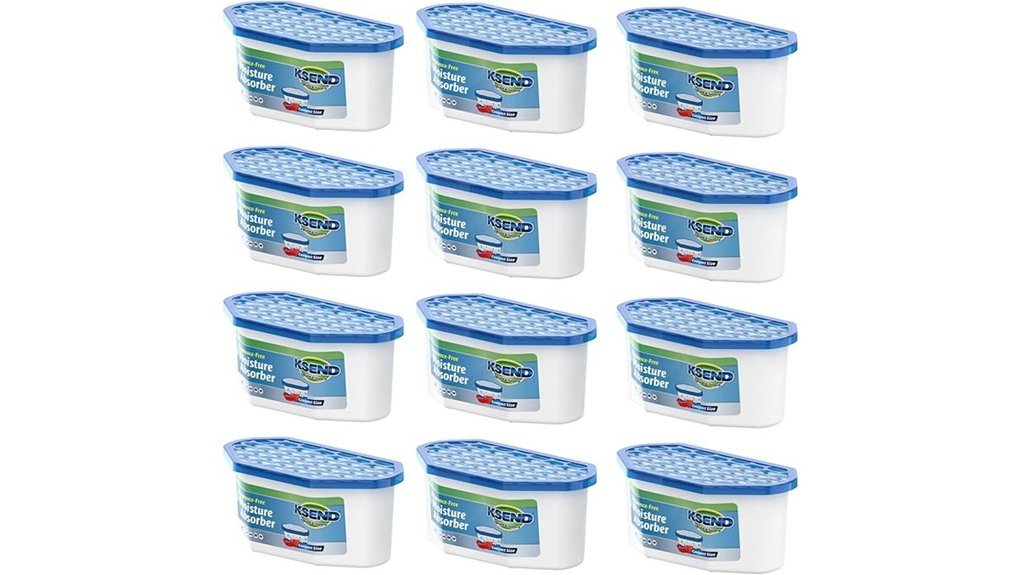
The Ksend 12-pack contains compact calcium chloride absorbers with a listed 300-milliliter capacity per unit. They are intended for small storage locations such as closets, cabinets, bathrooms, and pantry-adjacent storage, provided they are kept separate from food and placed on a stable surface. Treat the container as spill-resistant rather than spill-proof.
Best For: Buyers who need several small disposable absorbers for different cabinets and closets.
Why You’ll Like It: The multi-pack is convenient for distributing moisture control across several cabinets, closets, or storage zones.
Who Should Avoid It: Skip it if the units cannot remain upright or if a larger bucket would be easier to monitor.
Pros:
- Twelve compact units for multiple locations.
- Simple setup with no power or recharging.
- Small footprint fits shelves and corners.
Cons:
- Limited capacity compared with large buckets.
- Single-use and must be replaced when full.
- Keep upright and away from children, pets, food, metal, leather, and electronics.
Factors to Consider When Choosing a Dehumidifier for Storage
The right choice depends on the size and sealing of the storage area, the moisture load, the materials being protected, spill tolerance, and whether you prefer recharging or replacement. Start by deciding whether you need a passive absorber for an enclosed space or a powered dehumidifier for room-scale control.
Fast Decision Guide
- Sealed tote, safe, camera case, or electronics box: Choose silica gel.
- Closet or cabinet with safe upright placement: Choose a calcium chloride box, cup, bucket, or hanging bag.
- Open basement, garage, or storage room: Measure humidity and use a powered dehumidifier when moisture is persistent.
Choose the Right Moisture-Control Type
Rechargeable silica gel works well in sealed bins, safes, cabinets, toolboxes, and parked vehicles because it adsorbs water vapor without creating a liquid reservoir. Calcium chloride generally offers more collection capacity for closets and larger enclosed areas, but it turns absorbed moisture into liquid and must remain upright. A powered dehumidifier is the better choice for an open basement, storage room, or garage with continuously high humidity.
Moisture Absorption Capacity
Do not confuse container capacity with room coverage. A 300-milliliter cup or 2200-milliliter bucket describes how much liquid the container may hold, not the size of the room it can control. Compare the listed absorption or reservoir capacity, then consider humidity, airflow, temperature, and how often the storage space is opened. Severe dampness can overwhelm any passive absorber.
Rechargeability and Reusability
Reusable silica products cost more upfront but can reduce replacement waste. Check the indicator or product weight regularly and follow the manufacturer’s exact microwave, oven, or plug-in reactivation directions. Do not overheat a desiccant bag, recharge damaged packaging, or return a hot unit directly to a storage container.
Size, Sealing, and Placement
Passive absorbers work best in enclosed or reasonably sealed spaces. A tiny packet may protect a camera case but will do little in an open closet. Place calcium chloride products on a level, stable surface or secure hanging point, with enough clearance to prevent contact with valuables if the container leaks or tips. Use more than one unit only when the product directions and storage layout support it.
Safety and Material Compatibility
Silica gel is not the same as food, even when a listing describes the material as non-toxic. Keep packets intact and follow package guidance for use near food, medicine, seeds, or children’s items. Calcium chloride liquid can damage leather, metal, wood finishes, fabrics, and electronics. Keep all absorbers away from children and pets, and wash exposed skin if the collected liquid spills.
Temperature and Unheated Storage
Passive desiccants can be useful in unheated storage, although absorption may slow in cold conditions. Compressor dehumidifiers may frost or stop removing moisture when the temperature falls below their operating range. For cold spaces, check the product’s minimum operating temperature and consider a desiccant-type powered unit if room-scale control is required.
Monitoring and Maintenance
Use a separate hygrometer rather than judging humidity by smell alone. Inspect passive absorbers weekly at first, then adjust the schedule based on how quickly they saturate. Replace damaged packets, full liquid collectors, or products with swollen, leaking, or deteriorated packaging.
Frequently Asked Questions
What Type Is Best for a Sealed Storage Tote?
A rechargeable silica gel bag or desiccant pack is usually the safer choice because it does not create a liquid reservoir. Choose a size that matches the tote and the sensitivity of the stored items, and check the indicator regularly.
Can I Use Moisture Absorbers in Unheated Storage Spaces?
Yes, but performance depends on temperature. Passive silica gel and calcium chloride products can still work in cold storage, although absorption may slow. A powered compressor dehumidifier must be rated for the expected low temperature to avoid icing and poor performance.
What Is the Ideal Humidity Level for Storage?
For general household storage, keeping relative humidity roughly between 30% and 50% is a practical starting range. Some items, including musical instruments, photographs, documents, wine, and certain collectibles, may need a narrower range, so follow item-specific guidance.
How Many Moisture Absorbers Do I Need?
There is no reliable one-size-fits-all number. Use the manufacturer’s stated coverage as a starting point, then account for enclosure size, air leakage, temperature, and moisture load. If a unit saturates unusually fast, investigate leaks or use a powered dehumidifier rather than continuously adding passive absorbers.
How Often Should I Check a Storage Moisture Absorber?
Check it weekly during the first month. Once you know how quickly it saturates, you can inspect it more or less often. Always check after heavy rain, a leak, a long period of closed storage, or a major temperature change.
Are Calcium Chloride Absorbers Safe Near Valuables?
They can be useful when placed correctly, but the collected liquid can damage leather, bare metal, wood finishes, fabrics, paper, and electronics. Keep the unit upright on a protective tray and never place it directly above valuable items.
Can Passive Absorbers Replace a Powered Dehumidifier?
Not in a large, open, or continuously damp room. Passive products are best for localized enclosed storage. Persistent condensation, mold, standing water, or rapidly refilling absorbers indicates that you should fix the moisture source and consider a properly sized powered dehumidifier.
Conclusion
The best storage moisture-control product depends on the space you are protecting. The Eva-Dry E-333 is the most convenient all-around choice for small closets and cabinets. The Wisedry 2 x 500g pack provides reusable capacity without a liquid reservoir, while the DampRid Hi-Capacity bucket is better for larger enclosed storage where an upright disposable collector can be placed safely. For totes and bins, the DryTote 100g pack is the more focused option.
Final Recommendation
Choose silica gel when spill risk matters, calcium chloride when you need more passive collection capacity, and a powered dehumidifier when the entire room stays humid. Check the current Amazon listing and package directions before buying because pack counts, scents, capacities, and reactivation instructions can change. No absorber can compensate for an active leak, poor drainage, or water entering the storage area.