Robot vacuums often stop at thresholds because the barrier exceeds their climbing limit, usually around 2 cm, or because the edge profile defeats the wheels. Motor torque, traction, and sensor behavior can all contribute to the failure. A quick measurement of the step height and shape usually reveals the problem, but the real fix is not always obvious, especially when rugs, ramps, and dock placement complicate the diagnosis.
Why Robot Vacuums Get Stuck at Thresholds
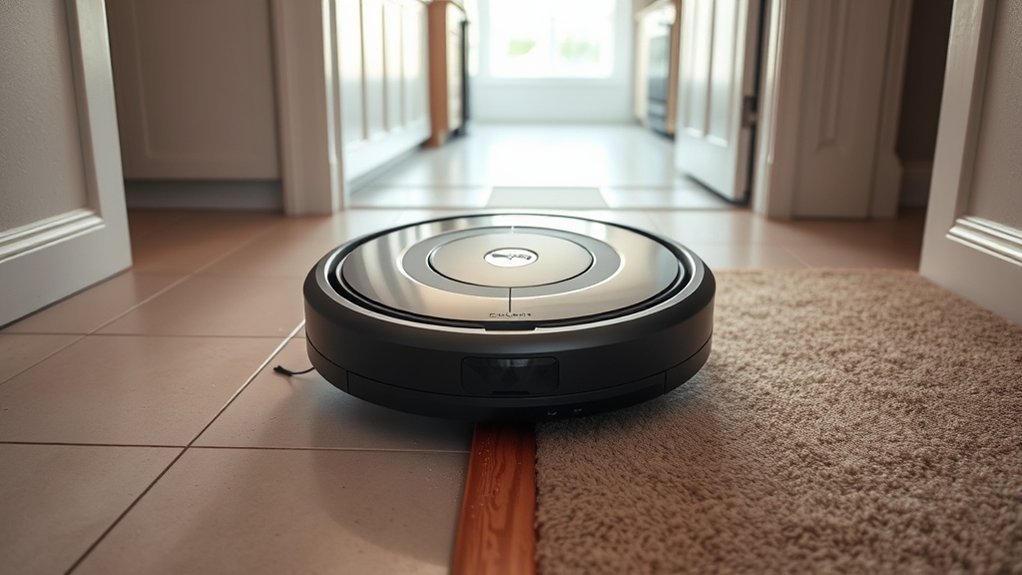
Robot vacuums typically get stuck at thresholds because many are engineered to clear only low rises, generally around 2 cm (0.8 inches) or less. Their climbing ability is constrained by a compact chassis that balances ground clearance against low-profile cleaning under furniture, leaving little margin for higher thresholds.
When a threshold is wider, square, or steep, the front wheels may lose leverage and the unit may stall. Surface traction also governs success: glossy or uneven flooring can reduce grip and trigger getting stuck.
Cliff sensors add another failure mode, since high-contrast edges may be read as drop-offs, causing robot vacuums to stop, reverse, or reroute. Narrow, beveled passages are usually simpler because they present a gradual ramp rather than a barrier.
In practice, the issue is not a single defect but a design limit in thresholds handling, where geometry, sensing, and traction intersect.
How to Measure a Door Threshold
To determine a door threshold’s suitability, one should measure the vertical rise from the lower floor to the top edge with a ruler or tape measure. This threshold height establishes whether a robot vacuum has adequate climbing clearance and compatibility with the door opening.
If carpet is present, it should be pressed down lightly so the measure reaches the top of the pile, not the compressed surface. When both sides differ, each side must be assessed separately, and the tallest dimension should be compared with the vacuum’s rated climbing specification.
Edge shape also matters: square edges can behave as if they are slightly taller than the measured value because they present a sharper step. All readings should be recorded in inches for consistent comparison.
Precise measurement removes guesswork, supports informed selection, and helps users avoid unnecessary barriers to autonomous cleaning freedom, especially where floor changes interrupt movement.
How High a Robot Vacuum Can Climb?
Most robot vacuums can climb thresholds up to about 2 cm, which is usually sufficient for standard doorway shifts.
Climbing performance depends on wheel geometry, motor torque, ground clearance, and the shape of the threshold edge, with sensor accuracy also affecting approach and clearance.
Higher-capability models, including some advanced units such as the Dreame X50 Ultra and Narwal Flow, can cross considerably taller obstacles when specialized traction systems are present.
Typical Climbing Heights
A typical robot vacuum can usually clear thresholds up to about 2 cm (0.8 inches), which covers many standard doorway strips and low crossover bars in residential layouts. This threshold height marks the practical ceiling for most units, with climbing performance falling off on high thresholds. In diagnostic terms, robot vacuums can go farther only when obstacle clearance is generous.
| Model range | Typical climb |
|---|---|
| Basic units | 1.5–2.0 cm |
| Roomba i3/i7/s9+ | 1.8–2.0 cm |
| Roborock S7/S8 | 2.2 cm |
| High-performance models | 2.1–2.5 cm |
| Advanced models | Up to 4 cm |
Larger wheels, stronger motors, and better ground clearance extend capability, but only advanced models approach exceptional crossings.
What Affects Climbing
Threshold-climbing performance depends on several mechanical variables, including wheel diameter, motor torque, and chassis ground clearance, all of which determine how effectively a robot vacuum can overcome an edge.
In practice, robot vacuums work best on thresholds near 2 cm, where climbing ability remains stable and predictable. Rubberized wheels improve surface traction, but success still depends on edge shape and approach angle. A blunt rise is easier than a sharp lip, which can stall forward motion.
- Higher ground clearance reduces drag.
- Stronger drive motors sustain ascent.
- A suspension system helps maintain contact.
- Excess height above 2.5 cm often defeats standard units.
Models With Higher Reach
While most mainstream robot vacuums clear thresholds up to 2 cm, higher-reach models extend that limit through stronger drive systems, larger rubberized wheels, and greater ground clearance.
In practice, premium models such as the Narwal Flow and DEEBOT X11 OmniCyclone can pass higher thresholds near 4 cm or 1.57 inches, depending on the surface profile. Their climbing ability comes from advanced wheel design, suspension tuning, and motor torque, not from software alone.
By contrast, models like the Roborock S7 and S8 series manage about 2.2 cm, yet vacuum struggles increase on carpeted passages.
For users seeking liberation from manual lifting, selecting models with reinforced wheels and clearance is the most direct path to reliable passage over obstacles.
Why Threshold Height and Shape Matter
Threshold height and geometry directly determine whether a robot vacuum can move successfully between rooms, since most units handle changes under 2 cm (0.8 inches) more reliably than rises in the 1.5 cm to 2.5 cm range.
The threshold shape further governs climbing ability: beveled edges distribute contact and reduce impact loading, while square edges create abrupt passage challenges that lower vacuum performance. Wider sills demand more torque and wheel travel than narrow ones, so even modest increases can block passage.
Carpet height also matters, because thick pile can register as an obstacle and alter the effective rise.
- Measure threshold height at multiple points.
- Inspect threshold shape for beveled edges.
- Compare carpet height to wheel clearance.
- Match dimensions to stated climbing ability.
Consistent assessment supports liberation from avoidable navigation failures.
Why Robot Vacuum Sensors Misread Rugs
Even when a robot vacuum clears a doorway, rugs can still disrupt navigation because onboard sensors may read their surface characteristics as a hazard.
In many models, robot vacuum sensors rely on contrast in color, texture, and reflected light, so a patterned rug may resemble obstacles or a drop instead of a flat floor.
Cliff sensors are especially vulnerable: dark strips, dense pile, or a raised weave can mimic an edge and trigger immediate reversal.
Thicker carpets and shag surfaces amplify this effect because the height change at the juncture appears larger than it is.
Approach angle matters as well; a steep entry can distort readings and intensify misinterpretations.
For users seeking practical autonomy, the diagnostic point is clear: sensor logic is not seeing the room as intended.
Regular calibration and software updates can improve detection models, reduce false positives, and restore more reliable movement over rugs, mats, and other low-profile coverings.
How to Fix a Robot Vacuum That Stalls at Thresholds
A threshold height measurement should be the first diagnostic step, since many robot vacuums stall when the change exceeds about 2 cm.
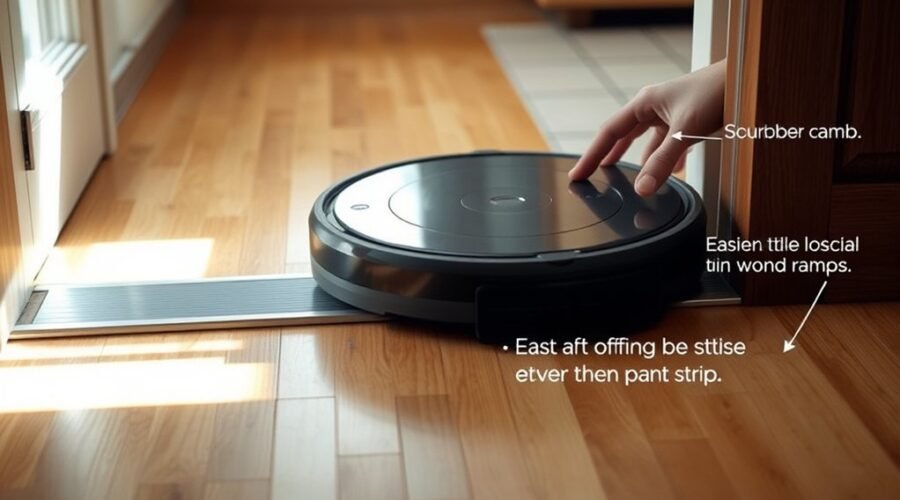
If the obstacle is confirmed to be too high, a rubber or wooden ramp can reduce the step height and improve traversal.
This correction addresses the mechanical limitation directly and lowers the likelihood of repeated stalling.
Check Threshold Height
When a robot vacuum stalls at a doorway or room change, the first diagnostic step is to measure the threshold height with a ruler or tape measure and compare it with the unit’s obstacle-clearance rating. Most robot vacuums cross thresholds up to 2 cm; premium models may exceed that.
If the measured threshold height is within range, inspect the edge shape for a beveled profile, since square thresholds increase resistance. Technical review should also confirm obstacle clearance in the manual, because misread flooring transitions can halt motion.
- Record threshold height at multiple points.
- Compare results with robot vacuums specifications.
- Note whether thresholds are beveled or square.
- Apply routine cleaning tips for wheels and sensors.
Add A Ramp
Installing a ramp can correct threshold stalls by reducing the effective step height to within the robot vacuum’s climbing range, typically about 2 cm (0.8 inches).
To add a ramp, the installer should match the slope to the threshold and the robot vacuums’ climbing capacity, allowing a gradual shift instead of a sharp impact. Materials such as rubber, wood, or aluminum are suitable, provided the surface is stable and non-slip.
DIY ramps can be cut to exact dimensions for specific thresholds, improving access without costly hardware changes. The ramp should be wide enough for the wheelbase to remain centered and secure.
Proper installation reduces abrupt stops, protects the chassis, and lets the machine move with greater freedom across restrictive thresholds.
When a Threshold Ramp Helps
Where a threshold exceeds a robot vacuum’s climbing limit, a ramp can restore traversability by reducing the effective step height to a gradual incline, especially at barriers above 2 cm (0.8 inches). A threshold ramp improves robot vacuums’ climbing ability by converting an abrupt change into a manageable grade, allowing the machine to clean across adjacent floor types without intervention.
This fix is most effective at doorways, raised thresholds, and similar choke points that interrupt coverage.
- Rubber or wood ramps provide a stable, low-slip profile.
- Low-profile designs preserve appearance while supporting access.
- Installation is a practical fix for multiple height changes.
- Existing robot vacuums may regain full route freedom cost-effectively.
Diagnostic use is straightforward: if the robot stalls, spins, or reverses at the same edge, the threshold rather than the navigation logic is likely the limiting factor.
In such cases, a ramp is the least disruptive intervention.
Best Robot Vacuums for High Thresholds
For homes with high thresholds, the most capable robot vacuums are those engineered for greater climb geometry, stronger traction, and stable suspension.
In this category, Robot Vacuums go beyond standard clearance limits only when their climbing ability is supported by oversized wheels and high-torque drive systems. The Narwal Flow reaches thresholds up to 4 cm with an advanced suspension layout, while the DEEBOT X11 OmniCyclone clears 1.57 inches and suits moderate step-offs.
The Dreame X50 Ultra, using retractable legs, extends capability to 6 cm and addresses severe obstacles. Among high-end models, these systems offer the most reliable mobility for liberated floor coverage.
When to Upgrade Your Robot Vacuum
A robot vacuum should be upgraded when threshold performance becomes a repeated failure point rather than an occasional nuisance. If the robot vacuum stalls at thresholds above 2 cm, mainstream vacuums are no longer sufficient; liberation from manual intervention requires a model with stronger climbing ability and advanced wheel design.
Homes with higher elevations, carpet edges, or multi-level layouts expose weak navigation and justify a strategic upgrade.
- Repeated stops at thresholds signal inadequate chassis geometry.
- Frequent carpet-edge misreads indicate sensor limitations.
- Thresholds above 2 cm favor premium models over mainstream vacuums.
- Smart approach systems with dual RGB cameras and LIDAR improve traversal.
For specific cleaning needs, models such as the Narwal Flow or Dreame X50 Ultra offer markedly better obstacle handling, with climbing ability suited to demanding interiors.
When the robot vacuum cannot move freely across the home, efficiency collapses; upgrading restores autonomous coverage and reduces dependence on human correction.
Frequently Asked Questions
How Can I Make My Robot Vacuum Go Over a Threshold?
It can cross by using threshold adjustments, reducing vacuum height limits, and adding ramp solutions to ease floor changes. Cleaning efficiency improves when surface compatibility is checked, wheels are cleaned, and user modifications are tested.
What Are the Most Common Problems With Robot Vacuums?
Common robot vacuum problems include Battery issues, Navigation problems, Dustbin capacity limits, Sensor malfunctions, reduced Cleaning efficiency, and Connectivity glitches. Proper Maintenance tips improve reliability, enabling autonomous cleaning that supports liberation from repetitive domestic labor.
What Is the Average Lifespan of a Robot Vacuum?
Robot vacuums typically last 3–6 years; robot vacuum durability improves with maintenance tips, while battery lifespan often limits service. Cleaning efficiency, smart features, brand comparisons, and user reviews indicate premium units may exceed 6 years.
Is There a Robot Vacuum That Can Climb Thresholds?
Yes—some robot vacuums can climb thresholds. Threshold climbing depends on robot design, wheel mechanics, surface compatibility, weight distribution, sensor technology, and floor types; advanced models handle higher elevations through stronger motors and specialized traction.
Conclusion
To sum up, a robot vacuum that cannot cross a threshold is usually facing a mechanical limit, not a mystery. Threshold height, edge shape, wheel traction, and sensor behavior all determine whether it climbs or stalls. As with a key that fits the lock but cannot turn, the machine may be close to success yet still fail. Measuring the obstruction, reducing the step, or upgrading the robot are the most reliable corrective actions.