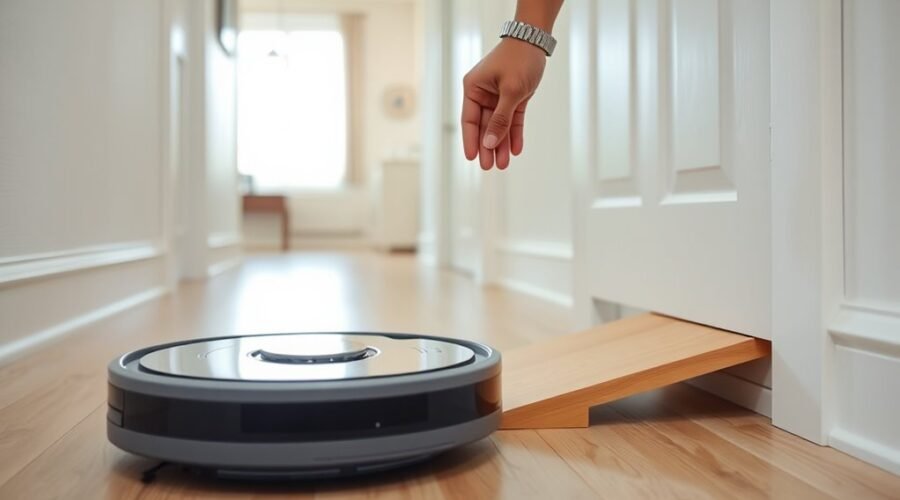
Using a robot vacuum with door thresholds starts with a few simple checks that can prevent constant stops and missed rooms. The threshold height, the vacuum’s climbing limit, and the layout of each doorway all matter. A small setup change can make cleaning smoother, while the wrong one can leave the machine stuck. The next steps show how to measure, prepare, and adjust the vacuum so it moves through the home with fewer problems.
Measure Your Door Thresholds
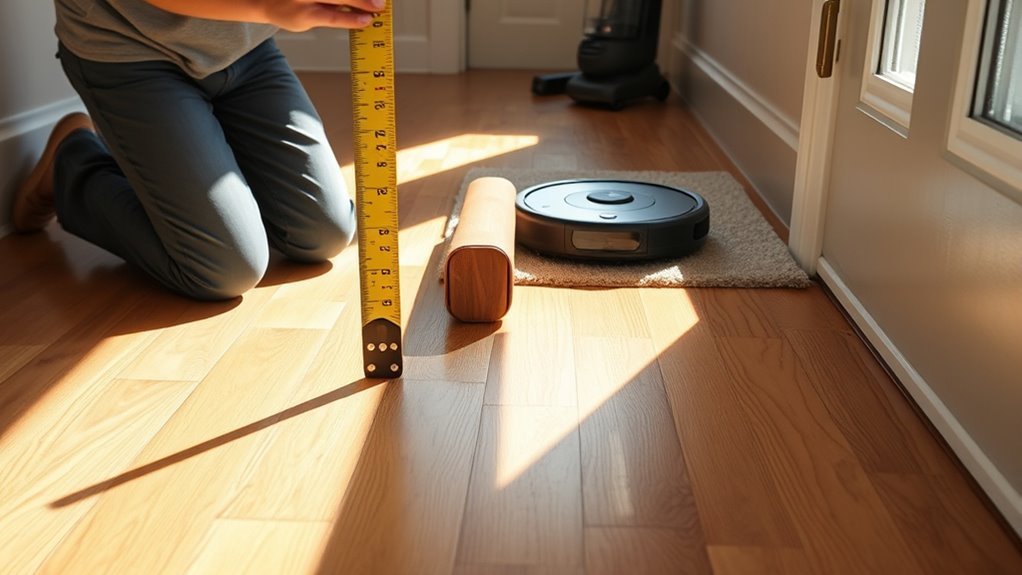
Before choosing or using a robot vacuum, the height of each door threshold should be measured with a ruler or tape measure from the lower floor to the top edge of the threshold. Each measurement should be recorded in inches for clear comparison. This gives a practical view of whether robot vacuums can navigate between rooms without assistance.
Multiple thresholds should be checked, because height can vary from doorway to doorway, especially in older homes with raised thresholds. Those variations can limit cleaning freedom if they are ignored.
Multiple thresholds should be checked, since doorway heights can vary and limit a robot vacuum’s cleaning freedom.
After measuring, compare the numbers with the robot’s stated climbing ability in the manual to judge compatibility. Many models manage only low thresholds, while advanced units handle taller ones.
Precise measurements reduce guesswork and help a user avoid buying a vacuum that cannot move freely across the home. Careful checking supports reliable movement, efficient cleaning, and better independence.
Check Which Threshold Height Your Robot Vacuum Can Handle
The threshold height should be matched to the robot vacuum’s climbing limit after measuring the gap with a ruler or tape measure.
Most standard models handle about 0.8 inches, while advanced units may clear up to 1.57 inches.
The manufacturer’s specifications should confirm whether the vacuum can cross the threshold reliably.
Measure Threshold Height
Using a tape measure, the threshold height should be checked from the lower floor to the top edge of the barrier and recorded in inches or centimeters. This simple step lets the user measure threshold height accurately and judge threshold-crossing ability without guesswork.
Most standard robot vacuums can climb about 0.8 inches, so the reading should stay within their climbing limits. High-end models can handle higher barriers, with some able to clear 1.57 inches.
Robot vacuums can climb only when the obstacle fits their design, so the measurement should be compared with the manual to confirm compatibility. If the threshold is too tall, ramps or no-go zones can preserve freedom from stuck machines and keep cleaning routes open.
Match Vacuum Specs
Most robot vacuums can climb thresholds up to about 0.8 inches (2 cm), while some high-end models can handle barriers closer to 1.57 inches (4 cm).
So the model’s specifications should be checked against the measured threshold height. A ruler or tape measure confirms whether the vacuum’s ability matches the home’s thresholds. If the gap exceeds the unit’s climbing capabilities, choose a different route or a stronger model.
Review robot vacuum specs for the maximum threshold climbing height, since brands vary widely. Raised door sills, thick rugs, and other obstacles may stop movement even when the height seems manageable.
Sensors also need correct calibration so the machine recognizes the edge and attempts crossing. Clear knowledge of limits helps users direct cleaning without unnecessary barriers.
Choose a Robot Vacuum for High Thresholds
When a home has high door thresholds, a robot vacuum should be chosen for climbing ability first. For robot vacuums, high thresholds demand large, rubberized wheels, strong motors, and enough ground clearance. Advanced models with obstacle detection and real-time path planning handle uneven surfaces better and keep movement smooth. The DEEBOT X11 OmniCyclone is a useful benchmark because it climbs up to 1.57 inches.
| Feature | Why it matters | Check point |
|---|---|---|
| Rubberized wheels | Better grip | Compare wheel size |
| Ground clearance | Clears sills | Measure threshold height |
| Obstacle detection | Smarter routing | Review navigation specs |
User reviews and third-party tests should confirm real climbing capabilities in homes like the one being considered. This keeps the purchase aligned with actual needs, not marketing claims. Choose only models that match the tallest threshold, so access remains free and dependable.
Clear Doorways Before the First Run
After selecting a robot vacuum that can handle the home’s threshold heights, the next step is to clear every doorway before the first run. Each clear doorway should be free of obstacles, clutter, and loose cords so the robot vacuum can move without interruption.
Thick rugs or mats, especially those above 0.8 inches, should be removed or repositioned because they can block thresholds and weaken navigation. Furniture legs, shoes, and low objects near entries should also be shifted aside so sensors can read the environment accurately.
The height of each threshold should be checked in advance; most models manage up to 2 cm, or 0.8 inches, with better performance when the path is prepared. A prepared passage gives the machine room to travel, turn, and cross smoothly.
Set Up Maps and No-Go Zones
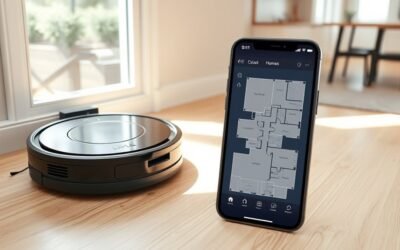
The robot vacuum’s app should be used to create a map of the home, with threshold passages marked as passable or blocked based on how the unit handles them.
No-go zones should then be placed around thresholds where the vacuum may snag, stall, or fail to climb cleanly.
After any layout change, the map should be updated and the vacuum tested again to confirm it follows the new boundaries.
Map Threshold Passages
Using the robot vacuum’s app, a detailed home map should be created first so door thresholds and floor changes are represented accurately.
Each passage should be labeled on the map as passable or blocked, based on threshold limitations and the vacuum’s wheel design. When height changes are too steep, no-go zones should be set to keep the machine in accessible spaces and protect navigation efficiency.
The map should then be reviewed after any flooring changes, added rugs, or threshold repairs, because small shifts can alter performance. After saving the layout, the vacuum should be tested in mapped areas to confirm it crosses manageable door thresholds smoothly.
If it hesitates, settings should be adjusted and the map updated until movement remains reliable and independent.
Mark No-Go Zones
Open the robot vacuum’s app and mark no-go zones around thresholds, tight passages, or any area where the machine tends to stall or snag. Create a precise map, then use mapping settings to decide which thresholds are passable for the chosen vacuum models and their climbing ability. This keeps navigation efficient and preserves performance across mixed surfaces.
| Area | Action | Result |
|---|---|---|
| Thresholds | mark no-go zones | Avoids failed crossings |
| Tight hallways | Block access | Improves navigation |
| Open rooms | Allow passable paths | Stronger performance |
Check manufacturer guidance or community tips for best settings. Keep zones clear of risky edges, and let the robot move where it can work freely.
Remap After Changes
After any flooring change or new carpet installation, the vacuum should be remapped so its app reflects the updated layout and any new thresholds.
During remapping, the robot vacuum should scan each room again so navigation matches the updated environment. The app should then be used to place no-go zones around thresholds that sit too high for safe crossing. This keeps the unit from meeting obstacles it cannot clear and reduces wasted movement.
After mapping, the sensors should be checked for accurate height detection at doors and barriers. If thresholds shift or new obstacles appear, the map should be updated again.
A short test run confirms the robot vacuum moves cleanly through open areas and avoids trouble at thresholds, preserving freedom from constant supervision.
Use a Ramp for Tough Thresholds
For thresholds that are too high for a robot vacuum to cross on its own, a ramp can create a smoother path. To use a ramp, measure your threshold and confirm the threshold height first; many robot vacuums handle obstacles up to 2.5 cm.
Then choose a ramp with a gentle slope built for thresholds and sized to the opening. Material matters, because durable materials improve traction and support repeated passes.
- Measure the threshold height accurately before buying.
- Select a ramp made for robot vacuums.
- Choose durable materials such as rubber or aluminum.
- Test the setup by placing the ramp securely and running the vacuum over it.
A correct ramp gives the machine freedom to move without constant intervention. If the slope is too steep or the surface slips, replace it with a better fit.
Regular checks keep the route clear and reliable.
Watch the First Cleaning Pass
Once a ramp or other threshold solution is in place, the first cleaning pass should be watched closely so the vacuum’s real ability can be assessed. The Robot should be observed as it approaches thresholds, since climbing ability and performance are revealed in motion.
Attention should shift to navigation across hard floors and carpets, where smooth passages signal that the setup is working. If the unit hesitates, bumps, or stalls, those moments show where adjustments may be needed.
Attention should shift to navigation across hard floors and carpets, where smooth passages signal the setup is working.
Mapping accuracy should also be checked so the device treats thresholds as passable in its settings rather than as barriers. During this first cleaning pass, coverage matters as much as crossing success.
The route should be reviewed afterward to see whether the Robot reached all intended areas. Any missed spots or weak coverage can guide simple changes to the room, ramp, or placement of the charging base, helping the machine operate with greater freedom.
Fix a Robot Vacuum That Gets Stuck on Thresholds
A robot vacuum that gets stuck on thresholds should be checked against the height of each doorway, since many standard models handle up to 0.8 inches and advanced units can manage about 1.57 inches. If the robot vacuum cannot pass, the thresholds should be measured and the app maps updated so the device treats them correctly.
- Place ramps of rubber, wood, or aluminum where the incline is steep.
- Review cleaning logs to find where it tends to get stuck.
- Mark problem spots as no-go zones in the app to preserve movement.
- Note whether larger wheels and higher ground clearance would improve climbing ability.
These adjustments reduce friction and let the vacuum move with less interruption.
When the path is clear, the machine can travel more freely, maintain momentum, and support cleaner rooms without repeated rescue.
Know When It’s Time to Upgrade
When threshold fixes and app adjustments no longer solve the problem, it may be time to upgrade the robot vacuum. If the vacuum repeatedly stalls on thresholds above 0.8 inches, its climbing ability is no longer sufficient for the home.
Frequent stops, missed rooms, and poor cleaning efficiency across mixed surfaces show that the current model cannot keep pace with the layout. New flooring or taller thresholds can make this gap worse. At that point, comparing newer models is practical.
Look for units with stronger navigation systems that read barriers and adjust routes without help. Larger rubberized wheels and a robust motor also improve lift over obstacles. A model such as the DEEBOT X11 OmniCyclone can handle heights up to 1.57 inches, giving more freedom from manual intervention.
The right upgrade restores coverage, reduces frustration, and lets the vacuum move through the home with less interference.
Frequently Asked Questions
Do Robot Vacuums Work Over Thresholds?
Yes, many robot vacuums clear thresholds, depending on threshold height, robot design, vacuum wheels, and surface compatibility. Better obstacle detection improves user experience and cleaning efficiency. Maintenance tips include checking wheels and clearance regularly.
Can Roomba Go Over the Door Threshold?
Yes, a Roomba can often cross a door threshold. Success depends on robot vacuum features, threshold height, carpet changes, floor materials, navigation technology, obstacle detection, cleaning efficiency, and user reviews.
Is There a Robot Vacuum That Can Climb Thresholds?
Yes—many robot vacuum models can climb thresholds; why settle for less? Threshold height, vacuum performance, surface types, navigation technology, battery life, maintenance tips, and user reviews should guide selection. Premium units handle taller elevations confidently.
Can Roborock Go Over Thresholds?
Yes, many Roborock models can cross thresholds. Threshold height, robot design, floor types, vacuum features, cleaning efficiency, battery life, obstacle detection, and user reviews should be checked before purchase to guarantee reliable passage.
Conclusion
In practice, successful robot vacuum use with door thresholds depends on preparation and testing. Most standard models can climb thresholds up to about 0.8 inches, so measuring each doorway is essential. A useful statistic is that many homes have multiple thresholds, which can quickly reduce cleaning coverage if ignored. By mapping the home, clearing obstacles, and adding ramps where needed, the vacuum is more likely to move smoothly, avoid getting stuck, and clean more consistently.