LiDAR and vSLAM take different paths to the same task, and that difference shapes how each robot vacuum performs in real homes. LiDAR uses laser-based distance sensing for steady mapping and obstacle detection, while vSLAM depends on camera data and visual landmarks. The contrast becomes more pronounced in dark rooms, cluttered spaces, and homes with shifting layouts, where one system may hold an advantage the other cannot match.
What Is vSLAM vs LiDAR?
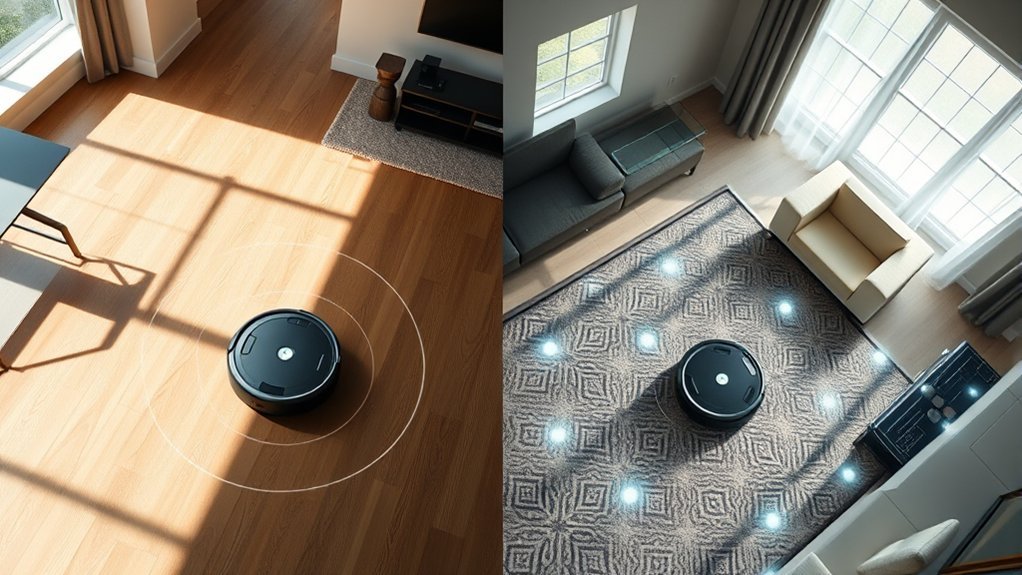
LiDAR and vSLAM are two distinct navigation methods used in robot vacuums, each with different sensing principles and performance tradeoffs.
LiDAR employs a laser to measure distances and build detailed maps, supporting precise localization and stable navigation even in low light. Its accuracy is high, making cleaning routes more consistent across sessions.
vSLAM uses a camera to identify visual features and estimate position while mapping. It is faster to process and more affordable, but it depends on adequate lighting and recognizable landmarks. Without them, map drift can occur over time, reducing accuracy.
LiDAR is typically heavier and costlier, yet it offers reliable coverage in larger homes and during overnight cleaning.
vSLAM is lighter and budget-friendly, suiting cluttered spaces with strong visual contrast.
Both systems enable autonomous cleaning, but they differ in how they balance cost, speed, and precision.
How LiDAR Robot Vacuums Navigate
LiDAR robot vacuums navigate by emitting laser pulses and measuring their time of flight to build accurate spatial maps.
A rotating 360° sensor array converts these distance measurements into dense point clouds for obstacle detection and route planning.
Because this process is independent of ambient light, performance remains consistent in low-light and nighttime conditions.
Laser Time-Of-Flight Mapping
Using laser time-of-flight sensing, these robot vacuums emit rapid laser pulses and measure the return time to calculate distances, building a detailed 3D point cloud of the room.
This LiDAR mapping method gives a robot vacuum navigation technology that functions without visual landmarks, preserving accuracy in darkness and low light.
The resulting map supports obstacle avoidance, route optimization, and boundary control, letting the machine move with measured autonomy rather than blind repetition.
By translating spatial data into efficient paths, the system improves cleaning performance while respecting no-go zones and furniture layouts.
Advanced units add dual-laser hardware and deep learning for tighter inference in complex interiors, extending mapping precision and operational freedom.
360° Room Scanning
Building on time-of-flight mapping, 360° room scanning allows these robot vacuums to continuously sample the surrounding environment from all directions.
In a LiDAR robot vacuum, rotating laser pulses build a spatial model with high mapping accuracy, supporting precise route selection and obstacle detection. Unlike vSLAM, which depends on camera images, this approach is less constrained by visual texture and delivers steadier navigation systems behavior in varied layouts.
The robot vacuum can update maps as furniture shifts, preserving path integrity and improving cleaning results. Continuous scanning also improves recognition of narrow passages, open rooms, and irregular edges, reducing wasted motion.
For users seeking liberated, automated upkeep, the system converts complex floorplans into actionable geometry, enabling efficient coverage without constant human adjustment.
Low-Light Navigation Performance
In low-light environments, LiDAR robot vacuums maintain reliable navigation by emitting their own laser pulses and constructing distance-based maps through Time of Flight measurement. This low-light navigation method frees a cleaning cycle from dependence on ambient light, unlike vSLAM, which requires visual mapping and degrades in darkness.
The result is an accurate map that supports precise obstacle recognition in dim corridors, under furniture, and across multi-floor changes.
- Laser pulses sketch room contours
- Time of Flight gauges wall distance
- Obstacles appear as clear depth returns
- Night cleaning proceeds without drift
Because LiDAR supplies its own sensing signal, coverage remains consistent in poorly lit spaces, reducing missed zones and preserving autonomy.
The system’s analytical mapping enables thorough, repeatable movement where vision-only platforms may stall or leave gaps.
How vSLAM Robot Vacuums Navigate
vSLAM robot vacuums navigate by using one or more cameras to capture sequential visual frames and extract stable environmental features for tracking. In this camera-based system, vSLAM compares point shifts between frames to estimate motion, build mapping data, and refine navigation without fixed external infrastructure.
Adequate lighting conditions are essential because clear visual features improve obstacle detection and reduce missed regions during cleaning. The resulting map supports dynamic cleaning paths, allowing the robot to adapt as rooms change and free movement corridors emerge.
By recognizing toys, cables, and furniture, the system strengthens localized obstacle avoidance and preserves operational autonomy. However, accuracy drift can accumulate when landmarks blur, disappear, or shift, gradually weakening mapping precision and route consistency.
Even so, the method remains effective for users seeking flexible, self-directed cleaning in structured indoor spaces where visual information stays sufficiently stable and the environment can be interpreted continuously.
LiDAR vs vSLAM in Dark Rooms
LiDAR maintains reliable navigation in complete darkness because it emits its own laser light for mapping.
vSLAM depends on sufficient ambient illumination, and its performance can degrade in poorly lit rooms, increasing the risk of missed areas and mapping drift.
In dark environments, LiDAR consequently offers a clear operational advantage for consistent coverage and efficiency.
LiDAR In Darkness
Even in complete darkness, LiDAR retains reliable navigation because it emits its own laser pulses to measure distances via Time of Flight, producing accurate maps without dependence on ambient light. In low-light situations, this preserves mapping accuracy and supports autonomous cleaning solutions where vSLAM may falter.
LiDAR scans walls, furniture, and open corridors with consistent geometry, enabling systematic coverage. By contrast, vSLAM depends on visual features, so darkness can reduce certainty and increase drift.
- A hallway mapped cleanly by laser reflections
- A sofa edge traced with exact contours
- A threshold detected before collision
- A room covered methodically, even at night
For users seeking liberation from lighting constraints, LiDAR offers technical stability, predictable pathing, and dependable performance across darkness, making it a stronger choice for varied household environments.
vSLAM Light Requirements
Where ambient light is limited, vSLAM systems lose some of the visual detail required for reliable localization and mapping, which can reduce navigation accuracy in dark rooms. Its light requirements depend on sufficient ambient lighting to detect visual features and maintain mapping accuracy.
In poorly lit spaces, vSLAM may misread layouts, omit zones, or weaken navigation stability, affecting reliable cleaning. By contrast, LiDAR does not depend on room brightness; it projects its own laser signal and preserves mapping accuracy even in darkness.
For homes with shadowed corridors or nighttime operation, LiDAR offers more autonomous performance and fewer constraints on illumination. vSLAM remains effective in well-lit environments, but in dark rooms its dependence on ambient lighting limits consistency.
Users seeking liberated, low-maintenance cleaning often favor LiDAR there.
How Each Handles Furniture, Toys, and Cables
In cluttered rooms, LiDAR-based robot vacuums generally perform well around large furniture because distance sensing produces accurate room maps and clear obstacle boundaries. However, they can be less reliable with small toys, cables, and other low-profile objects that do not present strong spatial signatures.
vSLAM systems use camera-based visual recognition to identify such items in real time, improving avoidance of scattered clutter in well-lit environments while maintaining a detailed understanding of furniture layout.
LiDAR supports stable mapping and obstacle recognition near sofas and tables, yet it may miss unusual shapes. vSLAM improves detection of small items, though ambient light is required for consistent performance.
LiDAR maps sofas and tables reliably, while vSLAM helps spot small clutter in well-lit rooms.
Hybrid robot vacuums merge LiDAR mapping with vSLAM visual recognition, balancing room-scale planning and close-range avoidance.
- a chair leg beside a play area
- a cable stretched across hardwood
- toys under a low shelf
- open floor lines around a couch
LiDAR vs vSLAM: Speed and Accuracy
LiDAR generally delivers stronger speed-and-accuracy performance because laser pulses rapidly generate precise environmental maps, including detailed 3D point clouds that support reliable distance measurement and obstacle avoidance even in low light. vSLAM can often build maps faster, but its accuracy depends on visible landmarks and stable illumination, so performance can degrade in dim or visually repetitive rooms as drift accumulates over time.
| System | Performance |
|---|---|
| LiDAR | High speed |
| LiDAR | High accuracy |
| vSLAM | Faster mapping |
| vSLAM | Lower accuracy |
| LiDAR | Stable navigation |
For robot vacuum navigation, LiDAR maintains consistent results across sessions, preserving distance measurements and route fidelity. vSLAM can exploit strong visual features in bright, textured spaces, yet insufficient cues may leave areas uncleaned. From an analytical perspective, LiDAR offers more reliable mapping and greater operational autonomy, while vSLAM trades precision for quicker initial setup.
Which Navigation Is Best for Your Home?
Selecting the best navigation system depends on the home’s lighting, layout, and budget constraints. LiDAR suits users seeking reliable navigation in low-light spaces, with strong mapping accuracy and stable cleaning efficiency across repeated runs. It is especially appropriate for larger homes and complex floorplans where precise route planning matters.
LiDAR suits low-light, larger homes with complex floorplans, offering reliable mapping accuracy and stable cleaning efficiency.
vSLAM better serves homes filled with visible landmarks and obstacles, because its obstacle recognition can improve avoidance in cluttered rooms. For households prioritizing affordability, vSLAM is the budget-friendly option and may offer strong value in straightforward environments.
- A dark hallway illuminated only by moonlight favors LiDAR.
- A bookshelf-lined apartment with clear visual cues favors vSLAM.
- A wide, multi-room home benefits from LiDAR home layout suitability.
- A compact, object-rich living space can exploit vSLAM navigation.
In practical terms, the best choice depends on whether autonomy should emphasize exact mapping or visual interpretation.
LiDAR vs vSLAM: Cost and Battery Life
Cost differences between LiDAR and vSLAM vacuum systems are primarily driven by hardware complexity, with LiDAR units typically occupying the mid-range to premium segment and vSLAM models remaining more common in budget-oriented devices. The cost of technology shapes the initial investment, often adding several hundred dollars for LiDAR systems. | Factor | Impact |
| — | — |
|---|---|
| Hardware | LiDAR higher |
| Price | vSLAM budget-friendly |
| Power | LiDAR heavier draw |
| Mapping | vSLAM faster in light |
| Upkeep | LiDAR higher maintenance costs |
Battery life influences purchasing freedom: LiDAR systems can shorten runtime because laser modules consume more energy, while energy-efficient vSLAM models may sustain longer sessions in well-lit rooms. Operational efficiency also matters, as quicker mapping can reduce wasted motion and preserve charge. Over time, lower maintenance costs further strengthen the economic case for vSLAM models. For households prioritizing autonomy from recurring expense, the budget-friendly path often favors vSLAM, while LiDAR suits users willing to trade a larger initial investment for more advanced sensing and navigation.
Frequently Asked Questions
Is vSLAM Better Than Lidar?
VSLAM is not universally better; VSLAM accuracy, VSLAM costs, VSLAM applications, VSLAM limitations, VSLAM technology, VSLAM efficiency, VSLAM sensors, VSLAM mapping, and VSLAM positioning suit budgeted, bright-space autonomy, but LiDAR dominates dark, complex liberation tasks.
Is Lidar Better for Robot Vacuums?
Yes—LiDAR is often better, unless one enjoys gambling with darkness. It improves LiDAR accuracy, mapping efficiency, room coverage, and user convenience; obstacle detection is steadier. Yet cost comparison, battery consumption, maintenance requirements, and technology advancements matter too.
What Are the Downsides of Using Lidar?
LiDAR limitations include cost factors, maintenance requirements, and battery consumption. Environment sensitivity, light interference, and data processing demands can reduce map accuracy and obstacle detection, especially in cluttered spaces, limiting reliable autonomous operation.
Which Robot Vacuum and Mop Has the Best Lidar Navigation?
DEEBOT T30S appears strongest: a scanning beam sketches rooms like a blueprint, delivering robot vacuum smart cleaning, high navigation accuracy, mapping efficiency, obstacle detection, strong floor types coverage, good battery life, and favorable user reviews.
Conclusion
In the comparison of LiDAR vs vSLAM robot vacuum navigation, each system shows clear tradeoffs. LiDAR delivers superior mapping precision, stronger performance in dark rooms, and more reliable obstacle detection around furniture, toys, and cables. vSLAM offers a lower-cost, camera-based alternative, but it is more sensitive to lighting and visual clutter. Which system is best depends on the home environment, cleaning demands, and budget. For most complex spaces, LiDAR remains the more robust choice.