Can robot vacuums clean cat litter without scattering it or clogging? Many models can pick up dry litter around a cat’s box, but results depend on the litter, floor type, and vacuum design. Understanding these differences helps you choose a suitable machine and avoid expensive cleaning mistakes.
Quick Answer
Yes, most robot vacuums can clean small amounts of dry cat litter, especially from hardwood, tile, and low-pile rugs. Strong suction, suitable brushes, and reliable navigation improve pickup. However, wet clumps, large litter piles, and pet waste require manual cleaning. Regular dustbin and filter maintenance helps prevent clogs and loss of suction.
Key Takeaways
- Dry clay and crystal litter are generally easier to vacuum than wet clumps or large pellets.
- An anti-tangle brush reduces hair wrapping, but it cannot prevent every litter blockage.
- Smart mapping and targeted cleaning zones help manage litter around boxes in busy homes.
- Robot vacuums offer convenient daily maintenance, while cordless vacuums are often better for large spills and detailed cleaning.
- Emptying the bin, inspecting brushes, and cleaning filters regularly protect pickup performance.
Can Robot Vacuums Clean Cat Litter?
)
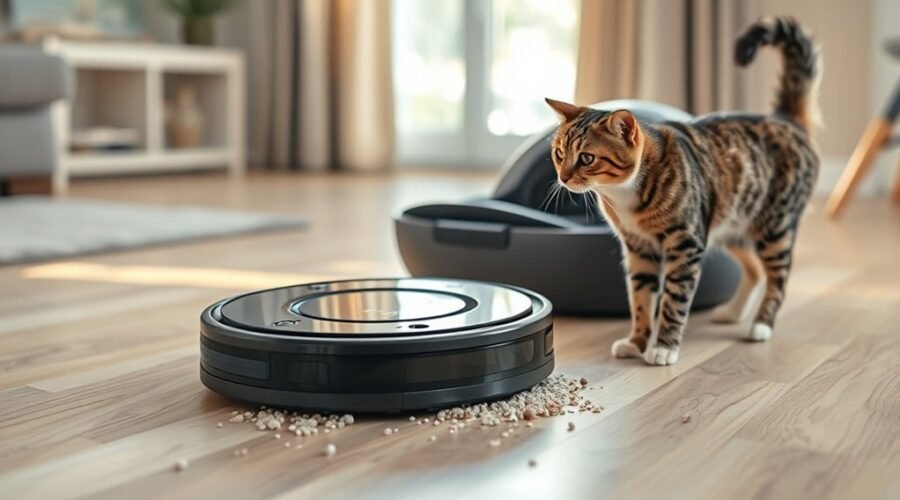
Robot vacuums can collect loose, dry cat litter from many household floors. They work particularly well for routine cleanup around litter boxes, where small amounts of litter collect throughout the day.
Most machines use a combination of suction and rotating brushes to move debris into an internal dustbin. Depending on their design, they can also collect pet hair, dust, and fine litter particles.
Robot vacuums are useful for maintaining clean floors around litter boxes, but they should supplement regular litter-box cleaning rather than replace it.
Performance depends on several factors:
- Litter size: Fine granules may be easy to collect, while larger pellets can struggle to pass through a narrow suction opening.
- Floor type: Smooth hard floors usually allow easier pickup than thick carpets.
- Brush design: Rotating side brushes can direct litter toward the intake, but they may also scatter loose particles.
- Dustbin capacity: Small bins fill faster when collecting heavy granules and pet hair.
- Navigation: Mapping and obstacle avoidance help a robot clean around furniture and pet supplies.
Some Roomba models use Dirt Detect Technology to recognize areas with concentrated debris and make extra cleaning passes. Advanced robot vacuums can also use cameras and sensors to identify obstacles near pet areas.
According to ECOVACS’ guidance on vacuuming cat litter, dry litter is generally suitable for compatible vacuums, while damp litter and large clumps can cause blockages.
For everyday cleaning, a robot vacuum can significantly reduce scattered litter. However, it cannot scoop the litter box, disinfect contaminated surfaces, or reliably remove every grain.
What to Look for in a Robot Vacuum for Cat Litter
The best robot vacuum for cat litter should combine good debris pickup with dependable navigation and manageable maintenance. Suction matters, but brush design, filtration, and floor coverage are equally useful when comparing models.
Before choosing a machine, consider whether your litter box sits on hard flooring, carpet, or a litter-catching mat. Also consider how much fur and litter your cats produce.
Strong Suction Power
Strong suction helps lift cat litter from hard floors, shallow gaps, and low-pile carpet. It is especially useful when fine granules settle between floorboards or carpet fibers.
Some premium robot vacuums advertise suction ratings of 10,000 Pa or more. Pa stands for pascals, a unit used to measure pressure.
For example, the DEEBOT X8 PRO OMNI advertises 18,000 Pa of maximum suction. However, a higher Pa rating does not automatically mean better litter pickup.
Actual cleaning also depends on airflow, the size of the suction opening, brush movement, and how closely the vacuum contacts the floor.
A lower-powered model with a well-designed intake may collect dry litter more effectively than a stronger machine that scatters debris with its side brush.
For homes with several cats, consider a larger dustbin or self-emptying station. Both can reduce interruptions during frequent cleaning.
Tangle-Free Brush Design
A tangle-free brush helps prevent cat hair from wrapping tightly around the main roller. This makes routine maintenance easier and allows the vacuum to collect litter and fur together.
Systems such as ZeroTangle 2.0 use specially shaped brushes and comb-like parts to guide hair away from the roller.
These designs offer several advantages:
- Less hair wrapping around brush rollers and bearings.
- Fewer cleaning interruptions caused by tangled fur.
- More consistent brush movement during repeated cleaning runs.
- Less time spent manually removing accumulated hair.
However, anti-tangle technology primarily addresses hair. It does not guarantee that cat litter will never block the suction passage or fill the filter.
For floors covered with loose granules, a direct-suction design without a main roller can also be worth considering. Its performance still depends on the intake and side brushes.
Smart Navigation Features
Smart navigation helps a robot vacuum cover the area around a litter box without repeatedly missing the same patches. Models with mapping can follow planned routes instead of relying entirely on basic obstacle sensors.
Useful features include:
- Room mapping: Helps the robot identify and revisit specific rooms.
- Targeted cleaning: Lets compatible models focus on the floor near the litter box.
- Obstacle avoidance: Helps the vacuum move around pet bowls, toys, cords, and furniture.
- No-go zones: Allow you to exclude areas where the vacuum might disturb a litter box or encounter pet waste.
- Low-profile construction: Helps the robot reach under nearby cabinets and furniture.
The DEEBOT T50 PRO OMNI is one example. Its official specifications list 15,000 Pa suction, an 81 mm body height, and AIVI 3D 3.0 obstacle recognition using a Vision-Language Model.
This technology helps identify objects and follow their boundaries while cleaning.
However, no obstacle detection system is perfect. Always remove visible pet accidents before starting an automated cleaning run.
Which Types of Cat Litter Can Robot Vacuums Handle?
Robot vacuums generally perform best with small amounts of dry, loose litter. The material, particle size, and amount of dust influence how easily the vacuum collects it.
Some litter types need more attention because they can scatter, clog filters, or become trapped inside the machine.
| Litter Type | Robot Vacuum Performance | Main Concern |
|---|---|---|
| Dry clay litter | Usually suitable for small amounts of scattered granules. | Fine dust can clog filters. |
| Dry crystal litter | Can be collected if the pieces fit through the intake. | Larger particles may scatter or remain behind. |
| Wood or paper pellets | Variable; smaller pieces are easier to collect. | Large pellets may not enter the suction opening. |
| Wet or urine-soaked clumps | Not recommended for ordinary robot vacuums. | Moisture, hardened deposits, blockages, and contamination. |
Floor type also matters. On tile, vinyl, and hardwood, the vacuum can collect visible granules directly. On low-pile rugs, some particles may become lodged between fibers and require additional passes.
Thick rugs and textured litter mats are more challenging. Large pellets may remain trapped even after the robot finishes cleaning.
If your cat tracks litter onto carpet, a cordless vacuum with an appropriate floor head may be more effective for occasional deeper cleaning.
Pro Tip: If the vacuum’s side brush keeps throwing litter away from the intake, try a small-area cleaning mode with another pass. If scattering continues, manually collect the loose granules and use the robot for the surrounding floor.
Best Robot Vacuums for Cat Litter
Several robot vacuums have features suited to cleaning dry cat litter and pet hair. The best choice depends on your flooring, maintenance preferences, and need for advanced navigation.
The following models offer different approaches, from premium self-emptying systems to basic suction-focused cleaning.
| Robot Vacuum | Notable Features | Best Suited For |
|---|---|---|
| DEEBOT X8 PRO OMNI | 18,000 Pa maximum suction, ZeroTangle 2.0, advanced obstacle avoidance, self-emptying station. | Homes needing premium automation for everyday debris and pet hair. |
| DEEBOT T50 PRO OMNI | 15,000 Pa suction, slim body, smart mapping, obstacle recognition. | Pet areas with low furniture and tighter cleaning spaces. |
| Roomba 694 | Dirt Detect Technology, dual multi-surface brushes, scheduled cleaning. | Basic routine cleaning without advanced room mapping. |
| ILIFE V3s Pro | Direct-suction intake, slim construction, multiple cleaning modes. | Budget-conscious homes with mostly hard floors and pet hair. |
| Shark IQ Robot Self-Empty | Room mapping, self-cleaning brushroll, bagless self-emptying base. | Pet owners who want scheduled cleaning with reduced manual bin emptying. |
DEEBOT X8 PRO OMNI: Its main strengths are powerful suction and automated maintenance. The manufacturer’s product specifications confirm the 18,000 Pa rating and ZeroTangle 2.0 brush system. These are useful features for homes that collect both litter and pet hair.
Roomba 694: This basic model uses two multi-surface brushes and Dirt Detect Technology. According to iRobot’s Roomba 694 specifications, it can focus additional cleaning effort on dirtier areas. It does not offer the advanced object recognition found in more sophisticated robots.
ILIFE V3s Pro: Its direct-suction design avoids the main rotating brush used by many competing vacuums. This can help reduce hair wrapping. The official ILIFE V3s Pro product information also describes its cleaning modes and suitability for hard floors and low-pile carpet.
Shark IQ Robot Self-Empty: Shark combines room mapping, a self-cleaning brushroll, and an automatic dirt-disposal base. These features are documented in SharkNinja’s official product announcement.
These models should be compared by their actual pickup performance, not suction specifications alone. A machine that collects dry litter without scattering it is more useful than one with impressive numbers but inconsistent floor coverage.
How to Prevent Cat Litter Clogs
Preventing cat litter clogs starts with keeping wet material and excessive debris out of the robot vacuum. Even a powerful model can lose suction when fine litter dust accumulates in its filter or large particles block the intake.
Use the following routine to reduce these problems.
- Remove large litter piles. Sweep or scoop up heavy spills before starting the robot. Leave only scattered dry granules for automated cleaning.
- Keep wet litter out. Remove damp clumps, urine, feces, and other pet accidents manually. Allow the surrounding floor to dry before vacuuming.
- Use a suitable cleaning mode. Choose a vacuum-only setting around dry litter when your machine supports one. If your model allows suction adjustment, increase it when normal cleaning leaves granules behind.
- Clear the cleaning path. Pick up cords, small toys, and loose objects that could block the robot near the litter box.
- Inspect the dustbin and intake. Check for packed litter, trapped hair, or blocked airflow after heavy cleaning runs.
Warning: Never use an ordinary dry robot vacuum to collect urine-soaked litter, feces, vomit, or other wet pet waste. Moisture can damage components, while contaminated material may spread through the brushes and floor. Remove the mess manually and clean the affected surface before restarting the robot.
If your robot repeatedly clogs, inspect the brush housing and suction channel with the machine switched off. Remove visible debris according to its manual.
If the vacuum still leaves litter behind after its bin, filter, and intake are clean, the problem may be its brush design or floor compatibility rather than a mechanical fault.
Robot Vacuums vs. Cordless Vacuums for Cat Litter
Robot vacuums are usually more convenient for regular cat litter cleanup, while cordless vacuums are often better for large spills and detailed cleaning. Neither type is automatically superior in every situation.
The right choice depends on whether you want frequent hands-free maintenance or stronger control over individual messes.
| Feature | Robot Vacuum | Cordless Vacuum |
|---|---|---|
| Daily cleanup | Can operate automatically on a schedule. | Requires manual operation. |
| Large litter spills | Less suitable; large piles may clog the intake. | Often easier to control for larger dry spills. |
| Carpet cleaning | Useful for routine surface debris, depending on the model. | Often better for deeper cleaning with a suitable floor head. |
| Corners and tight areas | Limited by body size and navigation. | Crevice tools can reach narrow gaps. |
| Maintenance | Requires brush, wheel, sensor, bin, and filter care. | Requires bin and filter care, plus attachment maintenance. |
Cleaning Power Compared
Cordless vacuums generally offer greater control during intensive litter cleanup. You can aim the floor head at a specific spill, adjust your cleaning technique, and make repeated passes without waiting for automated navigation.
Robot vacuums provide a different advantage: they can remove smaller amounts of litter regularly before debris spreads across the room.
Both types may have strong suction, but their performance should not be compared using maximum Pa numbers alone. Airflow, floor heads, brushes, and intake design affect how well each machine picks up debris.
For scattered dry litter on hard floors, a good robot vacuum may be enough. For heavily soiled carpets or large spills, manual cleaning is often more effective.
Maneuverability Around Litter
Robot vacuums can move around furniture without manual guidance, but they cannot reach every corner beside a litter box. Their round bodies, sensors, and clearance requirements limit access to narrow spaces.
Smart mapping improves route planning. Some models can clean a selected area near the litter box rather than covering the entire room.
Cordless vacuums offer more precise control. A crevice attachment can reach behind the litter box, beneath shelving, and along baseboards where litter gathers.
If the litter box stands in a tight corner, you may need both automated cleaning and occasional manual attention.
Maintenance and Convenience
Robot vacuums offer greater convenience because they can clean while you handle other tasks. Scheduled runs are especially useful in homes with multiple cats.
Some robot vacuums also include self-emptying bases and brush systems designed to resist hair tangles. These features reduce manual work, but they do not eliminate maintenance.
Cordless vacuums require you to clean the floor yourself. However, their accessible dustbins and attachments can make occasional litter cleanup straightforward.
For many pet owners, the most practical approach is to use a robot vacuum for daily maintenance and a cordless vacuum for larger dry spills.
How to Maintain a Robot Vacuum With Cats
A robot vacuum used around cats needs regular care because fur, litter dust, and granules can collect inside its moving parts. Proper maintenance helps preserve suction and reduces the chance of a clogged intake.
Regular dustbin emptying, filter care, and brush inspection help keep a robot vacuum working reliably in homes with cats.
A weekly inspection is a useful starting point, but heavy litter tracking and shedding may require more frequent attention.
Follow this maintenance checklist:
- Dustbin: Empty it after heavy litter pickup or whenever it becomes full. For models without self-emptying, check it after each cleaning session.
- Main brush: Remove accumulated pet hair and check for trapped litter.
- Side brushes: Clear hair wrapped around the brush hubs and check for damaged bristles.
- Filters: Remove dust using the method recommended by the manufacturer. Never wash a filter unless the manual confirms it is washable.
- Wheels and sensors: Remove trapped litter from the wheels and wipe dirty sensors with an appropriate cloth.
- Self-emptying station: Inspect the dust bag or container and check its transfer passage for blockages.
For example, iRobot’s maintenance recommendations specify emptying the bin after each use for older Roomba models and cleaning brushes and filters twice weekly in homes with pets.
These schedules vary by model. Follow the maintenance requirements for your specific vacuum, particularly if it has washable parts or a self-emptying dock.
It also helps to schedule cleaning when your cats are away from the immediate area. This reduces interruptions and allows nervous pets to avoid the vacuum’s noise.
Keep the Litter Area Clean Between Vacuuming Runs
A robot vacuum cannot replace regular litter-box hygiene. Keeping the box itself clean reduces the amount of waste and loose material that may reach the floor.
Use a litter-catching mat, remove tracked granules, and keep the surrounding area free of unnecessary obstacles. A stable litter box and suitable mat can reduce how much litter spreads beyond the pet area.
Choose a mat that lies flat so the vacuum does not catch or push its edges. If litter collects deep inside the mat, clean the mat separately.
Note: The CDC’s pet-supply cleaning guidance recommends daily litter-box cleaning and careful hygiene because cat feces can carry germs, including the parasite that causes toxoplasmosis. Pregnant people and those with weakened immune systems should have someone else handle litter-box cleaning when possible. Follow healthcare advice for any additional precautions.
With consistent upkeep, a robot vacuum can reduce everyday litter tracking while keeping its suction system and moving parts in better condition.
Frequently Asked Questions
Is There a Robot Vacuum That Can Clean Cat Litter?
Yes, several robot vacuums can collect dry cat litter from hard floors and low-pile rugs. Models with strong suction, suitable brushes, and reliable navigation are useful for regular cleanup. The best results come from removing wet clumps manually and keeping the vacuum’s dustbin and filters clean.
What Are the Downsides of Using a Robotic Vacuum Cleaner?
Robot vacuums can miss debris, scatter litter, struggle with certain flooring, and require regular maintenance. An unverified estimate suggests about 30% of owners experience missed debris. In homes with cats, another concern is accidentally running over pet waste, which can spread contamination and damage the machine.
What Vacuum Is Best for Picking Up Cat Litter?
The DEEBOT X8 PRO OMNI is a strong premium option, offering 18,000 Pa maximum suction and ZeroTangle 2.0 technology. The DEEBOT T50 PRO OMNI offers slim construction and advanced navigation. Roomba 694, Shark IQ, and ILIFE V3s Pro provide alternative approaches. Actual litter pickup depends on flooring, debris size, and brush design.
Does Roomba Pick Up Cat Litter?
Yes, many Roomba models can collect small amounts of dry cat litter. The Roomba 694 includes Dirt Detect Technology to concentrate cleaning effort in dirtier areas. Pickup varies by floor type and litter size. Keep its dustbin and brushes clean, and remove damp clumps before running it.
Conclusion
Robot vacuums can handle everyday cat litter cleanup when you use them for small amounts of dry debris. Strong suction, suitable brushes, and dependable navigation improve results, while regular maintenance helps prevent clogs.
Choose a model that suits your flooring and litter type. Keep wet clumps and pet waste out of the vacuum, and use manual cleaning for heavier messes. This combination can make daily floor care easier without putting unnecessary strain on your machine.
Sources
- ECOVACS: Can You Vacuum Cat Litter Safely?: Dry litter pickup, clog prevention, and cleaning limitations.
- ECOVACS: DEEBOT X8 PRO OMNI: Official 18,000 Pa suction specification, ZeroTangle 2.0, and cleaning technology.
- ECOVACS: DEEBOT T50 PRO OMNI: Suction specifications, slim body design, navigation, and obstacle detection.
- iRobot: Roomba 694: Dirt Detect Technology, brush design, and basic cleaning features.
- ILIFE: V3s Pro Official Product Information: Direct suction, cleaning modes, dimensions, and supported flooring.
- SharkNinja: Shark IQ Robot Announcement: Mapping, self-cleaning brushroll, and self-emptying technology.
- iRobot: Roomba Care Procedure Frequency: Dustbin, brush, filter, and routine maintenance recommendations.
- CDC: Cleaning and Disinfecting Pet Supplies: Litter-box hygiene, infection prevention, and household safety precautions.