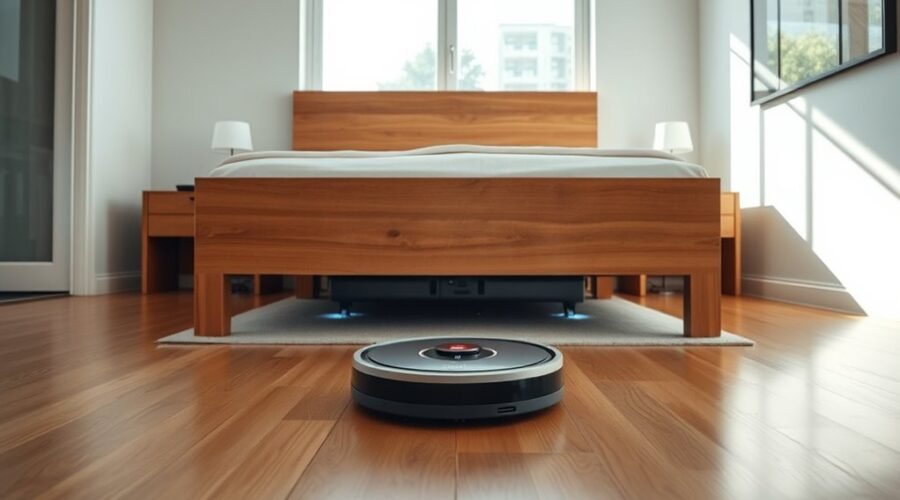
Robot vacuums can clean under beds, but a low bed frame or hanging fabric may keep them from reaching hidden dust. Even a robot that fits beneath the outer edge can get trapped by a support rail farther inside. The key is to measure the available space, remove obstacles, and check how your robot navigates the area.
Quick Answer
Yes, robot vacuums can clean under beds when there is enough clearance for the entire machine, including its sensors. The required gap depends on the model, not a universal height. Leave extra headroom, lift hanging bed skirts, and remove cables. If the robot still skips the area, check its navigation map and obstacle settings.
Key Takeaways
- Robot vacuum heights vary considerably. Some low-profile models are under 3 inches tall, while others exceed 4 inches.
- Measure the lowest support rail beneath your bed, not just the visible opening.
- Hanging fabric can confuse navigation sensors or become tangled in brushes.
- No-go zones prevent access. Use targeted cleaning zones instead when you want a reachable area cleaned.
- Regular robotic cleaning reduces routine dust buildup, but occasional manual deep cleaning remains useful.
Can Robot Vacuums Clean Under Beds?

Yes. Most conventional low-profile robot vacuums can clean beneath raised beds when the opening is large enough for the machine to enter and move freely. However, the actual height requirement depends on the vacuum’s body, sensors, and navigation design.
A robot vacuum moves across the floor using powered wheels, rotating brushes, and suction. Depending on its design, cameras, infrared sensors, or LiDAR help it detect walls and obstacles. LiDAR uses laser light to measure distances and map the surrounding space.
Under-bed cleaning works best when the robot has enough height, an unobstructed entrance, and a clear route back out.
In practice, several conditions affect cleaning success:
- Furniture clearance: The bed must sit higher than the vacuum’s tallest point, with additional space to move safely.
- Bed skirts: Hanging fabric can appear to be a barrier or catch in the brushes.
- Floor obstacles: Cables, toys, socks, and stored items can block movement.
- Navigation: Incorrect maps or obstacle readings may cause the robot to skip reachable spaces.
- Maintenance: Dirty sensors, tangled brushes, and full dustbins can reduce performance.
Robot vacuums are particularly useful for removing everyday dust, hair, and loose debris from accessible floors. However, heavy dust buildup, thick carpet, and narrow corners may still require a conventional vacuum with a hose or crevice attachment.
How Much Clearance Do Robot Vacuums Need?
Robot vacuums need more clearance than their full physical height to move reliably under beds. Although 3.6 inches is a common reference point, it is not a universal requirement. Some models are considerably shorter, while others need more space.
For example, official Roomba j7 specifications list a robot height of 3.4 inches.
A separate manufacturer height comparison lists some slim models at 2.85 inches and taller laser-navigation models at 4.09 inches.
| Robot Example | Published Height | What It Means |
|---|---|---|
| Slim 11S-type model | 2.85 inches | Can fit beneath relatively low furniture when sufficient extra space remains. |
| Roomba j7 | 3.4 inches | Needs a gap greater than its full 3.4-inch height. |
| L70 Hybrid | 3.96 inches | Requires a taller opening, including room for its navigation hardware. |
| L50/L60 series | 4.09 inches | May not fit beneath beds designed with very low frames. |
As a practical starting point, allow approximately 1 cm of extra headroom above the robot’s tallest point. This is a planning margin, not a guaranteed fit.
Manufacturer requirements can be stricter. One furniture clearance guide specifies at least 10.2 cm for a robot measuring 9.6 cm tall and recommends 11 cm or more where possible.
Another manufacturer’s under-furniture guidance recommends 13–14 cm of clearance for its listed models to support reliable navigation.
These examples show why measuring the bed and checking the exact model specifications matter more than relying on a general height estimate.
How Bedskirts and Kickboards Block Cleaning
Bed skirts and kickboards can stop robot vacuums even when the space beneath the bed appears tall enough. Fabric creates a flexible barrier, while solid trim and crossbars can physically block the machine.
Some LiDAR-guided systems may interpret a hanging bed skirt as a wall because the sensor detects fabric instead of the open space behind it. Certain Wyze vacuum owners have reported this type of behavior, although the exact response depends on the model.
Loose fabric can also wrap around the side brush or become trapped beneath the vacuum.
| Obstacle | Effect |
|---|---|
| Bedskirts | May block entry or tangle in brushes |
| LIDAR sensors | May interpret hanging fabric as a wall |
| Kickboards | Create solid barriers or narrow openings |
| Low furniture | Can trap robots beneath frames or support rails |
| Firmware limits | May affect obstacle recognition and navigation |
To improve access, tuck the bed skirt securely above the opening. Make sure it cannot fall into the robot’s path during cleaning.
For rigid kickboards or low crossbars, measure the opening and avoid sending the robot into a space it cannot exit. Furniture risers may help when the bed frame and manufacturer permit their safe use.
How to Prep Your Room for Better Coverage
Preparing your bedroom helps the robot vacuum enter tight spaces and clean without repeated interruptions. Focus on clearing obstacles, confirming furniture clearance, and setting useful boundaries before starting a cleaning cycle.
These three checks also reduce the chance of the robot becoming trapped far beneath the bed.
Clear Floor Obstacles
Remove loose objects from the floor before starting a cleaning cycle. This prevents cords, clothing, and small items from interfering with the vacuum’s brushes, wheels, and sensors.
Use this preparation checklist:
- Lift charging cables: Coil phone chargers, extension cords, and other loose wires above floor level.
- Remove small objects: Pick up toys, socks, slippers, and lightweight items stored beneath the bed.
- Secure furniture: Check nearby furniture legs, drying racks, and other objects that might shift or block the cleaning route.
- Clear doorways: Remove loose rugs or obstacles that might prevent the robot from reaching the bedroom.
Keep the vacuum away from water sources, fragile objects, and areas where items might fall into its path.
Once the floor is clear, the robot can follow a more predictable route without repeatedly stopping to avoid clutter.
Measure Furniture Clearance
Measure the distance between the floor and the lowest part of your bed frame. Include any support rails, crossbars, decorative panels, or bed skirts that reduce the usable opening.
Follow these steps:
- Measure the entrance: Place a tape measure vertically from the floor to the underside of the bed.
- Check deeper sections: Measure near the center support, bed legs, and any lower structural bars.
- Account for floor coverings: Measure above carpet pile or rugs rather than assuming the floor is perfectly flat.
- Compare dimensions: Check the robot’s full height, including raised sensors, against the smallest measurement.
- Allow extra room: Follow the manufacturer’s minimum clearance recommendation before permitting access.
Also check doorway thresholds. Some earlier robot vacuum models have climbing limits of 1.5–2 cm, although capabilities vary and some newer machines can cross higher obstacles.
If your threshold exceeds the robot’s rated limit, a suitable leveling strip or threshold ramp may improve access.
Pro Tip: Measure the middle of your bed as carefully as the outer edge. A hidden center rail can be lower than the visible frame and trap a robot that entered without difficulty.
Mark No-Go Zones
No-go zones tell compatible robot vacuums which areas they must avoid. They are useful for protecting delicate objects or preventing the robot from entering spaces where it might become stuck.
For example, iRobot’s Keep-Out Zone guidance explains how mapped boundaries can keep supported models away from clutter and difficult areas.
Consider marking these problem spots:
- A curtain or bed skirt that hangs directly onto the floor.
- A charger cable looped beside the bed frame.
- A fragile glass vase on a low shelf within the robot’s reach.
- A narrow area where the bed clearance becomes too low.
Do not mark the entire under-bed area as a no-go zone if you want the robot to clean there. Instead, restrict only the unsafe section.
If your vacuum supports targeted cleaning zones, use one to request additional cleaning beneath an accessible bed. Review the map afterward to see whether the robot actually traveled through the area.
Why Robot Vacuums Miss Under-Bed Spots
Robot vacuums often miss under-bed areas because their sensors detect obstacles or the physical opening is too small. Incorrect maps, uneven flooring, and clutter can also prevent complete coverage.
To identify the problem, observe whether the vacuum refuses to enter, enters but becomes stuck, or passes through without collecting much debris.
- Refuses to enter: Look for blocked sensors, hanging fabric, or an incorrectly mapped boundary.
- Gets stuck underneath: Inspect low crossbars, uneven flooring, tangled cables, and insufficient headroom.
- Misses sections: Check the cleaning map, obstacles, and available turning space.
- Leaves dust behind: Inspect the dustbin, filter, suction opening, and brushes for buildup.
Each pattern points to a different fix, so avoid changing multiple settings before identifying the likely cause.
Bedskirt Sensor Confusion
Bed skirts can interfere with navigation by hiding the open space beneath the frame. On some LiDAR-based systems, fabric may appear to be a continuous wall rather than a soft obstacle.
This can produce a chain of events:
- The sensor detects the hanging fabric.
- The navigation system treats it as an obstacle.
- The robot changes direction or marks the space as blocked.
- The floor beneath the bed remains uncleaned.
Some owners report that older robots entered such spaces more readily, while newer obstacle-avoidance systems can be more cautious. Actual behavior depends on the navigation method and software.
Try securing the bed skirt before starting a new cleaning run. If the robot still avoids the area, inspect its map and use a supported targeted cleaning command.
If accessible floor space has been incorrectly mapped, the app may offer an option to update or recreate the map.
Low Clearance Obstacles
Low-clearance obstacles create a physical problem that settings cannot solve. A robot may fit beneath the bed’s outer frame but encounter a lower rail or uneven surface farther inside.
Other common obstacles include thick rugs, stored boxes, loose cables, and bed frame supports that narrow the passage.
If the vacuum becomes trapped repeatedly, stop sending it into that section. Adjust the furniture when safe, or use a no-go zone to prevent further problems.
For spaces the robot cannot reach, use a conventional vacuum with a slim floor head, extension wand, or crevice tool.
Best Robot Vacuum Settings for Beds
The best robot vacuum settings for under-bed cleaning combine reliable navigation, suitable suction, and a practical schedule. Settings cannot overcome insufficient clearance, but they can improve coverage after the physical path is clear.
Focus on the following adjustments:
- Use targeted cleaning: Select the bedroom or a supported cleaning zone to direct the robot toward the under-bed floor.
- Set suitable suction: Choose a stronger suction mode when the area contains heavier dust or hair, if your model supports it.
- Schedule regular runs: Clean during a period when the room is unoccupied and the floor is free of clutter.
- Maintain the robot: Empty the dustbin, clean sensors, inspect the brushes, and check the wheels according to the manufacturer’s instructions.
- Check lighting needs: Give camera-dependent navigation systems sufficient room light when needed.
Lighting requirements differ between models. For example, iRobot’s camera-navigation troubleshooting guidance explains that extremely dark rooms can affect navigation and coverage on certain Roomba models.
LiDAR-based navigation does not depend on visible room lighting in the same way, although physical obstacles and sensor limitations can still affect performance.
After adjusting the settings, run one complete bedroom cleaning cycle. Review the cleaning map and inspect the floor beneath the bed to confirm the robot reached the intended areas.
Frequently Asked Questions
What Is the Best Vacuum for Cleaning Under the Bed?
The best vacuum for regular under-bed cleaning is a low-profile robot that fits beneath your specific bed frame. Choose a model with reliable navigation, sufficient suction, and suitable clearance. Compare its full height with the lowest available gap before buying. A conventional vacuum remains useful for deeper cleaning.
What Are the Downsides of Using a Robotic Vacuum Cleaner?
Robot vacuum cleaners can miss tight corners, become trapped beneath furniture, and struggle with thick carpets or large debris. They also need regular brush, filter, and sensor maintenance. Battery life and navigation limits can interrupt cleaning. They are convenient for routine floor care but cannot replace every traditional vacuuming task.
What Is the Best Vacuum Cleaner for Under Beds?
A slim robot vacuum is a convenient choice for everyday cleaning beneath accessible beds. For very low furniture or heavy dust buildup, a canister vacuum with a hose and extension wand may work better. A flat floor attachment can also reach spaces that are too narrow for a robot.
Is It Good to Vacuum Under Bed?
Yes, vacuuming under your bed helps remove dust, hair, and debris that collect in hidden spaces. Regular cleaning can reduce indoor dust buildup and help manage some allergens. A robot vacuum makes routine maintenance easier, but deeper cleaning may still be needed for stubborn dirt and thick carpet.
Can Robot Vacuums Clean Under Beds in the Dark?
Some robot vacuums can clean beneath beds in darkness, particularly models that rely on LiDAR navigation. However, camera-based systems may need some ambient light to navigate reliably. If your robot avoids dark spaces, review its lighting requirements and try cleaning with the bedroom lights on.
Conclusion
Robot vacuums can clean under beds effectively when there is enough clearance, a clear route, and suitable navigation. Start by measuring the lowest part of your bed frame and comparing it with your robot’s full height.
Lift hanging fabric, remove floor obstacles, and review the cleaning map after a test run. With the right setup and regular maintenance, your robot can keep this hard-to-reach area cleaner with less manual effort.
Sources
- iRobot: Roomba j7 Specifications: Confirms the robot’s published height and physical dimensions.
- eufy Support: RoboVac Furniture Clearance: Provides published heights for different robot vacuum series and guidance for tight furniture gaps.
- eufy Support: S1 Series Clearance Requirements: Explains the minimum furniture clearance and recommended extra space for navigation.
- Narwal Support: Under-Furniture Height: Provides clearance recommendations for cleaning beneath beds and sofas.
- iRobot Support: Keep-Out Zones: Explains how compatible robots use mapped boundaries to avoid difficult areas.
- Roborock Support: Threshold Climbing Height: Confirms obstacle-climbing limits for the listed earlier models.
- iRobot Support: Roomba Navigation Troubleshooting: Describes problems caused by low lighting, clutter, and obstructed cameras.
- US Environmental Protection Agency: Indoor Particulate Matter: Explains indoor dust sources, routine cleaning, and ways to reduce dust and allergens.