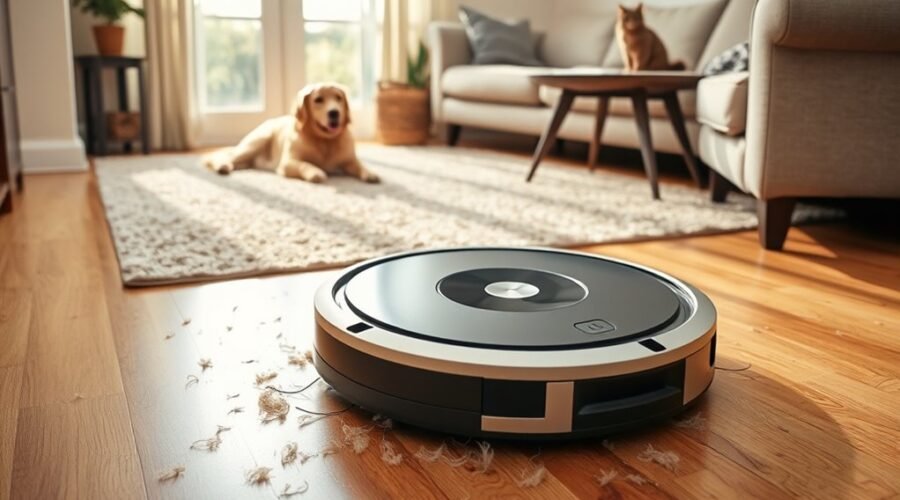
Can robot vacuums clean pet hair well enough to keep up with a shedding dog or cat? Yes, but results depend on your flooring, the vacuum’s brush design, and how often you run it. Some models collect loose fur easily, while others struggle with hair trapped deep in carpets. Knowing which features matter helps you choose a vacuum that needs less attention.
Quick Answer
Yes, robot vacuums can clean pet hair from hardwood, tile, low-pile carpets, and many area rugs. Models with effective brush rolls, strong airflow, and tangle-resistant designs work best. Daily cleaning helps control shedding, while auto-emptying docks reduce maintenance. However, thick carpets and deeply embedded fur may still require a traditional vacuum.
Last checked: October 28, 2026. Model specifications and figures were verified against manufacturer and authoritative sources.
Key Takeaways
- Hard floors and low-pile carpets are generally easier to clean than thick, high-pile rugs.
- Anti-tangle brushes reduce hair wrapping, but you still need to inspect and clean them.
- A higher suction rating does not automatically mean better pet-hair pickup.
- High-efficiency filtration helps contain fine particles, but it does not eliminate pet allergies.
- Smart mapping, obstacle avoidance, and self-emptying docks make frequent cleaning more practical.
Can Robot Vacuums Clean Pet Hair?
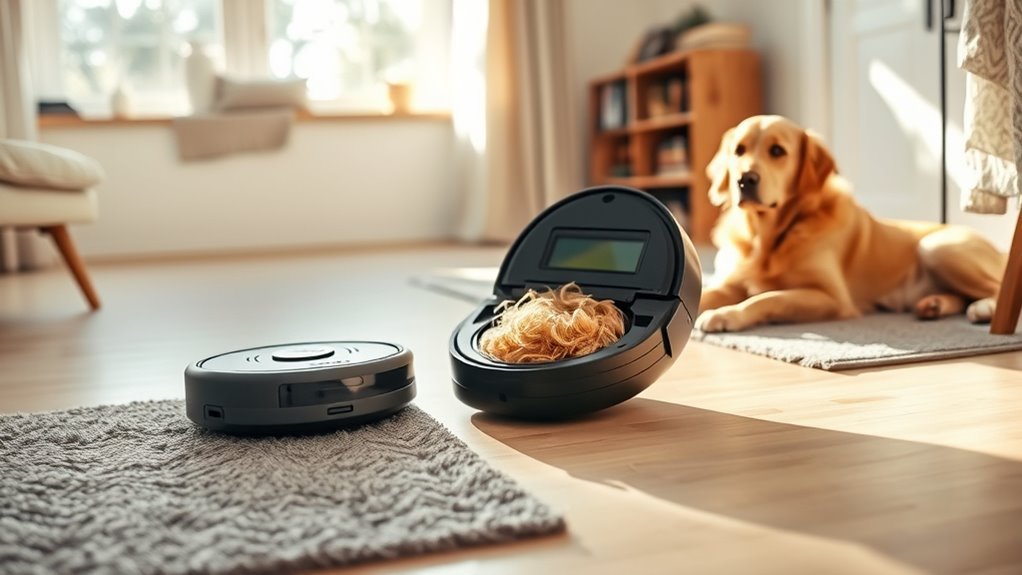
Yes, robot vacuums can remove pet hair from most common household floors. They work especially well on loose fur scattered across hardwood, tile, laminate, and short carpets. Their biggest advantage is frequent cleaning without requiring you to vacuum manually each day.
Robot vacuums collect hair using three main components:
- Rotating brushes: Loosen hair and guide it toward the suction opening.
- Suction and airflow: Pull loose fur and debris into the dustbin.
- Filtration: Help prevent collected dust and fine particles from escaping through the exhaust.
Models with rubber rollers or specially designed bristle brushes can reduce the amount of hair that wraps around the cleaning head.
Smart navigation also helps the vacuum clean around furniture and reach areas where pets regularly shed.
Regular runs keep hard floors cleaner, reducing buildup and saving owners from constant manual vacuuming.
However, robot vacuums do not replace every type of cleaning. Hair embedded deep in carpets, trapped along tight edges, or stuck to upholstered furniture may need a full-size vacuum or upholstery attachment.
For everyday shedding, a robot vacuum is best used as a maintenance cleaner that prevents large amounts of fur from accumulating.
Which Robot Vacuums Work Best on Carpets?
The best robot vacuums for carpet pet hair combine effective brush agitation, strong airflow, and reliable contact with carpet fibers. Suction matters, but brush performance is often just as important.
Low-pile carpets are generally easier to clean because hair stays closer to the surface. Thick carpets hold strands deeper in their fibers, making removal more difficult.
Carpet Suction Strength
Strong suction helps a robot vacuum collect loosened fur, dirt, and debris. However, a high Pascal (Pa) rating alone cannot tell you how thoroughly a vacuum will clean your carpet.
Pascal ratings measure suction pressure. Actual pickup also depends on airflow, brush agitation, floorhead design, and how well the vacuum moves across the surface.
For example, the Dreame L60 Ultra PE advertises 30,000 Pa of Vormax suction. It also uses an anti-tangle DuoBrush system designed to collect hair while reducing brush wrapping.
The Ecovacs Deebot X8 Pro Omni has a manufacturer-rated 18,000 Pa suction system and ZeroTangle 2.0 brush technology.
Both offer features designed for pet hair, but their different suction ratings do not establish which will remove more hair from a particular carpet.
When comparing models, prioritize independent pet-hair pickup tests on the same carpet type. A vacuum that collects embedded fur consistently is more useful than one with a higher advertised number but weaker brush contact.
Anti-Tangle Brush Design
Anti-tangle brushes help robot vacuums collect pet hair without wrapping large amounts around their rollers. They are particularly useful in households with long-haired dogs, cats, or several shedding pets.
The Roomba j9+ uses dual multi-surface rubber brushes. One brush helps loosen debris while the other guides it toward the suction opening.
Other models, including the Roomba Max 705 and Dreame L60 Ultra PE, also use brush designs intended to resist hair tangles.
Rubber rollers are often easier to clear of wrapped hair. However, bristled brushes can provide useful agitation on carpets, and some models combine both approaches.
A controlled pet-hair test reported complete flattened-hair pickup and no brush wrapping for the Dreame L60 Ultra PE. That result applies to the test conditions and does not guarantee identical performance on every carpet or hair type.
For better results, choose a vacuum with brushes that you can remove easily for cleaning.
Why Anti-Tangle Brushes Matter for Pet Homes
Anti-tangle brushes matter because wrapped hair can interfere with normal brush movement and reduce cleaning efficiency. A tangle-resistant system helps the vacuum complete cleaning sessions with fewer interruptions.
Traditional bristle brushes may collect strands around their shafts, particularly when cleaning long pet hair. Over time, the buildup can make maintenance more difficult.
Modern anti-tangle systems use different methods to reduce this problem:
- Flexible rubber rollers: Guide hair toward the suction opening while reducing snagging.
- Comb-assisted brushes: Help separate strands from the rotating brush.
- Special roller shapes: Direct hair toward the center or an area where it can be collected more easily.
These designs can improve cleaning consistency on carpet, tile, and hardwood.
However, anti-tangle does not mean maintenance-free. Long strands can still accumulate around roller bearings, end caps, and side brushes.
For multi-pet homes, the practical advantage is fewer cleaning interruptions and less time spent cutting hair away from the brush assembly.
How Robot Vacuums Handle Dander and Allergens
Robot vacuums can help reduce pet dander and dust that collect on floors. They do this by lifting particles into a dustbin and passing the exhaust air through a filter.
However, removing visible pet hair is not the same as eliminating allergens. Effective filtration and regular cleaning are important, especially for people with pet allergies.
Dander Capture Systems
Pet dander consists of tiny flakes of skin shed by animals. Pet allergens also come from proteins found in saliva, urine, and other sources, rather than fur alone.
The American Academy of Allergy, Asthma & Immunology explains that these proteins can cause allergic reactions and worsen asthma symptoms in sensitive people.
Robot vacuums help by collecting settled hair, dust, and some allergen-containing particles before they build up.
For effective containment, consider these features:
- A high-efficiency filter designed to retain fine particles.
- A well-sealed dustbin and airflow path.
- A brush system that captures debris without excessive scattering.
- An auto-emptying dock with a sealed disposal bag.
Self-emptying docks can reduce direct handling of dusty bins. However, their effectiveness depends on the dock’s filtration, seals, and bag design.
Allergen-Focused Filtration
High-efficiency filtration helps prevent collected particles from being released through a vacuum’s exhaust. This is useful in homes where pet dander and fine dust are concerns.
According to the US Environmental Protection Agency’s HEPA guidance, a true HEPA filter can theoretically capture at least 99.97% of particles measuring 0.3 microns.
That percentage describes the filter’s performance under specified conditions. It does not mean a robot vacuum removes 99.97% of allergens from an entire room.
Also, not every robot vacuum has a genuine HEPA filter. Some use high-efficiency filters without meeting the full HEPA specification.
If allergies are a concern, look for verified filtration performance and a well-sealed system rather than relying only on marketing claims.
Robot vacuuming should also be combined with cleaning furniture, washing pet bedding, and appropriate air filtration where needed.
Note: Robot vacuuming may help reduce settled pet allergens, but it does not treat pet allergies or asthma. If symptoms persist, consult an allergist for appropriate testing and advice.
Daily Run Benefits
Daily cleaning helps control pet hair and dander before they accumulate. This is especially useful in homes with multiple animals or pets that shed heavily throughout the year.
Frequent cleaning can also reduce the amount of loose fur that gets tracked between rooms.
| Feature | Effect | Benefit |
|---|---|---|
| Daily run | Removes loose debris regularly | Less floor buildup |
| Pet hair pickup | Collects fur before it spreads | Cleaner living areas |
| Advanced filtration systems | Retain some fine particles | Better dust containment |
Models with carpet boost can automatically increase suction when moving onto carpet. Smart mapping also helps them cover rooms in a more organized pattern.
For homes with heavy shedding, frequent cleaning is usually more manageable than allowing fur to build up between occasional deep-cleaning sessions.
What Smart Navigation Does Around Pets?
Smart navigation helps robot vacuums move around furniture, pet bowls, toys, and other obstacles while covering your floors efficiently. Depending on the model, the system may combine mapping sensors with cameras or other object-detection technology.
Many advanced models use LiDAR, a laser-based system that measures distances and creates a map of your home’s layout.
Mapping allows you to schedule specific rooms and create cleaning zones. Some robots also let you set no-go areas around pet beds, food bowls, or places where your animals prefer to rest.
Obstacle avoidance is different from basic mapping. A robot with object recognition may detect small items such as socks, cables, or toys and move around them.
Some advanced models can also identify solid pet waste. However, this feature is not available on every robot, and no obstacle-avoidance system is perfect.
Warning: Never rely completely on obstacle avoidance to detect pet accidents. Remove waste or liquid messes before starting a cleaning run. A robot that spreads waste across your floors can create a much larger cleanup problem.
Pets may also react differently to robot vacuums. Some ignore them, while others become nervous when the machine approaches.
If your pet seems uncomfortable, schedule cleaning while the animal is in another room. You can also use no-go zones to protect its resting space.
For many households, good navigation means fewer interruptions, better room coverage, and less need to move the robot manually.
How Often Should You Run a Robot Vacuum?
Run your robot vacuum daily if you have heavily shedding pets or several animals. For lighter shedding, three to five cleaning sessions per week may be enough to maintain reasonably clean floors.
The right schedule depends on your pets, flooring, home size, and the amount of fur you notice between runs.
| Schedule | Purpose | Effect |
|---|---|---|
| Daily | Control heavy shedding | Limits visible accumulation |
| 3–5 times weekly | Manage lighter shedding | Reduces routine buildup |
| Short targeted runs | Clean favorite pet areas | Maintains high-traffic spots |
| Auto-empty models | Reduce bin handling | Make frequent runs easier |
| Brush and filter checks | Maintain cleaning performance | Reduce clogs and tangles |
For large homes, choose a robot with sufficient battery capacity and recharge-and-resume functionality. This lets it continue unfinished cleaning after returning to the dock.
Frequent operation does not remove the need for basic maintenance.
According to iRobot’s Max 700 Series maintenance guidance, main brushes should generally be checked once weekly, or twice weekly in homes with pets. Its maintenance schedule also recommends regular filter cleaning and replacement according to the model.
For practical upkeep:
- Empty the dustbin when full, unless the dock empties it automatically.
- Remove hair from the main brush, side brush, and roller ends.
- Check the filter for dust buildup and follow the manufacturer’s cleaning instructions.
- Inspect wheels and suction openings for trapped fur.
- Replace worn brushes, filters, and disposal bags when needed.
Do not wash a filter unless its manufacturer specifically says it is washable.
Keeping these parts clean helps the robot maintain reliable pickup during frequent use.
Which Roomba Models Are Best for Pet Owners?
For pet owners, the Roomba Max 715, Roomba Plus 575, and Roomba Max 775 Combo offer different approaches to automated floor cleaning. The best choice depends on whether you need strong vacuuming alone or a machine that also mops.
These models are worth comparing based on brush design, dock functions, navigation, and your home’s flooring.
- Roomba Max 715 Vacuum Robot: The Roomba Max 715 uses dual rubber brushes, carpet boost, and an anti-tangle edge brush. Its AutoEmpty Dock and odor-control bags make it a practical option for homes with heavy shedding.
- Roomba Plus 575 Combo: The Roomba Plus 575 combines vacuuming with spinning mop pads. Its tangle-resistant brush design helps manage fur, while the AutoWash Dock handles debris emptying and mop cleaning. It suits homes that need both pet-hair removal and regular hard-floor mopping.
- Roomba Max 775 Combo: The Roomba Max 775 Combo combines dual rubber brushes with a roller mop and AutoWash Dock. It also has carpet detection that lifts and protects the mop when the robot moves onto rugs.
The Roomba Max 705 and Roomba j9+ are also relevant options for pet owners. Both use dual rubber brush systems, with features designed for collecting fur from carpets and hard floors.
If your home has mostly carpet, prioritize strong pet-hair pickup and brushes that maintain contact with carpet fibers.
If you have mainly tile, hardwood, or laminate floors, a vacuum-and-mop model may provide greater everyday convenience.
Pet owners should also consider the cost and availability of replacement brushes, filters, and disposal bags. These are ongoing maintenance items even on premium models.
For US buyers, iRobot’s website currently advertises 10% off a new customer’s first purchase after email signup. This promotion may change and should not be assumed available in every country.
When Robot Vacuums Don’t Work Well
Robot vacuums struggle with pet hair when carpets are too thick, brush systems become tangled, or the machine cannot cover the entire cleaning area. Even premium models have limits.
Understanding those limits helps you decide when to use a traditional vacuum instead.
| Condition | Effect | Practical result |
|---|---|---|
| High-pile carpet | Reduced brush contact or movement | Hair remains embedded |
| No anti-tangle technology | Greater risk of brush wrapping | More manual maintenance |
| Low battery life | Incomplete cleaning sessions | Missed pet-hair zones |
Thick carpets and shag rugs can create resistance against the brush or wheels. Loose rug edges and fringe can also become trapped in the cleaning mechanism.
On hard floors, some robots may push lightweight hair away with their side brushes before collecting it.
Another limitation is cleaning coverage. Robot vacuums may leave hair in tight corners, on stairs, behind barriers, or beneath furniture they cannot fit under.
Small dustbins can fill quickly during heavy shedding. Without an auto-emptying dock, this may interrupt a cleaning session or reduce pickup performance.
Robot vacuums also cannot clean sofas, curtains, bedding, or other raised surfaces. These areas need separate cleaning tools.
Pro Tip: If your robot leaves visible fur on a rug, make a second cleaning pass over the same area. If hair remains trapped in the fibers, use a full-size vacuum with a suitable powered brush rather than repeatedly running the robot.
With reasonable expectations, a robot vacuum can handle routine shedding while a traditional vacuum takes care of deeper cleaning.
Frequently Asked Questions
What Are the Downsides of Using a Robot Vacuum?
Robot vacuums may miss corners, struggle with thick carpets, and require regular brush and filter maintenance. Small dustbins and limited battery life can also affect cleaning. Most cannot clean stairs or furniture, and liquid messes usually require a separate cleaning method.
Which Robot Vacuum Is Best for Cleaning Pet Hair?
The Dreame L60 Ultra PE is a strong option for pet hair because it combines high suction with tangle-resistant brushes. The Roomba j9+ and eufy X10 Pro Omni are also worth considering. The best choice depends on your carpet type, pet shedding, and maintenance needs.
Which Robot Vacuum Cleaner Is Best for Removing Pet Hair?
The Roomba j9+ is a strong choice for removing pet hair from carpets and hard floors. Its dual rubber brushes help loosen fur, while smart navigation and self-emptying reduce daily work. The Ecovacs Deebot X8 Pro Omni and Dreame L60 Ultra PE are useful alternatives.
Which Robot Vacuum Is Best for Cleaning Dog Hair?
The Dreame L60 Ultra PE is a good option for dog hair because of its anti-tangle brush system and strong advertised suction. However, the best vacuum depends on whether your dog sheds short, fine fur or long strands. Carpet performance and brush maintenance matter more than suction numbers alone.
Conclusion
Robot vacuums can manage everyday pet hair effectively, particularly on hard floors and low-pile carpets. Choose a model with reliable hair pickup, tangle-resistant brushes, effective filtration, and navigation suited to your home.
For the best results, match your cleaning schedule to your pet’s shedding level and maintain the brushes and filters. A robot vacuum can handle routine fur collection, leaving deeper carpet cleaning and furniture care to your traditional vacuum.
Sources
- Dreame Official Product Specifications: L60 Ultra PE suction rating, anti-tangle DuoBrush, and cleaning features.
- Ecovacs DEEBOT X8 Pro Omni: Manufacturer-rated suction, ZeroTangle technology, navigation, and carpet cleaning.
- iRobot Roomba j9+ Product Information: Dual rubber brushes, pet-hair cleaning, obstacle avoidance, and self-emptying features.
- US Environmental Protection Agency: What Is a HEPA Filter?: HEPA filtration definition and particle capture efficiency.
- American Academy of Allergy, Asthma & Immunology: Pet Allergy: Pet allergens, dander, allergy exposure, and management guidance.
- iRobot Max 700 Series Maintenance Guidance: Brush cleaning frequency, filter care, and replacement guidance for pet households.
- iRobot Roomba Max 715 Specifications: Vacuuming features, anti-tangle brushes, carpet boost, and dock functions.
- iRobot Roomba Plus 575 Specifications: Brush design, vacuum-and-mop operation, navigation, and AutoWash Dock.
- iRobot Roomba Max 775 Combo Specifications: Dual rubber brushes, roller mopping, carpet protection, and AutoWash Dock.