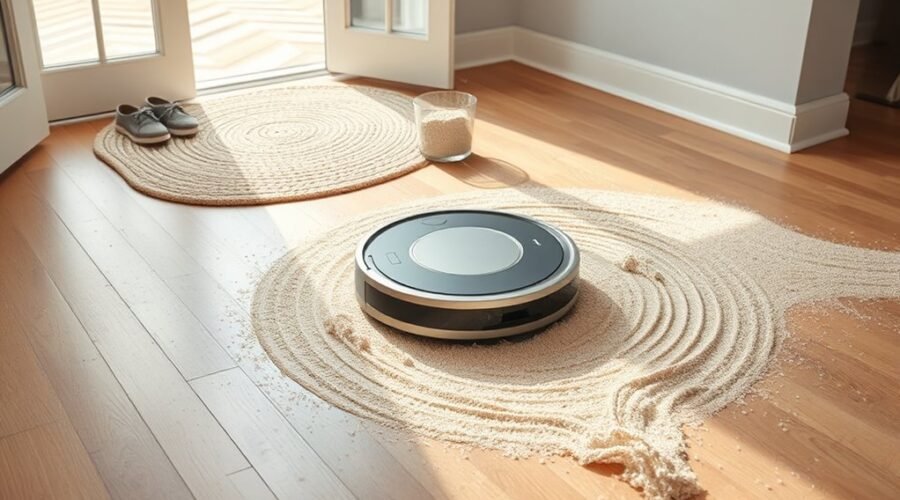
Robot vacuums can handle sand, but only to a point. Hard floors usually present fewer problems than carpet, yet fine grains, static cling, and weak brush systems can reduce pickup fast. Performance depends on suction, brush design, and how often the machine is maintained. Some models leave less behind than others, and the differences matter more in sandy homes than most owners expect.
Can Robot Vacuums Clean Sand Well?
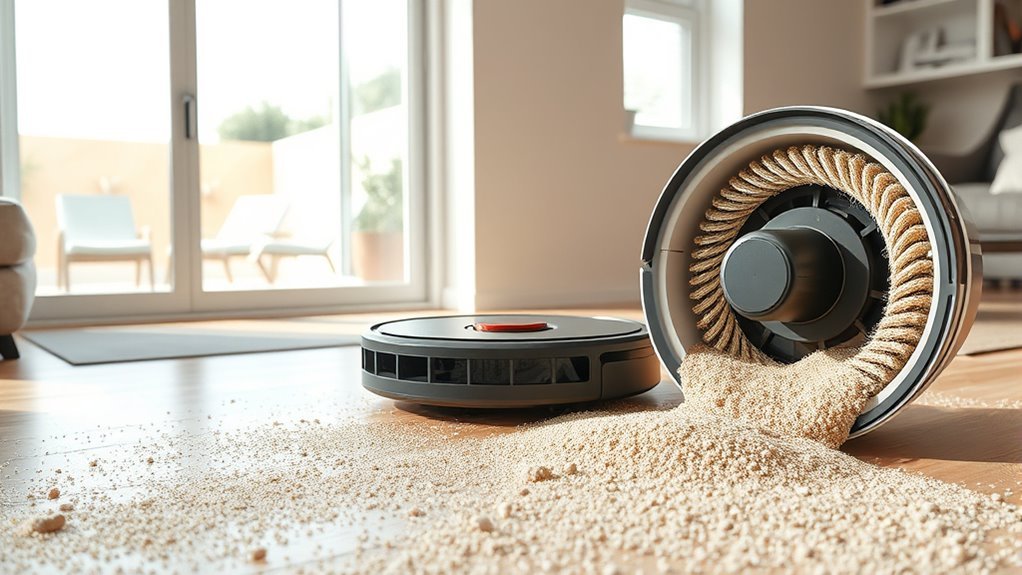
Robot vacuums can clean sand, but performance is often inconsistent because fine particles can cling to floors through static and settle into carpet fibers.
In practice, robot vacuums for sand work best on hard floors, where repeated passes can clean sand more reliably. Results vary widely: some units remove only part of the load, while the Ecovacs Deebot X8 Pro Omni reached a 60.28% pickup rate in testing, showing that design matters.
Strong suction power, ideally above 2000 Pa, helps lift embedded granules from carpets and textured surfaces. Advanced brush systems, especially rubber and bristle combinations, improve contact and gather fine particles without scattering them.
Strong suction and advanced brushes help lift embedded sand without scattering it across floors.
High-efficiency filtration also matters, since trapped dust and sand should not re-enter the room. For households seeking relief from constant sweeping, these machines can reduce labor, but they do not yet replace targeted cleanup after heavy sand exposure entirely.
Which Robot Vacuum Features Matter Most for Sand?
For sand, suction power and brush design are the primary performance factors, because fine particles must be lifted from both hard floors and carpet fibers.
HEPA filtration and effective mapping also matter, since they help contain escaped dust and improve coverage in corners, under furniture, and along edges.
Together, these features determine whether a robot vacuum removes sand efficiently or simply redistributes it.
Suction And Brush Design
When evaluating robot vacuums for sand, suction power and brush design are the two most important factors. Effective pickup generally begins at 2000 Pa, while stronger units approaching 11,000 Pa handle fine grains with greater consistency.
Powerful suction reduces scatter and helps lift abrasive particles from seams, edges, and low-pile rugs. Brush design matters because rubber rollers work well on carpet, while bristle brushes improve contact on hard floors and loosen settled grit.
A balanced setup supports cleaner passes without constant reruns. The filtration system also matters for retaining captured sand, but the core performance gains come from suction and brush geometry.
Regular maintenance of brushes is necessary to keep rotation free and preserve cleaning efficiency across different surfaces, giving users a more autonomous cleaning routine.
Filtration And Mapping
High-efficiency filtration is essential in sand-focused cleaning because fine grains can recirculate without a true HEPA filter, reducing air quality and leaving residue behind.
For a robot vacuum for sand, filtration efficiency matters as much as suction power, since weak filters let dust escape after pickup.
Mapping technology also determines coverage: 3D navigation and object detection help the unit reach corners, under furniture, and other sand traps without wasting passes.
Brush design should pair rubber rollers with bristles to lift grit from tile, carpet, and thresholds.
Regular maintenance remains nonnegotiable; filters and brushes clog quickly, lowering performance.
In practice, liberation from sand comes from a system that captures, contains, and routes debris efficiently, not from brute force alone.
How We Tested 10 Robot Vacuums for Sand
The 10 robot vacuums were evaluated in a controlled lab setting across simulated floor types to measure sand cleanup under consistent conditions.
Each model completed three sand tests per session over five sessions, producing 15 trials for pickup scoring.
Results were then compared using suction performance, brush action, navigation, and object-avoidance behavior.
Test Setup
A simulated living room with mixed floor types was used to evaluate how 10 robot vacuums handled sand pickup in realistic cleaning conditions.
The test setup placed each unit across varied cleaning surfaces to measure vacuum performance against embedded sand, a debris that challenges suction capabilities through static cling and small particle size. Each vacuum ran three tests per session over five sessions, producing 15 total runs and a consistent comparison framework.
Sand was selected because it reflects common household grit while exposing limits in brush action and airflow. This method emphasized practical, repeatable results rather than controlled lab abstraction, giving a clear view of how each robot performed across different surfaces under ordinary use.
Pickup Scoring
Pickup scoring was based on how effectively each of the 10 robot vacuums collected sand across 15 test runs in the mixed-floor living room setup.
Each vacuum was judged on visible sand removal, residue left behind, and consistency across flooring types. Fine sand was a demanding task because static cling reduced clean pickup and exposed weak roller brush design or poor filtration.
Suction mattered, but not alone: the Ecovacs X8 Pro Omni reached the top score at 60.28%, while the Roborock Saros 10R showed that 22,000Pa suction did not guarantee effective collection.
The scoring method favored repeatable performance, practical clean results, and clear differences among robot vacuums, giving consumers a precise guide for sand management and helping them choose models that better support everyday freedom.
Which Robot Vacuums Picked Up the Most Sand?
Which robot vacuums picked up the most sand in testing?
The best robot vacuums for sand pickup performance were led by the Ecovacs X8 Pro Omni, which reached 60.28% and set the benchmark for cleaning sand.
The Dreame L40 Ultra followed at 55.89%, showing that effective sand cleaning is possible without the top score.
The Ecovacs X9 Pro Omni, despite being newer, posted 51.47%, a reminder that recent robot vacuums do not automatically improve sand pickup performance.
At the bottom, the Roborock Saros 10R underperformed even with 22,000Pa suction, proving that suction alone does not secure effective sand cleaning.
For practical use, models such as the iRobot i7+, Neato D7, and Ecovacs Deebot 930 remain strong options for households that face sand routinely.
Their design choices can better support controlled pickup and easier floor management.
Why Do Some Robot Vacuums Struggle With Fine Sand?
Fine sand is difficult for many robot vacuums to handle because static cling makes particles adhere to floors and carpet fibers, while their small size allows them to settle deeper into pile and crevices.
| Factor | Effect | Result |
|---|---|---|
| Static cling | Sand bonds to surfaces | Weak pickup |
| Particle size | Settles in fibers | Harder extraction |
| Low suction power | Below 2000 Pa in many models | Limited sand collection |
| Brush design | Poor floor contact | Reduced lift |
In practice, robot vacuums with modest suction power and basic roller brushes often leave fine sand behind. The issue is not only lifting debris but also freeing it from textured surfaces without scattering it. When sand enters carpet, each pass may loosen only a fraction, forcing repeated runs. Clogs can also form as fine grit accumulates in filters and brush housings, reducing performance further. Routine maintenance, including cleaning brushes and filters, preserves airflow and keeps sand collection more consistent. For liberated floors, the machine must stay clear, sealed, and unobstructed.
What Should You Look for in a Robot Vacuum for Sand?
When evaluating a robot vacuum for sand, suction, brush design, filtration, and maintenance features should be prioritized. A robot vacuum should provide at least 2000 Pa of suction; stronger units, reaching 11,000 Pa, better pick up sand from rugs, seams, and hard floors.
The brush system matters: rubber rollers suit carpeted surfaces, while mixed bristle designs improve debris transfer on smooth floors. Advanced filtration, especially HEPA, helps trap fine particles and allergens before they recirculate.
Rubber rollers suit carpet, while mixed bristles boost pickup on smooth floors; HEPA filtration traps fine particles.
Smart navigation and mapping are also essential, because precise routing reduces missed zones and limits repeated passes in sandy rooms. Self-emptying features further support clean operation by moving collected sand into a dock, reducing contact and keeping dust contained.
Accessible filters and durable intake paths are practical signs of a robot vacuum built for demanding environments. A well-chosen model gives users more control, less labor, and cleaner space.
How Do You Maintain a Robot Vacuum in Sandy Homes?
Maintaining a robot vacuum in a sandy home requires frequent filter cleaning, since sand accumulation can clog airflow and reduce suction and efficiency. For effective sand cleaning, the filters should be rinsed after each use and fully dried before reinstallation.
Brushes also need regular inspection; trapped grit, hair, or fibers can increase wear and tear and weaken pickup. Before any servicing, the unit should be powered down to prevent accidental movement or damage.
Corners and edges often fall outside the robot vacuum’s cleaning path, so a handheld vacuum can supplement coverage and keep dust from drifting back. Routine maintenance checks help identify worn brushes, damaged seals, and exhausted filters before performance drops.
Replacing parts on schedule allows the machine to maintain peak cleaning power and supports reliable operation in abrasive environments. Consistent care preserves independence from manual sweeping and keeps the device working with less friction, fewer clogs, and stronger results.
Frequently Asked Questions
What Is the Best Vacuum for Cleaning up Sand?
Narwal Freo Z10 appears best for sand, pairing 15,000 Pa suction with obstacle avoidance. In sand vacuum comparison, robotic vacuum features, sand removal efficiency, vacuum maintenance tips, floor type considerations, and user reviews insights favor it.
What Are the Downsides of Using a Robotic Vacuum Cleaner?
Robotic vacuums have robotic limitations: modest suction power, battery life constraints, navigation issues, and surface compatibility gaps. They also create maintenance challenges, especially with fine debris, requiring frequent brush and filter cleaning for reliable operation.
What Is the Best Way to Clean up Sand?
The best sand removal techniques combine a 2000+ Pa vacuum, dual brushes, and careful maintenance routines. Effective vacuuming tips vary by surface types, sand types, and indoor vs outdoor conditions; edges need broom or dustpan support.
Will Sand Mess up a Vacuum Cleaner?
Yes—sand can act like grit in the gears, wearing vacuums down. Sand particle size, vacuum filter types, surface compatibility, suction power, maintenance frequency, and debris collection all determine whether a cleaner survives or suffers.
Conclusion
In sandy homes, robot vacuums can act like tireless sweepers, but their reach has boundaries. Models with strong suction, effective brushes, and sound filtration catch the majority of debris, while ultra-fine grains can still slip through like smoke through a screen. Regular filter cleaning, brush checks, and occasional handheld cleanup keep performance steady. With proper care, these machines remain practical allies, turning a stubborn sand problem into a manageable routine.