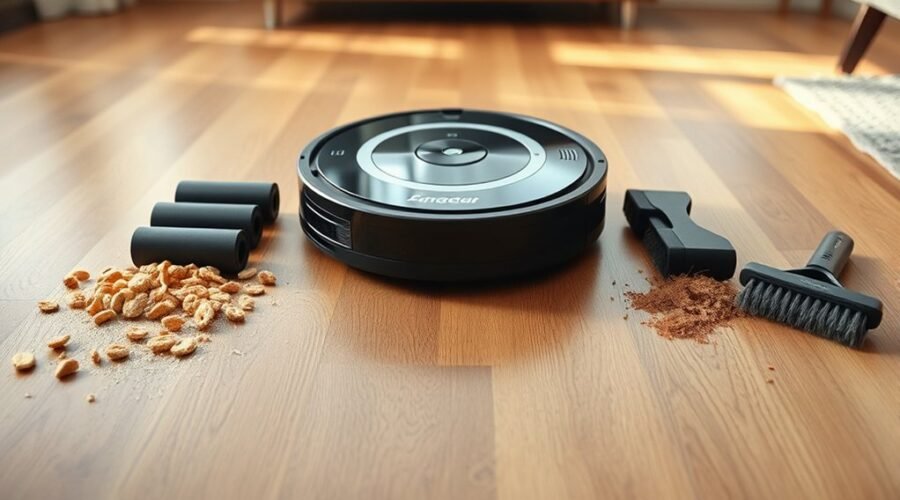
Choosing between rubber rollers vs bristle brushes can make a big difference in how well your robot vacuum cleans. Both brush types remove dust, dirt, and pet hair, but they work differently on carpets and hard floors. Understanding their strengths, maintenance needs, and limits helps you choose a vacuum that suits your home.
Quick Answer
Rubber rollers are generally better for reducing pet hair tangles and cleaning mixed flooring with less upkeep. Bristle brushes can provide stronger agitation for embedded dirt and hair on carpets. Dual-roller and specialized anti-tangle systems offer another option. Choose based on your flooring, shedding levels, carpet thickness, and willingness to clean the brushes.
Key Takeaways
- Rubber fins help reduce hair wrapping, but they do not make every roller completely tangle-free.
- Bristle and combination brushes can provide better carpet agitation, especially for embedded dirt.
- A dual-roller system is different from a system that combines one main roller with anti-tangle side brushes.
- Brush design, suction, navigation, and dustbin capacity all affect real cleaning performance.
- Replacement schedules and maintenance costs depend on the model, not just the brush material.
What Makes Rubber Rollers Better for Pet Hair?
)
Rubber rollers are often better for pet hair because their flexible fins are less likely to trap long strands than dense bristles. The fins loosen fur while suction carries it into the dustbin. This can reduce the time you spend cutting hair away from the brush.
Traditional bristle brushes use rows of stiff fibers to agitate the surface. They can lift stubborn dirt effectively, but long pet hair may twist around the bristles and roller shaft.
Rubber brushes avoid some of that wrapping because they have fewer places for strands to catch. Their flexible surfaces also maintain contact with different floor textures.
For example, iRobot’s pet hair cleaning guidance describes how rubber brushes and controlled suction work together to collect fur from carpets and hard floors.
However, rubber rollers are not completely tangle-proof. Hair can still collect around the end caps, bearings, and side brushes. The overall anti-tangle design matters as much as the material.
Here is how the two main brush types compare:
| Feature | Rubber rollers | Bristle brushes |
|---|---|---|
| Pet hair tangling | Generally less wrapping | More wrapping without an anti-tangle design |
| Hard floors | Flexible contact and effective surface pickup | Effective with suitable bristle stiffness |
| Carpet agitation | Good on many low-pile carpets | Often stronger at loosening embedded debris |
| Maintenance | Usually easier to remove wrapped strands | May require more frequent hair removal |
| Cost | Varies by model and replacement part | Common on simpler budget models |
For a home with shedding dogs, cats, or people with long hair, a well-designed rubber roller can reduce maintenance. For carpet-heavy rooms, a combination brush with anti-tangle features may offer a useful balance.
How Do Rubber Rollers Compare on Different Floors?
Rubber rollers work well across many hard floors, low-pile carpets, and mixed surfaces. Their flexible fins sweep loose debris while helping maintain contact with the floor. However, carpet thickness and the robot’s suction and wheel design affect the final result.
Rubber rollers balance grip and protection, lifting fine debris while helping guard tile and hardwood from scratches.
On hardwood, laminate, and tile, rubber fins can collect dust, crumbs, and pet hair without aggressive bristle action. However, a dirty roller can still drag grit across a delicate finish. Keeping the brush clean remains essential.
On carpets, rollers need enough agitation to loosen dirt trapped between the fibers. Rubber fins can perform well on low-pile carpet, but some bristle or combination designs provide more effective deep cleaning.
Consider these common flooring situations:
- Hard floors: Rubber rollers offer flexible contact and effective pickup of everyday debris.
- Carpets and rugs: Rubber rollers work well on many low-pile surfaces, while bristles may loosen embedded grit more effectively.
- Mixed rooms: A rubber or combination roller can handle transitions between tile, hardwood, and rugs.
- Maintenance: Rubber fins often collect fewer hair tangles, although all brushes require regular inspection.
Large debris creates another challenge. A fast-spinning brush can scatter cat litter, cereal, or crumbs before suction collects them. Brush speed, airflow, and the shape of the cleaning head affect how much material stays in the suction path.
For thick rugs, neither brush type guarantees success. A robot must first move across the carpet without its wheels or roller getting stuck.
If your home has several floor types, prioritize reliable carpet detection and good debris pickup rather than choosing by brush material alone.
Are Dual Roller Robot Vacuums Worth It?
Dual-roller robot vacuums can be worth the extra cost when your home has pets, carpets, and heavier debris. Two main rollers work together to loosen and guide dirt toward the suction inlet. However, their advantage depends on the complete brush design.
A dual-roller cleaning head is not the same as a robot with two side brushes. It is also different from a branded system that combines one main roller with self-detangling side brushes.
Dual Roller Benefits
Dual main rollers can increase contact with debris and help feed hair into the vacuum. Some designs use opposing rotation, while others use a divided brush system to direct hair toward the center.
For example, Roborock’s DuoDivide brush design combines rubber and bristle elements. Its divided rollers guide hair toward the central suction inlet.
Dual-roller systems can provide several benefits:
- Stronger debris pickup: Paired brushes can help collect dirt and crumbs from the cleaning path.
- Better carpet agitation: Additional brush contact may loosen embedded dirt.
- Improved pet hair handling: Suitable roller geometry can direct hair away from the shafts.
- Less manual maintenance: Effective anti-tangle systems can reduce interruptions.
Still, two rollers do not automatically mean better performance. More moving parts can also mean additional replacement components and maintenance.
The best dual-roller models combine effective brush action with strong airflow, good navigation, and easy access to the rollers for cleaning.
Single vs Dual Use Cases
A single-roller vacuum may be enough for hard floors, light dust, and occasional pet hair. It usually has fewer cleaning-head components and can cost less to maintain.
A dual-roller design becomes more attractive when the vacuum regularly handles carpet dirt, heavy shedding, or mixed debris.
Here is a practical way to choose:
- Mostly hard floors: A single rubber roller with good suction is often sufficient.
- Pets and low-pile carpets: Either design can work well if it has effective hair management.
- Heavy carpet debris: Consider dual rollers or a bristle-and-rubber combination that provides stronger agitation.
- Limited maintenance budget: A simpler single-roller system may be more economical.
- Long human hair: Prioritize proven anti-tangle features over the number of rollers.
Also, do not confuse dual cleaning rollers with dual spinning mop pads. Mop pads scrub floors with water, while the main vacuum roller collects dry debris.
For most buyers, the deciding factor should be how reliably the machine removes dirt without jamming or requiring frequent attention.
Which Robot Vacuums With Tangle-Resistant Brushes Are Worth Comparing?
The Narwal Freo Z10, Freo Z Ultra, and Freo Pro are useful examples of robot vacuums with specialized hair-management systems. They offer different suction levels, navigation features, and maintenance options.
These models should not all be classified as rubber-only vacuums. Narwal’s floating roller designs also use shaped brush elements, including angled bristles, to help move hair into the suction path.
Top Rubber and Anti-Tangle Brush Models
The three Narwal models suit different cleaning priorities. Their main advantages extend beyond roller material to include navigation, automatic emptying, and mopping features.
- Freo Z10: Offers 15,000 Pa rated suction, the DualFlow Tangle-Free System, automatic dust emptying, and extending mops for cleaning edges and corners.
- Freo Z Ultra: Combines 12,000 Pa rated suction, dual-camera obstacle recognition, a zero-tangling floating brush, and an automatic base station.
- Freo Pro: Provides 8,500 Pa rated suction and DualFlow hair management, including dynamic side brushes and a cone-shaped floating main roller.
The Narwal Freo Z10 specifications describe its DualFlow system, which manages hair at both the main roller and side brushes. Its extending mop system also improves access along edges.
The Narwal Freo Pro specifications describe a cone-shaped floating roller with angled bristles. Its shape helps direct hair toward suction instead of allowing it to collect around the brush.
Meanwhile, Narwal’s Freo Z Ultra comparison confirms its 12,000 Pa rated suction, zero-tangling floating brush, and dual-chip obstacle avoidance system.
These are manufacturer specifications, not proof that one model cleans every surface better than another. Rated suction alone cannot establish real carpet pickup or hair-tangle performance.
Key Features To Compare
When comparing robot vacuums with rubber or tangle-resistant brushes, focus on the complete cleaning system. Hair control matters, but navigation, carpet detection, and maintenance convenience determine how reliably the vacuum works.
These features deserve particular attention:
| Feature | Why it matters |
|---|---|
| Tangle-free system | Reduces manual hair removal from rollers and side brushes |
| Navigation sensors | Improve floor coverage and obstacle avoidance |
| Self-emptying base | Reduces how often you manually empty collected debris |
| Carpet detection | Allows suitable suction and cleaning adjustments on rugs |
| Replacement parts | Affect long-term maintenance cost and convenience |
For pet owners, a self-emptying dock can be especially useful because fur quickly fills small dustbins. However, it does not remove the need to clean brushes and check the filters.
Also consider whether the replacement roller is easy to remove. A brush that requires extensive disassembly can turn routine cleaning into an unnecessary chore.
With proper care, a robot vacuum may last around 3 to 5 years, although its actual service life depends on battery health, component wear, cleaning frequency, and the availability of replacement parts.
Choose the model whose cleaning system and maintenance demands match your home, not simply the one advertising the highest suction figure.
How Do You Maintain a Rubber Roller Brush?
To maintain a rubber roller brush, regularly remove collected hair, inspect its end caps, and check for wear. Keeping the roller clear allows it to spin freely and helps maintain debris pickup.
Routine care keeps a rubber roller brush efficient, helping maintain suction and prevent hair buildup after every cleaning cycle.
The exact schedule depends on your vacuum and how much hair it collects. For example, iRobot’s main brush maintenance guidance recommends cleaning the brushes weekly, or twice weekly in homes with pets.
Follow these steps to clean a removable roller:
- Turn off the robot: Stop the cleaning cycle and remove the vacuum from its dock if required by the manual.
- Remove the roller: Open the brush cover and release the roller using the manufacturer’s instructions.
- Clear tangled hair: Remove strands from the roller, its end caps, and the bearing areas. Use a soft brush or the supplied cleaning tool.
- Clean the roller surface: Wipe away dust and residue. If the manufacturer permits washing, use warm water and mild soap, then dry the roller completely before reinstalling it.
- Inspect and reinstall: Look for cracks, flattened fins, worn bristles, or damaged fittings. Refit the roller and ensure it rotates normally.
Never assume that every roller, bearing assembly, or filter can be submerged in water. Some components require dry cleaning only.
Brush replacement intervals also vary. iRobot recommends replacing many of its main brushes every 6 to 12 months, or sooner if wear affects cleaning.
For the Freo Z10, Narwal’s official support guidance recommends replacing the main roller every 6 months, with the actual schedule depending on wear.
Signs that a roller needs attention include:
- Visible cracks, tears, or flattened rubber fins
- Frayed or permanently bent bristles
- Repeated brush-stall errors
- Unusual rubbing or rattling noises
- Hair collecting tightly around the bearings
- Reduced debris pickup despite a clean filter and dustbin
Pro Tip: If your robot suddenly leaves hair behind, inspect the roller end caps before replacing the brush. Hidden strands around the axle can stop a roller from spinning freely even when its main surface looks clean.
Regular cleaning helps extend brush life and avoids unnecessary replacement. Follow your model’s maintenance instructions rather than relying on a single schedule for every vacuum.
When Is a Bristle Brush the Better Choice?
A bristle brush can be the better choice when you need stronger carpet agitation. Its stiff fibers can reach between carpet strands and loosen embedded dust, grit, and hair before suction removes them.
This makes bristle and combination brushes attractive for carpeted rooms, particularly when the robot includes a system that prevents long hair from wrapping around the brush.
Bristle brushes can also be practical for buyers who want a simpler, lower-cost machine and do not deal with heavy pet shedding.
| Use case | Bristle brush | Result |
|---|---|---|
| Thick carpet | Stronger fiber agitation | Can improve embedded dirt pickup on compatible carpets |
| Light pet hair | Adequate hair collection | Effective routine cleaning |
| Hard floors | Suitable soft bristles | Satisfactory dust and debris removal |
| Budget use | Available on simpler models | Potentially lower upfront cost |
| Low shedding | Less hair accumulation | Straightforward maintenance |
However, thick carpet requires more than strong bristles. The robot needs suitable wheel clearance, motor power, and carpet compatibility.
For example, Narwal’s Freo Z10 guidance identifies its preferred carpet conditions as pile height no greater than 0.7 cm and overall carpet thickness under 20 mm. These are model-specific limits, not universal specifications for all robot vacuums.
High-pile rugs, long fringes, and dense shag can still cause brush resistance or wheel problems. A roller that agitates carpet effectively is not useful if the robot cannot move across the surface.
For homes without heavy shedding, a bristle brush may provide the cleaning performance you need at a manageable cost. For pet-heavy homes, look for a combination or anti-tangle design that reduces the need for manual hair removal.
Frequently Asked Questions
What Are the Features of Robot Vacuums With Rubber Rollers?
Robot vacuums with rubber rollers use flexible fins to sweep hair and debris toward the suction inlet. Many reduce hair wrapping and work across hard floors and low-pile carpet. Noise, suction, mapping, and maintenance still depend on the individual machine, not the roller material alone.
When to Use a Vacuum Brush Roll?
Use an active brush roll for normal cleaning on carpet and for hair or crumbs that suction alone may miss. On delicate hard floors, use the manufacturer’s suitable floor mode and keep grit off the roller. A brush that jams, scrapes, or leaves debris needs inspection rather than extra suction alone.
Which Robot Vacuum Models Have Rubber Brushes?
Roomba models with dual multi-surface rubber brushes are clear examples of rubber-roller designs. The Narwal Freo Z10, Freo Z Ultra, and Freo Pro instead advertise specialized zero-tangling floating rollers, including bristle-based components. Check the exact main-brush construction before treating a model as rubber-only.
Which Roller Robot Vacuum Is Best?
For homes with pets, a proven anti-tangle system and strong carpet pickup matter more than the roller label. The Freo Z Ultra offers dual-camera navigation and 12,000 Pa rated suction, while the Freo Z10 and Freo Pro offer different tangle-management and mopping features. There is no single winner for every floor.
Are Rubber Rollers Better for Long Hair?
Rubber fins often reduce long-hair wrapping compared with conventional dense bristles, but hair can still collect near roller ends and bearings. Tapered or comb-assisted brushes may also perform well. Check the main brush and side-brush design together, because either part can trap strands.
Can You Swap a Bristle Brush for a Rubber Roller?
Only if the robot manufacturer lists the replacement roller as compatible with your exact model. Brush diameter, drive fitting, and clearance can differ, even within one brand. Fitting an unsupported brush may cause poor pickup, rubbing, or a brush-stall error. Use the specified replacement part.
Conclusion
The choice between rubber rollers and bristle brushes depends on your flooring, pet hair levels, and cleaning priorities. Rubber rollers generally reduce hair tangles and simplify maintenance, while bristle brushes can provide stronger carpet agitation.
Dual-roller and combination-brush systems can offer additional benefits, but brush count and suction ratings do not guarantee better results. Compare the complete cleaning system, carpet compatibility, and replacement requirements before choosing your robot vacuum.
Sources
- iRobot: Robot Vacuums for Pet Hair: Rubber brush operation, pet hair pickup, and dual rubber brush systems.
- Roborock: Qrevo 2 Pro: DuoDivide brush design and combined rubber-and-bristle hair management.
- Narwal: Freo Z10: Rated suction, DualFlow technology, mopping features, and automatic maintenance.
- Narwal: Freo Pro: Floating roller construction, angled bristles, and anti-tangle side brushes.
- Narwal: Robot Vacuum Comparison: Freo Z Ultra suction, navigation, and brush specifications.
- iRobot Support: Main Brush Care: Brush-cleaning frequency, maintenance procedures, and replacement intervals.
- Narwal Support: Freo Z10: Roller replacement guidance, carpet compatibility, and routine maintenance.